Software Product Development Company for Startups: How to Choose the Right Partner in 2026
How to choose a software product development company for startups in 2026: criteria, engagement models, questions, red flags.
On this page47 sections
A great product idea is only the beginning. The team you choose for custom software development can determine whether your startup grows quickly or struggles with delays, bugs, and rising costs.
Many startups choose a development partner based on price or a polished sales pitch. A few months later, deadlines slip, costs increase, and the product still isn't ready for customers.
The problem is that almost every software product development company makes the same promises. They all claim to have experienced developers, agile processes, quality code, and transparent communication. So how do you know which one is actually the right fit?
That's exactly what this guide will help you answer.
In this guide, you'll learn:
- 8 signs your startup needs a software product development partner
- Which engagement model works best for your startup
- 15 key factors to compare before making a decision
- A simple 5-step process to choose the right partner
- Important questions to ask before signing a contract
- Red flags that should make you walk away
By the end of this guide, you'll know exactly what to look for, what to avoid, and how to choose a software product development company that helps your startup launch faster and grow with confidence.
8 Signs Your Startup Needs a Software Product Development Partner
Many startups wait too long before bringing in outside help. If two or more of these signs sound familiar, it may be time to partner with a software product development company.
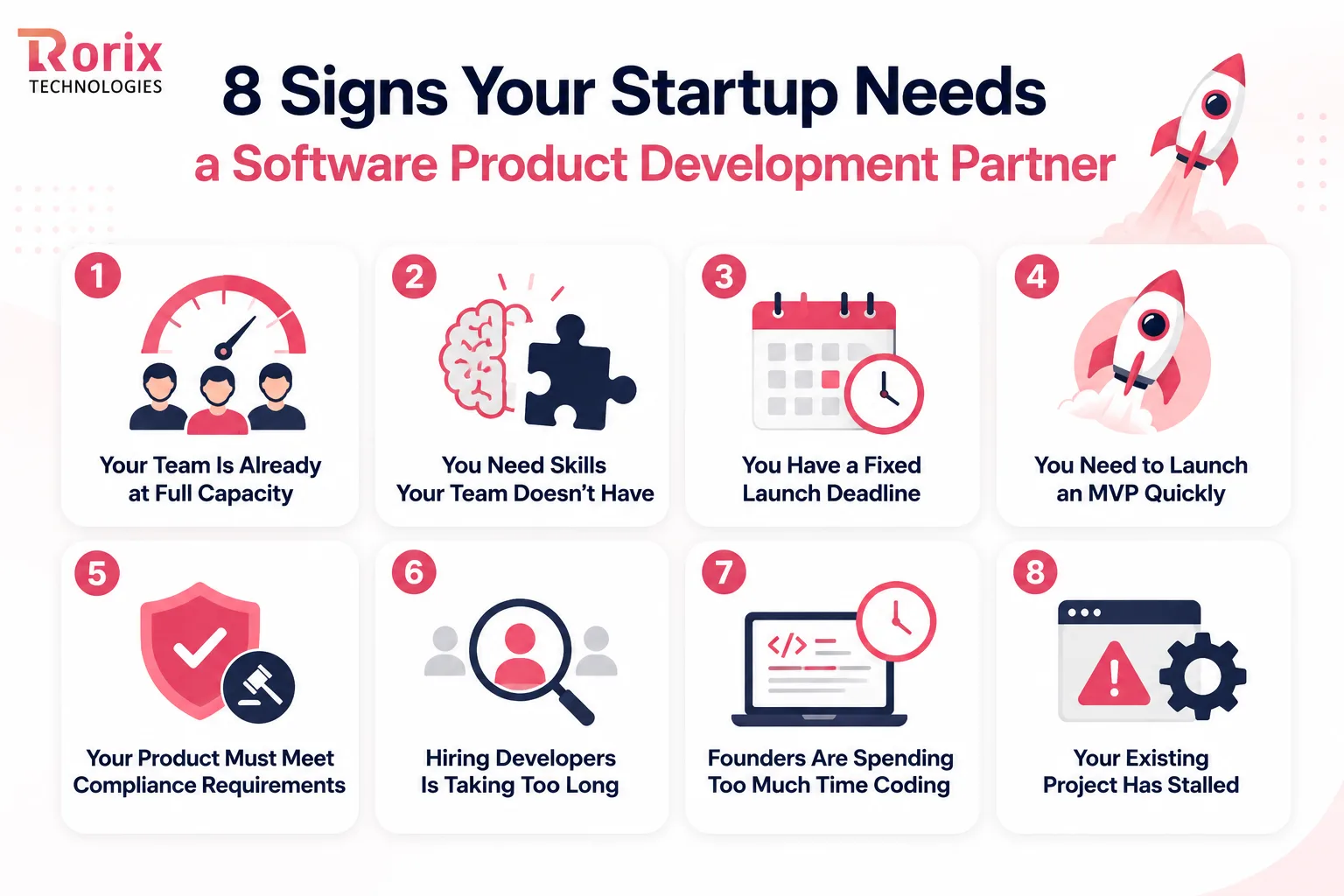
1. Your Team Is Already at Full Capacity
If every new feature delays another task, your team is overloaded. A development partner adds extra capacity so your in-house team can stay focused on high-priority work.
2. You Need Skills Your Team Doesn't Have
Some projects need specialized expertise, such as AI, cloud architecture, payment systems, or mobile app development. An experienced partner helps you avoid costly mistakes and speeds up delivery.
3. You Have a Fixed Launch Deadline
Investor demos, customer commitments, and product launches cannot always be delayed. A development partner helps you meet important deadlines without sacrificing quality.
4. You Need to Launch an MVP Quickly
The sooner you launch, the sooner you get real customer feedback. An MVP development partner helps you build, test, and release your product much faster.
5. Your Product Must Meet Compliance Requirements
If you're building software for healthcare, finance, or other regulated industries, compliance is essential. An experienced partner builds security and compliance into the product from the start.
6. Hiring Developers Is Taking Too Long
Finding experienced developers can take months. A software development partner lets you start building immediately while you continue hiring your own team.
7. Founders Are Spending Too Much Time Coding
Founders should focus on growing the business, talking to customers, and raising funding. A development partner handles the technical work so you can focus on scaling your startup.
8. Your Existing Project Has Stalled
If your current product is delayed, over budget, or difficult to maintain, the right partner can review the code, fix the problems, and get development back on track without starting from scratch.
Engagement Models: Which One Fits Your Startup Stage
Software development engagement models differ mainly in who carries delivery risk. Get it wrong, and you either micromanage a team you cannot direct, or surrender control you needed.
| Model | Best for | Pricing structure | Who manages delivery |
|---|---|---|---|
| Freelancers | Small, well-defined tasks | Hourly | You |
| Staff augmentation | Existing team needs capacity | Monthly per engineer | You |
| Project-based agency | Fixed scope, one-off build | Fixed price or milestones | The agency |
| Retainer product partner | Products you keep evolving | Monthly retainer | Shared, partner-led |
1. Freelancers and independent contractors
Freelancers work well when the task is small, clear, and separable from everything else. You get speed and low overhead, and you carry all the coordination. The risk appears on anything ongoing, because one person leaving takes the context with them.
2. Staff augmentation
Here you keep the wheel and simply add hands. External engineers join your standups, your board, and your review process, reporting into your technical lead. This suits teams that already have engineering leadership, and it fails quietly for teams that do not.
3. Project-based agency delivery
With project-based work, an agency takes responsibility for shipping an agreed scope. Founders like the predictability, and the trade-off is rigidity, because anything outside the original scope becomes a change request. It fits a well-understood build, not a product still finding its shape.
4. Retainer-based product partner
A retainer buys continuous capacity and, more usefully, continuity of knowledge. The same engineers stay on your product across releases, so context compounds instead of resetting. The strongest versions run in 2-week sprints with full task visibility, which is what makes it feel in-house.
5. Onshore, nearshore, and offshore delivery
Location changes cost, overlap hours, and how much process you need. Onshore gives the easiest collaboration at the highest rate, while nearshore trades some overlap for better economics. Offshore delivery works well with disciplined async communication, and it struggles badly without it.
Also Read: Real-Time Inventory: WebSocket and Pub-Sub Architecture
15 Criteria for Evaluating a Software Product Development Company for Startups
Use these as a scorecard rather than a wish list. Most vendors clear the first five easily, and the last ten are where the real differences show up.
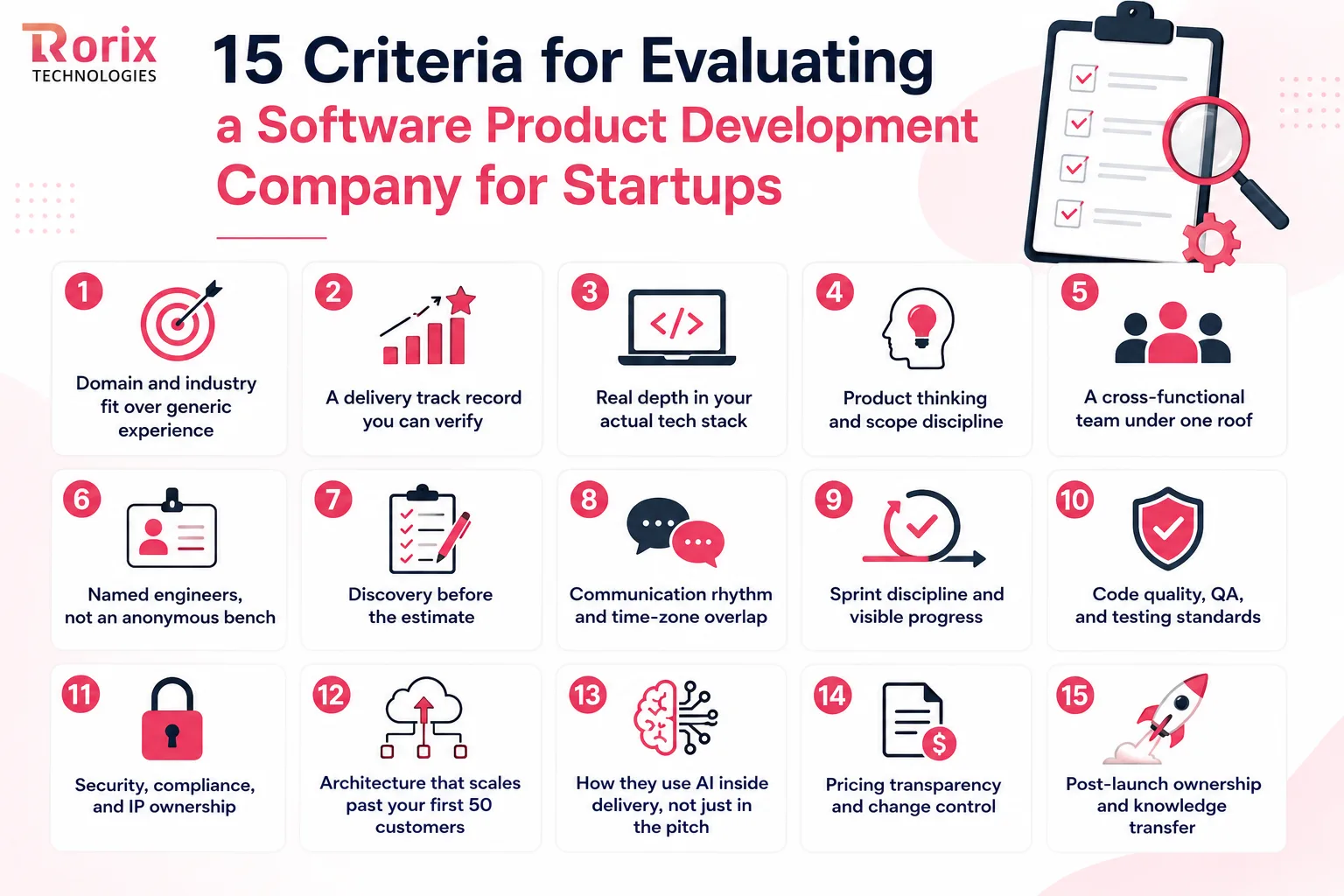
1. Domain and industry fit over generic experience
A team that already understands your workflows asks fewer basic questions. That fluency shows up in sharper product decisions and fewer discovery surprises. Published depth helps you judge it, and a guide like this returns management breakdown shows domain knowledge rather than claiming it.
2. A delivery track record you can verify
Portfolios show output, while references show behavior. Ask for engagements similar to yours in scope, complexity, and stage, then check what happened after launch. Process documentation such as a 50-step WMS implementation checklist tells you a team has shipped real deployments.
3. Real depth in your actual tech stack
Breadth on a services page means little. What matters is whether the team has shipped production systems in the exact languages, frameworks, and cloud services your product needs. Public technical writing like this Angular 20 Signals deep-dive demonstrates that depth.
4. Product thinking and scope discipline
A software product development company for startups should push back on your feature list before pricing it. Expect questions about which assumption you are testing and what can wait until release two. A team that agrees to everything is not helping, and the cost of that is measurable: McKinsey's study of more than 5,400 projects with the BT Centre for Major Programme Management at the University of Oxford found large IT projects run 45% over budget and 7% over time, while delivering 56% less value than predicted.
5. A cross-functional team under one roof
Shipping a product needs more than developers. You want product ownership, UX, architecture, engineering, and QA working from the same context. When those roles sit in one team, decisions move quickly, and nothing gets lost between suppliers.
6. Named engineers, not an anonymous bench
Ask who will actually build your product, then how long they stay. Many vendors staff the sales call with seniors and the sprint with juniors. Insist on names, seniority, and reporting lines in writing, because accountability needs to be specific.
7. Discovery before the estimate
A serious partner asks about users, integrations, data, and constraints before quoting. That conversation surfaces the risks that drive cost, and delay is expensive: the same McKinsey and Oxford research found every additional year spent on a project increases cost overruns by an average of 15%. An instant fixed price sounds efficient, and it usually means the thinking got deferred to a change request.
8. Communication rhythm and time-zone overlap
Distributed delivery succeeds on structure, not enthusiasm. Agree the standup cadence, review cycle, escalation path, and overlap window upfront. Watch how a prospect communicates during the sales process, because that previews the engagement.
9. Sprint discipline and visible progress
Everyone says agile, so make them show it. Ask how sprints are planned, how velocity gets tracked, and what happens in a retrospective. You should see working software early and often, not reports about software you have never touched.
10. Code quality, QA, and testing standards
Testing belongs inside development, not stapled to the end. Google Cloud's DORA research reports that running tests continuously as part of the pipeline produces quick feedback for developers, a short lead time from check-in to release, and a low error rate in production. Look for automated coverage on critical paths, peer review as a rule, separate environments, and a clean release process. Teams that track framework releases closely, as in this Angular v21 breakdown, tend to keep dependencies healthy.
11. Security, compliance, and IP ownership
Any software product development company for startups should settle ownership before code gets written. Your contract must confirm you own the source, the data, and the intellectual property. Ask about secure coding, access control, private repositories, and NDAs covering every contributor.
12. Architecture that scales past your first 50 customers
Early simplicity is good, and fragility is not. Multi-tenancy, data isolation, and integration boundaries are inexpensive to design upfront and painful to retrofit. McKinsey's survey of CIOs put tech debt at 20% to 40% of the value of an entire technology estate before depreciation, with 10% to 20% of the budget for new products diverted to resolving it. A partner who has built real-time inventory architecture under concurrent load knows where those decisions bite.
13. How they use AI inside delivery, not just in the pitch
Plenty of vendors market AI capability, and fewer have operationalized it. Ask where AI actually sits in their workflow: documentation, code review, test generation, or design validation. Google Cloud's State of AI-assisted Software Development 2025 found AI's primary role is as an amplifier, magnifying an organization's existing strengths and weaknesses, and that the greatest returns come from the underlying organizational system rather than the tools themselves. So the answer you want describes a workflow, not a tool list.
14. Pricing transparency and change control
Clear pricing signals operational maturity. You should see a breakdown across discovery, build, testing, and support, plus a written scope-change process. The McKinsey and Oxford research also found software projects carry the highest risk of cost and schedule overruns of any IT project type, which is exactly what a change-control clause exists to contain. Vague proposals rarely get clearer once work begins, and they almost always get more expensive.
15. Post-launch ownership and knowledge transfer
Launch is the start of the real work. A custom software development partner confirms response times, bug-fix policy, monitoring, and who handles releases after the contract. You should also receive architecture diagrams, deployment scripts, and credentials, so continuity never rests on one person.
Now that you know what to look for, let us walk through how to actually run the selection.
A 5-Step Process for Choosing the Right Software Development Partner
Run this as a sequence, not a checklist you dip into. Each step narrows the field using evidence the previous step produced, and skipping one usually means paying for it later during the build.
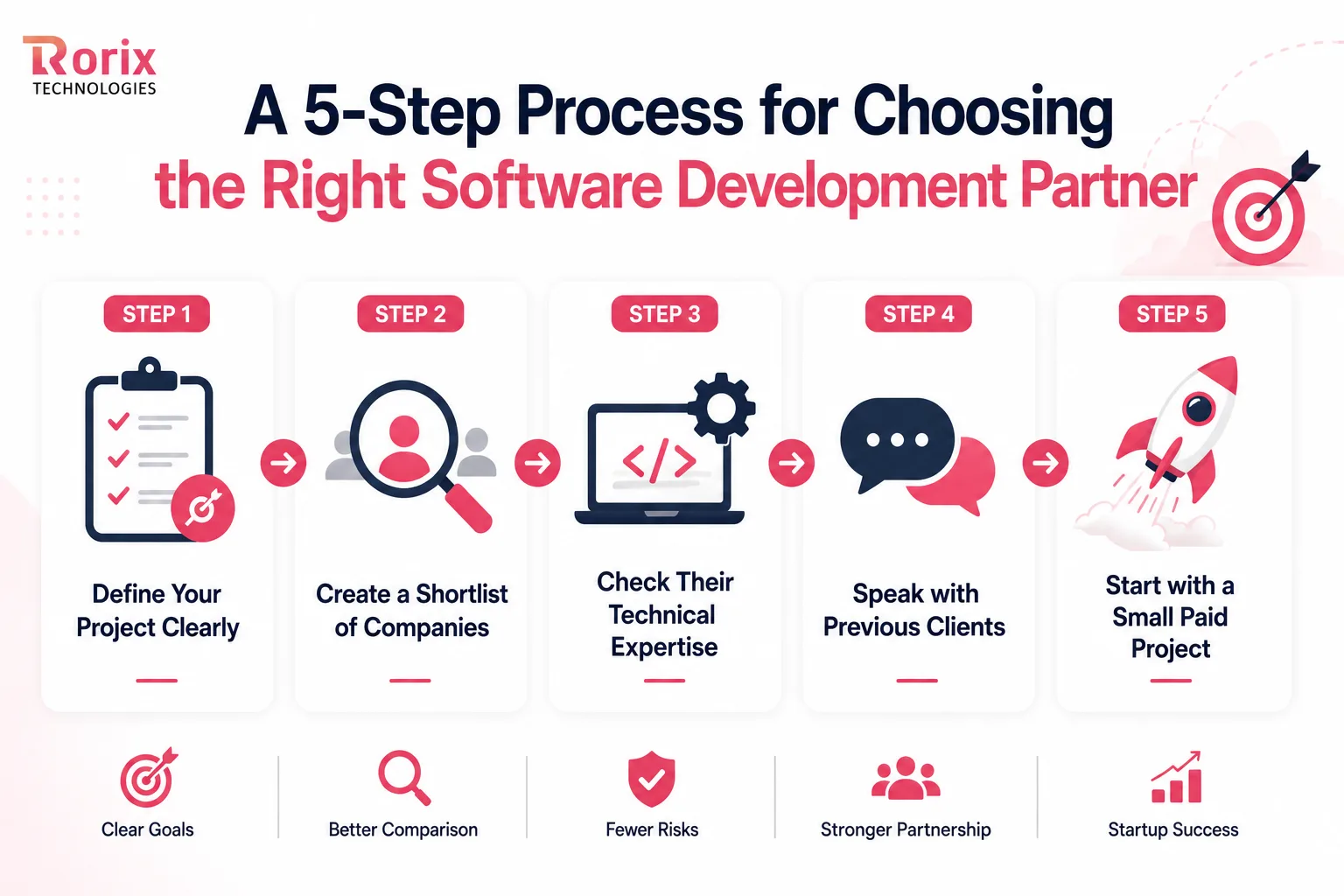
Step 1: Define Your Project Clearly
Before you start contacting companies, create a simple one-page project brief. Explain what you're building, who your users are, your budget, timeline, key features, and any technical or compliance requirements.
The more clearly you explain your project, the more accurate the proposals you'll receive. A clear brief also makes it much easier to compare different companies.
Step 2: Create a Shortlist of Companies
Don't choose the first company you find. Research multiple options through trusted platforms like Clutch, GoodFirms, and LinkedIn. You can also ask other founders or people in your network for recommendations.
Shortlist around five to eight companies that have experience building products similar to yours. This gives you enough options without making the selection process overwhelming.
Step 3: Check Their Technical Expertise
A good development partner should be able to explain how they solve real problems, not just show attractive case studies.
Ask them to walk you through a recent project. Find out what challenges they faced, how they solved them, and why they made certain technical decisions. Their answers will help you understand whether they have the experience your project needs.
Step 4: Speak with Previous Clients
Always ask for client references before making a final decision. Talking to previous clients gives you a much clearer picture than reading online reviews.
Ask whether the company delivered on time, communicated regularly, handled unexpected challenges well, and provided support after launch. Positive feedback from real clients is one of the strongest signs of a reliable partner.
Step 5: Start with a Small Paid Project
Instead of signing a long-term contract immediately, begin with a small paid project or a two-week pilot sprint.
This allows you to see how the team communicates, manages deadlines, solves problems, and delivers work. A successful pilot gives both sides confidence before moving into a larger development project.
Important Questions to Ask Before You Sign
The questions below reveal how a software product development company for startups thinks. These are the questions to ask a software development company before money changes hands.
- Who will actually work on our project? Find out who the developers are, their experience level, and whether the same team will stay with your project.
- Have you built a similar product before? Ask for examples of projects similar to yours in size, industry, or features.
- How did you calculate the project cost? A good company should clearly explain how they estimated the budget and timeline.
- What happens during the discovery phase? Understand how they gather requirements and plan the project before development starts.
- How do you handle changes during development? Ask how they manage new feature requests, changing requirements, and additional costs.
- How can we track project progress? Make sure you'll have access to project management tools and regular progress updates.
- How do you manage development sprints? Learn how often they share demos, collect feedback, and plan upcoming work.
- How do you test the software? Ask about their quality assurance process, automated testing, and bug-fixing approach.
- How do you protect our data and ensure security? Find out how they handle security, compliance, and sensitive information.
- Who owns the source code and intellectual property? The contract should clearly state that your company owns the code, data, and IP.
- What happens if a team member leaves? Ask how they ensure the project continues without delays if someone leaves.
- Can you quickly add more developers if needed? Understand how easily they can scale the team as your project grows.
- What support do you provide after launch? Ask about bug fixes, maintenance, monitoring, and ongoing support.
- What will we receive when the project is complete? Make sure you'll get the source code, documentation, credentials, and everything needed to manage the product.
- Can you share a project that didn't go as planned? Their answers will show how they solve problems and learn from mistakes.
Also Read: Returns Management Optimization: Complete Guide to Reverse Logistics
8 Red Flags That Should End the Conversation
Some warning signs deserve a follow-up question. These eight should end your interest in a software product development company for startups outright.
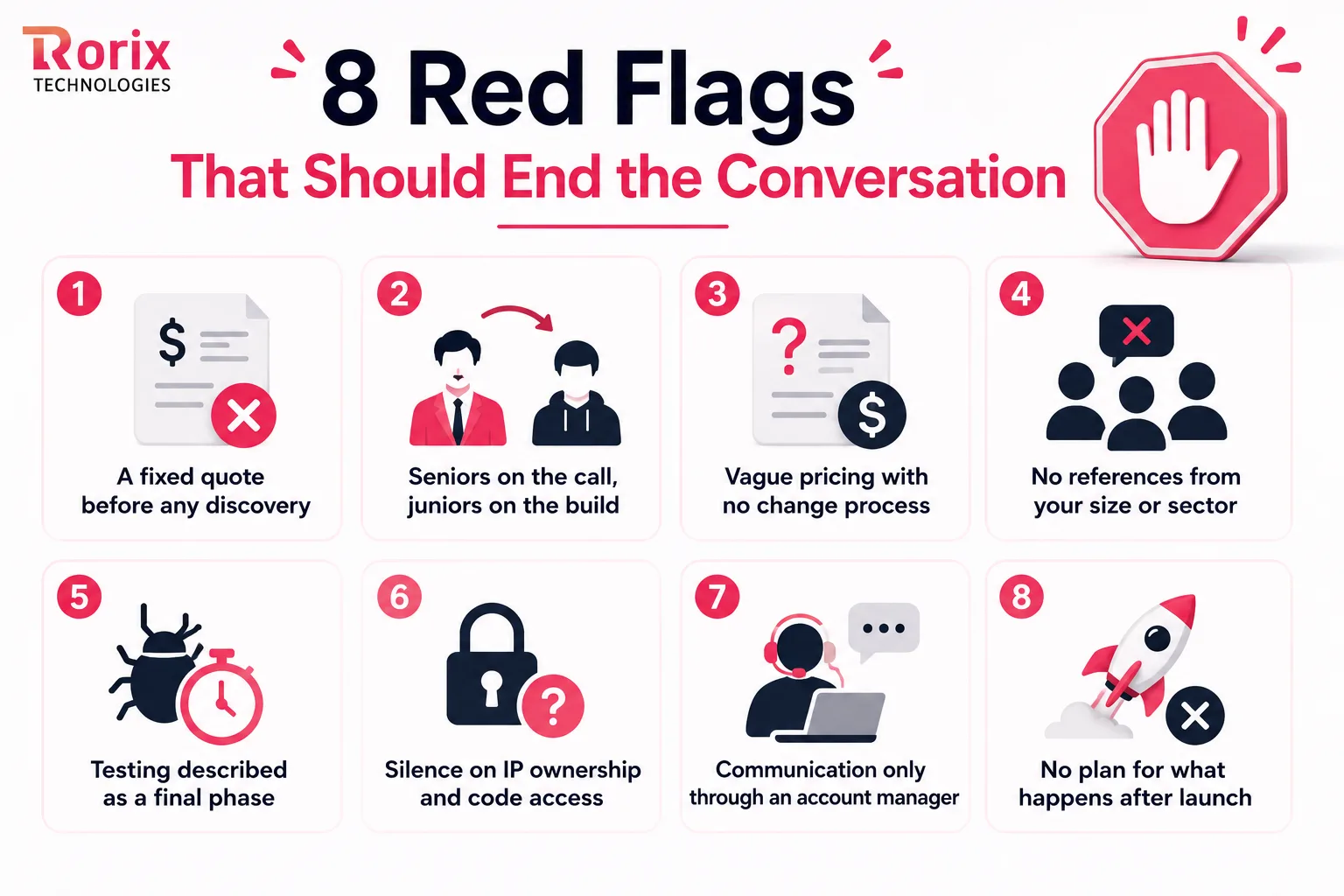
- A fixed quote before any discovery: Confident pricing without questions pushes the risk onto you.
- Seniors on the call, juniors on the build: Ask for names and reporting lines, then verify them.
- Vague pricing with no change process: Undefined scope always resurfaces as an unexpected invoice.
- No references from your size or sector: Reluctance to connect you with past clients is deliberate.
- Testing described as a final phase: QA at the end guarantees unstable releases and rushed fixes.
- Silence on IP ownership and code access: Any hesitation here is a legal problem waiting to happen.
- Communication only through an account manager: You need engineers, not a translation layer.
- No plan for what happens after launch: A partner without a support model is planning to disappear.
Why Startups Choose Rorix Technologies For Custom Software Development
Rorix Technologies works as a software product development company for startups building operations-heavy products. That record covers 27 projects delivered and a 5.0 rating on Clutch. The retainer model keeps a named dedicated team of senior engineers accountable well past go-live.
- Engineered for the domain: WMS, HRMS, ecommerce, and SaaS platforms built around real workflows, not templates.
- 2-week sprints with full task visibility: You see the board, the progress, and the blockers as they happen.
- Proven integration depth: 40+ vendor integrations on one white-label platform, plus React Native for iOS and Android.
- Long-term partnerships: A 5+ year engineering relationship with a B2B sales-intelligence SaaS, plus clients across the US, UK, Canada, Australia, and New Zealand.
Get a Free Consultation and Project Estimate, and we will scope your build, name the team, and map the first sprints.
Evidence Beats Instinct When Picking a Build Partner
Choosing a build partner is one of the biggest bets an early team places. The right software product development company for startups protects your runway, your architecture, and your market timing at the same time.
Run the process properly. Write the brief, score the criteria, ask the uncomfortable questions, and buy a paid pilot before committing. Evidence beats instinct on every one of these decisions.
The 15 criteria above are not a scorecard to file away. They are the questions that separate a partner who will still be around at month eighteen from one who quoted well.
Score your shortlist against the 15 criteria, then connect with our experts to scope your product and map a delivery plan. If what you need first is the smallest version a customer would pay for, that is MVP development.
FAQs
What does a software product development company for startups actually do?
It owns engineering execution end to end: architecture, design, sprint-based build, QA, release, and post-launch support. You keep product direction and priorities while the partner handles delivery and technical decisions.
How much does it cost to build a startup product with a development partner?
Cost depends on scope, integrations, and compliance far more than any hourly rate. Ask for a phase-level breakdown across discovery, build, testing, and support, then confirm exact figures with the partner.
How long does it take to build an MVP with a development partner?
There is no dependable industry benchmark, because timelines move with scope, integration count, and compliance load far more than with team size. What the data does show is the cost of drift: McKinsey and the University of Oxford found every additional year spent on a project increases cost overruns by an average of 15%. Ask for a phase-level timeline after discovery, and treat any date offered before discovery as a guess.
Should a startup hire freelancers, an agency, or a retainer partner?
Freelancers suit small, separable tasks. Agencies suit fixed-scope builds. A retainer partner suits a product you plan to keep evolving, because the same engineers retain context across releases.
Who owns the source code and IP when you work with a development partner?
You should, and the contract must say so explicitly. Confirm ownership of source code, data, and intellectual property before development starts, with NDAs covering every contributor, including subcontractors.
Have an MVP to get in front of users?
We ship SaaS MVPs in 12 weeks on 2-week sprints. Send us the smallest version of your idea a customer would pay for.
Continue learning
Written by
Renish DadhaniyaFounder & Director, Rorix Technologies
Renish co-founded Rorix Technologies and drives the engineering and delivery culture across the organization. Beyond engineering, he leads the company's sales, finance, and HR operations, building the infrastructure that lets the team focus on shipping quality software. With deep hands-on expertise in architecture and team building, he ensures every project lands on time to the quality standards clients demand.
View full profileRelated articles
Top 15 Small Software Development Companies for Startups (2026)
Every small development firm sounds the same on a sales call. Compare 15 startup-ready companies, what each one builds, what it costs, and how to choose.
Read article
How to Build an MVP: What to Cut, and What You Cannot
How to build an MVP: the test that separates a real MVP from a small product, what you can safely cut, what you cannot, plus honest timeline and cost.
Read article
WMS Requirements Template: How to Write the Document That Picks Your System
A WMS requirements template that works like a test: the 8 sections to include, how to write requirements vendors can demo, and the scoring that follows.
Read article