
How to Build an MVP: What to Cut, and What You Cannot
How to build an MVP: the test that separates a real MVP from a small product, what you can safely cut, what you cannot, plus honest timeline and cost.
On this page28 sections
Everyone agrees you should build a minimum viable product. Almost nobody agrees on what minimum means, which is why so many MVPs turn out to be the full product with fewer users.
The failure data is unusually clear about what this costs. CB Insights' analysis of 431 VC-backed companies that shut down since 2023 found 70% ran out of capital, but that is the final cause rather than the root one. Underneath it, 43% failed on poor product-market fit, and two thirds of those product-market fit failures were early-stage companies that never found a market at all. They did not run out of money because building software is expensive. They ran out of money because they spent it building the wrong thing carefully.
That is the entire argument for scoping an MVP properly, and it reframes what you are doing. An MVP is defined by the question it answers, not by the features it contains. If you cannot name the assumption you are testing and the result that would make you stop, you are not building an MVP. You are building version one slowly.
In this guide, you'll learn:
- The one test that tells you whether you have an MVP or just a small product
- Why experienced product teams cannot predict which features matter either
- What you can cut without damaging the answer, and what you can never cut
- A 6-step scoping sequence that starts with the question rather than the feature list
- Honest timelines and costs, and the 6 ways MVP scoping goes wrong
Quick Answer: What Actually Makes Something an MVP
| A real MVP | A small product | |
|---|---|---|
| Starts from | A named assumption to test | A feature list, trimmed |
| Success looks like | A trustworthy answer | Shipping on time |
| Failure looks like | A clear no, learned cheaply | Nothing, because no one defined it |
| Scope set by | What the question requires | What the budget allows |
| Manual work | Expected and deliberate | Treated as technical debt |
| After launch | A decision to continue, pivot, or stop | A backlog |
The difference is not size. A real MVP and a small product can contain identical code. They differ in whether anyone decided in advance what the build was supposed to find out.
Key Takeaways: What Makes a Build a Real MVP
- An MVP is defined by the question it answers, not by the features it contains, so the scope starts with a written assumption to test and the result that would make you stop.
- CB Insights' analysis of 431 VC-backed companies that shut down since 2023 found 70% ran out of capital, and underneath that final cause 43% failed on poor product-market fit.
- Pendo's 2019 Feature Adoption Report, which analyzed 615 subscriptions, found that 80% of features in the average software product are rarely or never used.
- Rorix scopes most MVPs at $10,000 to $25,000 over 6 to 10 weeks with one to three engineers, and the spread inside that band is driven by scope rather than by hourly rates.
- Rorix's SaaS development engagements target a first paying customer in 12 weeks as a separate milestone, carrying multi-tenancy, subscription billing, and real tenant isolation.
What Is an MVP, and What Is It Not?
A minimum viable product is the smallest thing you can build that produces a trustworthy answer to your riskiest assumption. Minimum refers to the scope, viable refers to the answer, and the second word carries far more weight than the first.
It is not a prototype, because a prototype demonstrates and an MVP measures. It is not a demo, because a demo persuades. And it is not a cheap version of your product, though it usually costs less, because cost is a consequence of the scoping rather than the goal of it.
The distinction matters commercially. A cheap version of your product tells you whether you can build software on a budget, which you already knew. An MVP tells you whether anyone wants what you are building, which is the thing that closes 43% of the companies in that CB Insights data.
The Test: Can You Name the Assumption and the Stopping Result?
Two sentences, written down before anyone estimates anything:
- "We believe that [specific group] will [specific behavior] because [specific reason]."
- "If fewer than [number] do, we will [stop, pivot, or narrow]."
If you cannot complete the first sentence with something falsifiable, the build has no question and any result will be interpreted as encouraging. If you cannot complete the second, you have not built a decision point, and the project will continue on momentum regardless of what happens.
The second sentence is the one teams skip, and it is the expensive omission. Without a stated stopping condition, every outcome becomes "promising early signal," and the next six months get funded on the strength of a number nobody agreed to in advance.
Write both sentences into the project brief. They are the only part of the scope that cannot be renegotiated later without admitting you renegotiated it.
Why Even Experienced Teams Cannot Guess Which Features Matter
Because the data says they cannot, and these are teams with real customers and years of usage history.
Pendo's 2019 Feature Adoption Report, which analyzed 615 subscriptions from customers using its analytics for more than a year, found that 80% of features in the average software product are rarely or never used, while roughly 12% of features generate 80% of daily usage. It estimated that publicly traded cloud software companies had collectively invested up to $29.5 billion building the underused remainder.
The report is from 2019 and the ratio may have shifted since, but the shape of the finding is what matters, and the implication is uncomfortable in the right way. These are funded product organizations with analytics, user research, and customers to ask. They still spent most of their engineering budget on features nobody adopted.
A pre-launch founder has none of those advantages and considerably more certainty. That combination is what produces a twelve-feature MVP where two features would have answered the question.
What You Can Cut Without Damaging the Answer
Most of what feels essential is infrastructure for a scale you have not reached, or convenience for a workflow you have not validated. All of it can wait.
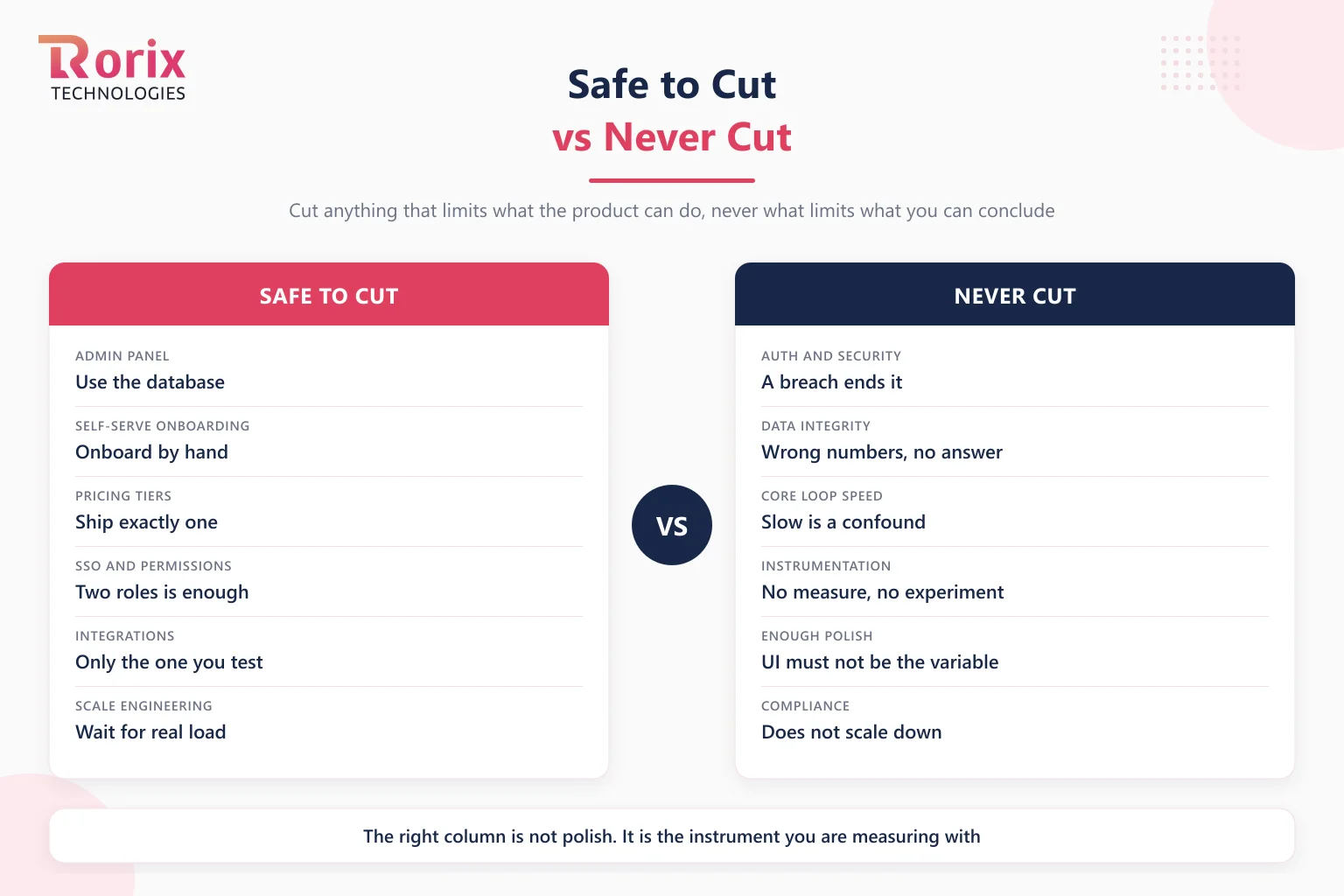
The admin panel. Someone on your team can do it in the database, or you can build one screen later once you know what actually needs administering. Admin tooling is where MVP budgets quietly disappear, because it feels like real work and no customer ever sees it.
Self-serve onboarding. Onboard your first users by hand, on a call. It does not scale, which is the point: you learn more from twenty manual onboardings than from an automated flow built on guesses about where people get stuck.
Every pricing plan but one. Multiple tiers, proration, and plan migrations are real engineering. Pick the single plan that tests willingness to pay and defer the ladder.
SSO and granular permissions. Two roles is almost always enough to answer the question. Enterprise access control is a sales requirement, and you do not have enterprise sales yet.
Every integration except the one that matters. Integrations are where scope creep is most defensible-sounding and most expensive. Build the one your assumption depends on. Our API integration strategy guide covers the connective decisions once there are several, but at MVP stage the correct number is usually one.
Scale engineering. Caching layers, queues, and horizontal scaling for traffic you do not have. If the MVP succeeds you will rebuild this part with real load numbers, and it will be better than what you would have guessed.
The mobile app, if the web answers the question. Two platforms is roughly two builds. Unless the assumption is specifically about mobile behavior, pick one surface.
What You Cannot Cut, Because It Poisons the Result
This is the list that separates a lean MVP from a broken experiment. Cutting these does not save money; it spends money on a result you will not be able to trust.
Authentication and basic data security. A breach ends the experiment and possibly the company, and "it was only an MVP" is not a defense anyone accepts. This is not a scale concern, it is a floor.
Data integrity. If your numbers can be wrong, every conclusion you draw is unfalsifiable. Getting the core writes right is not gold-plating, it is the instrument you are measuring with.
Performance on the core loop. If the main workflow is slow, you do not learn whether people want your product. You learn that people dislike waiting, which you already knew. Slowness is a confound, not a rough edge.
Instrumentation. If you cannot measure the behavior in your assumption sentence, there was no experiment. Analytics on the core loop is part of the MVP, not a phase two item, and it is usually a day of work.
Enough polish that the interface is not the variable. Users who cannot find the button do not become users who do not want the product, but your data will not distinguish those two cases. You are not aiming for beautiful, you are aiming for the interface not being the thing you accidentally tested.
Compliance where it genuinely applies. If you are handling regulated data, the requirement does not scale down with your user count.
The pattern across all six: cut anything that limits what the product can do, and never cut anything that limits what you can conclude.
How to Scope an MVP in 6 Steps
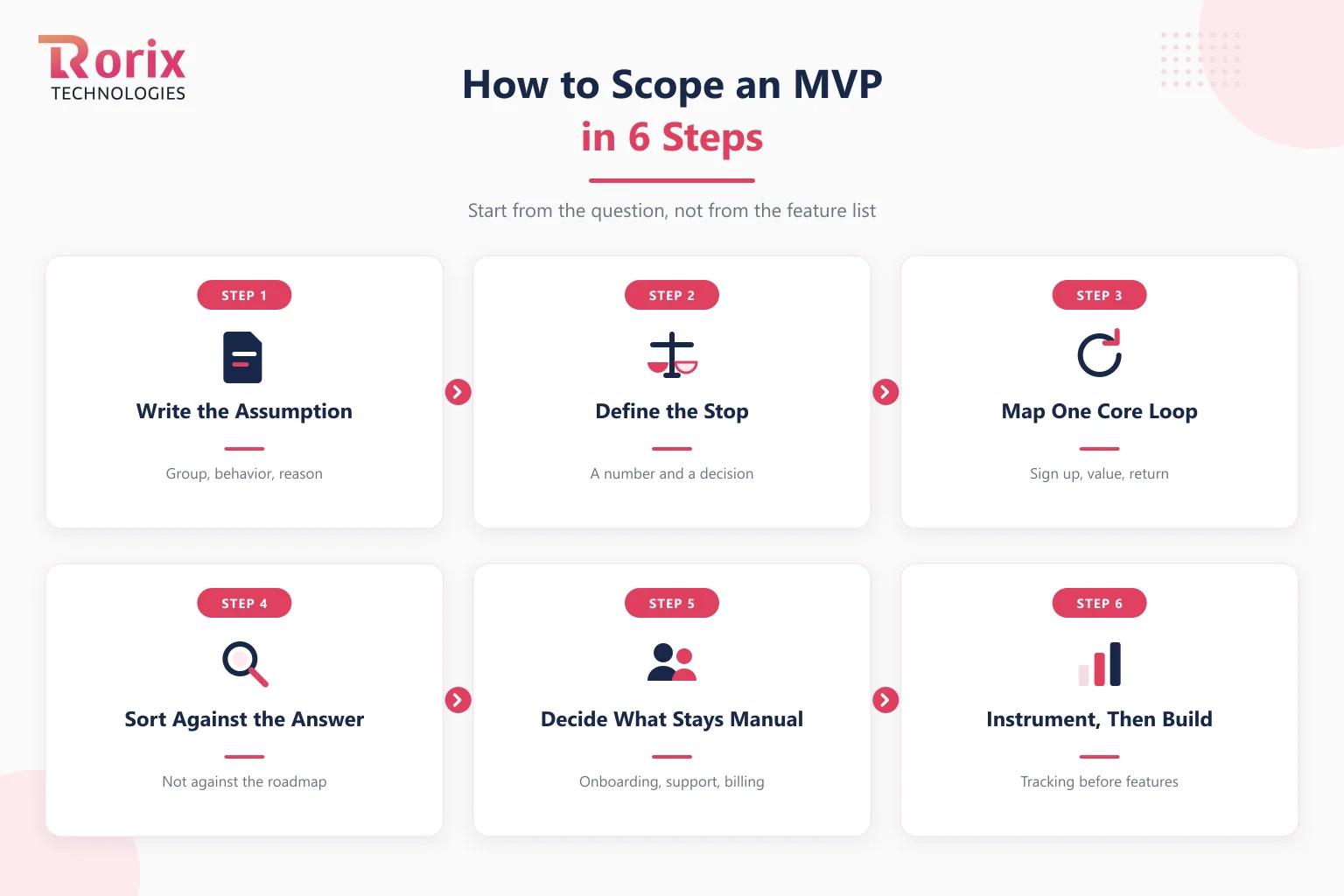
Step 1. Write the Assumption Sentence
The specific group, the specific behavior, the specific reason. If three people on your team write this independently and produce three different sentences, that disagreement is the most valuable thing you will find this month, and it is better found now than in month four.
Step 2. Define the Result That Would Stop You
A number and a decision. Agreeing it in advance is what makes the eventual result mean something, and it is much easier to agree before anyone is emotionally invested in the build.
Step 3. Map the Single Core Loop
The one sequence a user must complete for the assumption to be tested: sign up, do the central thing, get the value, come back. Everything outside that loop is a candidate for cutting, and most of it should be cut.
Step 4. Sort Every Feature Against the Answer, Not the Roadmap
For each proposed feature ask one question: if we remove this, can we still trust the result? If yes, it is out of the MVP. Not deprioritized, out. A feature list with priorities is a roadmap; an MVP scope is a boundary.
Step 5. Decide What You Will Do Manually
Explicitly list the work a human will do behind the scenes: onboarding, provisioning, support, reporting, billing adjustments. Writing it down turns manual process from embarrassing debt into a deliberate scoping decision, and it usually removes weeks of build.
Step 6. Instrument, Then Build
Add the tracking for your assumption's metric before the feature work starts, so it cannot get dropped when the timeline tightens. Then build the loop, hand-onboard your first users, and hold the boundary from Step 4 when the requests start arriving.
How Long Should It Take to Build an MVP?
Six to ten weeks for most builds, and where you land inside that says more about your scope discipline than your team's speed.
A lean MVP on a familiar stack, with one integration and one pricing plan, can ship in about six weeks. A SaaS MVP ready for a first paying customer, carrying multi-tenancy, subscription billing, and real tenant isolation, is a bigger floor outside that window, and our SaaS development engagements target that milestone in 12 weeks by keeping the scope thin while keeping the process intact. Past 12 weeks, the honest conversation is whether this is still an MVP or has quietly become version one.
The timeline lever that actually works is cutting features, not cutting steps. Skipping QA, design, or code review does not make an MVP faster; it makes the result less trustworthy, which is the one thing you were paying for. Our breakdown of the custom software development process covers what each step owes you, and the timeline estimator will size your specific scope.
What Does It Cost to Build an MVP?
$10,000 to $25,000 for most MVPs, typically over 6 to 10 weeks with one to three engineers. That band comes from the same scale as our custom software development cost guide, and the spread inside it is driven almost entirely by scope rather than by rates.
The cost lever most founders reach for is the hourly rate. The lever that actually moves the number is the feature count, because a rate difference changes the total by a fraction while a scope decision changes it by a multiple. Cutting the admin panel and the second pricing tier will save you more than any negotiation.
If you are still deciding whether to build at all, our build versus buy framework is the earlier question, and it is worth answering honestly. Plenty of assumptions can be tested with existing tools and a spreadsheet before anyone writes code, and that is a better MVP than a cheap build.
For an engagement-shaped view of the same budget, dedicated capacity starts at $3,500 per month for one developer and $10,000 per month for three developers plus a project manager, which is how most MVP builds are actually staffed. The project cost estimator will scope your case, and pricing has the full ladder.
The 6 Ways MVP Scoping Goes Wrong
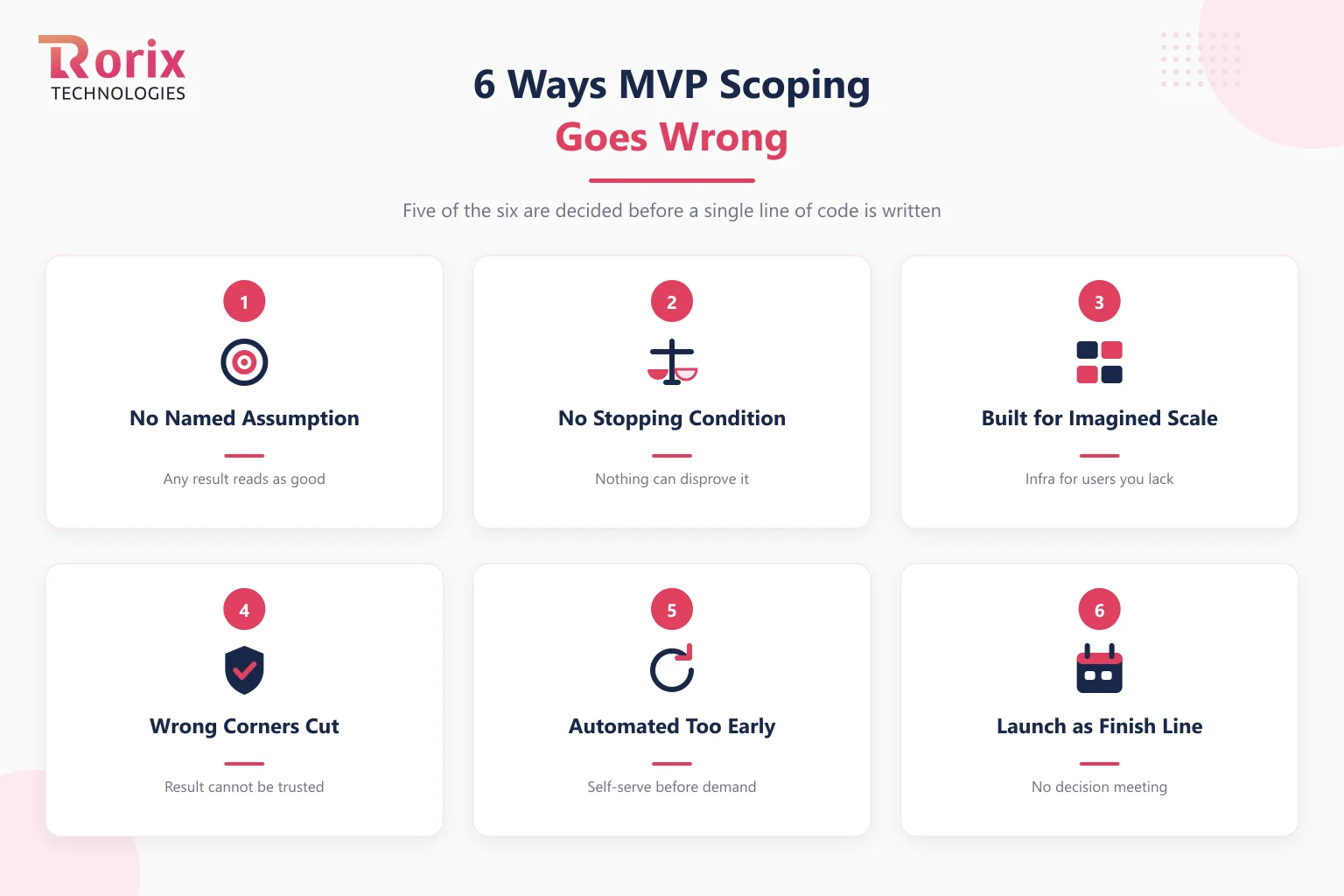
1. No named assumption. The build starts from a feature list, so no result can contradict it and the project can only be judged on delivery.
2. No stopping condition. Every outcome reads as a promising signal, and the follow-on budget gets approved on a number nobody agreed to in advance.
3. Building for imagined scale. Infrastructure for the hundred thousand users you hope for, paid out of the budget meant to find your first hundred.
4. Cutting the corners that corrupt the answer. Skipping instrumentation, integrity, or basic performance, and ending up with a result that cannot be trusted either way.
5. Automating what should have stayed manual. Building the self-serve flow before knowing whether anyone wants to serve themselves.
6. Treating launch as the finish line. The MVP is the instrument, not the outcome. If nobody has scheduled the decision meeting where the result gets acted on, the experiment was never really running.
How Rorix Builds MVPs
Rorix Technologies builds MVPs for funded startups and mid-market product teams, and the part we push hardest on happens before any code: what question is this build answering, and what would make you stop.
- Scope discipline as the deliverable: we will argue for cutting features, including ones that shrink the engagement, because a smaller build that produces a trustworthy answer is the thing you are actually buying.
- A 12-week path to your first paying SaaS customer: multi-tenancy, auth, one pricing plan, and your core loop, with working software after every two-week sprint rather than a reveal at the end.
- The floor stays intact: auth, data integrity, and instrumentation are in every build, because those are what make the result mean something.
- A named team that stays past launch: senior engineers averaging 11 years of production experience, 27 platforms delivered, and a 5.0 Clutch rating across the US, UK, Canada, Australia, and New Zealand.
- Honest boundaries: we build application software; infrastructure and DevOps stay with you. If your assumption can be tested without a build, we would rather tell you that on the first call.
If you are choosing a partner rather than scoping a build, our guide for startup founders covers the evaluation criteria. Book a free consultation and we will help you write the assumption sentence before we quote anything.
The Smallest Build That Produces a Trustworthy Answer
Most MVPs are too big, and they are too big for a reason that sounds responsible: every feature in them is defensible on its own. The discipline is not in judging features individually, it is in holding them all against one question.
Name the assumption. Name the result that would stop you. Build the single loop that tests it, do the rest by hand, and protect the handful of things that make the answer trustworthy while cutting nearly everything else.
The teams that get this right are not the ones who build fastest. They are the ones who find out soonest, and who are still funded when the answer arrives.
Ready to scope one? Talk to our engineers about the assumption you need tested, and we will tell you the smallest build that would settle it, including when that build is nothing at all.
Frequently Asked Questions
How do you build an MVP the right way?
Start from the assumption rather than the feature list. Write down the specific behavior you expect from a specific group, and the result that would make you stop. Then build only the single core loop that tests it, do everything else manually, and instrument the metric before development starts.
What should be included in an MVP?
The core loop that tests your assumption, plus the things that make the result trustworthy: authentication and basic security, correct data writes, acceptable performance on the main workflow, and analytics on the behavior you are measuring. Almost everything else, including admin panels, self-serve onboarding, multiple pricing tiers, and SSO, can wait.
How long does it take to build an MVP?
Six to ten weeks for a working MVP on most builds. A lean MVP on a familiar stack with one integration can ship in around six weeks, while a SaaS MVP ready for a first paying customer, with multi-tenancy and subscription billing, runs longer, closer to 12 weeks. Beyond 12 weeks it is usually worth asking whether the scope is still an MVP.
How much does it cost to build an MVP?
Most MVPs run $10,000 to $25,000 over 6 to 10 weeks with one to three engineers. The spread is driven by scope rather than hourly rates, which is why cutting features moves the total far more than negotiating a rate does.
What is the difference between an MVP and a prototype?
A prototype demonstrates and an MVP measures. A prototype can be clickable screens with no working backend, built to communicate an idea. An MVP is real software that real users use in a real workflow, because the point is to observe behavior rather than reactions.
Why do most MVPs fail to produce useful results?
Usually because no falsifiable assumption was written down and no stopping condition was agreed, so any outcome can be read as encouraging. The second most common cause is cutting the wrong corners, since skipping instrumentation or basic performance produces a result that cannot be trusted in either direction.
Should we build an MVP or just use existing tools first?
Test with existing tools first whenever the assumption allows it. Many assumptions about demand and willingness to pay can be settled with a landing page, a spreadsheet, and manual fulfillment, and that is both faster and more conclusive than a cheap build. Write code when the assumption genuinely requires software to test.
What happens after the MVP launches?
You hold the decision meeting you scheduled in advance and compare the result against the stopping condition you wrote down. The outcome is continue, pivot, or stop, and all three are successful uses of an MVP. The failure case is having no criteria, which turns the launch into a backlog rather than a decision.
Have an MVP to get in front of users?
We ship SaaS MVPs in 12 weeks on 2-week sprints. Send us the smallest version of your idea a customer would pay for.
Continue learning
Written by
Renish DadhaniyaFounder & Director, Rorix Technologies
Renish co-founded Rorix Technologies and drives the engineering and delivery culture across the organization. Beyond engineering, he leads the company's sales, finance, and HR operations, building the infrastructure that lets the team focus on shipping quality software. With deep hands-on expertise in architecture and team building, he ensures every project lands on time to the quality standards clients demand.
View full profileRelated articles
Software Product Development Company for Startups: How to Choose the Right Partner in 2026
How to choose a software product development company for startups in 2026: evaluation criteria, engagement models, key questions to ask, and red flags to avoid.
Read article
Bespoke Software Development for Startups: Everything You Need to Know (2026)
Learn how bespoke software development for startups works, including costs, tech stacks, IP ownership, and how to choose the right development partner.
Read article
SaaS Product Development: The Complete Guide From Idea to Launch (2026)
Planning a SaaS build? The 10-phase process from validating demand to pricing, tenancy, and launch, with realistic timelines, cost bands, and metrics.
Read article