Build vs Buy Software: A Decision Framework for 2026
Should you build custom software or buy off-the-shelf? Use this 2026 decision framework, a side-by-side comparison, and total-cost-of-ownership math to decide.
On this page17 sections
The short answer
Buy when the software is a commodity that every company runs the same way; build when the software is a competitive differentiator or has to fit a workflow no product supports. Most companies should do both: buy the commodity, build the differentiator.
Key Takeaways: When to Build and When to Buy
- Buy for solved problems: email, accounting, CRM, generic HR, basic e-commerce.
- Build when software is your edge, off-the-shelf forces painful workarounds, or per-seat fees will balloon at scale.
- Off-the-shelf wins on time-to-value and upfront cost; custom wins on fit, control, and long-term total cost of ownership (TCO).
- The honest comparison is 3-year TCO, not the sticker price: subscription fees compound with headcount.
- A hybrid approach (buy commodity + build differentiator) is the right answer more often than a pure build or pure buy.
Prefer to work it out interactively? Try the Build vs Buy tool.
Build vs buy: what each really means
- Buy (off-the-shelf / SaaS): license a ready-made product (e.g. BambooHR, Shopify, Salesforce). You pay a recurring subscription, usually per user.
- Build (custom software): commission software designed around your exact workflows. You pay once to build it and you own the code. See how custom software is priced.
- Hybrid: buy proven products for commodity functions and build custom software only for the parts that differentiate you.
The decision framework: 5 questions
Answer these honestly. The more "build" answers you give, the stronger the case for custom.
- Is this software a competitive differentiator, or table stakes? If customers choose you because of how this works, build it. If it's just plumbing, buy it.
- Does an off-the-shelf product fit your workflow, or would you bend your process to fit the tool? Constant workarounds are a hidden, recurring cost.
- How will cost scale? Per-seat SaaS that's cheap at 20 users can be punishing at 500. Model the 3-year number, not month one.
- Do you need to own the data, IP, and roadmap? Compliance, exit options, and the ability to ship features on your timeline all favor building.
- What's your time-to-value pressure? If you need it live next month, buy now. You can always build later.
Build vs buy at a glance
| Dimension | Buy (off-the-shelf) | Build (custom) |
|---|---|---|
| Time to value | Days to weeks | Weeks to months |
| Upfront cost | Low (subscription) | Higher (one-time build) |
| 3-year TCO | Grows with users | Predictable; you own the asset |
| Workflow fit | You adapt to the tool | The tool fits you |
| Differentiation | Same tool as competitors | Shaped to your edge |
| Control & IP | Vendor owns roadmap & data | You own code, data, roadmap |
| Maintenance | Included in subscription | Your responsibility (~15% to 25%/yr) |
| Risk | Vendor lock-in, price hikes | Build risk, needs a capable team |
Total cost of ownership: the part teams underestimate
The sticker-price comparison almost always flatters SaaS, because it ignores time. Consider a tool at $40/user/month:
- 50 users: $24,000/year → $72,000 over 3 years.
- 200 users: $96,000/year → $288,000 over 3 years.
A custom build of comparable functionality might cost $60,000 to $120,000 once, plus ~15% to 25%/year maintenance, and you own it. Below a certain user count, buying is clearly cheaper. Above it, the lines cross and building wins. The crossover point is exactly what a 3-year TCO model reveals. Estimate the build side with the cost estimator.
When buying wins
- The function is a commodity (payroll, accounting, email, ticketing).
- You need it live immediately.
- Your volume is small enough that per-seat pricing stays cheap.
- A mature product already fits your process closely.
When building wins
- The software is your product or a core competitive advantage.
- Off-the-shelf tools force expensive workarounds or manual glue work.
- Per-seat fees will balloon as you scale.
- You need full control of data, compliance, and the roadmap.
- You're stitching several systems together: a custom layer (e.g. a WMS or HRMS) often beats juggling five subscriptions.
For warehouse systems specifically, the custom WMS vs off-the-shelf WMS comparison applies this framework with our published build bands beside each cost line.
The hybrid path most companies should take
You rarely have to choose globally: choose per capability. Buy the commodity, build the differentiator. Run accounting on QuickBooks, email on a SaaS, and CRM on a standard product, then invest your custom budget in the one workflow that wins you customers. This concentrates engineering spend where it creates advantage and keeps everything else cheap and maintained by someone else.
How to decide in practice
- List every software capability your business needs.
- Tag each as commodity or differentiator.
- Buy the commodities. For differentiators, run the 5 questions and a 3-year TCO.
- For anything you'll build, pick the engagement model: fixed-price for stable scope, a dedicated team for evolving scope.
Across 27 projects we've delivered, the most successful clients didn't build everything; they bought ruthlessly for commodity needs and built precisely where custom software moved the business. Every build we ship transfers 100% of the code and IP to the client, so "build" never means "locked in."
If the answer comes back "build", full stack development is the engagement that follows.
Next step: weigh your options with the Build vs Buy tool, price a build with the cost estimator, or talk to our team.
Frequently Asked Questions
Is it cheaper to build or buy software?
It depends on scale and time horizon. Buying is cheaper upfront and for small user counts; building is usually cheaper over 3+ years once per-seat subscription fees compound. Compare the 3-year total cost of ownership, not the monthly price.
When should a company build custom software instead of buying?
Build when the software is a competitive differentiator, when off-the-shelf tools force costly workarounds, when per-seat fees will balloon as you scale, or when you need full control of data, compliance, and the roadmap.
What is the hybrid build-vs-buy approach?
The hybrid approach is to buy proven products for commodity functions (email, accounting, CRM) and build custom software only for the capabilities that differentiate your business. It concentrates engineering spend where it creates advantage.
How do I calculate the total cost of ownership for SaaS vs custom?
Multiply the per-user SaaS price by your expected user count over three years, then compare it to a one-time custom build plus roughly 15% to 25% per year in maintenance. The point where the two lines cross tells you which option is cheaper at your scale.
Does buying software mean we don't own our data?
Usually you retain ownership of your data, but the vendor controls the platform, roadmap, and export formats, which can create lock-in. Building custom software gives you full ownership of the code, data, and IP.
How long does it take to build custom software versus buying?
Off-the-shelf software can be live in days to weeks. A custom build typically takes 6 weeks for an MVP to several months for a full platform. If time-to-value is urgent, buy now and build later once requirements are clear.
Still deciding between building and buying?
We have talked clients out of custom builds when an off-the-shelf tool would have done the job. Send us the requirement and we will tell you which way it goes.
Continue learning
Written by
Renish DadhaniyaFounder & Director, Rorix Technologies
Renish co-founded Rorix Technologies and drives the engineering and delivery culture across the organization. Beyond engineering, he leads the company's sales, finance, and HR operations, building the infrastructure that lets the team focus on shipping quality software. With deep hands-on expertise in architecture and team building, he ensures every project lands on time to the quality standards clients demand.
View full profileRelated articles
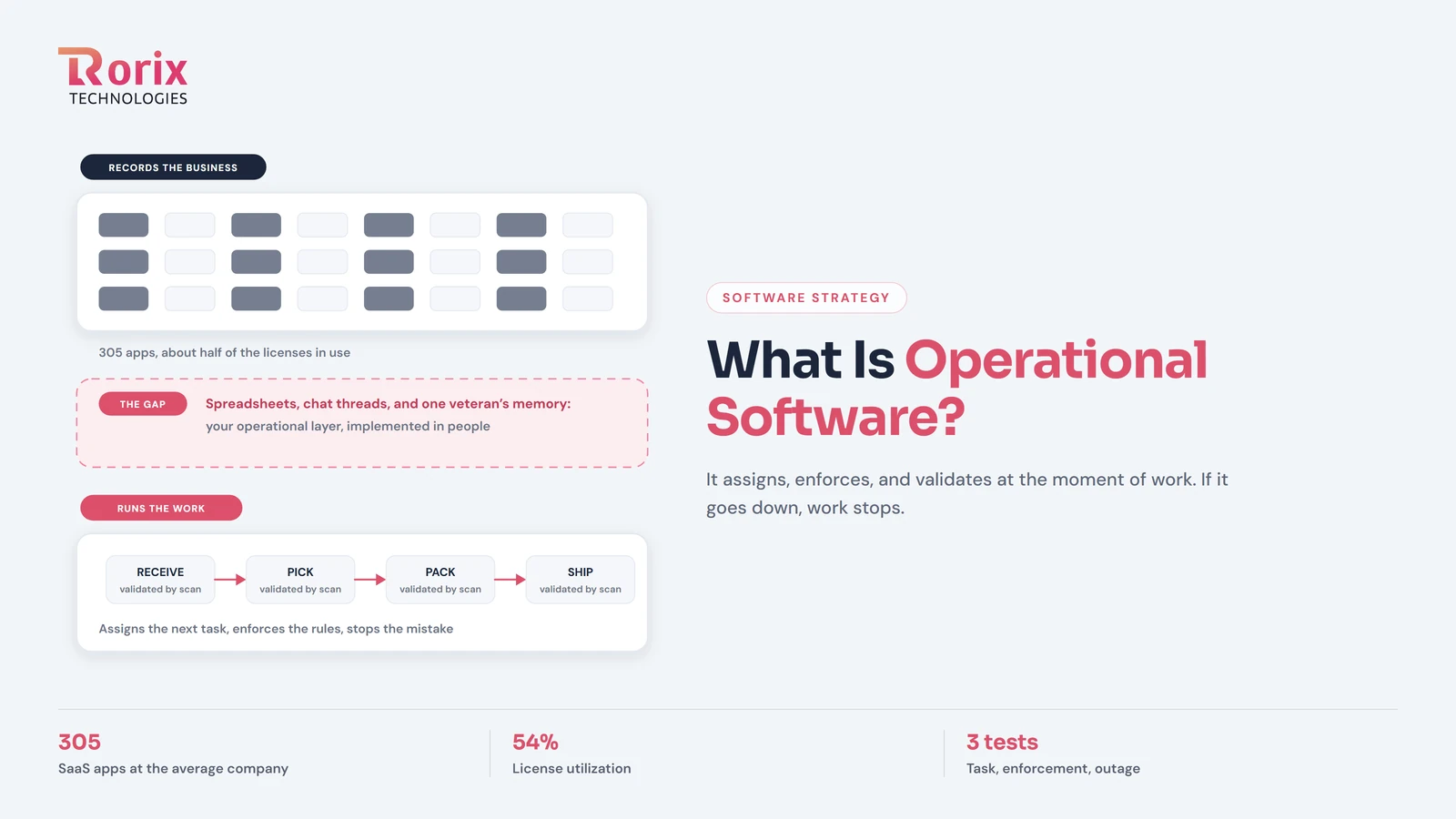
What Is Operational Software? The Layer That Runs the Work
Operational software executes the work itself: it assigns tasks, enforces rules, and validates as work happens. How it differs from record-keeping tools.
Read article
Top 25 API Development Companies in 2026
Compare 25 API development companies in 2026 by expertise, costs, integrations, and project fit to find the right partner for your business.
Read article
SaaS Development Cost in 2026: Pricing by Stage, Features and Team
Explore SaaS development cost in 2026, with pricing by product stage, features, team, and timeline, plus hidden expenses and ways to save money.
Read article