Top 25 API Development Companies in 2026
Compare 25 API development companies in 2026 by expertise, costs, integrations, and project fit to find the right partner for your business.
On this page59 sections
Key Takeaways: Choosing an API Development Company
- Match the project: Choose a partner based on your integrations, industry, and technical needs.
- Check reliability: Ask how they handle rate limits, retries, security, and failures.
- Verify experience: Look for relevant case studies and measurable results.
- Plan the full cost: Include development, maintenance, monitoring, and future updates.
- Secure ownership: Confirm source code, documentation, and ongoing support in the contract.
One failed API connection can leave an order marked as shipped in your warehouse system but unpaid in finance, with no clear answer about which record is correct.
That is usually when businesses start looking for an API development company to connect their systems properly. But the real challenge begins when every vendor promises secure, scalable APIs and every custom software development proposal looks equally convincing.
The trouble is that building an API is only part of the job. Without reliable integrations, proper error handling, and post-launch support, one unexpected field change or rate limit can quietly disrupt business operations.
In this guide, you'll learn:
- Top 25 API development companies and their strengths
- How we evaluated and verified each vendor
- Which partner fits your project requirements
- 8 checks to run before signing a contract
- API development costs and project timelines
- Whether custom API development or an iPaaS platform fits (in the FAQ)
By the end of this guide, you'll have a practical shortlist, a realistic budget range, and the right questions to identify a reliable partner before committing to a project.
Quick Answer: Best API Development Company by Project Need
Need to shortlist an API development company quickly? Match your project to the table below, then read the relevant company profiles to compare strengths and fit.
| Project need | Shortlist first |
|---|---|
| Operations systems (WMS, ERP, CRM) | Rorix Technologies (that is us), Velvetech, Modgility |
| Legacy systems connected to modern SaaS | Velvetech, OpenXcell, Moon Technolabs |
| Fintech and payment APIs | Softjourn, Fortunesoft IT Innovations, Zazz |
| Healthcare APIs (FHIR and HL7) | Belitsoft, Netguru, Space-O Technologies |
| Security-critical APIs | Apriorit, ScienceSoft |
| Cost-effective custom API development | Capital Numbers, RaftLabs, ValueCoders |
| Onshore teams in the US or Canada | Orases, Konverge Digital Solutions, Outright Development |
Each company has a full profile below, including its strengths and, where we found one, a point to confirm before you commit.
What Does an API Development Company Do?
An API development company builds and maintains the connections that let software systems exchange data. Postman's 2025 State of the API Report found that 82% of organizations follow some level of API-first approach.
1. Custom API Development
Teams build APIs that expose product data and functions to web, mobile, and partner applications. REST API development is a common starting point, while GraphQL, gRPC, and webhooks suit specific needs.
2. Third-Party API Integration
Vendors connect payment gateways, CRMs, carriers, and ERPs while mapping fields and preventing duplicate records. Reliable API integration services are especially important for WMS integration with ERP.
3. Legacy API Modernization
Older SOAP services and fragile scripts can block modern integrations. A partner can introduce a REST or GraphQL layer and support gradual legacy application modernization without disrupting existing operations.
4. API Security and Testing
Security measures such as OAuth 2.0, token rotation, rate limiting, and input validation help protect data. Contract and load testing catch compatibility and performance issues before launch.
5. Documentation, Monitoring, and Maintenance
OpenAPI specifications, usage examples, and monitoring help teams integrate APIs and detect failures early. Ongoing maintenance covers version updates and third-party changes that could disrupt existing connections.
Also Read: How to Consolidate Fragmented Business Systems Into One Platform
How We Verified and Shortlisted These API Development Companies
Full disclosure: Rorix Technologies publishes this guide and ranks itself first. We applied the same shortlisting criteria to our own entry as to every other company.
Rather than relying on outdated directories, we checked each company's website and Clutch profile to verify four things:
- Published API offering: A published API development or integration offering, on a service page or in documented client work.
- Company details: Current business name and listed headquarters or office locations.
- Comparable size: Fewer than 1,000 employees to keep the comparison focused on small and mid-sized providers.
- Clear specialty: Each company's main strengths and, where we found one, a point to confirm before you commit.
We excluded global consulting giants and freelance marketplaces because they serve different needs. When a company listed multiple offices without identifying its headquarters, we included the listed locations instead. Ratings, review counts, project sizes, hourly rates, and team-size bands are from each firm's Clutch profile as read in October 2026.
Top 25 API Development Companies at a Glance
Compare these 25 API development companies by their best-fit projects, locations, and technical focus to build your initial shortlist.
| Company | Best For | Headquarters | API Focus |
|---|---|---|---|
| Rorix Technologies (that is us) | Operations systems that must stay in sync | Ahmedabad, India | Custom APIs for WMS, HRMS, and SaaS integrations |
| Velvetech | Connecting legacy systems with SaaS | Sunny Isles Beach, Florida, US | REST, SOAP, RPC, GraphQL, and API strategy |
| Space-O Technologies | Web and mobile products requiring APIs | Ahmedabad, India | REST, GraphQL, event-driven APIs, and SOAP-to-REST migration |
| Softjourn | Fintech, payments, and ticketing | Fremont, California, US | REST, GraphQL, and gRPC for payment systems |
| Apriorit | Security-critical and system-level integrations | Lynn, Massachusetts, US | Secure APIs and undocumented API research |
| ScienceSoft | Regulated industries needing end-to-end delivery | McKinney, Texas, US | API design, management, and penetration testing |
| Belitsoft | Healthcare and financial data exchange | Offices in Alexandria, US, London, and Warsaw | REST, GraphQL, FHIR, HL7, and DICOM integration |
| Netguru | Design-led digital products | Poznań, Poland | REST, GraphQL, SOAP, and WebSocket APIs |
| Orases | Complex projects with a US-based team | Frederick, Maryland, US | REST, SOAP, GraphQL, gRPC, ERP, and CRM integration |
| Capital Numbers | Cost-conscious custom API projects | Kolkata, India | REST, GraphQL, API gateways, and security |
| OpenXcell | Mid-market systems integration | Ahmedabad, India | Custom APIs, middleware, and SaaS connectors |
| Moon Technolabs | REST APIs and legacy modernization | Offices in Ahmedabad, India, and Chicago, US | REST APIs, microservices, and third-party integrations |
| RaftLabs | Small, clearly scoped API projects | Dublin, Ireland | REST, GraphQL, and webhook systems |
| Fortunesoft IT Innovations | Fintech and healthcare APIs | Bengaluru, India | REST, GraphQL, SOAP, gRPC, and compliance-focused integrations |
| Altoros | API platforms and developer portals | Pleasanton, California, US | Custom APIs, API-as-a-service platforms, and security |
| MindInventory | Projects requiring multiple API styles | Offices in Ahmedabad, India, and Strongsville, US | REST, GraphQL, SOAP, gRPC, webhooks, and WebSockets |
| DevCom | .NET and Java systems using cloud gateways | Port Orange, Florida, US | REST, SOAP, and AWS or Azure API gateways |
| ValueCoders | Adding API developers to an in-house team | Noida, India | REST, GraphQL, WebSocket APIs, and security testing |
| Konverge Digital Solutions | Canadian businesses seeking local teams | Toronto, Canada | REST, SOAP, GraphQL, and CRM, ERP, and payment integrations |
| AppIt Ventures | Web and mobile apps needing a backend | Denver, Colorado, US | Database, server, and API backends |
| Modgility | Manufacturing and distribution systems | Westlake, Ohio, US | ERP, CRM, and accounting integrations |
| SDSol Technologies | Mobile and IoT products | Miami, Florida, US | REST and GraphQL APIs for apps and connected devices |
| Zazz | Payment gateway integrations | Toronto, Canada | REST APIs using Java and Python, with payment integrations |
| Outright Development | Small and mid-sized businesses in New England | Newton, Massachusetts, US | REST API design and cloud-to-enterprise integration |
| OSKI Solutions | .NET-based API integration | Tallinn, Estonia | .NET APIs and CRM, ERP, and identity integrations |
Let's take a look at each one in detail.
1. Rorix Technologies (that is us)
Rorix Technologies builds custom software and API integrations for operations-heavy businesses, connecting warehouse management, HR, and SaaS platforms with the systems they rely on.
For Driven, a US performance platform for pest control and field service teams, Rorix connected 40+ third-party integrations, including HubSpot, Twilio, RingCentral, and Google APIs. Its approach includes retry rules, idempotency keys, and reconciliation to help prevent duplicate records and keep data consistent.
With 27 projects delivered and a 5.0 Clutch rating across 4 verified reviews, Rorix works with clients across the US, UK, Canada, Australia, and New Zealand.
Key Highlights:
- Technology stack: Node.js, NestJS, REST APIs, and event-driven workflows.
- Operational proof: WorkCenter Central, the platform we built for distributor Lorecs, cut manual errors by 80% and sped up order processing by 50%. Read the WorkCenter Central case study.
- Project management: Two-week sprints with a named technical lead to maintain clear communication and delivery priorities.
- Engagement model: Retainer-based development with a dedicated team of senior engineers.
- Client markets: US, UK, Canada, Australia, and New Zealand.
- Where it may not fit: No healthcare, fintech, or government client work to date, and infrastructure and DevOps stay with the client.
Best for: Operations teams, distributors, 3PLs, and SaaS businesses that need custom APIs to connect complex workflows and keep business data consistent.
2. Velvetech
Velvetech helps businesses connect legacy systems with modern SaaS platforms without replacing the software they still depend on. Its API practice spans REST, SOAP, RPC, and GraphQL, backed by API strategy consulting and test automation. The firm holds a 5.0 Clutch rating across 22 reviews.
Key Highlights:
- API testing automation: Helps identify integration issues before they disrupt connected systems.
- Multiple API architectures: Supports different protocols to suit existing systems and project requirements.
- Project minimum: Clutch lists a $25,000 minimum project size, which may rule out smaller integration jobs.
Best for: Mid-size businesses modernizing legacy systems.
3. Space-O Technologies
Space-O Technologies offers dedicated API development and integration services, covering REST, GraphQL, event-driven APIs, and SOAP-to-REST migration. Its healthcare expertise includes HL7 FHIR, while its web and mobile development capabilities let product teams build connected applications with one partner. It holds a 4.8 Clutch rating across 75 reviews.
Key Highlights:
- Healthcare integration: Supports HL7 FHIR for exchanging healthcare data.
- Legacy migration: Helps modernize older SOAP interfaces.
- Delivery planning: Agree on time-zone overlap with its India-based team before kickoff.
Best for: Product teams building connected web or mobile applications.
4. Softjourn
Softjourn specializes in fintech, event ticketing, and media, where APIs must handle transactions reliably under heavy demand. Its engineers build REST, GraphQL, and gRPC services for payment processing, prepaid cards, expense management, and ticketing, with particular attention to integration reliability.
Key Highlights:
- Payment workflows: Experience with payment processing and prepaid card systems.
- High-load systems: REST, GraphQL, and gRPC for demanding applications.
- Distributed delivery: R&D offices in Ukraine, Poland, and Brazil.
Best for: Fintech and ticketing platforms handling transactions through APIs.
5. Apriorit
Apriorit combines API engineering with cybersecurity and low-level system expertise, making it useful when integrations involve closed or poorly documented software. Its services include undocumented API research, reverse engineering, and security testing, backed by a 4.9 Clutch rating across 45 reviews.
Key Highlights:
- Undocumented APIs: Researches interfaces when usable vendor documentation is unavailable.
- Security expertise: Suits projects requiring deeper technical investigation.
- Hourly rates: Clutch lists $100 to $149 per hour, which may be high for simple integrations.
Best for: Technology teams integrating with closed or security-sensitive systems.
6. ScienceSoft
ScienceSoft manages APIs across design, implementation, ongoing management, and penetration testing. Its ISO 9001 and ISO 27001 certifications can help organizations assess quality and information security practices, particularly when compliance and long-term ownership matter.
Key Highlights:
- Security assurance: ISO 27001 certification supports its information security credentials.
- Quality processes: ISO 9001 certification demonstrates a quality management framework.
- Full lifecycle: Covers API management and security testing beyond initial development.
Best for: Regulated organizations needing long-term API ownership.
7. Belitsoft
Belitsoft develops APIs for healthcare and financial data exchange, with specific experience in FHIR, HL7v2, and DICOM integration. It also builds REST and GraphQL APIs and modernizes legacy interfaces, while its connection to the Noventiq group adds enterprise backing.
Key Highlights:
- Healthcare standards: FHIR, HL7v2, and DICOM integration.
- Legacy modernization: Updates older interfaces for modern systems.
- Client validation: Request references relevant to your data standards.
Best for: Healthcare and fintech teams exchanging regulated data.
8. Netguru
Netguru combines product design and software engineering, helping teams connect backend APIs with the user experiences built around them. Its technical capabilities include REST, GraphQL, SOAP, WebSockets, and HL7 FHIR, supported by a 4.8 Clutch rating across 73 reviews.
Key Highlights:
- Product-focused delivery: Connects API engineering with front-end and design work.
- Healthcare capability: Supports HL7 FHIR for healthcare applications.
- Project minimum: Clutch lists a $50,000 minimum project size, making it less suited to small API jobs.
Best for: Funded product teams building complete digital products.
9. Orases
Orases keeps development in the US and states that it does not outsource coding, making its delivery model a key differentiator. Its team builds REST, SOAP, GraphQL, and gRPC APIs and connects ERP, CRM, accounting, and legacy systems. It holds a 5.0 Clutch rating across 74 reviews, with named clients including the NFL Foundation.
Key Highlights:
- Onshore delivery: US-based engineering team with no outsourced coding, according to the company.
- Enterprise integrations: Connects business systems across multiple API styles.
- Project minimum: Clutch lists a $75,000 minimum and $150 to $199 hourly rates.
Best for: US organizations with complex integration requirements.
10. Capital Numbers
Capital Numbers is an India-based publicly listed technology company offering API development and modernization services. Its capabilities include REST and GraphQL APIs, API gateway implementation, and legacy interface modernization. It has a 4.8 Clutch rating across 237 reviews, giving it a substantial review history.
Key Highlights:
- API gateways: Helps manage API access and traffic between systems.
- Legacy modernization: Updates older interfaces to support newer applications.
- Team clarity: Confirm which engineers will handle your project and their relevant experience.
Best for: Startups and small businesses seeking cost-conscious API development.
11. OpenXcell
OpenXcell focuses on connecting business systems through custom APIs, middleware, data synchronization, SaaS connectors, and webhook pipelines. Its broad software development offering can suit companies juggling several platforms, while Clutch lists a 4.8 rating and an hourly rate below $25.
Key Highlights:
- Middleware: Connects systems that cannot communicate directly.
- Data synchronization: Helps keep information aligned across SaaS tools.
- Team expertise: Confirm the assigned team's experience with your specific integrations.
Best for: Mid-market businesses connecting multiple SaaS platforms.
12. Moon Technolabs
Moon Technolabs builds REST APIs, microservices, and third-party integrations using frameworks such as Spring Boot, Django REST, Express.js, FastAPI, and Gin. It also modernizes legacy APIs and holds a 4.9 Clutch rating across 36 reviews.
Key Highlights:
- Framework flexibility: Supports several established backend technologies.
- Real-time integration: Useful for keeping connected applications and data in sync.
- Technology fit: Confirm GraphQL or SOAP experience if your project requires either.
Best for: Businesses needing REST APIs and reliable data synchronization.
13. RaftLabs
RaftLabs focuses on smaller, clearly defined software projects, including REST APIs, GraphQL layers, webhooks, and third-party integrations. Its 4.9 Clutch rating across 20 reviews and a most common project size of $10,000 to $49,999 on Clutch make it worth considering for scoped builds.
Key Highlights:
- Defined budgets: The project sizes Clutch lists can help with early planning.
- Integration options: Supports webhooks, GraphQL, REST, and third-party connections.
- Team capacity: Its smaller scale may not suit large, multi-team enterprise programs.
Best for: Founders needing a clearly scoped API project.
14. Fortunesoft IT Innovations
Fortunesoft IT Innovations builds APIs for fintech, healthcare, and life sciences, with an emphasis on security and compliance. Its services cover REST, GraphQL, SOAP, and gRPC, alongside OAuth 2.0, audit logging, penetration testing, and work aligned with HIPAA, PCI DSS, and SOC 2 requirements.
Key Highlights:
- Compliance support: Experience with regulated data and security requirements.
- Security controls: OAuth 2.0, audit logging, and penetration testing.
- Client references: With only three Clutch reviews found as of October 2026, ask for relevant references and sample documentation.
Best for: Regulated businesses that need security-conscious API development.
15. Altoros
Altoros supports the full API adoption journey, from custom development and security to developer portals, documentation, and code samples. This helps businesses make APIs easier for external developers and partners to understand, integrate, and use. It holds a 4.8 Clutch rating across 34 reviews.
Key Highlights:
- Developer portals: Give API consumers a place to find documentation and resources.
- API-as-a-service: Supports businesses offering APIs as a product.
- Team availability: Confirm current API project capacity alongside its other technology offerings.
Best for: Companies building APIs for external developers and partners.
16. MindInventory
MindInventory supports REST, GraphQL, SOAP, gRPC, WebSockets, and webhooks, with development across Node.js, Python, Go, Java, and PHP. It also provides Swagger and OpenAPI documentation and lists SOC 2 Type II and ISO 27001 certifications.
Key Highlights:
- Documentation: Swagger and OpenAPI resources support smoother integration.
- Technology range: Multiple API styles and backend languages under one vendor.
- Security credentials: Listed SOC 2 Type II and ISO 27001 certifications.
Best for: Teams requiring several API styles from one development partner.
17. DevCom
DevCom builds REST and SOAP APIs using .NET, Java, and Node.js, with serverless gateways on AWS and Azure. Its API design service names MCP alongside REST as a communication pattern.
Key Highlights:
- Cloud gateways: Supports serverless API deployments on AWS and Azure.
- API testing: Offers a separate service for checking API quality.
- Technical fit: Confirm GraphQL, gRPC, and any required compliance expertise before committing.
Best for: .NET and Java teams building cloud-connected systems.
18. ValueCoders
ValueCoders provides developers who can join an existing team to build REST, GraphQL, and WebSocket APIs. Its engineers also handle integrations with payment, CRM, ERP, and AI platforms, alongside automated and security testing. Clutch lists a $1,000 minimum project size.
Key Highlights:
- Flexible staffing: Adds development capacity without requiring a fully outsourced project.
- Testing support: Includes automated and security testing.
- Low entry point: The listed minimum may suit smaller engagements.
Best for: Teams with technical leadership that need additional API developers.
19. Konverge Digital Solutions
Konverge Digital Solutions develops custom software in Toronto and connects operational systems through REST, SOAP, and GraphQL APIs. Its work includes CRM, ERP, payment, and legacy integrations, with experience across manufacturing, pharmaceuticals, and industrial businesses.
Key Highlights:
- Industry experience: Manufacturing, pharmaceutical, and industrial projects.
- Operational integration: Connects business applications and legacy systems.
- Client validation: With no Clutch reviews found as of October 2026, request references and consider a small initial project.
Best for: North American businesses seeking local integration support.
20. AppIt Ventures
AppIt Ventures builds the database, server, and API layers behind custom web and mobile applications. Its development process considers HIPAA and GDPR requirements during architecture, while named clients include the State of Colorado, GE, and Natural Grocers. It holds a 4.9 Clutch rating across 39 reviews.
Key Highlights:
- Compliance planning: Considers healthcare and data-protection requirements early.
- Named clients: Includes the State of Colorado, GE, and Natural Grocers.
- Project scope: Confirm fit if you need a standalone API platform rather than an app backend.
Best for: Organizations building web or mobile apps with compliance requirements.
21. Modgility
Modgility connects the ERP, CRM, and accounting systems that manufacturers and distributors rely on daily. Its integration experience spans SAP, Oracle, Epicor, Business Central, HubSpot, Salesforce, and QuickBooks. As a HubSpot Platinum Partner, it also brings CRM expertise to projects where customer data drives operations.
Key Highlights:
- Broad integrations: Connects established business platforms without requiring a complete system replacement.
- CRM expertise: HubSpot experience can help when customer data needs to flow across operational systems.
- Service mix: Its broader focus includes marketing and RevOps, so confirm the depth of API engineering available.
Best for: Mid-market manufacturers, MedTech companies, and distributors connecting business systems.
22. SDSol Technologies
SDSol Technologies stands out by publishing estimated effort ranges for API work, giving businesses a clearer starting point for budgeting. It builds REST and GraphQL APIs for mobile back ends and connects services such as Stripe, Twilio, Salesforce, and Shopify. Its team also supports IoT connectivity for products that exchange data with connected devices.
Key Highlights:
- Published estimates: Lists 8-20 hours for basic third-party integrations and 40-100 hours for custom internal APIs.
- Connected products: Experience with mobile back ends and IoT integrations.
- Capacity planning: Check team availability before committing to a large or multi-phase program.
Best for: Small and mid-sized businesses building mobile applications or IoT products.
23. Zazz
Zazz helps businesses add payment processing and identity features to existing products through custom REST APIs and integrations. Its payment experience covers PayPal, Stripe, Braintree, and Authorize.Net, while its identity capabilities include SAML, OIDC, and SCIM. The company holds a 4.9 Clutch rating across 40 reviews.
Key Highlights:
- API documentation: States that it provides OpenAPI documentation for every API.
- Identity integration: Supports standards used for authentication and user provisioning.
- Team availability: Its broader focus includes managed IT and cybersecurity, so confirm current capacity for API development.
Best for: Mid-market businesses adding payments or single sign-on to existing software.
24. Outright Development
Outright Development helps businesses design REST APIs, connect cloud applications with enterprise systems, and turn APIs into products that other developers can use. Its feature-based pricing makes individual capabilities easier to scope before development begins. Clients can choose fixed-price or time-and-materials contracts depending on how clearly requirements are defined.
Key Highlights:
- Cost visibility: Feature-based pricing helps clarify what individual capabilities will cost.
- Flexible contracts: Offers fixed-price and time-and-materials engagement models.
- Team scale: With only three Clutch reviews found as of October 2026, request relevant references and confirm capacity for larger projects.
Best for: Small and mid-sized businesses in New England seeking a local API development partner.
25. OSKI Solutions
OSKI Solutions focuses on API integration within the Microsoft ecosystem, making it relevant for teams built around .NET applications. Its work connects CRM, ERP, logistics, and identity platforms, including Okta. A verified Clutch review also describes a .NET microservices project using HotChocolate GraphQL, and the company holds a 5.0 rating.
Key Highlights:
- Microsoft ecosystem: Suits teams using .NET and related application technologies.
- GraphQL experience: A client review references HotChocolate GraphQL in a microservices build.
- Service scope: Its published offering emphasizes API integration, so confirm experience building new APIs from scratch.
Best for: Small .NET teams connecting CRM, ERP, logistics, or identity systems.
Now that you have seen all 25 firms, let's take a look at the checks that separate a reliable partner from a polished sales deck.
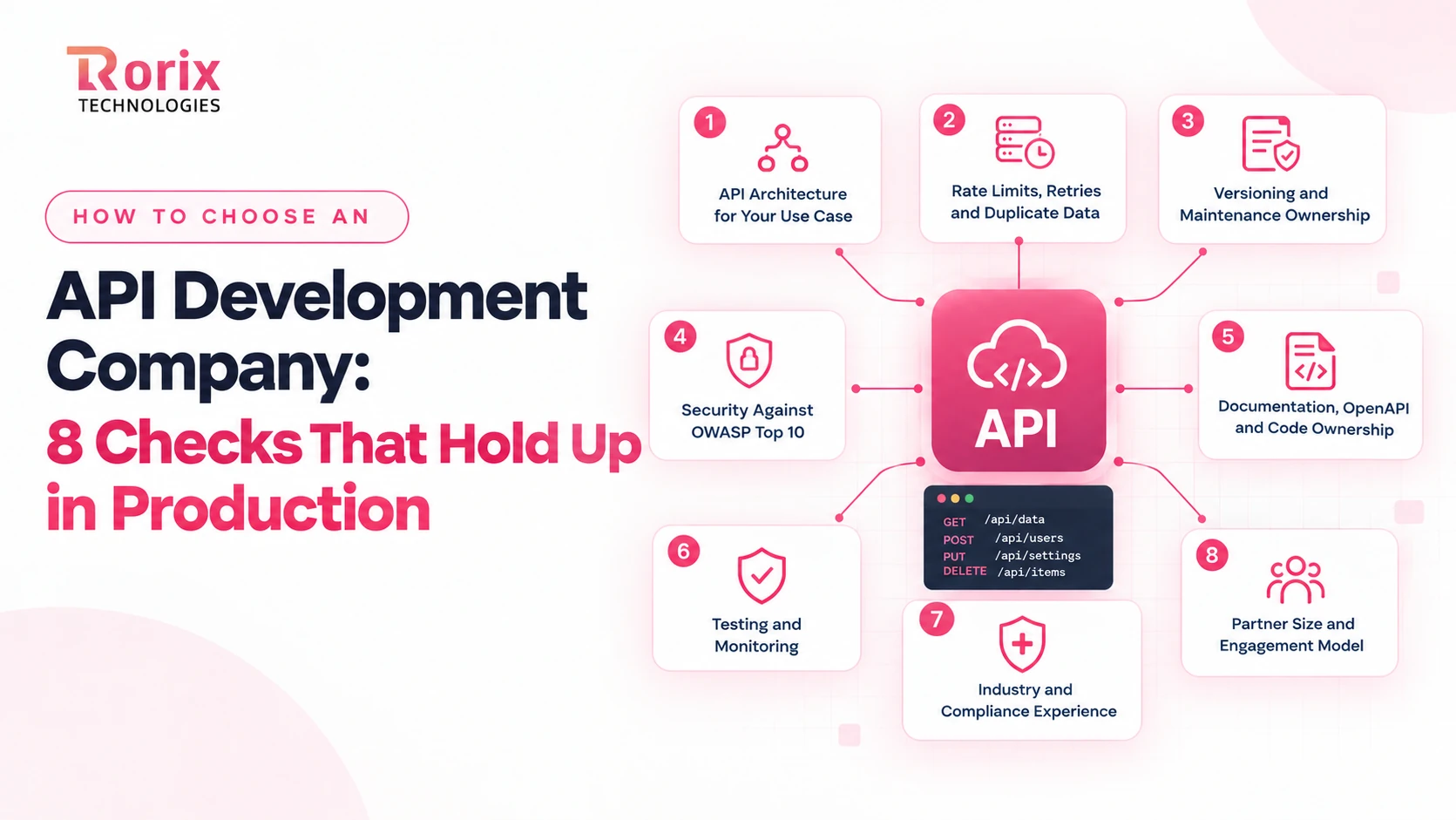
How to Choose an API Development Company: 8 Checks That Hold Up in Production
A demo shows that an API works once. Production reveals whether it survives traffic spikes, data errors, and third-party changes.
For general vendor checks, see our guide to choosing a custom software development company. Use these eight checks to assess every API development company on your shortlist.
1. Confirm the Right API Architecture for Your Use Case
Ask why the vendor recommends REST, GraphQL, gRPC, or webhooks for your project. REST suits many standard integrations, GraphQL supports flexible data requests, and gRPC works well between internal services. If the choice is unclear, an independent technology consulting review can help validate the architecture.
2. Ask How They Handle Rate Limits, Retries, and Duplicate Data
Third-party APIs impose rate limits, and retries can create duplicate records when requests fail midway. Ask how the team handles queuing, backoff, idempotency keys, and conflicting data across connected systems. Our API integration strategy guide explains these failure points in more detail.
3. Get Versioning and Maintenance Ownership in Writing
Ask who fixes the integration when a provider changes its API or removes a field. Postman's 2025 State of the API Report found that only 26% of teams use semantic versioning, making clear change management important. Put version updates, incident ownership, and ongoing maintenance in the contract to control long-term costs.
4. Check Security Against the OWASP API Security Top 10
Ask the vendor to explain how it addresses the OWASP API Security Top 10, including broken access controls and exposed data. Look for OAuth 2.0, short-lived tokens, least-privilege scopes, input validation, and security testing. If the team cannot explain these controls clearly, do not trust it with sensitive customer or business data.
5. Make Documentation, the OpenAPI Spec, and Code Ownership Deliverables
Your contract should include the OpenAPI specification, practical usage examples, source code, and clear ownership rights. Good documentation helps your internal team maintain integrations without depending on the original vendor for every change. It also helps AI agents for business operations discover and call APIs through structured specifications.
6. Confirm Testing and Monitoring Ship With the Build
Ask whether contract tests, load tests, error tracking, and uptime alerts are included before launch. Postman's 2025 report found that only 17% of teams use contract testing, leaving many integrations vulnerable to unexpected changes. Make testing and monitoring part of the delivery scope, not optional work for a later phase.
7. Match Industry and Compliance Experience to Your Data
Choose a partner that understands your industry's data and compliance requirements, not just its technology stack. Healthcare projects may need HIPAA safeguards and FHIR compatibility, while payment integrations require appropriate PCI DSS controls. Ask for a relevant case study with measurable results to see how the team handles real-world requirements.
8. Match Partner Size and Engagement Model to Your Project Stage
A startup building its first integration needs a different team from an enterprise modernizing a large platform. Compare fixed-price, time-and-materials, and retainer models, and confirm who will handle development and ongoing support. Make sure experienced engineers are directly involved, and the team can scale with your requirements.
Also Read: Legacy Application Modernization: How to Upgrade a System You Cannot Turn Off
Now that you know how to test a vendor, let's take a look at what API work costs and how long it takes.
How Much Does API Development Cost?
API development cost depends on project scope, integration complexity, security, and team rates. The ranges below are market estimates, not Rorix pricing.
For a broader budget breakdown, see our custom software development cost guide.
1. API Development Cost and Timeline by Project Type
| Project type | Typical scope | Market cost range | Typical timeline |
|---|---|---|---|
| Single integration or simple API | One or two REST integrations with standard authentication | $5,000 to $20,000 | 2 to 6 weeks |
| Multi-integration project | Several integrations, shared data layer, rate-limit handling, and monitoring | $20,000 to $75,000 | 2 to 4 months |
| Complex or regulated API platform | Multiple data sources, microservices, high traffic, and compliance requirements | $75,000 to $250,000+ | 4 to 9 months |
Use these ranges to assess quotes, not as a final budget, because requirements can change the total significantly. The number of endpoints, security controls, and existing systems all affect delivery effort. For an estimate based on your project, use our Get a Project Cost Estimate interactive estimator.
2. 5 Factors That Move the Price
Two projects with similar goals can have very different budgets depending on their technical requirements. These five factors explain most pricing differences and help you compare proposals more accurately. Check that each vendor has included them in its estimate.
- Integrations and endpoints: Every additional system adds data mapping, testing, and error handling.
- Security and compliance: HIPAA, PCI DSS, or GDPR requirements can add encryption, audits, and documentation.
- Legacy systems and data mapping: Older or poorly documented software usually takes longer to connect than modern SaaS tools.
- Real-time and traffic demands: High request volumes, live data, and strict uptime targets require more engineering and testing.
- Team location and seniority: Rates vary by region, while experienced engineers may reduce costly rework.
3. What It Costs to Keep an API Running After Launch
The initial build is only part of the total cost, because third-party APIs can change schemas, retire endpoints, or introduce new rate limits. Your team needs time and budget to monitor performance, fix failures, update integrations, and maintain security. Ask your API development company to define ongoing support and maintenance costs before signing the contract.
Also Read: Software Maintenance Cost: What the 15% to 25% Rule Actually Buys
Why Rorix Technologies Fits Complex API Integration Projects
Choosing an API partner is easier when its experience matches the systems you need to connect.
Rorix Technologies builds custom software and API integrations for operations-heavy businesses, connecting warehouse management, HR, and SaaS platforms with the systems they rely on.
Its approach combines senior engineers, a named technical lead, two-week sprints, and ongoing support, helping businesses maintain reliable integrations beyond the initial launch.
- 27 projects: Delivered across custom software products.
- 80% fewer manual errors: Achieved with WorkCenter Central, the platform we built for distributor Lorecs.
- 40+ integrations: Connected for Driven, a US performance platform for pest control and field service teams, including HubSpot, Twilio, RingCentral, and Google APIs.
- Reliable integrations: Retries, idempotency, and reconciliation help prevent duplicate records and keep data consistent.
- Senior engineering: Dedicated senior engineers, a named technical lead, and two-week development sprints.
- Ongoing support: Retainer-based engagement to maintain and improve integrations after launch.
- Global delivery: Experience with clients across the US, UK, Canada, Australia, and New Zealand.
Need custom API integrations that fit your existing workflows?
Book a Free Consultation to discuss your systems, integration requirements, and next steps with the Rorix team.
Conclusion: Shortlist the Partner That Owns the API After Launch
Choosing the right API partner means looking beyond development skills. Compare their integration experience, security practices, and support after launch.
Use the cost estimates and eight selection checks in this guide to compare API development companies based on your systems, budget, and long-term needs.
We hope this guide helps you understand what different API development companies offer and how to choose the right fit for your project.
Ready to connect your business systems with reliable APIs? Connect with our experts to discuss your requirements and plan your API project.
Frequently Asked Questions
How much does it cost to hire an API development company?
A single integration costs around $5,000 to $20,000, while multi-integration projects range from $20,000 to $75,000. Complex or regulated platforms cost $75,000 to $250,000 or more, depending on scope, security, and team location.
How long does custom API development take?
A simple API takes 2-6 weeks, multi-integration projects take 2-4 months, and complex platforms take 4-9 months. Legacy systems and poor documentation can delay delivery.
What is the difference between API development and API integration?
API development creates new APIs, while API integration connects existing systems and services. Many projects need both.
Should I choose REST or GraphQL?
REST suits most standard business APIs, while GraphQL works well when different clients need different data. Some products use both for different needs.
Is custom API development better than an iPaaS platform?
iPaaS works well for simple workflows with ready-made connectors. Custom API development suits complex business rules and specialized integrations. Use our build versus buy decision framework to compare both options.
Do API development companies provide ongoing maintenance?
Many do, but confirm it in the contract. Maintenance should cover monitoring, version updates, security fixes, and third-party API changes.
Who owns the source code and API documentation after delivery?
Confirm in writing that you own the source code, OpenAPI specification, and documentation after payment. This makes future maintenance or switching vendors easier.
Which API development company is best for a startup?
RaftLabs, Capital Numbers, and ValueCoders are worth considering for focused projects and tighter budgets. Compare their minimum project sizes, integration experience, and ability to scale with your product.
Systems that do not talk to each other?
Most of the cost in an integration project sits in the edge cases nobody documented. Send us the systems and the data that has to move between them.
Continue learning
Written by
Renish DadhaniyaFounder & Director, Rorix Technologies
Renish co-founded Rorix Technologies and drives the engineering and delivery culture across the organization. Beyond engineering, he leads the company's sales, finance, and HR operations, building the infrastructure that lets the team focus on shipping quality software. With deep hands-on expertise in architecture and team building, he ensures every project lands on time to the quality standards clients demand.
View full profileRelated articles
API Integration Strategy: How to Connect Systems Without Building Debt
An API integration strategy decides where coupling lives and who owns the contract. Here are the three topologies, six failure modes, and a six-step plan.
Read article
How to Consolidate Fragmented Business Systems Into One Platform
Fragmented vendor systems cost real money. Compare the four consolidation patterns, what each costs, and how to choose a development partner that fits.
Read article
WMS Integration Best Practices: ERP, E-Commerce and TMS
WMS integration best practices for connecting ERP, e-commerce, shipping carriers, and TMS: proven patterns, sync strategies, and common failure points.
Read article