
AI Agents for Business Operations: Use Cases, Architecture and Rollout
See how AI agents run business operations: use cases by team, warehouse and order workflows, architecture, guardrails, and a step-by-step rollout plan.
On this page55 sections
Every operations team has now sat through the same demo. An agent reads the email, checks the system, updates the record, and sends the reply, all on its own. It works on stage. Then it meets your exception rate.
Gartner expects more than 40% of agentic AI projects to be canceled by the end of 2027, citing escalating costs, unclear business value, and inadequate risk controls. The same analysis puts a name to part of the problem, "agent washing," the rebranding of existing assistants, chatbots, and RPA scripts as agents, and estimates only around 130 of the thousands of vendors claiming agentic capability are the real thing.
None of that means agents do not work. It means the scoping is usually wrong, and there is now published evidence about exactly where the line sits. AI agents for business operations succeed when they own short, bounded, reversible tasks inside a system that already holds the truth. They fail when they are handed a process.
This guide is the version with the measurements in it: what an agent is, how far its autonomy actually stretches, where it pays back by function, and the guardrails that decide whether yours reaches production.
In this guide, you'll learn:
- What separates an agent from the automation you already run
- Why 40% of agent projects get canceled, and what that failure looks like up close
- The reliability math that should set your scope before any vendor conversation
- Use cases by team, and in warehouse and order operations
- The architecture of an operations agent and the guardrails it needs before it touches production data
- A step-by-step rollout, what it costs to run, and how to test a vendor's autonomy claims
Quick Answer: What an AI Agent Can Safely Own in Operations Today
An AI agent for operations is software that takes a goal, calls your systems to act, and checks the result until the task is done. It should own short, reversible steps inside a system of record, with a person approving any costly write.
Five places operations teams start:
- Inventory exceptions: Triage count variances and receiving mismatches for a supervisor to approve.
- Order exception triage: Classify held orders and draft the fix before a person releases them.
- HR document checks: Screen onboarding documents and prefill records, with pay kept out of scope.
- Invoice matching: Match invoices to purchase orders and explain each mismatch.
- Support context: Summarize account history and draft a reply for a rep to send.
Key Takeaways: Scope Agents to Short, Reversible Tasks
- In a June 2025 prediction, Gartner expects more than 40% of agentic AI projects to be canceled by the end of 2027. It cites escalating costs, unclear business value, and inadequate risk controls.
- METR's 2025 research found the models it tested succeeded on close to 100% of tasks that take a human under four minutes, and under 10% of tasks that take a human more than around four hours.
- A 95% per-step success rate compounds to 74% across six steps, so an agent should own one short step at a time with a human approval or a deterministic validation between hops.
- In the Stack Overflow 2025 Developer Survey, only 14.1% of developers report using agents daily, and 66% named AI solutions that are almost right, but not quite, as their top frustration.
- Ongoing accuracy work for an agent behaves like the 15% to 25% annual maintenance already budgeted for software, and tool and integration engineering is normally the largest build cost.
What Are AI Agents for Business Operations?
An AI agent is software that takes a goal, decides its own sequence of steps, calls tools and systems to carry them out, observes the result, and loops until it finishes or gives up. The difference from every previous generation of automation is that nobody wrote the sequence. The model chooses it at run time.
That single property is the source of both the value and the risk. Because the path is not fixed, an agent can handle the messy long tail that broke your rule-based automation, the invoice with the odd line item, the return that does not match any category. Because the path is not fixed, it can also take a sequence nobody reviewed, against production data, at three in the morning.
An agent is therefore not a smarter chatbot. A chatbot answers. An agent acts, and acting is what needs governing.
How Is an Agent Different From the Automation You Already Have?
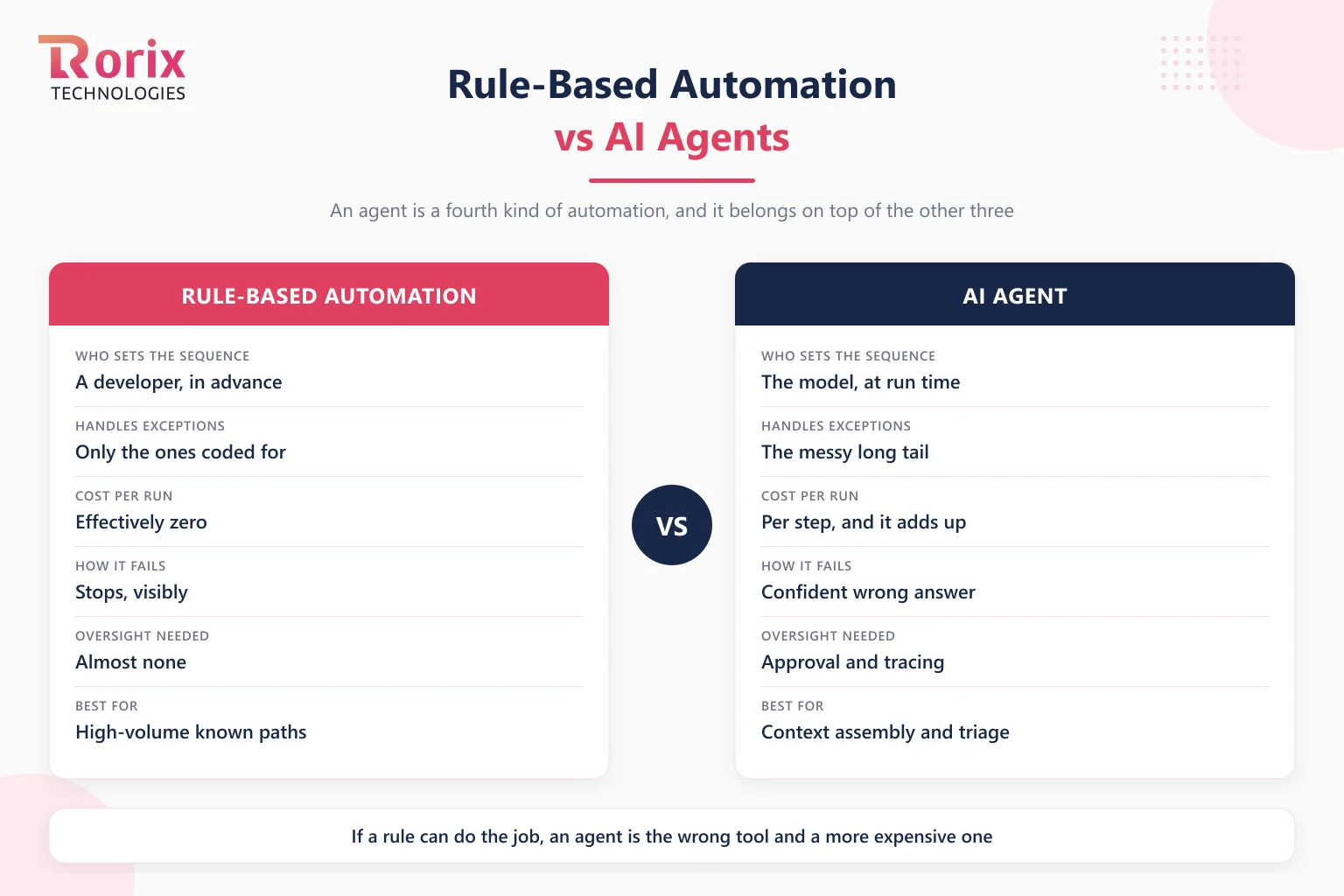
Most operations teams already run three kinds of automation. An agent is a fourth kind, and it belongs on top of the other three rather than in place of them.
Workflow Rules
Workflow rules fire when a condition is met. They are cheap, instant, and completely predictable, which is why they should still handle everything they can handle. If a rule can do the job, an agent is the wrong tool and a more expensive one.
RPA
RPA replays recorded clicks against systems that have no usable API. It breaks whenever a screen changes, which is the well-known tax, and it has no judgment at all.
Prediction and Scoring
Prediction and scoring, the decision layer covered in our guide to AI-enabled business systems, produces a number: a forecast, a risk score, a classification. It does not act on its own.
Agents
Agents sit above all of these. The agent's job is to decide which of your existing rules, APIs, and models to invoke, in what order, for this particular case. Which means an agent is only ever as capable as the tools you expose to it. A team with clean APIs and one system of record can build a useful agent in weeks. A team whose data is spread across four systems that disagree will build an expensive way to be wrong faster, which is why consolidating fragmented business systems is so often the real first project.
Why Do Most Agent Projects Get Canceled?
Because they are scoped as process replacements, priced as experiments, and measured after the fact. Gartner's cancellation prediction lists cost, unclear value, and weak risk controls, and each of those has a recognizable shape on the ground.
The adoption data suggests the enthusiasm gap is real even among the people closest to the technology. In the Stack Overflow 2025 Developer Survey, only 14.1% of developers report using agents daily at work. Among the same respondents, 66% named "AI solutions that are almost right, but not quite" as their top frustration.
"Almost right, but not quite" is the specific failure mode that kills operations agents. A wrong answer gets caught. A plausible answer that is wrong in one field gets approved, written to the system of record, and discovered a week later by finance.
The second pattern is that the pilot never had a number attached. Teams that cannot state what the process cost before the agent arrived have no way to defend it in the next budget cycle, which is how a technically working agent still gets canceled.
The Reliability Math That Should Set Your Scope
This is the part most agent conversations skip, and it is the one that decides your architecture.
METR's 2025 research on AI ability to complete long tasks measures models by task length rather than by benchmark score: the 50% time horizon is the duration of task, measured by how long a skilled human takes, that a model completes successfully half the time. That horizon keeps lengthening, which is the headline everyone quotes.
The more useful number is the shape of the curve underneath it. In that same work, the models current at the time of the research succeeded on close to 100% of tasks that take a human under four minutes, and under 10% of tasks that take a human more than around four hours. Reliability does not decline gently with task length. It falls off a cliff, and while the position of that cliff keeps moving, its shape has not.
There is a clean explanation for why. Toby Ord's analysis, Is there a half-life for the success rates of AI agents?, models an agent as having a roughly constant chance of failing during each minute of work a human would have spent, which produces an exponentially declining success rate as tasks get longer. Longer tasks contain more subtasks, and failing any one of them fails the whole run. Each agent effectively has a half-life. Ord is explicit that this came from one task suite and may not generalize, but the mechanism matches what operations teams observe: the six-step agent that works beautifully in a demo fails a quarter of the time in production, because a 95% per-step success rate compounds to 74% across six steps.
Three design consequences follow, and they are worth more than any vendor's autonomy roadmap:
- Make the hops short. Decompose the process into steps a human would finish in minutes, and let the agent own one at a time. This is the difference between an agent that runs your returns process and an agent that classifies one return.
- Checkpoint between hops. A human approval or a deterministic validation between steps resets the failure compounding instead of letting it multiply. Every checkpoint you remove is a decision to accept exponential risk in exchange for a bit of speed.
- Design for the wrong answer, not the missing one. Failures do not usually announce themselves as errors. They arrive as a confident, well-formatted, incorrect field. Validation has to check the content, not just that a response came back.
Scoping to this curve is not pessimism about the technology. The horizon is genuinely moving. It is an argument for building your agent so that when the horizon doubles again, you lengthen the leash by changing a policy, rather than rebuilding the system.
Also Read: How to Add AI to Existing Software: What Your System Will Let You Do
AI Agents for Internal Operations: Use Cases by Team
Agents earn their keep where the work is high-volume, exception-heavy, and currently done by a person reading across two or three systems to assemble context. That last part matters most, because context assembly is slow for humans and fast for agents, and getting it wrong is cheap to catch.
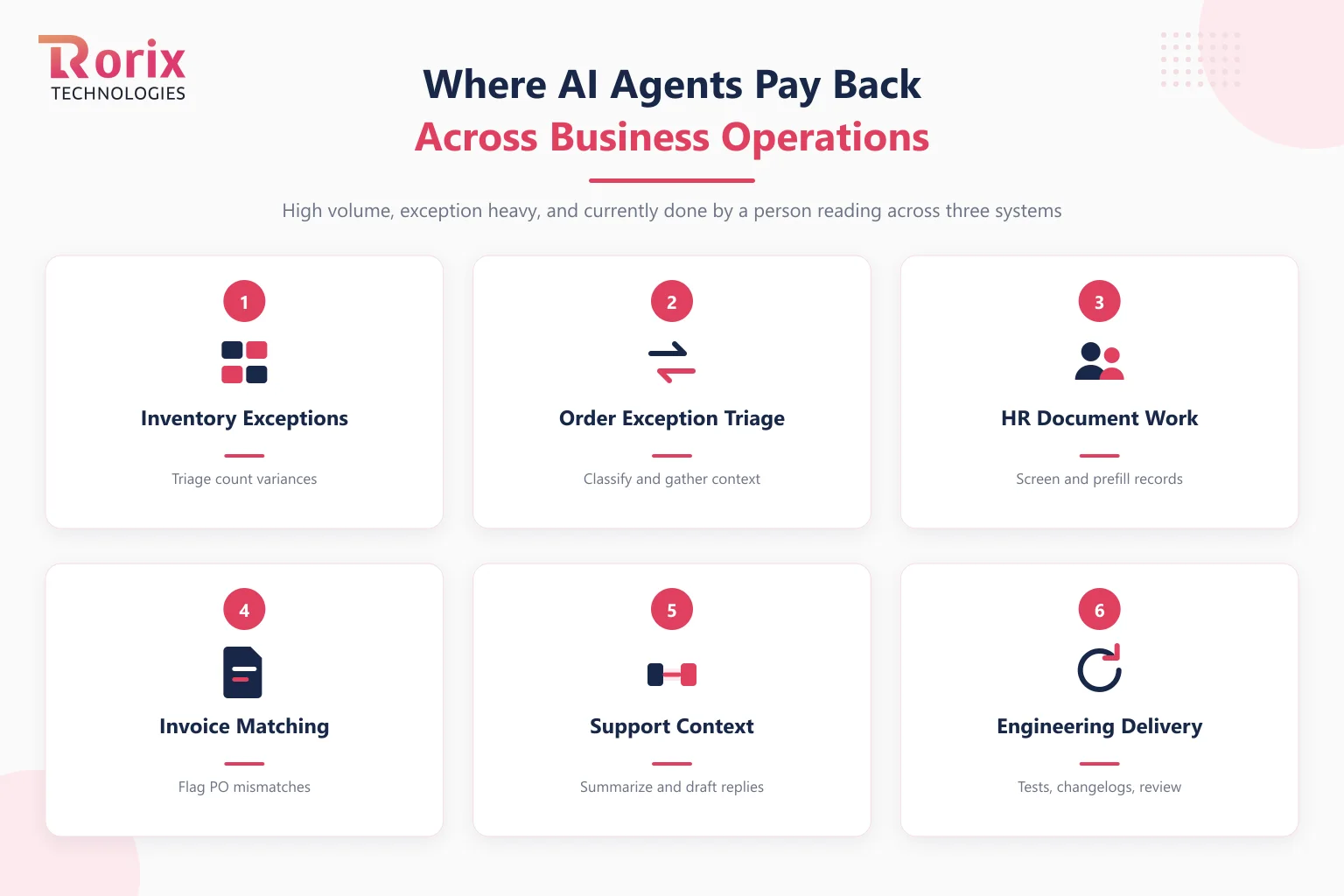
| Operation | Agent Task | Systems Connected | Human Checkpoint |
|---|---|---|---|
| Inventory and warehouse | Triage count variances, draft replenishment suggestions | WMS and inventory ledger | Approve stock writes, resolve physical discrepancies |
| Order management | Classify exceptions, gather context across systems | Order management system, ERP, carrier APIs | Release holds, issue credits, contact the customer |
| HR operations | Screen documents, prefill onboarding records | HRMS and document storage | Hiring calls, policy exceptions, anything about pay |
| Finance and procurement | Match invoices to POs, flag mismatches | ERP and accounts payable | Approve payment, write off a variance |
| IT service desk | Classify tickets, gather logs, draft a fix | Help desk and monitoring tools | Production changes and access grants |
| Customer support | Summarize history, draft a reply, propose routing | Help desk, CRM, and order history | Sending anything to a customer on a sensitive thread |
| Engineering delivery | Draft tests, changelogs, and first-pass code review | Code repository and CI pipeline | Merging, releasing, touching production |
The pattern across every row: the agent does the gathering, the drafting, and the classifying. The write that costs money if it is wrong stays behind a human approval.
HR Operations Document Work
Screening submitted documents, checking completeness, prefilling onboarding records, and chasing what is missing are bounded, repetitive, and low-risk when the agent only drafts. Anything touching compensation, performance, or a policy exception should never be inside an agent's write scope, regardless of what the model can do.
Invoice and Purchase Order Matching
Three-way matching is the textbook case: high volume, clear inputs, verifiable output, and an obvious human checkpoint at payment approval. The agent flags the mismatch and explains it. A person decides whether to pay.
IT Service Desk Triage
Password resets, access requests, and alert noise fill the IT queue. An agent can classify each ticket, pull the relevant logs, and draft a fix or a runbook step. Access grants and production changes stay with a person.
Customer Support Context Assembly
Summarizing the account history, retrieving the relevant order, and drafting a reply for a support rep to edit. The measurable win is handle time, not deflection, and the guardrail is that nothing reaches a customer on a sensitive thread without a person sending it.
Engineering Delivery Tasks
Test drafting, changelog generation, and first-pass review. Worth noting given the survey data above: this is the area where the technology is most used and still least trusted, which is a useful calibration for how much oversight the other areas deserve.
AI Agents in Warehouse and Order Operations
Warehouse and order work suits agents because exceptions are frequent, data is event-based, and every write can be checked. The agent needs live stock data to reason from, which our real-time inventory architecture guide covers. If your current system cannot expose clean tools, a custom WMS built API-first gives the agent something safe to call.
Inventory and Warehouse Exceptions
Cycle count variances, receiving mismatches, and short picks all follow the same path today: someone opens three screens, reconstructs what happened, and decides. An agent that assembles that reconstruction and proposes a category turns a fifteen-minute investigation into a thirty-second approval. The broader function-level view sits in our guide to AI in warehouse management, and the agent version depends on the same prerequisite: event-level history, not nightly snapshots, which is why event sourcing in warehouse systems tends to precede any of this.
Order Exception Triage
Held orders, address failures, payment mismatches, and partial shipments arrive as a queue that grows faster than headcount. An agent can classify each one, pull the customer and carrier context, and draft the resolution. The release itself stays human, because releasing a held order is a write with money attached.
Replenishment Alerts
An agent can watch pick-face levels against open orders and draft a replenishment task before a picker finds an empty slot. A supervisor approves the move, so no stock changes without a person.
Slotting Suggestions
Using pick history, an agent can propose moving fast-moving SKUs closer to pack stations. It suggests the move and the reason. The warehouse team decides when to run it.
Carrier Issue Resolution
Failed labels, missed pickups, and tracking gaps pile up at the dock. An agent can pull the shipment, carrier status, and order context, then draft the fix or the customer note. A person approves anything that changes cost or delivery promises.
AI Agents for Operations Management: Architecture
An operations agent has five parts. Make each one explicit, and the agent becomes something you can govern.
- Triggers: An event starts each run, such as a new exception in the queue, a failed scan, or a scheduled check.
- Tools: Narrow, validated functions the agent may call, such as reading an order or drafting a stock adjustment. Many teams expose them through the open Model Context Protocol (MCP) or a model provider's tool-calling API.
- Data access: Read access to the records the task needs, and write access only through approved tools.
- Memory: Run history and case notes stored in your own system, not inside the model.
- Human approval steps: Checkpoints where a person accepts, edits, or rejects a proposed write before it lands.
Why an Agent System of Record Matters
An agent is only as reliable as the data it reads and the place it writes. A system of record is the one agreed source for each fact, such as stock on hand or an order's status. When the agent reads from it and writes back through validated tools, every action is traceable and reversible. When facts sit in systems that disagree, the agent spreads the disagreement faster.
Also Read: SaaS Product Development: The Complete Guide From Idea to Launch (2026)
Risks, Guardrails and Human-in-the-Loop
An agent without these is a prototype, whatever the demo showed. Each guardrail is an engineering artifact, not a policy document.
1. A Written Tool Scope
Enumerate every function the agent can call and every table it can write to, and default everything else to unavailable. Read access can be generous. Write access should be a short list that a reviewer can read in a minute.
2. Idempotent, Reversible Writes
Every action the agent takes needs an identity so a retry cannot double-post, and an inverse so a mistake can be undone without a database restore. Agents retry. If your write path assumes exactly-once delivery, an agent will find the day it is not true. This is the same discipline that makes message queue patterns for ERP integration safe, applied to a caller that improvises.
3. Approval Thresholds Tied to Value and Reversibility
Not a single on-off switch for autonomy. A rule that says the agent acts alone below a dollar threshold on reversible actions, proposes above it, and never acts alone on anything irreversible. Tune the threshold with evidence once you have a track record.
4. A Full Decision Trace
Every run should log the goal, the tools called, the inputs, the model output, and the person who approved it. You need this for debugging within the first week, and for audit within the first quarter. Teams that add tracing after go-live spend the intervening months unable to explain their own system.
5. A Kill Switch and a Monitored Evaluation Set
One flag that stops the agent without a deploy, plus a fixed set of real historical cases the agent is re-run against after every model or prompt change. Model behavior shifts under you; without a regression set you will not notice until an operator does.
How to Implement AI Agents in Operations: Step by Step
The sequence below assumes the objective is a working agent in production on one task, not a capability program. Anything broader is where the cancellation statistics come from.
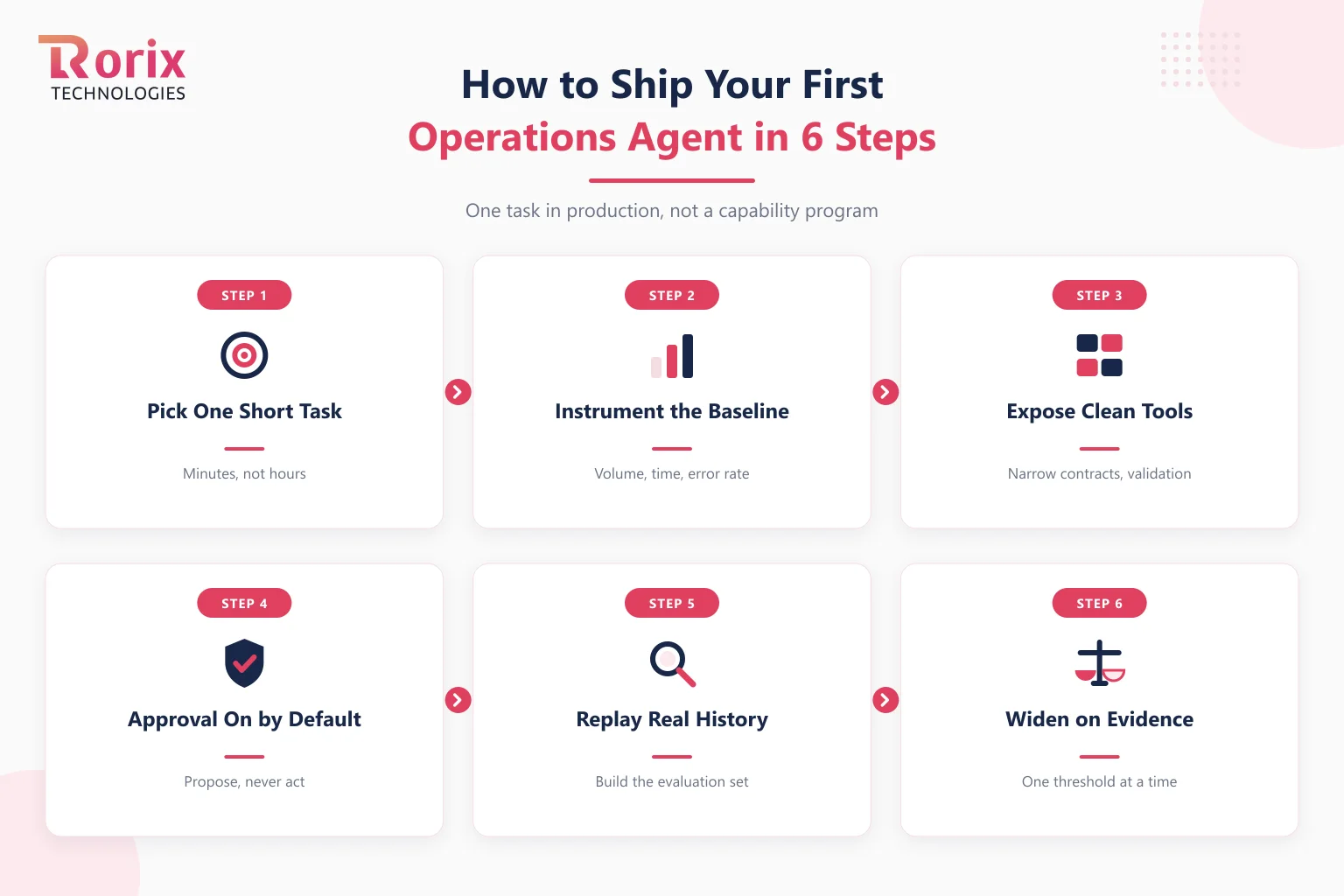
Step 1. Pick One Task a Person Finishes in Minutes
Choose a high-volume task with a clear input, a checkable output, and a person doing it today. Short duration is the selection criterion, for the reliability reasons above. Resist the process-shaped ambition; the process is a later composition of tasks you have each proven.
Step 2. Instrument the Baseline Before You Build
Volume, handling time, error rate, and rework, measured over a window long enough to cover a normal month. This is the cheapest step and the most commonly skipped, and without it the agent's fate depends on whoever argues most confidently in the review.
Step 3. Expose the Tools the Agent Will Need, Cleanly
An agent is limited by its tools, so this step is usually the real engineering. Each tool needs a narrow contract, validation at the boundary, and predictable errors. Where the underlying system cannot expose its own data reliably, that is a legacy modernization question surfacing early, and it is better to know now.
Step 4. Build It With Approval Switched On by Default
Ship the first version proposing, never acting. Operators accept, edit, or reject with a reason. You get adoption, an audit trail, and a labeled dataset of exactly where the agent is wrong, all from the same control, and that dataset is what justifies widening autonomy later.
Step 5. Run It Against Real History Before Real Traffic
Replay the agent over cases from the last quarter where you already know the right answer. Cases the agent gets wrong become your permanent evaluation set. This is where you find the confident-but-wrong failures, and finding them here costs nothing.
Step 6. Widen Autonomy on Evidence, One Threshold at a Time
Compare against the Step 2 baseline. If the accept rate holds above your bar for a sustained period, raise the auto-approval threshold on the reversible, low-value end and measure again. If it does not, the honest answer may be that the task belongs to a rule rather than an agent, which is a good outcome found cheaply.
What Does It Cost to Run an Operations Agent?
The cost structure is predictable, and it is weighted almost the opposite of what most budgets assume. Inference is the line everyone models and the one that usually matters least. Four lines matter more.
Tool and Integration Engineering
Tool and integration engineering is normally the largest build cost. You are not paying for intelligence, you are paying for clean, safe, well-validated access to systems that were never designed to be called by something that improvises.
Evaluation Infrastructure
Evaluation infrastructure is the line nobody quotes: the harness, the historical case set, and the regression runs. Skip it and you save real money right up until a model update changes behavior silently.
Human Oversight
Human oversight is a running operational cost during the approval phase, and it should be modeled as such rather than treated as temporary. It falls as autonomy widens, but it does not go to zero on anything that writes to a system of record.
Ongoing Accuracy Work
Ongoing accuracy work behaves like the 15% to 25% annual maintenance you already budget for software rather than like a one-time purchase, because prompts, tools, and models all drift.
We do not publish a single number for agent work, because the honest answer is set almost entirely by the state of your systems rather than by the agent. Two companies asking for the same agent can be a month apart or a year apart, depending on whether one source of truth already exists. For the underlying build economics, our custom software development cost guide covers the full stack, and the project cost estimator will scope your specific case. If the question is still whether to build at all, the build versus buy framework is the earlier decision.
How to Test an Agent Vendor's Autonomy Claims
Given Gartner's agent washing finding, these six questions do more work than any capability deck. They are designed so that a team who has run this in production answers them immediately, and a team who has not, cannot.
- "Show me the tool list and the write scope." A real agent has an enumerable set of callable functions. If the answer is a description of what it can understand rather than a list of what it can call, you are looking at a chatbot with a project plan.
- "What is the average number of steps per run, and what is your per-step success rate?" Anyone running agents in production knows both. The product of those two numbers is the honest end-to-end reliability, and the arithmetic is rarely as good as the headline.
- "What happens on step four when step three returned something wrong but well-formed?" You want to hear about validation at the boundary and a checkpoint, not about the model being smart enough to notice.
- "How do you know a model update did not change behavior?" The answer is an evaluation set and a regression run. Any other answer means they find out from your operators.
- "Show me the decision trace for a run that went wrong." Real systems have these and teams are usually glad to show one. Hesitation here is the most reliable single signal in the conversation.
- "What did the process cost before, and what does it cost now?" A specific baseline and a specific after. Vendors who have delivered value can produce both numbers; the 40% that get canceled never had the first one.
Also Read: Top 16 Enterprise Software Development Companies in 2026
Why Rorix Builds Agents Into the System of Record
Rorix Technologies builds the operational platform first, because an agent is only as good as the tools and the truth underneath it. We deliver custom WMS, HRMS, ecommerce, and SaaS platforms with event-level data and integration depth designed in from the start, then add the agent layer where the volume and the error rate say it will pay back.
- Tools before autonomy: clean APIs, validated write paths, and one source of truth, so the agent has something safe to call.
- Operations depth: warehouse, order, HR, and SaaS workflows built around how the work actually runs. One white-label SaaS platform we built for a home-services company runs 40+ integrations.
- Delivery you can watch: a retainer model in 2-week sprints with full task visibility. A dedicated team of senior engineers with a named technical lead stays on the product past go-live.
- A verifiable record: 27 projects delivered and a 5.0 rating on Clutch, with clients in the US, UK, Canada, Australia, and New Zealand.
- Honest scoping: we build application software, and we will tell you when the answer is a workflow rule or a better pipeline rather than an agent, including when that means a smaller engagement.
Our software development process covers how an engagement runs end to end. Book a free consultation, and we will map which task in your operation is short enough to hand over first.
Agents Reward Short Leashes and Clean Tools
The teams getting value from agents are not the ones with the most ambitious autonomy roadmap. They picked one task a person finishes in minutes, exposed the tools properly, shipped it proposing rather than acting, and widened the leash only when the accept rate earned it.
That approach survives the thing every other approach breaks on: reliability compounds downward across steps, and no amount of model progress removes the arithmetic. It only moves where the cliff sits. Build so that moving the leash is a policy change rather than a rewrite, and each new model release makes your system better instead of obsolete.
Start with the task, not the process. Instrument the baseline before you build anything. Keep the write scope short and the trace complete, and let the accept rate decide what the agent earns next.
Deciding what is feasible on your current stack is the first stage of our AI integration services. Ready to scope one? Talk to our engineers about the task you would hand over first, and we will tell you honestly whether it needs an agent or a rule.
Frequently Asked Questions
What are AI agents for business operations?
They are software systems that take an operational goal, decide their own sequence of steps, call your tools and systems to carry them out, and loop until the work is done. The difference from workflow automation is that nobody wrote the sequence in advance; the model chooses it at run time, which is the source of both the flexibility and the risk.
How is an AI agent different from RPA or a workflow rule?
A workflow rule fires on a fixed condition and RPA replays recorded clicks, so both are predictable and both break on anything unusual. An agent decides which tools to call for this specific case, which lets it handle the exception long tail that breaks rules, at the cost of needing guardrails that rules never needed.
What is the difference between an AI agent and a chatbot?
A chatbot answers questions in a conversation. An AI agent takes actions: it calls your systems, updates records, and loops until a task is done. That is why an agent needs guardrails that a chatbot never did.
Which operations should we automate with AI agents first?
Start with one high-volume task a person finishes in minutes, with a clear input and a checkable output. Order exception triage, invoice matching, and inventory variance checks are common first picks.
How do we keep data secure with AI agents?
Give the agent read access only to the records it needs and write access only through approved tools. Log every run, keep sensitive fields such as pay out of scope, and review what data reaches the model provider.
Can AI agents integrate with our ERP, WMS, or HRMS?
Yes, through their APIs. The agent calls narrow, validated tools that read and write each system, and a message queue protects writes when a system is offline. If a system has no usable API, fix that first.
How much does it cost to build an AI agent?
There is no reliable single market range, because integration work sets most of the cost, not the model. Budget for tool engineering, evaluation, human review, and 15% to 25% a year in upkeep. Our guide to custom software development cost covers the build economics.
Should we build or buy an AI agent?
Buy when a packaged agent already fits a standard workflow, such as support ticket routing. Build when the agent must act inside your own WMS, HRMS, or order system, because the value sits in those tools and rules.
How do we measure whether an operations agent worked?
Compare against a baseline captured before the build: volume, handling time, error rate, and rework. After launch, track the operator accept rate, the edit rate, and the reasons attached to rejections, since those tell you where the agent is wrong and whether it has earned a wider write scope.
Adding AI to a system that already runs the business?
Most of the work sits in the data plumbing rather than the model. Send us the workflow you want to automate and we will tell you what is feasible on your current stack.
Continue learning
Written by
Renish DadhaniyaFounder & Director, Rorix Technologies
Renish co-founded Rorix Technologies and drives the engineering and delivery culture across the organization. Beyond engineering, he leads the company's sales, finance, and HR operations, building the infrastructure that lets the team focus on shipping quality software. With deep hands-on expertise in architecture and team building, he ensures every project lands on time to the quality standards clients demand.
View full profileRelated articles
How to Add AI to Existing Software: What Your System Will Let You Do
How to add AI to existing software: the four insertion points, whether your system can emit what a model needs, shadow mode, and when to modernize first.
Read article
AI-Enabled Business Systems: How to Build One That Pays Back
AI-enabled business systems explained: the six layers, where AI pays back by function, a data readiness checklist, six build steps, and the real cost drivers.
Read article
AI in Warehouse Management: 8 Use Cases That Actually Pay Back
AI in warehouse management explained: 8 proven use cases, the payback signal for each, a readiness checklist, and how to start without a science project.
Read article