
AI in Warehouse Management: 8 Use Cases That Actually Pay Back
AI in warehouse management explained: 8 proven use cases, the payback signal for each, a readiness checklist, and how to start without a science project.
On this page31 sections
Every warehouse software vendor now has "AI" on the homepage. Far fewer can tell you, in plain numbers, what it will do for your pick rate, your stock accuracy, or your labor bill.
That gap matters, because the money is real on both sides. McKinsey's State of AI research finds 88% of organizations now use AI in at least one business function, yet most are still stuck between pilot and payback. Warehouses are no exception.
This guide is the operator's version of AI in warehouse management: the eight use cases that consistently earn their keep, the signal that tells you each one is working, and the order of operations that keeps you out of science-project territory. It comes from what our WMS engineering team sees when these features meet a real floor.
In this guide, you'll learn:
- What AI actually means inside a warehouse management system
- The 8 use cases with a track record of paying back
- The readiness checklist to run before you spend anything
- A 5-step sequence for bringing AI onto your floor
- What the investment looks like and where the costs hide
- How to judge vendor AI claims before you sign
By the end, you'll know which use cases fit your operation, which to run first, and how to measure whether the system is earning its keep.
Quick Answer: Where AI in Warehouse Management Pays Back Fastest
The short version: AI pays back fastest where your warehouse already generates clean data and a human is currently making the same decision over and over. The table below is the map; the rest of the guide is the detail.
| Use case | What it does | The payback signal |
|---|---|---|
| Demand forecasting | Predicts what you will sell, by SKU and season | Fewer stockouts and less dead stock |
| Dynamic slotting | Moves fast-movers into easy-reach locations | Shorter pick paths, more picks per hour |
| Task orchestration | Resequences work as conditions change | Fewer missed cut-offs, less supervisor replanning |
| Vision quality control | Inspects items and parcels with cameras | Fewer claims and wrong-item shipments |
| Anomaly detection | Flags count drift and unusual movements | Shrinkage caught in days, not at stocktake |
| Predictive maintenance | Predicts equipment failure before it happens | Less unplanned downtime |
| Labor forecasting | Matches staffing to predicted volume | Lower overtime, steadier throughput |
| Operations copilot | Answers questions from live warehouse data | Faster decisions, fewer report requests |
Key Takeaways: Where Warehouse AI Actually Pays Back
- AI in warehouse management is the decision layer over a WMS, not the robots: machine learning that forecasts demand, volume, or failure, optimization engines that decide slotting, routing, and task order, and language models that let a team query live operations in plain English.
- McKinsey's State of AI research finds 88% of organizations now use AI in at least one business function, yet most are still stuck between pilot and payback.
- Zebra's Warehousing Vision Study finds 63% of warehouse leaders planning to bring AI into their operations within five years.
- The eight use cases with a track record of paying back are demand forecasting, dynamic slotting, task orchestration, vision quality control, anomaly detection, predictive maintenance, labor forecasting, and an operations copilot, and each replaces a repeated human judgment with a number you can check.
- Under a few hundred orders a day, disciplined process usually beats a model on ROI, and the recurring cost of a model behaves like the 15% to 25% annual maintenance already budgeted for software.
What Does AI in Warehouse Management Actually Mean?
AI in warehouse management means software that learns patterns from your operational data and either makes a prediction or takes an action a person used to handle. It is not the robots themselves. It is the decision layer that tells people and machines what to do next.
In practice that covers three things. Machine learning models that forecast demand, volume, or failure. Optimization engines that decide slotting, routing, and task order. And, most recently, language models that let your team query live operations in plain English instead of pulling reports.
None of it works without a foundation: a warehouse management system feeding it accurate, real-time data. A model trained on a stock count that is 12% wrong will confidently make 12%-wrong decisions, faster than any human could.
The 8 AI Use Cases That Actually Pay Back
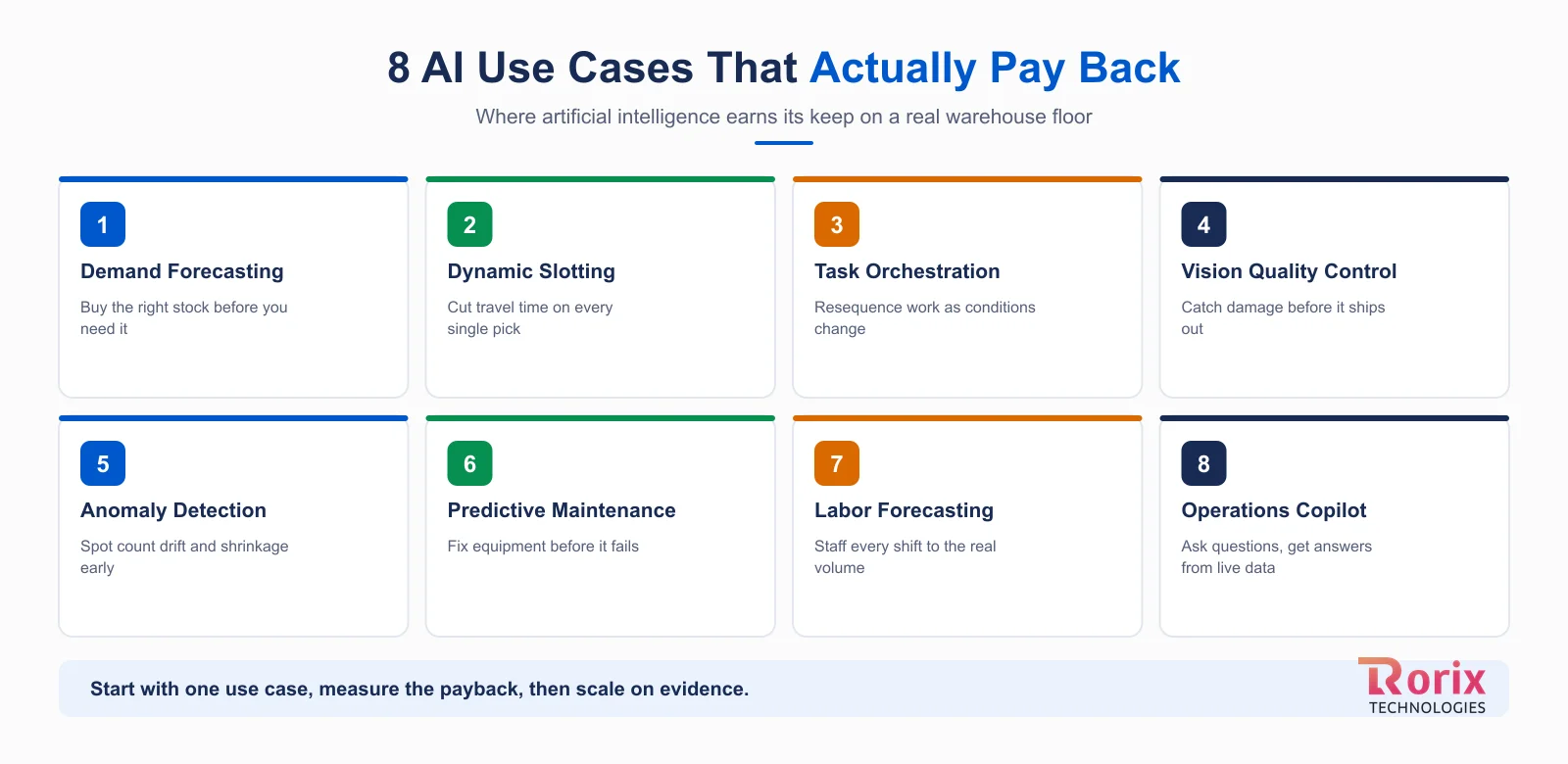
Each use case below earns its place the same way: it replaces a repeated human judgment with a faster, more consistent one, and it produces a number you can check.
1. Demand Forecasting and Smart Replenishment
The model reads your sales history, seasonality, and promotions, then predicts demand at SKU level and triggers replenishment before you run short. It beats spreadsheet forecasting because it updates continuously and catches patterns a planner cannot hold in their head. The payback shows up as fewer stockouts on bestsellers and less cash buried in slow movers.
2. Dynamic Slotting Optimization
Static slotting decays: what was a fast-mover in March is aisle filler by September. AI-driven slotting re-scores every location against current velocity and re-slots continuously, so pickers walk less every single shift. Watch picks per labor hour: if slotting is working, that number moves within weeks.
3. Intelligent Task Orchestration
This is the decision layer that sequences work in real time: which task, which picker, which zone, right now. It absorbs the constant replanning your supervisors currently do by hand, and it reacts to a blocked aisle or a rush order in seconds. It is the same territory a warehouse execution system covers. Our WES vs WMS guide explains where that layer sits and when you need it.
4. Computer Vision Quality Control
Cameras at pack stations and dock doors verify items, count quantities, and flag damage automatically. Vision QC catches the errors scanning cannot: the right barcode on a crushed box still ships without it. The payback lands in fewer customer claims and less rework on returns.
5. Inventory Anomaly Detection
Instead of finding shrinkage at the annual stocktake, anomaly models watch every movement and flag the patterns that do not fit: counts drifting in one zone, an unusual adjustment pattern, a location that keeps going wrong. You investigate in days, while the trail is warm, rather than months later when it is a write-off.
6. Predictive Equipment Maintenance
Conveyors, sorters, and forklifts telegraph failure before they fail, in vibration, temperature, and cycle data. Predictive models read those signals and schedule maintenance before the breakdown, not after. Every hour of unplanned downtime you avoid during peak is the ROI case.
7. Labor Forecasting and Shift Planning
Volume is predictable more often than it feels on the floor. AI forecasts orders by day and hour, then builds staffing plans to match, so you stop paying overtime to recover from understaffed mornings. Compare planned versus actual labor cost per order before and after. That is the whole scorecard.
8. The Operations Copilot
The newest arrival: a language-model layer over your live warehouse data. Your manager asks "which orders are at risk of missing today's cut-off?" and gets an answer in seconds, without a report request or a SQL query. It pays back in decision speed, and it only works if the underlying data is live and trustworthy.
Also Read: WES vs WMS: Key Differences and Which One Your Warehouse Needs
Are You Ready for Warehouse AI? The Honest Checklist
The industry is moving: Zebra's Warehousing Vision Study finds 63% of warehouse leaders planning to bring AI into their operations within five years. But planning to adopt and being ready to benefit are different things. Run this list first:
- Your inventory records are accurate. If your WMS and your shelves disagree, fix that first: real-time inventory tracking is the foundation every model stands on.
- You have a WMS producing event data. Scans, movements, timestamps. No event stream, nothing to learn from.
- You have one measurable problem. "We miss cut-offs on Mondays" is a use case. "We should do AI" is a budget leak.
- Someone owns the number. A named person who will compare before and after, and is allowed to say it did not work.
- Your volumes justify it. Under a few hundred orders a day, disciplined process usually beats a model on ROI.
Three or more gaps? Spend the budget on the foundation first. That money comes back regardless of what you do about AI later.
How to Bring AI Into Your Warehouse in 5 Steps
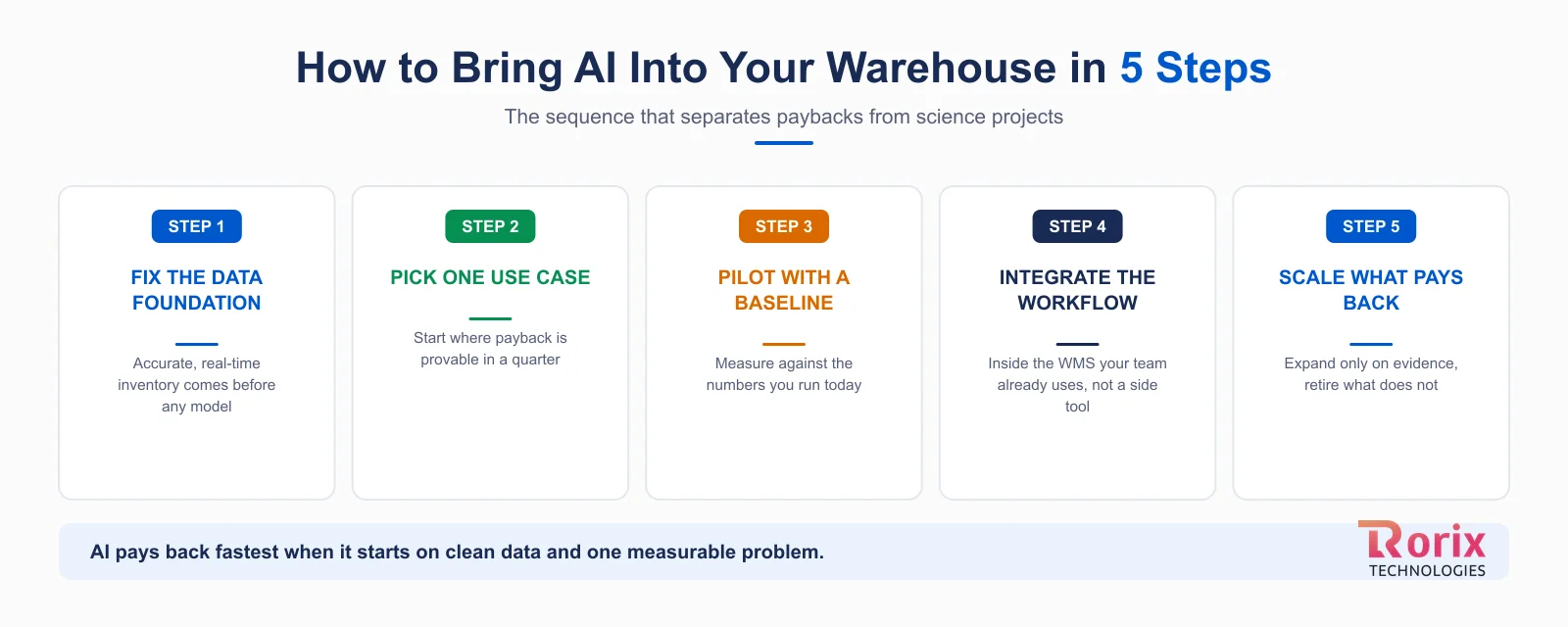
The failed projects almost all make the same mistake: they start with the technology and go looking for a problem. This sequence runs the other way.
Step 1. Fix the Data Foundation
Accurate, real-time inventory and a clean event stream come before any model. If this is not true yet, it is the project, and it pays back on its own, model or no model.
Step 2. Pick One Use Case
Choose the use case that maps to your most expensive repeated decision, from the eight above. One. The portfolio approach is how pilots multiply and payback never arrives.
Step 3. Pilot With a Baseline
Write down today's number first: picks per hour, stockout rate, overtime spend. Run the pilot against that baseline for a defined window. No baseline, no verdict.
Step 4. Integrate Into the Workflow
The model's output has to land inside the WMS screens and scanners your team already uses. A separate dashboard nobody opens is where warehouse AI goes to die.
Step 5. Scale What Pays Back
Expand the use case that beat its baseline; retire the one that did not. Evidence, not roadmap enthusiasm, decides what gets funded next.
What AI in the Warehouse Actually Costs
There is no honest single number, but the cost structure is predictable. You pay in three places: the data foundation (WMS, integrations, and cleanup, which is the largest line if yours is weak), the AI capability itself (licensed as a module of your WMS, a third-party tool, or a custom model), and the integration work that puts predictions inside real workflows.
Two rules of thumb keep budgets honest. First, if your data foundation is weak, most of the first check goes there, and it should. Second, the recurring cost of a model (retraining, monitoring, tuning) behaves like the 15% to 25% annual maintenance you already budget for software, not like a one-time purchase.
For the underlying platform numbers, our WMS cost guide breaks down the full stack, and the project cost estimator will scope your specific case.
Why Rorix for AI-Enabled Warehouse Systems
Rorix Technologies builds custom WMS platforms with the data foundation AI depends on: real-time inventory, barcode scanning, and event-level tracking from day one. We have delivered 27 projects with a 5.0 rating on Clutch, including warehouse builds carrying 40+ integrations on a single platform.
That foundation-first approach is deliberate. We build the system of record, prove the data is trustworthy, then add the intelligence layer where your numbers say it will pay back: forecasting, slotting, orchestration, or a copilot over your live operations.
Most of this rides on the warehouse system underneath it, which is what we build: see custom WMS development. Book a free consultation, and we will map which of the eight use cases fits your floor, and which ones you should skip.
Warehouse AI Earns Its Place One Measured Decision at a Time
AI earns its place in a warehouse the same way any hire does: it takes over a repeated decision, does it faster and more consistently than before, and the number that proves it is visible to everyone.
Start with the checklist, not the technology. Fix the data, pick one expensive decision, baseline it, and let the evidence choose what scales. The operators winning with warehouse AI in 2026 are not the ones who bought the most models. They are the ones who can show you the before-and-after number for each one.
When you are ready, connect with our experts to scope the data foundation and the first use case worth funding.
Frequently Asked Questions
What is AI in warehouse management?
It is software that learns from your warehouse's operational data to predict or decide things a person used to handle: what to stock, where to slot it, which task runs next, when a machine will fail. It is the decision layer over your WMS, not the robots themselves.
Does AI replace a warehouse management system?
No. It depends on one. AI models learn from the event data a WMS produces and push decisions back into WMS workflows. Without that system of record underneath, there is nothing reliable to learn from and nowhere for the decisions to land.
Which AI use case should a warehouse start with?
Start where your most expensive repeated decision lives. For most operations that is demand forecasting or dynamic slotting, because both run on data you already have and produce a measurable number within weeks. Task orchestration pays back most in high-volume, multi-zone floors.
How much does warehouse AI cost?
It splits into the data foundation, the AI capability, and integration work. If your inventory data is weak, the foundation is most of the first investment, and it pays back on its own. Recurring model costs behave like standard software maintenance, around 15% to 25% annually.
Do small warehouses benefit from AI?
Below a few hundred orders a day, disciplined process and accurate inventory usually beat a model on ROI. The exception is demand forecasting, which can pay back at modest volumes because buying mistakes are expensive at any size.
How long does it take to see payback from warehouse AI?
A well-scoped pilot should show movement against its baseline within one quarter. Demand forecasting and slotting typically prove out fastest; vision QC and predictive maintenance need longer windows because the events they prevent are rarer.
What data does warehouse AI need?
Accurate, timestamped operational events: receipts, putaways, picks, packs, shipments, counts, and adjustments, all at SKU and location level. The cleaner and more real-time that stream, the better every model performs. Garbage in remains garbage out, just faster.
Can AI help with warehouse labor shortages?
Yes, in two ways. Labor forecasting matches staffing to predicted volume so the people you have are used well, and orchestration removes the constant replanning that burns supervisor hours. Neither adds headcount, but both raise throughput per person.
Costing a WMS build?
Send us your SKU count and daily order volume. You get back a scope and a number you can take to your CFO.
Continue learning
Written by
Renish DadhaniyaFounder & Director, Rorix Technologies
Renish co-founded Rorix Technologies and drives the engineering and delivery culture across the organization. Beyond engineering, he leads the company's sales, finance, and HR operations, building the infrastructure that lets the team focus on shipping quality software. With deep hands-on expertise in architecture and team building, he ensures every project lands on time to the quality standards clients demand.
View full profileRelated articles
WCS vs WMS: Which One Is Right For You In 2026
WCS vs WMS explained: what a warehouse control system actually does, the five differences that change your floor, real cost ranges, and which layer you need.
Read article
Warehouse Automation Cost in 2026: Complete Pricing Breakdown Guide
Learn how much warehouse automation costs, from basic scanning to advanced robotics. Explore pricing, software, integration, hidden costs, ROI, and TCO.
Read article
AI Agents for Business Operations: Use Cases, Architecture and Rollout
See how AI agents run business operations: use cases by team, warehouse and order workflows, architecture, guardrails, and a step-by-step rollout plan.
Read article