
Warehouse Automation Cost in 2026: Complete Pricing Breakdown Guide
Learn how much warehouse automation costs, from basic scanning to advanced robotics. Explore pricing, software, integration, hidden costs, ROI, and TCO.
On this page50 sections
A $340,000 warehouse automation quote does not always mean a $340,000 project.
Key Takeaways: What Warehouse Automation Really Costs
Warehouse automation can cost anywhere from $15,000 to $15M+, depending on the automation level, equipment, software, integrations, and facility requirements. This guide breaks down equipment and software costs, hidden expenses, five-year TCO, ROI, and payback periods. It also covers phased implementation so you can automate without overspending.
Software, system integration, facility upgrades, data cleanup, training, commissioning, and maintenance can push the final investment much higher. That is why understanding the real warehouse automation cost matters before you sign a vendor contract.
In 2026, warehouse automation can cost anywhere from $15,000 for basic scanning and inventory technology to $15M+ for advanced robotics and highly automated facilities.
If you are costing the software layer separately, see our guide to how much a warehouse management system costs.
Your actual warehouse automation cost depends on your warehouse size, order volume, product mix, automation level, software, integrations, and facility readiness.
In this guide, you'll learn:
- Warehouse automation cost by automation level and warehouse type
- WMS, WCS, WES, and integration costs
- Hidden costs that vendors may not include upfront
- Five-year TCO, ROI, and payback calculations
- How to phase automation and control your investment
- How to reduce warehouse automation cost
By the end, you will know what to budget and what to question in vendor quotes. You will also know how to pick a strategy that delivers real value.
Quick Answer: Warehouse Automation Cost at a Glance
Warehouse automation ranges from about $15,000 for basic scanning to $15M+ for advanced robotics. Most growing warehouses spend $90,000 to $900,000 on a first meaningful phase, depending on operation type.
| Level | Typical Cost | Payback | Best Fit |
|---|---|---|---|
| Basic | $15K-$120K | 6-15 months | Paper-based operations |
| System | $75K-$400K | 12-24 months | Growing 3PLs and sellers |
| Mechanized | $500K-$5M | 24-48 months | High-volume warehouses |
| Advanced robotics | $1M-$15M+ | 30-60 months | Large, stable operations |
Your final cost depends heavily on integration complexity and inventory data quality. More systems to connect and more data to clean usually mean higher implementation costs.
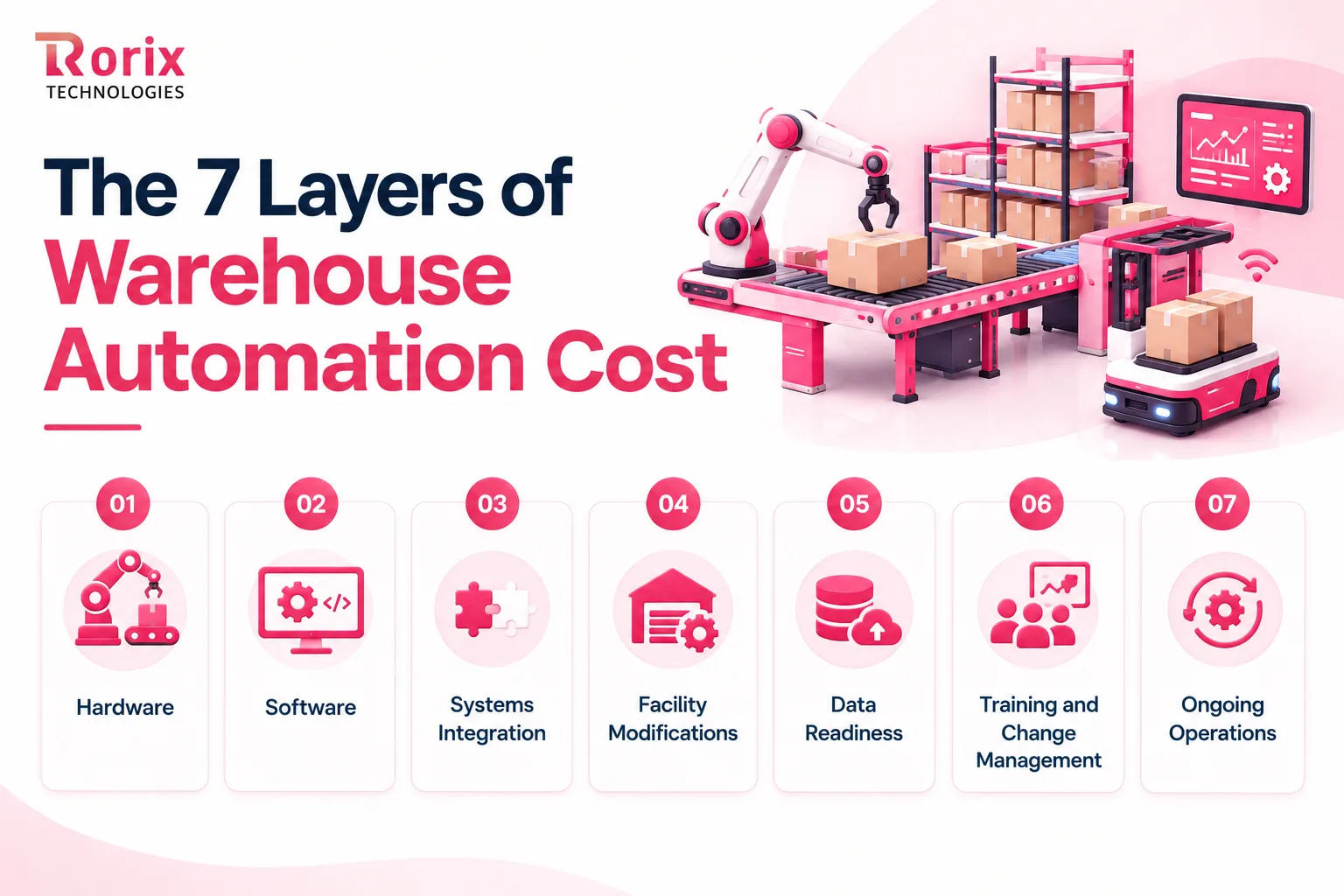
The 7 Layers of Warehouse Automation Cost
A warehouse automation quote is rarely one simple number. It usually covers seven cost layers, and the biggest budget surprises often come from the less visible ones.
1. Hardware
Robots, conveyors, cranes, scanners, and racking form the visible investment. Hardware typically accounts for 40-60% of project spend and is usually the easiest component to estimate accurately.
2. Software
Your WMS manages warehouse tasks, while WCS and WES coordinate equipment and workflows. The right software connects operations and automation, helping equipment deliver the speed and accuracy you expect.
3. Systems Integration
Automation must connect with your ERP, e-commerce platforms, carriers, accounting systems, and vendor APIs. These connections require engineering work, making integration one of the most underestimated project costs.
4. Facility Modifications
Automation may require level floors, reliable wireless coverage, additional power, and safety zones. Older facilities often need upgrades before equipment can be installed and operated safely.
5. Data Readiness
Automation depends on accurate SKU data, dimensions, weights, and location records. Incorrect or incomplete data must be cleaned and migrated before deployment, adding time and internal effort.
6. Training and Change Management
Employees need training on new workflows, interfaces, exception handling, and safety procedures. Initial training is only part of the expense, as new employees will require training after deployment.
7. Ongoing Operations
Maintenance, spare parts, software subscriptions, energy, and future expansion continue after launch. Annual maintenance can typically range from 8%-15% of hardware value, adding significantly to long-term costs.
Warehouse Automation Cost by Automation Level
Warehouse automation can range from simple scanning tools to fully integrated robotic systems. Each level increases the investment, but also the potential for higher productivity and throughput.
1. Basic Automation
Typical Cost: $15,000-$120,000 Typical Payback: 6-15 months
Basic automation focuses on improving data capture and inventory accuracy rather than automating physical movement. It typically includes barcode labels, RF scanners, mobile computers, and an entry-level WMS. It is a good starting point for warehouses moving away from paper and spreadsheets.
2. System Automation
Typical Cost: $75,000-$400,000 Typical Payback: 12-24 months
System automation moves warehouse decisions into software through a full WMS, directed picking, real-time inventory, and tools such as pick-to-light or short conveyor runs. It works well for growing 3PLs and multi-channel sellers that need better productivity and control before investing in heavy automation.
3. Mechanized Automation
Typical Cost: $500,000-$5 million Typical Payback: 24-48 months
Mechanized automation automates physical movement using conveyors, sortation, AS/RS, and goods-to-person systems. A WCS typically coordinates the equipment and workflows in real time. This level is best suited to high-volume warehouses with stable order patterns and predictable product movement.
4. Advanced Robotics and Full Integration
Typical Cost: $1 million-$15 million+ Typical Payback: 30-60 months
Advanced automation combines AMRs, autonomous forklifts, robotic picking, fleet management, and deep system integration. It is generally suited to large, stable operations where high throughput, scalability, and reduced manual movement can justify the higher investment and complexity.
If you are shortlisting build partners for the software layer, our guide on how to evaluate a warehouse management software development company covers the checks that matter.
Warehouse Automation Cost by Equipment Type
Equipment pricing depends on capacity, technology, and deployment size. These ranges provide a practical starting point for budgeting.
| Equipment | Typical Cost | Starting Deployment |
|---|---|---|
| Barcode labels & rack signage | $2-$40 each | $5K-$30K |
| RF scanners & mobile computers | $900-$3,500 each | $20K-$90K |
| Pick-to-light / put-to-light | $150-$400 per position | $40K-$200K |
| Voice picking | $1,500-$4,000 per user | $30K-$150K |
| AMRs | $15K-$50K each | $75K-$250K |
| Autonomous forklifts | $60K-$150K each | $300K-$600K |
| Conveyors | $150-$500 per linear foot | $100K-$800K |
| Automated sortation | Varies | $400K-$2M |
| AS/RS - Case handling | Varies | $1M-$5M |
| AS/RS - Pallet handling | Varies | $2M-$10M+ |
Remember that equipment quotes may exclude installation, software, integration, controls, and facility upgrades. Check these items before comparing vendors.
The Software Layer: What a WMS, WCS, and WES Actually Cost
Software can become a major part of your warehouse automation budget. The real investment may include WMS, WCS, WES, integrations, and robot fleet software, not just the software license.
| Software Type | Typical Cost | Implementation | Best For |
|---|---|---|---|
| SaaS WMS | $500-$2,000/month + $10K-$75K implementation | Faster deployment | Growing warehouses that want predictable costs |
| Licensed On-Premise WMS | $100K-$500K + annual support | 6-12 months | Businesses needing greater data control or customization |
| Configured Enterprise WMS | $250K-$1M | 6-18 months | Large operations with complex workflows |
| Custom-Built WMS | $70K-$250K+ | Depends on scope | Businesses needing highly customized workflows and integrations |
| Fleet & Control Software | $10K-$80K/year for fleet management | Depends on equipment | Warehouses using AMRs, robotics, WCS, or WES |
Important: The license price is only part of the investment. Implementation, integrations, customization, infrastructure, support, and ongoing development can significantly increase the total software cost. If a packaged platform cannot express your workflows, custom warehouse management software built around your operation is usually the honest comparison to run.
Integration Costs: The Line Item That Breaks Budgets
Integration can quietly push a project over budget. Warehouse automation cost depends not just on the equipment you install, but on how many systems need to work together.
A small warehouse with nine integrations can cost more than a larger warehouse with only two. That's why integration estimates can vary so widely between similar projects.
| System | Typical Cost | Build Time |
|---|---|---|
| ERP | $25K-$100K | 6-14 weeks |
| Ecommerce | $8K-$30K/channel | 2-5 weeks |
| Carrier & shipping APIs | $10K-$40K | 3-8 weeks |
| Accounting | $6K-$20K | 2-4 weeks |
| TMS | $20K-$60K | 5-10 weeks |
| Robot fleet APIs | $15K-$70K | 4-12 weeks |
| Barcode, RFID & scales | $5K-$25K | 2-6 weeks |
| EDI | $10K-$45K/partner | 3-8 weeks |
| Reporting & BI | $8K-$35K | 2-6 weeks |
The cost doesn't stop at implementation. ERP upgrades, API changes, firmware updates, and EDI changes can require ongoing testing and fixes. Plan for roughly 10%-20% of the original integration cost each year for maintenance.
Real-time integration costs more than batch processing, but delayed inventory data can cause stock errors and fulfillment problems. See our real-time inventory architecture guide for the trade-offs.
Warehouse Automation Cost by Operation Type
Warehouse size isn't the only cost driver. What you store, who you serve, and the rules you must follow can change the project significantly.
| Operation Type | Typical First Phase | Main Cost Driver |
|---|---|---|
| 3PL & multi-client | $120K-$450K | Client rules, billing, onboarding |
| Ecommerce & D2C | $90K-$350K | Channels, peaks, returns |
| Cold storage & food | $150K-$600K | Cold-rated hardware, traceability |
| Pharma & regulated | $200K-$750K+ | Validation, compliance, audit trails |
| Manufacturing & raw materials | $250K-$900K | Line integration, sequencing |
| Retail multi-site | $500K-$3M | Store count, sortation, cross-docking |
Now that you can see how the price shifts by operation type, let us put every layer together. Next, we look at what automation really costs across a full ownership cycle.
Total Cost of Ownership Across Five Years
The upfront quote is not the full bill. Warehouse automation cost becomes clearer when you calculate the five-year total cost of ownership (TCO).
For a mid-market ecommerce warehouse handling 3,000 orders/day and 12,000 SKUs, a WMS plus starter AMR fleet could look like this:
| Period | Hardware | Software | Integration | Facility & Data | Ongoing Ops | Cumulative Total |
|---|---|---|---|---|---|---|
| Year 1 | $210K | $95K | $85K | $60K | $18K | $468K |
| Year 2 | $0 | $42K | $22K | $0 | $46K | $578K |
| Year 3 | $65K | $48K | $28K | $8K | $58K | $785K |
| Year 4 | $0 | $52K | $18K | $0 | $64K | $919K |
| Year 5 | $40K | $56K | $20K | $5K | $70K | $1.11M |
| 5-Year Total | $315K | $293K | $173K | $73K | $256K | $1.11M |
Here's the surprise: hardware is only 28% of the five-year spend. Software, integration, and ongoing operations make up roughly 65%.
So don't compare vendors on equipment price alone. Check the five-year TCO, especially software fees, integrations, maintenance, and proprietary technology. Regulated operations run higher still, as our breakdown of the cost of warehouse management software in pharma shows.
Hidden Costs Most Automation Quotes Leave Out
A $340K project can become a $520K project when overlooked costs start adding up. Check these before you sign:
- Parallel cutover: Running old and new processes for 2-8 weeks can temporarily double operating costs.
- Peak-season staffing: If go-live falls near peak, you pay for temporary workers and overtime on top of the project budget. That protects service levels during the transition.
- Spare parts: Batteries, sensors, belts, and grippers wear out. Keep critical spares on-site to avoid costly downtime.
- Floor repairs: Uneven floors can delay robots. Resurfacing typically costs $3-$10 per square foot.
- Network upgrades: Racking can create wireless dead zones. A medium facility may need $5K-$30K in access-point upgrades.
- Extra licenses: Adding robots can also increase WMS, fleet-management, and control-system license costs.
- Data cleanup: Wrong SKU dimensions, weights, or locations must be fixed before go-live.
- Internal resources: IT, operations, and finance teams may spend months supporting the project. That opportunity cost still belongs in the budget.
Warehouse Automation ROI and Payback Period
A lower quote does not always mean better ROI. The right warehouse automation cost should be judged against the savings and capacity it creates.
1. Labor Savings
Labor is usually the biggest saving. An autonomous forklift can replace 2-3 operator roles, creating roughly $93,000 to $139,000 in annual labor value. A WMS with directed picking can also improve picker productivity by 25%-40% without adding robots.
2. Fewer Picking Errors
Mis-picks create costs through reships, refunds, returns, and lost customer trust. Scan validation at each picking step helps reduce these errors. A 2012 Intermec study of 250 supply-chain managers put the average mis-pick at about $22. That adds up to roughly $389,000 a year for a single distribution center.
3. More Storage in Less Space
Automation can reduce aisle space and use more vertical capacity. Recovering 30%-50% of storage capacity may delay or eliminate the need for a larger facility, creating significant savings on rent and expansion.
4. More Throughput Without More Staff
Automation helps warehouses handle volume growth without matching increases in headcount. If orders rise 40% while staffing stays flat, every avoided hire becomes part of the long-term return.
How to Calculate Payback
Use these two simple formulas to estimate how quickly your warehouse automation investment can pay for itself:
1. Annual Net Benefit
Annual Net Benefit = Labor Savings + Error Savings + Avoided Space Costs − Maintenance − Licensing.
2. Payback Period
Payback Period = Upfront Investment ÷ Annual Net Benefit
Example: If your upfront investment is $600,000 and your annual net benefit is $215,000:
$600,000 ÷ $215,000 = 2.79 years
That means your estimated payback period is approximately 33 months, which sits inside the 24 to 48 month range typical of mechanized automation.
You can also factor in soft savings such as lower product damage, fewer workplace claims, better accuracy, and easier peak-season staffing. These can potentially add another 15%-25% to the overall value of automation.
Want a project-specific figure? Use the project cost estimator for a number you can take to your CFO.
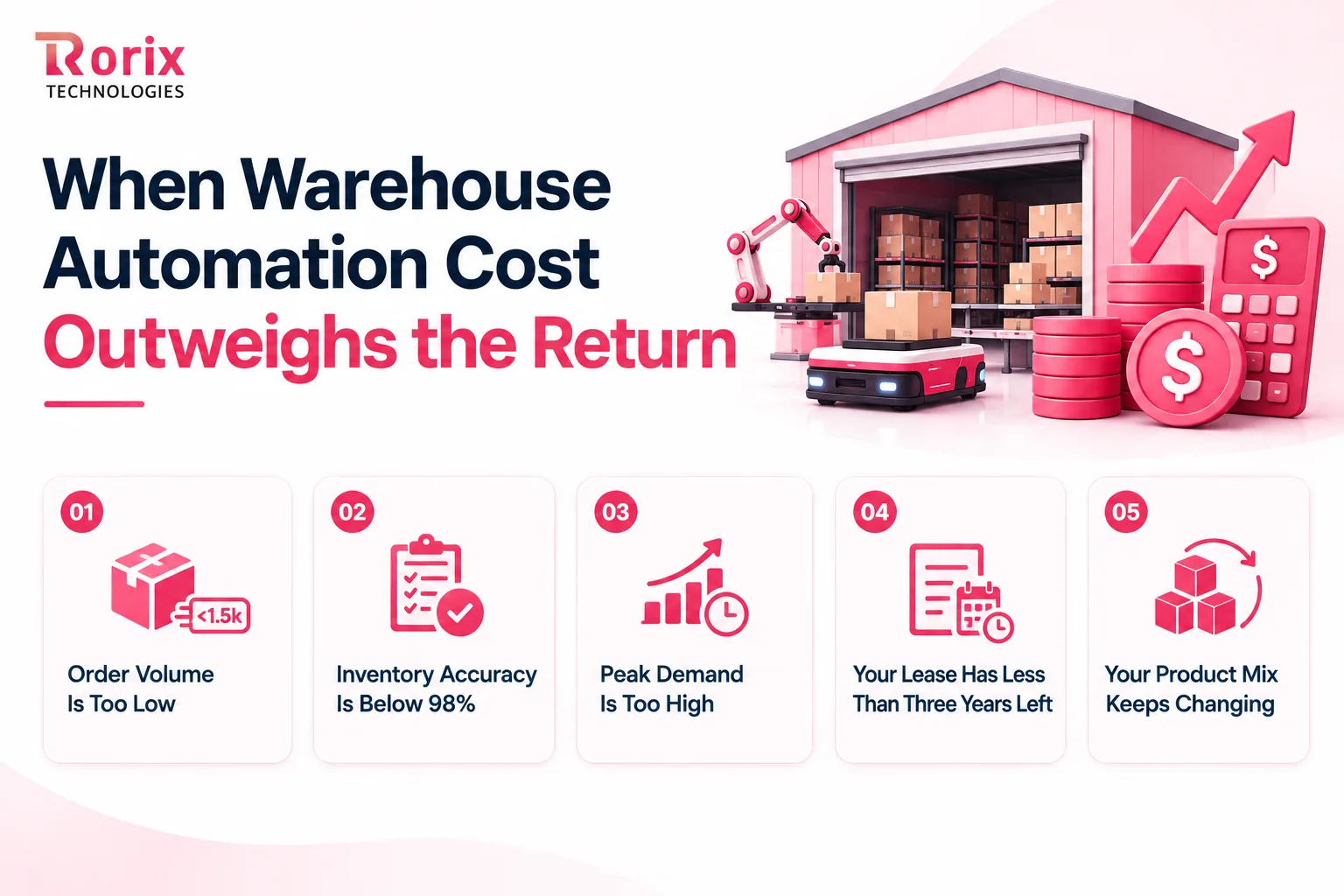
When Warehouse Automation Cost Outweighs the Return
Automation is not always the right answer. If your operation is not ready, the investment can make existing problems more expensive, not easier to fix.
1. Order Volume Is Too Low
Robotics usually make less financial sense below 1,500-2,000 orders per day, where utilization may be too low. At this volume, start with WMS, scanning, and process automation before investing in robots.
2. Inventory Accuracy Is Below 98%
Automation depends on accurate inventory data. If stock records are wrong, automated workflows can repeatedly send equipment to empty or incorrect locations. Fix inventory accuracy first.
3. Peak Demand Is Too High
If peak volume is three times your average but lasts only a few weeks, fixed automation may sit idle most of the year. AMRs, flexible automation, or seasonal labor may offer better economics.
4. Your Lease Has Less Than Three Years Left
Conveyors, sortation, and AS/RS are difficult and expensive to move. With a short lease, you risk paying for equipment you cannot fully recover. Portable automation and software are safer options.
5. Your Product Mix Keeps Changing
Automation works best when product size, weight, packaging, and handling requirements are stable. If these change every quarter, frequent reconfiguration can delay your return.
If two or more of these conditions apply, strengthen your software, data, and process layer first. These investments are cheaper, portable, and provide the foundation for future robotics.
A Phased Three-Year Warehouse Automation Budget Model
You don't need to automate everything at once. A three-phase approach lets you improve operations first, measure the results, and use that data to decide what to automate next.
| Phase | Timeline | What You Deploy | Spend | Main Return |
|---|---|---|---|---|
| 1. Data Foundation | 0-6 months | Barcode, RF scanning, core WMS, inventory accuracy | $60K-$180K | Better accuracy and visibility |
| 2. Directed Operations | 6-18 months | Directed picking, wave/batch logic, integrations, light mechanization | $120K-$400K | Higher productivity and lower overtime |
| 3. Physical Automation | 18-36 months | AMRs or goods-to-person, fleet management, WCS | $300K-$1.5M | More throughput and capacity |
Phase 1 covers data and scanning only. Phases 1 and 2 together run roughly $180,000 to $580,000.
The sequence matters. Phase 1 improves your data, Phase 2 shows where the real bottlenecks are, and Phase 3 automates the workflows that have proven value. This reduces the risk of buying more robots than you actually need.
Each phase should have a measurable target and clear ROI before funding the next one. This also gives leadership a stronger business case at every stage.
Getting each phase live smoothly is just as important as planning it. Our WMS implementation checklist covers the key deployment steps.
Now that the sequence is clear, let us look at the levers that reduce what you actually spend at every phase.
How to Reduce Warehouse Automation Costs Without Losing Capability
Lowering automation costs does not mean buying cheaper equipment. It means spending on the areas that create the most operational value.
- Start with software: Fix inventory accuracy and task logic before buying hardware. This helps you size equipment based on real needs.
- Pilot one costly workflow: Start with the process that has the highest labor cost or error rate. A focused pilot also makes integration issues cheaper to fix.
- Choose open APIs: Open APIs and documented SDKs reduce vendor lock-in and make future integrations easier and cheaper.
- Reuse existing equipment: Check whether your racking, scanners, and mobile computers can work with the new system before replacing them.
- Fix inventory accuracy first: Aim for 98%+ accuracy before automation. Clean data prevents costly problems after deployment.
- Use CapEx or OpEx strategically: Subscription models can protect cash flow, while upfront purchases may cost less over the full lifecycle. Choose based on your financial priorities.
- Check incentives: Look for automation, robotics, energy-efficiency grants, tax credits, and accelerated depreciation that can reduce the effective project cost.
Temperature-controlled operations carry extra constraints, which our guide to a warehouse management system for the food industry works through in detail.
CapEx vs OpEx: Automation Financing Models Compared
How you finance automation affects upfront cost, monthly payments, ownership, and maintenance risk. The best option depends on your cash flow, growth plans, and how much risk you want to carry.
| Model | Upfront Cost | Who Owns It? | Best For |
|---|---|---|---|
| Outright purchase | High | You | Stable operations with available capital |
| Equipment lease | Low | Lessor | Predictable volume and limited capital |
| Robots-as-a-Service | Minimal | Vendor | Robotics pilots and testing |
| Automation-as-a-Service | Minimal | Vendor | Fast scaling without major CapEx |
| Facility lease + automation | None | Landlord | New sites and network expansion |
| Vendor financing | Low-Moderate | You after term | Ownership without a large upfront payment |
| Hybrid: own software, subscribe hardware | Moderate | Split | Control plus hardware flexibility |
Subscription models can cost more over the full asset lifecycle, but they preserve cash for inventory, hiring, or expansion. For growing businesses, that flexibility can be more valuable than the lowest total purchase price.
The hybrid model is especially useful when software and data are strategically important. You keep control of your software while subscribing to hardware that can be replaced or upgraded as your needs change.
How to Compare Warehouse Automation Quotes Fairly
Two vendors can quote the same project and still differ by 40% because their scopes are different. Compare every quote against the same checklist before looking at the final price.
- What software and licenses are included? Confirm WMS, WCS, fleet software, users, devices, and license limits.
- Which integrations are included? Get a named list of ERP, ecommerce, carrier, EDI, and other integrations. Anything outside that list could become a change request.
- Who owns the integration code and APIs? Vendor-owned code can make switching platforms expensive later.
- Are site surveys included? Confirm whether floor, network, power, and site-readiness checks are part of the quote.
- What does maintenance cover? Ask for the annual percentage and confirm whether parts, labor, travel, and software updates are included.
- What will expansion cost? Ask the price to add five more robots or units, including hardware, licenses, and configuration.
- What uptime is guaranteed? Check the promised uptime and what compensation or remedy applies if it is missed.
- Who owns data migration and accuracy? Confirm who cleans and migrates your data and who is responsible if inaccurate records affect go-live.
- How much internal effort is required? Ask for the expected person-days from your IT, operations, and finance teams.
- What happens if you leave? Check data export, license termination, equipment resale, and platform-switching terms before signing.
Send the same questions to every shortlisted vendor and compare the answers side by side. Often, what a quote excludes tells you more than the headline price.
Why Rorix Technologies for the Software Layer of Your Automation Build
Great warehouse automation needs more than hardware. The software and integration layer determines how well your systems work together, scale, and adapt.
That is where Rorix Technologies stands out. We have delivered 27 software projects across the US, UK, Canada, Australia, and New Zealand, with a 5.0 Clutch rating.
Why businesses work with Rorix:
- Built for your workflow: Custom WMS, integrations, and operational software designed around your processes, not generic templates.
- Deep integration expertise: 40+ integrations on a single white-label SaaS platform we built for a home-services company, connecting the systems that operation depends on.
- Dedicated engineering team: Senior engineers, a named technical lead, and 2-week sprints with clear visibility into progress.
- Built for long-term growth: We support ongoing improvements, maintenance, and scaling, not just the initial launch.
- Proven operational impact: Our WMS solutions cut manual errors by 80% on a Lorecs warehouse build. Real-time inventory tracking, barcode scanning, and automated workflows made the difference.
- Accountable after go-live: The same team can continue improving your software as your warehouse and automation needs evolve.
Not sure what your automation project will actually cost?
Rorix Technologies can help you assess your requirements, map the software and integration needs, and estimate the right project scope.
Book a free consultation to understand your investment before you commit.
Conclusion: What to Budget Before You Sign
Warehouse automation cost is not just the equipment price. Software, integration, facility upgrades, maintenance, and ongoing operations can significantly change your total investment.
The smartest warehouses start with accurate data, identify their biggest bottlenecks, and automate in phases. This keeps spending controlled while allowing each stage to prove its value before the next investment.
We hope this guide helped you understand the real costs, ROI, and planning considerations behind warehouse automation. The right strategy is not about automating everything; it is about automating what creates the most value.
Ready to turn your automation plans into a practical project? Connect with our experts to scope your software, integrations, timeline, and next steps.
Frequently Asked Questions
How much does warehouse automation cost?
Warehouse automation cost ranges from about $15,000 for basic scanning to $15M+ for advanced robotics. Most growing warehouses spend $90,000 to $900,000 on their first meaningful phase, depending on operation type.
What is the most cost-effective way to start automating a warehouse?
Start with barcode labeling, RF scanning, and a WMS. This improves accuracy and productivity while creating the data needed for future automation.
How long is the payback period for warehouse automation?
Basic automation can pay back in 6-15 months, system automation in 12-24 months, and robotic systems in 24-60 months. Well-scoped projects often target 2-3 years.
Why can software add so much to an automation budget?
A project may require a WMS, WCS, or WES, fleet software, and multiple integrations. Each adds licensing, implementation, and ongoing maintenance costs.
How much does it cost to integrate automation with an existing ERP?
ERP integration typically costs $25,000-$100,000 and takes 6-14 weeks. Budget another 10%-20% annually for maintenance and system changes.
What does a fully automated warehouse cost?
A facility combining AS/RS, sortation, robotics, and full software integration can cost around $5M to $15M+. The final investment depends on capacity, equipment, facility, and integration requirements.
What hidden costs should you budget for warehouse automation?
Budget for facility upgrades, data cleanup, training, spare parts, network improvements, parallel operations, software licenses, and internal staff time. These costs can significantly increase the final project budget.
Can warehouse automation be implemented in phases?
Yes. A phased approach can start with WMS and scanning, move to directed operations, and then add AMRs, goods-to-person systems, or other physical automation. This reduces upfront risk and lets each phase prove its ROI.
Costing a WMS build?
Send us your SKU count and daily order volume. You get back a scope and a number you can take to your CFO.
Continue learning
Written by
Renish DadhaniyaFounder & Director, Rorix Technologies
Renish co-founded Rorix Technologies and drives the engineering and delivery culture across the organization. Beyond engineering, he leads the company's sales, finance, and HR operations, building the infrastructure that lets the team focus on shipping quality software. With deep hands-on expertise in architecture and team building, he ensures every project lands on time to the quality standards clients demand.
View full profileRelated articles
AI in Warehouse Management: 8 Use Cases That Actually Pay Back
AI in warehouse management explained: 8 proven use cases, the payback signal for each, a readiness checklist, and how to start without a science project.
Read article
How to Calculate WMS ROI: Complete Guide for 2026
Learn how to calculate warehouse management system (WMS) ROI with our step-by-step guide. Includes formulas, real examples, and a free ROI calculator tool.
Read article
IT Staff Augmentation Cost: What You Actually Pay in 2026
IT staff augmentation cost in 2026: real hourly rates, the fully loaded math against a US in-house hire, and the six cost lines no rate card shows you.
Read article