
IT Staff Augmentation Cost: What You Actually Pay in 2026
IT staff augmentation cost in 2026: real hourly rates, the fully loaded math against a US in-house hire, and the six cost lines no rate card shows you.
On this page29 sections
Ask what staff augmentation costs and you get an hourly rate. Ask what an in-house engineer costs and you get a salary. Those two numbers are not comparable, and almost every buying decision in this category is made by comparing them anyway.
The salary is roughly 70% of what the employee costs you, and the hourly rate is close to 100% of what the augmented engineer costs you. Comparing them directly understates your in-house cost by about a third before anyone has mentioned recruiting, ramp time, or the months a seat sits empty.
This guide does the arithmetic properly, in public. Every figure below is either from a primary source with a link or derived from one in a way you can check line by line. The IT staff augmentation cost that matters is cost per productive hour, and once you compute it on both sides, the decision usually stops being about rates at all.
In this guide, you'll learn:
- What staff augmentation actually costs per hour in 2026, by region and seniority
- What a US in-house developer costs per productive hour, with the math shown
- The 6 cost lines that never appear on a rate card
- Which pricing model (hourly, retainer, or fixed) costs less, and when
- When staff augmentation is genuinely more expensive than hiring
- How to compare two quotes so the cheaper one is actually cheaper
Quick Answer: What IT Staff Augmentation Costs in 2026
| What you are buying | Typical 2026 cost | What moves it |
|---|---|---|
| Offshore engineer (South Asia) | $20 to $30/hr | Complexity of the work, commitment length |
| Nearshore engineer (LatAm, Eastern Europe) | $30 to $85/hr | Seniority, time zone overlap |
| US in-house engineer, fully loaded | $100 to $150/hr | Location, benefits, utilization |
| Small augmented team (3 devs + PM) | $10,000/mo | Team size, duration commitment |
| Single dedicated developer | $3,500/mo | Complexity tier |
The spread between the first row and the third is the entire commercial case, and it is smaller than it looks once you account for management overhead on your side. The rest of this guide explains both ends of it.
Key Takeaways: The Real Math Behind Staff Augmentation Cost
- A US in-house developer costs about $106 per productive hour before overhead and $100 to $150 fully loaded, derived from the BLS median wage of $133,080, wages at 69.9% of total employer cost, and 1,800 productive hours a year.
- Clutch's software development pricing data puts most listed providers at $25 to $49 an hour, with Canada and Australia at $100 to $149 and the United States and Poland at $50 to $99.
- Accelerance's 2026 rate trends report benchmarks senior developers at $64 to $76 an hour in Central and Eastern Europe, $60 to $75 in Latin America, and $31 to $41 in Asia.
- Two staff augmentation quotes that differ by 40% on rate frequently land within 10% on total cost once both are normalized to cost per productive hour and modeled over 12 months.
- Rorix charges $20 to $30 an hour by complexity tier rather than seniority, or $3,500 per month for one dedicated developer and $10,000 per month for 3 developers plus a project manager, with commitment discounts of 5% at three months, 10% at six, and 15% at twelve.
What Is the Hourly Rate for IT Staff Augmentation?
Rates cluster by region far more tightly than by vendor. Clutch's software development pricing data puts most listed companies in the $25 to $49 per hour band, with providers in Canada and Australia at $100 to $149, the United States and Poland at $50 to $99, and India, Ukraine, Mexico, Spain, and the Philippines at $25 to $49.
Seniority moves the number inside those bands. Accelerance's 2026 rate trends report benchmarks senior developers at $64 to $76 an hour in Central and Eastern Europe and $60 to $75 in Latin America, with its senior figure for Asia lower at $31 to $41.
Our own published rate is $20 to $30 an hour, and it is priced by project complexity rather than by the seniority of the person assigned, which is a deliberate choice covered further down. If you want the full regional picture, our guide to nearshore versus offshore software development compares the trade-offs beyond price, and the cost of outsourcing software development breaks down project-level totals rather than hourly rates.
Rates are the starting point, not the answer. A senior engineer who ships in week two costs less in practice than a cheaper one who needs a quarter to become useful.
Why the Hourly Rate Is the Least Useful Number in the Comparison
Because it is the only number in the comparison that is complete.
When a vendor quotes $30 an hour, that $30 covers salary, benefits, payroll taxes, recruiting, equipment, workspace, sick days, vacation, training, the replacement if someone leaves, and the vendor's margin. When your finance team quotes a $133,000 salary, that number covers salary.
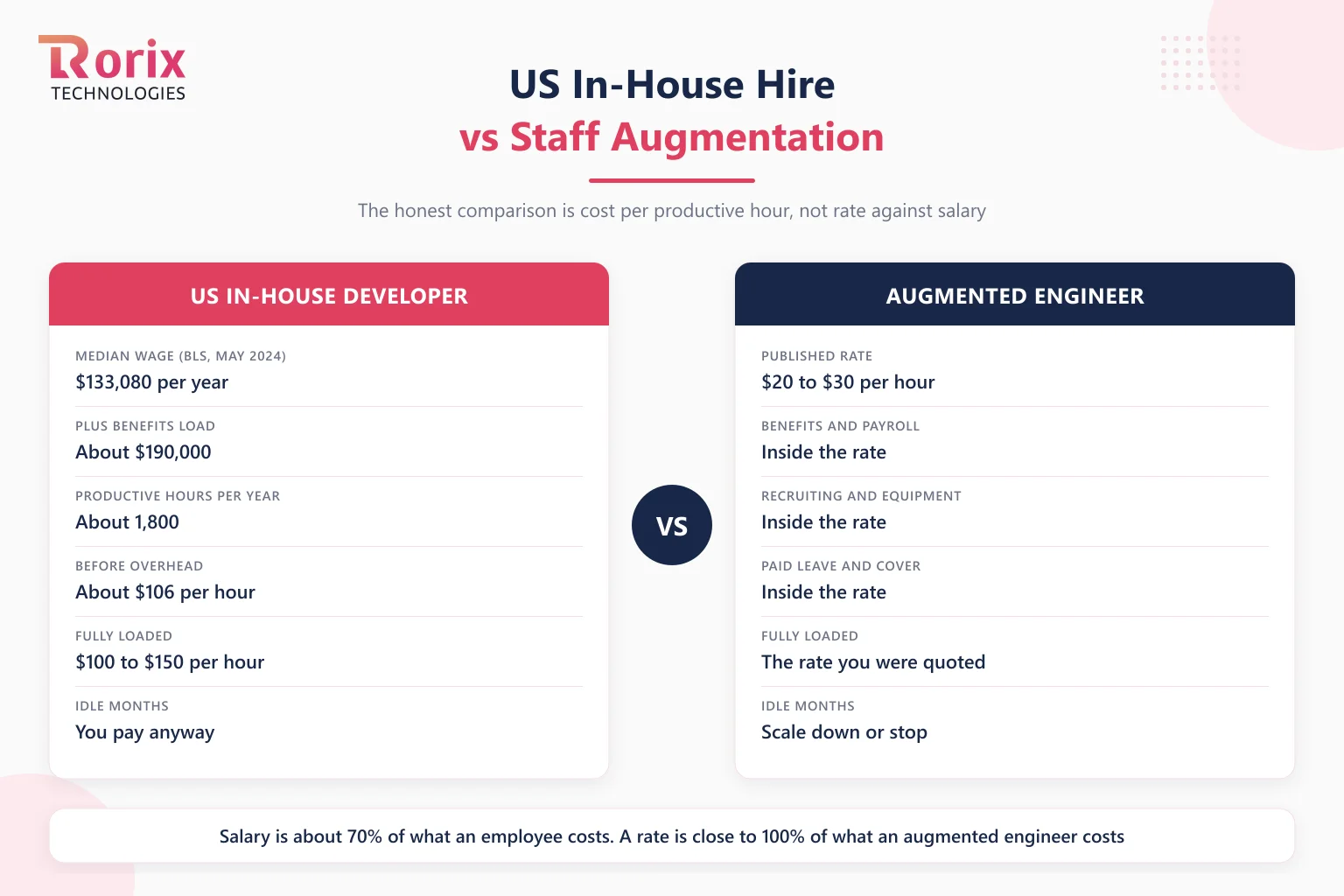
Every other line still exists. It has just moved somewhere less visible in your own budget. So the honest comparison is not rate against salary, it is fully loaded cost per productive hour against fully loaded cost per productive hour.
What Does a US In-House Developer Actually Cost Per Hour?
Around $106 an hour before overhead, and $100 to $150 once overhead is included. Here is every step of that calculation so you can substitute your own numbers.
Salary Is About 70% of the Real Cost
The US Bureau of Labor Statistics puts the median annual wage for software developers at $133,080 as of May 2024. That is the number that usually anchors the conversation, and it is the wrong one to stop at.
The BLS also tracks what employers pay beyond wages. Its Employer Costs for Employee Compensation release for March 2026 finds that for private industry workers, wages and salaries averaged $32.60 per hour worked and accounted for 69.9% of employer costs, while benefits averaged $14.01 per hour and made up the remaining 30.1%.
Apply that ratio to the median developer salary and the employer's cost is roughly $133,080 divided by 0.699, or about $190,000 a year, before anything that is not payroll. That ratio is the all-private-industry average rather than a software-specific one, so treat it as a close approximation: the same release shows benefit costs rising with wages, from $10.63 an hour at the median wage percentile to $29.31 at the 90th, which is the band most engineering salaries fall into.
Productive Hours Are Not 2,080
A full-time year is 2,080 scheduled hours. Nobody bills 2,080. Subtract around 15 days of vacation, 11 holidays, and a handful of sick days and you have removed roughly 210 hours. Take out internal meetings, training, and administration and 1,800 productive hours a year is a generous estimate for most teams.
That gives you $190,000 divided by 1,800, or about $106 per productive hour, and that figure still excludes recruiting, equipment, software licenses, workspace, and the management time the role consumes.
The Overhead Nobody Puts in the Model
Add laptops and licenses, the recruiting effort, and the share of an engineering manager's salary the role consumes, and the fully loaded figure lands in the $100 to $150 per hour range that shows up throughout this site. The point of walking through it is that this is a derived number, not a market rumor, and you can rerun it with your own salary band and utilization in about five minutes.
The 6 Cost Lines That Never Appear on a Rate Card
These are the lines that decide whether the cheaper option was actually cheaper. Five of the six sit entirely on the in-house side of the comparison.
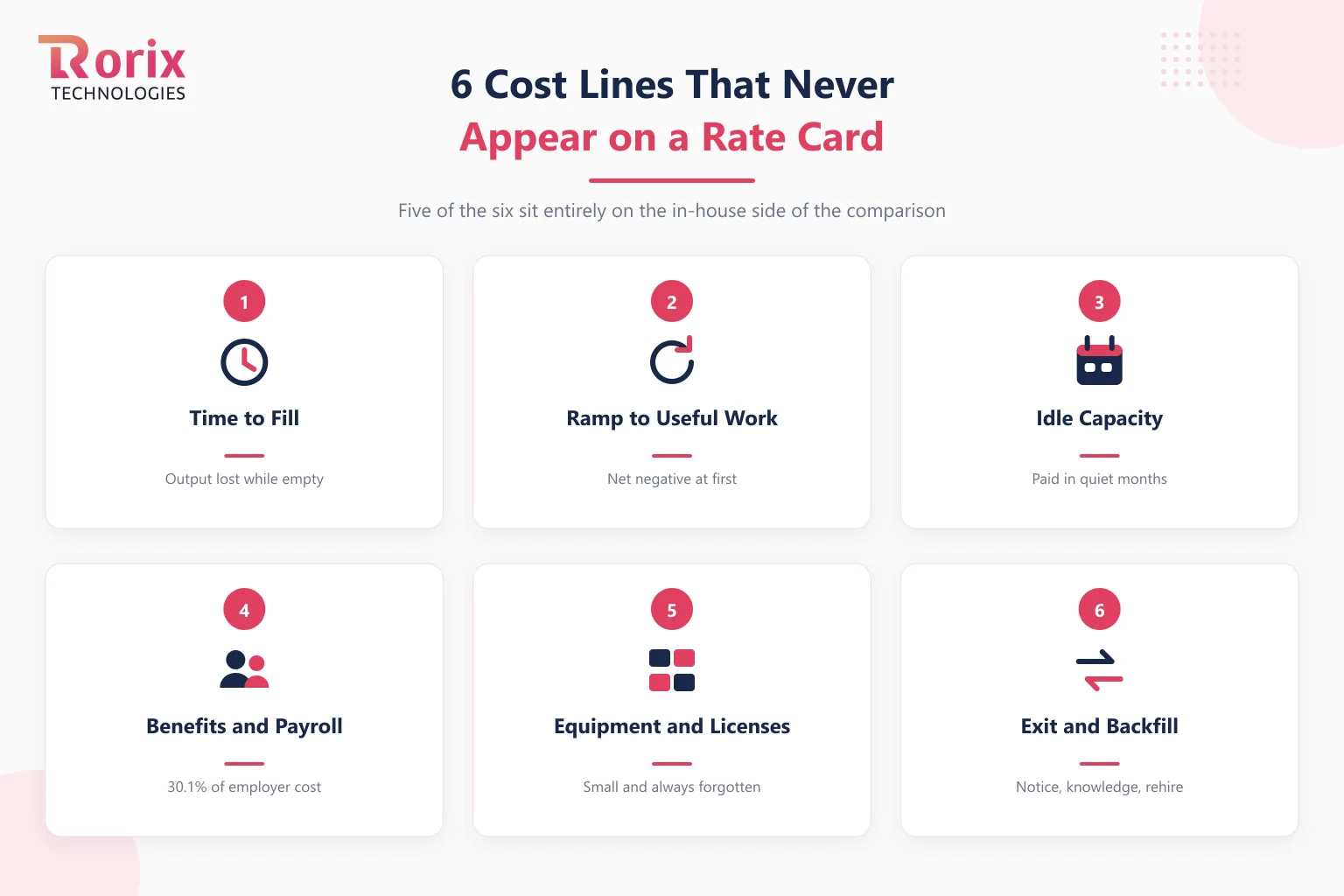
1. Time to fill. The dominant cost of an unfilled role is not the recruiter fee, it is the output you do not get while the seat is empty. At the fully loaded rate above, every month a role stays open costs roughly a month of that engineer's output in delayed roadmap. The BLS projects employment of software developers, QA analysts, and testers to grow 15% between 2024 and 2034, with about 129,200 openings a year, so the market is not getting looser.
2. Ramp to first useful work. New engineers are net negative for a period, because they consume senior time while producing little. This cost is identical whether the person is an employee or augmented, which is why churn is expensive in both models and why you should ask any vendor how they handle a mid-engagement replacement.
3. Idle capacity. An employee is paid in the quiet months. Augmented capacity can be scaled down, and that optionality is worth real money on a roadmap with uneven demand. It is also the single most common reason a monthly retainer beats a headcount plan on total cost.
4. Benefits and payroll load. The 30.1% established above, plus payroll taxes and legally required benefits, all of which sit inside a vendor's hourly rate already.
5. Equipment, licenses, and workspace. Modest per person, and consistently forgotten in the first version of every model.
6. Exit and backfill. Notice periods, severance where applicable, knowledge that leaves with the person, and the cost of running the hiring process again. Augmentation converts this from an event into a contract term.
Staff augmentation does not eliminate these costs. It converts most of them from fixed costs you carry into a variable rate you can stop paying. That is the actual product.
Hourly, Monthly Retainer, or Fixed Cost: Which Costs Less?
All three can be cheapest. The variable is how well you know the scope.
Hourly suits genuinely unpredictable work: support, maintenance, and exploratory phases where the requirements change week to week. You pay only for hours used, and in exchange you carry the estimating risk. It is the wrong model for anything with a deadline, because nobody can tell you the total in advance.
Monthly retainer suits sustained product work and is what most staff augmentation actually is. You are buying reserved capacity rather than a deliverable, which makes forecasting trivial and rewards duration commitments. It costs more than hourly if your pipeline of work is thin, so be honest about whether you can keep the team busy.
Fixed cost suits scopes that are genuinely nailed down, and almost nothing else. The price includes a risk premium for the unknowns, so a fixed bid on a vague scope is the most expensive way to buy software. Every change becomes a change order, and the relationship becomes contractual rather than collaborative.
Our pricing model is complexity-based rather than seniority-based, which is a decision worth explaining, because it inverts the industry norm. Most vendors charge more for a senior engineer. We charge for the difficulty of the work and staff it with whoever it actually needs, so you are not paying a senior rate for routine work or getting a junior on something architectural. Standard work runs $20 an hour, advanced $25, and architecture-heavy or compliance-bound work $30.
When Does Staff Augmentation Cost More Than Hiring?
Four situations, and any honest vendor will tell you about them before you sign.
When the work runs for years on the same core system. Over a long enough horizon, an employee's fixed cost beats a variable rate, and accumulated domain knowledge compounds. If you are certain the work is permanent, hire.
When you have no capacity to direct the work. Augmented engineers extend your team; they do not replace your engineering management. If nobody on your side can prioritize, review, and unblock, you will pay for hours that produce the wrong thing. That is a delivery-ownership question rather than a cost one, and our comparison of staff augmentation versus a dedicated team is the right place to settle it.
When the scope is tiny. Below a certain size, onboarding overhead exceeds the work. A two-week task rarely justifies bringing anyone new into your codebase, employee or otherwise.
When domain knowledge is the moat. If the thing that makes your product hard to copy is deep institutional knowledge, keep that knowledge in people you employ, and augment around the edges.
If you recognize your situation in the first or fourth of these, our guide to hiring a dedicated development team covers the longer-commitment model, and what a dedicated development team is and when to hire one covers the structure.
How to Compare Two Staff Augmentation Quotes in 6 Steps
Two quotes that differ by 40% on rate frequently land within 10% on total cost. This sequence surfaces that before you sign rather than in month four.
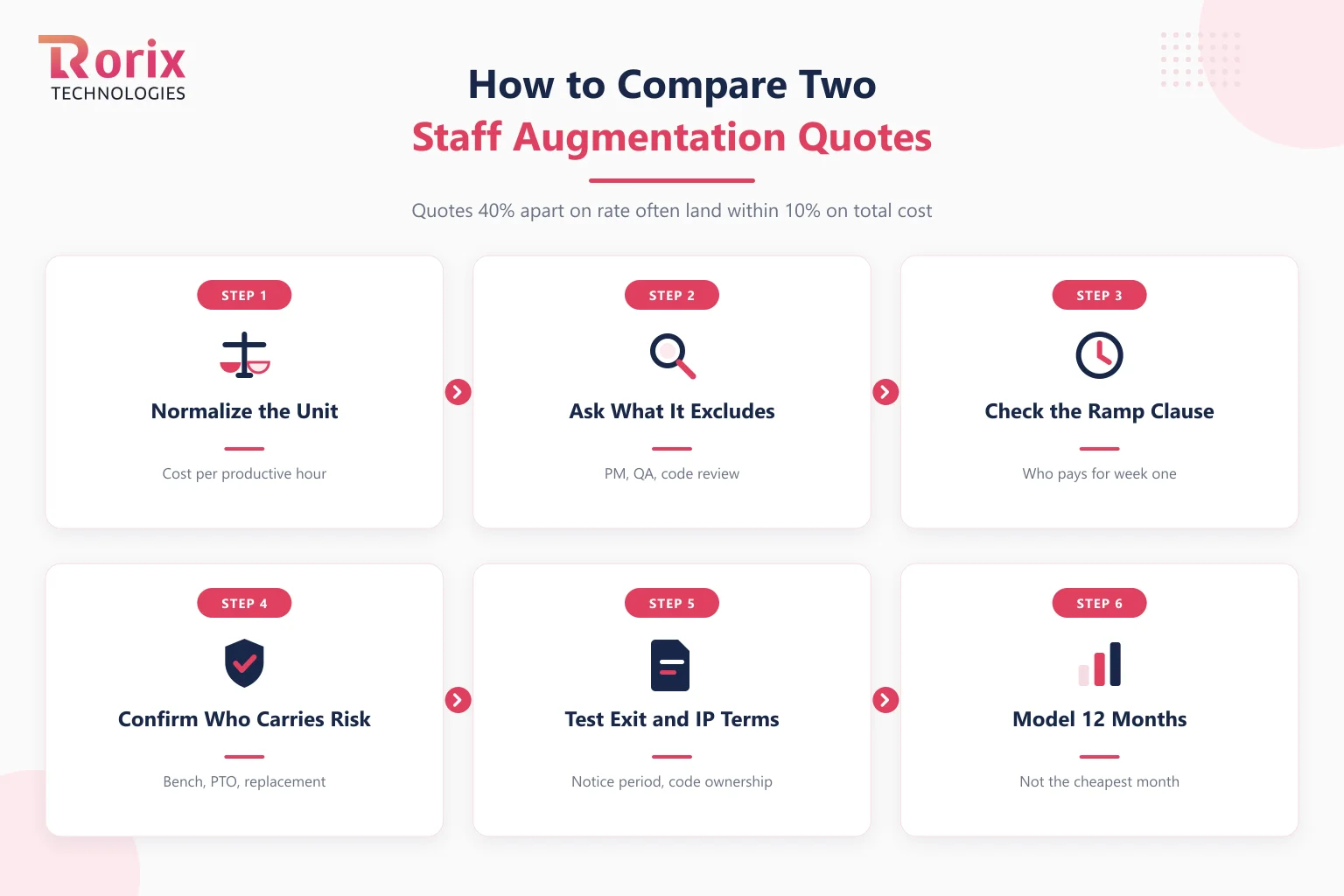
Step 1. Normalize Both Quotes to Cost Per Productive Hour
Convert every quote to the same unit: total annual cost divided by expected productive hours. Monthly retainers, hourly rates, and salaries all become comparable, and roughly half of the apparent difference usually disappears at this step.
Step 2. Ask Exactly What the Rate Excludes
Project management, QA, DevOps, code review, and onboarding are sometimes inside the rate and sometimes billed separately. A $25 rate that excludes PM and QA can easily exceed a $35 rate that includes both.
Step 3. Check the Ramp Clause
Ask whether the first weeks are billed at full rate, and what happens if the assigned engineer is replaced. Some vendors absorb ramp on a replacement and some rebill it, and that difference is worth more than a few dollars an hour.
Step 4. Confirm Who Carries Bench, PTO, and Replacement Risk
If your engineer takes two weeks off, do you pay? If they leave, who covers the gap and at whose cost? These answers separate a staffing broker from a delivery partner, and they never appear on the rate card.
Step 5. Test the Exit Terms and IP Transfer
Notice period, month-to-month versus locked term, and whether you own 100% of the code from day one. An exit clause you cannot live with turns a cheap rate into an expensive relationship.
Step 6. Model 12 Months, Not One
Apply the duration discounts, the expected ramp, and a realistic utilization assumption across a full year. The cheapest month and the cheapest year are frequently different vendors, and the year is the number that matters.
What Rorix Charges for Staff Augmentation
Our dedicated development teams publish their rates rather than quoting them per deal, because a cost guide that hides its own pricing is not worth much.
- Hourly: $20 for standard work, $25 for advanced, $30 for architecture-heavy or compliance-bound work. Priced by complexity, not by the seniority of who is assigned.
- Dedicated capacity: $3,500/month for one developer, $10,000/month for 3 developers plus a dedicated project manager, $16,000/month for 5, and $30,000/month for 10.
- Commitment discounts: 5% at three months, 10% at six, 15% at twelve. Engagements are month-to-month by default.
- What is included: project management, code review, and QA inside the retainer, with 100% IP transfer and an NDA from day one.
- What is not included: infrastructure and DevOps remain with you. We build application software, and we would rather say so than discover it in month two.
Against the $100 to $150 fully loaded US figure derived above, the arbitrage is real, and it comes from labor market geography rather than from anything being cut. Agencies reselling that capacity under their own brand rather than buying it for an internal roadmap will want the same arithmetic from the reseller's side. Our team averages 11 years of production experience per engineer, with 27 platforms delivered and a 5.0 rating on Clutch across clients in the US, UK, Canada, Australia, and New Zealand.
See the full ladder on our pricing page, or run your own numbers in the project cost estimator. If you are still deciding between models rather than vendors, start with what IT staff augmentation is.
The Cheapest Rate and the Cheapest Year Are Rarely the Same Vendor
Staff augmentation is not cheaper because the engineers cost less. It is cheaper because it converts six fixed costs into one variable one, and because you stop paying for capacity in the months you do not need it.
That also means the savings are real only if you would genuinely have carried those fixed costs. A company that would never have hired in the first place is not saving anything; it is spending. The comparison is only honest against the alternative you were actually going to fund.
Run the math on both sides at cost per productive hour, over twelve months, with your own utilization. If the answer is close, pick on delivery quality and exit terms, because at that point those are worth more than the rate.
Want the calculation done against your actual roadmap? Talk to our engineers and we will model both options with your numbers, including the case where hiring wins.
Frequently Asked Questions
How much does IT staff augmentation cost per hour in 2026?
Most of the market sits between $25 and $80 an hour depending on region and seniority. Clutch's pricing data puts most listed providers at $25 to $49, with Canada and Australia at $100 to $149 and the US and Poland at $50 to $99. Rorix publishes $20 to $30, priced by complexity of the work rather than seniority.
Is staff augmentation actually cheaper than hiring in-house?
Usually, but by less than the rate difference suggests, and only if you would genuinely have hired. The saving comes from converting recruiting, benefits, idle capacity, equipment, and exit costs from fixed costs into a variable rate you can stop paying, not from the engineers themselves being cheaper to employ.
What does a US in-house developer cost per hour, fully loaded?
Roughly $100 to $150. BLS puts the median developer wage at $133,080, and its Employer Costs release shows wages are only 69.9% of what employers pay, which brings salary plus benefits to about $190,000. Divided by roughly 1,800 productive hours a year, that is about $106 an hour before recruiting, equipment, and management overhead.
What is included in a staff augmentation hourly rate?
At minimum salary, benefits, payroll taxes, recruiting, equipment, paid leave, and the vendor's margin. What varies between vendors is whether project management, QA, code review, and onboarding time are inside the rate or billed on top, which is the single question that most often reverses which quote is cheaper.
Is an hourly rate or a monthly retainer cheaper?
Hourly is cheaper when the work is genuinely intermittent, because you pay only for hours used. A retainer is cheaper when you have sustained work, because reserved capacity is discounted and duration commitments reduce it further. Retainers cost more than hourly only when you cannot keep the team busy.
Why are offshore staff augmentation rates so much lower?
Labor market geography, not a difference in what is delivered. Salary levels, cost of living, and benefits obligations differ by an order of magnitude between markets, and the rate reflects that. What you should check is experience level, English fluency, time zone overlap, and delivery process, since those vary far more between vendors than between countries.
When does staff augmentation cost more than hiring?
When the work runs for years on the same core system, when you have no engineering management capacity to direct it, when the scope is too small to justify onboarding, or when deep domain knowledge is your competitive moat. In the first and last of those, an employee's fixed cost wins over a long horizon.
How much does Rorix charge for staff augmentation?
$20 to $30 an hour by complexity tier, or a monthly retainer starting at $3,500 for one developer, $10,000 for 3 developers plus a project manager, $16,000 for 5, and $30,000 for 10. Commitment discounts run 5% at three months, 10% at six, and 15% at twelve, and engagements are month-to-month with full IP transfer.
Need engineers who stay?
Dedicated developers at $3,500 per developer per month, working your backlog on 2-week sprints with a named technical lead.
Continue learning
Written by
Renish DadhaniyaFounder & Director, Rorix Technologies
Renish co-founded Rorix Technologies and drives the engineering and delivery culture across the organization. Beyond engineering, he leads the company's sales, finance, and HR operations, building the infrastructure that lets the team focus on shipping quality software. With deep hands-on expertise in architecture and team building, he ensures every project lands on time to the quality standards clients demand.
View full profileRelated articles
In-House vs Outsourcing Software Development: Cost, Speed, and Control Compared (2026)
Compare in-house vs outsourcing software development on cost, speed, control, risks, and the hybrid model with a practical 2026 decision guide.
Read article
Staff Augmentation vs Dedicated Team: Which Model Fits Your Roadmap?
You added the engineers and delivery still slipped. Compare staff augmentation vs dedicated team on delivery ownership, management load and continuity.
Read article
NestJS vs Express: Which Node.js Framework Fits Your Backend?
NestJS runs on Express by default, so this is not a performance contest. It is a decision about where your backend structure comes from, and who maintains it.
Read article