
Staff Augmentation vs Dedicated Team: Which Model Fits Your Roadmap?
You added the engineers and delivery still slipped. Compare staff augmentation vs dedicated team on delivery ownership, management load and continuity.
On this page30 sections
Staff augmentation gives you engineers and leaves delivery ownership with you. A dedicated team gives you delivery, with the partner owning the process inside your priorities. Choose augmentation when you have a named gap and someone with the capacity to manage it. Choose a dedicated team when you need an outcome and nobody in-house is free to run it.
Here is the failure that sends most buyers looking for the difference. Two companies each add four engineers to a stalled roadmap. Six weeks later one is shipping and the other is not, and the second company's VP of Engineering is now spending most of the week writing tickets, reviewing pull requests, and answering questions across three time zones. The engineers were fine in both cases. Only one of the two companies had someone free to direct them.
That is the whole decision. Every other difference between these models, including cost, follows from a single question about who is accountable for the work getting done.
In this guide, you will learn:
- What each model actually delivers, past the sales language
- Who owns delivery, architecture, and the sprint plan in each
- How much of your own management time each one consumes
- Which model survives an engineer leaving mid-project
- What drives cost in each model
- A 6-step framework for choosing
- How to move between the models without restarting
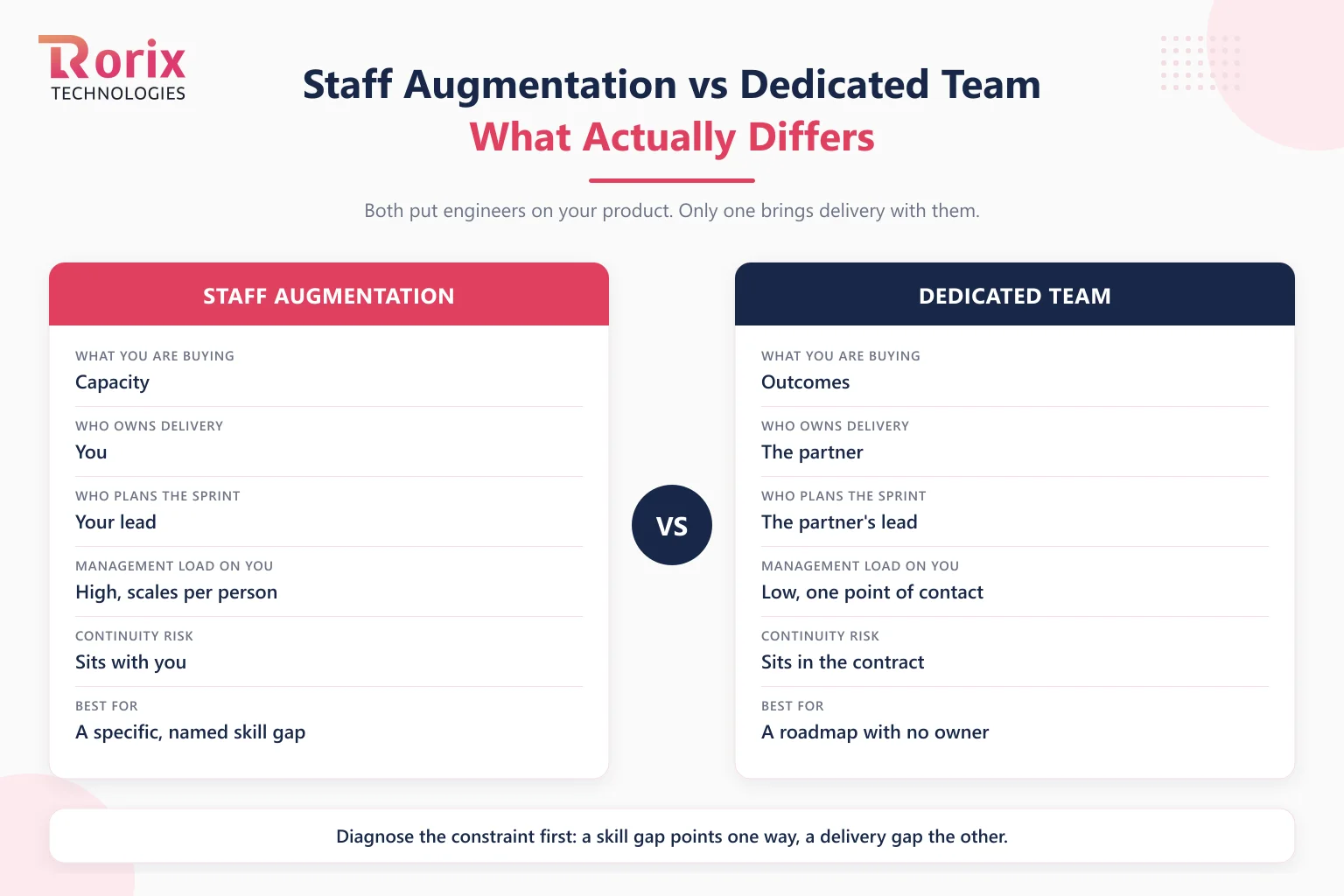
Staff Augmentation vs Dedicated Team at a Glance
Both models put engineers you do not employ onto your product. The difference is what arrives with them.
| Factor | Staff augmentation | Dedicated team |
|---|---|---|
| What you are buying | Capacity | Outcomes |
| Who owns delivery | You | The partner, inside your priorities |
| Who plans the sprint | Your lead | The partner's lead, from your backlog |
| Who owns architecture | Your team | The partner's technical lead, with your sign-off |
| Management load on you | High, and it scales per person | Low, one point of accountability |
| Ramp | Fast per person | Slower to form, then compounds |
| Continuity risk | Sits with you | Sits in the contract |
| Best for | A specific, named skill gap | A roadmap with no owner |
| Fails when | Nobody in-house has time to direct | You hire the model but will not delegate |
In short:
- Choose staff augmentation when the gap is narrow, the codebase is yours, and your lead has room to absorb more people.
- Choose a dedicated team when the gap is delivery itself, and you want one party accountable for shipping rather than for attendance.
Key Takeaways: Who Owns Delivery Decides the Model
- Staff augmentation gives you engineers and leaves delivery ownership with you, while a dedicated team gives you delivery with the partner owning the process inside your priorities.
- Staff augmentation consumes your management time in proportion to headcount, while a dedicated team consumes a roughly fixed amount regardless of size, and that line never appears on either quote.
- According to the US Bureau of Labor Statistics, median tenure with a current employer was 3.9 years in January 2024 and just 3.5 years in the private sector, the lowest reading since 2002, so continuity belongs in writing rather than in goodwill.
- The economics usually turn toward a dedicated team once you are adding a third person to the same area of the product, because coordinating individuals starts costing more than delegating the coordination.
- Rorix Technologies runs dedicated teams on retainer with a named technical lead on every engagement, has delivered 27 software projects, and holds a 5.0 rating on Clutch across 4 verified reviews.
What Is Staff Augmentation?
Think of it as renting skills into a structure you already run. The structure has to exist first.
Staff augmentation places individual engineers into your existing team. They work in your tools, attend your standups, and take direction from your lead exactly as an employee would. You are adding hands to a machine you already operate. Our full breakdown of how IT staff augmentation works covers the contracting mechanics and the setup sequence in detail.
The commercial model is usually per person, per month or per hour. That granularity is the appeal: you can add one specialist for one quarter without restructuring anything.
What Is a Dedicated Development Team?
Here the unit you are contracting is not a person. It is a functioning delivery group with its own internal structure.
A dedicated development team is a group of engineers assigned exclusively to your product, usually with a technical lead and delivery management included, working on a monthly retainer. You set priorities each sprint and the partner runs the process that turns them into shipped work. Our guide to what a dedicated development team includes sets out the composition and commitment terms.
The team is exclusive to you, which is what separates it from a project agency juggling six clients. Nobody rotates off to cover someone else's deadline.
Who Actually Owns Delivery in Each Model?
This is the question that decides the rest, and it is the one most vendor conversations skip. In staff augmentation, delivery accountability stays with you: if the sprint misses, that is your sprint that missed. In a dedicated team, the partner carries delivery accountability inside the priorities you set.
That distinction shows up in four concrete places.
Who writes the tickets. Augmented engineers consume a backlog someone else refined. A dedicated team refines it with you, which means the work of turning an intention into an acceptance criterion moves off your plate.
Who catches the architectural mistake. An augmented engineer will implement what you specified. A dedicated team's technical lead is supposed to tell you when what you specified will not hold at volume, and to own that call.
Who chases the blocker. With augmentation, a blocked engineer waits for you. With a dedicated team, a blocked engineer is the lead's problem before it is yours.
Who is answerable when it slips. Augmentation vendors answer for whether the person showed up and performed. Dedicated-team partners answer for whether the sprint landed. Those are genuinely different contracts, and the second one is harder to sell, which is why fewer firms offer it honestly.
Neither is better in the abstract. A strong engineering leader with spare capacity gets more leverage from augmentation, because they can direct good engineers more precisely than any outside lead could. A team without that spare capacity is buying a second job when they choose it.
How Much Management Time Does Each Model Cost You?
Staff augmentation consumes your management time in proportion to headcount, because each person needs direction, review, and unblocking from someone inside your company. A dedicated team consumes a roughly fixed amount regardless of size, because you are managing one relationship rather than several people.
This is the cost line that never appears on either quote, and it is usually the one that decides which model was actually cheaper. An augmented engineer who waits two days for a decision is being paid to wait. Multiply that by four engineers and a busy lead, and the rate advantage evaporates without anything visibly going wrong.
Before you choose, count honestly. Look at your lead's calendar and work out how many hours a week are genuinely free for directing other people's work, not merely nominally free. If the answer is close to zero, augmentation will underperform no matter how good the engineers are, and the fix is a model change rather than better contractors.
Which Model Protects Continuity When an Engineer Leaves?
Continuity is contractual in a dedicated team and personal in staff augmentation. When an augmented engineer leaves, the context they built leaves with them unless you captured it. When a dedicated team member leaves, backfilling and re-onboarding are the partner's obligation, and the surrounding team retains the product knowledge.
Plan for this rather than hoping. According to the US Bureau of Labor Statistics, median tenure with a current employer was 3.9 years in January 2024, and just 3.5 years in the private sector, the lowest reading since 2002. People move. A staffing model that only works if nobody moves is not a model, it is a bet.
The market pressure behind that is structural. The BLS also projects software developer, QA, and tester employment to grow 15% from 2024 to 2034, much faster than the average occupation, with roughly 129,200 openings a year. Engineers who want to move will keep having somewhere to go, which is exactly why continuity belongs in writing.
In practice, that means asking either kind of partner the same three questions: who specifically is assigned, what notice applies before they are replaced, and who pays for the ramp when a replacement arrives. A partner confident in their retention answers all three without hedging.
How Fast Can Each Model Ramp?
Staff augmentation ramps faster per person and a dedicated team ramps faster overall. One engineer joining your existing structure is productive sooner than a newly formed group, because they inherit your conventions instead of establishing shared ones.
The curves cross. A dedicated team spends its first sprints building shared context, then compounds, because that context lives in the group rather than in one person's head. Augmentation stays linear: every new person costs roughly the same onboarding again, paid by your team each time.
The practical read is duration. Short and narrow favors augmentation. Long and broad favors a dedicated team, and the crossover usually sits somewhere around the point where you are adding a third person to the same area of the product.
What Drives the Cost of Each Model?
Neither model is reliably cheaper on paper, and comparing the two quotes side by side is the mistake. What actually moves your total is the mix of seniority, how much delivery management is bundled, and how much of your own team's time gets consumed.
| Cost driver | Staff augmentation | Dedicated team |
|---|---|---|
| Engineering time | Billed per person | Bundled into the retainer |
| Delivery management | Yours to supply | Included, and priced in |
| Onboarding and ramp | Repeats per person, absorbed by your team | Paid once, retained by the group |
| Your lead's hours | The largest hidden line | Materially smaller |
| Backfill after attrition | Falls on you | Falls on the partner |
| Scaling up or down | Easiest, per person | Slower, by agreement |
Two lines decide most comparisons: your lead's hours, and backfill. Both are invisible at quote time and both land on somebody. Our breakdown of the cost of outsourcing software development walks through the same arithmetic across engagement types, and you can pressure-test a specific scope with our project cost estimator.
There is a location question sitting underneath the model question too. Where the team works from changes overlap and rate independently of which model you choose, which our guide to nearshore vs offshore software development works through in full.
Which Model Fits Your Situation?
The abstract comparison stays balanced forever. Held against a specific situation, it usually resolves immediately.
| Your situation | Better fit | Deciding factor |
|---|---|---|
| Strong in-house lead, one narrow skill gap | Staff augmentation | Direction already exists |
| A roadmap and nobody free to run delivery | Dedicated team | You are buying accountability |
| Short burst of hands on a codebase you know well | Staff augmentation | Ramp speed per person |
| Long-running product with evolving scope | Dedicated team | Context compounds |
| You are the product owner and the only manager | Dedicated team | Your time is the constraint |
| Specialist skill for a defined phase | Staff augmentation | Narrow and time-boxed |
| You want one party answerable for shipping | Dedicated team | Accountability is the product |
| You are an agency, and the build belongs to your client | Dedicated team, white-labelled | The client relationship has to stay yours |
That last row is a different problem from the rest of the table. An agency is not choosing how to staff its own roadmap; it is deciding whether it can take on a build without hiring ahead of the revenue, and whether the engineers who do the work can stay invisible to the client. That is what a white-label engineering team is for: the team contracts with the agency, never with the agency's client, and ships under the agency's brand. Whether a given build is worth taking that route on is a separate decision, worked through in when an agency should subcontract a build.
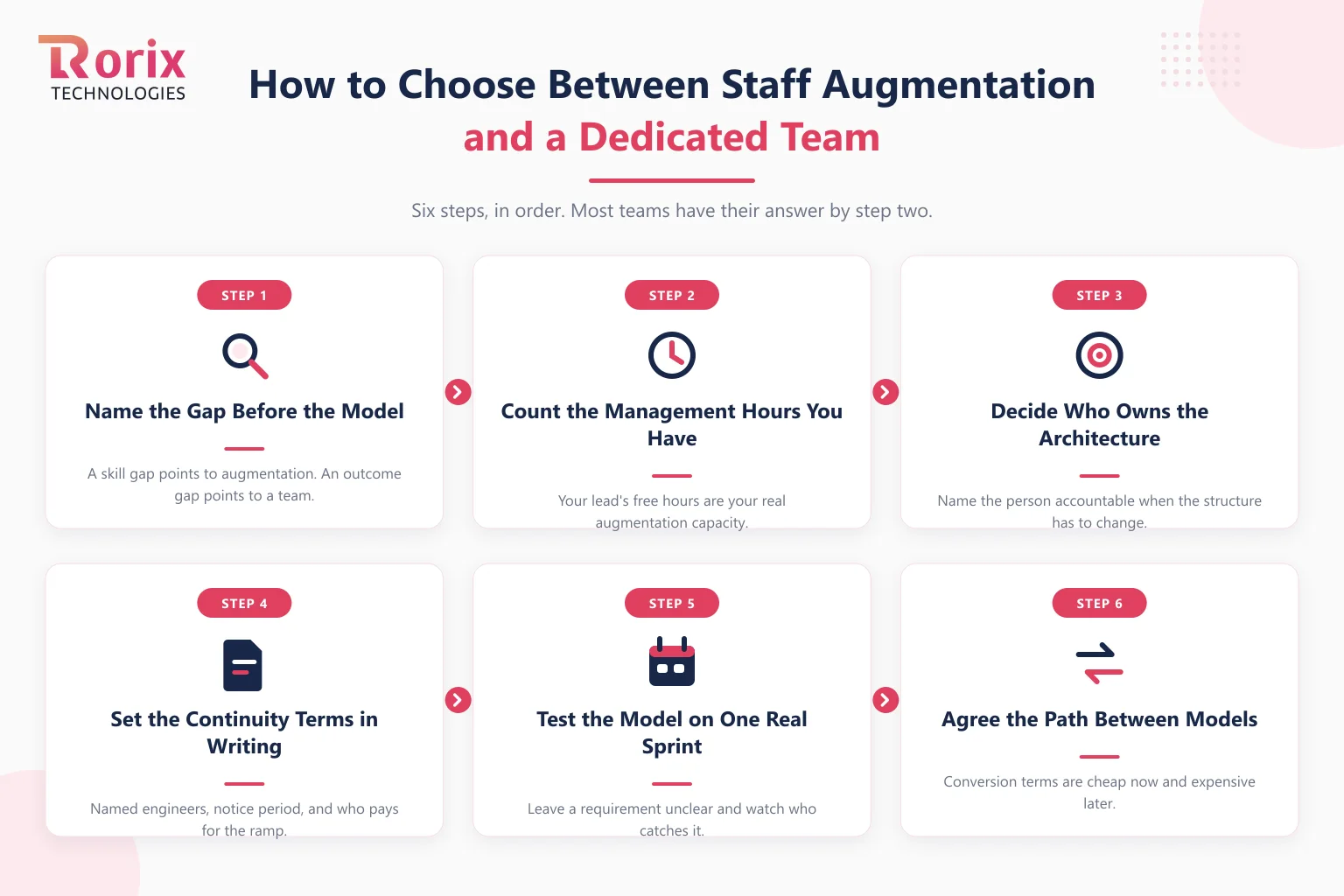
How to Choose Between Staff Augmentation and a Dedicated Team in 6 Steps
Work these in order. Most teams have their answer by step two, and the remaining steps protect it.
Step 1: Name the Gap Before You Name the Model
Write down what is actually missing in one sentence. If the sentence names a skill, augmentation is in play. If it names an outcome, you are describing a dedicated team.
Be specific enough to be falsifiable. "We need React help" is a skill gap. "We need the customer portal shipped by Q1 and nobody owns it" is a delivery gap wearing a skill gap's clothes.
Step 2: Count the Management Hours You Actually Have
Open your engineering lead's calendar for the last month and total the genuinely uncommitted hours. That number, not your intention, is your augmentation capacity.
If it will not cover direction, review, and unblocking for the people you plan to add, the decision is already made. Adding engineers to an unmanaged backlog produces motion, not delivery.
Step 3: Decide Who Owns the Architecture
Architecture ownership is not shareable in practice. Name the person who decides how the system is structured and who is accountable when that structure has to change.
If that person is in-house and has capacity, augmentation works well. If you need the partner to own it, you need a dedicated team with a named technical lead, and you should meet that lead before signing.
Step 4: Set the Continuity Terms in Writing
Ask for named engineers, a notice period before anyone is replaced, and a written statement of who absorbs the ramp cost of a replacement. Do this in both models.
Continuity is the single term most likely to be assumed and least likely to be documented. It is also the one you cannot renegotiate once the team is embedded.
Step 5: Test the Model on One Real Sprint
Run a paid two-week sprint on genuine work with real acceptance criteria before committing to a quarter. Leave one requirement deliberately underspecified and watch what happens.
In augmentation, watch whether the engineer asks your lead early or guesses. In a dedicated team, watch whether the lead catches it before it reaches an engineer at all. That single behavior predicts more than any reference call.
Step 6: Agree the Path Between Models Before You Need It
Ask how an engagement converts if your needs change, and get the answer in the contract rather than in an email. Conversion terms are cheap to agree up front and expensive to negotiate later.
A partner who only offers one model will tell you your situation suits that model. A partner who offers both will ask you about your lead's calendar.
Can You Start With One Model and Move to the Other?
Yes, and the most common path runs from augmentation toward a dedicated team. Companies typically start by renting a specialist, find the relationship works, and then discover the constraint was never the skill but the management overhead of directing it.
That transition is straightforward when the same partner supplied the engineers, because the context stays put. What changes is the contract and the reporting line: the partner adds a technical lead and delivery management, takes over sprint planning from your lead, and starts answering for outcomes rather than for hours. The engineers can stay exactly where they are.
The reverse move happens too, and it is a legitimate outcome rather than a failure. A dedicated team that has shipped the hard part of a roadmap sometimes should shrink into two augmented specialists on maintenance. The mistake is drifting into that state without renegotiating, which leaves you paying for delivery management that no longer has anything to manage.
What does not work is running both models on the same area of the product at once. Two groups with different accountability lines working the same surface produces exactly the gaps you would expect, and each will reasonably assume the other had it.
Mistakes That Make Either Model Fail
- Buying a dedicated team and managing it like augmentation: If you assign tasks directly to individual engineers and bypass the lead, you are paying for delivery management you have chosen not to use
- Buying augmentation without a manager: The most common and most expensive version, because the cost lands on your best engineer's calendar rather than on an invoice
- Comparing the two quotes directly: One includes delivery management and one does not, so the cheaper line is not the cheaper engagement
- Leaving continuity undocumented: "The same people will stay on it" is a sentence, not a term
- Scaling before the model is proven: Two engineers who ship beat six who arrived before anyone confirmed the setup works
- Treating the trial sprint as a formality: The trial exists to surface how the partner behaves when a requirement is unclear, which is the only part you cannot learn from a case study
- Splitting one product surface across both models: Accountability that is shared in theory is absent in practice
How Rorix Runs Dedicated Teams
Most of the failures above come down to a partner who supplies people and then leaves the hard part, which is running delivery, with the client. We built the opposite model.
Rorix Technologies has delivered 27 software projects for operators in the US, UK, Canada, Australia, and New Zealand. We hold a 5.0 rating on Clutch across 4 verified reviews, and we work on retainer rather than project handoff.
- The same engineers stay: A dedicated team of senior engineers rather than a rotating bench, so product context compounds instead of resetting
- Named technical leads: Every engagement has a lead who owns architecture and answers for the sprint, not a coordinator who forwards messages
- Two-week sprints with full visibility: You set priorities each sprint and see every task in progress
- Proven duration: A B2B sales-intelligence SaaS has worked with the same Rorix engineers for over five years
- Real integration depth: 40+ vendor integrations delivered on Driven's field-service performance platform
- Accountable past go-live: We stay embedded after launch and keep proposing improvements each sprint
If you are weighing the two models against a specific roadmap, our dedicated development teams service page sets out how engagements are structured, and our guide to hiring a dedicated development team covers the vetting sequence.
Need a team that works like your in-house team? Book a free consultation and we will map your roadmap to the right model and team composition.
Buy the Accountability You Are Missing
The two models are not competing products. They answer different questions, and the reason buyers conflate them is that both arrive looking like engineers on a video call.
Staff augmentation is the right call when your constraint is capacity and you already have the structure to aim it. A dedicated team is the right call when your constraint is that nobody has time to aim anything. Diagnosing which of those you have takes an hour with your lead's calendar and costs nothing.
Get that diagnosis wrong and both models look broken for the same reason. The engineers ship what they are asked for, nobody is quite sure who was supposed to do the asking, and the quarter ends with a burn rate and not much else. That question is worth settling before you compare a single rate. When you are ready, connect with our experts and we will work through it against your actual roadmap.
Frequently Asked Questions
What is the difference between staff augmentation and a dedicated team?
Staff augmentation supplies individual engineers who work under your management, so delivery accountability stays in-house. A dedicated team supplies a managed group with its own technical lead, and the partner is accountable for delivery inside the priorities you set.
Is a dedicated team more expensive than staff augmentation?
Not reliably, because the two quotes cover different things. A dedicated team's price includes delivery management that augmentation expects you to supply yourself, so the honest comparison adds your own lead's hours to the augmentation side before either total means anything.
When should you use staff augmentation instead of a dedicated team?
Use augmentation when the gap is a specific skill, the work is time-boxed, and you have an engineering lead with real capacity to direct extra people. It is the better fit for narrow, short, well-understood work on a codebase your team already knows.
Can you convert staff augmentation into a dedicated team?
Yes, and it is the most common progression. The partner adds a technical lead and delivery management, takes over sprint planning, and shifts to being accountable for outcomes, while the engineers already working on your product stay in place.
Who owns the code and IP in each model?
You should own it outright in both, from the moment the code is written rather than on final payment. Require written IP assignment covering every contributor, including any subcontractor either kind of partner engages.
How many engineers do you need before a dedicated team makes sense?
There is no fixed threshold, but the economics usually turn once you are adding a third person to the same area of the product. Below that, direction from your own lead is efficient. Above it, coordinating individuals starts costing more than delegating the coordination.
What happens if an engineer leaves mid-project?
In staff augmentation, the context leaves with them and re-onboarding lands on your team. In a dedicated team, backfilling is the partner's obligation and the surrounding team retains the product knowledge, which is why the notice period and ramp responsibility belong in the contract.
Can you run both models at the same time?
Yes, provided they work on separate areas of the product with clearly separate ownership. Running both across the same surface reliably creates gaps, because each group assumes the other is accountable for the work in between.
Need engineers who stay?
Dedicated developers at $3,500 per developer per month, working your backlog on 2-week sprints with a named technical lead.
Continue learning
Written by
Renish DadhaniyaFounder & Director, Rorix Technologies
Renish co-founded Rorix Technologies and drives the engineering and delivery culture across the organization. Beyond engineering, he leads the company's sales, finance, and HR operations, building the infrastructure that lets the team focus on shipping quality software. With deep hands-on expertise in architecture and team building, he ensures every project lands on time to the quality standards clients demand.
View full profileRelated articles
IT Staff Augmentation Cost: What You Actually Pay in 2026
IT staff augmentation cost in 2026: real hourly rates, the fully loaded math against a US in-house hire, and the six cost lines no rate card shows you.
Read article
Nearshore vs Offshore Software Development: Which One to Choose In 2026
Three vendors quote the same build and the numbers barely overlap. Compare nearshore vs offshore software development on overlap, total cost and risk.
Read article
NestJS vs Express: Which Node.js Framework Fits Your Backend?
NestJS runs on Express by default, so this is not a performance contest. It is a decision about where your backend structure comes from, and who maintains it.
Read article