
Cost of Outsourcing Software Development: Complete Pricing Breakdown 2026
Three vendors quoted the same build at $45,000, $95,000 and $160,000. See what outsourced software development really costs in 2026, line by line.
On this page52 sections
Outsourced development runs $25 to $150 an hour in 2026. A simple build lands between $20,000 and $90,000, a mid-complexity product between $90,000 and $250,000, and a complex platform starts at $250,000. Scope and team seniority move that total further than location does.
Here is how that plays out in practice. You ask three software development companies to build the same product. You send them the same requirements, the same features, and the same timeline. Then the quotes arrive. One says $45,000. Another says $95,000. The third asks for $160,000.
So which number is right?
The final cost depends on what you need to build, who builds it, where the team is based, the technology used, integrations, testing, communication, and ongoing support. A low quote can quickly become expensive when requirements change, rework increases, or important costs are left out of the initial proposal.
That is why the better question is not "What is your hourly rate?" but "What will this project cost from planning to launch and beyond?"
In this guide, you will learn:
- What outsourcing costs by project size
- Average rates by region, country, role, and seniority
- How different pricing and engagement models affect your budget
- The hidden costs that can increase your final bill
- How to compare vendor quotes
- Practical ways to reduce costs
By the end, you will have a clearer picture of what you should actually budget for, what questions to ask vendors, and how to spot a quote that looks cheap today but could become expensive later. If you have not settled the underlying decision yet, our guide on why companies outsource software development covers when the model fits and when it does not.
Cost of Outsourcing Software Development at a Glance
If you need a number before the details, here is the whole picture on one screen.
| Cost | Typical range | What it means |
|---|---|---|
| Hourly rate | $25 to $150/hour | Depends on location and team experience |
| Small project | $20,000 to $90,000 | Simple app or internal tool |
| Medium project | $90,000 to $250,000 | More features and integrations |
| Large project | $250,000+ | Complex, multi-platform software |
| Monthly team | $11,000 to $70,000/month | Small outsourced team; the spread is region and seniority |
| Extra costs | 20% to 35% | QA, project management, rework, hosting, and other costs |
| Main cost factor | Scope and team experience | These affect the cost more than location does |
Published market data sits inside these bands. Clutch's software development pricing data puts the average reviewed project at roughly $132,480 across a 13-month timeline, and GoodFirms' cost survey finds most small and mid-sized builds landing between $30,000 and $100,000. Both figures fall between the small and medium tiers above, which is where the majority of business software is actually commissioned.
Quick tip: never judge a proposal on the hourly rate alone. Check the total, the team, the scope, and what the quote leaves out.
Key Takeaways: What Outsourced Software Development Costs in 2026
- Outsourced software development runs $25 to $150 an hour in 2026, with a simple build landing between $20,000 and $90,000, a mid-complexity product between $90,000 and $250,000, and a complex platform starting at $250,000.
- Clutch's software development pricing data puts the average reviewed project at roughly $132,480 across a 13-month timeline, and GoodFirms' cost survey finds most small and mid-sized builds landing between $30,000 and $100,000.
- Blended hourly rates run $20 to $55 in South and Southeast Asia, $30 to $85 in Eastern and Central Europe, $30 to $75 in Latin America, and $80 to $180+ in North America and Western Europe.
- Extra costs add 20% to 35% on top of the engineering quote, and a worked 12-month budget for a mid-complexity build that most vendors would quote at $120,000 lands between $204,000 and $361,000 once every line is counted.
- Maintenance after launch runs 15% to 25% of the original build cost every year, so a $200,000 build costs $30,000 to $50,000 annually to keep running.
How Project Size Sets Your Budget Before Any Rate Is Agreed
Project size is the fastest sanity check on any proposal. Most of the spend is settled here, before a single rate is negotiated. The final figure still shifts with features, stack, and integrations, and you can pressure-test your own scope with our project cost estimator before the first vendor call.
| Build type | What it usually includes | Timeline | Indicative cost |
|---|---|---|---|
| Simple build | Single platform, a tight feature set, minimal external dependencies | 2 to 5 months | $20,000 to $90,000 |
| Mid-complexity product | Purpose-built backend, layered permissions, live third-party connections | 5 to 10 months | $90,000 to $250,000 |
| Complex platform | Multi-platform delivery, high-load design, audit and compliance duties | 9 to 18 months and beyond | $250,000 to $500,000+ |
1. Simple Build or Internal Tool
Basic features, one platform, and few integrations put a project in this tier. Internal dashboards and simple inventory tools are the common examples, and they are usually the safest place to test a new partner before committing to a larger program.
2. Mid-Complexity Product
Most business software lands here. A mid-level product may include a custom backend, multiple user roles, third-party integrations, and mobile or scanner support. The cost climbs with the number of systems that have to agree with each other, not with the number of screens.
3. Complex and Enterprise Platform
These projects involve multiple platforms, high data volume, legacy integrations, and security or compliance needs. Enterprise systems and multi-location platforms are common examples, and the architecture decisions made in the first month set the price of every month after it.
4. What an Outsourced Team Costs Per Month
For ongoing development, you can hire an outsourced team on a monthly basis. The cost depends mainly on team size, roles, and experience, and it buys continuity rather than a finished deliverable. Our breakdown of what a dedicated development team includes explains where that continuity pays for itself.
| Team shape | Who is on it | Monthly cost |
|---|---|---|
| Lean team | 2 to 3 engineers plus QA, with part-time delivery management | $11,000 to $70,000 |
| Standard product team | 4 to 6 engineers, dedicated QA, full-time delivery lead, design input | $21,000 to $120,000 |
| Senior specialist team | 5 to 7 people: an architect leading 3 to 4 engineers, with QA and DevOps embedded throughout | $44,000 to $200,000+ |
Those spans are wide on purpose, because a monthly team cost is just the regional rate multiplied by the headcount you actually engage. Work it out for yourself rather than taking the band: a lean team is roughly 3.5 to 4.5 full-time equivalents, so about 560 to 720 hours a month. At the South and Southeast Asia rates in the table below, that is the bottom of the range. At onshore rates it is several times higher, for the same three people.
That arithmetic is the reason "what does a team cost per month" has no useful single answer. Fix the region and the headcount first, and the number falls out.
Software Development Outsourcing Rates by Region
Location is the most visible lever on your budget. It is also the one buyers overweight. A region sets your rate band, but seniority and scope decide whether that band turns into good value, which is the distinction our guide to choosing an outsourced development partner uses to separate cheap from economical.
| Region | Blended hourly rate | Working-hour overlap with US and UK teams | Where it fits best |
|---|---|---|---|
| South and Southeast Asia | $20 to $55 | Limited with US, partial with UK | Sustained delivery capacity at the widest rate spread, from specified builds to multi-year product ownership |
| Eastern and Central Europe | $30 to $85 | Strong with UK, partial with US | Architecture-heavy builds and multi-year product ownership |
| Latin America | $30 to $75 | Strong with US, limited with UK | Teams that need decisions made within the same working day |
| Africa and emerging hubs | $20 to $60 | Strong with UK and Europe | Small, tightly scoped squads on a controlled budget |
| North America and Western Europe | $80 to $180+ | Full overlap locally | Contracts that mandate local presence or data residency |
Accelerance's 2026 rate trends report benchmarks senior developers at $64 to $76 an hour in Central and Eastern Europe and $60 to $75 in Latin America, both sitting inside the blended bands above. Its senior figure for Asia is lower, at $31 to $41, which runs under the senior column in the country table below. Read the higher Asian senior numbers as specialist and lead-level pricing rather than a market-wide average, and ask any vendor quoting at the top of a regional band what specifically justifies it.
Country-Level Rate Benchmarks
Region gives you the shape, and country plus seniority give you the number you can actually budget against. Rates move inside a single region too, so a senior engineer in one market can cost what a mid-level costs in another. Use these as sanity checks on any proposal.
| Country | Junior | Mid-level | Senior |
|---|---|---|---|
| India | $15 to $30 | $25 to $45 | $40 to $70 |
| Vietnam | $18 to $30 | $28 to $45 | $40 to $60 |
| Philippines | $18 to $30 | $28 to $45 | $40 to $60 |
| Poland | $28 to $40 | $40 to $60 | $60 to $90 |
| Ukraine | $22 to $32 | $32 to $48 | $45 to $70 |
| Romania | $20 to $35 | $32 to $52 | $45 to $80 |
| Mexico | $28 to $40 | $40 to $55 | $55 to $80 |
| Colombia | $25 to $38 | $38 to $52 | $50 to $70 |
| Brazil | $28 to $42 | $40 to $58 | $55 to $80 |
| United States | $60 to $90 | $90 to $135 | $130 to $200+ |
Clutch's rate data reports company-level averages rather than per-seniority figures, which is why its bands look narrower: most US firms report $50 to $99 an hour, Canadian and Australian firms $100 to $149, and firms in India, Ukraine, the Philippines, and Mexico $25 to $49. Those averages blend juniors and architects into one number, so a senior-only team will always quote above its country's published average.
Also Read: How to Calculate WMS ROI: Complete Guide
Outsourcing Rates by Role and Seniority
A development team is never billed at one flat number. Each role carries different responsibilities, and rates climb with the decisions a person is trusted to make. Reading a quote at role level shows where the money actually accumulates.
| Role | Junior | Mid-level | Senior |
|---|---|---|---|
| Backend or frontend developer | $25 to $45 | $40 to $75 | $60 to $120+ |
| Mobile developer | $25 to $50 | $40 to $80 | $60 to $125+ |
| QA engineer | $20 to $40 | $35 to $65 | $55 to $100+ |
| Product designer | $25 to $45 | $40 to $70 | $60 to $110+ |
| Business analyst | $30 to $50 | $45 to $75 | $65 to $110+ |
| DevOps engineer | $35 to $60 | $55 to $90 | $80 to $135+ |
| Delivery or project manager | $35 to $55 | $50 to $85 | $75 to $120+ |
| Data or AI engineer | $40 to $70 | $65 to $110 | $90 to $150+ |
| Solution architect | Rarely staffed at this level | $70 to $110 | $100 to $160+ |
How Your Technology Stack Moves the Rate
Two teams with identical seniority can quote very differently depending on what they are asked to write. Scarcity sets the premium: the smaller the pool of engineers who can do the work safely, the higher the rate, regardless of region. Before you accept a stack recommendation that carries a premium, check whether the choice is technical or habitual, the way our Node.js versus .NET comparison does for enterprise backends.
| Technology or specialization | India, Eastern Europe and Latin America band | Onshore band |
|---|---|---|
| JavaScript, React, Node | $20 to $55 | $90 to $150 |
| Python | $25 to $60 | $95 to $160 |
| Java and .NET | $25 to $60 | $95 to $160 |
| PHP | $18 to $45 | $80 to $130 |
| React Native and Flutter | $22 to $55 | $90 to $150 |
| DevOps and cloud | $30 to $70 | $110 to $170 |
| Data engineering | $30 to $70 | $110 to $170 |
| AI and machine learning | $35 to $80 | $120 to $200 |
| Cybersecurity | $30 to $70 | $110 to $200 |
| Blockchain | $35 to $75 | $120 to $250 |
Engagement Models and How Each One Prices Your Work
The contract shape decides who absorbs uncertainty. Pick the wrong one and you will pay for that uncertainty twice: once in the rate and again in change requests.
| Model | How you are billed | Best fit | Where the budget risk sits |
|---|---|---|---|
| Fixed price | Agreed total for a defined scope | Small, stable, well-specified builds | Every change is repriced |
| Time and materials | Logged hours at agreed role rates | Evolving requirements and discovery | Total is less predictable |
| Dedicated team | Monthly team retainer | Products with a continuous roadmap | Idle capacity if the roadmap thins |
| Staff augmentation | Per specialist, hourly or monthly | Filling a defined skills gap | You carry delivery management |
| Build, operate, transfer | Setup fee, running cost, then handover | Standing up an owned engineering unit abroad | Transfer terms decide the real cost |
1. Fixed Price
Fixed price gives you one number to take to finance, which is why buyers like it. The catch is that vendors price their risk into that number, and anything outside the specification triggers a change request. It works beautifully when your scope is genuinely settled and badly when it is not.
2. Time and Materials
Here you pay for hours actually worked, so the model bends as your product does. That flexibility is exactly what an evolving roadmap needs, and it usually carries a lower hourly rate than fixed price. It only stays affordable with disciplined backlog management on your side.
3. Dedicated Team
A dedicated team works only on your product under a monthly retainer and keeps its context between sprints. After roughly six months, it beats project-based delivery because nobody is re-learning your domain every quarter. Our guide on how to hire a dedicated development team covers vetting and retainer structure in depth.
4. Staff Augmentation
You bring in specific engineers who join your existing team, follow your process, and take direction from your leads. It is the fastest way to close a skills gap without adding headcount. The savings depend entirely on your ability to manage the people you have added, as our breakdown of IT staff augmentation explains.
5. Build, Operate, Transfer
Your partner builds the team, runs it for an agreed period, then hands the whole unit to you. It suits companies that want an owned engineering team in another country without setting up an entity from scratch. Read the transfer clause carefully, because that is where the true cost of this model lives.
6. Which Model Costs Least for Your Situation
If your scope is locked and small, a fixed price is usually the cheapest route. If your product is still finding its shape, a dedicated team on time and materials wins. Match the model to how stable your requirements really are, not how stable you wish they were.
12 Hidden Costs That Never Appear in the Quote
The spending that breaks budgets is rarely the engineering line. It is the work that has to happen around the engineering, which most proposals assume you have already accounted for.
| Hidden cost | Typical budget impact |
|---|---|
| Discovery and requirements | 5% to 10% of the build |
| Onboarding and knowledge transfer | 2% to 5% of first-quarter spend |
| Project management and communication | 10% to 15% of contract value |
| QA cycles and rework | 5% to 15% of the budget |
| Scope creep | 10% to 30% when unmanaged |
| Hosting, licenses, and paid services | 2% to 5% of program spend |
| Compliance and legal review | Varies widely by industry |
| Vendor markup | 30% to 60% above the engineer's own rate |
| Attrition and replacement | 50% to 150% of an engineer's annual cost |
| Cross-border payment fees | 1% to 3% of each transfer |
| Maintenance after launch | 15% to 25% of build cost per year |
| Documentation and handover | Rises sharply when skipped |
Also Read: Custom Software Development Cost in 2026: Pricing by Project Type, Team and Region
Total Cost of Engagement: A Budget That Survives Month Six
Hourly rates tell you almost nothing on their own. What you need is a total cost of engagement: everything you will spend from the first workshop to the end of your first year. That is the number your finance team should approve.
The Cost Formula That Holds Up
Start with roles rather than an average rate. Estimate hours per role, multiply by the rate for that role, then add infrastructure, your own team's time, and a contingency for technical unknowns. The formula looks like this:
Total = (role rates × estimated hours) + hosting, tooling, and paid service fees + your internal time + contingency + first-year run cost
Hold 15% back as contingency. Projects that need it will use it, and projects that do not will hand you a rare piece of good news.
A Worked 12-Month Budget for a Mid-Complexity Build
Here is a realistic picture for an operations platform with a custom backend, several user roles, and integrations into ERP and scanner hardware. The team is three engineers at South Asia rates, across a seven-month build.
| Budget line | Assumption | Indicative cost |
|---|---|---|
| Discovery and requirements | Three weeks with an architect and analyst | $8,000 to $14,000 |
| Product design | UX and UI across the core flows | $9,000 to $18,000 |
| Core engineering | Three engineers for seven months | $85,000 to $130,000 |
| Quality assurance | One QA engineer across the build | $18,000 to $30,000 |
| DevOps and environments | Pipelines, staging, release tooling | $9,000 to $16,000 |
| Delivery management | Embedded project manager | $12,000 to $22,000 |
| Integrations | ERP, carriers, scanner hardware | $12,000 to $28,000 |
| Infrastructure and licenses | Cloud, monitoring, paid APIs | $5,000 to $14,000 |
| Your own team's time | Product owner, stakeholders, sign-off | $8,000 to $20,000 |
| Contingency | 15% held against technical unknowns | $20,000 to $35,000 |
| Post-launch support | Four months of fixes and iteration | $18,000 to $34,000 |
| Total | $204,000 to $361,000 |
Look closely at what just happened to that budget. A build most vendors would quote at $120,000 lands between $204,000 and $361,000 once the whole engagement is counted. Nothing here is padding, and every line is work that has to happen.
Run Costs Most Budgets Miss
Your product starts costing money the moment it goes live. Hosting scales with usage, security patches never stop, and integrations break when a partner changes an API. Budget 15% to 25% of the original build cost every year, which on a $200,000 build means $30,000 to $50,000 annually, and you will rarely be caught short.
Outsourcing vs In-House: The Real Cost Comparison
Salary against hourly rate is the wrong comparison, because only one of those two numbers carries the full cost of employing somebody. Line the two models up on everything you actually pay for, including the dedicated development team you would otherwise have to staff internally, and the gap narrows or widens for reasons most spreadsheets miss.
| Where the money goes | Building in-house | Working with a partner |
|---|---|---|
| Recruitment | Agency fees, adverts, months of leadership time | Absorbed by the provider |
| Salary and payroll tax | Paid directly, every month | Priced into the hourly figure |
| Benefits, equipment, workspace | Entirely your responsibility | Absorbed by the provider |
| Ramp-up | Weeks before the first useful commit | Days when the partner knows the stack |
| Scaling up | A fresh hiring cycle each time | Capacity added inside a sprint |
| Scaling down | Severance and morale cost | Dials down with the retainer |
| Idle capacity | You pay for it regardless | Usually adjustable month to month |
| Knowledge retention | Strongest here | Only as good as your contract terms |
| Provider margin | None | Built into the hourly figure |
What an In-House Team Actually Costs
- Employee salary is only the starting cost.
- You also pay for payroll taxes, benefits, equipment, workspace, and software.
- Recruitment, training, and other hiring costs add more.
- Employees also have non-billable time.
What an Outsourced Team Actually Costs
- The hourly rate usually includes many of the costs you pay separately in-house. Our in-house vs outsourcing software development guide sets the two cost structures side by side over three years.
- You get a ready-to-work team without a long hiring process.
- The provider usually handles benefits, equipment, and replacement costs.
- You can add or reduce team members as your needs change.
- You pay a provider margin, but you gain faster hiring and more flexibility.
Why the Lowest Quote Usually Ends Up Costing the Most
Cheap quotes are rarely dishonest. They are usually incomplete, and the missing work does not disappear: it arrives later as rework, delay, and a change request you did not budget for.
The Cost of Rework
- Lower quote: A $90,000 quote may look better than a $150,000 quote.
- More rework: Poor development can mean paying again to fix or rebuild features.
- Project delays: Rework can push the launch date and increase the total cost.
- Better value: A slightly higher quote can be cheaper if it reduces mistakes and rework.
Signs a Low Quote Will Grow
- Few questions: The vendor gives a quote without properly understanding your project.
- Missing QA: Testing and quality checks are not clearly included.
- Sales team only: Senior experts join sales calls but are not part of the development team.
- Unclear costs: Important services or extra charges are not explained.
- Unclear ownership: The quote does not explain who owns the code and data.
- No post-launch plan: Support and maintenance costs are missing or unclear.
How to Compare Outsourcing Quotes Line by Line
Two proposals are only comparable when they itemize the same work. Send every vendor the same structure and the differences stop being about price and start being about what each team actually intends to do.
What Every Quote Must Itemize
- Roles and seniority: Who exactly is on the team, at what level, and for how many hours
- QA and project management: Included in the rate, or billed as separate lines
- Architecture and DevOps: Who designs the system and who runs the pipelines
- Integrations: Which external systems are in scope and which are assumed simple
- Infrastructure: What the client pays for directly versus what is bundled
- Change process: How scope changes get approved, priced, and scheduled
- Support after launch: What is covered, for how long, and at what rate
- Ownership: Who holds the source code, data, and documentation at the end
10 Questions to Ask Before You Sign
Run every shortlisted vendor through the same list and compare the answers, not the totals.
- Who works on this? Name the engineers and their seniority, not the company average.
- Can I speak to them? Ask to interview the people who will actually build it.
- What is your retention rate? High churn means you fund the same ramp-up repeatedly.
- What sits outside this quote? Get the exclusions in writing.
- How is a change priced? Understand the mechanism before you need it.
- What does your overhead buy? Separate real delivery management from pure margin.
- How do you handle QA? Look for automation, coverage, and acceptance criteria.
- Who owns the code? Confirm full source and IP transfer in the contract.
- What happens after launch? Clarify support scope, response times, and cost.
- What would you cut? A strong partner will challenge your scope, not just accept it.
A partner that answers all ten clearly is usually the one that will still be affordable in month nine. Our guide on how to compare development agencies turns this into a scoring framework you can reuse.
8 Ways to Spend Less Without Damaging the Codebase
You can reduce development costs without cutting quality. Focus on avoiding unnecessary work, reducing rework, and using your team efficiently.
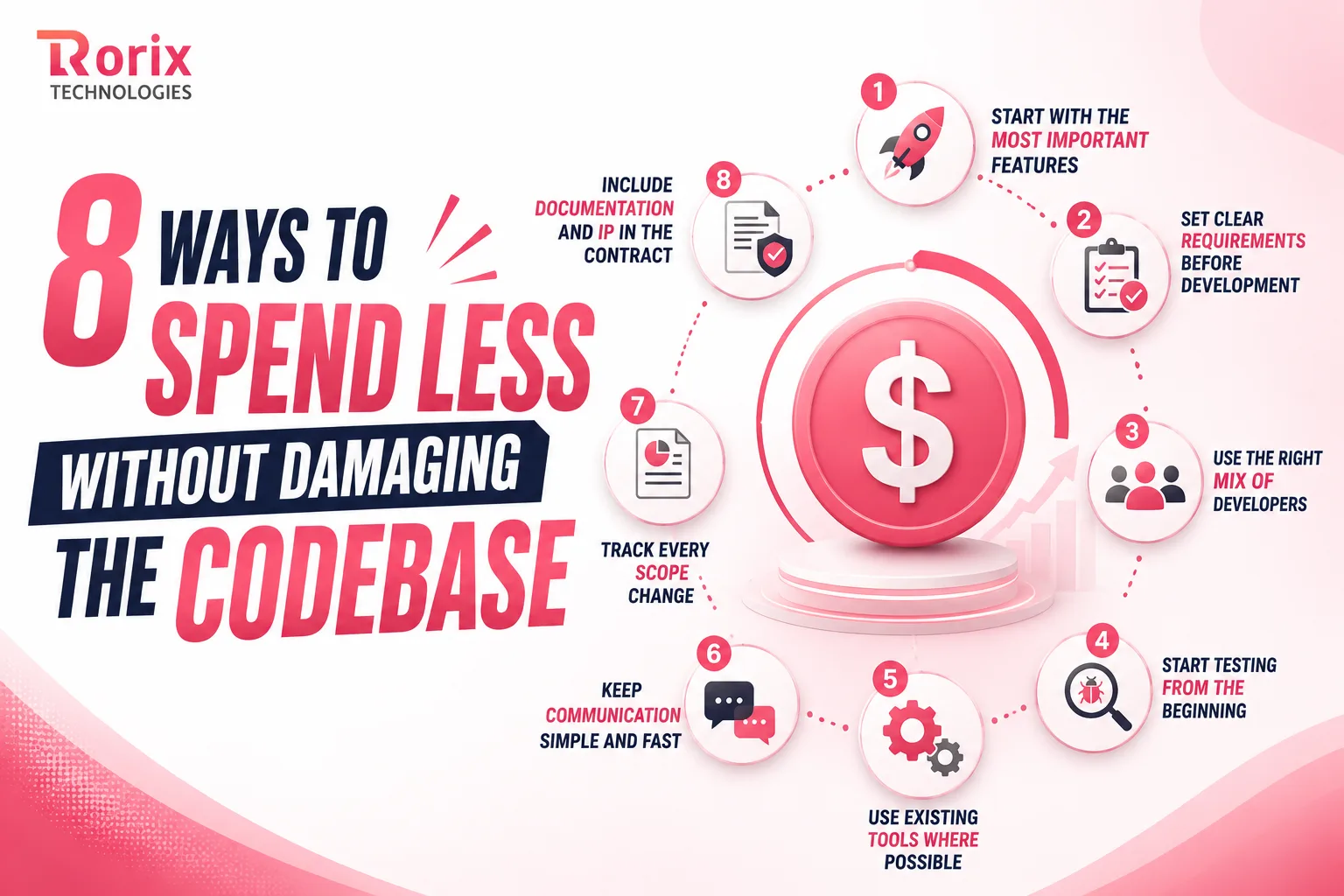
1. Start With the Most Important Features
Build a small first version that tests your biggest idea. Add more features once you know what works and what users actually need.
2. Set Clear Requirements Before Development
Clearly define features, user flows, and expected results before development starts. This reduces confusion, delays, and costly rework.
3. Use the Right Mix of Developers
Use senior developers for complex work, mid-level developers for regular tasks, and junior developers for simple work. This keeps the team cost-effective.
4. Start Testing From the Beginning
Test features during development instead of waiting until the end. Finding bugs early makes them easier and cheaper to fix.
5. Use Existing Tools Where Possible
Use ready-made tools for common features such as payments, login, notifications, and reporting. Save custom development for features that make your product unique.
6. Keep Communication Simple and Fast
Set a few hours of daily overlap between teams to quickly solve questions and blockers. Use written updates for routine communication and avoid unnecessary meetings.
7. Track Every Scope Change
Record every new feature or requirement and check its cost and timeline impact. This helps you control scope and avoid unexpected budget increases.
8. Include Documentation and IP in the Contract
Make documentation, testing, source code, and IP ownership part of the contract. This protects you and makes future maintenance or partner changes easier.
Why Buyers Choose Rorix Technologies for Outsourced Builds
Rorix Technologies helps businesses build custom software with clear pricing, experienced teams, and long-term support.
- Clear pricing: Know the team, roles, hours, and costs before you sign.
- Built for your business: Get custom WMS, HRMS, order management, and SaaS solutions designed around your workflows.
- 2-week sprints: Track tasks, progress, and blockers throughout the project.
- Strong integration experience: 40+ integrations delivered on one platform, with up to 80% fewer picking errors on an inventory project.
- Dedicated team: Work with a consistent team that understands your product, reducing rework and onboarding time.
- Long-term partnerships: 5+ year client relationships with businesses across the US, UK, Canada, Australia, and New Zealand.
Planning a software project? Book a free consultation and get a project estimate based on your requirements.
Budget for the Engagement, Not the Hourly Rate
There is no universal answer, and any vendor offering one without asking questions is guessing. The hourly rate is a fraction of what you will actually spend.
Your final cost depends on the scope, the team, the technology, the location, the integrations, the testing, and the support that follows launch. Hidden costs and changing requirements move it further still.
So do the arithmetic that most buyers skip. Price your build at role level, add the lines no proposal includes, hold 15% back, and add a year of run cost. If the total still works, you have a project. If it does not, you have found that out for the price of an afternoon rather than the price of a failed build.
When you are ready to turn a range into a real estimate, connect with our experts to scope, price, and plan your build.
Frequently Asked Questions
How much does it cost to outsource software development?
The cost of outsourcing software development typically runs $25 to $150 per hour depending on region, role, and seniority. A small build typically costs $20,000 to $90,000, a mid-complexity product $90,000 to $250,000, and a complex platform $250,000 and above.
What is the average hourly rate for outsourced software development?
Blended rates run roughly $20 to $55 in South and Southeast Asia and $30 to $85 in Eastern Europe. Latin America sits at $30 to $75, while onshore delivery runs $80 to $180+. Specialist skills carry a premium in every one of those markets.
How much does an outsourced development team cost per month?
A small team of two or three developers with QA and part-time project management runs roughly $11,000 to $70,000 monthly, and where you land inside that is set by region before anything else. That team is about 3.5 to 4.5 full-time equivalents, so South and Southeast Asian rates put it near the bottom and onshore rates near the top. Larger teams with DevOps, architecture, and full-time delivery management cost considerably more.
Is outsourcing cheaper than hiring an in-house team?
Usually yes for variable workloads, specialist skills, and fast starts, because recruitment, benefits, equipment, and idle capacity are already included in the rate. In-house tends to win when you have steady long-term work and strong technical leadership.
Which region offers the best value rather than the lowest rate?
Value tracks team seniority and delivery process far more closely than geography does. Eastern Europe and Latin America price closest to onshore while keeping strong overlap with US and UK hours. South and Southeast Asia carry the widest rate spread, which means the best and the worst value in the market both live there. In every region, the question that predicts the outcome is who owns the architecture and whether the engineers you interviewed are the ones who will write the code.
How much should I budget for hidden and post-launch costs?
Add roughly 20% to 35% on top of the engineering quote for discovery, coordination, QA, rework, and infrastructure. After launch, budget 15% to 25% of the original build cost every year for hosting, security, and ongoing work.
Which pricing model gives the most predictable budget?
Fixed price gives the most certain headline number when your scope is genuinely settled, though every change is repriced. For evolving products, a dedicated team on a monthly retainer usually delivers steadier real-world spending.
How do I tell an efficient low quote from a risky one?
An efficient quote explains its assumptions, itemizes QA and management, and names the engineers and their seniority. A risky one arrives fast, asks nothing about your workflows, and leaves ownership and change pricing undefined.
Need engineers who stay?
Dedicated developers at $3,500 per developer per month, working your backlog on 2-week sprints with a named technical lead.
Continue learning
Written by
Renish DadhaniyaFounder & Director, Rorix Technologies
Renish co-founded Rorix Technologies and drives the engineering and delivery culture across the organization. Beyond engineering, he leads the company's sales, finance, and HR operations, building the infrastructure that lets the team focus on shipping quality software. With deep hands-on expertise in architecture and team building, he ensures every project lands on time to the quality standards clients demand.
View full profileRelated articles
Nearshore vs Offshore Software Development: Which One to Choose In 2026
Three vendors quote the same build and the numbers barely overlap. Compare nearshore vs offshore software development on overlap, total cost and risk.
Read article
Staff Augmentation vs Dedicated Team: Which Model Fits Your Roadmap?
You added the engineers and delivery still slipped. Compare staff augmentation vs dedicated team on delivery ownership, management load and continuity.
Read article
Custom CRM Development Cost in 2026: Pricing by Features, Team & Timeline
How much does custom CRM development cost in 2026? See pricing by build tier, features, team size, timeline, data migration, and ongoing maintenance.
Read article