
Node.js vs .NET for Enterprise Backends: A 2026 Comparison from Engineers Who've Used Both
An honest, project-grounded comparison of Node.js and .NET for enterprise backends in 2026, from an engineering team that runs both in production daily.
On this page18 sections
For long-lived, financially transactional backends maintained by a large team, we lean .NET, because its strong typing, Entity Framework Core, and long support horizon are what kept our seven-plus-year Lorecs supply chain platform maintainable, including a migration from .NET Core 2.1 all the way to .NET 9. We lean Node.js for integration-heavy, real-time, and fast-moving systems where a full-stack TypeScript team is an advantage, which is the shape of both our HRMS platform and the event-driven Driven build with its forty-plus integrations. The decision tracks the workload: transactional longevity points to .NET, while integration breadth and iteration speed point to Node.js.
At Rorix we run both in production, side by side, across very different products in our project portfolio. .NET powers the Lorecs supply chain platform, a seven-plus-year engagement, and the Kragworks AgTech backend. Node.js powers Driven, an event-driven CRM wiring together more than forty integrations, and our own HRMS platform on Node, Express, and PostgreSQL. Both run inside the same engagement model, a dedicated development team working your backlog on two-week sprints. So this is not a language war. It is what we have learned choosing a backend for systems that have to stay correct, supported, and shippable over time, focused on the enterprise case where that choice carries the most weight.
Key Takeaways: Which Backend Runtime Fits Which Workload
- The decision tracks the workload: transactional longevity points to .NET, while integration breadth and iteration speed point to Node.js, and neither is the universal answer.
- Rorix leans .NET for long-lived, financially transactional backends, the profile of its long-running Lorecs supply chain platform, which was migrated from .NET Core 2.1 to .NET 9 without disrupting live operations.
- Rorix leans Node.js for integration-heavy, real-time systems, the shape of Driven, an event-driven CRM wiring together more than forty integrations including HubSpot, Twilio, RingCentral, and Google APIs.
- Rorix's HRMS runs more than fifteen scheduled jobs on Node with node-cron, covering payroll processing, leave-balance resets, reminder emails, and database backups, alongside its request traffic.
- Node's single-threaded event loop is outstanding for I/O-bound work, while .NET's thread-pool model and mature async support handle CPU-bound and mixed workloads strongly, so the runtime is matched to the load rather than to a benchmark.
What an enterprise backend has to get right
An enterprise backend is judged on a few unglamorous things: correctness under load, the cost of keeping it supported for years, how well it absorbs integrations, and how quickly a team can change it safely. On Lorecs those priorities were sharp. The platform automates the full order lifecycle, client request to vendor quote to order to invoice, with multi-currency billing and a QuickBooks sync, and when Amazon introduced AI-based invoice validation, an error in invoice generation directly blocked fulfillment until we diagnosed and fixed it. That is the enterprise backend reality: the data is money, the system lives for years, and downtime is expensive. The right runtime is the one that fits that specific pressure, which is why the answer changes by workload and why the choice sits near the front of our custom software development process.
Comparison at a glance
| Criterion | Node.js | .NET |
|---|---|---|
| Type system | TypeScript, strong but opt-in and configurable. | C#, statically typed and enforced by the compiler. |
| Data access | Prisma or TypeORM; lightweight and migration-driven (our HRMS uses Prisma). | Entity Framework Core; mature and deep (Kragworks uses EF Core with targeted indexing). |
| Concurrency model | Single-threaded event loop, excellent for I/O-bound work. | Thread pool plus async, strong for CPU-bound and mixed workloads. |
| Throughput profile | Shines on many concurrent I/O operations and external calls. | Shines on compute-heavy and large transactional workloads. |
| Long-term support | Fast-moving runtime and npm; you track changes more often. | Predictable LTS cadence and a long migration horizon (Lorecs ran 2.1 to 9). |
| Ecosystem and supply chain | Vast npm registry, so more third-party surface to vet. | Curated and first-party-heavy, a smaller supply-chain surface. |
| Full-stack unification | Same TypeScript on client and server (our HRMS). | A separate language from a JavaScript frontend. |
| Real-time and streaming | Event-driven model is a natural fit (Driven). | SignalR is capable but more ceremony. |
| Team and hiring | Large JS/TS pool, full-stack flexibility. | Strong enterprise pool, deep specialists. |
No single row decides it. The weight goes to whichever rows match your hottest workload, which the analysis below works through.
Type safety and the data layer
Both stacks give you strong typing in 2026, but they get there differently. .NET is statically typed in C# and the compiler enforces it, which is reassuring on a money-touching system where a wrong type is a financial bug. On Kragworks the backend leans on Entity Framework Core, and when query performance degraded against large harvest and quality-control datasets, we tuned it with EF Core query optimization and targeted indexing, the kind of deep, mature data tooling .NET is known for. Node.js reaches strong typing through TypeScript, which is excellent but opt-in, so the discipline is partly yours to enforce. Its data layer is lighter: on our HRMS we use Prisma, where every schema change is an explicit, reviewed migration. Both are productive; .NET's data story is deeper and more battle-tested, Node's is leaner and faster to move in, and the database underneath deserves the same scrutiny, which is why we compared PostgreSQL vs MongoDB for warehouse systems separately.
Transactional correctness and systems that live for years
This is where .NET is our default. Lorecs is the evidence: a seven-plus-year platform where the order and billing ledger has to stay exactly consistent, and where we migrated the backend from .NET Core 2.1 to .NET 9 without disrupting live operations. Two things made that viable, the static type system catching whole classes of error at compile time, and .NET's long-term support cadence, which turns a multi-year, multi-version upgrade into a planned path rather than a gamble. Kragworks reinforces it, with a multi-tenant security model built on .NET Identity and role-based access enforced at the feature level. When the system is financially transactional, must stay supported for years, and is maintained by a large team, .NET's strengths line up with the requirement.
Integration-heavy and real-time workloads
This is where Node.js is our default, and it is not a consolation prize. Driven is the clearest case: a hybrid monolith-plus-microservices backend with event-driven processing, wiring together more than forty integrations including HubSpot, Twilio, RingCentral, and Google APIs, and serving real-time dashboards and leaderboards. Node's event loop is built for exactly that profile, many concurrent I/O operations and external calls, and the npm ecosystem meant most of those integrations had a maintained client ready to use. We also ran GraphQL across every module on Driven, web and mobile, where Node's ecosystem is especially strong. When the backend's job is to talk to many systems at once and push updates in real time, Node fits the shape of the work.
One language across the stack
A quieter Node.js advantage is language unification. On our HRMS the entire stack is TypeScript, React on the front and Node with Express and Prisma on the back, so the same engineers move between tiers without a context switch, which speeds a lean team. With .NET your backend is C# while a typical web frontend is JavaScript or TypeScript, so you accept a language boundary in exchange for .NET's other strengths; the frontend side of that pairing is what our React vs Angular enterprise comparison works through. For a small full-stack team shipping quickly, the single-language stack is a real productivity gain; for a large team with dedicated backend specialists, the boundary matters far less.
Performance: where each model shines
Performance is not a single number, it is a question of workload. Node's single-threaded event loop is outstanding for I/O-bound work, which is why Driven's integration-heavy, real-time backend fits it so well. It is less suited to heavy CPU-bound computation, where long synchronous work can block the loop. .NET's thread-pool model and mature async support handle CPU-bound and mixed workloads strongly, which suits the large transactional processing in a platform like Lorecs. In practice we have not found either to be "faster" in the abstract; we have found each faster for the workload it was designed around, so we match the runtime to the load rather than to a benchmark.
Ecosystem and supply-chain surface
The two ecosystems have opposite shapes, and both shapes carry a cost. Node's npm registry is vast, which is why Driven's forty-plus integrations mostly had a maintained client ready to drop in, a real speed advantage for integration-led work. The flip side is supply-chain surface: more third-party packages means more code to vet and keep patched, which is a standing responsibility on any Node project we run. .NET's ecosystem is more curated and first-party-heavy, so you pull in fewer external packages and carry a smaller surface, at the cost of sometimes building what npm would have handed you for free. For an integration-heavy product the npm breadth wins outright; for a system where minimizing dependencies is a security priority, .NET's leaner surface is the safer default.
Background jobs and scheduled work
A lot of enterprise backend work is not request-and-response, it is scheduled. Our HRMS runs more than fifteen scheduled jobs on Node with node-cron, covering payroll processing, leave-balance resets, reminder emails, and database backups, and Node handled that background workload comfortably alongside its request traffic. .NET offers mature equivalents through hosted services and background workers, which suit the heavier, longer-running batch jobs common in transactional platforms like Lorecs. Both runtimes do scheduled work well; the difference is texture. Node's cron-driven jobs are lightweight and quick to wire, while .NET's hosted services fit heavier, compute-bound batch processing where the work runs for minutes rather than seconds.
When we would pick .NET
We reach for .NET when the system is long-lived, financially transactional, and maintained by a large team. Lorecs is the clearest case: a seven-plus-year supply chain platform where billing correctness is non-negotiable, sustained through a .NET Core 2.1 to .NET 9 migration. Kragworks is the second: a multi-tenant backend on .NET 8 with .NET Identity and EF Core indexing tuned for large datasets. When correctness, a long support horizon, and big-team maintainability are the priorities, .NET's strong typing and mature data tooling are the right tools.
When we would pick Node.js
We reach for Node.js when the backend is integration-heavy, real-time, or built by a lean full-stack team that benefits from one language end to end. Driven is the clearest case: forty-plus integrations, event-driven processing, and real-time data on a Node backend. Our HRMS is the second: a six-person team running TypeScript across the whole stack with Node, Express, and Prisma. When the work is I/O-bound and integration-led, when real-time matters, or when a single-language stack speeds the team, Node is our default, and our Node.js enterprise backend guide goes deeper on running it at that scale.
From the author. "The backend question I ask is what the system has to be excellent at. If it is a money-touching platform that has to stay correct and supported for years, like Lorecs, .NET and Entity Framework Core earn their keep. If it is integration-heavy and real-time, or a lean team that wants one language end to end, like Driven or our HRMS, Node.js wins. I have shipped both for a long time, and neither is the universal answer."
Renish Dadhaniya, Founder and Director at Rorix Technologies
Frequently Asked Questions
Is Node.js fast enough for enterprise scale?
For I/O-bound and integration-heavy workloads, yes. Driven runs an event-driven Node.js backend wiring together more than forty integrations and serving real-time dashboards, and our HRMS serves a live workforce on Node, Express, and PostgreSQL. For heavy CPU-bound computation, .NET's threading model has the edge, so the honest answer is to match the runtime to the workload rather than to assume one is universally faster.
Does .NET still make sense for greenfield projects in 2026?
Yes, especially for long-lived, transaction-heavy systems. The strong typing, Entity Framework Core, and long support horizon are exactly what kept our seven-plus-year Lorecs platform maintainable, including a migration from .NET Core 2.1 to .NET 9. For a money-touching backend that must stay supported for years, .NET remains a strong greenfield choice.
Can one full-stack TypeScript team really cover the whole app?
Yes, and that is a genuine Node.js advantage. Our HRMS runs TypeScript end to end, React on the front and Node with Express and Prisma on the back, so the same engineers move between tiers without a context switch. For a lean team, that single-language stack is a real speed boost.
How hard is a multi-year .NET upgrade in practice?
Significant work, but predictable. On Lorecs we carried the platform from .NET Core 2.1 to .NET 9 without disrupting live operations, and .NET's long-term support cadence made planning that multi-version path straightforward rather than a rewrite. The effort is real, but it is plannable, which is what enterprises need.
Which is better for an integration-heavy product?
Node.js usually fits better. Its event-driven model and the breadth of the npm ecosystem made Driven's forty-plus integrations and real-time data flows a natural fit, with maintained clients available for most third-party systems. .NET can absolutely do this too, but for integration breadth and streaming, Node was the faster path for us.
Need engineers who stay?
Dedicated developers at $3,500 per developer per month, working your backlog on 2-week sprints with a named technical lead.
Continue learning
Written by
Renish DadhaniyaFounder & Director, Rorix Technologies
Renish co-founded Rorix Technologies and drives the engineering and delivery culture across the organization. Beyond engineering, he leads the company's sales, finance, and HR operations, building the infrastructure that lets the team focus on shipping quality software. With deep hands-on expertise in architecture and team building, he ensures every project lands on time to the quality standards clients demand.
View full profileRelated articles
Node.js for Enterprise Backends: Where It Wins and What It Needs
Choosing a backend runtime for a business-critical system? Where Node.js wins, where it is the wrong tool, and the discipline an enterprise backend needs.
Read article
NestJS vs Express: Which Node.js Framework Fits Your Backend?
NestJS runs on Express by default, so this is not a performance contest. It is a decision about where your backend structure comes from, and who maintains it.
Read article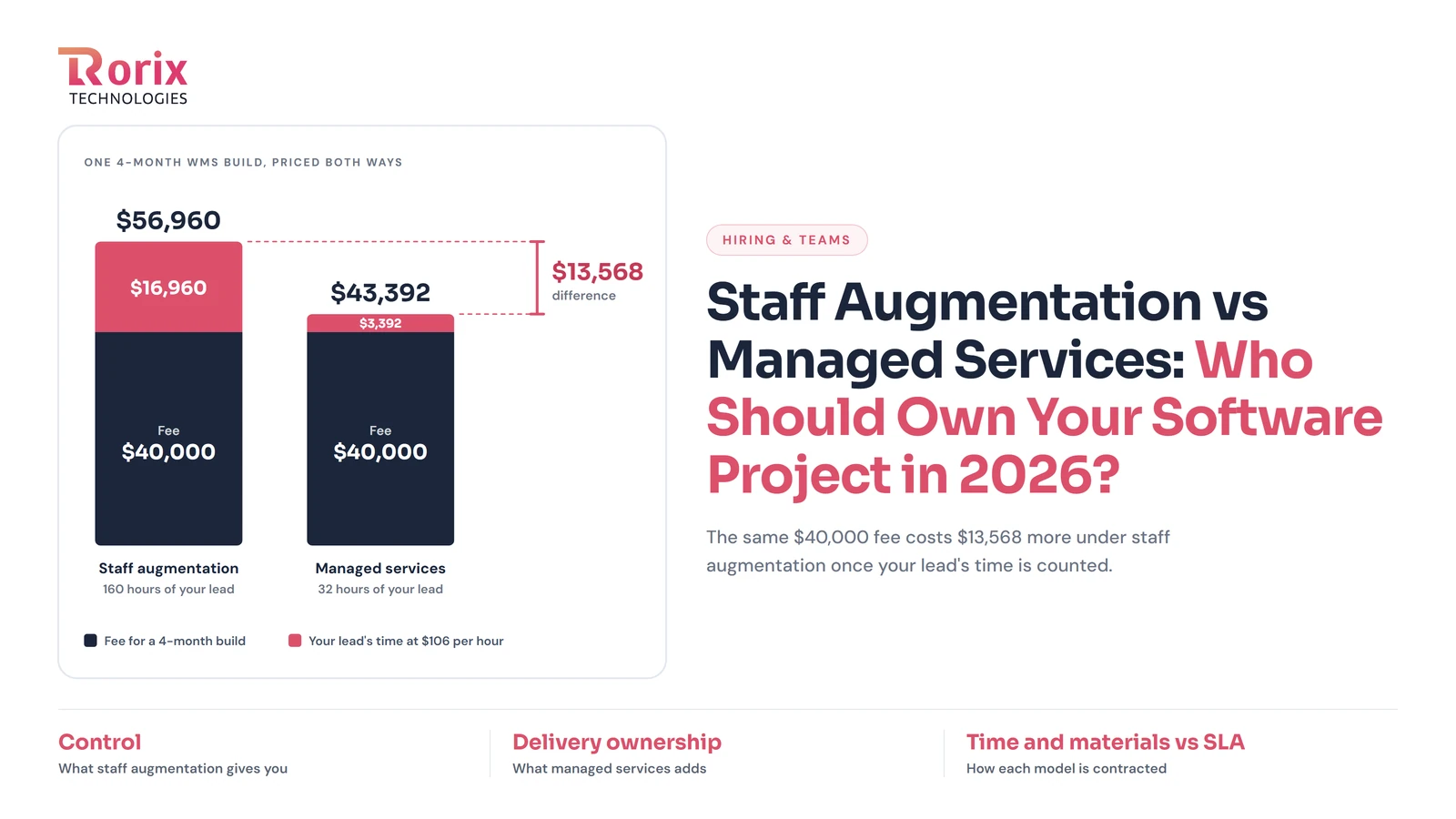
Staff Augmentation vs Managed Services: Who Should Own Your Software Project in 2026?
Compare staff augmentation vs managed services, including costs, key differences, pros and cons, and how to choose the right model for your project.
Read article