
NestJS vs Express: Which Node.js Framework Fits Your Backend?
NestJS runs on Express by default, so this is not a performance contest. It is a decision about where your backend structure comes from, and who maintains it.
On this page21 sections
These two are not really rivals: NestJS runs on Express by default, so it is a structured layer over the thing it is compared against. The real question is where your conventions come from. Express leaves structure to your team, which is fast and clean when the team is small and senior and has actual conventions. NestJS ships the structure in the box, which pays off as the team grows, the codebase ages, and the people who set those conventions move on.
We run Express in production. Our HRMS platform is Node, Express, and Prisma over PostgreSQL, with TypeScript end to end and React on the front, built and maintained by a six-person team. Driven, an event-driven CRM wiring together more than forty integrations including HubSpot, Twilio, RingCentral, and Google APIs, serves GraphQL across every module for web and mobile from a hybrid monolith-plus-microservices backend. You can see the wider set in our project portfolio.
So this is not a framework war. It is what we have learned about the one thing this choice actually settles, which is who is responsible for the shape of your codebase two years from now. It also assumes you have already picked the runtime, and if that is still open, our Node.js vs .NET comparison is the argument one level up.
Key Takeaways: Where Your Backend Structure Comes From
- NestJS uses Express as its default HTTP adapter, so this is not a performance contest but a decision about whether structure comes from the team or from the framework.
- The 2025 Stack Overflow Developer Survey puts Express at 19.9% of all respondents and NestJS at 6.7%, against Node.js itself at 48.7%.
- Express describes itself as a fast, unopinionated, minimalist web framework, which means nothing in it enforces the conventions a team started with once the original authors move on.
- Rorix runs Express in production on its HRMS platform, Node, Express, and Prisma over PostgreSQL with TypeScript end to end, and its Driven CRM backend serves GraphQL across more than forty integrations.
- Because NestJS runs on Express, an Express codebase migrates incrementally by mounting existing middleware inside a NestJS application and moving routes across one domain at a time, without a rewrite.
What this decision actually decides
Almost every comparison of these two starts with performance, which is the least interesting part. NestJS uses Express as its default HTTP adapter, so in the common configuration you are running Express either way, with a structured layer on top. Benchmarks between them mostly measure that layer.
What the choice really settles is where structure comes from. In Express, module boundaries, folder layout, error handling, validation, and how a request reaches your business logic are all decisions your team makes and has to keep making consistently. In NestJS, most of those are decided by the framework before anyone writes a line. That is the whole trade, and every practical difference below is a consequence of it.
Adoption reflects the gap in maturity rather than in quality. The 2025 Stack Overflow Developer Survey puts Express at 19.9% of all respondents and NestJS at 6.7%, against Node.js itself at 48.7%. Express is the default a lot of Node backends were started on, which matters mainly because it means most migrations run in one direction.
Comparison at a glance
| Criterion | NestJS | Express |
|---|---|---|
| Structure | Modules, controllers, and providers by default | Yours to define and enforce |
| Learning curve | Steeper, decorators and dependency injection first | Shallow, a routing layer and middleware |
| TypeScript | First-class and assumed throughout | Supported, and entirely opt-in |
| Dependency injection | Built in, and central to the design | Not provided, wire it yourself |
| Testing seams | Provided by the injection container | You create them by hand |
| Boilerplate | More up front, less repeated later | Minimal at the start |
| Convention drift risk | Low, the framework holds the line | High as the team grows |
| Ecosystem | Smaller, plus everything Express has | Enormous, the Node default |
| Microservices and GraphQL | First-party modules and patterns | Assembled from libraries |
| Best fit | Larger teams, long-lived domains | Small senior teams, focused services |
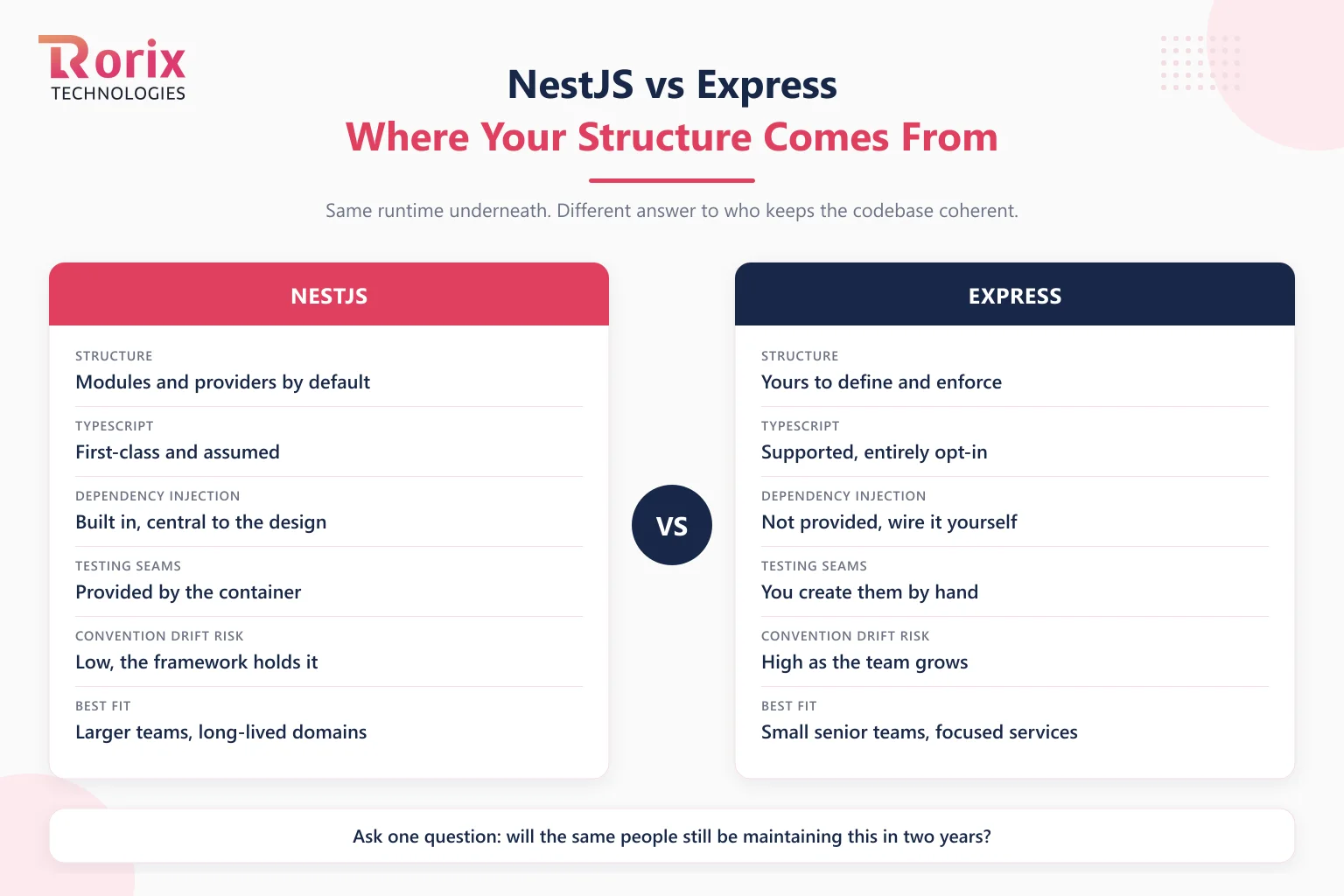
No single row settles it. Weight the rows that match your team's shape and how long the codebase has to survive.
Structure: yours or the framework's
Express is honest about what it is. Its own documentation calls it a fast, unopinionated, minimalist web framework, and unopinionated is the operative word. It gives you routing and a middleware pipeline and then gets out of the way, which is genuinely liberating when the people writing the code agree on how code should be written.
NestJS takes the opposite position, describing itself as a progressive Node.js framework built around modules, controllers, and providers. Open any NestJS project and you already know roughly where things live. Open any Express project and you find out what its authors believed in at the time.
The catch with Express is not the first six months. It is that unopinionated means nothing enforces the opinion you started with. Conventions live in your team's heads and in review comments, and both are lossy. Two years and three engineers later, a codebase that began coherent has usually grown three ways of doing validation, because nothing in the framework objected.
TypeScript and dependency injection
TypeScript works fine in Express, but it is bolted on. You add it, configure it, and rely on discipline to keep types meaningful at the boundaries where they matter most, which is where requests arrive and where data is written. That works, and our HRMS runs TypeScript across the whole stack that way.
NestJS assumes TypeScript and builds on it. Decorators, injection tokens, and the module graph all depend on type information, so types are not something you can quietly stop maintaining. If the framework is the thing keeping types honest, you get a floor that does not depend on anyone's discipline.
Dependency injection is the sharper divide. Express has none, so you wire dependencies yourself, usually by importing modules directly or passing things through closures. That is simple until you want to swap a real implementation for a fake one. NestJS puts an injection container at the center, so swapping an implementation is configuration rather than refactoring. That is worth real money on a system with external integrations you cannot call in tests.
Testing and the cost of mocking
Testing is where the structural difference stops being philosophical. In Express, the seams you need for testing are seams you have to have deliberately created, and direct imports are the enemy: a route handler that imports a database client at the top of the file is awkward to test without reaching for module mocking.
NestJS gives you those seams for free, because everything already arrives through the container. Its testing utilities let you build a module with selected providers replaced, so unit tests get the narrow slice they need without patching the module system.
You can absolutely reach the same place in Express by injecting dependencies by hand and keeping handlers thin. Plenty of good teams do. The difference is that in one framework that discipline is a choice you have to keep re-making, and in the other it is the path of least resistance.
Team size, onboarding, and convention drift
This is the row we weight most heavily, because it is the one that changes with time rather than with the technology. A small senior team with strong shared conventions moves faster on Express, full stop. There is less to learn, less ceremony, and nothing between the engineer and the request.
That advantage inverts as the team grows. Every new engineer on an Express codebase has to learn conventions that are not written down anywhere enforceable, and every one of them brings habits from the last Express codebase they worked on, which was structured differently. NestJS front-loads a steeper learning curve and then makes every subsequent engineer cheaper to onboard, because the structure is the same in every NestJS project they have ever seen.
The crossover usually lands somewhere around the point where more than a handful of engineers touch the same service, or where the original authors are no longer the maintainers. Our own experience matches that: a six-person team with settled conventions runs Express comfortably, and the calculus changes when a codebase has to outlive the people who set its patterns. We work through the same tension more broadly in our guide to building an enterprise backend on Node.js.
Performance and the middleware layer
Treat performance as close to a tie and you will rarely be wrong. Because NestJS sits on Express by default, its overhead is the abstraction layer rather than a different runtime, and for the I/O-bound work that Node is chosen for in the first place, that layer is not what limits throughput. Your database queries, your external calls, and your serialization are.
NestJS can also swap its HTTP adapter to Fastify, which closes most of what remains for services where raw request handling genuinely is the bottleneck. That is a narrow case, and it is worth measuring before it drives a framework decision.
If your performance problem is real, it is usually somewhere else. We have found the wins in the data layer and in the shape of the integrations far more often than in the framework, which is part of why we compared PostgreSQL and MongoDB separately.
Microservices, GraphQL, and integration breadth
For a backend that is mostly talking to other systems, both work, and the ecosystem is shared. Anything that runs as Express middleware runs under NestJS's default adapter, so the integration libraries are the same ones either way.
Where NestJS pulls ahead is when a service becomes several services. It ships first-party modules for microservice transports, GraphQL, queues, and scheduling, with the same module conventions across all of them. On a system like Driven, with more than forty integrations, GraphQL across every module, and a hybrid monolith-plus-microservices shape, that kind of uniformity is the difference between a system a new engineer can navigate and a collection of services that each made their own choices.
Express gets to the same functionality through assembly. You choose the GraphQL server, the queue library, and the transport, and you own how they fit together. That is more freedom and more decisions, which is the trade in every row of this comparison. Our NestJS development and Node.js development pages set out how we approach each.
Migrating an Express codebase to NestJS
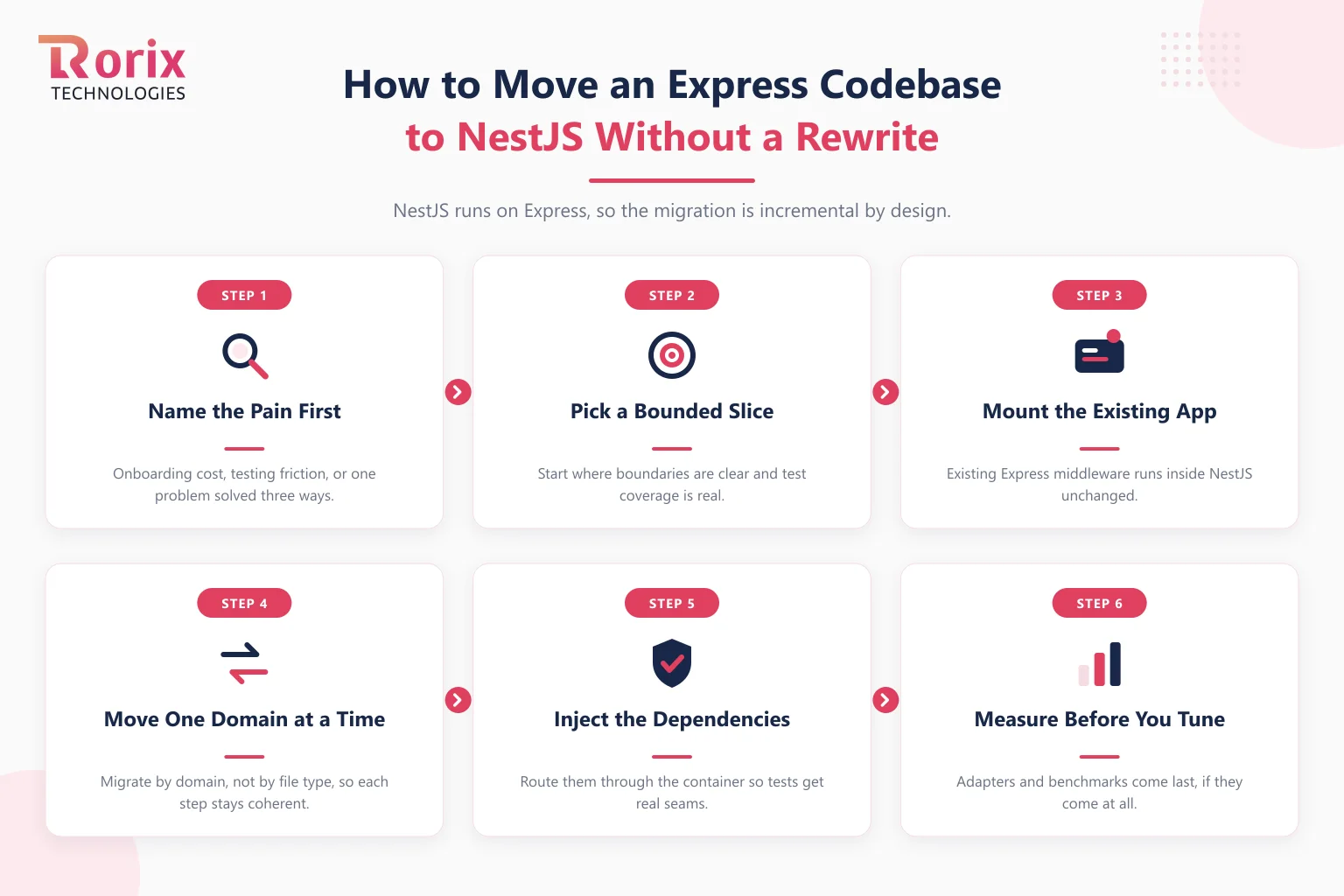
Because NestJS runs on Express, migration is incremental rather than a rewrite, which is the single most useful fact in this comparison. You can mount existing Express middleware inside a NestJS application and move routes across a module at a time.
The order that works is to start with a slice that has clear boundaries and real test coverage, move it into a NestJS module with its dependencies injected, and leave the rest running as it was. Repeat by domain rather than by file type, so each step leaves the system coherent.
The mistake is doing it for its own sake. A stable Express service that a settled team ships confidently does not become better by acquiring decorators. Migrate when you can name the pain, which is usually onboarding cost, testing friction, or a codebase where the same problem is solved three ways.
When we would pick Express
We reach for Express when the team is small and senior, the service has a focused job, and the people writing it have conventions they actually hold to. Our HRMS is the case in point: a six-person team, TypeScript end to end, Node with Express and Prisma, where the structure lives in the team rather than in the framework and that works because the team is the constant.
It is also the right answer for a narrow service, an internal tool, or anything where the framework's job is to stay out of the way. If you can hold the whole service in your head, structure imposed from outside is overhead you are paying for nothing.
When we would pick NestJS
We reach for NestJS when the codebase has to outlive its original authors. Long-lived domain systems maintained by a rotating set of engineers benefit from structure that is enforced rather than remembered, and dependency injection makes the testing story materially better on anything with external integrations to stub.
It is also the better default for a backend heading toward multiple services, or for a team large enough that consistency between engineers matters more than the speed of any one of them. The exception is a team that genuinely does stay put, which is the case we make for dedicated development teams: when the same engineers hold the codebase for years, more of Express's freedom stays safe to use. If your engineers will change over the life of the system, buy the structure, and pick the framework early, because it is one of the decisions our custom software development process settles at architecture rather than mid-build.
From the author. "I ask one question on this: will the same people still be maintaining this in two years? If the answer is yes and the team is small, Express is faster and I would not add ceremony for its own sake. If the answer is no, and honestly it is usually no, then the structure has to live somewhere other than in people's heads, and that is exactly what NestJS sells. It is not a better framework. It is a different answer to who keeps the codebase coherent."
Renish Dadhaniya, Founder and Director at Rorix Technologies
Weighing this against a specific system rather than in the abstract? Talk to our engineers and we will work through it against your team and your roadmap.
Frequently Asked Questions
Is NestJS faster than Express?
No, and the question slightly misses the point. NestJS uses Express as its default HTTP adapter, so you are running Express underneath either way, and the difference is the cost of the abstraction layer. For the I/O-bound work Node is usually chosen for, your database and external calls set the throughput, not the framework.
Does NestJS use Express under the hood?
Yes, by default. That is why existing Express middleware works inside a NestJS application and why migrations can proceed a module at a time. NestJS can also run on Fastify instead when raw request handling is genuinely the bottleneck.
Should a small team use NestJS or Express?
A small senior team with settled conventions usually moves faster on Express, because there is less to learn and less ceremony between the engineer and the request. The calculation changes once more than a handful of engineers touch the same service, or once the original authors will not be the long-term maintainers.
Can you migrate from Express to NestJS without a rewrite?
Yes. Mount your existing Express middleware inside a NestJS application and move routes across one domain at a time, starting with a slice that has clear boundaries and real test coverage. Migrate because you can name the pain, not because the newer framework is newer.
Is Express still a good choice in 2026?
Yes, and it remains the more widely used of the two by a wide margin, at 19.9% of respondents against 6.7% for NestJS in the 2025 Stack Overflow survey. It is an excellent fit for focused services and small senior teams. What it does not do is enforce the conventions you started with, and that is what tends to decide against it on larger, longer-lived systems.
Does NestJS require you to know TypeScript?
In practice, yes. NestJS assumes TypeScript and its decorators and injection container rely on type information, so treating types as optional works against the framework. Express accommodates plain JavaScript far more comfortably if that is a constraint.
Which is better for microservices?
NestJS, in most cases, because it ships first-party modules for microservice transports, GraphQL, queues, and scheduling under one set of conventions. Express reaches the same functionality by assembly, which gives you more control and leaves the consistency between services entirely up to you.
What actually decides this choice?
Where you want your structure to come from. Express leaves it to your team, which is an advantage when the team is small, senior, and stable. NestJS puts it in the framework, which is an advantage when the codebase has to stay coherent across people who have not met each other.
Need engineers who stay?
Dedicated developers at $3,500 per developer per month, working your backlog on 2-week sprints with a named technical lead.
Continue learning
Written by
Renish DadhaniyaFounder & Director, Rorix Technologies
Renish co-founded Rorix Technologies and drives the engineering and delivery culture across the organization. Beyond engineering, he leads the company's sales, finance, and HR operations, building the infrastructure that lets the team focus on shipping quality software. With deep hands-on expertise in architecture and team building, he ensures every project lands on time to the quality standards clients demand.
View full profileRelated articles
Node.js for Enterprise Backends: Where It Wins and What It Needs
Choosing a backend runtime for a business-critical system? Where Node.js wins, where it is the wrong tool, and the discipline an enterprise backend needs.
Read article
Node.js vs .NET for Enterprise Backends: A 2026 Comparison from Engineers Who've Used Both
An honest, project-grounded comparison of Node.js and .NET for enterprise backends in 2026, from an engineering team that runs both in production daily.
Read article
In-House vs Outsourcing Software Development: Cost, Speed, and Control Compared (2026)
Compare in-house vs outsourcing software development on cost, speed, control, risks, and the hybrid model with a practical 2026 decision guide.
Read article