
Node.js for Enterprise Backends: Where It Wins and What It Needs
Choosing a backend runtime for a business-critical system? Where Node.js wins, where it is the wrong tool, and the discipline an enterprise backend needs.
On this page30 sections
Backend choices are decade choices. The runtime you pick this quarter is the one your integrations, your hiring plan, and your 2 a.m. incident calls will live with long after the launch party, which is why the question deserves better than a popularity contest.
Node.js would win the popularity contest anyway. In the 2025 Stack Overflow developer survey, 48.7% of developers use it, the highest share of any web technology, and it long ago crossed from startup tool to enterprise default. The more useful question is the one this guide answers: which enterprise workloads Node.js is genuinely built for, which ones it handles badly, and what a Node backend needs around it before it deserves the word enterprise.
This is the backend companion to our guide on React for enterprise applications, and it takes the same position: the runtime is rarely what fails. The discipline around it is.
In this guide, you'll learn:
- Which enterprise workloads Node.js genuinely fits, and which it does not
- What the event-driven model means in practice, without the jargon
- The 8 things an enterprise-ready Node.js stack needs around the runtime
- A 6-step build sequence that front-loads the expensive decisions
- The 8 warning signs a Node.js backend is in trouble
- How we run Node.js on production systems with real integration loads
Quick Answer: Is Node.js Right for an Enterprise Backend?
Node.js is an excellent enterprise choice for the workloads most business systems are made of: API layers, integrations, and real-time data, where the server mostly waits on databases and third-party services. It is the wrong default for compute-heavy work, and it demands discipline: TypeScript, one framework decision, queues for slow work, and observability from day one.
| Workload | Node.js fit | Why |
|---|---|---|
| API and integration layers | Excellent | Event-driven I/O is exactly this shape of work |
| Real-time dashboards and updates | Excellent | WebSockets and streaming are native territory |
| Standard business systems (CRUD) | Strong | Fits well, provided the structure is disciplined |
| Background and scheduled jobs | Good, with queues | Slow work belongs off the request path |
| Heavy computation | Poor default | The event loop stalls; offload or use another runtime |
Key Takeaways: Where Node.js Fits an Enterprise Backend
- Node.js is an excellent enterprise choice for API layers, integrations, and real-time data, where the server mostly waits on databases and third-party services, and the wrong default for compute-heavy work that stalls the event loop.
- In the 2025 Stack Overflow developer survey, 48.7% of developers use Node.js, the highest share of any web technology, and TypeScript sits at 43.6% adoption.
- The US Bureau of Labor Statistics projects 15% growth for software developers between 2024 and 2034 with about 129,200 openings a year, so building on the runtime most engineers already know is a staffing insurance policy.
- An enterprise-ready Node.js stack needs 8 decisions made once, early, and in writing: TypeScript everywhere, one framework, typed contracts, thin routes, queues for slow work, observability, dependency governance, and load tests before launch.
- Rorix runs an event-driven Node.js backend on Driven that wires together more than forty integrations while serving real-time dashboards, and its HRMS platform runs TypeScript end to end with React, Node, Express, and PostgreSQL.
Is Node.js Good for Enterprise Backends?
Yes, for the shape of work most enterprise backends actually do, which is coordinating: reading and writing databases, calling third-party APIs, moving events between systems, and pushing live updates to screens. That work is input/output, and Node's event-driven model handles enormous amounts of it on modest hardware.
The honest caveat runs the other direction: Node.js is a poor default for workloads whose defining property is heavy computation, and no amount of tooling changes that cleanly. The mature position, and the one we run in production, is to match the runtime to the workload per service rather than declaring one winner for everything. Our Node.js vs .NET comparison covers that decision head-to-head, from projects that ship both.
What Does Event-Driven Actually Mean for Your System?
Traditional server models give every request its own thread, like a restaurant hiring one waiter per table: reliable, but expensive, and most waiters spend most of their time standing around waiting on the kitchen. Node.js runs one very fast waiter who never waits: it takes the order, hands it to the kitchen, and immediately serves the next table, coming back only when the kitchen rings the bell.
For I/O-heavy systems this is dramatically efficient, which is why a single Node service can hold thousands of open connections and why real-time features feel native rather than bolted on. The same design explains the weakness: if one table demands the waiter grind the coffee beans personally, every other table in the restaurant waits. That is a CPU-bound task on the event loop, and the whole discipline of enterprise Node.js comes down to never letting it happen.
Where Does Node.js Win for Enterprise Work?
The integration and API layer
Most enterprise backends spend their lives brokering between systems: the ERP, the payment provider, the logistics API, the CRM. That is precisely the waiting-heavy work the event model eats. On Driven, an event-driven Node.js backend wires together more than forty integrations while serving real-time dashboards, and npm's breadth means a maintained client library exists for nearly every third-party system you will ever need to touch. For integration patterns that survive contact with flaky external systems, our message queue integration guide covers the architecture in depth.
Real-time as a native capability
Live dashboards, order status that updates without a refresh, operational screens that reflect the warehouse floor as it moves: Node handles persistent connections as a first-class citizen rather than an add-on. Our real-time inventory architecture guide shows what that looks like in a production WMS, and the pattern generalizes to any system where stale data costs money.
One language across the whole stack
A React front end and a Node backend share TypeScript, which means shared types, shared validation logic, and engineers who move between tiers without a context switch. Our own HRMS platform runs TypeScript end to end, React on the front and Node with Express and PostgreSQL behind it, and for a lean team that single-language stack is a genuine velocity advantage: one hiring profile, one set of conventions, no translation layer between the people building the screens and the people building the APIs.
The deepest hiring pool in backend work
Node's 48.7% share in the Stack Overflow survey is a staffing insurance policy. The US Bureau of Labor Statistics projects 15% growth for software developers between 2024 and 2034 with about 129,200 openings a year, which means every engineer you need is being recruited by someone else too. Building on the runtime the most engineers already know keeps replacement risk, onboarding time, and rate pressure all pointed the right way.
Where Is Node.js the Wrong Tool?
Compute-heavy workloads are the clear case. Image and video processing, large-scale number crunching, complex document generation at volume: these hold the event loop hostage, and while worker threads exist for the occasional heavy task, a service whose core job is computation should simply be a different runtime behind an API. Service boundaries exist for exactly this, and a Node system that offloads its heavy work stays fast; one that does not becomes slow everywhere at once.
Systems whose defining requirement is transactional correctness maintained over decades deserve a real comparison rather than a default. Strongly-typed runtimes with mature ORMs have earned their reputation in money-touching platforms, which is why we run .NET on engagements with that profile and cover the trade-offs in the comparison guide.
The third weakness is one Node's fans understate: the npm ecosystem's size is also its attack surface. Deep dependency trees mean code from hundreds of authors ships inside your product, and supply-chain incidents in the ecosystem are a recurring reality. This is a manageable, budgetable problem, lockfiles, audits, and a curated dependency policy, but it is a real line item that a JVM or .NET shop does not pay at the same scale, and pretending otherwise is how it becomes an incident.
Also Read: Node.js vs .NET for Enterprise Backends: A 2026 Comparison
What Does an Enterprise-Ready Node.js Stack Look Like?
The runtime arrives with almost no opinions, which is exactly why the eight decisions below need making once, early, and in writing. Teams that skip them do not avoid the decisions; they make them accidentally, eight different ways, one incident at a time.
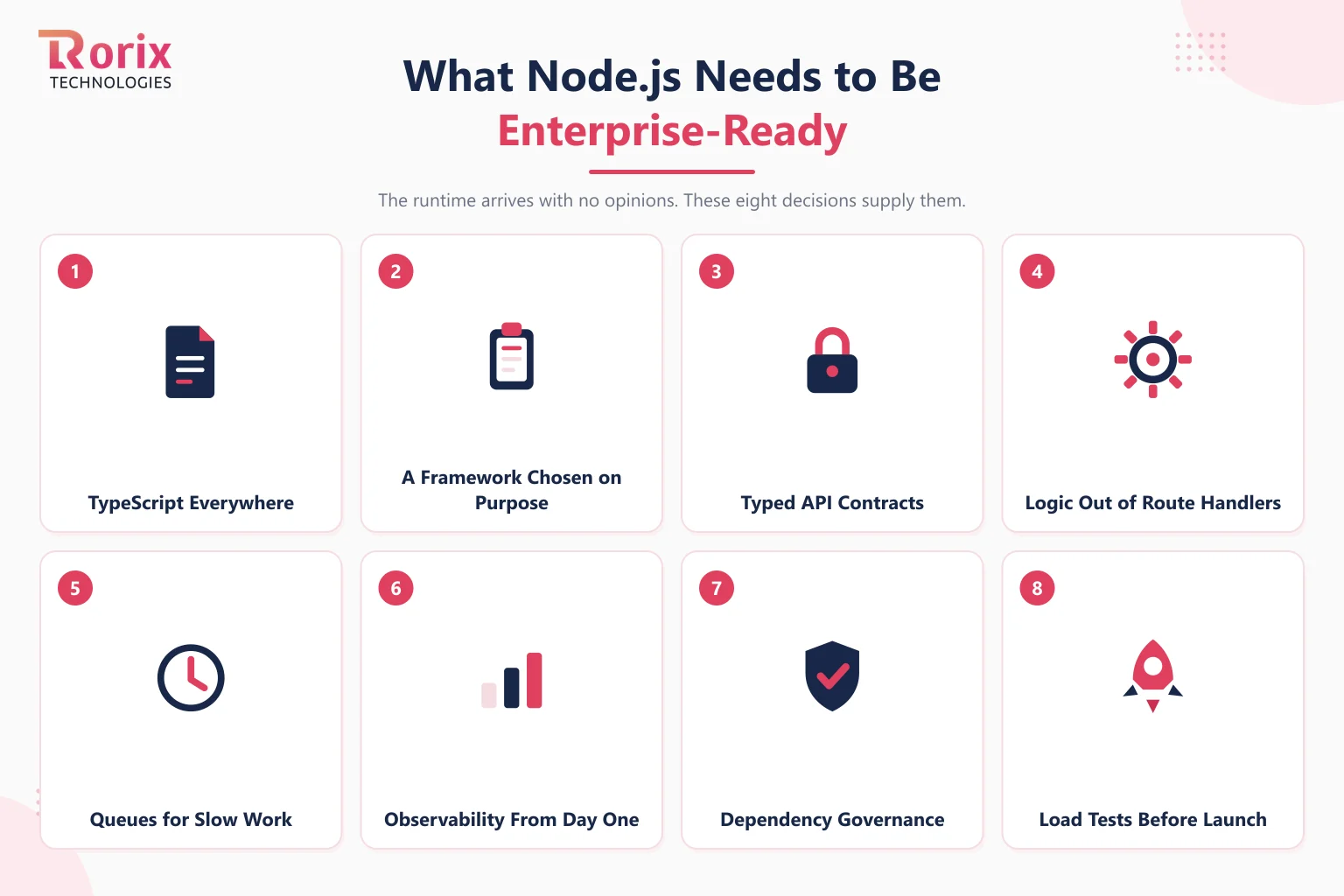
- TypeScript everywhere: at 43.6% adoption in the Stack Overflow survey, typed Node is the mainstream way serious backends get built, and on an API surface the types double as living documentation of every contract.
- A framework chosen on purpose: minimal Express with your own structure, or NestJS with structure built in. Either works; drifting between both in one codebase does not. Decide once, based on team size and how much convention you want the framework to carry.
- Typed API contracts: schemas validated at every boundary, so bad data is rejected at the edge instead of discovered three services deep.
- Logic out of route handlers: thin routes, a real service layer, and one data-access path. The fastest test of a Node codebase's health is opening three route files and seeing how much business logic lives there.
- Queues for slow work: anything slower than a database read, PDF generation, bulk imports, third-party syncs, belongs on a queue, off the request path, where it can retry and scale independently.
- Observability from day one: structured logs, metrics, and error tracking wired before launch. An event-driven system without observability fails mysteriously, because the stack trace rarely points at the cause.
- Dependency governance: lockfiles committed, automated audits in CI, and a curation habit that asks whether each new package earns its place in the tree.
- Load tests before launch: know the ceiling before your customers find it, using the volumes discovery wrote down rather than the volumes everyone hopes for.
How to Build an Enterprise Backend on Node.js
The sequence is the backend-specific version of the delivery discipline in our custom software development process guide, and its logic is the same: front-load the decisions that are expensive to reverse.
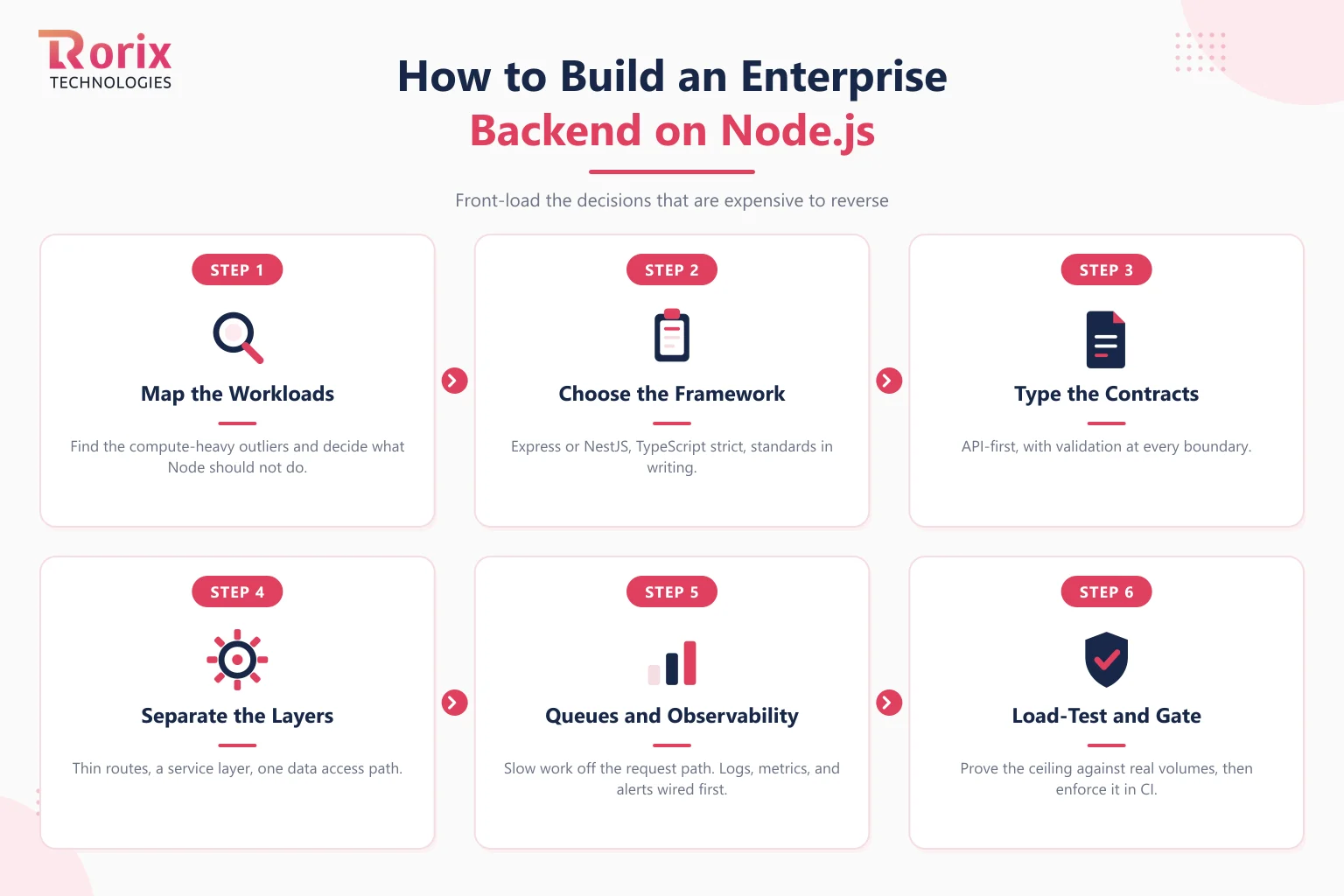
Step 1: Map the Workloads Before Writing Code
List what the system actually does and mark anything compute-heavy, because those items need a plan that is not "the event loop will cope." This is also where service boundaries get their first honest draft: what stays in the Node core, what runs behind a queue, and what belongs in a different runtime entirely.
Step 2: Choose the Framework and Write the Standards
Express, NestJS, or Fastify, decided against team size and how much structure you want enforced rather than assembled. Then the standards that make the choice stick: strict TypeScript, linting in CI, and a project layout documented well enough that the second team ships code shaped like the first team's.
Step 3: Type the Contracts Before the Endpoints
Define the API schema first and generate validation from it, so every boundary rejects malformed data on arrival. Contract-first sounds like ceremony until the first integration partner builds against a stable spec while your implementation is still moving, at which point it starts paying rent.
Step 4: Separate the Layers While the Codebase Is Small
Routes stay thin, business logic lives in services, data access goes through one path, and configuration comes from the environment with secrets nowhere near the repository. None of this is glamorous, and all of it is ten times cheaper at week two than at engineer ten.
Step 5: Wire Queues and Observability Before Go-Live
Slow work moves to queues with retry behavior you have actually tested, and structured logging, metrics, and alerting go live before users do. The difference between a five-minute incident and a five-hour one is almost always whether the system could explain itself when it failed.
Step 6: Load-Test Against Real Volumes and Gate in CI
Prove the ceiling against the traffic numbers discovery committed to, fix what buckles, and then wire the protections into CI: type checks, tests on the money paths, dependency audits. A backend that passed a load test once is a fact; a pipeline that re-proves it on every change is a discipline.
What Are the Signs a Node.js Backend Is in Trouble?
Each of these is checkable in an afternoon of code review, and every one of them is a governance gap before it is a technical one.
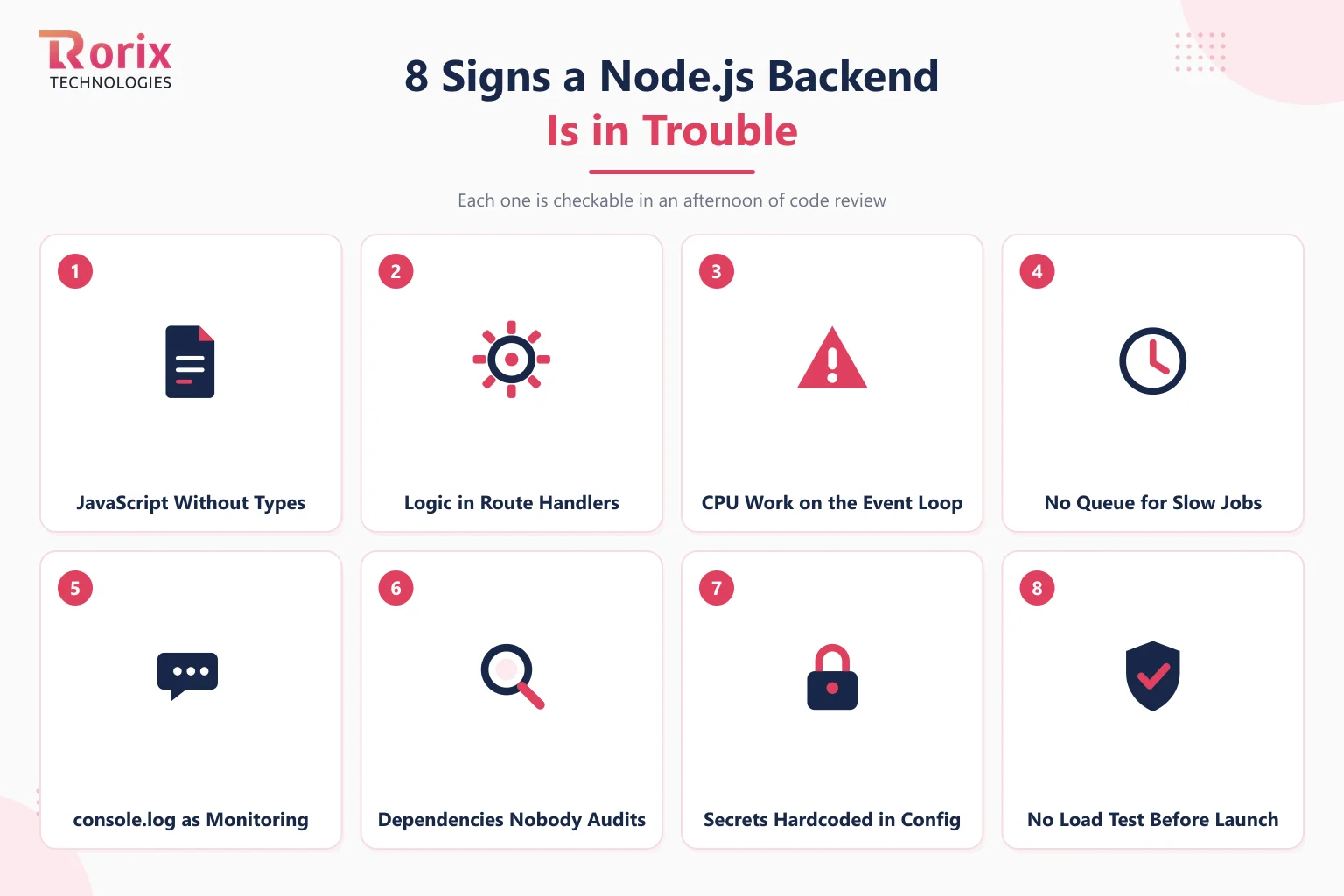
- JavaScript without types: every API contract lives in someone's memory, and every refactor is an act of faith.
- Logic in route handlers: the business rules are welded to the HTTP layer, so nothing can be tested or reused without standing up the whole server.
- CPU work on the event loop: one heavy request degrades every user at once, and the symptom shows up far from the cause.
- No queue for slow jobs: bulk imports and report generation run inside web requests, and timeouts are treated as weather.
- console.log as monitoring: the system cannot explain itself, so incidents get diagnosed by adding more logging and waiting for the failure to happen again.
- Dependencies nobody audits: the tree has a thousand packages, no one can say which are load-bearing, and the first audit happens after the first incident.
- Secrets hardcoded in config: credentials live in the repository, which means every past contractor still effectively has them.
- No load test before launch: the ceiling gets discovered in production, by customers, at the worst possible hour.
Two or more of these on a system you depend on, and the cheapest time to fix them was last quarter; the second cheapest is now.
How Rorix Builds Node.js Backends
Our dedicated development teams run Node.js and .NET side by side in production, which keeps the recommendation honest: the runtime follows the workload, and we will argue you out of Node where the evidence points elsewhere.
- Integration depth as evidence: 40+ integrations on Driven, a US performance platform for pest control and field service teams, with iOS and Android shipped from a single React Native codebase, on an event-driven Node.js backend serving real-time dashboards.
- Full-stack TypeScript, proven: our HRMS platform runs TypeScript end to end, React in front and Node with Express and PostgreSQL behind, with the same engineers moving across the whole stack.
- Senior-owned architecture: a dedicated team of senior engineers with a named technical lead on every engagement, workload mapping before framework debates, and decisions logged as they are made.
- A verifiable record: 27 projects delivered, a 5.0 rating on Clutch across 4 verified reviews, and clients across the US, UK, Canada, Australia, and New Zealand.
If the goal is a paying customer fast, our SaaS development engagements target a SaaS MVP ready for a first paying customer in 12 weeks on exactly this stack. Book a free consultation and bring your integration list. It is usually the fastest way to find out what your backend actually needs to be good at.
Match the Runtime to the Workload and Budget for Discipline
Node.js earned its place in enterprise backends by being exceptionally good at what most of them actually do: waiting on many things at once and moving data between them quickly. The hiring pool, the ecosystem, and the full-stack TypeScript story are compounding advantages on top of a genuinely well-matched engine.
What it never supplies is judgment. The runtime will not stop compute work from strangling the event loop, will not audit its own dependency tree, and will not move slow jobs onto a queue. Those are decisions, and the difference between the Node backends that scale for years and the ones that become cautionary tales is that someone made those decisions early, wrote them down, and enforced them.
Match the runtime to the workload. Budget for the discipline. And if you want a second opinion on either, talk to our engineers.
Frequently Asked Questions
Is Node.js good for an enterprise backend?
Yes, for the I/O-heavy work most enterprise backends consist of: API layers, integrations, real-time data, and standard business operations. It needs discipline supplied by the team, TypeScript, layered structure, queues, and observability, and it should not be the default for compute-heavy services, which belong behind a boundary in a runtime built for them.
What workloads is Node.js not suited for?
Heavy computation: image and video processing, large-scale calculations, and any task that occupies the CPU for long stretches. Node's event loop serves everyone from one line, so a single compute-heavy request degrades every user at once. Offload that work to queues, worker services, or a different runtime, and keep the Node core doing what it does best.
Which Node.js framework should an enterprise use, Express or NestJS?
Express gives you a minimal core and full freedom, which suits senior teams with their own conventions; NestJS builds the structure in, with TypeScript-first architecture and dependency injection, which suits larger teams that want the framework to enforce consistency. NestJS sits at 6.7% adoption in the Stack Overflow survey and rising. Either works; mixing both in one codebase does not.
Should an enterprise Node.js backend use TypeScript?
Yes, as a requirement. TypeScript sits at 43.6% adoption in the Stack Overflow survey, typed Node is how serious backends get built, and on an API surface the types are executable documentation of every contract. A backend is where wrong data becomes wrong money, which makes it the last place to rely on runtime discovery of type mistakes.
How does Node.js handle background jobs and scheduled work?
Through queues, and the pattern is non-negotiable at enterprise scale: anything slower than a quick database operation moves off the request path onto a queue with retries, scheduling, and independent scaling. The tooling is mature and the pattern is well worn; the failures come from teams that run bulk work inside web requests instead.
Is npm safe for enterprise use?
Yes, managed; no, unmanaged. The ecosystem's breadth is a real advantage and a real attack surface, so enterprise use means committed lockfiles, automated dependency audits in CI, and a habit of asking whether each new package earns its place. Treat dependency governance as a standing budget line and npm stays an asset.
Should we choose Node.js or .NET for an enterprise backend?
Match the runtime to the workload. Integration-heavy, real-time, or full-stack TypeScript ambitions favor Node.js; compute-heavy services and platforms whose defining requirement is decades of transactional correctness make a strong case for .NET. We run both in production and wrote up the honest comparison, linked above, from projects on each side.
What team does an enterprise Node.js backend need?
A senior lead who owns the architecture and the workload map, engineers fluent in TypeScript and asynchronous patterns, and named ownership of the dependency tree and the observability stack. The full-stack TypeScript story means one hiring profile can cover both tiers, which is a real advantage for lean teams, covered further in our guide to IT staff augmentation.
Need engineers who stay?
Dedicated developers at $3,500 per developer per month, working your backlog on 2-week sprints with a named technical lead.
Continue learning
Written by
Renish DadhaniyaFounder & Director, Rorix Technologies
Renish co-founded Rorix Technologies and drives the engineering and delivery culture across the organization. Beyond engineering, he leads the company's sales, finance, and HR operations, building the infrastructure that lets the team focus on shipping quality software. With deep hands-on expertise in architecture and team building, he ensures every project lands on time to the quality standards clients demand.
View full profileRelated articles
Node.js vs .NET for Enterprise Backends: A 2026 Comparison from Engineers Who've Used Both
An honest, project-grounded comparison of Node.js and .NET for enterprise backends in 2026, from an engineering team that runs both in production daily.
Read article
NestJS vs Express: Which Node.js Framework Fits Your Backend?
NestJS runs on Express by default, so this is not a performance contest. It is a decision about where your backend structure comes from, and who maintains it.
Read article
In-House vs Outsourcing Software Development: Cost, Speed, and Control Compared (2026)
Compare in-house vs outsourcing software development on cost, speed, control, risks, and the hybrid model with a practical 2026 decision guide.
Read article