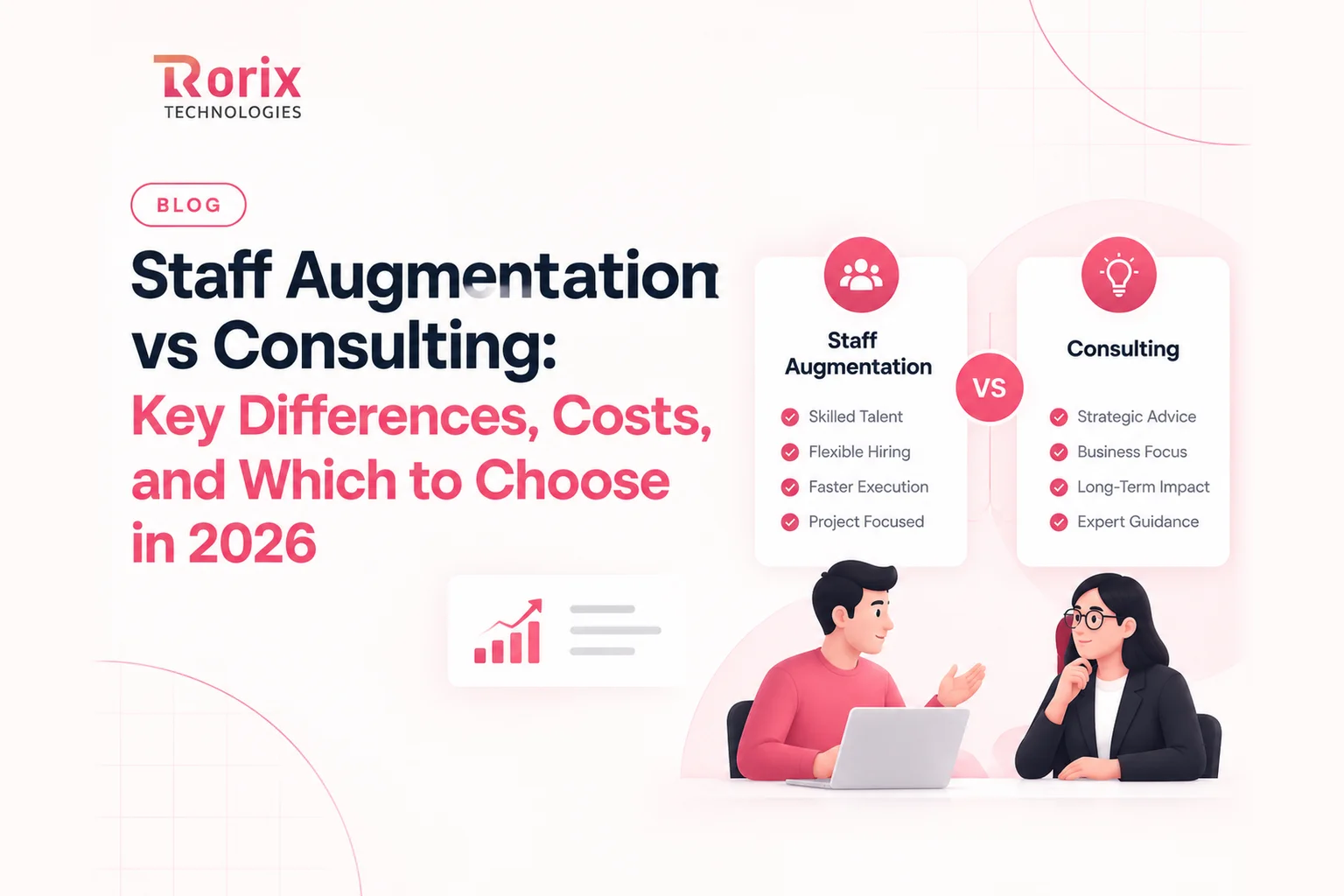
Staff Augmentation vs Consulting: Key Differences, Costs, and Which to Choose in 2026
Staff augmentation vs consulting compared: who directs the work, who owns delivery, Clutch rate ranges, a six-month cost example, and when to combine both.
On this page52 sections
Key Takeaways: Staff Augmentation vs Consulting
The right model depends on whether you need more engineering capacity, expert guidance, or both.
- Staff augmentation: Add skilled engineers to execute your plan under your team's direction.
- IT consulting: Get expert advice, technical strategy, or delivery against agreed outcomes.
- Hybrid model: Use consulting to define the plan, then bring in engineers to build it.
- Cost and risk: Compare total project costs, management effort, and delivery responsibilities, not just hourly rates.
- Ownership matters: Set clear terms for IP ownership, deliverables, and knowledge transfer before signing.
The deciding question: Are you short on people to execute the plan or expertise to define it?
Your project is falling behind, but the problem may not be a lack of developers. You might need skilled people to execute your plan, or expert guidance to decide what to build and how to build it.
That is why the staff augmentation vs consulting decision matters. Staff augmentation adds skilled professionals to your existing team, while IT consulting helps you solve problems, define strategy, and make better technical decisions.
Choosing the wrong model can waste budget, delay delivery, and leave ownership unclear. The right choice depends on your project goals, skill gaps, and how much control you want to retain.
In this guide, you'll learn:
- 10 key differences between staff augmentation and IT consulting
- How to identify capacity gaps vs. capability gaps
- A 15-point comparison and an 8-scenario decision matrix
- Market cost ranges and a six-month cost example
- When to choose either model or combine both
By the end, you'll know which engagement model fits your needs, what it may cost, and how to keep project ownership and knowledge within your business.
What Is Staff Augmentation?
Staff augmentation lets you bring vetted engineers into your existing team without managing a full-time hiring process. They join your standups, work in your repositories, and follow your technical lead's decisions while you retain control over the backlog, code reviews, and project outcomes.
You typically pay by the hour or month and can scale resources based on project needs, subject to the contract's notice period. The partner handles recruitment, payroll, and replacements, helping you fill skill gaps without long-term hiring commitments.
For a deeper explanation, see our guide to what IT staff augmentation is. If you also need technical leadership and delivery management, explore our dedicated development teams.
Our staff augmentation vs dedicated team comparison explains the difference between these models. Here, we compare staff augmentation with IT consulting and explain when each approach makes sense.
What Is IT Consulting?
IT consulting is an engagement where an outside firm studies a business or technical problem and supplies the judgment to solve it. Depending on the contract, the firm hands you a recommendation, a roadmap, or a working system it designed and delivered.
That range is why buyers often treat consulting vs staff augmentation as interchangeable when they are not. A two-day architecture review and a nine-month build can both be sold as consulting, yet they carry very different prices and ownership terms.
1. Advisory Consulting
Experts review your technology stack, assess vendor proposals, or help with build-vs-buy decisions. Your team handles implementation.
2. Assessment and Discovery Consulting
The firm evaluates your systems and delivers findings, a target architecture, and a phased roadmap, often for a fixed fee.
3. Implementation Consulting
The firm designs and builds the solution against agreed deliverables in a statement of work (SOW). If it also manages the system after launch, see our staff augmentation vs managed services guide.
Capacity Gap or Capability Gap: Which Model Do You Need?
The staff augmentation vs consulting decision often comes down to one question: do you need more people to execute a clear plan, or expert guidance to figure out the right plan?
A capacity gap means your roadmap, backlog, and technical direction are clear, but you lack enough engineers to deliver on time. Staff augmentation helps you add skilled professionals without changing who manages the work.
A capability gap means your team lacks the expertise to define the solution or make critical technical decisions. IT consulting helps you assess the problem, develop a strategy, and decide what to build before adding execution resources.
| Signal | Capacity Gap | Capability Gap |
|---|---|---|
| Roadmap | Clear and agreed | Missing or uncertain |
| Technical leadership | Available | Missing or lacks relevant expertise |
| Main problem | Not enough people | Not enough expertise |
| What you need | Additional engineers | Expert guidance |
| Best-fit model | Staff augmentation | Consulting, then possibly augmentation |
Ownership matters, too. With a capacity gap, your team directs the work and owns technical decisions. With a capability gap, the consulting firm provides the expertise and should be accountable for the agreed deliverables.
Also Read: In-House vs Outsourcing Software Development: Cost, Speed, and Control Compared (2026)
Staff Augmentation vs Consulting: 15-Point Comparison Table
This staff augmentation vs consulting comparison covers the factors that affect cost, control, delivery, and project ownership. The right model depends on whether you need extra execution capacity or outside expertise.
| Factor | Staff Augmentation | IT Consulting |
|---|---|---|
| What you buy | Skilled professionals | Expertise, strategy, or delivery |
| Gap it fills | Limited capacity | Limited expertise |
| Daily direction | Your technical lead | Consulting firm's engagement lead |
| Methodology | Your processes | Firm's approach |
| Team integration | Works within your team | Usually works as a separate team |
| Outcome ownership | Your team owns delivery | Firm owns agreed SOW deliverables |
| Pricing | Hourly or monthly per professional | Hourly, fixed fee, milestones, or retainer |
| Contract | Staffing agreement | Statement of work (SOW) |
| Time to start | Days to a few weeks | Often a few weeks, including discovery |
| Typical duration | Short-term or ongoing | Defined project or engagement phase |
| Scope changes | Your lead redirects tasks | May require a change request and added fees |
| Your management effort | Higher, with daily direction | Lower, with milestone reviews |
| System access | Your tools and access controls | Access depends on the engagement |
| IP ownership | Governed by contract; typically project code belongs to you | Custom work and pre-existing frameworks follow contract terms |
| Knowledge transfer | Integrated into your team | Depends on documentation and handover terms |
Two factors often settle the decision: who is accountable for the outcome and how much management time your team can commit. Use these to narrow your options before comparing rates.
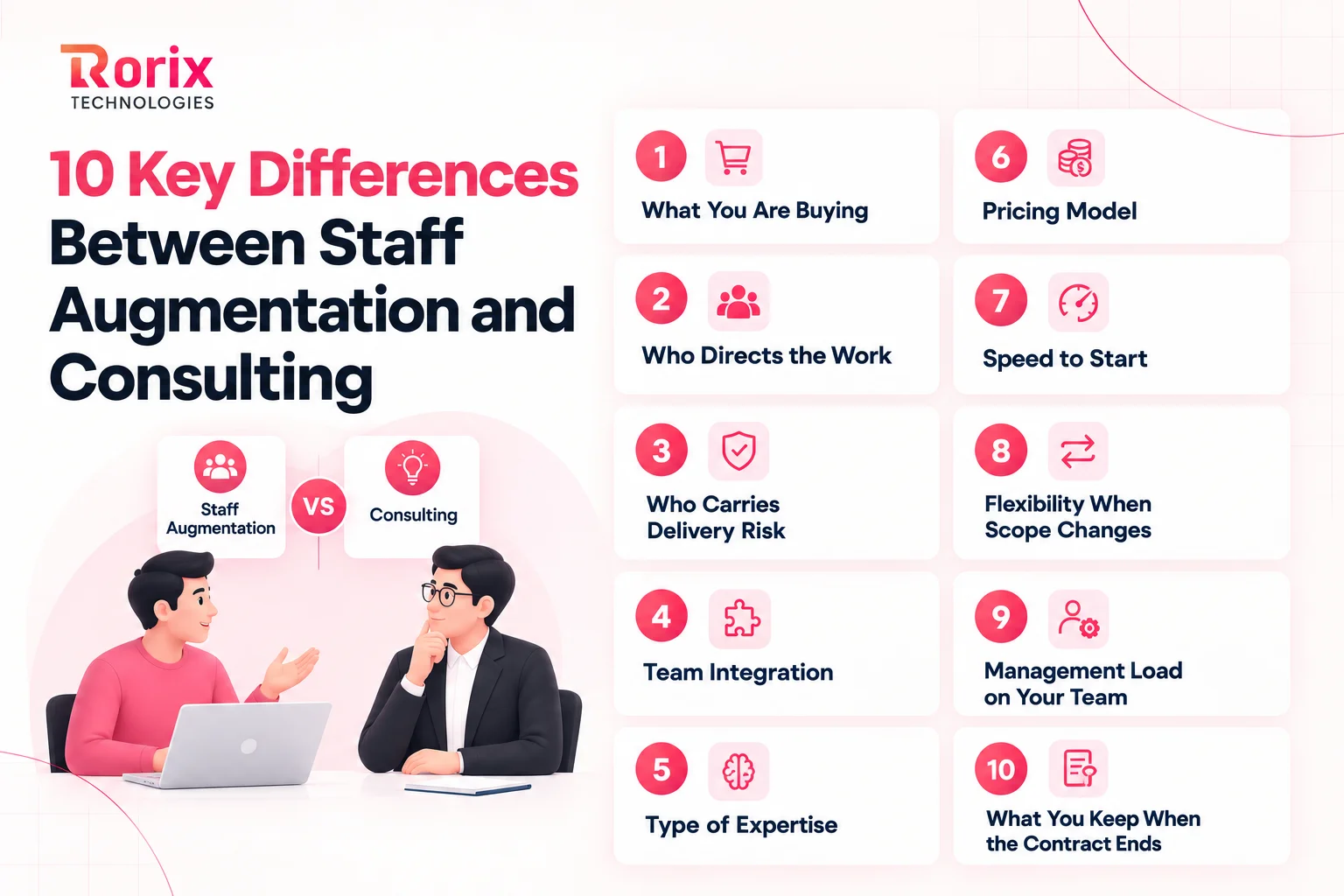
10 Key Differences Between Staff Augmentation and Consulting
The main difference in staff augmentation vs consulting is who provides direction, owns delivery, and manages risk. Here are the 10 differences that matter most.
1. What You Are Buying
Staff augmentation gives you skilled professionals to execute work your team has already planned. You pay for their time and expertise, not a guaranteed project outcome.
IT consulting provides expert judgment, a roadmap, or a completed solution. You pay for the expertise and deliverables defined in your agreement.
2. Who Directs the Work
With staff augmentation, your technical lead assigns tasks, sets priorities, and reviews code. Your team remains responsible for daily direction.
With consulting, the firm's engagement lead manages execution. Your team focuses on decisions, approvals, and milestone reviews.
3. Who Carries Delivery Risk
With staff augmentation, your company remains responsible for delivery, even when augmented engineers complete the assigned work. The contract typically covers resources and replacement terms.
Consulting can transfer responsibility for agreed deliverables through a fixed-fee or milestone-based statement of work (SOW). Hourly advisory contracts generally leave implementation risk with you.
4. Team Integration
Augmented engineers work in your tools, repositories, and workflows alongside your existing team. This helps build product knowledge within your company.
Consultants often work as a separate team, bringing an outside perspective. Include documentation and knowledge-sharing sessions to retain their expertise.
5. Type of Expertise
Staff augmentation suits defined tasks that require specific skills, such as a React Native developer for an app release or a data engineer for warehouse integrations.
Consulting works better when your team needs specialist guidance, help with architecture decisions, or lessons from similar projects. It helps when the right solution is not yet clear.
6. Pricing Model
Staff augmentation typically uses hourly or monthly rates per professional. Costs depend on team size, engagement length, and required skills.
Consulting may use hourly rates, fixed fees, retainers, or milestone payments. The price depends on expertise, scope, deliverables, and delivery responsibility.
7. Speed to Start
Staff augmentation can begin within days to a few weeks when suitable engineers are available and access is ready. Your team must already know what needs to be built.
Consulting may take a few weeks to assess the problem, agree on scope, and plan the engagement. Complex projects may require more discovery time.
8. Flexibility When Scope Changes
You can usually redirect augmented engineers during sprint planning as priorities change, subject to their skills and contract terms. Major changes to roles or resources may still require approval.
Consulting changes often require a formal change request, revised timeline, or additional fees. This works well for defined deliverables but can slow rapidly changing projects.
9. Management Load on Your Team
Staff augmentation requires your lead to manage tasks, review work, and resolve blockers. Without enough management capacity, adding engineers may not improve delivery speed.
Consulting usually needs less day-to-day supervision because the firm's engagement lead manages execution. Your team still needs to make decisions and review deliverables.
10. What You Keep When the Contract Ends
With staff augmentation, code, documentation, and decisions can remain in your repositories and workflows. Confirm intellectual property rights and access terms in the contract.
With consulting, knowledge transfer depends on the agreed handover, documentation, and training. Include these deliverables in the SOW to avoid losing important context when the engagement ends.
Staff Augmentation vs Consulting: Pros and Cons
In staff augmentation vs consulting, the right choice depends on your team's skills, management capacity, and delivery responsibilities.
Staff Augmentation Pros and Cons
Pros
- Quick access to skills: Add vetted engineers in days or weeks without a lengthy hiring process.
- More control: Your team manages priorities, workflows, and technical decisions.
- Flexible scaling: Add or reduce resources according to project needs and contract terms.
- Knowledge retention: Code and project context stay within your team's workflows and repositories.
Cons
- Requires strong leadership: Engineers need clear direction, reviews, and support to deliver effectively.
- Delivery risk stays with you: Your company remains responsible for project outcomes.
- Onboarding takes time: Engineers need access, documentation, and product context before reaching full productivity.
- Limited strategic guidance: Augmented engineers primarily execute your plan rather than define it.
- Management effort increases: More engineers require additional coordination and reviews.
Consulting Pros and Cons
Pros
- Specialist expertise: Get guidance from experts who have handled similar technical challenges.
- Objective advice: Consultants can identify problems your internal team may overlook.
- Defined deliverables: A milestone-based SOW can hold the firm accountable for agreed outcomes.
- Less daily supervision: The firm's engagement lead manages its team and execution.
- Faster decision-making: Discovery consulting can clarify complex problems and establish a practical roadmap.
Cons
- Higher engagement costs: Fees may include strategy, project management, and delivery responsibilities.
- Longer setup: Discovery and scope definition can delay the start of implementation.
- Less flexibility: Scope changes may require contract revisions and additional fees.
- Knowledge transfer risks: Without proper documentation and handover, expertise can leave with the consultants.
- Framework limitations: The firm's pre-existing tools and methods may remain its intellectual property.
Also Read: Cost of Outsourcing Software Development: Complete Pricing Breakdown 2026
Staff Augmentation vs Consulting Cost: What Each Model Really Costs
Hourly rates don't tell the full story. Compare pricing models, market ranges, and the hidden costs that affect your total project budget.
1. How Each Model Is Priced
Staff augmentation usually charges by the hour or month for each engineer. Consulting may use hourly rates, fixed fees, milestones, or retainers, depending on the work and delivery responsibility.
| Pricing Model | Used In | How It Works | Risk Sits With |
|---|---|---|---|
| Time and materials | Staff augmentation | Pay hourly or monthly per engineer | You |
| Hourly or daily advisory | Advisory consulting | Pay for expert time | You |
| Fixed-fee discovery | Assessment consulting | Pay an agreed fee for findings and a roadmap | Shared |
| Milestone SOW | Implementation consulting | Pay as deliverables meet acceptance criteria | Mostly the firm |
| Retainer | Ongoing advisory | Pay monthly for reserved expert time | Shared |
Generally, contracts tied to outcomes place more delivery responsibility on the consulting firm and may cost more than time-based engagements.
2. Market Cost Ranges for Both Models
These are market ranges, not Rorix pricing. The figures come from Clutch's IT Staff Augmentation Pricing Guide (2026) and Business Consulting Firm Pricing Guide (2026), based on verified client reviews. Clutch publishes no separate IT consulting guide, so the consulting column uses its business consulting figures.
| Cost Line | Staff Augmentation | Consulting |
|---|---|---|
| Clutch average rate | $25 to $49 per hour | $25 to $49 per hour overall; $100 to $149 per hour for business strategy and management consulting |
| US rate | $25 to $49 per hour | $100 to $149 per hour (US and Canada) |
| Typical engagement size | $50,000 to $199,999 per project | Not published by Clutch |
| Billing unit | Engineer hour or month | Hour, day, fixed fee, milestone, or retainer |
Rates vary by seniority, location, and scope. For regional and experience-based benchmarks, see our IT staff augmentation cost breakdown.
3. What Rorix Charges
Rorix offers staff augmentation and dedicated capacity at $20 to $30 per hour, depending on the complexity tier. Its published retainer options include:
- One developer with a shared project manager: $3,500 per month
- Three developers plus a dedicated project manager: $10,000 per month
- Five developers plus a dedicated project manager: $16,000 per month
- Ten developers plus a dedicated project manager: $30,000 per month
- Commitment discounts: 5% for three months, 10% for six months, and 15% for twelve months
Every retainer plan includes a project manager, an NDA from day one at no extra cost, and 100% IP transfer as work is delivered and paid for. Infrastructure and DevOps remain your responsibility, while technology consulting is scoped and quoted separately without a build commitment.
To estimate your budget, use the Get a Project Cost Estimate tool or review the full retainer pricing.
4. Worked Example: Staff Augmentation, Consulting, or Hybrid Over Six Months
Consider a distributor planning a warehouse returns workflow. The team has six months to deliver it but hasn't decided whether the returns logic belongs in the warehouse system or ERP.
The following example uses an augmented engineer rate of $45 per hour and a consultant rate of $125 per hour, with 160 hours per month. These are illustrative market figures, not quotes.
| Route | What You Pay For | Indicative Cost | Delivery Risk |
|---|---|---|---|
| A. Staff augmentation only | 3 engineers for 6 months (2,880 hours) | $129,600 | You |
| A with one rework cycle | Same team plus 2 months of rework (960 hours) | $172,800 | You |
| B. Consulting only | 3 consultants for 6 months (2,880 hours) | $360,000 | Mostly the firm, under a milestone SOW |
| C. Hybrid model | 2 consultants for 1 month of discovery (320 hours), then 3 engineers for 5 months (2,400 hours) | $148,000 | Split by phase |
The hybrid model costs $18,400 more than staff augmentation alone, but $24,800 less than augmentation with rework and $212,000 less than consulting for the entire project.
These estimates exclude your own team's management time. Staff augmentation and hybrid delivery still require internal leadership, making that an important part of the total cost.
5. Hidden Costs That Change the Total
The quoted rate is only part of your budget. Management time, onboarding, rework, scope changes, and knowledge transfer can significantly affect the final cost.
- Management time: Engineers need direction, reviews, and support from your team.
- Ramp-up time: New engineers need access, onboarding, and codebase knowledge before reaching full productivity.
- Rework: Unclear requirements or architecture can turn paid engineering hours into wasted effort.
- Change requests: Consulting scope changes may add fees and delay delivery.
- Handover gaps: Missing documentation can make knowledge expensive to recover after the engagement ends.
Now that you've seen what each route really costs, let's take a look at how to choose the right one for your project.
How to Choose Between Staff Augmentation and Consulting
Choose based on your biggest gap: execution capacity, technical expertise, or both. Use these signals and scenarios to find the right fit.
When Staff Augmentation Is the Right Choice
Staff augmentation works best when your plan is clear, but your team lacks the people to execute it.
- Your roadmap is ready: Requirements and architecture are agreed.
- You have a technical lead: Someone can manage tasks and review code.
- Deadlines are tight: You need skilled engineers without a lengthy hiring process.
- A specific skill is missing: You need a mobile, backend, or data specialist.
- Workload changes: You need to scale resources up or down.
- Control matters: Your team needs to manage its code, systems, and workflows.
- Product knowledge matters: You want expertise to build up within your company.
When Consulting Is the Right Choice
IT consulting fits when your team needs expert guidance before it can confidently plan or execute the work.
- The problem is unclear: You know the symptoms but not the solution.
- Expertise is missing: Your team lacks experience with the technical challenge.
- Decisions carry high risk: You need an outside review before a migration or platform choice.
- You need delivery accountability: A firm must own specific deliverables under an agreed SOW.
- The work is specialized: You need expertise for a one-time assessment or compliance project.
- Teams disagree: An independent view can help resolve competing recommendations.
- Several departments are involved: You need a coordinated plan across IT, finance, and operations.
The Five-Question Test Before You Decide
Answer these questions before comparing vendors. They help identify whether you need extra capacity, expert guidance, or both.
- Do you know what to build? A clear backlog points to staff augmentation; an unclear solution points to consulting.
- Can your technical lead manage more people? If not, free up management capacity or consider a consulting firm with its own delivery lead.
- Who owns the outcome? If your team owns delivery, augmentation may fit. If the firm must deliver agreed results, define accountability in a milestone-based SOW.
- How likely is the scope to change? Augmentation offers flexibility to redirect work, while consulting changes may require revised scope, timelines, and fees.
- Where should the knowledge stay? Augmentation integrates knowledge into your team; consulting requires clear documentation and handover terms.
If most answers point to one model, start there. If your team needs expert direction first and engineering capacity afterward, consider a hybrid approach.
Decision Matrix: 8 Common Scenarios
Use these examples to match the engagement model to your actual project needs.
| Scenario | Better Fit | Why |
|---|---|---|
| Your WMS rollout spec is signed, but development is behind schedule | Staff augmentation | The plan is clear; you need more engineers |
| You're choosing between custom warehouse management software and an off-the-shelf platform | Advisory or discovery consulting | You need expert input before committing |
| A SaaS founder has a product idea but no technical cofounder | Consulting first, then a dedicated team | Define the architecture before building |
| HRMS payroll integrations are piling up, and your lead has capacity | Staff augmentation | The work is known and internally managed |
| An undocumented legacy system needs migration | Discovery consulting, then augmentation | Map the system before planning development |
| Your company is preparing for its first SOC 2 or HIPAA readiness program | Consulting | Specialist guidance helps establish the approach |
| You need a React Native specialist for a three-month release | Staff augmentation | You need one specific skill for a defined period |
| Leadership wants AI in operations but hasn't chosen a use case | Consulting | Identify the right use case before adding developers |
The right choice becomes clearer when you identify the gap. For projects that need both strategic direction and execution, a hybrid model may be the better fit.
Also Read: How to Hire a Dedicated Development Team: The Complete 2026 Guide
The Hybrid Model: Consulting for the Plan, Staff Augmentation for the Build
The hybrid model combines consulting for expert direction with staff augmentation for execution. It closes the capability gap first, then adds engineers once the plan is clear.
How a Hybrid Engagement Runs, Phase by Phase
- Define the goal and budget: Set a measurable business outcome, deadline, and budget before hiring either team. This gives discovery a clear direction.
- Start with discovery: Engage consultants to assess your systems, compare options, and recommend an architecture. Require a target architecture, phased roadmap, and cost estimates as deliverables.
- Turn the plan into a backlog: Work with consultants and your technical lead to define development tasks, priorities, and acceptance criteria before the handover.
- Bring in augmented engineers: Add engineers to execute the approved backlog under your lead. With major decisions settled, the team can focus on development instead of debating the approach.
- Review progress and retain knowledge: Use milestone reviews to catch issues early. Keep code, architecture decisions, documentation, and runbooks accessible to your internal team.
When the Reverse Order Makes Sense
Sometimes, an augmented team encounters a problem it cannot solve with its existing expertise, such as a new compliance requirement or an unfamiliar integration.
Bring in consultants to resolve that specific issue while engineers continue other work. Once the team has a clear solution, development resumes without paying consulting rates for the entire project.
Now that you've seen how the two models work in sequence, let's take a look at the contract terms that protect you in either one.
Contracts, IP, and Knowledge Transfer: What to Settle Before You Sign
Clear contract terms protect your budget, delivery, and ownership. Settle them before work begins, not after problems arise.
Staff Augmentation Contract Terms
A staffing agreement should clearly define rates, responsibilities, and exit terms. Confirm these five points before signing:
- Rate and inclusions: Confirm whether the hourly or monthly rate includes code review, QA, and project management.
- Notice period: Define how quickly you can scale down and whether the contract is flexible or fixed-term.
- Replacement window: Agree on how quickly the partner will replace an engineer who leaves or underperforms.
- IP assignment: Ensure code ownership transfers to you as each piece of work is delivered and paid for, not only at the end of the engagement.
- Confidentiality and non-solicit: Require an NDA from day one and clarify rules for hiring each other's employees.
Consulting SOW Terms
A statement of work (SOW) should define exactly what the consulting firm must deliver. Make these five terms clear before signing:
- Named deliverables: Specify outputs, such as an architecture document or working module, rather than vague activities.
- Acceptance criteria: Define how each deliverable will be tested and approved before payment.
- Change-request pricing: Set out how scope changes are estimated, approved, and charged before work begins.
- Knowledge-transfer milestone: Require documentation and working sessions before final payment.
- Offboarding window: Agree on a post-delivery period when the firm remains available for questions.
IP Ownership and Knowledge Transfer
Neither staff augmentation nor consulting guarantees ownership by itself. In augmentation, ensure the contract assigns code and other agreed work to your business as each piece is delivered and paid for.
Consulting contracts may treat custom deliverables differently from pre-existing frameworks, tools, and methods. Confirm which assets you own, which are licensed, and whether you can reuse the firm's approach independently.
For both models, assign an internal counterpart and require a decision log, technical documentation, and a clear handover. This keeps critical knowledge within your business after the engagement ends.
8 Questions to Ask Any Partner Before You Sign
Ask these questions to check accountability, costs, and ownership before choosing a partner. For broader vendor checks, read our guide on how to choose a custom software development company.
- Who will work on our account, and can we meet them before signing?
- Who is responsible if a deliverable fails acceptance?
- What does the rate include, and what costs extra?
- How quickly can you replace someone who leaves mid-engagement?
- How are scope changes approved and priced?
- Who owns the code, documentation, and pre-existing frameworks?
- What documentation and knowledge transfer will we receive?
- Can the engagement shift between augmentation and consulting as our needs change?
A partner who gives clear answers about delivery accountability and IP ownership is worth a closer look.
Why Choose Rorix Technologies for Staff Augmentation and Technology Consulting?
Choosing between extra engineering capacity and expert technical guidance can slow a project when you need both. Rorix Technologies offers staff augmentation and technology consulting, so you can get the right support from planning through development.
Rorix Technologies has delivered 27 projects and holds a 5.0 Clutch rating across 4 verified reviews. We work with clients across the US, UK, Canada, Australia, and New Zealand, helping businesses solve technical challenges and move projects forward.
- One partner for planning and development: Add senior engineers to your sprints, or get technology consulting for architecture, technology stack, and vendor decisions, without committing to a build.
- Senior engineers with clear leadership: Work with a dedicated team of senior engineers and a named technical lead when you need delivery support, giving you clear direction and accountability.
- Visible progress every two weeks: Retainer engagements run in 2-week sprints, with task visibility and consistent engineering support throughout development.
- Results across real projects: WorkCenter Central, the platform we built for distributor Lorecs, cut manual errors by 80% and sped up order processing by 50%. We also connected 40+ integrations for Driven, a US performance platform for pest control and field service teams, including HubSpot, Twilio, RingCentral, and Google APIs.
- A practical route from idea to launch: We ship a working MVP in 6 to 12 weeks, depending on scope.
- Long-term engineering partnerships: Our founders have been DealSignal's engineering partner for 5+ years, continuing under Rorix.
- Your code and business stay yours: Engagements include an NDA from day one, 100% IP transfer as work is delivered and paid for, and month-to-month terms.
Need help deciding between staff augmentation and consulting?
Book a free consultation with our experts to discuss your goals, identify the right engagement model, and get a clear scope and price.
Conclusion: Choose the Right Model for Your Next Project
The right choice depends on what is holding your project back. Staff augmentation adds skilled engineers when your plan is clear, while IT consulting helps you make the right technical decisions when the path forward is uncertain. A hybrid model can give you both at the right stage.
Use the comparisons, cost examples, and decision matrix in this guide to identify your biggest gap. Before choosing a partner, confirm the budget, delivery responsibilities, IP ownership, and knowledge-transfer terms.
We hope this guide helps you understand staff augmentation vs consulting and choose an engagement model that fits your goals, team, and budget.
Need more engineers for your next sprint, expert guidance on your technical roadmap, or both? Connect with our experts to discuss your project and get a clear scope and price.
Frequently Asked Questions
What is the difference between staff augmentation and consulting?
Staff augmentation adds engineers to your team under your direction. Consulting provides expert advice, a roadmap, or agreed deliverables. The key difference is who directs the work and owns delivery.
Is staff augmentation cheaper than consulting?
Per hour, usually. Clutch puts staff augmentation at $25 to $49 per hour on average, and business strategy and management consulting at $100 to $149. Rework can still make augmentation more expensive overall.
Can you combine staff augmentation and consulting?
Yes. Use consulting to define the strategy and roadmap, then bring in engineers to build the solution. You can also add consultants when your development team faces a specialist challenge.
Who owns the code and IP in each model?
Ownership depends on the contract. Ensure it clearly assigns custom code and deliverables to your business, and explains any licensing limits on pre-existing tools or frameworks.
Which model can start faster?
Staff augmentation can often start within days to a few weeks when the scope is clear. Consulting may take a few weeks for discovery and planning before implementation begins.
Should a startup choose staff augmentation or consulting?
Choose staff augmentation if you have a clear product plan and technical leadership. If you need help with architecture or product decisions, start with consulting before adding developers.
Do consultants write code or only give advice?
Both are possible. Advisory consultants provide recommendations, while implementation consultants design and build solutions under a statement of work (SOW). Confirm the scope before signing.
How do you move from consulting to staff augmentation?
Ask consultants to turn the roadmap into development tasks with clear acceptance criteria. Then bring in engineers to execute the plan under your technical lead.
Need engineers who stay?
Dedicated developers at $3,500 per developer per month, working your backlog on 2-week sprints with a named technical lead.
Continue learning
Written by
Renish DadhaniyaFounder & Director, Rorix Technologies
Renish co-founded Rorix Technologies and drives the engineering and delivery culture across the organization. Beyond engineering, he leads the company's sales, finance, and HR operations, building the infrastructure that lets the team focus on shipping quality software. With deep hands-on expertise in architecture and team building, he ensures every project lands on time to the quality standards clients demand.
View full profileRelated articles
IT Staff Augmentation Cost: What You Actually Pay in 2026
IT staff augmentation cost in 2026: real hourly rates, the fully loaded math against a US in-house hire, and the six cost lines no rate card shows you.
Read article
Staff Augmentation vs Dedicated Team: Which Model Fits Your Roadmap?
You added the engineers and delivery still slipped. Compare staff augmentation vs dedicated team on delivery ownership, management load and continuity.
Read article
NestJS vs Express: Which Node.js Framework Fits Your Backend?
NestJS runs on Express by default, so this is not a performance contest. It is a decision about where your backend structure comes from, and who maintains it.
Read article