
What Is IT Staff Augmentation? The Model, the Trade-offs, and When to Use It
Need senior engineers now, without adding headcount? Here is how IT staff augmentation works, when it beats hiring or outsourcing, and when it does not.
On this page25 sections
The roadmap is committed for this quarter. The headcount request will not clear budget until the next one. Meanwhile the hiring pipeline for a senior engineer runs months, and the two people who could build the thing are already booked.
That gap is the whole reason IT staff augmentation exists. The US Bureau of Labor Statistics projects about 129,200 openings a year for software developers, quality assurance analysts, and testers through 2034, with employment growing 15 percent over the decade, much faster than the average occupation. Competing for permanent hires in that market is slow by design.
Staff augmentation is the answer to a narrow version of that problem: you need more engineering capacity under your own direction, and you do not need, or cannot yet justify, a permanent hire.
In this guide, you'll learn:
- What IT staff augmentation is, and what you are actually buying
- How the engagement works week to week
- How it differs from managed services and project outsourcing
- How it compares with hiring in-house
- When the model fits, and when it is the wrong call
- What actually drives the cost
- A 6-step setup, and the mistakes that waste the budget
Quick Answer: What IT Staff Augmentation Is and When to Use It
IT staff augmentation is a hiring model where a partner supplies vetted engineers who join your existing team and work under your management. You keep the backlog, the process, and the architecture decisions. The partner handles employment, payroll, and bench.
Use it when you have technical leadership in place and need capacity faster than you can hire it.
Avoid it when nobody internally can direct the work day to day, or when what you actually want is a finished deliverable rather than added hands.
What Is IT Staff Augmentation?
The clearest way to understand the model is by what does not change. Your sprint process, your definition of done, your code review standards, and your product decisions all stay exactly where they are. What changes is how many people are available to do the work.
An augmented engineer joins your standups, pulls from your board, commits to your repository, and reports to your lead. The partner's role is to find that person, employ them, cover payroll and benefits, replace them if the fit is wrong, and take them back when you no longer need the seat.
That is the distinction that matters commercially: you are buying capacity, not a deliverable. Every other difference between this and the alternatives follows from that one.
How Does IT Staff Augmentation Actually Work?
Most engagements follow the same shape, and knowing it up front is what keeps the first month from being wasted.
You define the role the way you would define an internal one: seniority, stack, domain exposure, and the specific work in the first quarter. The partner sends profiles, you interview and reject freely, and you onboard whoever you accept into your own tools, repositories, and rituals.
From there the work is indistinguishable from an internal team member's. Your lead assigns tasks, your reviews gate the merges, your retro covers their blockers. Billing runs monthly per engineer, and scaling down is a notice period rather than a redundancy process.
The one thing that stays with the partner is people risk. If someone leaves, resigns, or turns out to be the wrong fit, replacing them is their problem to solve, not a fresh hiring cycle for you.
IT Staff Augmentation vs Managed Services vs Project Outsourcing
These three get used interchangeably in sales conversations and they are not the same purchase. The table below separates them by the only question that matters: who is accountable for what.
| Staff augmentation | Managed services | Project outsourcing | |
|---|---|---|---|
| What you buy | Capacity | An ongoing function | A defined deliverable |
| Who owns the backlog | You | Shared, against an SLA | The vendor, against a scope |
| Who manages daily work | Your lead | The vendor's lead | The vendor's PM |
| Billed on | Per engineer, per month | Retainer or SLA tier | Fixed price or milestones |
| Where delivery risk sits | With you | Split | With the vendor |
| Scaling down | Notice period | Contract term | Project ends |
| Best for | Known work, in-house direction | Steady operational load | Bounded scope, clear spec |
The practical test: if you can write the tickets, augmentation works. If you can only describe the outcome, you want a project. If the work never ends and you would rather not think about it, you want managed services.
Also Read: Why Do Companies Outsource Software Development?
IT Staff Augmentation vs Hiring In-House
This is the comparison most teams are actually running, and it is rarely either-or. Augmentation is usually how you cover the months between deciding you need someone and having them.
| Augmented engineer | In-house hire | |
|---|---|---|
| Time to productive | Weeks | Months, including notice periods |
| Commitment | Notice period | Permanent, with severance exposure |
| Cost shape | Operating expense, scales with usage | Salary plus benefits, recruitment, equipment, overhead |
| Scaling down | Straightforward | Slow and expensive |
| Long-term knowledge | Stays if the engagement does | Compounds internally |
| Best for | Peaks, specialist gaps, unproven roadmaps | Core product ownership, roles you are certain about |
Neither is a permanent substitute for the other. Teams that get the most from augmentation treat it as capacity for defined stretches, while hiring in-house for the roles that carry institutional knowledge.
When Staff Augmentation Is the Right Model
- You have a technical lead who can direct and review the work
- The roadmap is committed and the work is understood well enough to ticket
- You need a specialist skill for a defined stretch rather than forever
- Hiring permanently is slower than the delivery date allows
- The workload is uneven, and you would carry idle salary between peaks
- You want to prove a role is needed before you commit headcount to it
When Staff Augmentation Is the Wrong Model
Being honest about this is what keeps the first engagement from being the last.
- Nobody internally can direct the work. Augmented engineers execute against direction. With no lead setting priorities and reviewing output, you have bought capacity you cannot aim.
- You want an outcome, not hands. If the requirement is "a working portal by March", that is a project with a scope and a delivery owner, not a seat filled.
- The role is genuinely core and permanent. For work that has to compound internally over years, spend the months and hire.
- You cannot onboard. No documentation, no environment setup, no test data, and the first month goes to archaeology instead of delivery.
What Drives the Cost of IT Staff Augmentation
Cost is set by seniority, location, and how long the seat stays open, far more than by the day rate on the first quote. The drivers below are what actually move a budget.
| Cost driver | What increases it | Effect on budget |
|---|---|---|
| Seniority mix | Architects and specialists over generalists | The largest single lever |
| Location | Onshore engagement over offshore or nearshore | Substantial, and the reason the model exists for many teams |
| Engagement length | Short stints, frequent stop-start | Higher effective rate, ramp-up paid repeatedly |
| Scarcity of the skill | Narrow stacks, regulated-domain experience | Moderate to high, and slower to fill |
| Overlap requirement | Mandated hours against your timezone | Moderate, priced into availability |
| Onboarding drag | Thin documentation, slow environment access | Hidden, paid in the first billed weeks |
| Churn | Replacing people mid-engagement | Recurring, the cost teams notice last |
Location is the driver with the widest spread. Clutch's software development pricing data puts most listed companies in the $25 to $49 per hour band, with providers in Canada and Australia at $100 to $149, the United States and Poland at $50 to $99, and India, Ukraine, Mexico, Spain, and the Philippines at $25 to $49. Rates are the starting point, not the answer: a senior engineer who ships in week two costs less in practice than a cheaper one who needs a quarter to become useful.
For a like-for-like view against a full build, our project cost estimator prices the same scope both ways.
How to Set Up an Augmented Team in 6 Steps
Most disappointing engagements were mis-set-up rather than mis-staffed. The sequence below front-loads the decisions that are expensive to reverse.
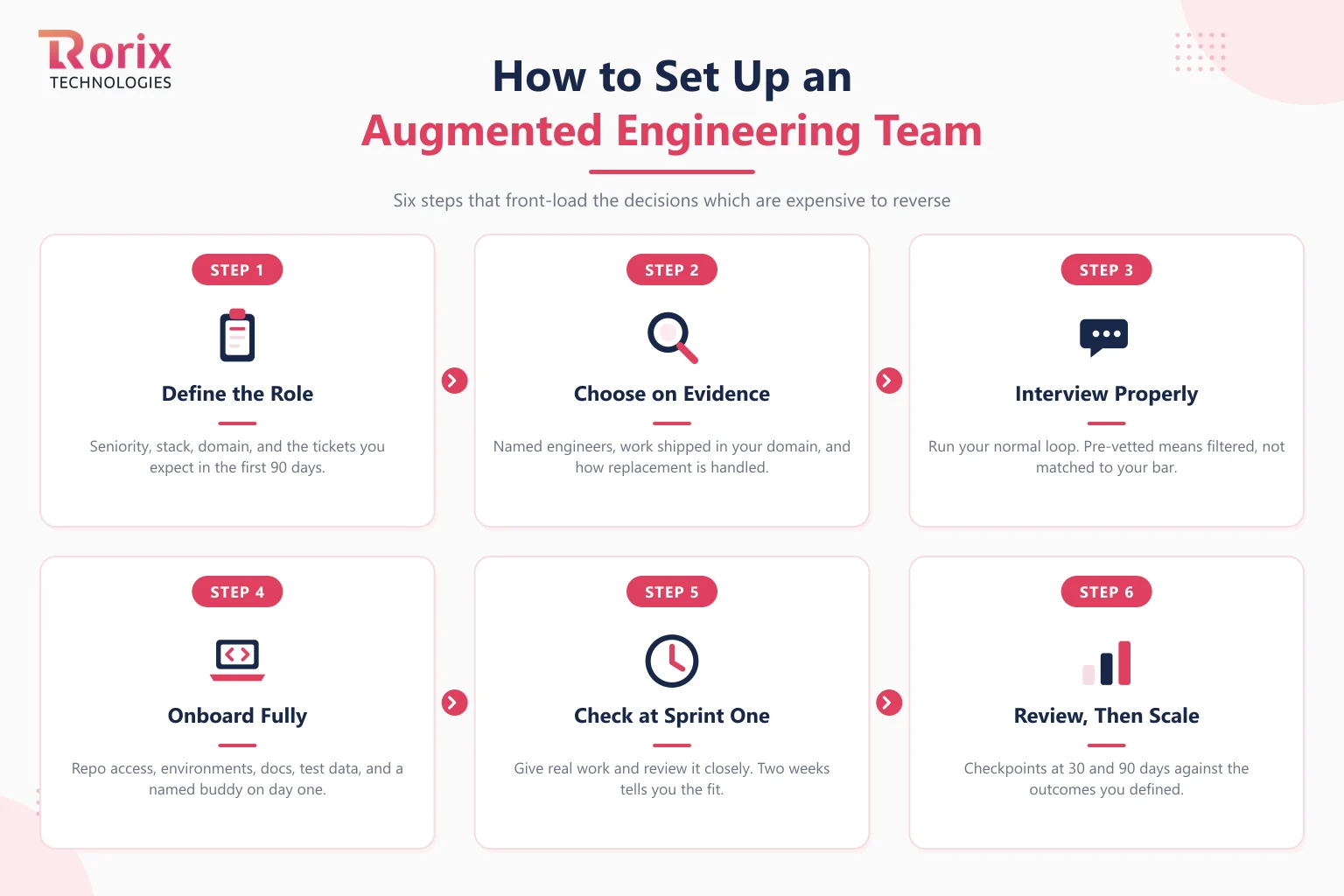
Step 1: Define the Role and the First Quarter of Work
Write the role as if it were an internal requisition: seniority, stack, domain exposure, and the specific tickets you expect in the first 90 days. A partner cannot match a profile to a job description that only says "senior backend engineer".
Step 2: Choose a Partner on Evidence, Not a Rate Card
Ask for named engineers, work they have shipped in your domain, and how replacement is handled. Reference calls with clients who scaled down tell you more than any pitch deck, because that is where the model usually strains.
Step 3: Interview Exactly as You Would for an Internal Hire
Run your normal loop, including the technical exercise, and reject freely. Skipping this because someone is "pre-vetted" moves the risk onto your delivery date rather than removing it.
Step 4: Onboard Into Your Own Tools and Rituals
Repository access, environment setup, documentation, test data, and a named buddy on day one. Every hour saved here is paid back several times over in the first billed month.
Step 5: Run the First Sprint With a Deliberate Check
Give real work, not a warm-up task, and review the output closely. Two weeks is enough to tell whether the fit is right, and raising it then is far cheaper than raising it in month three.
Step 6: Review, Then Scale Deliberately
Set a checkpoint at 30 and 90 days against the outcomes you defined in step 1. Add seats only after one is clearly working, because a pattern that fails at one engineer fails faster at four.
8 Mistakes That Waste an Augmentation Budget
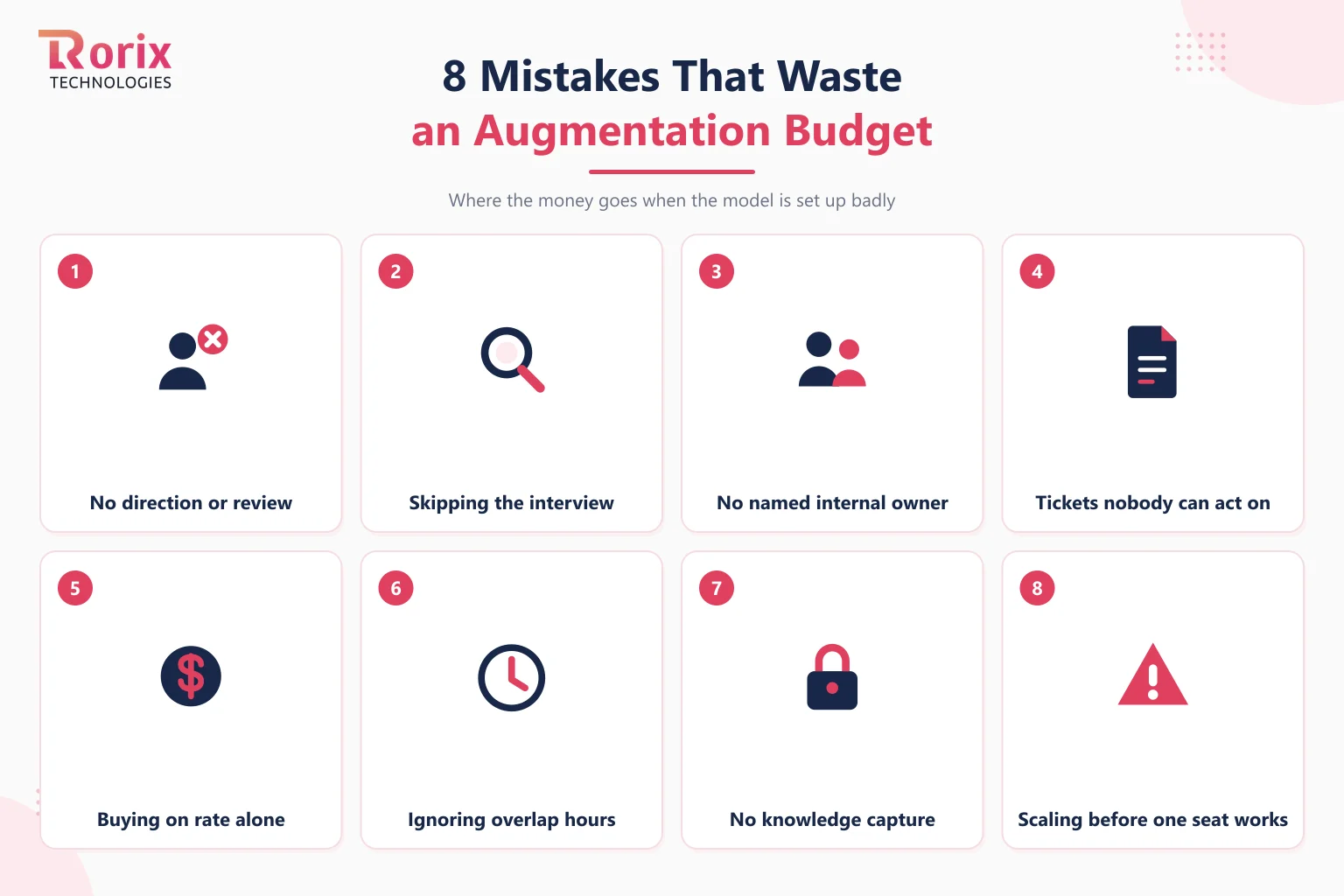
- No direction or review: an augmented engineer is not a black box. They need the same steering and code review as anyone else on the team.
- Skipping the interview: pre-vetted means the partner filtered, not that they matched your bar.
- No named internal owner: without one person accountable for the engagement, blockers sit unresolved and get billed for.
- Tickets nobody can act on: vague work produces vague output faster, which is the worst of both.
- Buying on rate alone: the cheapest seat that needs three months of ramp-up is not the cheapest seat.
- Ignoring overlap hours: distributed teams work well with a few deliberate hours of overlap and a written decision trail. They fail on ad-hoc availability.
- No knowledge capture: if the documentation leaves when the engagement ends, you rented the code as well as the person.
- Scaling before one seat works: prove the pattern with one engineer before you buy four.
Also Read: What Is a Dedicated Development Team and When Should You Hire One?
How Rorix Works as an Augmentation Partner
The failure mode we see most often is a partner that supplies people and then disappears from the engagement. Our model is the opposite: the same engineers stay on your product, and our technical leads stay accountable for their output.
Rorix Technologies has delivered 27 software projects for businesses across the US, UK, Canada, Australia, and New Zealand, with a 5.0 Clutch rating.
Why teams augment with us:
- Engineered for the domain: WMS, HRMS, and SaaS built from the workflow up, never adapted from a template
- Named people, not a bench: a dedicated team of senior engineers with a named technical lead on every engagement, working on retainer in 2-week sprints, which is why clients describe us as an in-house team
- Integration depth: 40+ integrations on a white-label SaaS platform for a home-services company, with iOS and Android shipped from a single React Native codebase
- Accountable past go-live: we stay on the product after launch rather than handing it back at the end of a statement of work
- Full ownership: you keep the code, the data model, and the roadmap
Not sure whether you need seats or a delivery team? Our dedicated development teams page covers the managed alternative, and our team will tell you plainly which one your situation calls for.
Staff Augmentation Is a Capacity Decision, Not a Hiring Decision
Staff augmentation is a capacity decision wearing a hiring decision's clothes. It works when you already know what needs building and who will direct it, and it disappoints when it is used to paper over the absence of either.
The useful question is not whether to augment. It is whether the work in front of you is defined enough to ticket. If it is, augmentation is usually the fastest way to get it moving. If it is not, fixing that comes first, whoever ends up writing the code.
Start with the one role blocking your roadmap this quarter. Write what its first 90 days look like. That document is both your hiring brief and your answer to whether you needed a permanent hire at all.
Frequently Asked Questions
What is IT staff augmentation?
IT staff augmentation is a model where an external partner supplies vetted engineers who join your existing team and work under your management. You keep the backlog, the process, and the technical decisions, while the partner handles employment, payroll, and replacement. You are buying capacity rather than a finished deliverable.
What is the difference between staff augmentation and outsourcing?
Staff augmentation adds engineers to your team under your direction, so delivery risk stays with you. Project outsourcing hands a defined scope to a vendor who owns the delivery and is paid against it. The deciding question is whether you can write the tickets yourself or only describe the outcome.
Is IT staff augmentation cheaper than hiring in-house?
It is usually cheaper for uneven or short-term workloads, because you avoid recruitment costs, benefits, equipment, and idle salary between peaks. For a permanent role you are certain about, hiring in-house is generally better value over several years and keeps the knowledge internally.
How quickly can an augmented engineer start?
Weeks rather than months, because the partner is drawing from people already employed rather than running a fresh hiring cycle. Realistic timelines depend on seniority and how narrow the stack is, and the bigger variable is usually how ready your onboarding is.
Does staff augmentation work with a distributed or offshore team?
Yes, when it is set up deliberately. What makes it work is senior-owned architecture, a few reliable overlap hours, written decisions, and disciplined sprints. What breaks it is a junior-heavy team with no named lead, which is a staffing problem rather than a geography one.
Who manages an augmented engineer day to day?
You do. Your lead assigns the work, reviews the output, and runs the retro, exactly as with an internal team member. The partner manages employment, performance escalation, and replacement if the fit turns out to be wrong.
Need engineers who stay?
Dedicated developers at $3,500 per developer per month, working your backlog on 2-week sprints with a named technical lead.
Continue learning
Written by
Renish DadhaniyaFounder & Director, Rorix Technologies
Renish co-founded Rorix Technologies and drives the engineering and delivery culture across the organization. Beyond engineering, he leads the company's sales, finance, and HR operations, building the infrastructure that lets the team focus on shipping quality software. With deep hands-on expertise in architecture and team building, he ensures every project lands on time to the quality standards clients demand.
View full profileRelated articles
IT Staff Augmentation Cost: What You Actually Pay in 2026
IT staff augmentation cost in 2026: real hourly rates, the fully loaded math against a US in-house hire, and the six cost lines no rate card shows you.
Read article
Staff Augmentation vs Dedicated Team: Which Model Fits Your Roadmap?
You added the engineers and delivery still slipped. Compare staff augmentation vs dedicated team on delivery ownership, management load and continuity.
Read article
NestJS vs Express: Which Node.js Framework Fits Your Backend?
NestJS runs on Express by default, so this is not a performance contest. It is a decision about where your backend structure comes from, and who maintains it.
Read article