Why Do Companies Outsource Software Development? 10 Reasons That Actually Drive ROI
Why do companies outsource software development? 10 ROI-driven reasons, the real costs and engagement models, and how to pick the right partner.
On this page73 sections
Hiring great developers is harder than ever. While you're trying to fill open roles, projects slow down, deadlines slip, and competitors keep shipping new features.
That is why more businesses are outsourcing software development. It is not just about saving money. Companies outsource to access experienced developers, launch products faster, scale teams without long hiring cycles, and keep projects moving when internal resources are stretched.
But outsourcing is not always a smart decision. Choosing the wrong partner, pricing model, or engagement approach can lead to delays, poor quality, and costs that quickly outweigh the expected savings.
So, why do companies outsource software development, and when does it actually make sense?
In this guide, you'll learn:
- What software development outsourcing is
- The top 10 reasons companies outsource software development
- What outsourcing really costs
- Different outsourcing and engagement models
- When outsourcing is the right choice and when you should avoid it
- How to choose a reliable software development outsourcing partner
By the end of this guide, you'll know whether outsourcing is the right fit for your business, what it should cost, and how to choose a partner that delivers real business results, not just lower hourly rates.
Quick Answer: Why Do Companies Outsource Software Development?
The short version: to convert fixed engineering overhead into flexible capacity, reach skills the local market cannot supply, and ship sooner. Here is what each of the ten reasons actually moves.
| Reason | What It Actually Moves |
|---|---|
| Lower total cost of ownership | Cost per delivered feature |
| Specialist skills on demand | Time to fill a critical role |
| Faster time to market | Months of revenue pulled forward |
| Elastic capacity | Utilization during peaks and troughs |
| Focus on core work | Management hours returned to the business |
| Risk distribution | Cost of a stalled or failed release |
| Delivery process maturity | Defect escape rate and rework |
| Round-the-clock coverage | Cycle time and incident response |
| Security and compliance discipline | Audit findings and remediation cost |
| Faster technology adoption | Time to a working feature on a new stack |
Key Takeaways: Why Outsourcing Software Development Pays Off
- Companies outsource software development to convert fixed engineering overhead into flexible capacity, reach skills the local market cannot supply, and ship sooner, with cost as the entry point rather than the payoff.
- The 2024 Deloitte Global Outsourcing Survey still lists cost reduction among the leading drivers, now alongside access to skilled talent and greater agility.
- Developer rates run $100 to $150 an hour in North America, $40 to $60 in Central Europe, $30 to $60 in Latin America, and $20 to $50 in South Asia, and that spread reflects local labor markets rather than engineering quality.
- Comparing salary against hourly rate hides most of the spend, because in-house cost also carries recruitment, benefits, tooling, onboarding, and idle capacity during quiet periods, which a partner absorbs inside one rate.
- Rorix Technologies has delivered 27 projects with a 5.0 rating on Clutch, reports up to 80% fewer picking errors on custom WMS builds, and has shipped 40+ vendor integrations on Driven, a US field-service performance platform.
What Is Software Development Outsourcing?
Strip away the jargon and it is a simple arrangement. You hire an external dedicated development team to build, improve, or maintain your software instead of doing everything with your in-house team.
You stay in control of the project, business goals, and final decisions. The outsourcing partner provides the developers, designers, testers, project managers, and the expertise needed to deliver the software.
The amount of work you outsource depends on your needs. Some companies outsource a single feature or module, while others outsource the entire project, from planning and development to testing, deployment, and ongoing support. Many businesses choose a mix of both, where their internal team manages the product while the external team handles development.
Outsourcing vs Outstaffing vs Freelancing
These three arrangements get used interchangeably, and the confusion causes real budget damage. They differ in who manages the work and who carries delivery risk.
| Factor | Outsourcing | Outstaffing | Freelancing |
|---|---|---|---|
| Who manages delivery | The partner | You | You |
| Who carries delivery risk | The partner, under contract | You | You |
| Process and QA | Provided by the partner | Yours | Rarely defined |
| Continuity if someone leaves | Partner replaces them | You re-hire | Engagement stops |
| Best fit | Defined outcomes and full builds | Adding hands to your process | Small, isolated tasks |
The 10 Reasons That Actually Drive ROI
So why outsource when you could simply hire? Across the market, the same reasons keep surfacing. What separates the ones that return money from the ones that just sound sensible is whether you can attach a number to them. Each reason below carries the metric it should move.
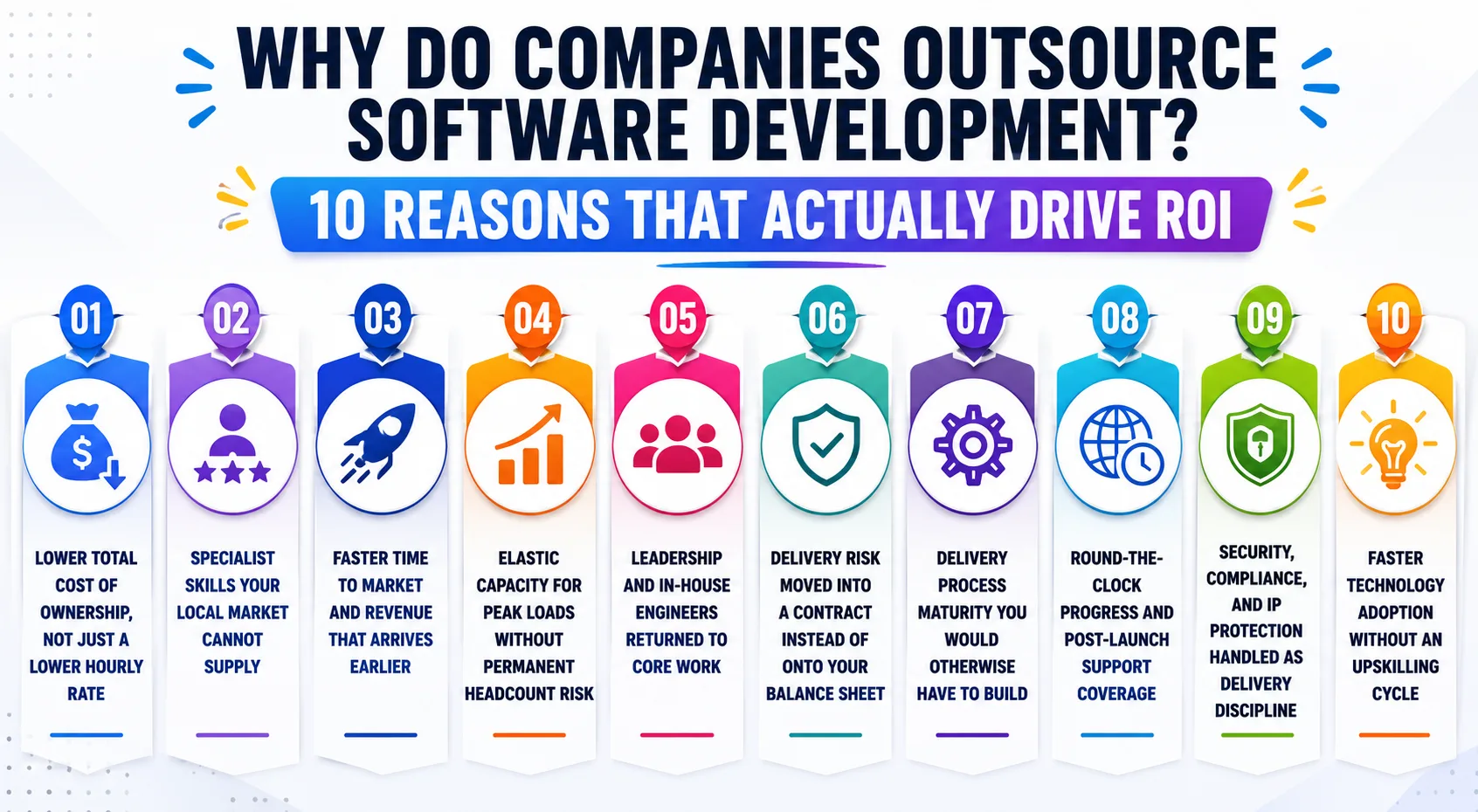
1. Lower Total Cost of Ownership, Not Just a Lower Hourly Rate
Rate comparisons mislead buyers. Your real cost includes recruitment fees, onboarding, benefits, tooling, and the months a vacant seat stays open. A partner absorbs that inside one blended rate. The 2024 Deloitte Global Outsourcing Survey still lists cost reduction among the leading drivers, now alongside access to skilled talent and greater agility.
2. Specialist Skills Your Local Market Cannot Supply
You cannot keep senior expertise in every stack sitting idle on payroll. Multi-tenant architecture, barcode and RFID integration, payroll compliance logic, and high-concurrency inventory systems are all niche. Hiring for a six-month need is slow and expensive, while a partner already employs those people and assigns them for the duration you need.
3. Faster Time to Market and Revenue That Arrives Earlier
Every month a product sits unfinished is a month of revenue you never recover. An established partner starts within weeks rather than quarters, because the team, the tooling, and the delivery process already exist. Shipping a fulfillment module one quarter earlier is worth more than the rate difference you negotiated.
4. Elastic Capacity for Peak Loads Without Permanent Headcount Risk
Demand in operations-heavy businesses is rarely flat. Peak season, a new warehouse, or a funding round all create short bursts of engineering need. Hiring permanently for a temporary spike leaves you paying salaries through the quiet months. An external team scales up and back down without severance exposure.
5. Leadership and In-House Engineers Returned to Core Work
Running an engineering team eats a large share of a founder's or COO's week. Recruitment, performance reviews, and vendor management pull attention away from revenue. When you outsource, that load moves across and your best people return to the work only they can do.
6. Delivery Risk Moved Into a Contract Instead of Onto Your Balance Sheet
With an internal team, every risk sits with you. One resignation, one skills gap, or one missed milestone lands entirely on your budget. A properly written agreement moves part of that exposure across, with defined delivery dates, quality standards, replacement guarantees, and remedies when milestones slip.
7. Delivery Process Maturity You Would Otherwise Have to Build
Sprint cadence, code review, automated testing, staging environments, and release discipline take years to embed. A partner that ships for a living arrives with those habits already working. You inherit a mature process on day one instead of paying for the learning curve while your product waits.
8. Round-the-Clock Progress and Post-Launch Support Coverage
A time-zone gap looks like a communication problem until you structure it properly. Requirements go out at the end of your day and reviewed work is waiting the next morning. That same coverage matters more after launch, when an incident at 2 am gets picked up by a team already at their desks.
9. Security, Compliance, and IP Protection Handled as Delivery Discipline
Serious partners treat access control, code review, and data handling as part of delivery. Signed NDAs, explicit IP ownership clauses, encrypted repositories, and audited access are standard practice. For regulated operations, that discipline often beats what a stretched internal team maintains.
10. Faster Technology Adoption Without an Upskilling Cycle
Moving to a new framework, database, or real-time architecture means months of internal learning before anything ships. A partner has already made those mistakes on someone else's timeline. Our engineers publish that work openly, including this deep-dive on real-time inventory architecture, so you can judge the depth before you commit.
Also Read: WMS Implementation Checklist: 50 Steps to Successful Deployment
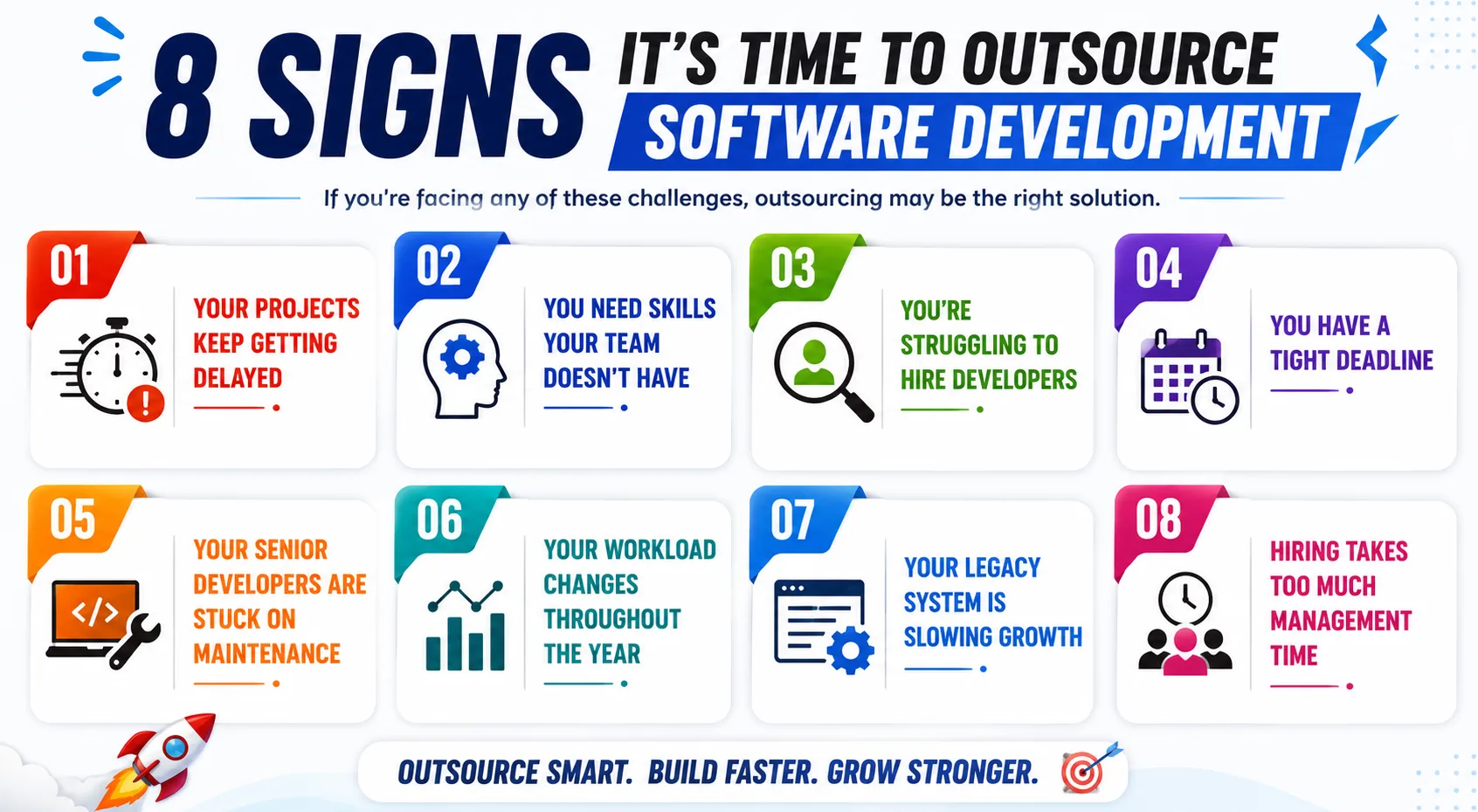
8 Signs It's Time to Outsource Software Development
If you're facing any of these challenges, outsourcing may be the right solution.
1. Your Projects Keep Getting Delayed
If deadlines keep getting pushed back and your backlog keeps growing, your team may not have enough capacity to handle the workload.
2. You Need Skills Your Team Doesn't Have
When your project requires specialized technologies or expertise, outsourcing gives you access to experienced developers without long hiring delays.
3. You're Struggling to Hire Developers
If important roles stay open for months, outsourcing helps you bring experienced developers on board much faster.
4. You Have a Tight Deadline
Whether it's a product launch, client commitment, or compliance deadline, outsourcing helps you add resources quickly and keep the project on track.
5. Your Senior Developers Are Stuck on Maintenance
If your best engineers spend most of their time fixing bugs instead of building new features, outsourcing maintenance can free them to focus on innovation.
6. Your Workload Changes Throughout the Year
If development demand increases only during certain periods, outsourcing lets you scale your team without hiring permanent staff.
7. Your Legacy System Is Slowing Growth
Old systems can make every new feature harder to build. An experienced outsourcing partner can help modernize your software faster.
8. Hiring Takes Too Much Management Time
Recruiting, onboarding, and managing developers can take valuable time away from growing your business. Outsourcing reduces that burden.
What Outsourcing Software Development Actually Costs
Cost sits at the center of most outsourcing decisions, and it is where most of them go wrong. The rate matters far less than the model you pick and the scope you define. Three views give you a realistic budget.
1. Developer Rates by Region
Rates vary with local labor markets, not with engineering quality. The spread below reflects typical market bands for comparable seniority, and it lines up with published benchmarks such as Clutch's rates by location.
| Region | Developer | Solution Architect | QA Engineer | Project Manager |
|---|---|---|---|---|
| North America | $100 to $150/hr | $120 to $200/hr | $60 to $100/hr | $90 to $140/hr |
| Western Europe | $90 to $150/hr | $120 to $190/hr | $55 to $95/hr | $85 to $140/hr |
| Central Europe | $40 to $60/hr | $60 to $85/hr | $30 to $50/hr | $45 to $65/hr |
| Latin America | $30 to $60/hr | $45 to $75/hr | $25 to $45/hr | $35 to $60/hr |
| South Asia | $20 to $50/hr | $30 to $70/hr | $15 to $35/hr | $25 to $50/hr |
2. In-House vs Outsourced Total Cost of Ownership
Comparing salary against rate hides most of the spend. Set the full picture side by side instead.
| Cost Line | In-House Team | Outsourced Team |
|---|---|---|
| Recruitment | Agency fees plus months of pipeline | Included in the engagement |
| Salary and benefits | Fixed, paid through quiet quarters | Variable, paid per sprint |
| Onboarding and ramp-up | Weeks per hire, repeated | Handled by the partner |
| Tooling, licenses, hardware | Yours to buy and renew | Carried by the partner |
| Management overhead | Your leadership time | Partner delivery manager |
| Attrition cost | Re-hire and lose context | Replacement guaranteed by contract |
3. Pricing Models and What Each One Protects You From
The pricing model decides who absorbs uncertainty. Choose it based on how well your scope is defined.
| Model | Best For | Protects You From |
|---|---|---|
| Fixed price | Tight, fully specified scope | Budget overrun |
| Time and materials | Evolving requirements | Paying for unused capacity |
| Dedicated team retainer | Ongoing product development | Team churn and re-onboarding |
| Milestone-based | Phased builds with clear gates | Paying ahead of delivered value |
Want a scoped number for your own project? Use the project cost estimator.
Hidden Costs That Can Reduce Your Outsourcing ROI
Outsourcing can save time and money, but only if the project is planned properly. Many companies lose their expected ROI because they overlook these hidden costs.
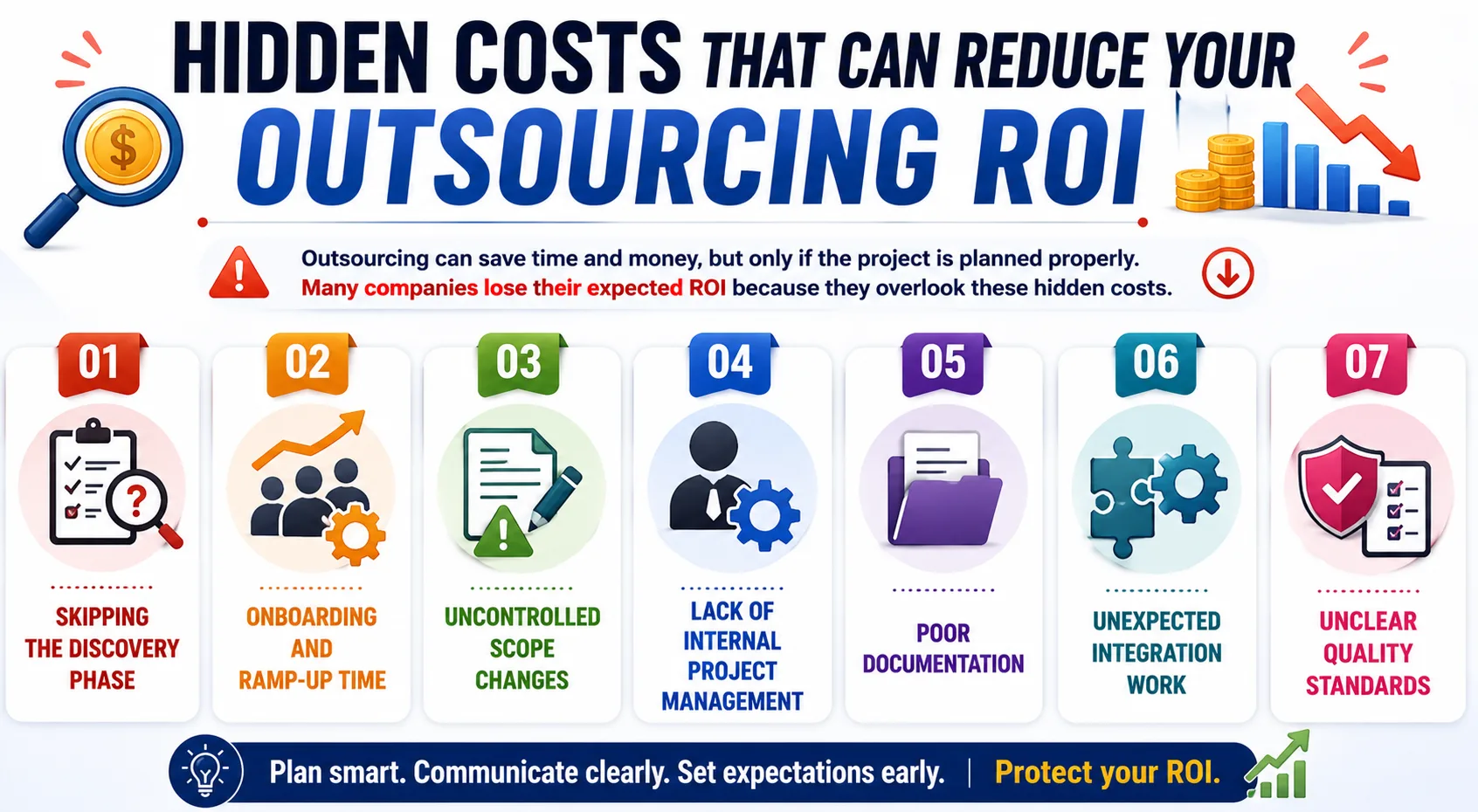
1. Skipping the Discovery Phase
Starting development without understanding your requirements can lead to confusion, delays, and expensive rework. Spending time on discovery helps avoid bigger problems later.
2. Onboarding and Ramp-Up Time
An outsourced team needs time to understand your business, software, and processes. Don't expect full productivity on the first day. Plan for a short onboarding period.
3. Uncontrolled Scope Changes
Small feature requests can quickly increase the project cost and timeline. Have a clear change request process so every new requirement is reviewed before work begins.
4. Lack of Internal Project Management
Outsourcing doesn't mean you can step away completely. Someone from your team should review progress, answer questions, and approve deliverables throughout the project.
5. Poor Documentation
If important knowledge stays with one developer, replacing them becomes difficult. Make sure the team documents the code, architecture, and processes throughout the project.
6. Unexpected Integration Work
Connecting your software with ERP systems, payment gateways, CRMs, or third-party APIs often takes more time than expected. Discuss and estimate these integrations before development starts.
7. Unclear Quality Standards
If you don't define quality expectations, the final product may not meet your needs. Set clear standards for testing, code quality, security, and performance before development begins.
In-House vs Outsourced vs Hybrid Development
Why outsource rather than build a permanent team? The comparison is not a contest, because each model wins in a different situation, and most mature companies end up running two of them together. Our full breakdown of in-house vs outsourcing software development works through the cost, speed, and control trade-offs in detail.
| Factor | In-House Team | Outsourced Team | Hybrid Model |
|---|---|---|---|
| Control | Full, day-to-day | Strategic, through governance | Full on core, delegated on execution |
| Cost structure | Fixed salaries and overhead | Variable, tied to scope | Fixed core, variable capacity |
| Speed to staff | Months | Weeks | Weeks for surge capacity |
| Specialist access | Limited to local market | Global | Global on demand |
| Domain knowledge | Deep and permanent | Built during discovery | Retained internally, applied externally |
| Risk ownership | Entirely yours | Shared under contract | Split by workstream |
| Best for | Core IP and product strategy | Defined builds and modernization | Scaling without losing ownership |
When In-House Development Is the Better Choice
Choose an in-house team if:
- Your software is your main product or competitive advantage.
- You need full control over development and business decisions.
- The project requires deep knowledge of your business.
- Your team needs to collaborate daily with other departments.
- You are building long-term technical expertise within the company.
When Outsourcing Is the Better Choice
Choose outsourcing if:
- The software supports your business but isn't your core product.
- You need specialized skills that your team doesn't have.
- You want to launch the project faster.
- You need to scale your development team quickly.
- You want to avoid the cost and time of hiring full-time developers.
When a Hybrid Team Is the Best Choice
Choose a hybrid model if:
- You want to keep strategy and key decisions in-house.
- You need extra development capacity for faster delivery.
- Your internal team knows the business, while the external team handles execution.
- You want the flexibility to scale the team up or down as project needs change.
- You need a balance between control, speed, and cost.
Which Outsourcing Engagement Model Fits Your Situation
When you outsource, the engagement model shapes everything that follows. Four models cover almost every situation, and picking the wrong one creates friction that no amount of goodwill later resolves.
| Model | You Manage | Partner Manages | Best Fit |
|---|---|---|---|
| Staff augmentation | Tasks and priorities | Sourcing and retention | Filling a skills gap inside your process |
| Dedicated team | Goals and roadmap | Delivery and team management | Ongoing product development |
| Project or managed delivery | Outcomes and acceptance | Everything to launch | New builds and modernization |
| Build, operate, transfer | Long-term direction | Setup, then handover | Standing up a capability you will own |
1. Staff Augmentation
External engineers join your team and work inside your process, your tools, and your sprint board. You set priorities and review output directly, which suits companies that already have strong technical leadership. It is the fastest way to add capability without changing how you work.
2. Dedicated Team
Here, a cohesive group works only on your product, but the partner handles day-to-day management and delivery mechanics. You keep strategic control through goals, roadmap, and sprint reviews. This model suits multi-quarter product work where continuity matters more than granular oversight. Our guide to dedicated development teams covers when this model fits best.
3. Project or Managed Delivery
The partner takes end-to-end responsibility, from architecture through QA and release, against outcomes you define upfront. You review milestones and sign off deliverables rather than manage engineers day to day. It fits new builds, legacy replacements, and any initiative where internal bandwidth simply is not there.
4. Build, Operate, Transfer
The partner assembles and runs the team, then hands the whole capability to you after an agreed period. You get speed early and ownership later, without a standing start. It works well when the long-term plan is an internal team, but the timeline cannot wait for one.
Where Outsourcing Pays Off Fastest: 5 Operational Domains
Returns are not evenly spread. Companies outsource fastest in areas where the software supports the operation rather than being the product itself.
1. Warehouse Management and Inventory Operations
Picking errors, stock discrepancies, and manual counts drain margin every single day. A custom WMS built around your actual floor workflow cuts picking errors by up to 80% through real-time inventory tracking, barcode scanning, and automated workflows. Our WMS implementation checklist walks through the deployment sequence step by step.
2. HRMS, Payroll, and Staffing Operations
Spreadsheet-driven onboarding, leave tracking, and payroll approvals break the moment headcount grows. Generic HR tools rarely match how staffing and shift-based businesses actually run. A custom HRMS encodes your real approval chains and compliance rules instead of forcing your team around a template.
3. SaaS Platform and MVP Delivery
Early architectural decisions determine whether a platform scales or needs a rewrite at customer 50. Tenancy model, data isolation, billing, and API contracts all have to be right in the first sprint. A partner who has shipped multi-tenant SaaS platforms before makes those calls once, correctly.
4. Order Management and eCommerce Operations
Order lifecycles that span marketplaces, carriers, and finance systems tend to be held together by manual steps. Each handoff is a place where an order stalls or a number stops matching. Automating that lifecycle end to end removes the reconciliation work nobody enjoys and the errors that follow it.
5. Legacy Modernization and System Integration
Old platforms rarely fail outright. They just make every new feature slower and more expensive until progress stops. Migrating without disrupting live operations takes engineers who have done it before, which is why this work is so commonly handed to a specialist team.
Also Read: Real-Time Inventory: WebSocket and Pub-Sub Architecture
How to Choose a Software Development Outsourcing Partner
Why do some outsourcing engagements succeed while others end up funding a rescue project? Selection is where the return is won or lost. Work through these ten points before you commit.
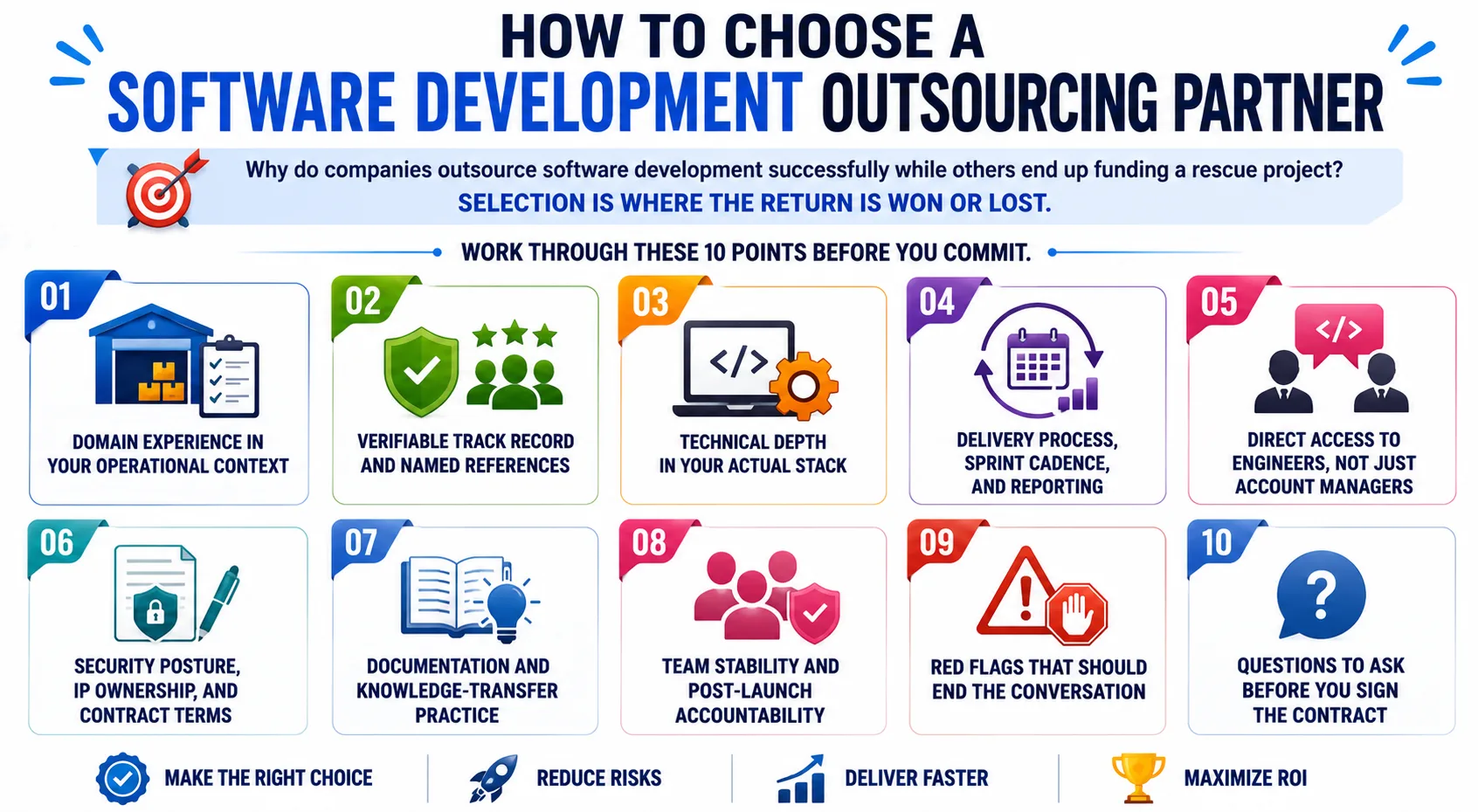
1. Domain Experience in Your Operational Context
A team that has built for warehouses, HR operations, or SaaS platforms already knows the edge cases yours will hit. That fluency shortens discovery and prevents expensive design mistakes. Ask for projects in your domain, not just projects in your tech stack.
2. Verifiable Track Record and Named References
Portfolios are easy to polish, so look for evidence you can check independently. Verified review platforms, named clients, and references willing to take a call are the strongest signals. A partner with multi-year client relationships has been tested in ways a case study cannot show.
3. Technical Depth in Your Actual Stack
Surface familiarity is not the same as production experience. Ask what they have shipped recently in your stack and how those systems behaved under load. Published engineering writing is a useful cross-check, since production depth is difficult to fake in public.
4. Delivery Process, Sprint Cadence, and Reporting
Ask precisely how work gets planned, tracked, demoed, and released, then ask to see a real sprint report. Fixed cycles with full task visibility prove the process exists before your project tests it. Vague answers at this stage reliably predict vague reporting six months in.
5. Direct Access to Engineers, Not Just Account Managers
You should be able to speak directly to the people writing your code, not only to a relationship owner. Layers of account management slow decisions and blur accountability when something slips. Watch how a partner handles unclear requirements during the sales process, because that behavior rarely changes later.
6. Security Posture, IP Ownership, and Contract Terms
Confirm in writing that you own the source code, the data, and the intellectual property once payment clears. Review access controls, repository permissions, and confidentiality obligations before you share a single credential. Settle all of it on day one rather than during a dispute you did not plan for.
7. Documentation and Knowledge-Transfer Practice
Ask what gets documented, where it lives, and exactly what happens when a team member rolls off your project. Strong partners maintain architecture notes, decision logs, and onboarding material as a matter of routine. That habit is what protects you from a single-person dependency later.
8. Team Stability and Post-Launch Accountability
Frequent team changes destroy momentum, because every new person spends weeks relearning your system and your domain rules. Ask about retention rates, guaranteed replacement timelines, and who supports the product after launch. A retainer relationship signals accountability well past go-live rather than a handover and goodbye.
9. Red Flags That Should End the Conversation
Watch for firm timelines quoted before anyone understands your problem, rates far below the market, and senior staff who vanish after the pitch. Unclear pricing, missing references, and reluctance to let you interview engineers all point the same way. Any one of these justifies walking away.
10. Questions to Ask Before You Sign the Contract
Take these into the final conversation and write the answers down.
- Similar projects: Which builds in our domain have you delivered, and can we speak to those clients?
- Team composition: Who exactly works on this, and how senior are they?
- Engineer access: Can we talk directly to the engineers rather than an account manager?
- Delivery process: How do you run sprints, demos, code review, and releases?
- Quality standards: What test coverage and review rules will apply to our code?
- Change control: How are scope changes estimated, approved, and billed?
- Security and IP: Who owns the code and data, and how is access controlled?
- Continuity: What happens if a key engineer leaves mid-project?
- Documentation: What will be documented, and what do we receive at handover?
- Post-launch: What does support look like after go-live, and at what cost?
Also Read: How to Choose a Custom Software Development Company in 2026
Why Rorix Technologies Is a Reliable Software Development Outsourcing Partner
Choosing a partner for operations-critical software is a different decision. The systems have to work on a live warehouse floor or through a payroll cycle, not just in a demo.
Rorix Technologies builds custom software for complex operations, including WMS, HRMS, mobile apps, and SaaS platforms. That record covers 27 projects delivered and a 5.0 rating on Clutch. We work on retainer, which keeps us accountable well past go-live.
- Domain-specialized engineering: Software engineered for the domain, not adapted from a template, across warehouse, HR, and SaaS operations.
- Measurable operational impact: Up to 80% fewer picking errors through real-time inventory tracking, barcode scanning, and automated workflows.
- Real integration depth: 40+ vendor integrations on Driven's field-service performance platform, with iOS and Android from one React Native codebase.
- In-house team, not a vendor: A dedicated team of senior engineers working 2-week sprints with full task visibility.
- Proven long-term partnerships: A multi-year engineering partnership with Lorecs, plus clients across the US, UK, Canada, Australia, and New Zealand.
Talk to our experts, and we scope your build against how your operation actually runs. Book a Free Consultation.
Companies Outsource for Capacity, Skills, Speed, and Shared Risk
The reasons companies outsource software development come down to capacity, specialist skills, speed, and shared risk. That risk sits inside a contract rather than on your balance sheet, which is where it belongs.
Cost matters, but it is the entry point rather than the payoff. What separates a strong engagement from an expensive one is scope clarity, an internal owner, and metrics agreed before the first sprint.
So look at your roadmap, your open roles, and the systems slowing your operation down, then decide which of the ten reasons above actually apply to you. When they do, connect with our experts to scope your build, agree the metrics, and start with a pilot milestone.
Frequently Asked Questions
Why do companies outsource software development?
Most do it to access specialist skills quickly, ship faster, and turn fixed engineering overhead into flexible capacity. Cost reduction is the common entry point, but speed, delivery process maturity, and shared risk usually produce the larger return.
Is outsourcing software development more cost-effective than hiring in-house?
Usually yes, once you compare total cost of ownership rather than salary against hourly rate. In-house cost includes recruitment, benefits, tooling, onboarding, and idle capacity during quiet periods. A partner absorbs those inside one rate you only pay while work is happening.
How much does it cost to outsource software development?
Cost is driven by scope, complexity, and the number of integrations far more than by any single hourly rate, which is why industry cost surveys show such a wide spread for similar-sounding projects. A tightly scoped module with few integrations sits at one end, and a multi-system platform with compliance requirements at the other. Get a scoped estimate against your actual requirements before setting a budget.
Does outsourcing software development reduce code quality?
Not when quality standards are written into the contract. Define test coverage, code review rules, and acceptance criteria, then verify them at each sprint review. Quality problems in outsourced work almost always trace back to missing standards rather than to the delivery model.
Which outsourcing engagement model should a startup choose?
Startups with a defined product usually get the most from project-based or managed delivery, since the partner owns execution end to end. If you already have strong technical leadership internally, staff augmentation adds capacity without changing your process.
How do I protect my source code and intellectual property?
Settle ownership before development begins. Your contract should state clearly that you own the source code, data, and intellectual property, backed by an NDA and defined confidentiality obligations. Also confirm repository access controls and how credentials are managed.
How long does it take an outsourced team to become productive?
A well-structured team ramps up over the first few sprints rather than delivering at full speed on day one. How fast that happens depends almost entirely on you: how quickly you provide codebase access, domain context, and a clear, prioritized backlog. A short, planned onboarding period is normal and worth budgeting for.
Can small businesses outsource software development?
Yes, and often more effectively than large organizations. You need three things: a written brief, one person who can judge the code that comes back, and payment tied to milestones. Project-based engagements suit smaller teams better than dedicated team models.
Need engineers who stay?
Dedicated developers at $3,500 per developer per month, working your backlog on 2-week sprints with a named technical lead.
Continue learning
Written by
Renish DadhaniyaFounder & Director, Rorix Technologies
Renish co-founded Rorix Technologies and drives the engineering and delivery culture across the organization. Beyond engineering, he leads the company's sales, finance, and HR operations, building the infrastructure that lets the team focus on shipping quality software. With deep hands-on expertise in architecture and team building, he ensures every project lands on time to the quality standards clients demand.
View full profileRelated articles
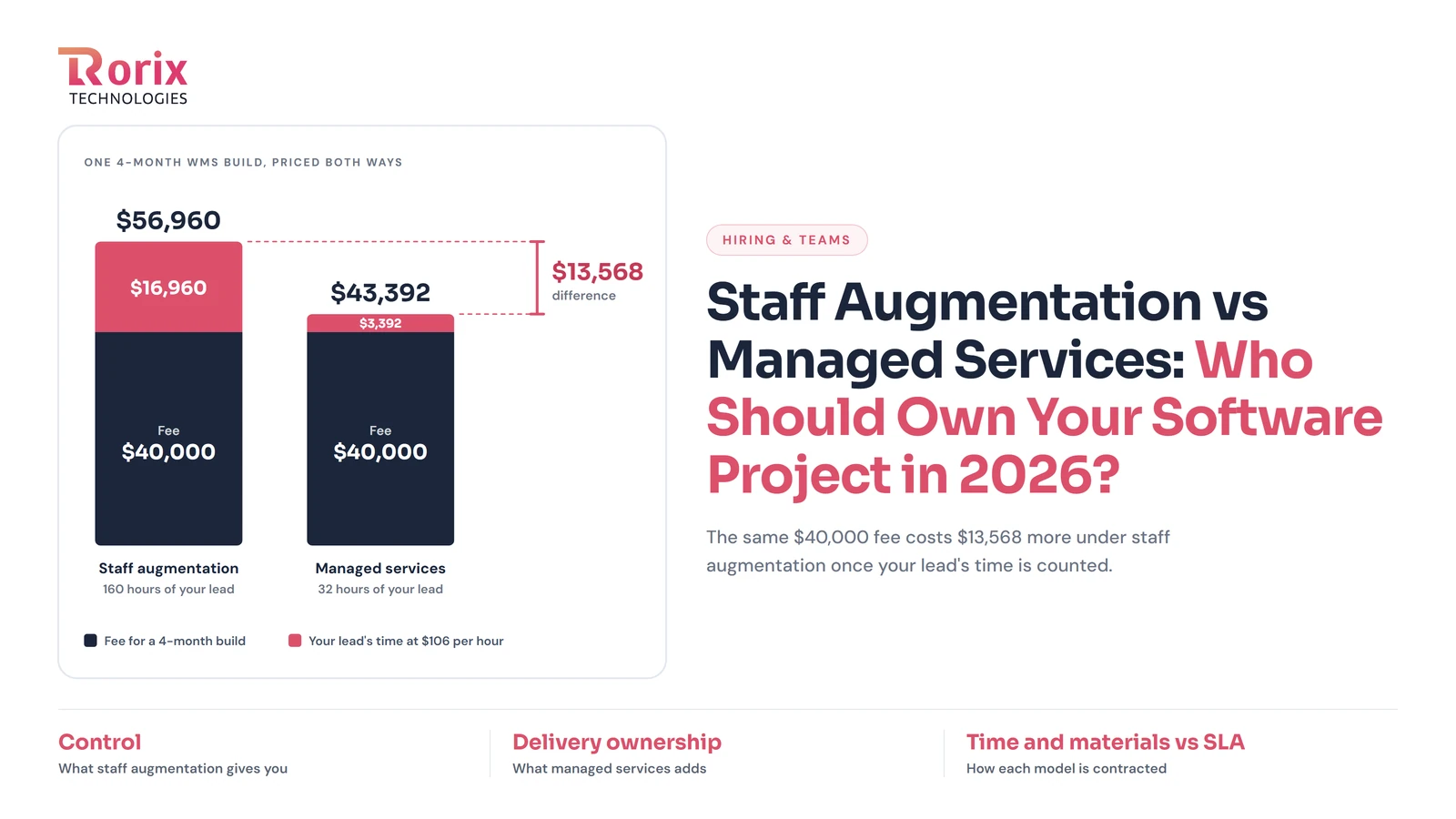
Staff Augmentation vs Managed Services: Who Should Own Your Software Project in 2026?
Compare staff augmentation vs managed services, including costs, key differences, pros and cons, and how to choose the right model for your project.
Read article
Staff Augmentation vs Dedicated Team: Which Model Fits Your Roadmap?
You added the engineers and delivery still slipped. Compare staff augmentation vs dedicated team on delivery ownership, management load and continuity.
Read article
How to Choose a Custom Software Development Company in 2026
How to choose a custom software development company: a vetting checklist, red flags, key questions to ask, and how to compare proposals with confidence.
Read article