How to Choose a Custom Software Development Company in 2026
How to choose a custom software development company: a vetting checklist, red flags, key questions to ask, and how to compare proposals with confidence.
On this page44 sections
Choosing a custom software development company is one of the biggest decisions you'll make for your business. The right partner can turn your idea into software that saves time, cuts costs, and supports growth. The wrong one can leave you with missed deadlines, budget overruns, and a product that never delivers the results you expected.
Many businesses don't fail because they had a bad idea. They fail because they chose a development partner that didn't understand their goals, lacked the right expertise, or couldn't deliver what was promised.
That is why choosing a software development company is about much more than comparing prices or portfolios. You need a team that understands your industry, communicates clearly, builds quality software, and stays accountable long after launch.
In this guide, you'll learn:
- What a custom software development company actually does
- Why choosing the right partner matters
- The 15 most important criteria for evaluating development partners
- How to choose a custom software development company
- Red flags that signal a bad vendor
- Key questions to ask before signing a contract
- Typical custom software development costs and timelines
- A practical checklist to confidently choose the right partner
By the end, you'll have a simple, proven framework to compare vendors, avoid costly mistakes, and confidently choose the custom software development company that's the right fit for your business.
What Is a Custom Software Development Company?
A custom software development company designs, builds, tests, and supports software shaped around one business, not the mass market. Instead of forcing your team into a generic tool, it engineers the workflows, data, and integrations your operations actually run on.
Off-the-shelf products serve broad audiences with fixed features and little room to change. That works until your process, your scale, or your industry rules push past what the tool allows. A custom build gives you full control of functionality, data, and how the system grows.
Most of these firms cover the full lifecycle. That includes discovery and architecture, design, development, quality assurance, deployment, and long-term maintenance, often across warehouse, HR, retail, logistics, and SaaS domains.
Key Takeaways: How to Vet a Software Development Partner
- A custom software development company designs, builds, tests, and supports software shaped around one business, and most cover the full lifecycle from discovery and architecture through long-term maintenance.
- Score every shortlisted firm against the same 15 criteria, from domain experience and team stability to IP ownership and post-launch support, instead of choosing on price alone.
- Clutch's software development pricing guide puts the average project at roughly $132,000, and GoodFirms' cost survey finds most small and mid-sized projects landing between $30,000 and $100,000.
- Indicative cost ranges run from $10,000 to $25,000 for an MVP to $250,000 to $500,000+ for a complex or enterprise platform, with third-party integrations often a third of the budget.
- Rorix has delivered 27 projects with a 5.0 rating on Clutch, and one warehouse build cut picking errors by 80% with real-time inventory tracking, barcode scanning, and automated workflows.
Why Choosing the Right Custom Software Development Company Matters
Here's why the right choice matters:
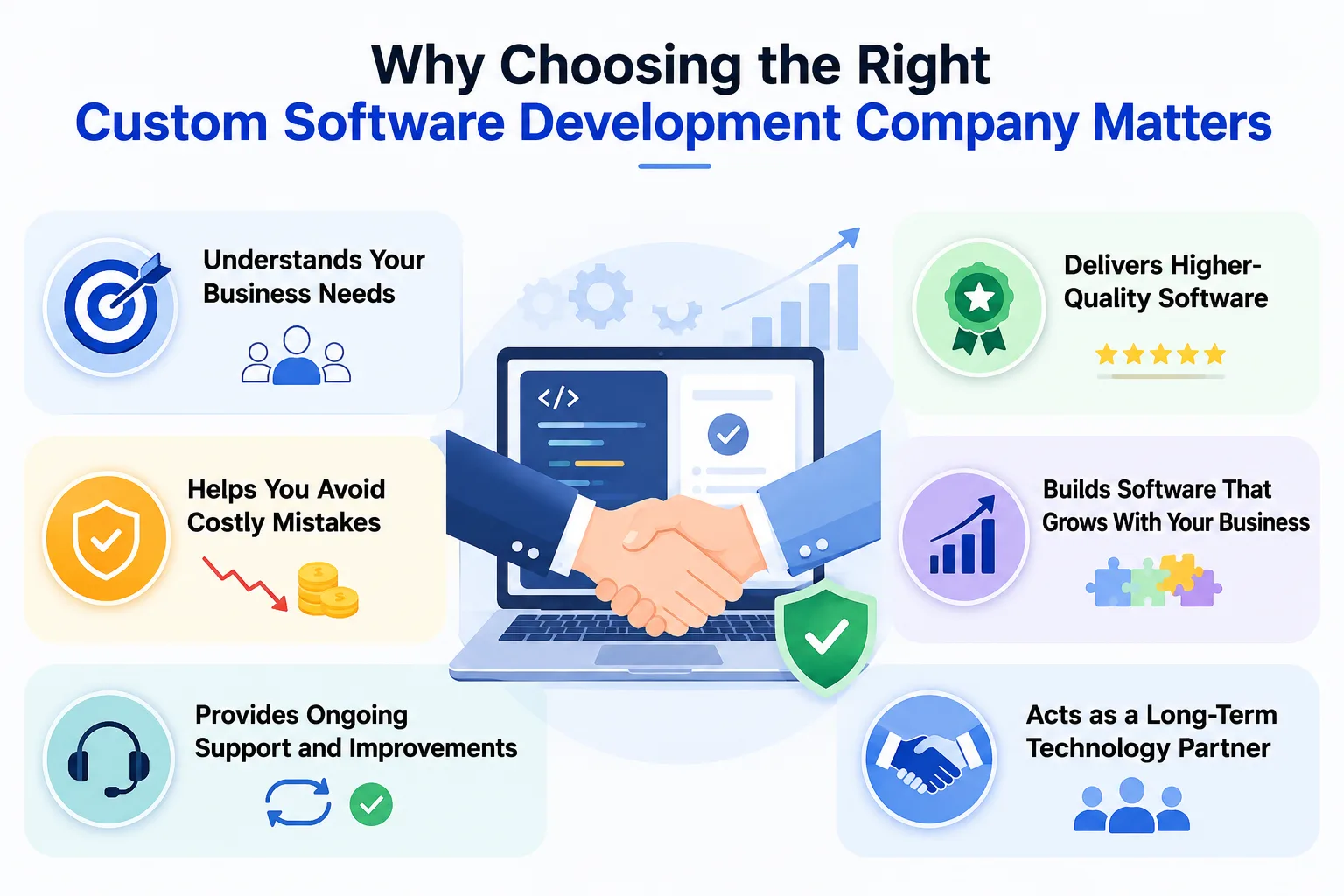
- Understands your business needs: A good development partner takes time to understand your goals, workflows, and challenges before recommending a solution. This results in software that solves the right problems from day one.
- Delivers higher-quality software: Experienced teams follow proven development, testing, and quality assurance processes to build reliable, secure, and scalable applications.
- Helps you avoid costly mistakes: The right partner identifies technical risks early, recommends better approaches, and prevents delays, budget overruns, and unnecessary rework.
- Builds software that grows with your business: Instead of creating a short-term solution, an experienced company designs software that can support more users, features, and integrations as your business expands.
- Provides ongoing support and improvements: Software needs regular updates after launch. A reliable partner continues to fix issues, improve performance, and add new features as your business evolves.
- Acts as a long-term technology partner: The best companies do more than write code. They provide strategic guidance, recommend the right technologies, and help you make better technical decisions throughout your software journey.
Also Read: WMS Implementation Checklist: 50 Steps to Successful Deployment
15 Criteria to Evaluate a Custom Software Development Company
Here are fifteen key factors to weigh on every shortlist call:
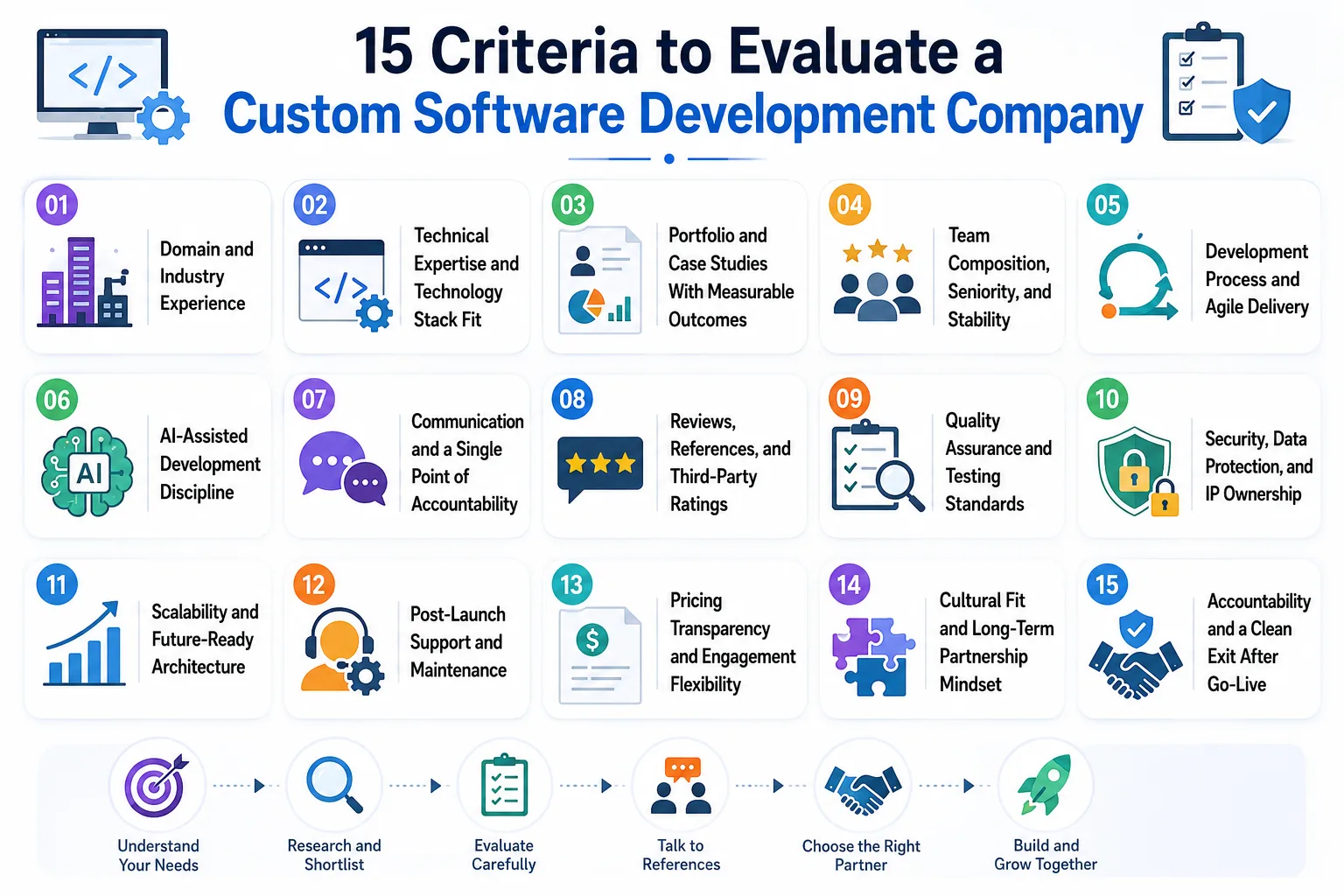
1. Domain and Industry Experience
A team that has already shipped in your world knows the traps before you hit them. A partner who has built warehouse management software grasps picking logic, compliance, and the edge cases that break generic tools. Ask which industries they have delivered into, and ask to speak to a client in your space.
2. Technical Expertise and Technology Stack Fit
Almost every firm lists React, Node, and a dozen other tools on its site, which proves little on its own. What matters is whether they have built something like yours and can defend their choices. Ask what they shipped recently, how it held up as it scaled, and why they picked that stack.
3. Portfolio and Case Studies With Measurable Outcomes
A portfolio is proof, so read it for outcomes, not screenshots. Look for case studies that name the problem, the work shipped first, and the measurable result after launch. Numbers like fewer errors, faster fulfillment, or higher revenue tell you more than a gallery of logos.
4. Team Composition, Seniority, and Stability
You are hiring the people, not the pitch deck. Confirm exactly who will build your product, how senior they are, and whether a named project manager owns your timeline. Ask about stability too, because constant churn means every new face has to relearn your system.
5. Development Process and Agile Delivery
Even strong engineers stall without a clear process. Look for a partner who runs structured sprints, shares progress openly, and adapts quickly when priorities shift. A waterfall approach that locks scope on day one rarely survives contact with real users. Ask how they plan work and handle change inside each cycle.
6. AI-Assisted Development Discipline
AI coding tools are now standard, so the question is not whether a firm uses them but how. You want discipline, where AI drafts boilerplate and tests, then humans review, test, and security-scan everything before it ships. Ask who signs off on AI-generated code and whether the contract holds the firm responsible for quality.
7. Communication and a Single Point of Accountability
You should have one named person who owns your scope and timeline, not a rotating cast or a salesperson who vanishes after kickoff. Expect a steady rhythm of sprint demos, weekly updates, and a clear channel for questions. Notice how fast they reply during the sales stage, because that pace rarely improves later.
8. Reviews, References, and Third-Party Ratings
Marketing is easy to fake, but a track record is hard to. Look for verified reviews on platforms like Clutch, and weigh client tenure heavily. Clients who stay for years are telling you the work held up. On a reference call, ask what went wrong and how the team handled it.
9. Quality Assurance and Testing Standards
Quality means confidence that your next change will not break the last one. A strong partner treats testing as part of development, with automated checks, code reviews, and clear release steps. Ask how they handle regression testing and catch issues before they reach production.
10. Security, Data Protection, and IP Ownership
Your data and your code both need protecting from day one. Confirm how the firm handles credentials, secrets, and user access, and check for standards like SOC 2 or GDPR alignment where they apply. Just as important, your contract must state that you own the code and intellectual property.
11. Scalability and Future-Ready Architecture
Your build should be simple to start, but never fragile. A good partner designs a real-time architecture that scales with more users and features, without forcing a costly rewrite the moment traction arrives. Ask how they plan for growth while avoiding over-engineering an early version.
12. Post-Launch Support and Maintenance
Launch is the start of the real work, not the end. Once users arrive, you will need fixes, refinements, and new features based on what you learn. Ask what support looks like after go-live, from response times to a written service agreement with clear priority tiers.
13. Pricing Transparency and Engagement Flexibility
You should always know what you are paying for and why. A reliable firm separates one-time build from ongoing costs, explains its pricing clearly, and offers models that fit your stage. Read change-request terms closely on fixed-price work, because that is where a tight quote quietly becomes expensive.
14. Cultural Fit and Long-Term Partnership Mindset
The best builds feel like one team, not a vendor on the other side of a wall. Shared working styles, honest communication, and compatible decision-making reduce friction and rework. Watch how a firm approaches problems and disagreement during evaluation, because that is how it behaves under pressure.
15. Accountability and a Clean Exit After Go-Live
The strongest partners stay accountable long after the invoice clears. Ask what happens if you ever part ways, because you want a clean handover of code, documentation, and access with reasonable notice. A team that works on retainer treats your product as its own, rather than shipping and disappearing.
How to Choose a Custom Software Development Company: A 5-Step Process
Follow these five practical steps to find a partner that fits your business needs, budget, and long-term goals:
Step 1: Define Your Project Requirements
Before contacting any company, be clear about what you want to build and why. Start by identifying the business problem you're trying to solve, then list your must-have features, budget, timeline, and expected outcomes.
The clearer your requirements are, the easier it becomes for development companies to understand your project, provide accurate estimates, and recommend the right solution.
Step 2: Choose the Right Development Model
Decide which type of development partner best suits your project. Compare an in-house team, freelancer, or custom software development company based on your budget, project complexity, and long-term goals.
If you already have an internal team, also decide whether you need staff augmentation, a dedicated team, or a full-service development partner. Choosing the right model early helps avoid delays and unnecessary costs.
Step 3: Shortlist the Best Companies
Research potential development partners and create a shortlist of three to five companies. Ask for recommendations, check trusted review platforms like Clutch and GoodFirms, and review their case studies, client feedback, and industry experience.
A focused shortlist makes it easier to compare companies and choose the ones that best match your project requirements.
Step 4: Evaluate Each Company Carefully
Compare every shortlisted company using the same criteria instead of choosing based on price alone. Review their technical expertise, communication, development process, security practices, pricing transparency, and post-launch support.
This helps you compare companies fairly and identify the partner that offers the best long-term value.
Step 5: Validate Before You Sign
Before making your final decision, speak with previous clients, review the contract carefully, and confirm ownership of the source code and intellectual property. If possible, start with a small paid discovery phase or pilot project.
Taking these final checks helps reduce risk and gives you confidence before committing to a long-term software development partner.
Also Read: Real-Time Inventory: WebSocket and Pub-Sub Architecture
7 Red Flags to Watch For When Choosing a Development Partner
Watch for these common red flags during your evaluation. Spotting them early can save you time, money, and months of frustration:
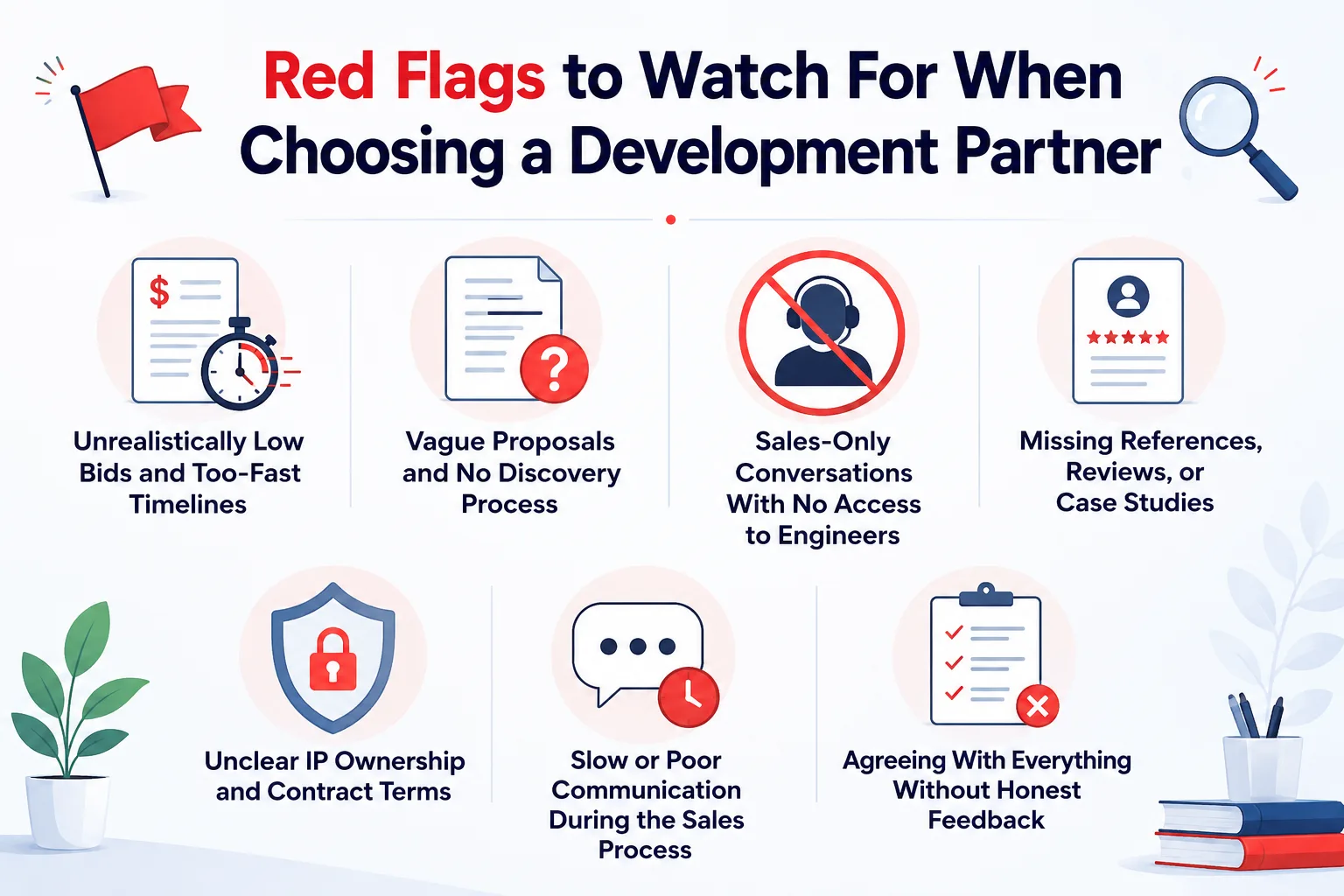
- Unrealistically Low Bids and Too-Fast Timelines: If a quote is much cheaper or faster than the others, be careful. It may leave out important work like testing, quality assurance, or project management, leading to delays and poor-quality software.
- Vague Proposals and No Discovery Process: A reliable company will first understand your business and project requirements before giving a quote. If they jump straight to pricing, they may not fully understand your needs.
- Sales-Only Conversations With No Access to Engineers: Before signing a contract, ask to meet the team that will build your software. If you only speak with the sales team, you may not know who is actually working on your project.
- Missing References, Reviews, or Case Studies: A trustworthy company should be able to show client reviews, case studies, and real project results. If they can't, it's difficult to judge their experience.
- Unclear IP Ownership and Contract Terms: Make sure the contract clearly states that you own the source code, intellectual property, and project assets after the project is completed.
- Slow or Poor Communication During the Sales Process: If a company is slow to reply, gives unclear answers, or misses commitments before the project starts, communication is unlikely to improve later.
- Agreeing With Everything Without Honest Feedback: A good development partner doesn't say yes to every request. They ask questions, explain trade-offs, and suggest better solutions when needed.
Also Read: How Much Does a Warehouse Management System Cost? (2026 Pricing Breakdown)
10 Questions to Ask Before You Sign
The right questions to ask a software development company separate a genuine partner from a polished pitch. Bring these ten to every shortlist call, and judge the answers by how specific and honest they are.
- Which projects in our industry have you shipped, and can we speak to those clients?
- Who exactly will build our product, and how senior are they?
- Can we talk directly with the engineers, not only an account manager?
- How do you decide which features to build first and which to cut?
- What does your process look like from discovery through launch?
- How do you handle data security, and who owns the code and IP at the end?
- How do you review and secure AI-generated code before it ships?
- What is your response time for a critical production issue, in writing?
- How do you handle changes in scope, scaling, and shifting priorities mid-build?
- What does support look like after launch, and how do you scale the team?
How Much Does Custom Software Development Cost?
The cost of custom software development depends far more on scope and complexity than on any single hourly rate. Still, you can plan with clear ranges, then tighten the number once a partner understands your build.
1. Cost Ranges by Project Complexity
Here is how custom software projects usually break down. Read these as industry ranges to plan against, not fixed quotes. For a full line-item breakdown, see our custom software development cost guide.
| Project Type | What You Usually Get | Indicative Cost Range |
|---|---|---|
| MVP | Core workflow only, built to validate an idea | $10,000 to $25,000 |
| Simple business application | Core features, a few flows, one primary use case | $20,000 to $90,000 |
| Mid-range | Several features, integrations, and a polished experience | $90,000 to $250,000 |
| Complex / enterprise | Advanced features, deep integrations, and compliance | $250,000 to $500,000+ |
These brackets are consistent with published industry data: Clutch's software development pricing guide puts the average project at roughly $132,000, and GoodFirms' cost survey finds most small and mid-sized projects landing between $30,000 and $100,000.
2. What Drives the Cost Up or Down
Several factors move the final number in either direction:
- Number and complexity of features. More features and custom logic mean more build time.
- Third-party integrations. Wiring into ERP, CRM, payment, or accounting systems is often a third of the budget.
- Team seniority and location. Senior engineers cost more per hour but usually deliver faster with fewer issues.
- UI and UX requirements. Clean, role-based interfaces for real operators take extra design effort.
- Security and compliance needs. Regulated data and standards like SOC 2 add scope you cannot skip.
- Ongoing support and maintenance. The build is the start, and long-term upkeep is a real line item.
3. Typical Development Timeline by Complexity
Time and cost move together, so a realistic timeline helps you plan the budget.
| Project Type | Typical Build Time | What Shapes It |
|---|---|---|
| MVP | 6 to 10 weeks | A focused scope ships fastest |
| Simple business application | 3 to 6 months | A few integrations add weeks |
| Mid-range | 3 to 6 months | Integrations and testing add weeks |
| Complex / enterprise | 6 to 12 months and up | Compliance and scale extend the work |
4. How to Get an Accurate Estimate for Your Build
The cost ranges above give you a general idea, but your actual project cost depends on your specific requirements. The more clearly you define your features, integrations, timeline, and business goals, the more accurate the estimate will be.
A reliable development company will first understand your project, discuss your requirements, and then provide a detailed estimate based on your scope instead of giving a rough quote upfront.
When you are ready, talk to our experts and get a scoped estimate for your project.
With the money side clear, you have everything the evaluation needs. Let's pull it together into one checklist you can actually use.
Your Custom Software Development Company Checklist
Use this as a quick tick-list on every shortlist call. If a firm clears most of it, they belong on your final list.
- Proven industry work. A shipped project and a client you can call.
- A senior, stable team. Named people and a project manager who owns delivery.
- A clear, sprint-based process. Regular demos and open progress updates.
- Disciplined AI use. Human review and security checks on generated code.
- Verified reviews and honest references. Third-party ratings, not just testimonials.
- Strong testing and security. Automated checks, code reviews, and data protection.
- Full code and IP ownership. Written into the contract from day one.
- Transparent pricing. Build and support costs separated clearly.
- A written support plan. Clear response times after go-live.
- A clean exit. A handover of code, docs, and access if you ever part ways.
Why Rorix Technologies for Custom Software Development
When you weigh partners for an operations build, Rorix Technologies is built for exactly this kind of work. We engineer custom software for the domain, from warehouse and HR systems to SaaS platforms, and we stay accountable well past go-live.
Our engineers ship production systems and share the craft, like this walkthrough of Angular 20 Signals.
What sets us apart:
- Domain-built software. Custom systems for WMS, HRMS, and SaaS, engineered for your operations, not adapted from a template.
- A record you can check. 27 projects delivered, a 5.0 rating on Clutch, and a dedicated team of senior engineers serving clients across the US, UK, Canada, Australia, and New Zealand.
- An in-house-team feel. We work on retainer in 2-week sprints, with full visibility into every task.
- Measurable outcomes. One warehouse build cut picking errors by 80% with real-time inventory tracking, barcode scanning, and automated workflows.
- Real integration depth. Driven, a US field-service performance platform, shipped with 40+ integrations and iOS plus Android from a single codebase.
- Fast, focused delivery. We ship a SaaS MVP to a first paying customer in 12 weeks.
Ready to scope your build? Book a free consultation, and we map your project, timeline, and the right approach.
Judge Development Partners on Evidence, Not the Pitch
Choosing the right partner is one of the biggest decisions in your product journey. It comes down to a clear scope, an honest evaluation against real criteria, sharp questions, and the discipline to judge evidence over a polished pitch.
Run the process, watch for the red flags, and score every option against what actually matters. The firms that clear the checklist are the ones worth your shortlist.
Look at your problem, your budget, and your shortlist, then move forward with a partner you can trust. When you are ready, connect with our experts to scope your build and turn your idea into software that ships.
Frequently Asked Questions
How do I choose a custom software development company?
Start by defining your problem, scope, and budget, then shortlist three to five firms. Score each against clear criteria like domain fit, technical depth, communication, references, and security. Check real references, run a small paid pilot, and pick the firm with the strongest evidence.
What should I look for in a custom software development company?
Look for proven work in your industry, a senior and stable team, and a clear sprint-based process. Confirm strong testing, security, and full IP ownership in the contract. Above all, choose a partner who communicates clearly and stays accountable after launch.
How much does it cost to build custom software?
Cost depends on scope, not a single rate. An MVP often runs $10,000 to $25,000, a simple business application $20,000 to $90,000, a mid-range project $90,000 to $250,000, and a complex platform $250,000 to $500,000 and beyond. Clear requirements and tight scope keep the number under control.
Should I hire a freelancer or a custom software development company?
Freelancers fit small, well-defined tasks with low risk. A full build usually needs a cross-functional team and one accountable owner, which a development company provides. For anything complex or long-term, a partner reduces risk and keeps delivery on track.
What are the biggest red flags when choosing a development partner?
Watch for suspiciously low bids, vague proposals with no discovery, and sales-only contact with no access to engineers. Missing references and unclear code ownership are also warnings. A firm that agrees to everything without pushback is a risk, not a bargain.
How do I protect my idea and own the source code?
Settle ownership before development starts. Your contract should state that you own the code, data, and intellectual property, and every contributor should sign an NDA. Ask for repository access from day one, not as a handover gift at the end.
How long does it take to build custom software?
Most builds take a few weeks to several months, depending on scope and integrations. A focused MVP can ship in 6 to 10 weeks, while complex platforms run six months or more. A tight scope and a focused partner are the fastest route to launch.
How do I evaluate a custom software development company if I am not technical?
Focus on what you can judge. Notice whether they ask sharp questions about your business, explain trade-offs in plain language, and offer clear terms on ownership and support. For a large build, a few hours with an independent technical advisor is money well spent.
Costing a custom build?
A dedicated team of senior engineers with a named technical lead on every engagement. Send us the problem and you get back a scope and a price.
Continue learning
Written by
Renish DadhaniyaFounder & Director, Rorix Technologies
Renish co-founded Rorix Technologies and drives the engineering and delivery culture across the organization. Beyond engineering, he leads the company's sales, finance, and HR operations, building the infrastructure that lets the team focus on shipping quality software. With deep hands-on expertise in architecture and team building, he ensures every project lands on time to the quality standards clients demand.
View full profileRelated articles
Top 16 Enterprise Software Development Companies in 2026
Compare the top 16 enterprise software development companies in 2026. Explore their expertise, timelines, and tips for choosing the right partner.
Read article
15 Best Small Software Development Companies for Startups in 2026
Compare the best software development companies for startups in 2026. See team size, engagement model, and fit for MVP, SaaS, and product builds.
Read article
25 Best Offshore Software Development Companies in 2026 (and How to Pick the Right One)
Compare 25 of the best offshore software development companies in 2026, with regional rates, engagement models, and a practical 7-step guide to picking one.
Read article