How to Choose an AI Development Company, and the Questions to Ask
How to choose an AI development company: what to settle first, 12 questions with good and weak answers, the contract terms and the model's life after launch.
On this page21 sections
How to choose an AI development company comes down to two things: what you settle before the first call, and what you ask during it. Settle the problem and how you will measure it. Then ask each firm to show an AI feature it runs in production, name the model it builds on and say what happens when that model is retired, put the monthly running cost in writing, and hand over the prompts, test set and code at the end. RAND's 2024 report notes that, by some estimates, more than 80 percent of AI projects fail, twice the rate of IT projects without AI, and the most common cause it found is a misunderstanding about what the project is for.
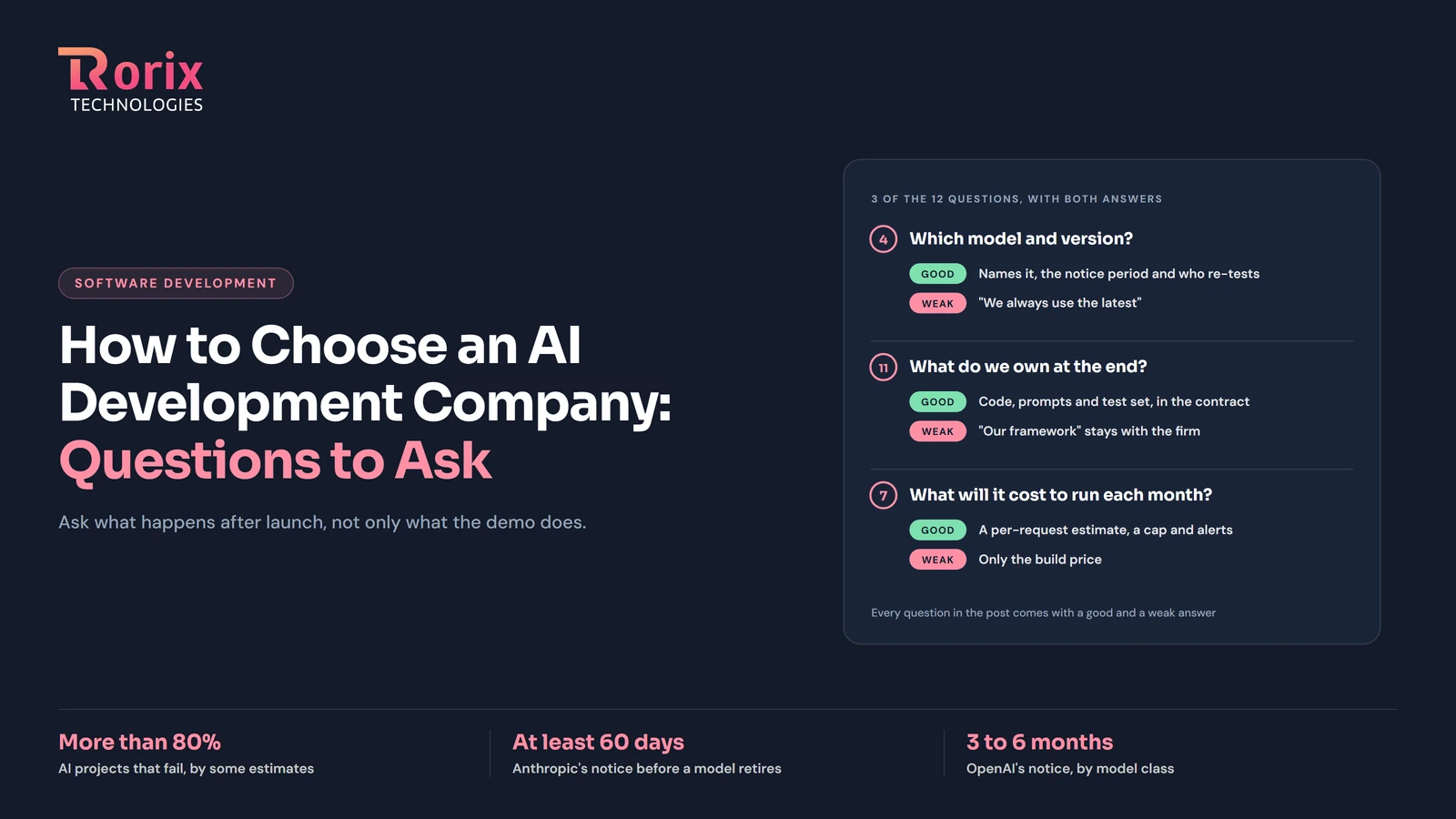
AI integration is the work we do at Rorix, so this guide gives you the questions we would want a buyer to ask us, each with what a good and a weak answer sound like. It also covers what most guides leave out: what happens to the model after launch, the contract clauses that are specific to AI, and the EU AI Act dates a buyer meets.
Key Takeaways: How to Choose an AI Development Company
- Decide first: one workflow, one measure and the data you have, before the first vendor call.
- Ask for production proof: an AI feature the firm runs today, and what it changed after launch.
- Ask which model version: Anthropic gives at least 60 days' notice before retiring a publicly released model and OpenAI at least three to six months by model class, with less for previews, so the plan must name who re-tests and who pays.
- Get the running cost in writing: the monthly cost at today's use and at ten times, with the model bill on your own account.
- Own what you pay for: put the code, prompts, test set and integration code in the contract, and read the model provider's terms on your data.
- Check the EU AI Act: it applies if your company is in the EU or the AI's output is used there; high-risk rules start on 2 Dec 2027 for stand-alone systems.
What Should You Decide Before You Talk to an AI Development Company?
Decide three things before the first vendor call: the one workflow the AI should change, the number that will show it worked, and the data the work would need. A firm can then quote against your goal instead of its favorite demo, and you can compare answers from different firms on the same terms.
RAND's researchers interviewed 65 data scientists and engineers and concluded that "misunderstandings and miscommunications about the intent and purpose of the project are the most common reasons for AI project failure." That cause sits on your side of the table, so settle those three, and who will run the feature after launch, before any firm is involved:
- One workflow. The task, who does it today, and the step the AI should take over or speed up, such as reading supplier invoices or ranking job applications.
- One measure, with today's number. Hours a week, errors a month or time to answer. Without a baseline, no pilot can pass or fail.
- The data. Where it lives, who owns it, whether another program can read it, and which fields may not leave your systems.
- Who runs it after launch. Your team, the firm or both. The answer changes which kind of partner fits and what the contract must say about support.
If "where do we start?" has no clear answer yet, our readiness assessment scores your technology, process, people and data in about two minutes and shows your biggest gaps, with no email needed to see the result.
Which Kind of AI Development Partner Do You Need?
Five kinds of firm sell AI work: an engineering firm that adds AI to the system you already run, an AI-only studio, a large consultancy, your software vendor's own AI add-on, and a freelancer. Pick by where the AI has to live and who will run it after launch, not by who has the best demo.
| Kind of Partner | When It Fits | What to Watch |
|---|---|---|
| Engineering firm that adds AI to your system | The AI must read from and write to software you already run: an ERP, a warehouse or HR system, or your own product | AI depth varies, so ask for an AI feature it runs in production |
| AI-only studio | A new AI product or a stand-alone feature with little integration | Your existing system may be treated as someone else's problem |
| Large consultancy or systems integrator | A program across many departments, with formal procurement | Higher cost and slower change; strategy is sometimes sold apart from the build |
| Your software vendor's AI add-on | The workflow lives inside one product whose AI feature already does the job | You rent it and cannot change how it works; the data terms are the vendor's |
| Freelancer | A small, well-defined prototype that your own engineers will take over | One person, no cover for holidays or support, and ownership must be written down |
Buying has become the common route. In a survey of 495 US enterprise AI decision-makers, Menlo Ventures, a venture firm that invests in AI companies, found that 76% of AI use cases are now purchased rather than built internally, up from 53% of AI solutions purchased in 2024 (9 Dec 2025). The MIT NANDA study "The GenAI Divide", as reported by Fortune on 18 Aug 2025, found that "Purchasing AI tools from specialized vendors and building partnerships succeed about 67% of the time, while internal builds succeed only one-third as often." It is one study, read here through a news report, so treat it as one data point.
If the AI must work inside a system you already run, start with the engineering firms: fitting the AI into your system is often the larger part of the job.
How Do You Tell Production AI Work From a Demo?
Ask for an AI feature that real users rely on today, then ask what it does when the model is slow or wrong and what the firm changed after launch. A demo runs on prepared questions; a production feature has met real data, and the firm can tell you what broke and how it was fixed.
The gap between the two is where a lot of AI work stops. S&P Global Market Intelligence, as reported by CIO Dive on 14 Mar 2025, found that the share of companies abandoning most of their AI initiatives jumped to 42%, up from 17% the year before, and that "The average organization scrapped 46% of AI proof-of-concepts before they reached production." The survey covered more than 1,000 respondents in North America and Europe. A portfolio made only of proofs of concept shows the stage where that 46% was lost.
Four checks separate the two:
- See it running. A screen you can use, not a recording, either public or shown with the client's permission.
- Ask what changed after launch. A firm that has run AI in production will usually have cut an input, added a fallback, rewritten a prompt or moved to a newer model, and can say why.
- Ask for one design detail. A time limit on the model call, a cap on input size, or where the AI's results are stored. A vague answer here means little production experience.
- Talk to the client who runs it. Ask how the AI's answers are checked today and who checks them.
To find firms worth the call, our shortlists compare them by the job: AI integration companies by business system, AI agent development companies for agents that take actions, AI SaaS development companies for features inside a SaaS product, and AI chatbot development companies for chatbots. For the vetting that is not specific to AI, such as references, team seniority and process, use our guide on how to choose a custom software development company.
What Questions Should You Ask an AI Development Company?
Ask twelve questions in six groups: the problem, the build, quality, cost, data and ownership, and proof. Each one below comes with what a good and a weak answer sound like, so you can score firms on the first call. A firm that has run AI in production usually answers most of them before you ask.
| # | Group | Ask | A Good Answer | A Weak Answer |
|---|---|---|---|---|
| 1 | Problem | What will this solve, and how will we measure it? | Names one workflow, today's number and a target before any price | Talks about models and features first |
| 2 | Problem | What data do you need, and have you looked at ours? | Asks for a sample and checks access before a fixed quote | A fixed price before anyone has seen the data |
| 3 | Build | Will you use a hosted model or train one, and why? | Starts with a hosted model and your data; trains only for a measured reason | Proposes a custom model before trying a hosted one |
| 4 | Build | Which model and version, and what happens when it is retired? | Names the model and version, the provider's notice period, who re-tests and who pays | "We always use the latest" |
| 5 | Quality | How will you test the answers, before and after launch? | A written test set built from your real cases, with a pass mark in the contract | "We try a few prompts" |
| 6 | Quality | What happens when the model is slow, down or unsure? | A time limit with a plain fallback, and a person approves the actions that change your records | No answer, or "it is very accurate" |
| 7 | Cost | What will it cost to run each month, today and at ten times the use? | A per-request estimate with the working shown, plus a spending cap and alerts | Only the build price |
| 8 | Cost | Whose account does the model bill run on? | Yours, or passed through at cost with usage you can see | Bundled into a fee with no usage shown |
| 9 | Data and ownership | Where does our data go, and may any provider train on it? | Names every company that processes it and quotes their terms | Cannot say what the provider's terms allow |
| 10 | Data and ownership | Who on your team sees our data, and how is access removed at the end? | Named roles, the least access the work needs, removal on the exit date | "Everyone on the team, as needed" |
| 11 | Data and ownership | What do we own at the end? | The code, prompts, test set, integration code and documentation, written into the contract | "Our framework" and the prompts stay with the firm |
| 12 | Proof | Show us an AI feature you run in production, and what you changed after launch. | A live feature and a change it needed once real users arrived | Demos and proofs of concept only |
Three of these need a word of explanation:
- Question 3, hosted or trained. Most business AI calls a hosted model, such as Claude, GPT or Gemini, through an API and hands it your documents or records at the moment of the question, which is called retrieval-augmented generation, or RAG. Training or fine-tuning costs more and needs examples you may not have, so a good firm proposes it only after a hosted model has failed a test on your cases.
- Question 5, the test set. A test set is a list of real inputs from your business with the answer you expect for each. It turns "the AI seems good" into a score that anyone, including another firm, can run again after a change.
- Question 7, running cost. Model fees are billed per token, so the cost grows with use. Ask for the estimate at ten times today's volume, because a feature that works gets used more. Our AI integration cost guide gives the one-line monthly formula and model list prices with the date they were checked.
What Happens When the AI Model Is Retired?
Requests to a retired model fail, so the feature stops until it is moved to a newer model and re-tested. Anthropic gives at least 60 days' notice before retiring a publicly released model; OpenAI gives at least six months for generally available models and at least three for specialized variants. Your plan has to name who re-tests and who pays.
A hosted model is rented, and the provider decides when each version ends. Anthropic's model deprecations page (read 23 Nov 2026) promises "at least 60 days' notice before model retirement for publicly released models", warns that "Once the model is retired, requests to it fail", and advises testing your applications "with the new models well before the retirement date." OpenAI's deprecations page (read 23 Nov 2026) gives generally available models "At least 6 months" of notice "Unless safety or compliance concerns require a faster timeline", gives "Specialized variants of generally available models and image generation models" "At least 3 months", and says preview models "may be retired with much shorter notice, such as 2 weeks."
| Provider | Model Version | Notice Date | Retirement Date | Replacement the Provider Recommends |
|---|---|---|---|---|
| Anthropic | Claude Sonnet 4.5 (claude-sonnet-4-5-20250929) | 30 Sep 2026 | 30 Nov 2026 | Claude Sonnet 5.5 |
| OpenAI | GPT-4o (gpt-4o-2024-08-06, gpt-4o-2024-11-20) | 14 Oct 2026 | 14 Jan 2027 | gpt-6-luna |
Sources: the Anthropic and OpenAI deprecation pages above, both read 23 Nov 2026.
Read the dates listed for your own model as well as the policy: the GPT-4o row shows three months between notice and shutdown, and the page does not say which notice class those versions fall under. Claude Sonnet 4.5 on Anthropic's own API got notice on 30 Sep 2026 and retires on 30 Nov 2026; Amazon Bedrock and Google's managed service set their own dates.
Put five lines in the plan:
- The exact model version the feature calls, written into the handover documentation.
- Whose account gets the notice. Anthropic notifies "customers with active deployments" and OpenAI emails "customers who are actively using the model". If the account is the firm's, you may never see the email.
- Who re-runs the test set on the replacement model, and how long that takes.
- Who pays for the move: inside the support agreement, or billed as new work.
- The replacement's price. A newer model can cost more or less per token than the one it replaces, so every running-cost estimate needs a date on it.
How Do You Compare AI Development Proposals?
Put every proposal into one table with the same rows: the problem and its measure, the data needed, the model and version, the test plan and pass mark, the build price, the monthly running cost, the team, the pilot milestone, ownership and support. Gaps show at once, and a low price that leaves rows empty stops looking cheap.
| Line in the Proposal | What It Should State | If It Is Missing |
|---|---|---|
| Problem and measure | The workflow, today's number and the target the pilot must hit | Nobody can say whether the work succeeded |
| Data needed | Which systems and fields, who grants access, and what may not leave | The price assumes data you may not have |
| Model and version | The hosted model, its version, and why it beat a smaller one | You cannot plan for its retirement or its price |
| Test plan and pass mark | A test set from your cases, the score it must reach, and who runs it | "Done" means the demo worked once |
| Build price | Fixed or time and materials, with what sits outside it | Scope changes arrive as surprises |
| Monthly running cost | Model fees per request at today's use and at ten times, plus hosting and monitoring | The bill appears after launch |
| Team | Named people, their roles, and who leads | A senior pitch and an unnamed team |
| Pilot milestone | A date, a scope and a go or no-go decision | The project grows without a check |
| Ownership | Code, prompts, test set, integration code and documentation | The firm keeps what you paid for |
| Support after launch | Monitoring, fixes, model moves, response times and price | Support ends at handover |
Compare prices only once the rows match, because two quotes for the same idea often price different scopes. Ask for the AI feature and the integration work as separate lines; fitting the AI into the system you already run is often the larger one.
What Should an AI Development Contract Say?
An AI development contract needs the usual terms plus clauses general contracts miss: how your data may be used, including by the model provider; who owns the prompts, test set and integration code; whose account the model bill runs on, with a cost cap; who re-tests on a model change; and the pilot's acceptance test.
| Clause | What It Should Say |
|---|---|
| Data use | What data the firm may access, for what purpose and for how long, and that it is deleted or returned at the end |
| Model provider's terms | Which providers process your data, with the terms that say whether they may train on it |
| Ownership | You own the code, prompts, test set, integration code and documentation |
| Model bill | Runs on your account, or is passed through at cost with usage reports |
| Running-cost estimate and cap | The estimate at today's use, a monthly cap, and alerts before the cap is reached |
| Model changes | Who watches retirement notices, re-runs the test set and moves the feature, and at what price |
| Pilot acceptance | The test set, the pass mark and the date; the next phase follows a pass |
| Exit handover | Access removed, keys and passwords changed, everything in the ownership clause delivered |
The model provider's own terms belong in the file. OpenAI's enterprise privacy page (updated 8 Jan 2026) says "We do not train our models on your data by default" for its business products and API. Anthropic's Commercial Terms (read 23 Nov 2026) say "Anthropic may not train models on Customer Content from Services." A good firm can quote the equivalent line for every provider it plans to use.
Read the terms of any AI tool the build relies on, too. A Stanford CodeX post of 21 Mar 2025, using TermScout contract data, found that 92% of the AI vendor contracts studied claim data usage rights beyond what is needed to deliver the service, against a market average of 63%; only 17% commit to complying with all applicable laws, against 36% of SaaS agreements; and just 33% indemnify the customer against third-party IP claims. Those figures describe AI tool vendors' standard terms, not development firms' contracts, which is why both need reading.
For a ready-made clause list, the European Commission's Public Buyers Community published updated model contractual clauses for buying AI on 5 Mar 2025 (the first version came out on 29 Sep 2023), with a full version for high-risk AI and a light version for other AI. They are written for public buyers, but they make a useful checklist for any contract. We are engineers, not lawyers, so have your own counsel review the final text.
Does the EU AI Act Affect Your AI Project?
You are in its scope if your company is in the EU or the AI's output is used in the EU, even when the firm and the system are elsewhere. The Act has applied since 2 August 2026, with exceptions: the high-risk rules start on 2 December 2027, or 2 August 2028 for AI built into regulated products.
Article 2 applies the Act to "providers and deployers of AI systems that have their place of establishment or are located in a third country, where the output produced by the AI system is used in the Union" (AI Act Service Desk, read 23 Nov 2026). So a firm and a system outside the EU can still be in scope when the output is used inside it.
| Date | What Applies | Source |
|---|---|---|
| 1 Aug 2024 | The AI Act entered into force | European Commission |
| 2 Feb 2025 | Prohibited AI practices and AI literacy obligations | European Commission |
| 2 Aug 2025 | Governance rules and obligations for general-purpose AI models | European Commission |
| 2 Aug 2026 | The Act became applicable, with some exceptions | European Commission |
| 2 Dec 2026 | New deadline for providers to put transparency solutions in place for AI-generated content | Council of the EU |
| 2 Dec 2027 | High-risk rules for systems used in certain high-risk areas, such as employment and education | European Commission |
| 2 Aug 2028 | High-risk rules for systems built into regulated products, such as lifts or toys | European Commission |
Sources: the European Commission's AI Act page (read 23 Nov 2026) for every date except 2 Dec 2026, which comes from the Council of the EU's announcement of 29 Jun 2026 approving the digital omnibus on AI, as published by the EU's External Action Service. The same announcement cut the grace period for that deadline from six months to three.
Which of these dates reach you depends on the risk category of what you build. Ask the firm which category it would place your feature in and why, and have your own counsel confirm the answer before the build starts.
The AI-Specific Red Flags That Should End the Conversation
End the conversation when a firm's proposal does not name the model, or when the firm has no plan for its retirement, keeps the model bill on its own account with no usage shown, proposes training before trying a hosted model, or has no answer on the EU AI Act when you or your users are in the EU.
- No model name in the proposal, or "we always use the latest." A proposal that does not name the model and version cannot tell you its notice period, its price or what changes when it is retired.
- No plan for the model's retirement. If nobody is named to re-test and move the feature, the first retirement notice becomes an emergency.
- The model bill on the firm's account, with no usage you can see. You cannot check the running cost, and the retirement notices go to the firm instead of you.
- A custom-trained model as the opening proposal. Training before a hosted model has been tried on your cases adds cost and time the project may not need.
- No answer on the EU AI Act when your company or your users are in the EU. A firm that has not looked at the dates has not planned for them.
The general warning signs, from demos without production work to a senior sales team and a junior delivery team, are the seven in our AI integration companies shortlist.
How Rorix Answers These Questions About Its Own AI Work
We add AI to systems that already run, on hosted models, and we do not train models. Three of our features show the answers in practice: candidate matching in our own HR system, the ROI report on our website, and the AI SKU price finder that sits beside WorkCenter Central, the platform we built for Lorecs, a distributor.
| Question | Our Answer | Feature |
|---|---|---|
| Hosted model or trained one? | Hosted models; we do not train models | All three |
| Show us a feature in production | Candidate matching in RMS, the management system we run Rorix on, shipped 8 Apr 2026 | Candidate matching |
| Which model? | Claude Haiku 5.5 by Anthropic, at a list price of $0.10 per million input tokens and $0.50 per million output tokens, checked 28 Oct 2026 | Candidate matching and the ROI report |
| What happens when the model is slow or down? | The page waits at most 10 seconds for the model, then shows the plain result | ROI report on our website |
| What will it cost to run? | About $0.0006 a score at list price (our estimate), because the resume text in every call is cut at 8,000 characters | Candidate matching |
| What changes in our system? | Two new tables; no column added to the existing hiring tables | Candidate matching |
| What changes in the client's platform? | None to WorkCenter Central's production codebase | Lorecs AI SKU price finder |
Candidate matching's response time, about 4 seconds (median 3.8 s, slowest 5.7 s), was measured on Claude Haiku 4.5; it and the ROI report now run on Claude Haiku 5.5. A model move is part of running an AI feature, which is why question 4 belongs on every list.
Behind those features:
- 27 platforms delivered and a 5.0 Clutch rating from 4 reviews on Clutch.
- A dedicated team of senior engineers with a named technical lead.
- Application engineering only: infrastructure and DevOps stay with your team.
- Clients in the US, UK, Canada, Australia, and New Zealand.
Bring the workflow and the measure from the first section, and ask us the twelve questions the way you would ask any other firm. Scope an AI build with our engineers.
Frequently Asked Questions
How do you choose an AI development company?
Settle one workflow, one measure and your data first. Then ask each firm for an AI feature it runs in production, the model version it builds on and who re-tests when that model is retired, the monthly running cost in writing, and the code, prompts and test set at handover. Compare proposals line by line, not by total price.
How much does it cost to hire an AI development company?
Market ranges, not a Rorix price: adding one AI feature to an existing app costs $5,000 to $300,000+, according to seven agency cost guides published or updated between April and October 2026, collected in our AI integration cost guide. A whole new AI app costs $15,000 to $300,000+ in agency guides from April to October 2026, and enterprise platforms can exceed $1,000,000, as our AI app development cost guide shows.
Should we build AI in-house or work with a partner?
Buying is now the more common route: in a survey of 495 US enterprise decision-makers, Menlo Ventures, an investor in AI companies, found 76% of AI use cases are purchased rather than built internally (9 Dec 2025). Build in-house when you already have engineers who have shipped AI to production and will run it afterward.
Who owns the AI solution after the project ends?
You should own the code, prompts, test set, integration code and documentation, written into the contract. A hosted model itself belongs to its provider; what you keep is your data and what was built around the model. OpenAI's enterprise privacy page, for one, says you own your inputs and outputs where the law allows. Check each provider's terms on training with your data, and keep the model account in your company's name.
Do we need a custom model, RAG or fine-tuning?
Usually a hosted model with retrieval (RAG), which hands the model the relevant documents at the moment of the question. Fine-tuning or training costs more and needs examples you may not have, so try it only after a hosted model has failed a test on your own cases. Our own AI features run on hosted models, and we do not train models.
Can AI work with our older systems?
Often, if another program can read the data the AI needs and the system can accept a suggestion back. Where it cannot, the gap is integration work rather than AI work. Our guide on how to add AI to existing software maps the places AI can enter an existing system.
Should we choose a US-based or offshore AI development company?
Judge on the twelve questions first. Location then changes four things: the working hours that overlap with yours, a named lead you can reach, where your data is processed, and how the ownership and exit terms are enforced. A firm abroad with clear answers carries less risk than a local one without them.
What security questions should we ask an AI vendor?
Ask which fields leave your systems and why, which providers process them and whether those providers may train on them, whether the model only sees records the signed-in user may see, what is logged, and how access is removed at the end. For features that take actions, ask which actions need a person's approval.
Should we pay for a discovery phase?
A short, paid discovery is reasonable when it ends in something you keep: a written proposal with every row of the comparison table filled in, a sample of your data checked, and a test set started. You should own that output, whichever firm builds the feature.
Adding AI to your system, or building a new AI feature?
Most of the work sits in the data plumbing rather than the model. Send us the workflow you want to automate and we will tell you what is feasible on your current stack.
Continue learning
Written by
Renish DadhaniyaFounder & Director, Rorix Technologies
Renish co-founded Rorix Technologies and drives the engineering and delivery culture across the organization. Beyond engineering, he leads the company's sales, finance, and HR operations, building the infrastructure that lets the team focus on shipping quality software. With deep hands-on expertise in architecture and team building, he ensures every project lands on time to the quality standards clients demand.
View full profileRelated articles
Top 15 AI Chatbot Development Companies in 2026
Compare 15 AI chatbot development services in 2026 by expertise, Clutch ratings, hourly rates, and use cases. Find the right partner for your business.
Read article
Top 15 AI Integration Companies for Business Systems in 2026
Explore the top 15 AI integration companies, their services, costs, and expertise to choose a partner for your business systems and workflows.
Read article
Top 12 AI SaaS Development Companies in 2026
Compare the 12 best AI SaaS development companies for 2026, with services, ratings, costs, and tips to choose the right development partner.
Read article