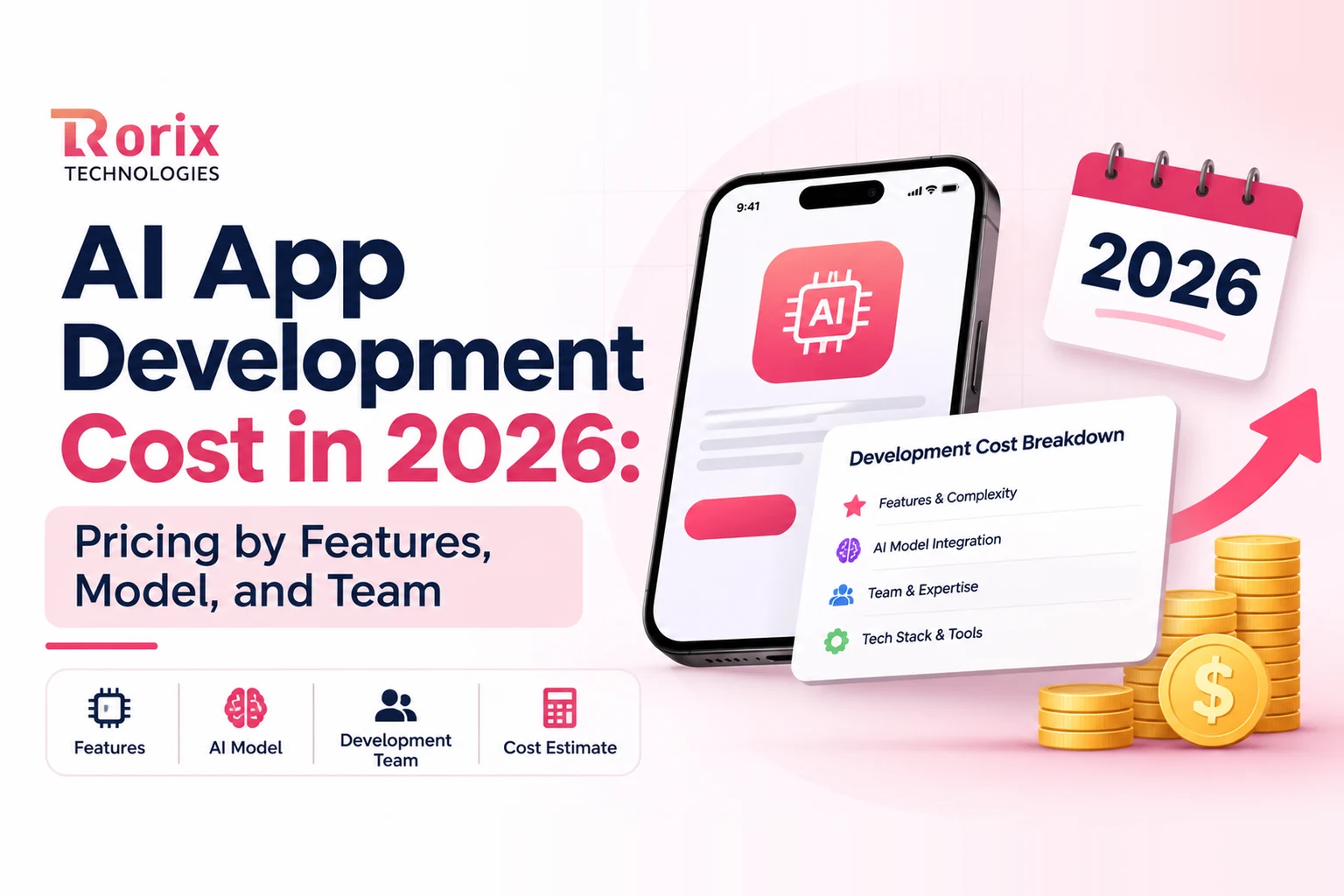
AI App Development Cost in 2026: Pricing by Features, Model, and Team
AI app development cost in 2026: $15,000 to $300,000+ to build, $1M+ for enterprise platforms. Prices by feature, AI model, team and monthly running cost.
On this page53 sections
Key Takeaways: Understanding AI App Development Costs
- Build cost: AI apps typically cost $15,000 to $300,000+, while enterprise platforms can exceed $1 million.
- Features: AI features can add $5,000 to $300,000+, depending on complexity and functionality.
- Models: Hosted APIs are cheaper to start with. Fine-tuning costs $15,000 to $100,000, while custom training can exceed $300,000.
- Team: Blended agency team rates range from $25 to $50 an hour in India and Southeast Asia, compared with $100 to $200 in the US.
- Running costs: Budget for model usage, hosting, monitoring, and annual maintenance of 15% to 25% of build cost.
- Cost savings: MVPs, no-code builders, and AI coding tools can reduce upfront spending, but production apps still need testing, security, and integrations.
An AI app prototype can cost just $25 a month on an AI app builder such as Lovable, yet one cost guide pictures three vendors quoting $25,000, $180,000, and more than $500,000 for the same AI product. The difference comes down to what the app needs to do, the systems it must connect with, and the experience it needs to deliver.
That is what makes AI app development costs hard to estimate. The AI model is only one part of the budget. Features, data preparation, integrations, platform requirements, backend infrastructure, and the development team all influence the final price.
As AI integration and development become part of the build, connecting business data, setting up workflows, and testing the app can add significantly to the investment. These requirements often explain why two projects with similar ideas receive very different quotes.
In this guide, you'll learn:
- AI app development cost by app type and features
- Pricing across AI models and platforms
- Development team rates and engagement models
- Monthly running expenses and hidden costs
- A practical first-year AI app budget
- Ways to reduce development costs without compromising quality
By the end of this guide, you'll know what affects the total investment, how to estimate your budget, and what to check before accepting a development quote.
How Much Does AI App Development Cost?
Most AI apps cost $15,000 to $300,000+ to build. Enterprise platforms can exceed $1,000,000, depending on their features, complexity, and infrastructure. The table below breaks down typical costs, timelines, and monthly running expenses.
| App Type | Typical Example | Build Cost (Market Range) | Timeline | Monthly Running Cost |
|---|---|---|---|---|
| Prototype or internal tool on an AI app builder | Booking tool or team dashboard with one AI step | $0 to $1,000+ | Hours to a weekend | $20 to $500 |
| Basic AI app or AI MVP | One AI feature, such as a support assistant on a hosted model | $15,000 to $60,000 | 2 to 4 months | $200 to $2,000 |
| Mid-level AI app | Answers over your own documents, several workflows, and a few integrations | $60,000 to $150,000 | 4 to 7 months | $2,000 to $10,000 |
| Advanced AI app | Fine-tuned models, computer vision, voice, or agents working inside other systems | $150,000 to $300,000+ | 7 to 12 months | $5,000 to $20,000+ |
| Enterprise AI platform | Multiple models, strict governance, deep integrations, or a model trained from scratch | $300,000 to $1,000,000+ | 9 to 18 months | $20,000+ |
These are market ranges from published guides, not Rorix pricing. The prototype row rests mainly on AI app builder vendors (Softr, Zite), who price that tier; the other rows come from development agencies. Use them as a starting point, then estimate your AI app development cost based on the features, data, integrations, and usage your project requires.
Sources: CMARIX (22 Jun 2026), Space-O Technologies (21 Oct 2026), Groovy Web (23 Oct 2026 and 24 Jun 2026), Monocubed (19 May 2026), Emerline (11 Jun 2026), TechNBrains (5 Oct 2026), Biz4Group (2 Jul 2026), Miquido (24 Apr 2026), GeekyAnts (July 2026), Softr (29 May 2026), Zite (23 Mar 2026) and Dev.co (26 Oct 2026).
The gap between these price tiers comes from the work behind the app. Data preparation, system integrations, model evaluation, guardrails, and monitoring can add substantial costs, especially when the app handles business-critical tasks or large numbers of users.
Where the Money Goes: AI App Cost Breakdown by Build Phase
An accurate AI app development cost estimate starts with the work involved in each build phase. The table below shows typical phase costs for a mid-level to advanced app. Basic MVPs combine or skip some phases.
| Build Phase | What It Covers | Cost (Market Range) |
|---|---|---|
| Discovery and solution design | Use case, data audit, model choice, and architecture | $5,000 to $25,000 |
| UI/UX design | User flows, AI chat screens, and admin views | $7,000 to $15,000 |
| Frontend and backend development | Screens, APIs, database, login, and roles | $25,000 to $120,000 |
| Data preparation | Cleaning, structuring, and indexing records and documents | $5,000 to $50,000 |
| AI model setup and integration | Prompts, retrieval, model connection, and guardrails | $8,000 to $80,000 |
| Testing, evaluation, and security | Accuracy checks, edge cases, and access reviews | $5,000 to $50,000 |
| Deployment and launch support | Hosting setup, monitoring, and initial fixes | $5,000 to $20,000 |
Sources: Space-O Technologies (21 Oct 2026), CMARIX (22 Jun 2026), Decipher Zone (18 Aug 2026), Nimble AppGenie (23 Mar 2026), Technource (19 Nov 2026), Biz4Group (2 Jul 2026), RipenApps (30 Sep 2026) and Emerline (11 Jun 2026).
Most mid-level projects cost $60,000 to $150,000, while basic AI apps typically range from $15,000 to $60,000. Not every project reaches the highest estimate in each phase.
Pay close attention to data preparation and testing. These AI app development cost factors are often reduced in low quotes, but they directly affect how reliably the app works with real users.
AI App Development Cost by Features
Features have a direct impact on your budget. Every AI app needs core software features, while each added AI capability increases the build cost.
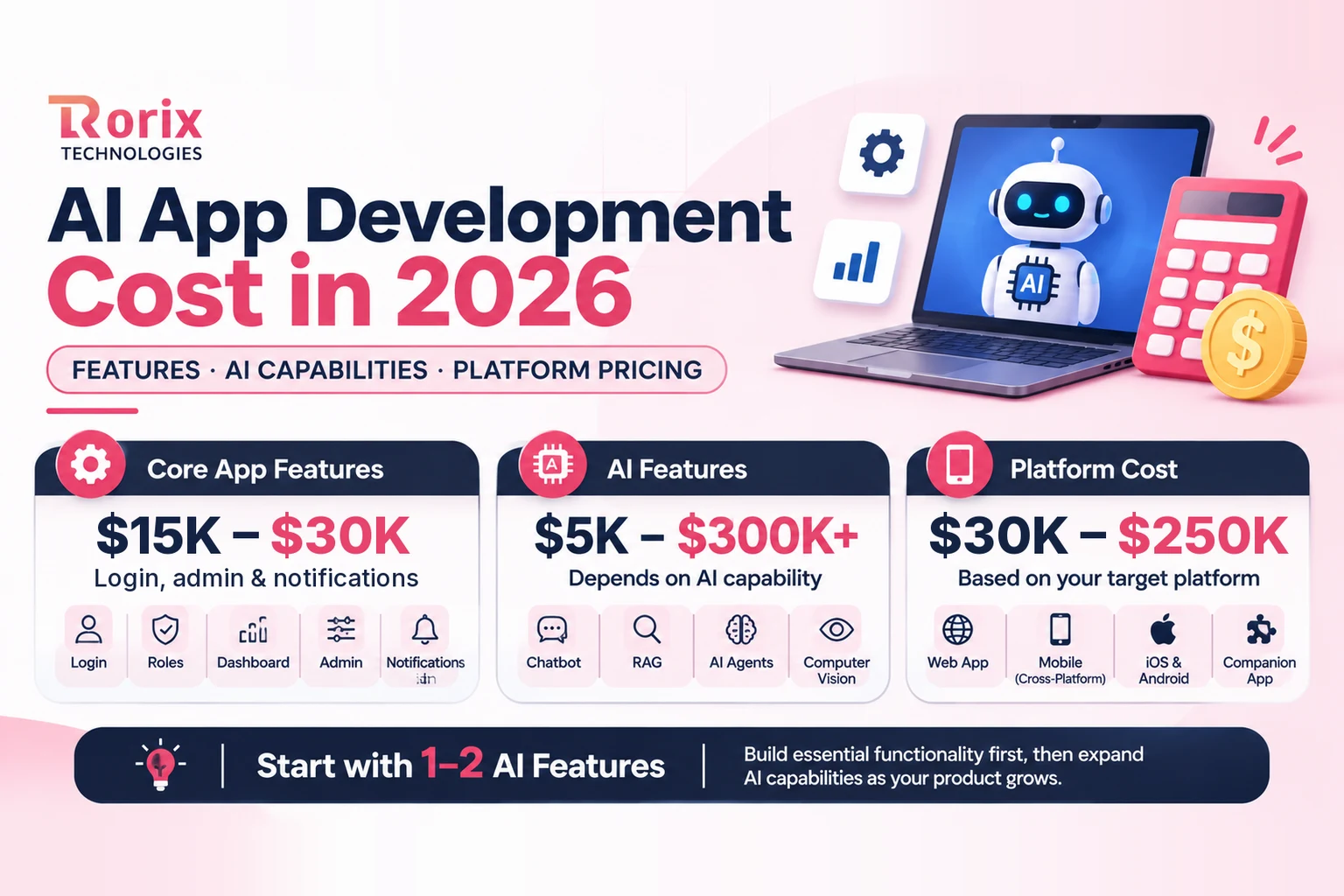
1. Core App Features: Login, Admin, Dashboards and Notifications
Every AI app needs basic features such as login, an admin panel with dashboards, and notifications. At $100 an hour, the three below cost around $15,000 to $30,000, before adding any AI functionality.
| Feature | Typical Effort | Cost at $100 an Hour |
|---|---|---|
| Login and password reset | 40 to 80 hours | $4,000 to $8,000 |
| Admin panel with dashboards and reporting | 80 to 160 hours | $8,000 to $16,000 |
| Email and push notifications | 30 to 60 hours | $3,000 to $6,000 |
Sources: Techsy (6 Nov 2026), which also prices these hours at $100 an hour, and RapidDev (November 2026).
Roles and permissions, usage metering for AI calls, and enterprise single sign-on with audit logs come on top. No dated guide we found prices them in hours, so ask each vendor to quote them separately. Usage metering tracks AI requests, sets limits, and helps calculate customer charges. Roles and permissions also control which data the AI can access and share, making them essential for apps with multiple user types.
2. AI Features: Assistants, Search, Extraction, Predictions and Agents
The AI features you choose can significantly change the budget. Costs depend on data quality, integrations, and the accuracy each feature needs to deliver.
| AI Feature | What It Does | Build Cost (Market Range) |
|---|---|---|
| Assistant or chatbot | Answers questions and guides users in plain language | $5,000 to $60,000+ |
| Answers over your own data (RAG) | Searches documents and records, then answers with sources | $15,000 to $120,000 |
| Document extraction | Pulls fields from invoices, forms, or bills of lading | $10,000 to $100,000+ |
| Scoring and classification | Ranks leads, tickets, or candidates using a hosted model | $5,000 to $80,000+ |
| Summaries and drafting | Creates summaries, replies, and first drafts | $5,000 to $50,000+ |
| Recommendations | Suggests products, content, or actions based on user behavior | $10,000 to $75,000+ |
| Predictions and forecasting | Forecasts demand, churn, or staffing using historical data | $10,000 to $90,000 |
| Voice input and output | Adds speech capabilities to a text assistant | $10,000 to $15,000 |
| Computer vision | Analyzes images or video for checks and counts | $8,000 to $90,000+ |
| Agent that takes actions | Completes multi-step tasks inside your systems | $25,000 to $300,000+ |
These ranges price a feature added to an app, and each runs from the lowest floor to the highest ceiling among the guides that price it. A standalone recommendation, forecasting, or computer vision platform costs more; the use case table below prices whole apps.
Sources: Apptitude (4 Apr 2026), Biz4Group (updated 27 May 2026), OrangeMantra (21 Sep 2026), Primocys (31 Aug 2026), Space-O Technologies (updated 21 Oct 2026), Aalpha (updated 18 Nov 2026), Dotcube Technologies (3 Sep 2026), Codewave (19 Jan 2026, forecasting) and TechEniac (28 Oct 2026, voice).
Most first releases need only one or two AI features. Our AI integration cost guide covers feature-level costs and monthly model fees.
For conversational apps, see the AI chatbot development cost breakdown. For apps that perform tasks across business systems, explore our AI agent development cost guide.
3. Platform: Web, iOS, Android or Cross-Platform
Your target platform affects both development and testing costs. Building for multiple platforms adds design, testing, and release work to the budget. The table prices a full app build on each platform, before the AI features priced above; a basic AI MVP with a small set of screens sits below these ranges.
| Platform | What You Get | App Build Cost Before AI Features (Market Range) |
|---|---|---|
| Web app or PWA | Browser access, faster release, and cloud-based AI | $30,000 to $90,000 |
| Cross-platform mobile (Flutter or React Native) | One codebase for iOS and Android | $60,000 to $140,000 |
| Native iOS and Android | Device-specific performance and on-device AI options | $110,000 to $250,000 |
| Companion mobile app for a web product | A field or customer app alongside your web platform | $25,000 to $60,000 added |
Sources: Tekrevol PWA guide (25 Aug 2026), Netguru (17 Nov 2026), Tekrevol mobile guide (24 Aug 2026), RaftLabs (29 Apr 2026), Droids On Roids (10 Feb 2026) and Techsy (6 Nov 2026).
Web apps are a practical starting point for most businesses. Drivers, technicians, and warehouse staff may need mobile access, where cross-platform mobile app development usually costs less than building two native apps.
On-device AI adds engineering work because models must be optimized to run quickly and offline. Most business apps use hosted models instead.
AI App Development Cost by AI Model Approach
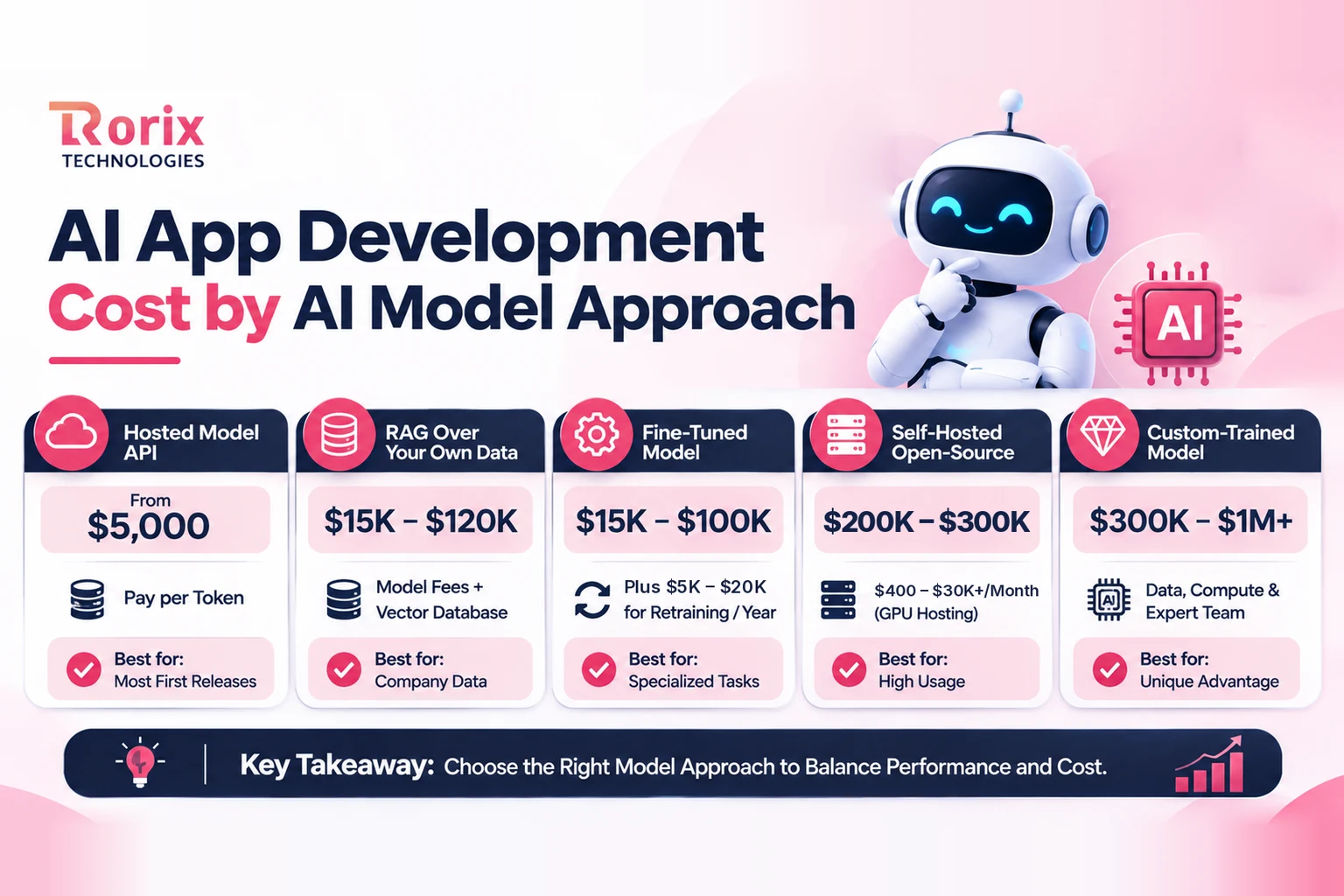
The model you choose affects both the upfront budget and monthly expenses. Each approach has different setup costs, running fees, and use cases.
| Model Approach | Added Build Cost (Market Range) | Ongoing Cost | Best Fit |
|---|---|---|---|
| Hosted model API | Included in feature costs, from $5,000 | Pay per token, increasing with usage | Most first releases |
| RAG over your own data | $15,000 to $120,000 | Model fees plus a vector database at $0 to $500+ a month | Answers from company documents and records |
| Fine-tuned model | $15,000 to $100,000, plus usage fees | Retraining at $5,000 to $20,000 a year | Narrow tasks with strict format or language needs |
| Self-hosted open-source model | About $200,000 to $300,000 for the first deployment at major-market engineering costs | GPU hosting at $400 to $30,000+ a month | High, steady volume or strict data residency |
| Custom-trained model | $300,000 to $1,000,000+ | GPUs, data work, and MLOps every month | Products where the model itself is the advantage |
Sources: Apptitude (4 Apr 2026), GMWare (18 May 2026), OrangeMantra (21 Sep 2026), Space-O Technologies (updated 21 Oct 2026), Pinecone (checked 20 Nov 2026, vector database), Monocubed (updated 19 May 2026, fine-tuning and retraining), Uvik Software (updated 15 Nov 2026, retraining), Azumo (updated 16 Aug 2026, self-hosting setup), Infinum (updated 30 Sep 2026, GPU hosting), Lambda and RunPod (list prices checked 20 Nov 2026), Abbacus Technologies (10 Apr 2026, custom-trained model), SmartDev (updated 27 Mar 2026) and Idea Usher (18 May 2026, labeling), and list prices published by Anthropic and OpenAI (checked 20 Nov 2026).
1. Hosted Model API
Hosted APIs are the simplest starting point for most AI apps. You connect to a provider's model and pay per token, keeping initial setup costs low. However, monthly bills increase with user activity and longer prompts.
2. RAG Over Your Own Data
RAG lets an AI app answer questions using your documents and business records without retraining the model. Setup costs range from $15,000 to $120,000 for data ingestion, embeddings, search, and permission controls. Answers can stay current as your source data changes.
3. Fine-Tuned Model
Fine-tuning adapts an existing model to your examples, usually costing $15,000 to $100,000 plus usage fees. It works well when prompts alone cannot deliver the required format or domain-specific language. Budget another $5,000 to $20,000 a year for retraining as your data changes.
4. Self-Hosted Open-Source Model
Self-hosting gives you more control over data and infrastructure, but you must manage GPUs, scaling, and uptime. One guide says the first deployment takes 2 to 4 engineers for 3 to 6 months and prices a two-engineer, four-to-five-month effort at $200,000 to $300,000 in major tech markets, with GPU hosting at $400 to $30,000+ a month. It suits apps with high, steady usage or strict data residency needs.
5. Custom-Trained Model
Training a model from scratch can cost $300,000 to $1,000,000+. The budget covers data collection, labeling, computing power, and specialist teams, with supervised labeling alone costing $15,000 to $300,000, depending on how many examples need labels and whether experts must label them. This approach makes sense when the model itself gives your product a clear advantage.
Model size also affects monthly spending. The largest models can cost about 100 times more per token than the smallest ones. A cost-efficient app uses smaller models for simple requests and reserves larger models for complex tasks.
Also Read: How to Add AI to Existing Software: What Your System Will Let You Do
AI App Development Cost by Team
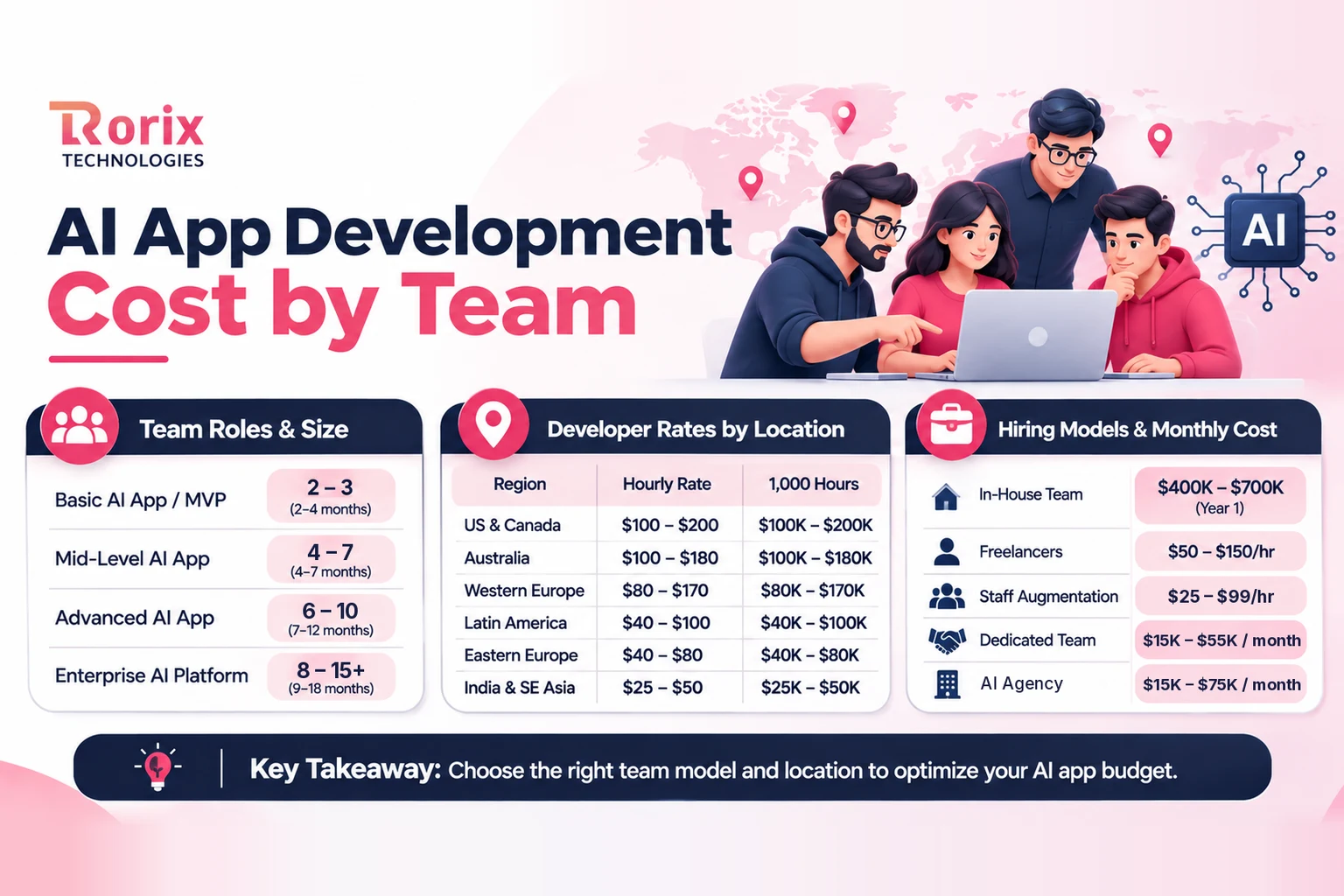
Your team affects the budget as much as the features and model. Roles, hourly rates, and hiring models all influence the final cost.
1. Who You Need on an AI App Build
An AI app needs more than developers who connect a model. Data engineers, AI specialists, QA testers, and DevOps engineers help prepare data, check outputs, and keep the app reliable.
| App Type | Core Roles | Team Size | Timeline |
|---|---|---|---|
| Basic AI app or AI MVP | Full-stack developer, AI engineer, part-time QA | 2 to 3 | 2 to 4 months |
| Mid-level AI app | Frontend and backend developers, AI engineer, designer, QA, and project manager | 4 to 7 | 4 to 7 months |
| Advanced AI app | Mid-level team plus data engineer, ML engineer, and DevOps engineer | 6 to 10 | 7 to 12 months |
| Enterprise AI platform | Advanced team plus MLOps, security lead, and solution architect | 8 to 15+ | 9 to 18 months |
Sources: team sizes from Netguru (21 Jul 2026), Neontri (3 Mar 2026) and CMARIX (22 Jun 2026); timelines as in the cost table above.
Senior engineers are especially important for complex AI projects. They can identify unreliable outputs, choose cost-effective models, and catch technical issues before users encounter them.
2. AI Developer Rates by Location, From the US to India
Location can change AI app development cost dramatically because hourly rates differ so much. These are blended agency team rates covering developers, AI engineers, and QA specialists, not the fully loaded cost of an in-house hire.
| Region | Blended Agency Team Rate (Market Range) | Cost of a 1,000-Hour Build |
|---|---|---|
| United States and Canada | $100 to $200 | $100,000 to $200,000 |
| Australia | $100 to $180 | $100,000 to $180,000 |
| Western Europe | $80 to $170 | $80,000 to $170,000 |
| Latin America | $40 to $100 | $40,000 to $100,000 |
| Eastern Europe | $40 to $80 | $40,000 to $80,000 |
| India and Southeast Asia | $25 to $50 | $25,000 to $50,000 |
Senior AI engineers typically charge more than blended team rates, at around $120 to $200 an hour in the US and $55 to $90 in India. When comparing IT staff augmentation companies in India, check experience and seniority alongside the quoted rate.
Sources: Space-O Technologies (US and Canada, Western Europe, Eastern Europe), Monocubed (India and Southeast Asia), OrangeMantra (Australia) and FullStack's Nearshore Engineering Economics 2026 report (Latin America); senior AI engineer rates from Index.dev and Upwork, as in our AI agent cost guide.
3. Staff Augmentation, Dedicated Team, Freelancers or In-House: Monthly Cost Compared
Your hiring model determines who manages the work and how you pay. Here is how the main options compare at market rates.
| Team Model | What You Get | Market Cost | Best Fit |
|---|---|---|---|
| In-house team | Your own AI/ML and software engineers on payroll | $400,000 to $700,000 in year-one pay for a three-person US team | AI as your core product for years |
| Freelancers | Individual specialists you manage directly | $50 to $150 an hour per person | Prototypes and focused tasks |
| Staff augmentation | Vetted engineers added to your team, managed by your lead | $25 to $49 an hour in India, Mexico, and Ukraine; $50 to $99 in Poland | Teams that need AI skills quickly |
| Dedicated team | Managed squad with its own project manager | $15,000 to $55,000 a month offshore or nearshore | Ongoing AI product builds |
| AI development agency | An agency team on a monthly retainer | $15,000 to $75,000 a month | Fast launch of a focused MVP |
Sources: in-house pay from the US Bureau of Labor Statistics and Levels.fyi; freelancer rates from Upwork; staff augmentation from Clutch's staff augmentation pricing data (updated 21 Sep 2026); dedicated teams from Decode (1 Sep 2026) and DEV.co (30 Sep 2026); AI agency retainers from SFAI Labs (22 Feb 2026).
Staff augmentation adds specialists to your existing team while your tech lead controls architecture and priorities. Compare quotes using the cost per productive hour, not just the hourly rate. Our IT staff augmentation cost guide explains what affects the final spend.
A dedicated team is a better fit when you need ongoing development but lack in-house delivery management. Offshore dedicated development teams can cost less than a US agency for comparable team capacity.
Also Read: Staff Augmentation vs Dedicated Team: Which Model Fits Your Roadmap?
Can AI App Builders or AI Coding Tools Lower the Cost?
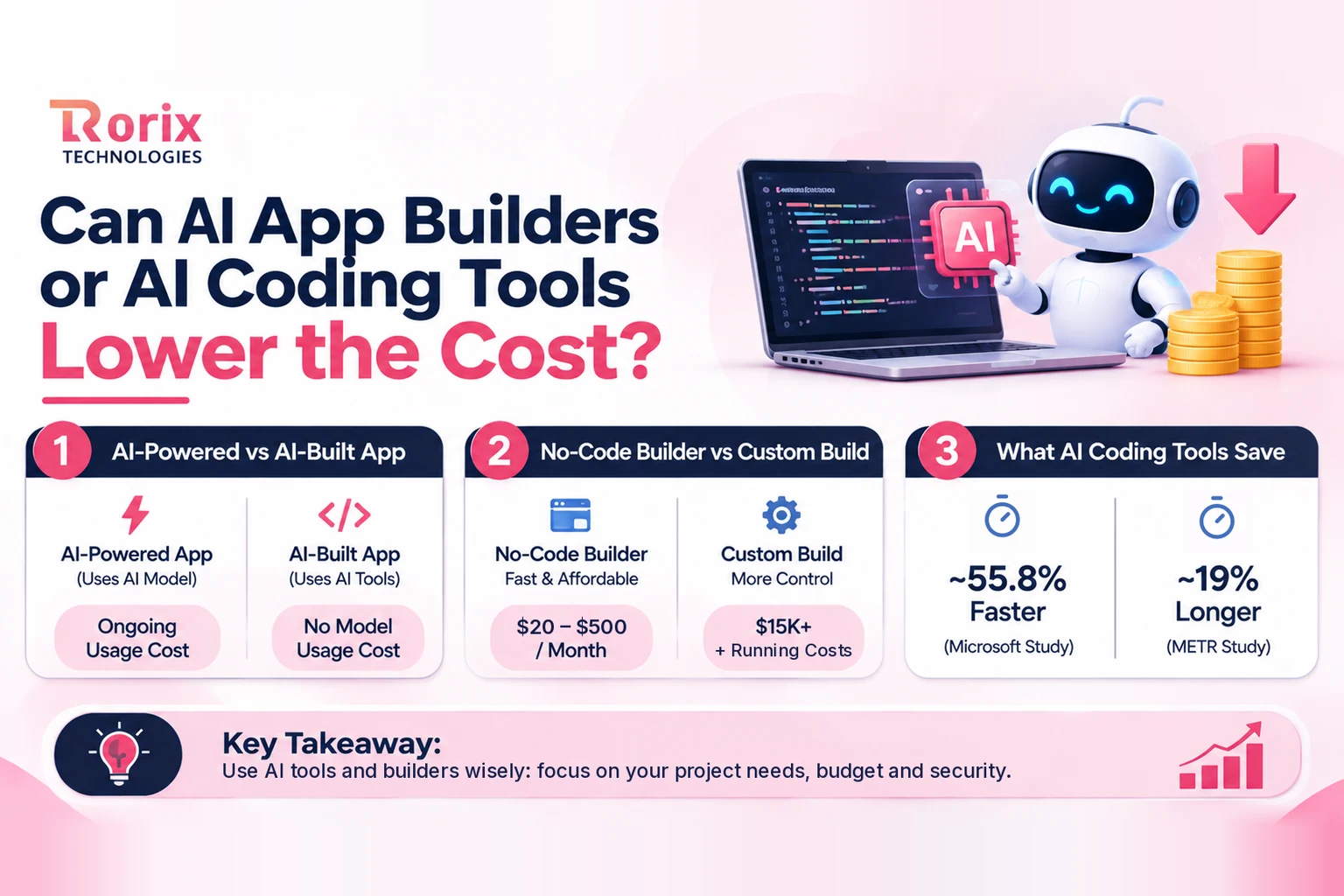
Yes. They reduce coding time and speed up simple app development, but integrations, security, testing, and review still add to the AI app development cost.
1. AI-Powered App vs AI-Built App: Two Different Budgets
An AI-built app uses AI tools to write its code but may not include AI features. Its costs cover subscriptions, engineering, testing, and deployment, with no model usage bill. An AI-powered app calls a model when users ask questions or upload files, creating ongoing usage costs.
2. No-Code AI App Builder vs Custom Build
No-code builders are useful for prototypes and small internal apps. Custom builds cost more upfront but offer better control over data, permissions, integrations, and ownership. Choose based on your app's users, security needs, and business requirements.
| Factor | No-Code AI App Builder | Custom Build |
|---|---|---|
| Upfront cost | $0 to about $1,000 | $15,000 for an AI MVP and up |
| Monthly cost | $20 to $500 in plans and credits, rising with users or usage | Model usage, hosting, and upkeep you control |
| How you pay | Credits, tokens, or per-user seats | Team time plus usage |
| Data and permissions | Limited to platform features | Designed around your roles and records |
| Integrations | Prebuilt connectors | Built for your WMS, ERP, CRM, or HRMS |
| Ownership | The platform runs your app | You own the code, prompts, and evaluation sets |
| Best fit | Internal tools, prototypes, and small teams | Customer-facing, regulated, or integration-heavy apps |
Builders work well for small teams using test or low-risk data. Custom development is better when the app handles customer data or payments, needs enterprise security, or requires two-way integration with core systems.
3. What AI Coding Tools Save on a Custom Build
AI coding tools speed up repetitive tasks, but savings vary. A 2023 study by Microsoft, GitHub, and MIT researchers found Copilot users completed an HTTP server task 55.8% faster. In contrast, METR's 2025 randomized trial found experienced developers took 19% longer on real issues in their own repositories when using AI tools. In a February 2026 update, METR said current tools likely speed developers up more, though its new data is weak evidence of how much.
Treat these tools as a way to reduce boilerplate, not the entire project budget. Heavy use costs $100 to $200 per developer a month on the top plans of GitHub Copilot, Cursor, and Claude (checked 20 Nov 2026), with usage beyond the plan billed extra, and generated code still needs senior review.
Now that you've seen what builders and AI tools can save, let's take a look at how your use case and industry move the price.
AI App Development Cost by Use Case and Industry
Your app's use case and industry determine its features, integrations, security needs, and overall budget. Here are typical market ranges for both.
1. Cost by Use Case
| Use Case | Operations Example | Build Cost (Market Range) |
|---|---|---|
| FAQ or support assistant app | Answers shipment, invoice, and account questions in a client portal | $15,000 to $50,000 |
| Knowledge assistant over company documents | Cited answers from contracts, rate sheets, and product specs | $30,000 to $120,000 |
| Generative content tool | Drafts product descriptions, job posts, or proposals | $40,000 to $150,000+ |
| AI-native SaaS MVP | Multi-tenant product with core AI features and billing | $25,000 to $80,000 |
| Predictive analytics or forecasting app | Forecasts late orders, demand, or staffing from historical data | $50,000 to $200,000 |
| Voice AI app | Phone-based order entry or appointment booking | $50,000 to $150,000+ |
| AI workflow or operations assistant | Purchase order follow-ups and supplier approvals with audit logs | $80,000 to $200,000+ |
| Custom enterprise AI app | Multi-site platform with complex data, security reviews, and integrations | $150,000 to $500,000+ |
Sources: Groovy Web (23 Oct 2026; support assistant) and 24 Jun 2026 (workflow), CMARIX (22 Jun 2026; support, content, voice), SolGuruz (14 Oct 2026; support), Netguru (21 Jul 2026; knowledge assistant, workflow), Decipher Zone (18 Aug 2026; knowledge assistant, analytics, workflow, enterprise), Emerline (11 Jun 2026; knowledge assistant, analytics), Biz4Group (2 Jul 2026; content, voice) and 8 Jun 2026 (AI SaaS MVP), Technource (26 Jun 2026; AI SaaS MVP) and 19 Nov 2026 (analytics, enterprise), Tekrevol (9 Sep 2026; content, voice) and Master of Code (14 Sep 2026; voice).
Costs rise when an app moves from answering questions to taking action inside business systems. Workflow automation needs more integrations, approvals, audit logs, and testing than a basic Q&A tool.
2. Cost by Industry
| Industry | Build Cost (Market Range) | What Pushes Cost Up |
|---|---|---|
| Ecommerce and retail | $30,000 to $150,000 | Product data, personalization, search, and traffic spikes |
| Manufacturing and field operations | $60,000 to $200,000 | Equipment and IoT data, computer vision, and device integration |
| Healthcare | $80,000 to $300,000+ | HIPAA rules, sensitive data, EHR integration, and extra testing |
| Finance and fintech | $100,000 to $400,000+ | Fraud controls, audit trails, explainable decisions, and security |
Regulated industries often need extra compliance work and detailed audit trails. Basic compliance controls can cost $3,000 to $8,000, while regulated-industry requirements can reach $15,000 to $40,000.
Sources: Decipher Zone (18 Aug 2026; all four industries), GeekyAnts (July 2026; healthcare, finance), SolGuruz (14 Oct 2026; ecommerce), Technource (19 Nov 2026; manufacturing), Tekrevol (9 Sep 2026; retail, finance), PixelBrainy (26 Aug 2026; basic compliance) and Groovy Web (16 Nov 2026; regulated compliance).
Also Read: SaaS Development Cost in 2026: Pricing by Stage, Features and Team
What an AI App Costs to Run After Launch
Your total AI app development cost does not stop at launch, because AI apps have ongoing expenses beyond the build. Include these in your budget before launch.
| Running Cost | What Drives It | Typical Cost (Market Range) |
|---|---|---|
| AI model usage | Requests, prompt length, output length, and model size | $20 to $5,000+ a month |
| Cloud hosting and databases | Servers, storage, backups, and GPUs if you self-host | $25 to $30,000+ a month |
| Vector database for RAG | Documents indexed and searches per day | $0 to $500+ a month |
| Monitoring and evaluation tools | Logging, tracing, and automated answer checks | $0 to $4,000+ a month |
| Maintenance and updates | Bug fixes, prompt updates, model changes, and security patches | 15% to 25% of the build cost a year |
| Retraining for fine-tuned or custom models | Fresh data and new training runs | $5,000 to $20,000 a year for a fine-tuned model; $20,000 to $60,000 for a custom model |
Sources: model usage from DesignRush (16 Mar 2026), SFAI Labs (22 Feb 2026), Netguru (21 Jul 2026) and CMARIX (22 Jun 2026); hosting from AI Hosting Costs in 2026 (2 Jul 2026) and Infinum (30 Sep 2026); vector database and monitoring from Pinecone, Langfuse and Datadog list prices (checked 20 Nov 2026); maintenance from Decipher Zone, Neontri, DestiLabs and Aloa (1 Apr 2026); retraining from Monocubed (19 May 2026), Uvik Software (15 Nov 2026), Netguru and Aloa.
AI model usage can rise quickly when real users send longer prompts, upload files, and ask follow-up questions. Estimate usage with the formula in Step 5 below and your provider's current list prices.
Maintenance also needs a yearly budget. Set aside 15% to 25% of the build cost each year for prompt updates, integration fixes, and security patches. This covers a major part of your ongoing AI app maintenance cost.
Hidden AI App Costs That Show Up After the Demo
Hidden costs often push AI app development costs above the first quote when an AI app moves from a demo to real users, business data, and security reviews. Plan for these eight areas before launch.
| Hidden Cost | Why Quotes Miss It | What to Plan For |
|---|---|---|
| Usage growth past the prototype | Test users send short prompts and few follow-ups | Low, expected, and high usage scenarios |
| Review of AI-written code | Demo-ready code can still contain weak logic | Independent code review and a fix allowance |
| Permission mapping | Demos often use shared data without user roles | Record-level access rules so AI only sees permitted data |
| Evaluation sets and regression tests | Standard QA checks features, not answer quality | $10,000 to $30,000 for pre-launch evaluation of a mid-complexity app, on top of standard testing |
| AI-specific interface work | AI responses can be slow, uncertain, or fail | Loading states, citations, feedback buttons, and fallback options |
| Model price changes and retirements | Providers can change prices or retire models | Date every estimate and retest when models change |
| Security questionnaires from buyers | Enterprise customers need written proof of security practices | Access logs, data-handling documents, and remediation time |
| Staff training and adoption | Teams may not trust or know how to review AI output | Onboarding, short guides, and a human-review period |
Source for the evaluation budget: Decipher Zone (18 Aug 2026).
Code review and fixes are easy to overlook in AI-built apps. In one published scenario, Fora Soft (17 Nov 2026) prices an audit of an app built on Lovable at $4,000 and three weeks of hardening at $18,000, $22,000 in total.
How to Price Your AI App Before You Ask for Quotes
Good AI app development cost estimation starts with a clear scope, not an industry average. Follow these five steps before asking vendors for quotes.
Step 1: List the Jobs the App Must Do at Launch
List who will use the app and what they need it to do on day one. Include practical tasks such as answering client questions or flagging late orders.
Mark each task as must-have or later, and identify which ones actually need AI. Simple tasks like routing requests may only need basic rules, saving a costly AI feature.
Step 2: Match Each AI Job to the Simplest Model That Works
Start with a hosted model API for each AI task. Use RAG when answers must come from company documents, and consider fine-tuning only when a task needs consistent formats or domain-specific language.
Avoid training a model from scratch unless it is essential to your product. Record the chosen approach for each task because it can significantly change vendor quotes.
Step 3: Choose the Platform and List Every System It Connects To
Decide whether you need a web app or mobile app. Web is usually the lower-cost starting point, while drivers, technicians, and field teams may need mobile access.
List every system the app must connect to, such as your WMS, ERP, CRM, HRMS, or accounting software. Simple integrations cost around $2,000 to $5,000 each (Softermii, 10 Mar 2026), while each hardened connection to a system of record can reach $5,000 to $25,000 (Uvik Software, 15 Nov 2026).
Step 4: Multiply Team Cost by Build Duration
Estimate hours for each development phase, then multiply them by your team's blended hourly rate. For example, 1,000 hours at $40 an hour costs $40,000, compared with $150,000 at $150 an hour.
If your estimate covers development only, it misses a large part of the work: one estimating guide from Technicate (14 Jan 2026) puts design at 15% to 25% of total effort, project management at 10% to 15%, and QA at 10% to 15%, and says a development-only estimate comes in 45% to 60% low. Before you ask for quotes, our readiness assessment scores your technology, process, people, and data in about two minutes and shows your biggest gaps, with no email needed to see the result.
Step 5: Add Low, Expected, and High Running-Cost Scenarios
Estimate monthly model usage using the formula below, then add hosting, monitoring, and maintenance.
Monthly AI cost = active users × sessions per user × AI calls per session × tokens per call × price per token
Calculate low, expected, and high usage based on user activity and prompt length. Build your budget around the expected case, keep the high case as a ceiling, and review actual cost per user and task every quarter.
Now that you've seen how to build the estimate yourself, let's take a look at what it produces for a real operations app.
First-Year AI App Budget: A Worked Example
To see how AI app development costs add up, here is a practical first-year budget for a 3PL operations app, from build to ongoing costs. These are illustrative market estimates, not a vendor quote.
A mid-sized 3PL needs a web and mobile client portal with an AI assistant for shipment and invoice questions. It also needs to extract data from bills of lading and connect with the WMS and accounting system.
| Budget Line | Estimate |
|---|---|
| Discovery and solution design | $10,000 |
| UI/UX design | $10,000 |
| Web app and cross-platform mobile app (login, roles, dashboards) | $40,000 |
| RAG assistant over shipment and invoice data | $30,000 |
| Document extraction for bills of lading | $20,000 |
| WMS integration with write access, plus read-only accounting sync | $15,000 |
| Testing, evaluation, and security | $12,000 |
| Deployment and launch support | $8,000 |
| Build total | $145,000 |
| Model usage and document processing ($500 a month) | $6,000 |
| Hosting, database, and vector search ($800 a month) | $9,600 |
| Monitoring and evaluation tools ($200 a month) | $2,400 |
| Maintenance and updates (20% of the build) | $29,000 |
| First 12 months of running costs | $47,000 |
| First-year total | $192,000 |
The two AI features account for $50,000 of the $145,000 build. The remaining $95,000 covers discovery, design, the app, integrations, testing, and launch support, costs that first-time buyers can easily underestimate.
The $40,000 app line assumes one cross-platform codebase that serves both the web portal and the mobile app, with a small set of screens. Building the web app separately and adding a companion mobile app would cost at least $55,000 at the platform table's floors, $15,000 more.
Its $1,500 a month in model, hosting, and monitoring fees sits below the mid-level band in the cost table because a client portal serves a few hundred users; the band's source prices apps with 10,000 to 100,000 users. The example also assumes the shipment and invoice data is already clean and that a light evaluation set fits inside the $12,000 testing line. Messier data would add the phase table's $5,000 to $50,000 for data preparation, and a full pre-launch evaluation adds $10,000 to $30,000.
Over three years, the total reaches about $286,000 if running costs stay flat. Higher usage can push it further, so include the high-usage scenario in your budget.
To measure the return, compare the $192,000 first-year spend with the monthly support and billing hours the portal saves.
8 Decisions That Lower AI App Development Cost
You can reduce development costs without sacrificing quality. These eight decisions help control spending while keeping your app reliable.
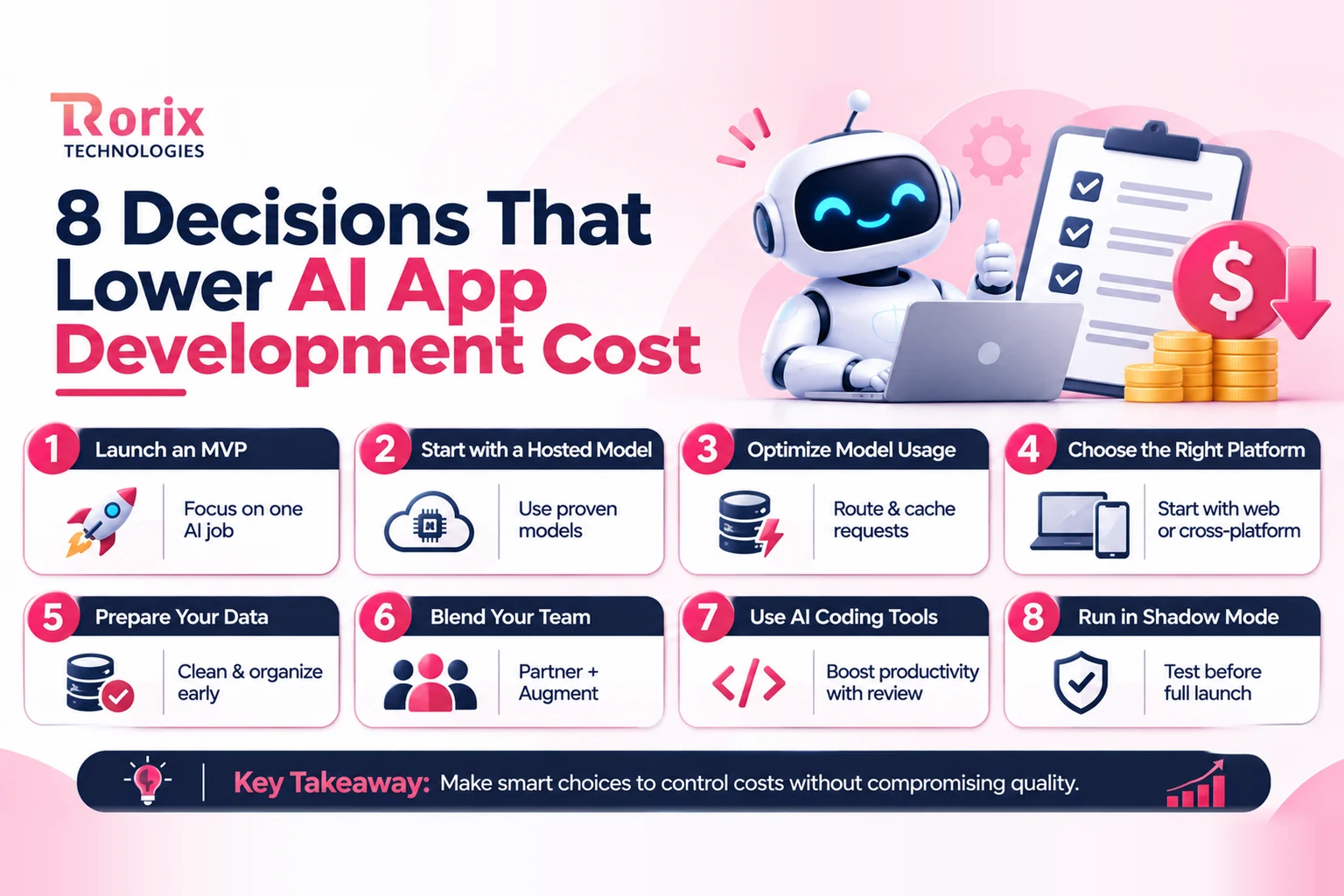
1. Launch an MVP Built Around One AI Job
Start with the AI feature that saves users the most time. A focused MVP helps test demand before funding the full roadmap. See how to build an MVP to decide what can wait.
2. Start on a Hosted Model Before Paying for Custom Training
Use a hosted model with good prompts and RAG for your first release. Custom training is rarely needed from day one. Consider fine-tuning later when real usage shows where accuracy needs improvement.
3. Route and Cache Requests to Cut Model Fees
Use smaller models for simple requests and larger ones for complex tasks. Cache repeated answers to avoid paying for the same response multiple times. This helps control monthly model usage.
4. Ship Web or Cross-Platform First
Building separate native apps increases design and testing work. Start with a web app or cross-platform framework, then add native features when user needs justify the extra cost.
5. Settle Data Readiness During Discovery
Messy data increases costs during retrieval, integration, and testing. Audit documents, records, and permissions during discovery so data cleanup is included in the initial estimate.
6. Blend Staff Augmentation With a Delivery Partner
Use a delivery partner for the first release, then add specialists through staff augmentation as the roadmap grows. This gives you access to AI skills without carrying a large fixed team.
7. Use AI Coding Tools Under Senior Review
Use AI tools for boilerplate, tests, and documentation to save development time. Have a senior engineer review every change to catch errors before they become expensive technical debt.
8. Roll Out in Shadow Mode Before Full Launch
Run the AI alongside your existing process before letting it handle live tasks. Compare its outputs with real results for a few weeks, fix errors, and reduce the risk of costly failures after launch.
Why Rorix Technologies for AI App Development
Rorix Technologies helps businesses build AI apps with clear scope, practical model choices, and predictable pricing.
Rorix has delivered 27 platforms and holds a 5.0 Clutch rating across 4 verified reviews, with clients in the US, UK, Canada, Australia, and New Zealand.
- Honest feasibility first: Every AI build starts with a system readiness survey. Rorix identifies where simple rules can replace AI before development begins.
- Proven AI economics: The First Interview, an AI mock-interview platform we designed and built (feature-complete, in pre-launch testing), runs a dual-model AI pipeline with automatic failover and credits priced on real token costs. Token costs were modeled across 60+ session types to verify gross margins above 70% before launch.
- AI without platform changes: The Lorecs AI price finder runs as a standalone, read-only service without changing the production codebase of WorkCenter Central. WorkCenter Central, the platform we built for distributor Lorecs, cut manual errors by 80% and sped up order processing by 50%.
- Integration experience: 40+ integrations connected for Driven, a US performance platform for pest control and field service teams, including HubSpot, Twilio, RingCentral, and Google APIs.
- Senior engineering team: A dedicated team of senior engineers with a named technical lead works in 2-week sprints and ships a working MVP in 6 to 12 weeks.
- Hosted AI models: Builds with hosted models such as Claude through APIs, avoiding custom foundation model training costs.
- Shadow-mode rollout: New AI runs alongside the existing process until its accuracy is tested against real outcomes. The work stays at the application layer, leaving infrastructure and DevOps with your team.
- Published pricing: Rates range from $20 to $30 an hour by complexity, or $3,500 a month for one dedicated developer. Fixed-price builds for an MVP or internal tool range from $10,000 to $25,000. See Rorix pricing for details.
- Flexible engagement: Every engagement includes an NDA from day one and 100% IP transfer as work is delivered and paid for. Retainers run month to month with no setup fee, and engineers work with you in Slack and GitHub.
Need a realistic plan for your AI app? Get a Free Consultation and Project Estimate to discuss your features, model, and budget.
Conclusion: Build an AI App That Fits Your Budget
Building an AI app requires more than choosing a model. Your features, integrations, development team, and running expenses all shape the total investment.
We hope this guide helps you understand what drives AI app development cost, compare development quotes, and plan for costs beyond launch. A clear scope and realistic first-year budget can prevent expensive surprises later.
Before signing with a vendor, define your launch features, choose the simplest model that meets your needs, and compare team rates and ongoing expenses.
Ready to turn your idea into a practical plan? Connect with the Rorix team to discuss your requirements, estimate your budget, and plan the next steps.
Frequently Asked Questions
How much does AI app development cost?
Most AI apps cost $15,000 to $300,000+. Enterprise platforms can exceed $1,000,000, depending on their complexity and requirements.
How much does a simple AI app or MVP cost?
AI app development cost for a basic MVP typically ranges from $15,000 to $60,000, and the build takes 2 to 4 months.
How long does it take to build an AI app?
A basic app takes 2 to 4 months, a mid-level app 4 to 7 months, and an advanced app 7 to 12 months. Enterprise platforms can take 9 to 18 months.
How much does an AI app cost to run monthly?
Monthly costs range from about $200 for a small MVP to $20,000+ for an enterprise platform. These cover model usage, hosting, vector search, and monitoring.
Is a model API cheaper than building a custom AI model?
Yes. Hosted APIs have lower upfront costs because they require no model training. Custom model development can cost $300,000 to $1,000,000+, while fine-tuning costs $15,000 to $100,000 plus usage fees.
Does hiring an AI development team in India reduce costs?
Yes. Blended agency team rates in India and Southeast Asia typically range from $25 to $50 per hour, compared with $100 to $200 in the US.
Can a no-code AI builder replace custom development?
No-code builders work well for prototypes and simple internal tools. Custom development is better for apps handling customer data, payments, enterprise security, or complex integrations.
How much does AI app maintenance cost annually?
Budget 15% to 25% of the original build cost each year for updates, fixes, and security. A fine-tuned model may need another $5,000 to $20,000 a year for retraining, and a custom model $20,000 to $60,000.
Adding AI to your system, or building a new AI feature?
Most of the work sits in the data plumbing rather than the model. Send us the workflow you want to automate and we will tell you what is feasible on your current stack.
Continue learning
Written by
Ankur AkvaliyaFounder & Director, Rorix Technologies
Ankur co-founded Rorix Technologies with a mission to deliver enterprise-grade software that growing businesses can actually afford. He drives technical project delivery and client success end-to-end, overseeing product strategy, client partnerships, and the company's long-term vision to ensure every engagement delivers measurable business outcomes across WMS, HRMS, and custom software verticals.
View full profileRelated articles
AI Chatbot Development Cost in 2026: Pricing by Type, Features and Team
AI chatbot development cost in 2026: $5,000 to $300,000+ by chatbot type, plus $50 to $3,500 a month to run. Prices by feature, team and hidden costs.
Read article
AI Agent Development Cost in 2026: Pricing by Complexity, Integrations, and Team
Explore AI agent development cost in 2026, including build prices, monthly expenses, integrations, maintenance, and ways to reduce your budget.
Read article
Top 12 AI SaaS Development Companies in 2026
Compare the 12 best AI SaaS development companies for 2026, with services, ratings, costs, and tips to choose the right development partner.
Read article