AI Chatbot Development Cost in 2026: Pricing by Type, Features and Team
AI chatbot development cost in 2026: $5,000 to $300,000+ by chatbot type, plus $50 to $3,500 a month to run. Prices by feature, team and hidden costs.
On this page58 sections
Key Takeaways: AI Chatbot Development Cost at a Glance
- Build cost: Ranges from $5,000 to $300,000+, depending on chatbot type and complexity.
- Typical budget: Gaincafe puts most production-ready business chatbots at $25,000 to $80,000.
- Monthly running cost: Around $50 to $3,500 for model, hosting, and tooling at 1,000 to 50,000 conversations (channel fees, agent seats, and maintenance are extra).
- Maintenance: Budget 15% to 25% of build cost annually.
- Biggest cost drivers: Integrations, knowledge preparation, security, and custom workflows.
- Team rates: An 840-hour build can cost $21,000 to $42,000 in India or $84,000 to $168,000 in the US.
- SaaS vs. custom: SaaS suits lower volumes, while custom chatbots can become more cost-effective as usage grows.
Two chatbots can look identical on the surface, yet their AI chatbot development cost can be $12,000, $48,000, or $160,000. The difference comes down to what each one can actually do, from answering basic FAQs to retrieving live order data and handling complex customer requests.
Understanding AI chatbot development costs starts with looking beyond the chat window. The features, integrations, model requirements, and engineering effort behind it all affect the final price. Even the AI chatbot development approach you choose can change what goes into the build.
Build costs are only part of the budget. Model usage, messaging channels, maintenance, and ongoing updates add recurring expenses after launch, which are easy to overlook when comparing vendor quotes.
In this guide, you'll learn:
- AI chatbot development cost by type and feature
- Development team rates and build options
- Monthly running and maintenance costs
- SaaS vs. custom chatbot pricing
- Hidden expenses and a five-step budget estimation method
By the end of this guide, you'll have a clearer view of AI chatbot development cost, know what drives the price, and be better prepared to compare quotes before committing to a build.
Chatbot Development Cost by Type
The AI chatbot development cost depends on what the bot needs to handle. A basic FAQ bot costs far less than one connected to live business systems.
These are market estimates from published agency cost guides, not Rorix pricing. A US-only team usually costs more; compare the rates by region below.
| Chatbot Type | What It Handles | Build Cost (Market Range) | Typical Timeline |
|---|---|---|---|
| 1. Rule-based FAQ chatbot | Scripted menus, FAQs, lead capture | $5,000 to $15,000 | 2 to 6 weeks |
| 2. NLP intent-based chatbot | Intent detection, guided flows, simple bookings | $10,000 to $40,000 | 8 to 14 weeks |
| 3. LLM-powered generative chatbot | Natural answers from a hosted model and a few documents | $5,000 to $60,000+ | 2 to 10 weeks |
| 4. RAG knowledge base chatbot | Cited answers from indexed documents | $15,000 to $120,000 | 4 to 20 weeks |
| 5. Transactional chatbot | Live lookups, tickets and bookings in business systems | $40,000 to $150,000+ | 10 to 18 weeks |
| 6. Voice AI chatbot | Phone calls with speech input and output | $40,000 to $100,000+ | 6 to 12 weeks |
| 7. Enterprise omnichannel chatbot | Multiple channels, SSO, audit logs, and system integrations | $100,000 to $300,000+ | 4 to 9 months |
Sources: Gaincafe (4 Nov 2026), OrangeMantra (13 Aug 2026), PixelBrainy (26 Aug 2026), Groovy Web (23 Oct 2026), CMARIX (2 Sep 2026), RaftLabs (14 Jun 2026), TechEniac (28 Oct 2026), Zethic (24 Aug 2026), Monocubed (19 May 2026), GMWare (14 May 2026 and 18 May 2026), Apptitude (4 Apr 2026) and Space-O Technologies (21 Oct 2026). The LLM and RAG cost ranges match our AI integration cost guide.
1. Rule-Based FAQ Chatbot
A rule-based chatbot follows predefined menus and decision trees to answer common questions. It works well for store hours, order lookup menus, and lead capture, costing $5,000 to $15,000 over 2 to 6 weeks. However, it struggles when users ask questions outside its scripted flows.
2. NLP Intent-Based Chatbot
An NLP chatbot identifies what users mean, even when they phrase the same question differently. Intent training, entity extraction, and fallback rules typically cost $10,000 to $40,000 over 8 to 14 weeks. It suits guided bookings and support flows that need more flexibility than fixed scripts.
3. LLM-Powered Generative Chatbot
An LLM chatbot uses models such as Claude, GPT, or Gemini to generate natural answers from instructions and supplied documents. Development usually costs $5,000 to $60,000+ over 2 to 10 weeks, depending on the setup. Model usage also adds recurring fees with every conversation.
4. RAG Knowledge Base Chatbot
A RAG chatbot searches indexed documents before generating an answer, helping it provide relevant responses with source references. Document cleanup, retrieval setup, and answer evaluation bring costs to $15,000 to $120,000 over 4 to 20 weeks. It works well for changing policies, SOPs, and product catalogs.
5. Transactional Chatbot Connected to Business Systems
A transactional chatbot connects to live business data to check orders, track stock, create tickets, or handle bookings. Login controls, permissions, and error handling typically bring costs to $40,000 to $150,000+ over 10 to 18 weeks. For bots that can take actions independently, see our AI agent development cost guide.
6. Voice AI Chatbot
A voice AI chatbot handles phone conversations by converting speech into text and speaking generated responses. Telephony, speech recognition, accents, and response delays make development more complex, with costs of $40,000 to $100,000+ over 6 to 12 weeks. Monthly speech and call charges apply separately.
7. Enterprise Omnichannel Chatbot
An enterprise chatbot handles conversations across web, mobile, WhatsApp, Teams, and voice through shared systems. SSO, role permissions, audit logs, and multiple integrations push the AI chatbot development cost to $100,000 to $300,000+ over 4 to 9 months. Many businesses start with a single-channel pilot before expanding.
AI Chatbot Cost by Feature: What Each Add-On Adds
Features can change the AI chatbot development cost even when two bots use the same technology. WhatsApp, system integrations, extra languages, and security controls all add to the budget.
These are market estimates, not Rorix pricing.
| Feature | What It Adds | Added Cost (Market Range) | Added Time |
|---|---|---|---|
| Knowledge base preparation | Cleaning, chunking, and indexing content | $3,000 to $20,000+ | 1 to 2 weeks for a clean set |
| SaaS integration | Read or two-way access to a CRM, helpdesk, or store | $2,000 to $10,000 each | 1 to 3 weeks each |
| System of record with write access | Updates inside an ERP, WMS or HRMS | $5,000 to $25,000 each | 1 to 3 weeks each |
| Extra channel | WhatsApp, Slack, Teams or a mobile SDK | $5,000 to $20,000 for multi-channel deployment | 1 to 2 weeks per channel |
| Voice on a text bot | Speech-to-text and text-to-speech | $10,000 to $15,000 | 2 to 3 weeks |
| Extra language | Local test sets and interface text | $5,000 to $15,000 per language | 1 to 2 weeks per language (our estimate) |
| Human handoff | Context transfer into your helpdesk | $3,000 to $8,000 | 1 to 3 weeks |
| Compliance controls | SSO, encryption, and audit logs | $3,000 to $8,000 basic; $15,000 to $40,000 regulated | Varies by rule set |
| Document upload | OCR or vision and field extraction | $15,000 to $25,000 for one document type | 3 to 5 weeks |
| Memory and monitoring | Saved context, dashboards and evaluation sets | $5,000 to $20,000+ for memory; $2,000 to $5,000 to set up monitoring | Varies |
Sources: TechEniac (knowledge base time, voice), PixelBrainy (data preparation, basic compliance, memory), Space-O Technologies (integrations, channels, languages, handoff), RaftLabs (integration and channel time), Monocubed (system-of-record integrations, fine-tuning), Groovy Web (regulated compliance), Apptitude (document upload, OCR, monitoring) and Langfuse (free monitoring plan). Integration figures also align with the per-integration ranges in our AI agent cost guide.
Fine-tuning is not necessary for most chatbots. RAG can update a bot's knowledge without retraining, while Monocubed puts fine-tuning a model on your own data at $15,000 to $100,000, plus usage fees.
1. Knowledge Base Size and Data Preparation
A chatbot needs clean, reliable content to give accurate answers. Cleaning, labeling, and indexing help articles, PDFs, and policies typically cost $3,000 to $20,000+. A clean document set may take 1 to 2 weeks, while scanned or duplicated files need more work.
2. CRM, Helpdesk, Order and WMS Integrations
Every connected system adds data mapping, authentication, and testing to the build. A SaaS integration costs $2,000 to $10,000, while write access to an ERP, WMS, or HRMS costs $5,000 to $25,000. A clear API integration strategy helps control scope, while API development fills gaps when the required endpoint does not exist.
3. Extra Channels: Mobile App, WhatsApp, Slack, Teams and Voice
Website chat is a practical starting point, but each additional channel needs its own setup and testing. Space-O Technologies prices multi-channel deployment at $5,000 to $20,000, and RaftLabs says each added channel, such as WhatsApp, SMS, a mobile app or a Slack bot, takes a week or two of engineering. Adding voice to an existing text bot costs another $10,000 to $15,000 and takes 2 to 3 weeks.
4. Multilingual Support
Supporting another language takes more than translating chatbot responses. Each language needs local test questions, interface text, and checks for mixed-language conversations. Space-O Technologies prices each added language at $5,000 to $15,000; as our own estimate, budget 1 to 2 weeks of additional QA per language.
5. Human Handoff and Live Agent Console
Some conversations need a human, so the chatbot should pass the full context to a support agent. Connecting this handoff to Zendesk, Freshdesk, or another helpdesk typically costs $3,000 to $8,000, according to Space-O Technologies. Without it, customers may have to repeat information they have already shared.
6. Login, Permissions and Compliance Controls
Chatbots handling order history, health records, or account data need stronger security than public FAQ bots. PixelBrainy prices basic compliance at $3,000 to $8,000, and Groovy Web puts compliance for regulated industries (HIPAA, PCI DSS, SOX) at $15,000 to $40,000.
7. Document Upload and Image Input
Invoice uploads, damage photos, and claim forms require OCR or vision models, data extraction, and additional testing. Supporting one document type typically costs $15,000 to $25,000 and takes 3 to 5 weeks. OCR usage can add another $0.01 to $0.05 per page processed.
8. Conversation Memory, Analytics and Evaluation
Memory helps a chatbot recall earlier conversations, but storing and managing that context adds $5,000 to $20,000+. Analytics and evaluation help identify weak answers and track chatbot performance. Monitoring setup costs around $2,000 to $5,000 (Apptitude), followed by $0 on Langfuse's free plan to about $500 per month, depending on volume.
Also Read: Top 15 AI Integration Companies for Business Systems
Chatbot Development Cost by Team
The team behind a chatbot can change the final AI chatbot development cost significantly. Roles, experience, location, and project hours all affect the price.
1. Roles and Team Size for Each Chatbot Type
Simple FAQ bots need fewer specialists, while transactional, voice, and enterprise chatbots require more integration, security, and testing work. The roles and team sizes below are our estimates, not fixed requirements.
| Chatbot Type | Core Roles | Team Size | Timeline |
|---|---|---|---|
| Rule-based FAQ | Bot developer, part-time QA | 1 to 2 | 2 to 6 weeks |
| NLP intent-based | NLP engineer, backend developer, part-time conversation designer and QA | 2 to 3 | 8 to 14 weeks |
| LLM-powered generative | AI engineer, full-stack developer, part-time QA | 2 to 3 | 2 to 10 weeks |
| RAG knowledge base | AI engineer, data or backend engineer, conversation designer, QA | 3 to 4 | 4 to 20 weeks |
| Transactional | AI and backend engineers, integration engineer, QA, part-time PM | 4 to 5 | 10 to 18 weeks |
| Voice AI | AI and backend engineers, speech and telephony engineer, QA | 4 to 6 | 6 to 12 weeks |
| Enterprise omnichannel | AI, integration and frontend engineers, security lead, MLOps, QA, PM | 6 to 10 | 4 to 9 months |
Conversation design is easy to overlook, but it shapes how the chatbot handles unclear questions and failed requests. A conversation designer creates fallback replies, handoff rules, and response flows. Cutting this role can leave users with confusing answers and poor support experiences.
2. Blended Chatbot Team Rates by Region
Blended hourly rates combine junior, mid-level, and senior engineering costs. Senior AI specialists may charge more, so use these figures as planning estimates rather than fixed quotes.
| Region | Blended Hourly Rate (Market Range) |
|---|---|
| United States and Canada | $100 to $200 |
| Western Europe | $80 to $170 |
| Australia | $100 to $180 |
| Eastern Europe | $40 to $80 |
| Latin America | $40 to $100 |
| India and Southeast Asia | $25 to $50 |
Sources: Space-O Technologies (North America, Western Europe, Eastern Europe), Monocubed (India and Southeast Asia), OrangeMantra (Australia) and FullStack's Nearshore Engineering Economics 2026 report (Latin America).
Lower hourly rates do not always mean lower project costs. An experienced team can avoid rework and costly delays, so ask for examples of production chatbots they have delivered before making a decision.
3. How Team-Weeks Turn Into a Build Price
The AI chatbot development cost comes down to the total billable hours and the team's blended rate. You can use this formula to check whether a vendor's estimate makes sense.
Build price = people × weeks × billable hours per week × blended hourly rate
For example, a RAG chatbot built by 3 people over 8 weeks at 35 billable hours per week requires around 840 engineering hours. The same workload can cost very different amounts depending on where the team is based.
| Team Location | Blended Rate | 840-Hour Build |
|---|---|---|
| India and Southeast Asia | $25 to $50 | $21,000 to $42,000 |
| Eastern Europe | $40 to $80 | $33,600 to $67,200 |
| Western Europe | $80 to $170 | $67,200 to $142,800 |
| United States and Canada | $100 to $200 | $84,000 to $168,000 |
The difference explains why a RAG chatbot can reach the $120,000 upper range in the earlier cost table. A US-only team working on the same scope may exceed that figure.
4. Who Should Build It: Freelancer, In-House Team or Development Partner
Your build route depends on the chatbot's complexity and whether it supports internal operations or your core product. Each option has a different cost, hiring commitment, and level of ongoing support.
| Build Route | Typical Cost | Best Fit | Watch Out For |
|---|---|---|---|
| Freelancer | $3,000 to $15,000 per project | Rule-based bots and prototypes | Support often stops after handover |
| In-house team | $400,000 to $700,000 in year-one pay for a three-person US team | Chatbot as your core product | 8 to 14 weeks to hire each ML engineer |
| Development partner | $20,000 to $80,000 per project | Production chatbots with integrations | Line items missing from the quote |
Sources: freelancer and agency ranges from Gaincafe; in-house pay from the US Bureau of Labor Statistics and Levels.fyi, as in our AI agent cost guide; hiring time from KORE1.
A freelancer can be a practical choice for a scripted FAQ bot, but an integrated RAG chatbot needs several skills working together. Our guide to in-house vs outsourcing software development explains the trade-offs. A dedicated development team can also provide continuity beyond the initial build.
What an AI Chatbot Costs to Run Every Month
The build is a one-time expense. Model fees, hosting, messaging, monitoring, and maintenance add a monthly running cost on top of your AI chatbot development cost.
1. Monthly Run Cost by Conversation Volume
Monthly costs increase with conversation volume and infrastructure usage. The estimates below use list prices checked on 5 November 2026.
| Cost Line | 1,000 Conversations a Month | 10,000 Conversations a Month | 50,000 Conversations a Month |
|---|---|---|---|
| Model fees (small to upper-mid models) | $2 to $30 | $15 to $300 | $75 to $1,500 |
| Vector database | $0 to $20 | $20 to $50 | $50 to $500 |
| Hosting and compute | $50 to $150 | $100 to $400 | $300 to $1,000 |
| Monitoring and evaluation | $0 to $29 | $29 to $199 | $199 to $500 |
| Total per month (rounded) | $50 to $230 | $165 to $950 | $625 to $3,500 |
Assumptions: 4 model calls per conversation, averaging 2,500 input and 250 output tokens.
Sources: Pinecone pricing, Langfuse pricing. Hosting is our estimate.
These totals exclude channel fees, agent seats, and maintenance. Gaincafe puts the total monthly operating cost of a mid-market generative AI chatbot at $2,500 to $7,500.
2. Cost per Conversation by Model Tier
Model choice affects the cost of every conversation. The estimates below use 10,000 input and 1,000 output tokens per conversation.
| Model Tier | Example Model | List Price per Million Tokens (Input / Output) | Cost per Conversation | 10,000 Conversations a Month |
|---|---|---|---|---|
| Small | Claude Haiku 5.5 (prompts up to 100,000 tokens) | $0.10 / $0.50 | $0.0015 | $15 |
| Mid | Claude Haiku 4.5 | $1 / $5 | $0.015 | $150 |
| Upper-mid | Claude Sonnet 5.5 | $2 / $10 | $0.03 | $300 |
| Premium | Claude Opus 5.5 | $4 / $20 | $0.06 | $600 |
| Top | Claude Fable 5.1 | $10 / $50 | $0.15 | $1,500 |
Source: Anthropic API pricing, checked on 5 November 2026. OpenAI and Google model comparisons are covered in our AI integration cost guide.
At 10,000 conversations, model fees range from $15 to $1,500 per month. Test a smaller model first and upgrade only when answer quality requires it.
Gartner predicts GenAI cost per resolution in customer service will exceed offshore human agent costs by 2030 (Gartner, 2026).
3. Channel and Messaging Fees: WhatsApp, SMS and Voice
Website chat usually has no per-message fee. WhatsApp, SMS, and voice add separate charges:
- WhatsApp: Meta charges per delivered template message, based on category and country. Since 1 October 2026, replies inside the 24-hour customer service window are free only for the first 1,000 service messages per business number each month; after that, and for utility templates sent inside the window, Meta charges per message.
- WhatsApp rates: At North America rates, marketing templates run about $0.025 each and utility templates about $0.0034, according to Meta's pricing documentation and rate cards.
- SMS: Twilio lists US SMS at $0.0083 per segment, sent or received.
- Voice: Twilio lists US voice at $0.0085 per minute for local inbound calls and $0.014 for outbound calls. Its ConversationRelay voice AI layer adds $0.07 per minute.
Example: 5,000 four-minute inbound calls equal 20,000 minutes. At $0.0085 plus $0.07 per minute, the monthly cost is approximately $1,570 before model fees.
4. Chatbot Maintenance Cost: What to Budget Each Year
Chatbot maintenance cost covers prompt updates, answer improvements, API fixes, and model testing. Annual upkeep typically runs 15% to 25% of the original build cost, according to Space-O Technologies and GMWare, the same range our software maintenance cost guide uses.
For a $60,000 RAG chatbot, budget $9,000 to $15,000 per year, excluding usage fees. Regular updates keep answers accurate as products, policies, and integrations change.
Now that you've seen what a chatbot costs to run, let's take a look at how SaaS platforms price the same job.
Chatbot Pricing: SaaS Platform vs Custom Build
SaaS chatbots cost less upfront, but usage charges can grow quickly. A custom build requires more investment initially, while giving you greater control over your long-term AI chatbot development cost.
1. How SaaS Chatbot Platforms Charge
Most SaaS chatbot platforms use three pricing models, often combining two or more in the same plan. The main difference is what triggers the charge and how quickly it grows.
| Pricing Model | How the Bill Works | Where the Budget Risk Sits |
|---|---|---|
| Per seat | Monthly fee for each human agent | Grows as your support team grows |
| Per outcome or resolution | Fee each time AI closes a conversation | Increases with traffic and seasonal peaks |
| Per conversation tier | Plan based on a monthly conversation limit | Overage charges and forced upgrades |
Intercom is a clear example: seat plans list at $29, $85, or $132 per seat a month on annual billing (checked 5 November 2026, before a 35% new-customer discount), while Fin AI Agent charges $0.99 per outcome. Fin on another helpdesk costs $0.99 per outcome, with a minimum monthly commitment (Intercom's example is 50 outcomes).
2. 3-Year Cost Comparison at Three Conversation Volumes
A three-year comparison shows when SaaS pricing becomes more expensive than a custom build. The estimates below use the same stated assumptions across all three traffic levels.
| Monthly Conversations | SaaS Per-Resolution, 3 Years | Custom RAG Chatbot, 3 Years | Lower-Cost Route |
|---|---|---|---|
| 2,000 | $42,768 | $91,200 | SaaS |
| 10,000 | $213,840 | $118,200 | Custom |
| 50,000 | $1,069,200 | $210,000 | Custom |
SaaS assumptions: $0.99 per AI resolution, with AI resolving 60% of conversations. Human agent seat fees are excluded because both options still need agents for escalations.
Custom assumptions: $60,000 initial RAG chatbot build, with monthly usage costs of $200, $950, and $3,500, respectively. Annual maintenance is 20% of the build cost in years two and three.
Under these assumptions, the crossover is around 5,000 monthly conversations, so calculate using your actual volume before choosing.
3. When a SaaS Platform Wins and When Custom Wins
| Factor | SaaS Chatbot Platform | Custom Chatbot Build |
|---|---|---|
| Upfront cost | Low, often just setup | $5,000 to $300,000+ one time |
| Monthly cost | Seats plus usage, rising with volume | Usage and upkeep you control |
| Integrations | Prebuilt connectors | Built for your WMS, ERP, or CRM |
| Data control | Stays inside the vendor's platform | Your hosting, model, and logs |
| Compliance | Vendor certifications | Controls designed around your rules |
| Time to launch | Days to a few weeks | 2 weeks to 9 months |
| Lock-in | Migration means rebuilding flows and reconnecting your helpdesk | You own the code and prompts |
SaaS works well when conversation volume is modest, and customer questions are predictable. Prebuilt helpdesk integrations also make it easier to launch quickly and test demand.
Custom development makes more sense when the chatbot needs access to systems such as a WMS, TMS, or homegrown ERP. Higher conversation volumes can also make owning the build more cost-effective than paying for every AI resolution.
Also Read: Top 15 AI Agent Development Companies (Compared)
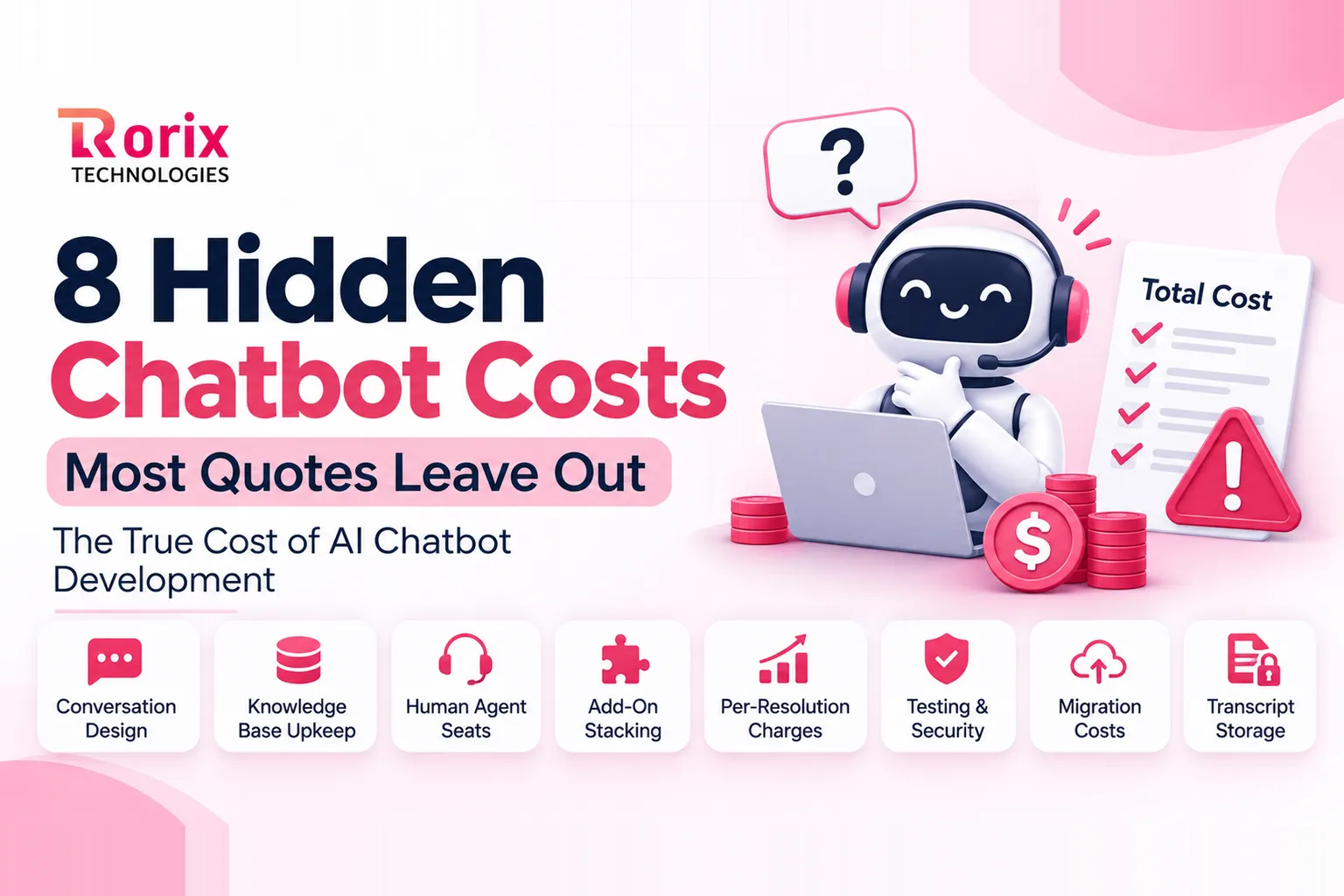
8 Hidden Chatbot Costs Most Quotes Leave Out
The initial quote rarely covers everything. Include these eight expenses when calculating your actual AI chatbot development cost.
1. Conversation Design and Fallback Flows
Some agencies exclude conversation design, fallback replies, handoff rules, and tone-of-voice planning from development quotes. Gaincafe prices discovery and conversation design at $3,000 to $10,000. Skipping them can leave you with a bot that gives confident but incorrect answers.
2. Knowledge Base Upkeep and Transcript Review
Product details, policies, and prices change, so your chatbot's knowledge base needs regular updates. Failed conversations also need weekly review to identify gaps and improve responses. RaftLabs budgets 5 to 10 hours a month of someone reviewing edge cases and updating responses.
3. Human Agent Seats for Escalated Chats
Chatbots cannot resolve every issue, so you still need human agents for complex requests and escalations. Their seats and support costs should be part of your monthly budget. Gartner predicts AI regulations could increase assisted service volume by 30% by 2028 (Gartner, 2026).
4. Add-On Stacking on SaaS Platforms
Basic SaaS plans may exclude AI answers, automation flows, and branding removal. Compare the full plan cost with the add-ons you need, not just the advertised starting price.
5. Per-Resolution Charges During Traffic Spikes
Per-resolution pricing can rise quickly during holidays, product launches, or support spikes. At $0.99 per resolution, monthly costs jump from $1,980 for 2,000 resolutions to $9,900 for 10,000. Budget for three to five times your average volume during peak periods.
6. Hallucination and Prompt-Injection Testing
Testing helps prevent incorrect answers, prompt injection, and accidental data exposure. These checks require engineering time. PixelBrainy puts formal security audits and penetration tests at $4,000 to $18,000. Include them when estimating enterprise chatbot development cost.
7. Platform Migration and Lock-In
Moving away from a SaaS platform can mean rebuilding chatbot flows, transferring content, and reconnecting your helpdesk. Check whether you can export your content, conversation logs, and prompts before signing up.
8. Transcript Storage and Privacy Reviews
Chat transcripts can contain names, addresses, and order details, making storage and access controls important. Retention rules, data masking, and legal reviews may be required under GDPR, HIPAA, or local privacy laws. PixelBrainy puts compliance and legal consultation at $2,000 to $15,000.
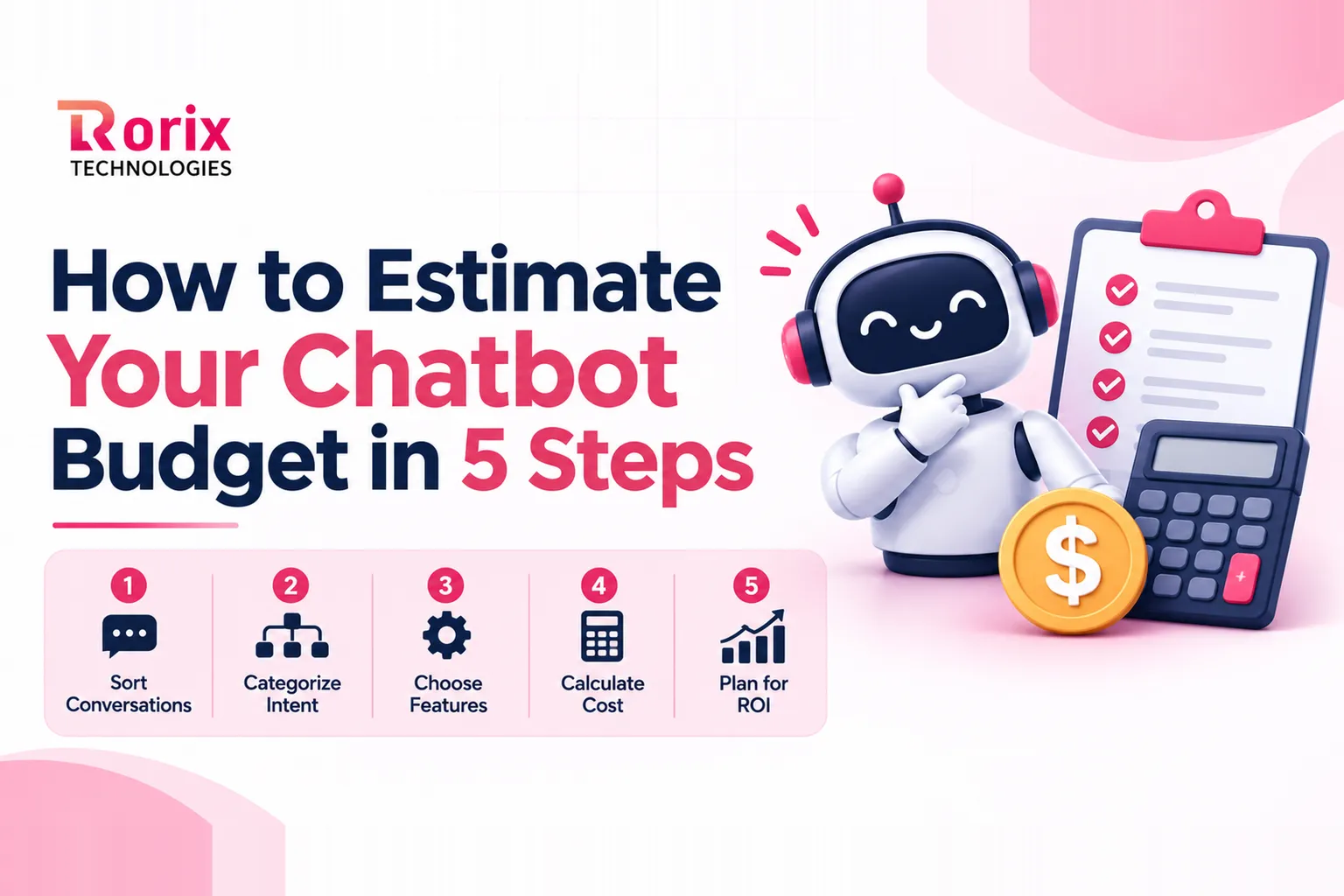
How to Estimate Your Chatbot Budget in 5 Steps
Use these five steps to estimate your AI chatbot development cost before comparing vendor quotes.
Step 1: Sort 100 Real Conversations by Intent
Start with your last 100 customer chats, emails, or support tickets. Label each by intent, such as order status, return policy, or damage claim, then count how often each appears.
TechEniac suggests writing down the 20 questions or tasks that generate the largest share of conversations. Use the ones that recur most as the starting scope for your first release instead of trying to automate everything at once.
Step 2: Mark Each Intent as Answer, Act, or Hand Off
Classify every intent into three groups: Answer, Act, or Hand Off. Answer covers questions the bot can resolve using existing knowledge, while Act requires system access to check orders or create tickets.
Hand Off sends complex or sensitive requests to a human agent. More Act workflows usually mean higher chatbot implementation cost because they require integrations and additional testing.
Step 3: Choose the Chatbot Type and Feature List
Match your intent groups to the right chatbot type. Answer requests may need an LLM or RAG chatbot, while workflows involving system updates usually require a transactional build.
List only the launch requirements, including channels, integrations, languages, and compliance controls. Move non-essential features to version two to keep the initial scope and custom AI chatbot development cost under control.
Step 4: Price the Build at Your Team Rate
Start with the chatbot type estimate, then add the feature costs from your scope. This gives you a more realistic AI chatbot development cost than relying on a broad industry average.
Cross-check it using this formula: people × weeks × billable hours per week × blended hourly rate. If the two estimates differ significantly, review your integrations, security, and compliance requirements before finalizing the budget.
Before you budget, our readiness assessment scores your technology, process, people and data in about two minutes and shows the gaps to close before a chatbot can draw on your systems.
Step 5: Price Year-One Running Costs and Payback
Estimate monthly conversations, model fees, hosting, monitoring, and channel charges for WhatsApp, SMS, or voice. Multiply the monthly running cost by 12 to calculate your first-year operating budget.
Next, divide the build cost by monthly net savings, calculated as agent time saved minus monthly running costs. If payback takes more than 12 to 18 months, start with the highest-value intents and expand after proving the savings.
Also Read: AI-Enabled Business Systems: How to Build One That Pays Back
Why Choose Rorix for Custom AI Chatbot Development?
Rorix Technologies builds AI chatbots that connect with existing business systems. The team has delivered 27 platforms and holds a 5.0 Clutch rating across 4 verified reviews, with clients in the US, UK, Canada, Australia, and New Zealand.
- Senior engineering team: A dedicated team of senior engineers with a named technical lead, working in two-week sprints.
- Proven AI implementation: WorkCenter Central, the platform we built for distributor Lorecs, cut manual errors by 80% and sped up order processing by 50%. An AI SKU price finder added on top answers vendor pricing questions in plain English from thousands of supplier files, without a change to the platform's production codebase.
- AI product experience: The First Interview, an AI mock-interview platform we designed and built (feature-complete, in pre-launch testing): token costs were modeled across 60+ session types to verify gross margins above 70% before launch.
- Our own chatbot: the Claude-powered discovery chat on this site interviews visitors about their project and files each brief as a structured inquiry.
- Integration experience: 40+ integrations connected for Driven, a US performance platform for pest control and field service teams, including HubSpot, Twilio, RingCentral, and Google APIs.
- Hosted AI models: Builds with hosted models such as Claude through APIs, avoiding custom foundation model training costs.
- Rates: Rorix is listed at $25 to $49 an hour on Clutch. The 840-hour RAG example would cost $21,000 to $41,160 in engineering time. Final AI chatbot development cost depends on scope and integrations. See Rorix pricing.
- Ongoing development: Dedicated developers start at $3,500 per month, while team packages start at $10,000 per month for three developers plus a project manager.
Get a Free Consultation and Project Estimate to discuss your chatbot scope, integrations, and running costs.
Conclusion: Plan Your Chatbot Budget Beyond the Build
AI chatbot development cost depends on the chatbot type, features, integrations, and development team. Model usage, maintenance, and channel fees also affect the total budget after launch.
We hope this guide helps you understand AI chatbot development costs, identify hidden expenses, and estimate both development and running costs.
Use the five-step budgeting process to assess your requirements, compare vendor quotes, and choose a build that fits your expected workload.
Ready to plan your chatbot project? Get a Free Consultation and Project Estimate to discuss your requirements, integrations, and budget.
Frequently Asked Questions
How much does AI chatbot development cost?
A basic FAQ chatbot costs $5,000 to $15,000, while enterprise builds can exceed $300,000. Gaincafe puts most production-ready business chatbots at $25,000 to $80,000, plus monthly running costs.
How much does an AI chatbot cost to run each month?
Monthly usage costs range from $50 to $3,500 for 1,000 to 50,000 conversations. Channel fees, agent seats, and maintenance are extra.
How long does it take to build an AI chatbot?
Basic bots take 2 to 6 weeks, LLM chatbots 2 to 10 weeks, and RAG chatbots 4 to 20 weeks. Enterprise builds can take 4 to 9 months.
Is a SaaS chatbot cheaper than a custom chatbot?
SaaS usually costs less at low volumes. Around 5,000 monthly conversations, costs may cross over. At 10,000 conversations, our estimate puts three-year SaaS costs at $213,840, compared with $118,200 for a custom RAG chatbot.
How much does a chatbot cost for a small business?
A basic FAQ bot costs $5,000 to $15,000, while a simple LLM chatbot starts around $5,000. Start with your top 20 customer intents and one channel.
How much does a RAG chatbot cost compared with a basic AI chatbot?
An LLM chatbot costs $5,000 to $60,000+, while a RAG chatbot costs $15,000 to $120,000. RAG adds document processing, retrieval, citations, and evaluation costs.
How much does chatbot maintenance cost per year?
Budget 15% to 25% of the initial build cost annually. For a $60,000 chatbot, that means $9,000 to $15,000, excluding monthly usage fees.
Why do chatbot development quotes vary so much?
Quotes often cover different features, integrations, testing, and team rates. Ask for an itemized breakdown so you can compare the actual scope, not just the final price.
Adding AI to your system, or building a new AI feature?
Most of the work sits in the data plumbing rather than the model. Send us the workflow you want to automate and we will tell you what is feasible on your current stack.
Continue learning
Written by
Ankur AkvaliyaFounder & Director, Rorix Technologies
Ankur co-founded Rorix Technologies with a mission to deliver enterprise-grade software that growing businesses can actually afford. He drives technical project delivery and client success end-to-end, overseeing product strategy, client partnerships, and the company's long-term vision to ensure every engagement delivers measurable business outcomes across WMS, HRMS, and custom software verticals.
View full profileRelated articles
AI Agent Development Cost in 2026: Pricing by Complexity, Integrations, and Team
Explore AI agent development cost in 2026, including build prices, monthly expenses, integrations, maintenance, and ways to reduce your budget.
Read article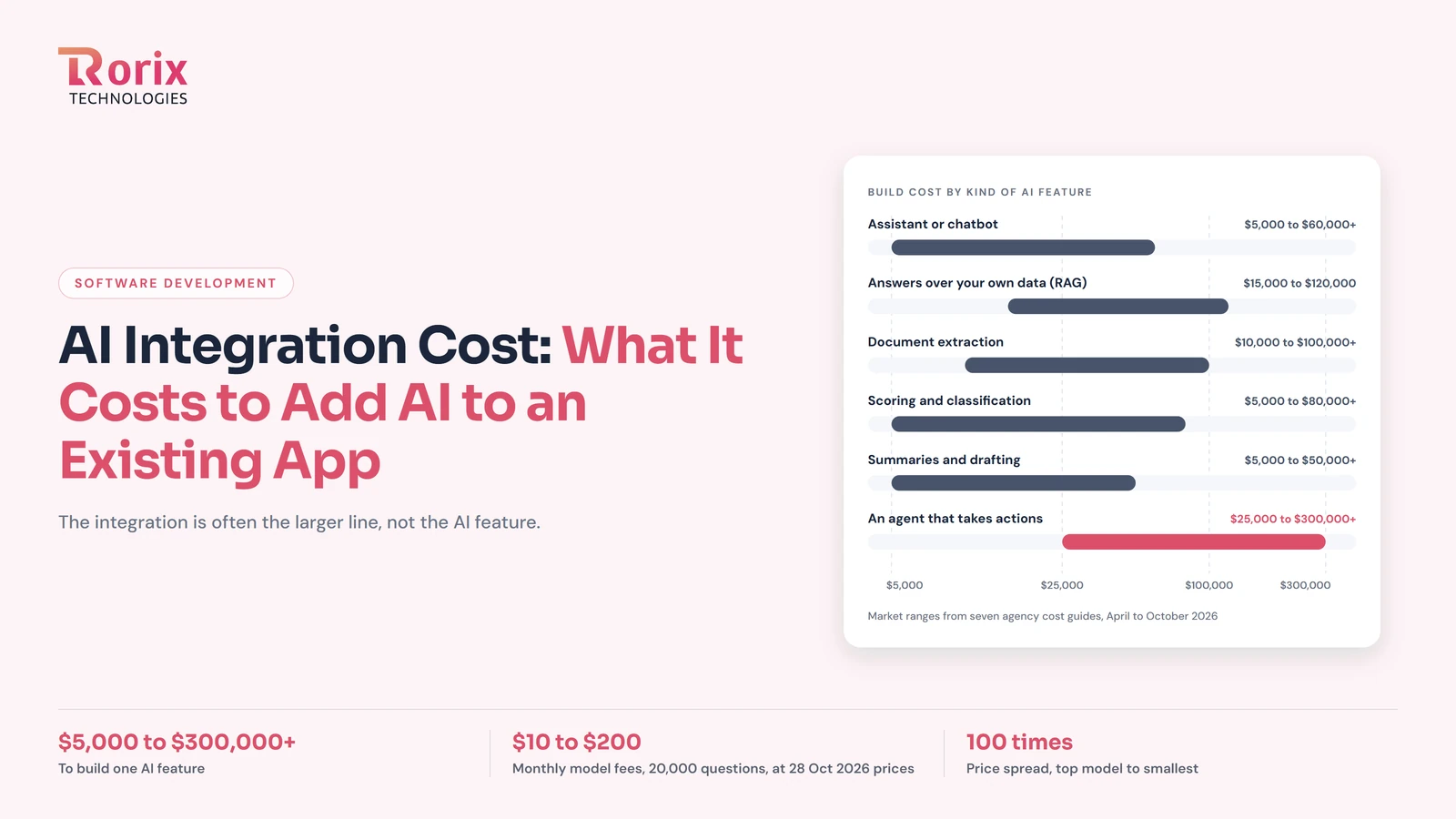
AI Integration Cost: What It Costs to Add AI to an Existing App
AI integration cost for an existing app: market ranges per feature, monthly model prices checked 28 Oct 2026, hidden costs and when to modernize first.
Read article
Top 12 AI SaaS Development Companies in 2026
Compare the 12 best AI SaaS development companies for 2026, with services, ratings, costs, and tips to choose the right development partner.
Read article