
API Integration Strategy: How to Connect Systems Without Building Debt
An API integration strategy decides where coupling lives and who owns the contract. Here are the three topologies, six failure modes, and a six-step plan.
On this page30 sections
The average organization runs 957 applications and has only 27% of them connected. That figure comes from MuleSoft's 2026 Connectivity Benchmark Report, a survey of 1,050 IT leaders covered by CIO Dive, which also found 35% naming siloed apps and data as their primary hurdle.
The interesting part is not the gap. It is that almost nobody chose it. Very few companies sat down and decided that 73% of their software would stay disconnected. They just built each integration as its own project, when someone needed it, in whatever way was fastest that quarter, and the estate is the residue of those decisions.
That is the difference between having integrations and having an API integration strategy. A strategy makes two decisions in advance that projects otherwise make by accident: where the coupling lives, and who owns the contract when something on the other side changes. Get those two right and individual integrations become routine. Get them wrong and every new connection makes the next one harder.
In this guide, you'll learn:
- The arithmetic that makes point-to-point integration collapse, and roughly where it happens
- The 3 topologies to choose between, and the size of estate each one suits
- Why contract ownership matters more than the transport you pick
- The 6 failure modes every integration has to survive
- Whether to build the integration layer, buy iPaaS, or do neither yet
- A 6-step sequence for putting a strategy on an estate that already exists
Quick Answer: The 5 Decisions an API Integration Strategy Makes
| Decision | The question it answers | Default if you never decide |
|---|---|---|
| Topology | Does everything talk to everything, or through something? | Point-to-point, growing quadratically |
| Contract ownership | Who defines the shape of the data crossing the boundary? | Whoever's system changed last |
| Failure semantics | What happens when the other side is down or wrong? | Retry until someone notices |
| Source of truth | Which system wins when two disagree? | Undefined, discovered during an incident |
| Layer ownership | Who builds and runs the connective tissue? | Whichever team needed it most recently |
Every one of these has a default that takes effect when nobody decides. The defaults are all the same shape: locally convenient, globally expensive.
Key Takeaways: Where Coupling Lives and Who Owns the Contract
- MuleSoft's 2026 Connectivity Benchmark Report, a survey of 1,050 IT leaders, found the average organization runs 957 applications with only 27% of them connected, and 35% name siloed apps and data as their primary hurdle.
- The number of possible direct connections between n systems is n(n-1)/2, so ten systems have 45 potential links and twenty have 190, and the practical breaking point for point-to-point arrives somewhere around six to eight systems.
- Postman's 2025 State of the API Report, surveying over 5,700 developers, architects, and executives, found functional and integration testing at 67% adoption while contract testing sits at just 17%.
- Four of the six integration failure modes produce no error at all, so monitoring an integration means checking that the data agrees, not just that the requests returned 200.
- The same MuleSoft research found 96% of IT leaders saying agentic AI's long-term effectiveness depends on data integration, which makes integration quality an AI prerequisite.
What Is an API Integration Strategy, and Why Do Most Companies Lack One?
An API integration strategy is a set of standing decisions about how systems in your estate exchange data, made once and applied to every subsequent connection, rather than re-litigated per project.
Most companies lack one for a structural reason rather than a negligent one. Integrations are always funded as part of something else. Nobody gets budget for "integration strategy"; they get budget for "connect the new CRM," and the fastest way to connect the new CRM is a direct call from the CRM to whatever it needs. That decision is correct in isolation every single time, and the accumulated result is an estate nobody can change safely.
The tell is simple. Ask who would have to be consulted before changing the shape of your customer record. If the answer is a list of teams and a shrug, you have integrations. If it is a named owner and a versioned contract, you have a strategy.
The Arithmetic That Makes Point-to-Point Integration Fail
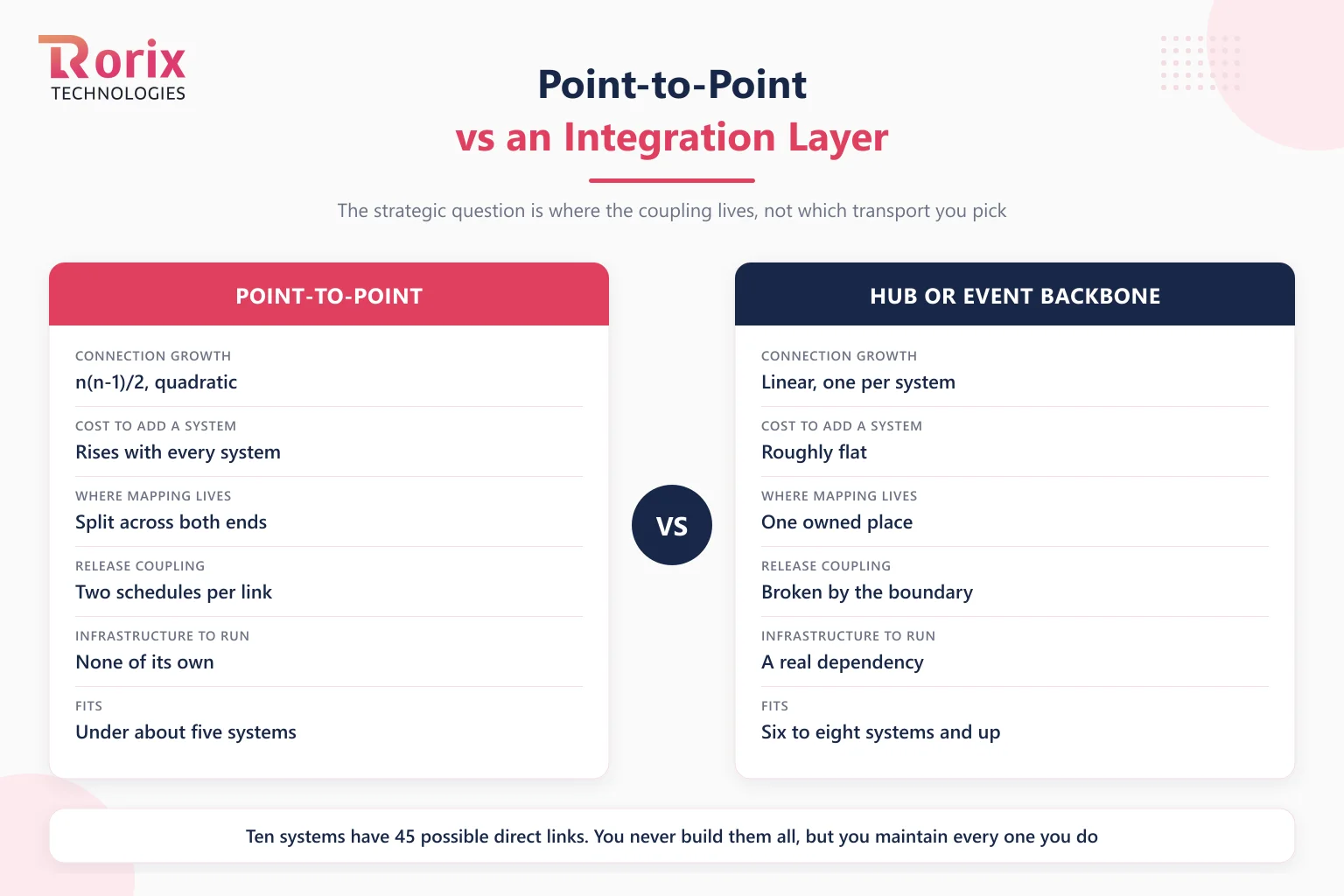
Point-to-point is not wrong. It is just quadratic, and quadratic growth is fine until abruptly it is not.
Connect systems directly and the number of possible connections between n systems is n(n-1)/2. Three systems have 3 possible links. Five have 10. Ten have 45. Twenty have 190. You will never build all of them, but you build a growing fraction, and each one is a thing that must be maintained, monitored, tested, and updated when either end changes.
The practical breaking point in the estates we work in arrives somewhere around six to eight systems, and it announces itself the same way every time: a change to one system requires a coordinated release across four teams, so changes stop being made. The estate has not failed. It has calcified, which is worse, because nothing looks broken.
The 3 Integration Topologies, and When Each One Fits
There are only three real answers to where the coupling lives. Most estates end up with a deliberate mix, which is fine, as long as the mix is deliberate.
Point-to-Point: Correct Below About Five Systems
Each system calls the others directly. It is the cheapest thing to build, the easiest to reason about with a small estate, and it has no infrastructure of its own to run. Below roughly five systems with stable interfaces, anything else is over-engineering.
Its cost is entirely deferred. Every direct link couples two release schedules together, and the coupling is invisible until you try to change something.
Hub and Spoke: An Integration Layer That Owns Translation
Every system talks to one place, and that place owns the mapping between them. New systems connect once rather than n times, and the translation logic lives somewhere a person can find it.
The trade is that the hub becomes a dependency with its own availability, its own team, and its own capacity to become a bottleneck. A hub that everyone must queue behind to ship anything has reproduced the original problem with better branding.
Event Backbone: Systems Publish Facts, Consumers Subscribe
Systems emit events describing what happened, and anything that cares subscribes. Producers do not know their consumers, which is what makes this the only topology where adding a consumer costs the producer nothing.
It is also the hardest to operate, because you inherit ordering, replay, and eventual consistency as permanent concerns rather than occasional ones. It pays off where the same fact has many interested parties, which is why event sourcing in warehouse systems shows up in operations-heavy estates, and why real-time inventory architecture is built this way rather than on polling.
For the transport-level decision inside any of these, our breakdown of the ERP integration message queue pattern compares synchronous REST against durable queues and covers idempotency in the depth it deserves.
Who Owns the Contract When a Vendor Changes Their API?
This is the question that separates estates that survive change from estates that fear it, and the industry answer is not encouraging.
Postman's 2025 State of the API Report, surveying over 5,700 developers, architects, and executives, found functional and integration testing both at 67% adoption while contract testing sits at just 17%. Two thirds of teams verify that their code works. One in six verifies that the agreement between two systems still holds.
The same report found 69% of developers spending more than 10 hours a week on API-related work, and 33% spending more than 20. That is a large share of engineering capacity flowing into the boundaries between systems, largely unprotected by tests that would catch a boundary breaking.
A contract is the shape of the data and the behavior promised at a boundary: fields, types, error cases, and what happens on retry. Three rules make ownership real rather than notional:
- Name an owner per contract, not per system. The owner decides what the payload means and approves changes to it.
- Version the contract, not just the endpoint. A URL version with a payload that quietly gains and loses fields is not versioned.
- Test the contract from the consumer's side. A provider's own test suite proves the provider is internally consistent. Only a consumer-driven test proves the provider has not broken you.
Without these, schema drift is discovered by a customer. With them, it is discovered by a build.
The 6 Failure Modes Every Integration Has to Survive
Integrations fail in a small number of well-understood ways. Designing for these six is most of what separates a durable integration from one that needs a person watching it.
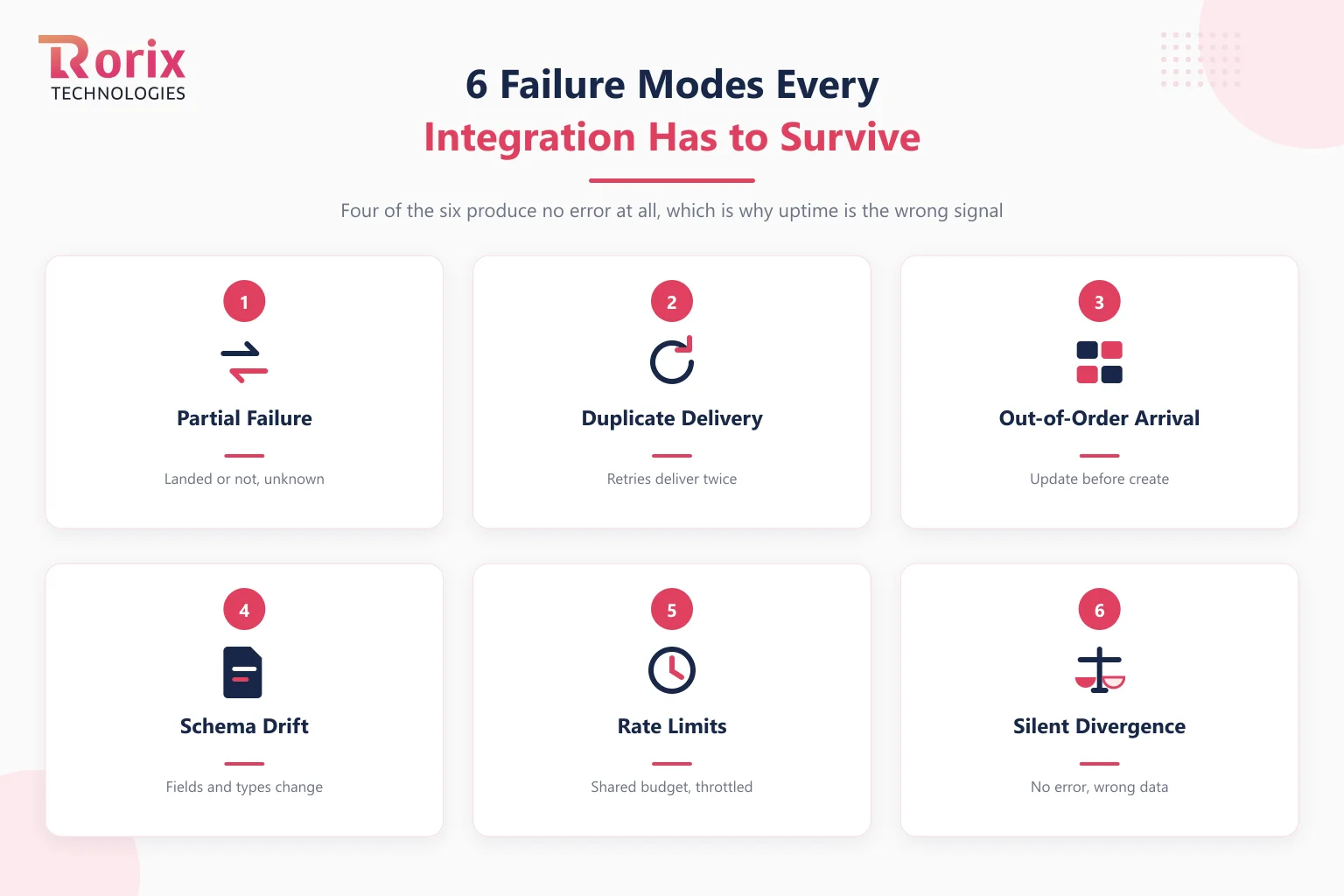
1. Partial failure. The call succeeded on their side and timed out on yours. You do not know whether it happened. Every integration needs an answer to this that is not "check manually."
2. Duplicate delivery. Anything that retries will eventually deliver twice. Idempotency keys are the answer, and they have to be designed in, because retrofitting them across a live estate is expensive.
3. Out-of-order arrival. The update arrives before the create. Ordering guarantees are narrower than most teams assume, so the receiving system needs to tolerate sequences it did not expect.
4. Schema drift. The other side adds a field, changes a type, or starts returning null where it never did. This is the failure the contract testing gap above leaves wide open.
5. Rate limits and throttling. Third-party APIs have budgets, and yours is shared across every integration you have built against them. Backoff belongs in the design, not in the incident review.
6. Silent data divergence. The worst one, because nothing errors. Two systems slowly disagree about the same fact, and the gap is found in a month-end report. Reconciliation jobs that compare rather than trust are the only real defense.
Notice that four of these produce no error at all. That is why monitoring an integration means checking that the data agrees, not just that the requests returned 200.
Build, Buy, or iPaaS: Who Should Own the Integration Layer?
All three are legitimate, and the choice follows the shape of your integrations rather than the size of your company.
Buy an iPaaS when your integrations are mostly between well-known SaaS products with published connectors, and the logic in between is light. You are buying maintained connectors and someone else's uptime, and that is genuinely cheaper than writing it. Watch the pricing model, since per-task pricing on a high-volume operational flow can quietly exceed the engineering it replaced.
Build the layer when the valuable logic lives in the translation itself: your business rules, your edge cases, your domain. This is common in operations-heavy estates where the mapping between two systems is not a field rename but a decision. Nobody sells a connector for how your business handles a partial shipment.
Do neither yet when you have four systems and a roadmap. Adding an integration layer to a small estate buys you architecture you have to run and solves a problem you do not have. Revisit at the point where a single change starts requiring coordinated releases.
If you are weighing this seriously, our build versus buy decision framework covers the general form of the question, and how to consolidate fragmented business systems covers the case where the honest answer is fewer systems rather than better connections between them.
One thing worth saying plainly given the direction of the market: integration quality is now an AI prerequisite. The same MuleSoft research found 96% of IT leaders saying agentic AI's long-term effectiveness depends on data integration. An agent is only as capable as the tools it can safely call, which is the argument our guide to AI agents for business operations makes from the other direction.
How to Build an API Integration Strategy in 6 Steps
This assumes what is normally true: you already have an estate, and you cannot stop to redesign it.
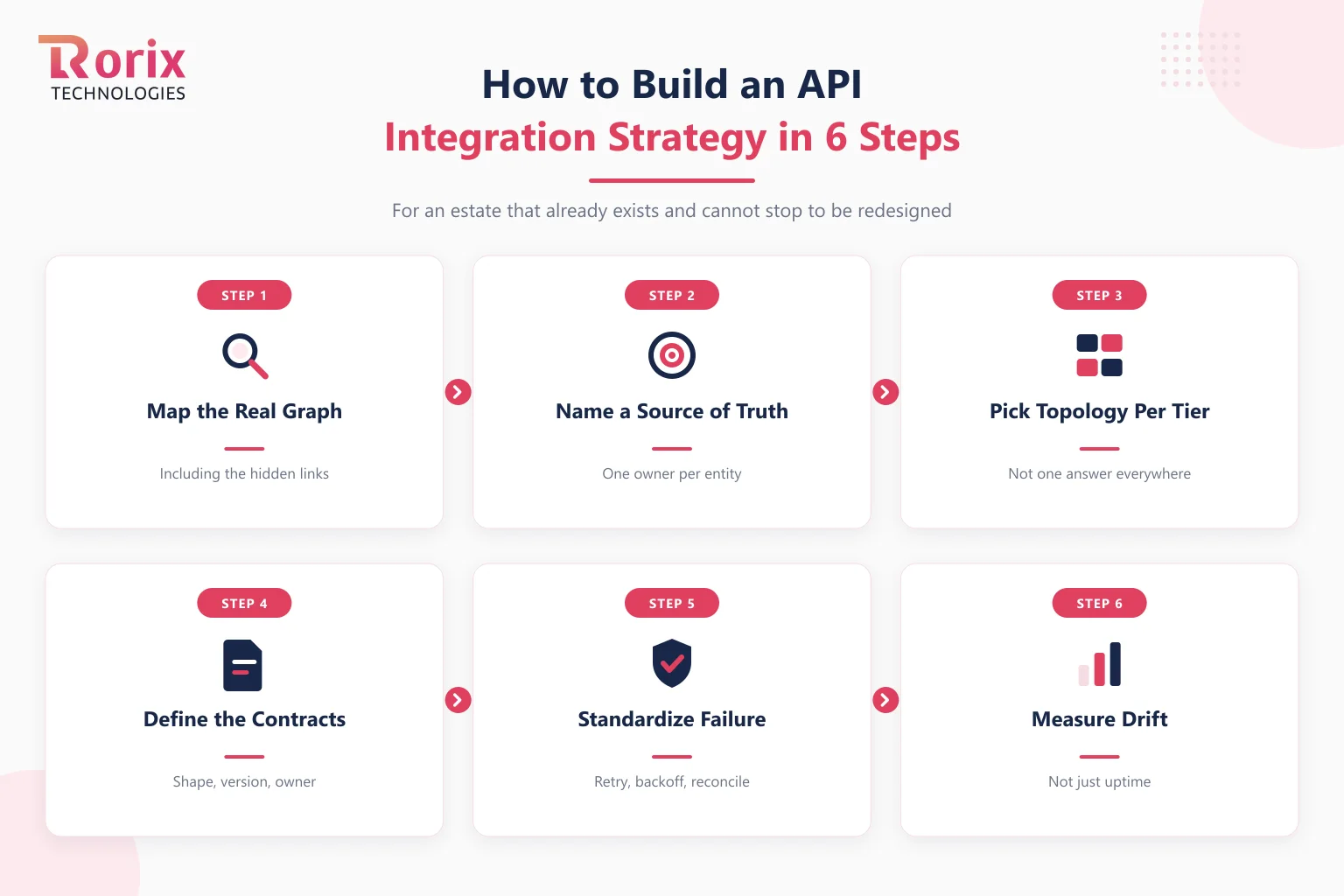
Step 1. Map the Graph You Actually Have
List every system and every live connection between them, including the scheduled export nobody mentions and the script on someone's machine. Teams routinely find more links than anyone expected, and the undocumented ones are usually the load-bearing ones. This map is the strategy's baseline, and it usually makes the topology decision obvious on its own.
Step 2. Name a Source of Truth for Each Core Entity
Customer, order, product, employee, inventory. One system owns each, and everything else holds a copy it does not get to authoritatively change. Until this is written down, every reconciliation argument gets settled by whoever is most senior in the room.
Step 3. Choose a Topology Per Tier, Not for the Whole Estate
High-volume operational flows may justify an event backbone while low-traffic admin systems stay point-to-point forever. A strategy is a rule for choosing, not a single answer imposed everywhere.
Step 4. Define the Contract and Its Owner Before Building
For each boundary: the payload shape, the version policy, the error cases, the retry semantics, and the named owner. This is a short document per boundary and it is the highest-leverage hour in the whole project.
Step 5. Standardize Failure Handling Once
Pick your idempotency approach, your retry and backoff policy, your dead letter destination, and your reconciliation cadence, then apply them everywhere. Six integrations each with their own hand-rolled retry logic is six things to debug at 2am instead of one.
Step 6. Measure Integration Health, Not Just Uptime
Track lag, error rate, retry volume, dead letter depth, and reconciliation drift per integration. Uptime tells you the pipe is open. Drift tells you whether the data at both ends still agrees, which is the thing you actually care about.
What Integration Debt Costs, and How to Tell If You Have It
Integration debt rarely appears as a line item. It shows up as a slowdown in everything else, which makes it easy to misattribute to team performance.
We do not publish a dollar figure for it, because any honest number depends entirely on your estate. What we can offer is a diagnostic. If three or more of these are true, integration debt is already your constraint:
- A change to one system requires a coordinated release with two or more other teams
- Nobody can produce a current diagram of what talks to what
- At least one critical flow depends on a scheduled export nobody has reviewed in a year
- Two systems regularly disagree about the same fact and a person reconciles them
- A third-party API change has caused a production incident in the last twelve months
- Onboarding an engineer to the integration surface takes longer than to the product itself
The cost is that the roadmap slows down for reasons nobody can point at. For the underlying build economics of fixing it, our custom software development cost guide covers how this kind of work is scoped, and the architecture builder will sketch the target topology. Where the constraint is an older platform that cannot expose its own data cleanly, that is a legacy modernization question rather than an integration one.
How Rorix Approaches API Integration
Rorix Technologies builds integration-heavy operational platforms, which means we have made most of these mistakes at least once and now design against them by default.
- Depth on a single estate: 40+ vendor integrations shipped on one platform, using a hybrid of direct APIs and event-driven flows chosen per tier rather than by preference.
- Contracts and idempotency first: retry semantics, idempotency keys, and reconciliation designed in at the boundary, because retrofitting them across live integrations is the expensive version.
- Domain-heavy translation: warehouse, order, HR, and ecommerce flows where the mapping is a business decision rather than a field rename, which is precisely where connectors run out.
- A named team that stays: senior engineers averaging 11 years of production experience, working in 2-week sprints with full task visibility, on 27 platforms delivered and a 5.0 Clutch rating across the US, UK, Canada, Australia, and New Zealand.
- Honest boundaries: we build the application side of integration. Infrastructure and DevOps stay with you, and we will say so before the engagement rather than during it.
Book a free consultation and we will map your actual integration graph with you, including the parts that turn out not to need rebuilding.
Strategy Is Deciding Where the Coupling Lives Before It Decides for You
The 27% connected figure is not a technology failure. It is what happens when a thousand locally sensible decisions accumulate without anyone holding the shape of the whole.
You do not fix that by connecting everything. Most estates need fewer connections, not more, with clear ownership on the ones that remain. The strategy is the standing set of rules that makes each new connection cheaper than the last instead of more expensive.
Map the graph you have. Name a source of truth per entity. Pick topology per tier, write the contracts down, and standardize failure handling once. None of that requires a platform migration, and all of it makes the next integration a routine piece of work rather than a negotiation.
Mapping an estate before anyone writes code is technology consulting work. Want the map drawn against your real estate? Talk to our engineers about what connects to what today, and we will tell you which links are load-bearing and which ones only look like it.
Frequently Asked Questions
What is an API integration strategy?
It is a set of standing decisions applied to every integration rather than decided per project: where coupling lives, who owns each data contract, what happens when a call fails, which system is the source of truth for each entity, and who builds and runs the connective layer. Without them, each of those questions gets an ad hoc answer that is locally convenient and globally expensive.
When should we move away from point-to-point integration?
When a change in one system starts requiring a coordinated release across several teams, which in practice tends to arrive somewhere around six to eight connected systems. The number of possible links grows as n(n-1)/2, so ten systems have 45 potential connections, and the maintenance burden grows with the fraction of them you have actually built.
What is the difference between hub-and-spoke and an event backbone?
In hub-and-spoke, systems call one central place that owns translation between them, so adding a system means connecting once instead of many times. In an event backbone, systems publish facts and interested consumers subscribe, so producers do not know their consumers and adding a consumer costs the producer nothing. The hub is simpler to operate; the backbone scales better when many parties care about the same event.
Should we buy an iPaaS or build our own integration layer?
Buy when your integrations are mostly between well-known SaaS products with maintained connectors and the logic between them is light. Build when the valuable logic is the translation itself, meaning your business rules and edge cases, which is common in operations-heavy estates. With four systems and no coordination pain, do neither yet.
Why is contract testing important for API integrations?
Because it is the only test that catches the other side changing on you. Postman's 2025 report found functional and integration testing at 67% adoption but contract testing at just 17%, which means most teams verify their own code works while leaving the agreement between systems unverified. Schema drift then gets discovered in production instead of in a build.
What are the most common API integration failure modes?
Partial failure where you cannot tell if the call landed, duplicate delivery from retries, out-of-order arrival, schema drift, rate limiting, and silent data divergence between two systems. Four of the six produce no error at all, which is why integration monitoring has to check that data agrees rather than only that requests returned successfully.
How do we know if we have integration debt?
Common signals: a change in one system needs a coordinated multi-team release, nobody can produce a current diagram of what talks to what, a critical flow depends on an unreviewed scheduled export, two systems regularly disagree and a person reconciles them, or a third-party API change caused an incident in the last year. Three or more of those and integration debt is your constraint.
Does an API integration strategy matter for AI adoption?
Yes, and it is now often the gating factor. MuleSoft's 2026 research found 96% of IT leaders saying agentic AI's long-term effectiveness depends on data integration, and an agent can only act through the tools and data you expose to it safely. Clean contracts and a defined source of truth are the prerequisite, not an optimization to do afterward.
Systems that do not talk to each other?
Most of the cost in an integration project sits in the edge cases nobody documented. Send us the systems and the data that has to move between them.
Continue learning
Written by
Renish DadhaniyaFounder & Director, Rorix Technologies
Renish co-founded Rorix Technologies and drives the engineering and delivery culture across the organization. Beyond engineering, he leads the company's sales, finance, and HR operations, building the infrastructure that lets the team focus on shipping quality software. With deep hands-on expertise in architecture and team building, he ensures every project lands on time to the quality standards clients demand.
View full profileRelated articles
How to Consolidate Fragmented Business Systems Into One Platform
Fragmented vendor systems cost real money. Compare the four consolidation patterns, what each costs, and how to choose a development partner that fits.
Read article
How to Add AI to Existing Software: What Your System Will Let You Do
How to add AI to existing software: the four insertion points, whether your system can emit what a model needs, shadow mode, and when to modernize first.
Read article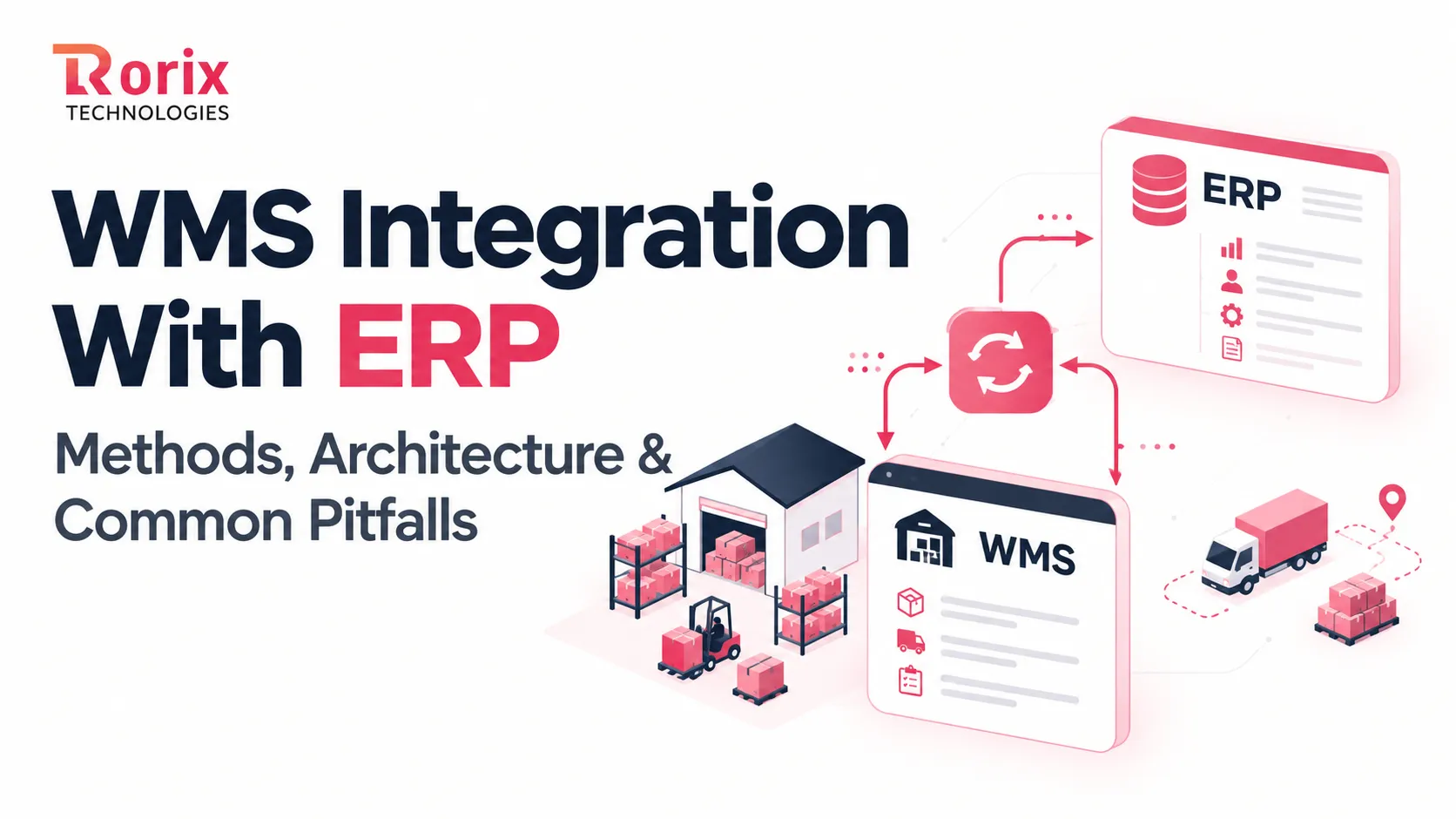
WMS Integration With ERP: Methods, Architecture & Common Pitfalls
Learn how WMS integration with ERP works, with 7 methods, architecture decisions, data flows, an 8-step roadmap, costs, timelines, and common pitfalls to avoid.
Read article