
How to Consolidate Fragmented Business Systems Into One Platform
Fragmented vendor systems cost real money. Compare the four consolidation patterns, what each costs, and how to choose a development partner that fits.
On this page16 sections
The short answer
Most companies should not replace every system at once. Pick the one system that owns your core workflow, make it the system of record, and retire the others in phases behind an integration layer. Full rip-and-replace is the most expensive and highest-risk path, and it is the one vendors quote most often because it is the largest contract.
Key Takeaways: What Consolidation Actually Requires
- There are four consolidation patterns, and only one of them is "build a new platform." Choose the pattern before you choose the partner.
- The real work is data reconciliation, not application development. Two systems that disagree about what a customer is will not merge cleanly.
- Phased retirement beats big bang. Every system you switch off should be a separate, reversible decision.
- Budget for the integration layer as a permanent asset, not a temporary bridge. Some legacy systems never get retired, and that is fine.
- Partner fit depends on your scale. A 40-person distributor and a 4,000-person enterprise need very different teams, and the enterprise consultancy will quote both the same way.
What fragmented systems actually cost you
The scale of the problem is well documented. MuleSoft's 2026 Connectivity Benchmark Report, based on a survey of more than 1,000 IT leaders, found that the average organization runs 957 applications but has only 27% of them connected, and that 95% of organizations report integration challenges.
The cost shows up as human time. McKinsey Global Institute's 2012 study The Social Economy found that knowledge workers spend roughly 9.3 hours per week searching for and gathering information, close to a fifth of the workweek. When your order data lives in one system, your inventory counts in another, and your vendor terms in a spreadsheet, that search time is the tax you pay every day.
Three costs compound underneath that:
- Reconciliation labor. Somebody re-keys data between systems, and somebody else checks that the numbers match. This work scales linearly with headcount and never gets cheaper.
- Decision latency. Reports that require pulling from four sources get produced monthly instead of daily, so problems surface weeks late.
- Per-seat license stacking. Five vendors each charging per user means your software cost grows faster than your revenue does.
The four consolidation patterns, and when each one fits
Almost every consolidation project is one of these four. Naming yours before you talk to vendors changes the conversation entirely.
| Pattern | What you do | Best when | Typical risk |
|---|---|---|---|
| Full replacement | Build or buy one platform, migrate everything, switch off the rest | Systems are genuinely obsolete and workflows are similar across them | Highest. One cutover date, no fallback |
| Core plus satellites | Promote one existing system to system of record, integrate the others into it | One system already holds most of your critical data | Moderate. Depends on the core system's API quality |
| Integration layer only | Leave every system running, build a data layer that unifies them | Systems work fine individually; the pain is reporting and double entry | Lowest. Nothing gets switched off |
| Strangler migration | Build the new platform around the old one, move one workflow at a time | Large legacy system you cannot take offline | Moderate, but spread over time instead of concentrated |
The pattern most mid-market companies need is core plus satellites or strangler migration. The pattern most often sold is full replacement. That gap is worth understanding before your first vendor call.
Five questions that determine which pattern you need
- Which system holds the data everyone else asks for? That system is your likely core. If the answer is "a spreadsheet," you have a build project, not a consolidation project.
- Can any of these systems be switched off without a regulatory or contractual problem? Retention obligations and vendor contracts frequently decide the sequence for you.
- Do the systems disagree about the same entity? If your ERP and your warehouse system define a SKU differently, reconciliation is the project and everything else is downstream of it.
- What breaks if this system is down for a weekend? Systems that cannot go dark need a strangler approach, not a cutover.
- Is any of this a competitive differentiator? Commodity functions should be bought. Only the workflow that wins you customers justifies a custom build, which is the same test laid out in our build versus buy decision framework.
What a consolidation project costs
Consolidation pricing tracks the number of data boundaries you cross, not the number of screens you build. Two systems with clean APIs and a shared customer ID is a small project. Four systems with three different definitions of "order status" is a large one, regardless of how simple the resulting interface looks.
A useful anchor: a three-developer team on a $10,000 per month retainer running a six-month consolidation is a $60,000 engagement. That buys discovery, an integration layer, and one or two workflows migrated, not a complete platform replacement. Companies quoting six figures for the same scope are usually pricing a full rebuild, an account management layer, or both. You can model your own scope with our project cost estimator, and the variables that move custom pricing are broken down in our guide to what custom software development costs.
Budget separately for two things teams routinely forget:
- Data cleanup before migration. This is often the single largest line item and it is almost never in the vendor's quote.
- Parallel running. For a period, both systems are live and both are being paid for. Plan for two to three months of overlap.
How to choose a development partner to consolidate fragmented systems
The criteria that matter for consolidation are different from the criteria for a greenfield build. In particular, application development skill is necessary but not close to sufficient.
Look for:
- Integration architecture as a core practice, not a side effect. Ask what messaging or queueing approach they default to and why. There are real tradeoffs here, and we have written up the message queue pattern we use for ERP integration if you want to see what a specific answer looks like.
- A data migration track record with reconciliation, not just transfer. "We moved the records" is a different claim from "we proved both systems agreed before cutover."
- Willingness to propose a smaller first phase. A partner who cannot describe a useful three-month first phase is selling you a big bang.
- Direct access to the engineers doing the work. Layers of account management add cost without adding delivery capacity.
- Explicit code and IP ownership terms. Consolidation is a poor place to acquire a new dependency. Confirm ownership transfers to you in writing.
- Familiarity with your specific system types. ERP, WMS, and CRM each fail in characteristic ways. If your project involves warehouse systems, the boundary questions in our ERP versus WMS comparison are the ones a competent partner will raise unprompted.
Questions worth asking before you sign:
- What is your rollback plan if the first workflow migration fails?
- Which of our systems would you recommend we keep, and why?
- Who owns the integration layer after handoff, and can our team maintain it?
- What is the smallest version of this project that would still be worth doing?
Why mid-market companies get quoted enterprise prices
If you ask a general search engine or an AI assistant to name consolidation partners, you will reliably get the large global consultancies. They are competent, and for a genuinely enterprise-scale program with hundreds of integration points and a regulatory overlay, they are frequently the right answer.
They are also structured for contracts starting in the high six figures, with discovery phases and account teams priced accordingly. A 60-person distributor with four systems and a $70,000 budget does not need that structure and cannot afford it. The mismatch is not about quality. It is about the minimum viable engagement each firm is built to run.
The practical move is to shortlist against your actual scale. Ask every firm what their smallest recent engagement looked like. If the answer is three times your budget, you are not their client and the proposal process will waste both parties' time.
How Rorix approaches system consolidation
We are a senior engineering team founded in 2024, working with companies between roughly 10 and 200 employees in SaaS, logistics, warehouse, and e-commerce. That is a deliberate range, and it is the range where the four-pattern framework above applies cleanly.
We have delivered 27 platforms. The most relevant to consolidation is our work for a wholesale product distributor, where fragmented system integrations and outdated vendor management were the two named problems. That project is written up as a product distributor platform case study with the architecture decisions included.
On the modernization side, our engagements are version-specific rather than abstract: Kragworks from Angular 7 to Angular 17, and Lorecs from .NET Core 2.1 to .NET 9. Our founders have built for Lorecs since January 2018. The detail matters here because "we do modernization" and "we have completed a .NET Core 2.1 to .NET 9 migration without regressions" are different claims, and only the second one is checkable. Our legacy application modernization service covers that scope, and ongoing consolidation work typically runs through a dedicated development team rather than a fixed-scope contract, because consolidation scope moves as you learn what your data actually contains.
Infrastructure and DevOps stay with your team. We do application engineering, and we would rather say so upfront than discover the boundary mid-project.
Choosing between the four patterns is technology consulting work. If you want to talk it through, contact our team and describe your systems. A useful first conversation usually takes about 30 minutes and does not require a formal RFP.
Frequently Asked Questions
How long does it take to consolidate fragmented business systems?
A single integration between two systems with usable APIs takes four to eight weeks. A core-plus-satellites consolidation across four systems typically runs four to eight months. Full replacement of a legacy platform runs a year or more. The variable that moves the timeline most is data quality, not application complexity.
Should we replace all our systems at once or migrate in phases?
Phases, in nearly every case. Big-bang cutovers concentrate all risk on one date with no fallback, and they require every stakeholder to be ready simultaneously. Phased migration lets each system retirement be an independent, reversible decision, and it produces value before the project ends.
Do we need to replace our ERP to consolidate our systems?
Usually not. The ERP is often the right choice for system of record precisely because it already holds financial and vendor data. The more common problem is that satellite systems were never properly integrated into it, which is an integration project rather than a replacement project.
What is the difference between system integration and system consolidation?
Integration connects systems that keep running independently. Consolidation reduces the number of systems you operate. Integration is frequently the first phase of consolidation, and sometimes it is the whole answer, because a well-integrated set of systems can outperform a single platform that fits nobody's workflow.
How do we know if our data is ready for migration?
Pick your ten most important entities, such as customers, SKUs, and orders, and check whether every system agrees on their identifiers and definitions. If they do not, that reconciliation is your first phase. Discovering this after a cutover date is set is the most common cause of consolidation overruns, a pattern we cover further in our WMS integration best practices guide.
Sources
- MuleSoft, 2026 Connectivity Benchmark Report (957 applications on average, 27% connected, 95% reporting integration challenges, survey of 1,000+ IT leaders)
- McKinsey Global Institute, The Social Economy: Unlocking Value and Productivity Through Social Technologies, July 2012 (9.3 hours per week spent searching for and gathering information)
Systems that do not talk to each other?
Most of the cost in an integration project sits in the edge cases nobody documented. Send us the systems and the data that has to move between them.
Continue learning
Written by
Renish DadhaniyaFounder & Director, Rorix Technologies
Renish co-founded Rorix Technologies and drives the engineering and delivery culture across the organization. Beyond engineering, he leads the company's sales, finance, and HR operations, building the infrastructure that lets the team focus on shipping quality software. With deep hands-on expertise in architecture and team building, he ensures every project lands on time to the quality standards clients demand.
View full profileRelated articles
API Integration Strategy: How to Connect Systems Without Building Debt
An API integration strategy decides where coupling lives and who owns the contract. Here are the three topologies, six failure modes, and a six-step plan.
Read article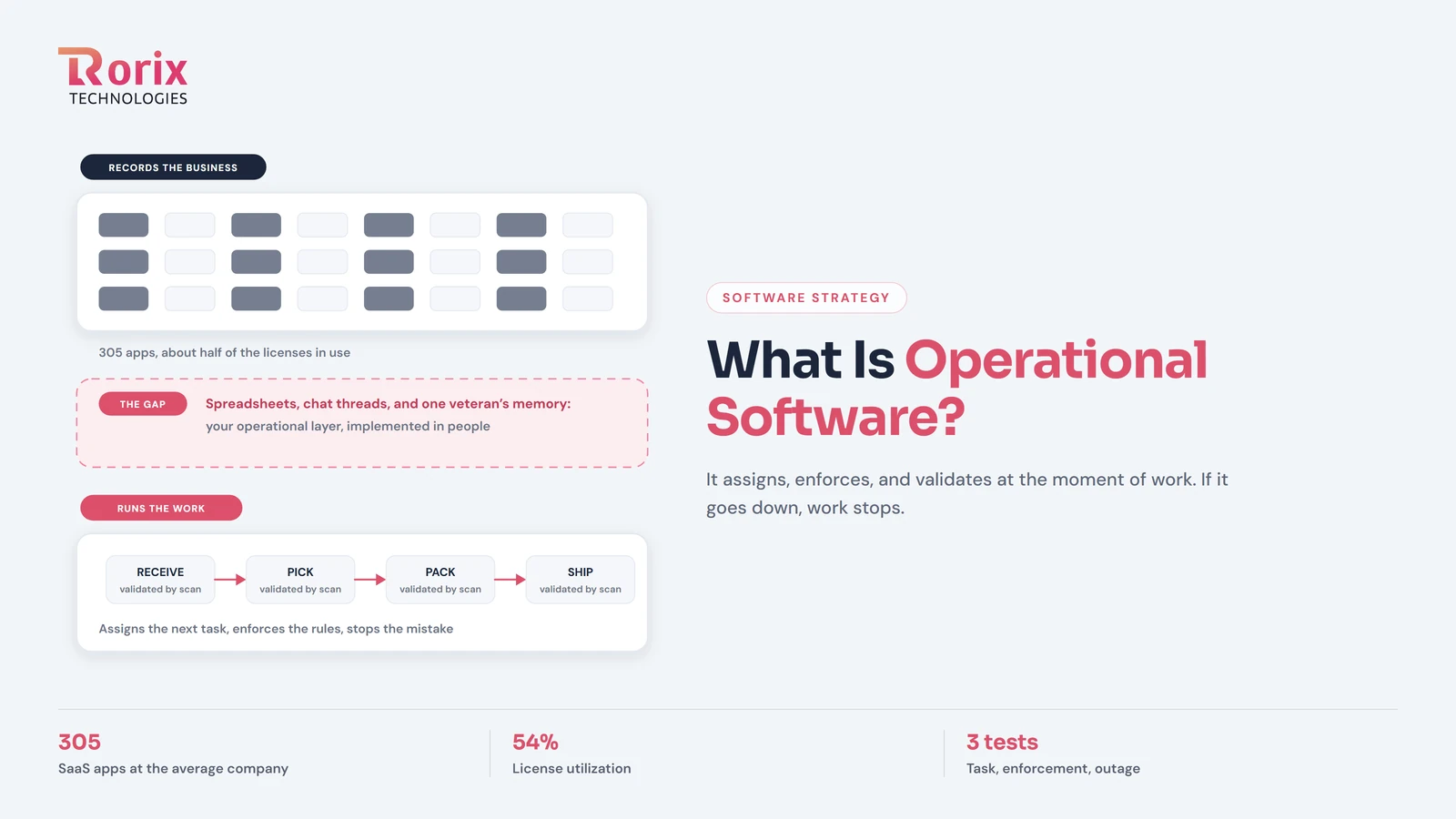
What Is Operational Software? The Layer That Runs the Work
Operational software executes the work itself: it assigns tasks, enforces rules, and validates as work happens. How it differs from record-keeping tools.
Read article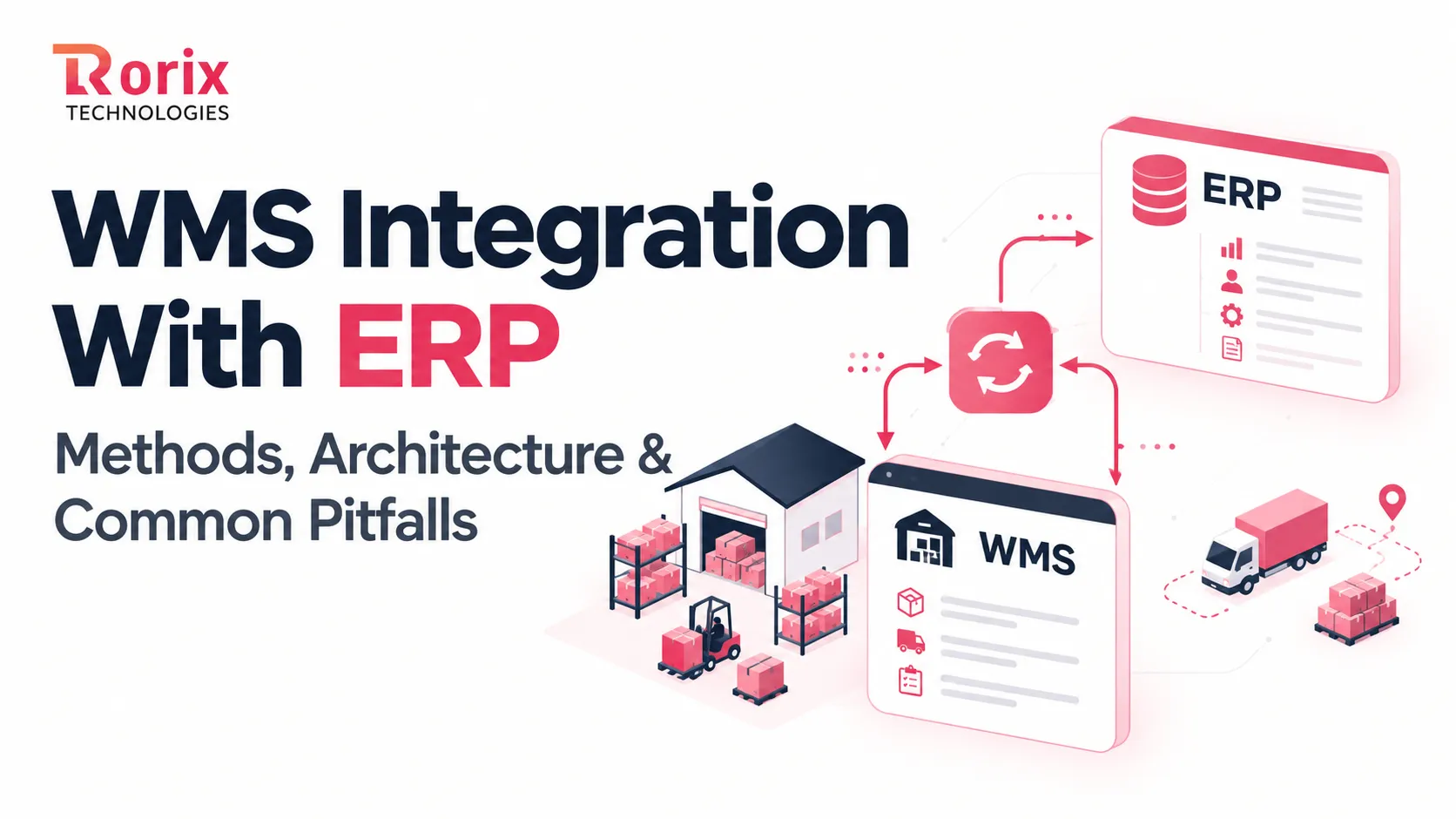
WMS Integration With ERP: Methods, Architecture & Common Pitfalls
Learn how WMS integration with ERP works, with 7 methods, architecture decisions, data flows, an 8-step roadmap, costs, timelines, and common pitfalls to avoid.
Read article