Top 15 AI Agent Development Companies in 2026 (Compared)
Explore the top AI agent development companies in 2026. Compare capabilities, headquarters, and Clutch ratings to choose the right development partner.
On this page51 sections
Key Takeaways: Choosing the Right AI Agent Development Partner
- Integration matters: Choose a partner experienced with your existing business systems.
- Prioritize production experience: Look for working agents, not just impressive demos.
- Start with one workflow: Set clear goals and measurable success metrics.
- Plan for ongoing costs: Budget for model usage, monitoring, and maintenance.
- Check security and support: Confirm safeguards, ownership, and post-launch assistance.
- Run a pilot first: Validate results before committing to a larger build.
An AI agent can process orders, check inventory, and draft replies in seconds. But outdated data, disconnected systems, and undocumented workflows can turn a promising pilot into a failed implementation.
That is why choosing the right AI agent development company matters. The right partner can connect AI agents with your CRM, ERP, billing system, or custom warehouse management system to automate real business workflows safely.
But not every vendor builds production-ready agents. Some develop autonomous AI solutions, while others simply repackage chatbots as agentic AI. Choosing the wrong partner can waste time and budget.
In this guide, you'll learn:
- 15 AI agent development companies and their core strengths
- How AI agents differ from chatbots, RPA, and copilots
- Five types of development partners and 10 selection factors
- Eight questions to ask before signing a contract
- Where AI agents deliver ROI in operations-heavy businesses
By the end of this guide, you'll know which partner fits your needs and what to consider before investing in AI agent development.
What Does an AI Agent Development Company Do?
An AI agent development company builds software agents that understand goals, plan tasks, and take action across business systems.
Unlike basic chatbots, these agents can use tools, follow workflows, handle exceptions, and escalate tasks to humans when needed.
A production-ready agent combines an AI model for reasoning with defined business rules, permissions, and error handling. This helps keep actions controlled, secure, and auditable.
A capable partner typically handles:
- Use-case scoping: Identifying workflows, business costs, and success metrics.
- Agent architecture: Selecting models, frameworks, and single-agent or multi-agent designs.
- System integration: Connecting ERP, WMS, CRM, HRMS, databases, and APIs.
- Knowledge retrieval: Using retrieval-augmented generation (RAG) to access internal documents and business data.
- Guardrails and approvals: Setting permissions, audit logs, and human review checkpoints.
- Monitoring and improvement: Tracking performance, costs, and failures after deployment.
AI Agents vs. Chatbots vs. RPA vs. Copilots
These technologies serve different purposes. Understanding the differences helps you choose the right solution for your workflow.
| Criteria | AI Agent | Chatbot | RPA Bot | Copilot |
|---|---|---|---|---|
| Core job | Completes multi-step goals | Answers questions | Automates fixed tasks | Assists human decisions |
| Handles exceptions | Can adapt or escalate | Limited | Usually breaks outside set rules | Human intervenes |
| Takes system actions | Yes, using tools and APIs | Limited | Yes, through scripted steps | Usually requires human action |
| Context | Across workflow steps | Mainly conversation-based | Little or none | Focused on the current task |
| Best fit | Order exceptions and reconciliation | FAQs and support | Repetitive data entry | Research and drafting |
When to Hire a Partner Instead of Building In-House
Building in-house makes sense if your team has experience deploying and maintaining LLM-based systems. Otherwise, an external partner can help you avoid common integration, security, and reliability issues.
Consider hiring a partner when:
- You lack production experience: Your team can build prototypes but struggles to make agents reliable at scale.
- Integrations are complex: The agent must work across multiple systems, including legacy software.
- Timelines are tight: You need a pilot to validate the use case before committing a larger budget.
- Compliance matters: The agent handles sensitive customer, employee, or financial data that requires access controls and audit trails.
How We Selected the Best AI Agent Development Companies
We reviewed leading comparison guides and shortlisted small and mid-size service providers that businesses can hire for AI agent development, excluding large IT giants and software platforms that sell no build services.
Each company was evaluated against six criteria:
- Dedicated services: Clearly offers AI agent or agentic AI development.
- Production evidence: Shows relevant case studies, client reviews, or completed projects.
- System integration: Demonstrates experience connecting agents with CRM, ERP, and internal tools.
- Governance: Addresses security, guardrails, human approvals, and monitoring.
- Verified reputation: Has a current Clutch profile with client reviews.
- Company details: Name, headquarters, and ownership are taken from its Clutch profile and official website as of October 2026.
Rorix Technologies publishes this list and ranks itself first. We applied the same criteria to our own work, and no company paid for placement.
Top 15 AI Agent Development Companies at a Glance
This table gives you a quick comparison of every AI agent development company on the list. Headquarters, team size and Clutch ratings come from each company's Clutch profile as of October 2026, and capabilities from its own website. Confirm current details before signing.
| Company | Headquarters | Team Size | Clutch Rating | Best For |
|---|---|---|---|---|
| Rorix Technologies (that is us) | Ahmedabad, India (serving the US, UK, Canada, Australia, and New Zealand) | Dedicated team of senior engineers with a named technical lead | 5.0 (4 reviews) | AI agents built into operations software (WMS, orders, HR, SaaS) |
| EffectiveSoft | San Diego, California, US | 250 to 999 | 4.9 (19 reviews) | Governed multi-agent systems for enterprise workflows |
| BotsCrew | San Francisco, US, with Lviv, Ukraine | 50 to 249 | 4.8 (40 reviews) | Task agents and voice or chat agents tied to business systems |
| HatchWorks AI | Atlanta, Georgia, US | 250 to 999 | 4.9 (29 reviews) | Agentic AI Pods accountable for a defined outcome |
| Azumo | San Francisco, US, with delivery in Argentina | 50 to 249 | 4.9 (27 reviews) | Nearshore teams for department-level agents |
| Addepto (part of KMS Technology) | Warsaw, Poland | 50 to 249 | 4.9 (19 reviews) | Agentic RAG over enterprise knowledge bases |
| InData Labs | Nicosia, Cyprus | 50 to 249 | 4.9 (20 reviews) | Data-heavy, multi-step workflow agents |
| Neurons Lab | London, UK, with Singapore | 50 to 249 | 5.0 (5 reviews) | Agentic AI for banks and financial services |
| Markovate | San Francisco, US | 50 to 249 | 5.0 (12 reviews) | Voice agents, copilots, and customer-service agents |
| Biz4Group | Orlando, Florida, US | 250 to 999 | 4.9 (28 reviews) | Customer-facing agents and AI coaching tools |
| Intellectyx | Pasadena, California, US, with Denver | 250 to 999 | 4.9 (10 reviews) | Lending agents with AgentOps |
| Maruti Techlabs | Austin, Texas, US, with Ahmedabad, India | 250 to 999 | 4.8 (33 reviews) | Process and workflow automation for mid-market teams |
| ThinkPalm Technologies | Kochi, India | 250 to 999 | 4.9 (7 reviews) | Telecom, maritime, and platform agents |
| LeewayHertz (A Hackett Group Company) | Gurugram, India | 50 to 249 | 4.7 (9 reviews) | Multi-agent systems on its ZBrain platform |
| Rootstrap | Beverly Hills, California, US, with Latin American hubs | 250 to 999 | 4.8 (44 reviews) | AI product engineering with agent features |
Let's take a look at each one in detail.
1. Rorix Technologies (that is us)
Rorix Technologies is a custom software and AI agent development company for operations-heavy businesses. The team builds warehouse management systems, HRMS platforms, order management solutions, and SaaS products, integrating AI agents into existing workflows rather than delivering standalone bots.
Rorix focuses on connecting agents with the systems businesses already use. For Driven, a US performance platform for pest control and field service teams, Rorix built a CRM and real-time performance platform that unifies data from 40+ third-party integrations, including HubSpot, Twilio, RingCentral, and Google APIs.
With 27 platforms delivered and a 5.0 Clutch rating across 4 verified reviews, Rorix serves clients across the US, UK, Canada, Australia, and New Zealand. Its engagement model includes two-week sprints, full task visibility, and ongoing support through a retainer, helping clients maintain continuity after launch. Rorix's founders have been DealSignal's engineering partner for 5+ years, continuing under Rorix.
Key Highlights:
- Headquarters: Ahmedabad, India, serving clients across the US, UK, Canada, Australia, and New Zealand.
- AI work: Builds task agents, chat assistants, retrieval over company data, and document extraction on hosted models. Shipped examples include the AI SKU price finder for Lorecs and AI-assisted verification for DealSignal.
- Technology and integrations: Connects agents and the software around them with CRM, telephony, messaging, and accounting tools, through APIs and workflow automation tailored to existing business systems.
- Operational proof: WorkCenter Central, the platform Rorix built for distributor Lorecs, cut manual errors by 80% and sped up order processing by 50%. An AI SKU price finder added on top answers vendor pricing questions in plain English from thousands of supplier files. Read the WorkCenter Central case study.
- Project management: Uses two-week sprints and full task visibility, with a named technical lead to keep communication and priorities clear.
- Engagement and support: Provides a dedicated team of senior engineers through a retainer model, with monitoring, workflow updates, and improvements after go-live. Scope stays at the application layer, and your team keeps infrastructure and DevOps.
- SaaS development: Builds AI features into SaaS products and delivers a working MVP in 6 to 12 weeks.
Best for: Distributors, 3PLs, ecommerce operators, HR product teams, and B2B SaaS companies that need AI agents built into the systems they already run.
2. EffectiveSoft
EffectiveSoft helps enterprises build AI agents that follow business rules, respect access permissions, and keep critical decisions explainable. Based in San Diego, the company builds governed multi-agent systems, choosing between single-agent, multi-agent, or hybrid orchestration and adding human-in-the-loop controls where required. Its work is backed by ISO/IEC 27001:2022-certified processes.
Key Highlights:
- Workflow automation agents: Builds agents that execute end-to-end business workflows across finance, supply chain, compliance, and document-heavy operations.
- Governance and security: Builds in monitoring, observability, permissions, and human approvals to support compliance requirements.
- Post-launch monitoring: Monitors deployed agents to detect performance issues and prevent drift.
Best for: Enterprises that need secure, explainable AI agents for regulated or complex workflows.
3. BotsCrew
BotsCrew builds custom AI agents that complete work rather than just answer questions, drawing on its background in conversational AI. Its agents connect to business systems such as NetSuite, Salesforce, and SAP, and it also builds voice and chat agents for customer-facing work.
Key Highlights:
- ERP-connected agents: Builds NetSuite-, Salesforce-, and SAP-connected agents for order status, quotes, inventory, and account operations.
- Voice and chat agents: Builds, manages, and scales chatbots and voice-powered assistants on one platform.
- Model flexibility: Uses a model-agnostic architecture, choosing Claude, GPT, Llama, or open-weight models per use case.
Best for: Businesses that need customer-facing agents or AI connected to ERP and CRM systems.
4. HatchWorks AI
HatchWorks AI builds agentic systems meant to work inside a business, not just in a demo, starting from AI strategy and moving into delivery. Its Agentic AI Pods are compact product, engineering, and quality teams with AI agents built into how the work gets done, each accountable for a defined result rather than a list of tasks.
Key Highlights:
- Agentic AI Pods: Compact product, engineering, and quality teams with AI agents built into delivery, accountable for a defined outcome.
- Knowledge-grounded agents: An Intelligence Layer that connects agents to trusted company knowledge, systems, models, and tools.
- AI strategy: Its GenROI approach identifies opportunities, assesses readiness, and creates a roadmap grounded in business value.
Best for: Product companies that want a self-contained team accountable for shipping AI capabilities.
5. Azumo
Azumo combines AI development with a nearshore engineering model. It is headquartered in San Francisco, and its developers work mainly from South America, many of them in Argentina. It builds agents for workflow automation, customer service, document processing, inventory management, and multi-system orchestration.
Key Highlights:
- Nearshore delivery: Developers work from nearshore locations, mainly across South America.
- Data engineering: Builds the pipelines, warehouses, and analytics that give agents reliable information.
- Dedicated developers: Developers stay dedicated to a project for the duration of the engagement.
Best for: US companies that want close collaboration with nearshore AI engineers.
6. Addepto (part of KMS Technology)
Addepto, now part of KMS Technology, specializes in AI and data engineering, with AI agents designed to retrieve information and reason across complex enterprise knowledge bases. Its agents connect siloed tools such as CRMs, ERPs, databases, and APIs, and coordinate actions between them.
Key Highlights:
- Agentic RAG: Builds agentic RAG over enterprise knowledge bases, so agents can retrieve and reason over large document collections.
- Document automation: Provides automated text analysis, document creation based on templates, and information retrieval.
- Data infrastructure: Builds the data pipelines and infrastructure agents need to access business information.
Best for: Businesses that need AI agents to work with large, technical document libraries.
7. InData Labs
InData Labs brings a data science background to AI agent development, building agents that handle complex multi-step tasks across intelligent workflows. It is headquartered in Nicosia, Cyprus (per Clutch), with offices in Vilnius and Miami, and it helps teams validate an idea against their real data with a working RAG system or agent in weeks.
Key Highlights:
- Workflow agents: Builds agents for multi-step tasks, including sales automation agents that score and segment leads and update CRM records.
- Predictive analytics: Covers demand forecasting, churn prediction, fraud detection, and pricing optimization.
- AI MVPs: Helps businesses test agent concepts before committing to full-scale development.
Best for: Data-heavy businesses that need agents to turn analytics into practical actions.
8. Neurons Lab
Neurons Lab focuses on AI for financial services, building custom AI agents tailored to specific workflows in banking, insurance, and wealth management. Headquartered in London with an office in Singapore, it builds auditability, traceability, and governance controls into its systems from the start and develops and deploys them within the client's infrastructure.
Key Highlights:
- Financial services agents: Builds custom AI agents tailored to specific financial services workflows.
- Compliance-aware development: Designs systems with full auditability, traceability, and governance controls built in.
- AWS expertise: Holds the AWS AI Competency (formerly the Generative AI Competency) in the Agentic AI category.
Best for: Banks and financial institutions that need domain-specific AI agents with strong governance.
9. Markovate
Markovate develops single-purpose and multi-agent systems for customer support, data analysis and decision support, document processing, supply chain operations, marketing automation, and financial workflows. Its focus is on moving beyond scripted conversations to agents that connect with business systems and complete tasks.
Key Highlights:
- Voice automation: Builds voice assistants and conversational IVR systems on speech recognition and synthesis.
- Customer service: Builds agents that handle support requests and automate support workflows.
- Internal copilots: Creates AI copilots that integrate with existing systems and help employees complete routine tasks.
Best for: Mid-market businesses automating voice support and customer service.
10. Biz4Group
Biz4Group combines custom software development with AI agent solutions, integrating agents into existing software, applications, and enterprise workflows. Its work includes an AI coaching automation platform with five specialized agents and a customer-service AI agent offered as a SaaS product.
Key Highlights:
- Customer service agents: Offers a customer-service AI agent as a SaaS product that integrates with existing CRM, ERP, and other enterprise systems.
- AI coaching: Builds coaching automation with specialized agents that cover tasks from email management to client retention analysis.
- App integration: Integrates AI agents and copilots into existing software and applications.
Best for: US businesses seeking customer-facing agents and AI copilots built into their existing software.
11. Intellectyx
Intellectyx develops agentic AI for financial workflows, with an additional focus on running agents after deployment. Its IX AI Foundry is a reusable technology foundation it uses to build client systems, not a platform it licenses, and its agents cover loan origination, boarding, and condition resolution.
Key Highlights:
- AgentOps: Handles release management, evaluation, incident response, and rollback once agents are live.
- Lending automation: Builds agents for loan origination, boarding, condition resolution, and loan file assembly.
- Multi-system orchestration: Builds agents for intake and validation, exception triage and resolution, and work that spans several systems.
Best for: Lenders and financial firms that need ongoing agent management.
12. Maruti Techlabs
Maruti Techlabs combines AI agent development with process automation and broader software product engineering. Headquartered in Austin, Texas, with an office in Ahmedabad, India, it builds agents that take action across business systems such as CRMs, ERPs, and APIs, which suits businesses automating connected processes across departments.
Key Highlights:
- Process automation: Automates repetitive tasks, approvals, and multi-step workflows.
- Product engineering: Designs, builds, modernizes, and scales digital products around agent capabilities.
- Conversational AI: Builds conversational agents for customer interactions and internal support requests.
Best for: Mid-market businesses automating multiple connected workflows.
13. ThinkPalm Technologies
ThinkPalm brings experience in telecom, networking, maritime, and industrial IoT software to its agentic AI work. It builds conversational AI agents, agentic RAG, and multi-agent systems that integrate with existing ERP, CRM, databases, and legacy systems, which makes it relevant where AI must operate inside specialized technical environments.
Key Highlights:
- Conversational AI agents: Builds text-based conversational agents for service and operational tasks.
- Document intelligence: Uses computer vision and NLP to analyze images, documents, and text.
- Platform engineering: Connects AI capabilities with telecom, networking, maritime, and IoT platforms.
Best for: Telecom, networking, and maritime businesses with complex technical environments.
14. LeewayHertz (A Hackett Group Company)
LeewayHertz, now part of The Hackett Group, builds single-agent and multi-agent systems that connect securely with enterprise data, applications, APIs, and workflows. It builds custom agents with frameworks such as CrewAI, and runs ZBrain, a governance-first platform that orchestrates agent crews on LangGraph, Google ADK, or Microsoft Semantic Kernel.
Key Highlights:
- ZBrain platform: Supports building, orchestrating, and governing enterprise AI agents.
- Multi-agent orchestration: Offers agent orchestration and workflow engineering for multi-agent systems.
- Domain agents: Its ZBrain agents for billing automate invoices, subscriptions, accounts receivable, and credit management.
Best for: Enterprises seeking a platform-led approach to multi-agent development.
15. Rootstrap
Rootstrap is a product engineering firm that builds AI-native products where the intelligence is the core feature, including voice AI, conversational agents, multi-model architectures, and agentic workflows. Rather than focusing solely on standalone agents, it pairs that work with product design, helping teams turn AI capabilities into usable features within complete applications.
Key Highlights:
- AI product engineering: Builds multi-agent systems for document analysis, pattern detection, and decision support, with audit trails and explainability.
- Retrieval: Builds RAG over proprietary data and semantic search into products.
- Product design: Provides research-led product design, prototyping, and design systems that ship alongside engineering.
Best for: Startups and product teams building AI-powered applications.
Now that you have seen the 15 partners, let's take a look at the types of firms behind them. The right type of partner matters as much as the right name.
5 Types of AI Agent Development Partners and Who Each Fits
Not every AI agent development company suits the same needs. Choose a partner based on your workflow, integration complexity, and in-house expertise.
| Partner Type | Best For | Main Strength | Main Trade-off |
|---|---|---|---|
| Domain software builders (like Rorix) | Agents for WMS, HR, order management, and SaaS | Understand real operational workflows | Narrower focus outside their domains |
| Specialist agent studios | Customer-facing or single-function agents | Focused expertise and faster development | Integration depth varies |
| Product engineering firms with an AI practice | Agents built into larger applications | Strong product design and full-stack delivery | Agents are one of several services |
| AI platforms and no-code builders | Standard use cases with in-house engineers | Faster setup and lower upfront costs | Limited flexibility and vendor lock-in risk |
| Large systems integrators | Enterprise-wide transformation programs | Scale and program management | Higher costs and slower iteration |
If your agent must work inside operational systems, consider a domain software builder or specialist studio. Large integrators suit enterprise-wide programs, while platforms may work well when your team has strong engineering skills and a standard use case. Our review of enterprise software development companies covers larger providers.
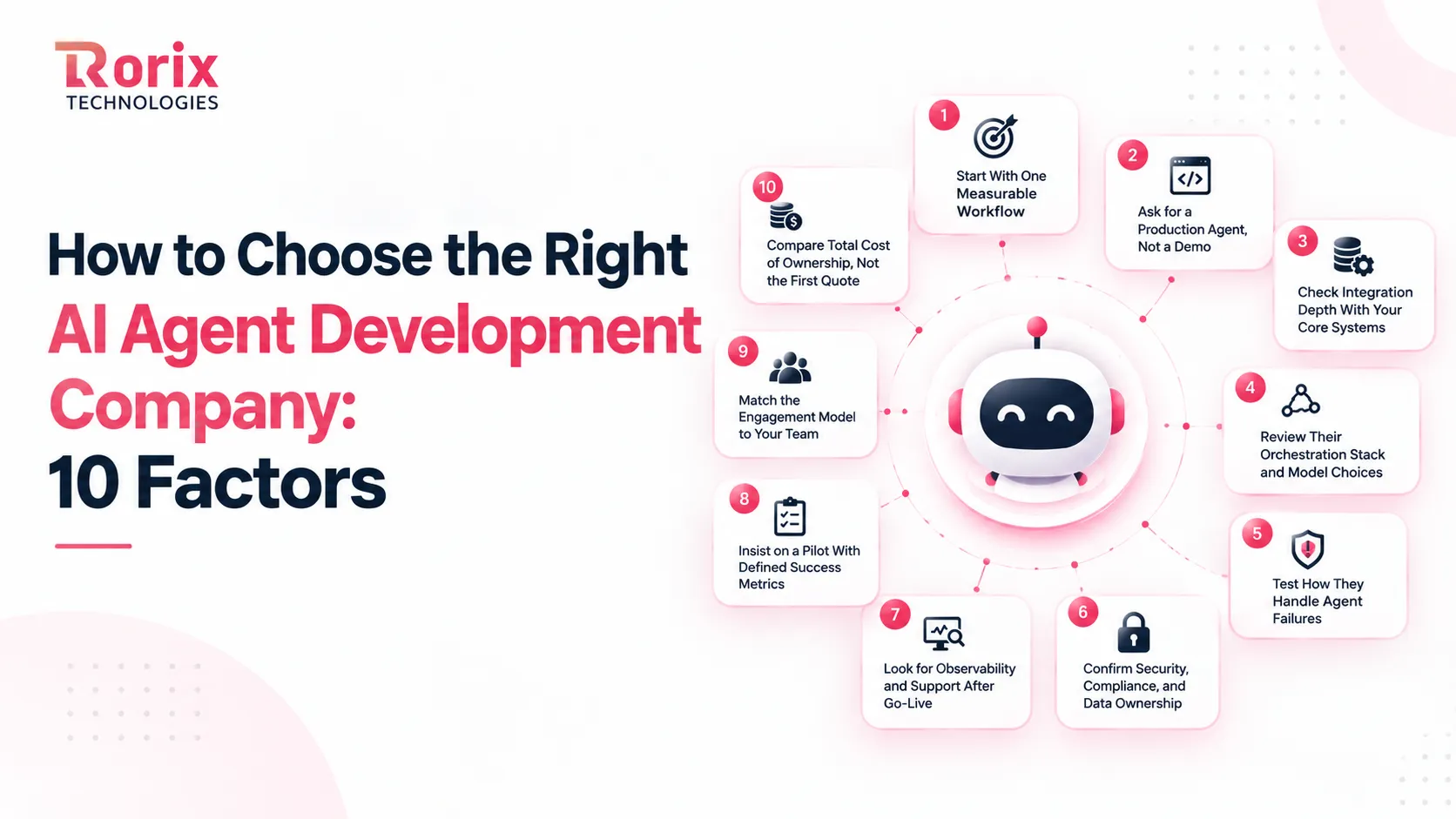
How to Choose the Right AI Agent Development Company: 10 Factors
The right partner must do more than build a working demo. Use these 10 factors to check whether a team can deliver, integrate, and maintain reliable AI agents.
1. Start With One Measurable Workflow
Choose one workflow, such as order exceptions or supplier follow-ups, before contacting vendors. Record its current cost, cycle time, and error rate so you can measure results. A clear baseline keeps the first build focused and makes vendor proposals easier to compare.
2. Ask for a Production Agent, Not a Demo
Demos often use clean data and predictable scenarios. Ask vendors to show a live agent, explain the workflow it handles, and demonstrate what happens when it fails. Real production experience shows in specific examples, not just a polished presentation.
3. Check Integration Depth With Your Core Systems
Your agent must connect with systems such as ERP, WMS, CRM, and HRMS to do useful work. Ask which platforms the vendor has integrated and how it handles legacy systems without modern APIs. Strong integration experience can reduce delays, rework, and unexpected costs.
4. Review Their Orchestration Stack and Model Choices
Ask why the team uses frameworks such as LangGraph, CrewAI, or Microsoft Agent Framework, and standards like the Model Context Protocol (MCP). Look for clear reasoning about each tool's strengths and limitations, not loyalty to one framework. The architecture should fit your workflow and avoid unnecessary dependence on a single model provider.
5. Test How They Handle Agent Failures
Agents can make incorrect decisions, encounter tool errors, or get stuck in loops. Ask how the team handles hallucinations, prompt injection, failed steps, and unexpected inputs. Strong safeguards include fallback paths, clear limits, and human approval for high-impact actions.
6. Confirm Security, Compliance, and Data Ownership
AI agents may access sensitive business data, so security must be planned from the start. Check role-based permissions, encryption, audit logs, and relevant industry requirements. Confirm in writing that you own the code, prompts, and data, with a clear exit process if you change vendors.
7. Look for Observability and Support After Go-Live
Ask how the vendor tracks answer quality, tool failures, and cost per task after deployment. Monitoring helps identify problems before they disrupt business workflows. Confirm who handles model updates, rule changes, and ongoing maintenance as your needs evolve.
8. Insist on a Pilot With Defined Success Metrics
Start with a limited pilot that has a clear scope, timeline, and measurable success criteria. Agree on the expected results before development begins, using your real workflow and data where possible. Be cautious of vendors promising production-ready results in two weeks without first understanding your systems.
9. Match the Engagement Model to Your Team
Fixed-scope projects suit clearly defined agents, while dedicated teams and retainers support ongoing development. Ask who will lead the project, how often you will review working software, and whether the same engineers will support it after launch. Choose a model that matches your internal team's capacity and long-term needs.
10. Compare Total Cost of Ownership, Not the First Quote
A low initial quote may exclude monitoring, model usage, integrations, and maintenance. Ask vendors to separate one-time development costs from ongoing operating expenses. Compare the estimated first-year cost to understand the full investment and avoid unexpected bills. Our AI agent development cost guide shows typical build and running costs by tier.
Want an outside view before you talk to vendors? Technology consulting can help you scope the workflow, choose a suitable stack, and prepare a clearer project brief.
Now that you know what to look for, let's take a look at the exact questions that turn these factors into a quick test on your first vendor call.
8 Questions to Ask Before You Hire an AI Agent Developer
Ask these eight questions on your first vendor call. Strong answers reveal real experience, while vague answers expose gaps before you commit.
| Question | Strong Answer Sounds Like | Red Flag |
|---|---|---|
| Can you show an agent running in production today? | A named workflow, real usage, and a clear failure plan | Only slides, sandbox demos, or hackathon projects |
| Which systems have you integrated agents with? | Specific ERP, CRM, or WMS platforms and integration challenges | "We integrate with anything" without examples |
| How do you handle a wrong decision by the agent? | Guardrails, human approvals, rollback, and audit logs | "Our model is very accurate" |
| What does your monitoring stack look like? | Session traces, tool error rates, and cost tracking | "We check logs if something breaks" |
| Who owns the code, prompts, and data? | Clear ownership terms written into the contract | Ownership tied to the vendor's platform license |
| Who will actually work on my project? | Named senior engineers and a technical lead | A sales contact now, with an unnamed team later |
| What happens after go-live? | Defined support, service-level agreements (SLAs), and update cycles | Support ends when the agent launches |
| Will you propose an architecture before we sign? | Questions about requirements, edge cases, and technical trade-offs | A price and timeline before reviewing your data |
Planning an agent build? Get a Free Consultation and Project Estimate from Rorix engineers who assess your workflow and integrations before quoting.
Also Read: AI Agents for Business Operations: Use Cases, Architecture and Rollout
Where AI Agents Deliver ROI in Operations-Heavy Businesses
AI agents deliver the most value in high-volume workflows with repetitive tasks, clear rules, and multiple connected systems. These five use cases show where automation can save time and reduce errors.
1. Warehouse and Inventory Operations
Agents monitor stock levels, flag inventory mismatches, and trigger replenishment before items run out. They rely on real-time inventory architecture to act on accurate data. Before automating warehouse workflows, understand WES vs WMS and follow the WMS Implementation Checklist: 50 Steps Plus a Plan Template.
2. Order Management and Fulfillment
Agents detect order exceptions, check inventory and carrier status, and suggest fixes for delays or address errors. They escalate cases involving financial or customer risks instead of acting without approval. Ecommerce teams can connect these workflows with suitable WMS software for ecommerce.
3. HR and Workforce Operations
HR agents answer policy questions using company handbooks, route onboarding tasks, and follow up on missing documents. They can also flag incomplete HRMS records and pending approvals. Human teams retain control over sensitive decisions such as hiring and pay.
4. Customer Support and Field Service
Agents can check orders, review schedules, book technicians, and send confirmations by text or email. This reduces repetitive calls and speeds up service bookings without adding dispatch staff. Home-service businesses can use them to manage requests from first contact through appointment confirmation.
5. SaaS Product Workflows
SaaS companies can add agents for onboarding, data entry, and in-app task completion. These features need clear permissions, tenant separation, and billing controls from the start. Building agents alongside SaaS development helps them scale with the product.
Also Read: How to Add AI to Existing Software: What Your System Will Let You Do
Why Rorix Technologies Fits AI Agent Development for Operations-Heavy Businesses
Choosing an AI agent development partner is easier when its experience matches your workflows, systems, and operational challenges.
Rorix Technologies builds custom software and AI agents on hosted models, and integrates AI-driven workflows with existing business systems, including warehouse management, order management, HR, and SaaS platforms. This helps businesses automate repetitive tasks while keeping critical processes connected and under control.
Its approach combines senior engineers, a named technical lead, two-week sprints, and ongoing support to keep development aligned with business needs.
Why choose us:
- 27 platforms delivered: Across custom software products.
- 80% fewer manual errors: Achieved with WorkCenter Central, the platform we built for distributor Lorecs, which also sped up order processing by 50%.
- 40+ integrations: Unified in one CRM for Driven, a US performance platform for pest control and field service teams, including HubSpot, Twilio, RingCentral, and Google APIs.
- Senior engineering: Dedicated senior engineers, a named technical lead, and two-week development sprints.
- MVP delivery: A working MVP in 6 to 12 weeks, depending on scope.
- Long-term partnerships: Our founders have been DealSignal's engineering partner for 5+ years, continuing under Rorix.
- Global delivery: Experience serving clients across the US, UK, Canada, Australia, and New Zealand.
Need AI agents that connect with your existing systems and automate real business workflows?
Book a free consultation with our experts to discuss your workflows, integrations, and project requirements.
Conclusion: Choose an AI Agent Partner Built for the Long Term
Choosing the right AI agent development company means looking beyond demos. Compare its workflow expertise, system integration capabilities, security practices, and support after launch.
Use the selection factors and vendor questions in this guide to compare partners based on your business needs, budget, and long-term goals.
We hope this guide helps you understand how to evaluate AI agent development partners and choose the right fit for your project.
Ready to automate a business workflow with AI agents? Connect with our experts to discuss your requirements, identify integration risks, and plan your first production-ready agent.
Frequently Asked Questions
What does an AI agent development company do?
It builds AI agents that automate workflows, connect business systems, follow security rules, and handle tasks with minimal human intervention.
How much does it cost to build an AI agent?
It depends on how many systems the agent connects to and how much it acts on its own. Our AI agent development cost guide breaks down build ranges, running costs, and timelines by tier.
How long does AI agent development take?
It depends on the agent's scope: a single-task agent ships far sooner than a multi-agent system, and integrations and testing usually set the pace. Our AI agent development cost guide lists typical timelines for each tier.
What is the difference between an AI agent and a chatbot?
A chatbot mainly answers questions. An AI agent can plan tasks, use tools, take action across systems, and escalate exceptions to a human.
Should I build AI agents in-house or hire a development company?
Build in-house if your team has production AI experience. Hire a partner for complex integrations, security requirements, or faster implementation.
Which frameworks do AI agent development companies use?
Common frameworks include LangChain, LangGraph, CrewAI, and Microsoft Agent Framework. The right choice depends on your workflow, integrations, and model requirements.
Can AI agents integrate with my existing ERP, WMS, or CRM?
Yes. AI agents can connect through APIs, connectors, or middleware. Ask vendors about their experience with your specific systems.
How do I identify a reliable AI agent development partner?
Ask for production examples, failure-handling methods, monitoring plans, and a clear architecture proposal. Look for specific evidence rather than general promises.
Adding AI to your system, or building a new AI feature?
Most of the work sits in the data plumbing rather than the model. Send us the workflow you want to automate and we will tell you what is feasible on your current stack.
Continue learning
Written by
Ankur AkvaliyaFounder & Director, Rorix Technologies
Ankur co-founded Rorix Technologies with a mission to deliver enterprise-grade software that growing businesses can actually afford. He drives technical project delivery and client success end-to-end, overseeing product strategy, client partnerships, and the company's long-term vision to ensure every engagement delivers measurable business outcomes across WMS, HRMS, and custom software verticals.
View full profileRelated articles
AI Agents for Business Operations: Use Cases, Architecture and Rollout
See how AI agents run business operations: use cases by team, warehouse and order workflows, architecture, guardrails, and a step-by-step rollout plan.
Read article
AI Agent Development Cost in 2026: Pricing by Complexity, Integrations, and Team
Explore AI agent development cost in 2026, including build prices, monthly expenses, integrations, maintenance, and ways to reduce your budget.
Read article
Best WMS for Ecommerce: Buyer's Guide (2026)
Choose the best WMS for ecommerce with a buyer's guide: a 10-step selection process, vendor questions, costs, timelines, and mistakes to avoid.
Read article