
How to Evaluate a Warehouse Management Software Development Company: 12 Builders Compared, Costs, and Red Flags
Evaluate a warehouse management software development company with a checklist, cost bands, red flags, and 12 builders compared, from a team that ships WMS.
On this page48 sections
A warehouse can process thousands of orders in a day and still lose money because of poor software.
Looking for a builder rather than a list? Rorix is a custom warehouse management software development company: one distributor cut manual errors by 80% on the system we built. This guide covers how to evaluate any partner, us included.
The problem is not always your team. It is often the system behind the operation. Slow inventory updates, picking mistakes, disconnected tools, and manual workarounds quietly reduce productivity, increase costs, and create unhappy customers.
Many businesses turn to off-the-shelf warehouse management systems first. They are quick to deploy, but they often struggle when your workflows, integrations, or growth plans go beyond standard requirements.
That is why many businesses hire a custom warehouse management software development company. Instead of adapting your processes to a pre-built platform, these companies build a WMS around your warehouse, workflows, and long-term goals. Rorix is one of them, and our custom WMS development work is built for operators in exactly this position.
The challenge is finding the right partner. Many companies offer WMS development services, but only a few have the technical expertise and warehouse experience to deliver a solution that performs in real-world operations.
In this guide, you'll discover:
- What a warehouse management software development company does
- How to choose the right development partner, and the questions to ask before you hire
- Typical development costs, engagement models, and red flags to avoid
- 12 warehouse management software development companies compared
By the end, you'll know how to evaluate your options and confidently choose a warehouse management software development company that fits your business.
What Is a Warehouse Management Software Development Company?
A warehouse management software development company builds custom software to help businesses manage their warehouse operations more efficiently. This includes inventory management, receiving goods, putaway, picking, packing, shipping, workforce management, and real-time inventory tracking.
Unlike ready-made WMS platforms, these companies build software based on how your warehouse actually works. They study your workflows, business processes, and integration requirements before developing a solution that fits your needs.
The biggest advantage is flexibility. A custom warehouse management system is designed around your operations, not the other way around. This helps eliminate manual work, improves accuracy, and gives you a system that can grow with your business.
Key Takeaways: How to Choose a WMS Development Company
- A warehouse management software development company builds a WMS around your warehouse, workflows, and long-term goals instead of adapting your process to a pre-built platform, and this guide compares 12 such builders.
- A basic single-site custom WMS typically runs $30,000 to $64,000 over 3 to 4 months, while a 3PL or multi-tenant SaaS platform runs $150,000 to $400,000+ over 6 to 9+ months.
- GoodFirms' cost survey finds most small and mid-sized custom builds landing between $30,000 and $100,000, and the average project reported on Clutch runs about $132,000.
- Rorix's system for one wholesale distributor cut manual order errors by 80%, on a record of 27 projects delivered and a 5.0 rating on Clutch.
- Score every candidate on warehouse-domain expertise, integration depth, and post-go-live accountability, and treat any of the 7 red flags, such as firm prices quoted before the partner understands your workflow, as a reason to slow down.
Custom WMS Development vs Off-the-Shelf Platform: When to Build
Not every warehouse needs a custom build, and honest partners will tell you that. The real question is workflow fit, not budget alone. Use the table below to see where each option earns its place.
| Factor | Custom WMS (development company) | Off-the-shelf WMS platform |
|---|---|---|
| Workflow fit | Built around your exact process | You adapt to the platform's model |
| Integrations | Designed for your ERP and systems | Limited to supported connectors |
| Scalability | Architected for your growth path | Scales within the vendor's limits |
| Upfront cost | Higher initial investment | Lower entry, recurring license fees |
| Time to launch | Longer, built from requirements | Faster to switch on |
| Ownership | You own the code and the data | The vendor owns the platform |
| Long-term support | Ongoing partner or in-house team | Tied to vendor roadmap and pricing |
6 Signs Your Operation Needs a Custom WMS
Here are six major signs your operation needs a custom WMS:
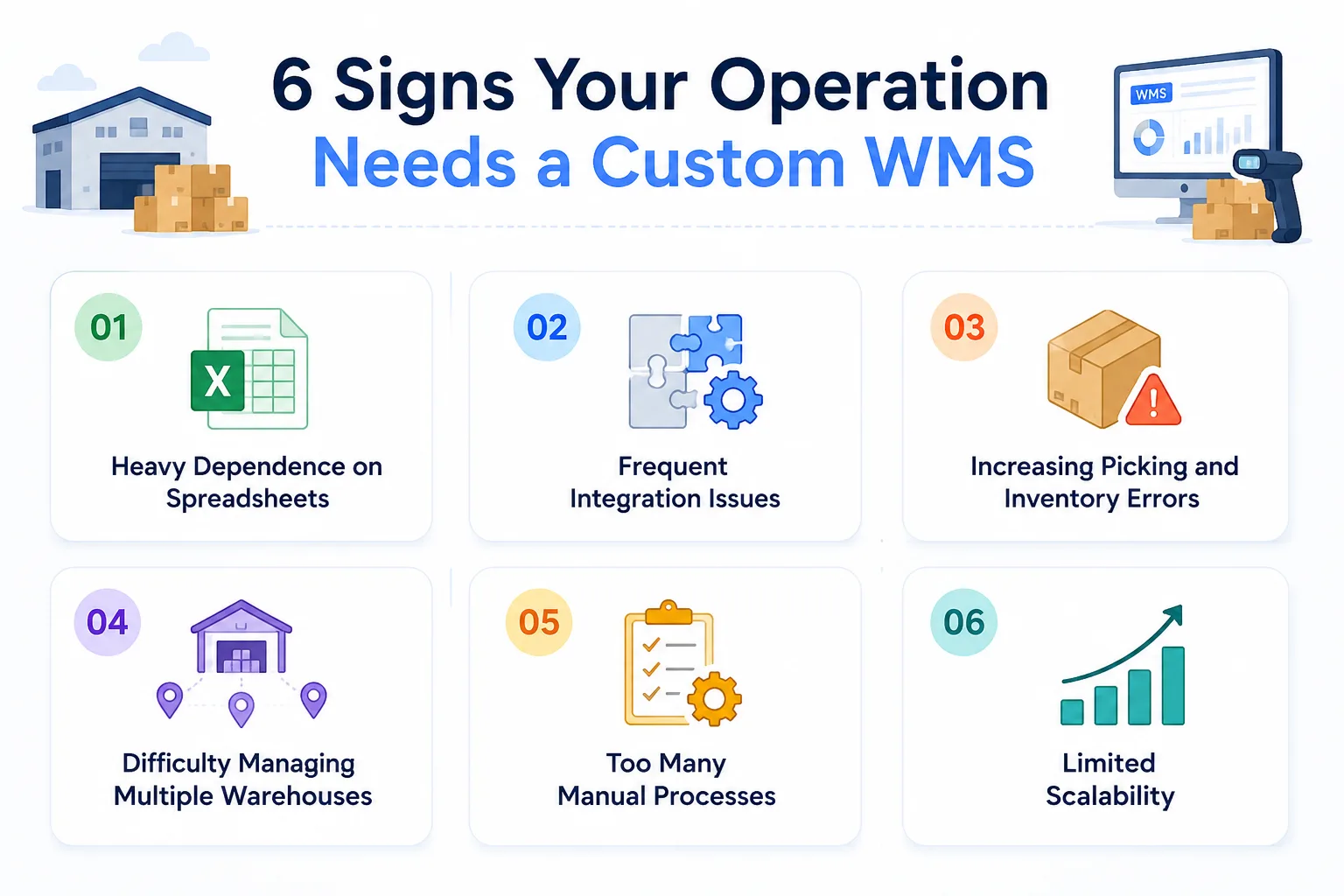
- Heavy Dependence on Spreadsheets: If your team still relies on spreadsheets to manage warehouse operations, your current system is no longer enough.
- Frequent Integration Issues: If your ERP, ecommerce platform, or shipping software does not connect smoothly, a custom WMS can simplify operations.
- Increasing Picking and Inventory Errors: Frequent picking mistakes, incorrect shipments, and inventory mismatches indicate your existing system is falling behind.
- Difficulty Managing Multiple Warehouses: Managing inventory across multiple locations becomes easier with a custom WMS built for multi-site operations.
- Too Many Manual Processes: If employees spend too much time on manual data entry and repetitive tasks, automation can significantly improve efficiency.
- Limited Scalability: If your current WMS cannot support business growth, a custom solution gives you the flexibility to scale.
Also Read: Real-Time Inventory: WebSocket and Pub-Sub Architecture
How We Shortlisted These Warehouse Management Software Development Companies
We kept the bar practical and focused on firms that actually build warehouse systems, not generalists who list it as one line among fifty services. Here is what shaped the shortlist.
- Real WMS delivery: Documented warehouse or inventory projects, rather than a service page that only mentions warehousing.
- Technical depth: Proven skill in integrations, real-time updates, barcode and RFID, and cloud architecture.
- Domain understanding: Clear grasp of picking, slotting, returns, and multi-site operations.
- Right-sized fit: Mid-size specialists that a growing operation can work with directly, rather than giants that treat smaller builds as an afterthought.
- Trust signals: Verifiable ratings, client feedback, and case evidence rather than marketing claims.
Every firm below is a genuine warehouse-software builder that a mid-market operation can realistically engage.
12 Warehouse Management Software Development Companies at a Glance
This table gives you a fast read on each pick, who it suits, and what it is known for. The detailed profiles follow below.
| Company | Best for | Specialization |
|---|---|---|
| Rorix Technologies (that is us) | Custom WMS matched to your exact workflow | Domain-specialized WMS, HRMS, and SaaS |
| Citrusbug Technolabs | Reliable full-cycle custom WMS | Custom software with a WMS practice |
| Acropolium | Multi-client 3PL platforms | Multi-tenant SaaS WMS |
| HQSoftware | Diverse-SKU warehouses | Pre-build operational discovery |
| Saritasa | Mobile and hardware-driven floors | Mobile and IoT warehouse apps |
| Wezom | Logistics and manufacturing builds | Configurable WMS logic |
| SysGears | Senior-led custom inventory builds | Tailored inventory tracking |
| Django Stars | Scalable Python and Django backends | Python and Django engineering |
| Softweb Solutions | Connecting commercial IoT devices | IoT data aggregation |
| Dreamztech | AI and RFID-driven tracking | AI-enabled WMS and RFID |
| Matellio | Automation and error reduction | Automation-led custom WMS |
| Binmile | High-velocity warehouses | Workflow control and routing |
Let's explore each company in detail.
1. Rorix Technologies
Rorix Technologies builds custom software for operations that generic tools cannot handle, and warehouse management sits at the core of that work.
The team engineers each system around your floor, your SKUs, and your integrations, rather than bending your process to fit a template. Rorix Technologies frames every build around operational outcomes first.
That focus shows up in results. For one wholesale distributor, the Rorix-built system cut manual order errors by 80% using real-time inventory tracking, barcode scanning, and automated workflows.
The retainer model keeps the team accountable well past go-live, so you get an in-house team feel instead of a vendor that vanishes after launch.
Notable strengths:
- Domain-specialized delivery: WMS, HRMS, and SaaS builds engineered for the domain, not adapted from a template.
- Proven operational impact: Up to 80% fewer picking errors, plus 40+ integrations delivered on a single platform.
- Verified track record: 27 projects delivered, a 5.0 rating on Clutch, and a dedicated team of senior engineers running 2-week sprints.
- Accountable engagement: A retainer model and full sprint visibility that clients describe as working with an in-house team.
Best for: Operations-heavy businesses that need a custom WMS matched to their exact workflow, with accountability after launch.
2. Citrusbug Technolabs

Citrusbug is a full-cycle custom software firm with a dedicated warehouse management practice and a solid review history. Its developers cover inventory, order fulfillment automation, and ERP integration, backed by strong Clutch and Google ratings. The mix of custom software depth and steady delivery makes it a dependable pick.
Notable strengths:
- Broad build capability: Custom software plus a focused warehouse management practice under one roof.
- Strong client feedback: A high Clutch rating and consistent testimonials on quality and communication.
- Flexible delivery: US and India teams that scale cost-effectively across project sizes.
Best for: Businesses that want a reliable custom WMS partner with a proven review history and flexible rates.
3. Acropolium

Acropolium stands out for multi-tenant SaaS warehouse platforms, the kind that third-party logistics providers depend on. Its documented 3PL work covers client data isolation, wave and batch picking, cross-docking, and high uptime under real load. The subscription-based engagement suits teams that want predictable costs.
Notable strengths:
- Multi-tenant architecture: Clean client isolation and billing built for 3PL operations.
- Production-grade SaaS: Real case evidence of high-uptime warehouse platforms at scale.
- Subscription model: Predictable engagement that spreads cost across delivery.
Best for: 3PL providers building or replacing a multi-client WMS platform.
4. HQSoftware

HQSoftware earns its place through discipline before code. The team runs deep operational discovery, flags redundant features early, and specializes in warehouses juggling diverse product categories and complex returns. That upfront rigor is exactly what prevents the scope creep that sinks many builds.
Notable strengths:
- Pre-build investigation: Thorough operational analysis before a single line of code.
- Scope discipline: Redundant features challenged early to protect budget and timeline.
- Diverse-SKU expertise: Strong fit for complex product mixes and returns workflows.
Best for: Distributors with mixed product types who want requirements nailed down before development starts.
5. Saritasa

Saritasa is a full-stack team that shines where the warehouse floor meets hardware. It builds scanner and tablet apps, integrates sensors, and handles data from smart shelves and connected devices with ease. If your operation runs on mobile devices, Saritasa speaks that language.
Notable strengths:
- Mobile-first apps: Scanner and tablet workflows built for warehouse staff.
- IoT integration: Comfortable with sensors, smart shelves, and device data.
- Full-stack delivery: Mobile, web, and backend handled by one team.
Best for: Warehouses that live on mobile devices and connected hardware.
6. Wezom

Wezom brings a highly configurable approach and a strong logistics and manufacturing track record. Its systems flex to fit the operation, and clients praise its project management and responsiveness. That balance of flexibility and communication keeps builds on track.
Notable strengths:
- Configurable logic: WMS systems that adapt to the process rather than the reverse.
- Sector depth: Real experience across logistics and manufacturing.
- Responsive delivery: Strong communication and dependable project handling.
Best for: Logistics and manufacturing operations that want a flexible, well-managed build.
7. SysGears
SysGears runs a smaller, senior-led team focused on tailored inventory and warehouse tracking systems. The emphasis lands on data accuracy and integration readiness, so stock counts stay trustworthy. For operations that want hands-on senior attention, this focus is a real advantage.
Notable strengths:
- Tailored tracking: Custom inventory and stock systems built around your data.
- Senior-led work: Experienced engineers close to the delivery.
- Integration-ready: Systems designed to connect cleanly with existing tools.
Best for: Operations that want a hands-on, senior-led custom inventory build.
8. Django Stars

Django Stars is a Python and Django engineering house serving startups through to enterprise across logistics and transportation. Its strength lies in scalable, data-heavy backends that hold up as volume climbs. When the engineering matters most, this depth pays off.
Notable strengths:
- Engineering depth: Strong Python and Django foundations for reliable backends.
- Scalability focus: Systems built to grow with order volume.
- Broad experience: Startups to enterprise across logistics use cases.
Best for: Teams that want deep Python and Django engineering for a scalable WMS.
9. Softweb Solutions

Softweb Solutions, backed by a major electronics distributor, connects commercial warehouse devices and sensors into cloud dashboards and WMS systems. Rather than building hardware, it makes existing devices talk to your software. That is a practical fix for warehouses whose device data never reaches the WMS.
Notable strengths:
- IoT data aggregation: Existing device data pulled into operational dashboards.
- Cloud platforms: Strong Azure and industrial IoT capability.
- Connected visibility: Equipment and sensor data made usable for operations.
Best for: Warehouses with commercial IoT devices whose data does not flow into the WMS.
10. Dreamztech

Dreamztech is an award-winning custom firm with AI-enabled warehouse work, RFID integration, and real-time analytics across logistics. It suits operations that want forecasting and smart tracking layered onto core WMS features. The analytics angle turns raw warehouse data into decisions.
Notable strengths:
- AI-enabled features: Forecasting and optimization built into the WMS.
- RFID integration: Real-time tracking across the warehouse.
- Analytics focus: Operational data turned into actionable insight.
Best for: Operations that want AI-assisted forecasting and RFID-driven tracking.
11. Matellio

Matellio builds custom warehouse software with a clear focus on automation and picking accuracy. Its systems reduce manual errors and keep operations consistent as they scale. For teams chasing fewer mistakes, that focus is the whole point.
Notable strengths:
- Automation-led builds: Manual, error-prone steps replaced with automated workflows.
- Accuracy focus: Systems designed to cut picking and stock errors.
- Custom depth: Features shaped around the specific operation.
Best for: Warehouses that prioritize automation and error reduction.
12. Binmile

Binmile builds customized warehouse systems for fast-moving environments, with an emphasis on workflow control, efficient routing, and space utilization. It fits high-velocity operations where every minute on the floor counts. That speed focus keeps throughput high under pressure.
Notable strengths:
- Workflow control: Systems that keep fast operations organized.
- Routing efficiency: Smarter movement and space utilization.
- Velocity focus: Built for high-throughput warehouse floors.
Best for: High-velocity warehouses that need tight workflow control.
Also Read: WMS Implementation Checklist: 50 Steps to Successful Deployment
How to Choose the Right Warehouse Management Software Development Company
A shortlist gets you started, but the final choice comes down to evidence. Score each candidate against the criteria below, and the right partner usually becomes obvious.
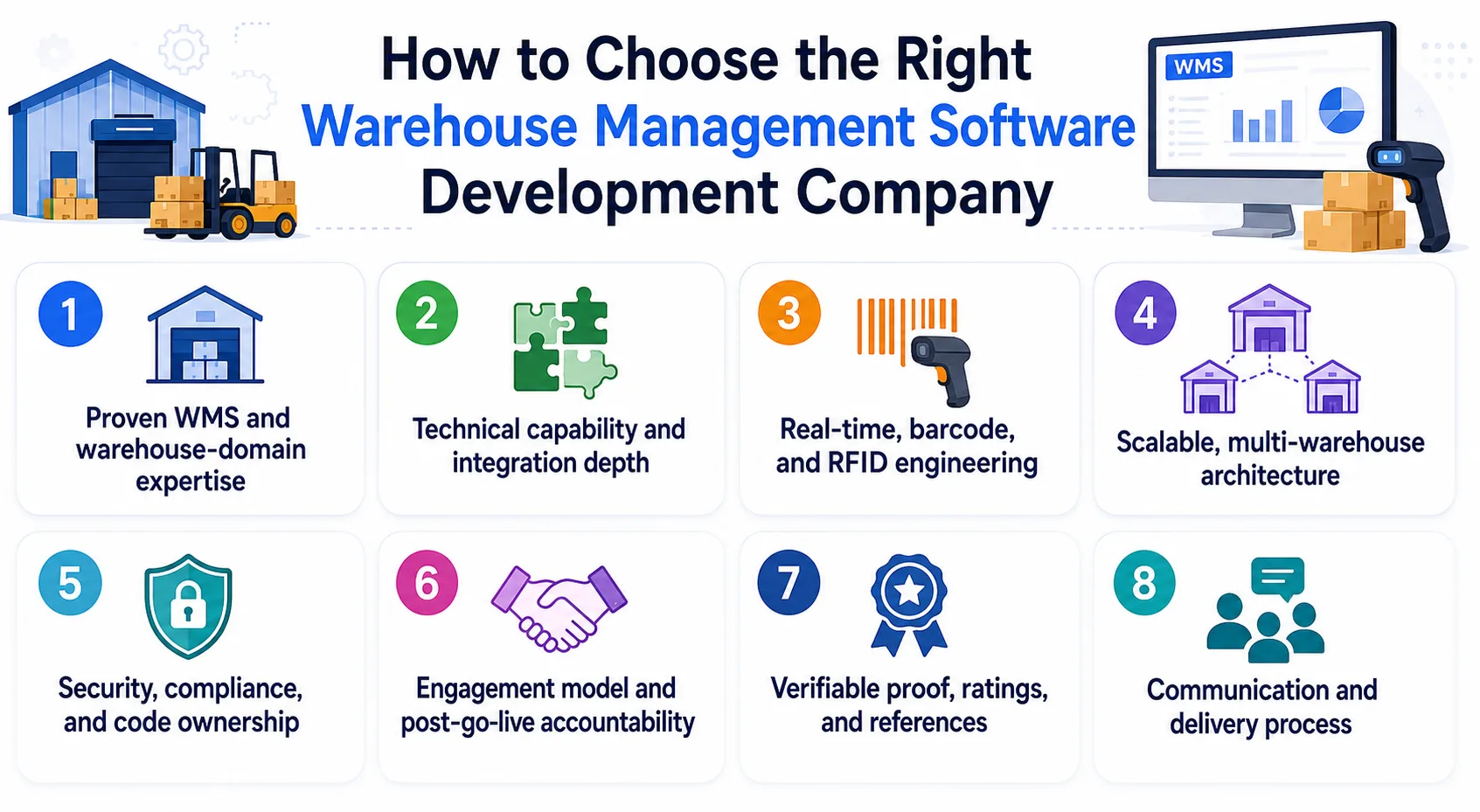
1. Proven WMS and warehouse-domain expertise
Look for a team that clearly understands warehouse reality, from FIFO and FEFO picking to slotting, returns, and cycle counts. Ask for real projects and the problems they solved. A partner who already knows your world spends less time learning and more time building the right thing.
2. Technical capability and integration depth
Your WMS has to connect with ERP, carriers, ecommerce, and scanners without breaking a workflow. Check what the team has actually shipped in production, and whether they publish real engineering thinking, like this Angular framework deep-dive. Strong integration skills are what keep data flowing cleanly across your whole operation.
3. Real-time, barcode, and RFID engineering
Warehouses run on live updates, so stale data quietly creates errors. Confirm the team can handle real-time stock sync, barcode scanning, and RFID at production scale. This is engineering depth you can verify, and it separates specialists from generalists quickly.
4. Scalable, multi-warehouse architecture
Your system should stay fast as SKUs, orders, and sites grow. Ask how the team architects for multiple warehouses and tenants without a costly rebuild later. A partner who plans for scale early saves you a painful re-platform down the road.
5. Security, compliance, and code ownership
Your warehouse data and your code both need protecting. Confirm secure coding, access control, and clear ownership so you keep full rights to the system. Settle these terms on day one, because sorting them out later is far more expensive.
6. Engagement model and post-go-live accountability
A build is not finished at launch, so accountability afterward matters. Favor partners who stay involved through support, fixes, and iteration. A retainer or in-house-team model, like the one Rorix runs, keeps someone responsible when real users hit the system.
7. Verifiable proof, ratings, and references
Polished pitches are easy, but proof is not. Check third-party ratings, client references, and documented outcomes before you commit. Verifiable delivery beats marketing language every time, and it tells you how a team performs under real pressure.
8. Communication and delivery process
Clear communication keeps a project aligned as requirements shift. Ask how the team runs sprints, shares progress, and handles risk. If you can talk directly to the engineers building your system, small issues get caught before they become rework. For stack and vendor decisions, some teams also offer technology consulting to guide the plan.
Now that you know what separates a strong partner from a risky one, let's turn to the questions that expose the difference.
Questions to Ask Before You Hire a WMS Development Company
The right questions surface capability gaps that a sales deck hides. Ask these before you commit to any of them.
- Can you show a real WMS you built and the throughput it handles?
- How do you handle a scan that does not match the expected location?
- Which carrier and ERP integrations have you shipped in production?
- What happens to operations when the WMS loses connectivity?
- Who exactly will build my system, and how senior are they?
- How do you migrate data from a legacy system or spreadsheets?
- Who owns the code, data, and intellectual property at the end?
- What does support look like after go-live?
7 Red Flags to Watch For When Choosing a WMS Partner
Some warning signs show up early if you know where to look. Treat these as reasons to slow down and dig deeper.
- Promises before understanding: Firm timelines and prices before they grasp your workflow.
- Senior sales, junior builds: Experts on the pitch, inexperienced developers on delivery.
- Vague integration answers: No concrete examples of ERP, carrier, or scanner work in production.
- Unclear ownership terms: Hesitation over who owns the code, data, and intellectual property.
- No post-launch plan: Little detail on support, fixes, or iteration after go-live.
- Thin proof: No verifiable ratings, references, or documented warehouse projects.
- Lowest-quote focus: Pricing that wins on cost by cutting planning, testing, or support.
4 Engagement Models for Warehouse Management Software Development
How you hire shapes cost, control, and speed. Most development partners offer a few models, and the right one depends on your team and scope.
1. Dedicated team
A dedicated team works only on your project under your direction, which suits long builds with evolving scope. You get continuity, deep product knowledge, and a group that feels like your own. This model fits operations that want sustained momentum over many months.
2. Staff augmentation
Staff augmentation adds skilled engineers to your existing team to fill specific gaps. It works well when you already have technical leadership and just need more hands. You keep control of the roadmap while the partner supplies proven talent fast.
3. Fixed-price project
A fixed-price model sets a defined scope, budget, and timeline upfront. It fits well when requirements are clear and unlikely to change much. You get cost certainty, though it leaves less room for mid-build shifts in direction.
4. Hybrid and retainer model
A hybrid or retainer model blends flexibility with ongoing accountability, and it shines after go-live. You get a partner on call for support, fixes, and new features without restarting from scratch. Rorix uses this approach so the team stays responsible long after launch.
Now that you have the right model in mind, let's look at what a warehouse management software development project actually costs.
How Much Does Warehouse Management Software Development Cost?
Cost depends far more on scope and complexity than on any single rate. The ranges below reflect typical market pricing and give you a planning baseline. The single-site row is also the band we publish for our own builds, so you can read one firm's real numbers next to the market average rather than only the average. Treat the rest as indicative, and confirm exact figures with a scoped estimate.
| Project type | What it covers | Indicative cost | Typical timeline |
|---|---|---|---|
| Basic custom WMS | Single site, core receiving to shipping | $30,000 to $64,000 | 3 to 4 months |
| Mid-level custom WMS | Multiple modules, integrations, mobile | $64,000 to $150,000 | 3 to 6 months |
| ERP-integrated WMS | WMS built into your ERP environment | $80,000 to $250,000 | 3 to 6 months |
| 3PL or multi-tenant SaaS | Client isolation, billing, and portals | $150,000 to $400,000+ | 6 to 9+ months |
These brackets track published market data: GoodFirms' cost survey finds most small and mid-sized custom builds landing between $30,000 and $100,000, and the average project reported on Clutch runs about $132,000. For the platform-versus-custom line items behind these numbers, see our WMS cost guide.
What Affects WMS Development Cost
Several factors influence the total cost of custom WMS development.
- Features and Modules: More features require more development time and budget.
- Third-Party Integrations: Connecting with ERP, e-commerce, CRM, or shipping platforms increases complexity.
- Hardware Integration: Barcode scanners, RFID, IoT devices, and warehouse equipment add to development costs.
- Compliance Requirements: Industry-specific regulations and security standards require additional development effort.
Get a scoped number for your own build with the project cost estimator.
Key WMS Features a Development Partner Should Build
A capable partner should handle the full range of warehouse functions, not just inventory counts. These are the modules a strong development partner builds well. Getting them live cleanly matters as much as building them, which a proper WMS implementation checklist makes obvious.
- Inventory management: Real-time stock levels, multi-location tracking, and automated updates.
- Order and fulfillment management: Centralized processing with faster, more accurate picking and packing.
- Barcode and RFID scanning: Error-free data capture and quick item identification on the floor.
- Real-time inventory tracking: Live stock sync that keeps counts trustworthy across sites.
- Space and slotting optimization: Smarter storage allocation and dynamic layout planning.
- Labor and workforce management: Task allocation, shift scheduling, and performance tracking.
- Reporting and analytics: Real-time dashboards and KPIs that surface bottlenecks early.
- Integrations and automation: Clean links to ERP, TMS, ecommerce, and automated workflows.
Also Read: WES vs WMS: Key Differences and Which One Your Warehouse Needs
Why Choose Rorix for Your Custom WMS Development
Building a custom WMS is a long-term investment. The right partner will not only build the software but also help you improve warehouse operations and support your business as it grows.
Here's why businesses choose Rorix Technologies:
- Built Around Your Business: We create a WMS that matches your warehouse processes instead of forcing you to change the way you work.
- Proven Results: Our solutions have helped businesses reduce picking errors by up to 80% with real-time inventory tracking and barcode scanning.
- Experienced Team: With 27 successful projects and a 5.0 Clutch rating, we have the experience to deliver reliable warehouse software.
- Easy Integrations: We connect your WMS with ERP systems, ecommerce platforms, barcode scanners, RFID, and other business tools.
- Support After Launch: We continue improving and supporting your system even after it goes live, so your WMS keeps growing with your business.
Ready to build a warehouse management system that fits your business? Book a free consultation, and let's discuss your project.
Choose a WMS Partner on Evidence, Not the Pitch
Choosing a build partner is one of the highest-leverage decisions in any warehouse upgrade. The right team turns a messy floor into a fast, accurate operation, while the wrong one turns a budget into a rebuild.
The shortlist above, the selection criteria, and the questions all point to the same idea. Match a partner's proven delivery to your specific operational reality, and the decision gets much simpler.
If your project also involves conveyors, sorters, or robots, our list of top warehouse automation companies adds the software-led integrators to the picture.
Score your options against real evidence, not a polished pitch. The partner who survives the hard questions on integrations, ownership, and post-launch support is the one who will still be answering your calls a year after go-live.
When you are ready, connect with our experts to scope your WMS build and map it to your exact workflow.
Frequently Asked Questions
What is a warehouse management software development company?
It is a firm that builds custom software to run and optimize your warehouse, from receiving and picking to shipping and real-time inventory. Unlike a platform vendor, it engineers the system around your specific workflow rather than a fixed template.
How is custom WMS development different from buying a WMS platform?
A platform gives you fixed software that you adapt to, while custom development builds around your process. Custom work fits non-standard workflows, integrations, and growth plans far better, though it needs a higher upfront investment than a license.
How do I choose the right warehouse management software development company?
Score each candidate on warehouse-domain expertise, integration depth, real-time engineering, scalability, security, and post-launch accountability. Then check verifiable ratings and references, and ask the hard questions before you commit rather than trusting a polished pitch.
How much does custom WMS development cost?
A basic single-site build often runs between $30,000 and $64,000, which is the band we publish for our own single-site work, while multi-tenant or 3PL platforms can exceed $400,000. The real driver is scope and integration complexity, so the figures are indicative and worth confirming with a scoped estimate.
How long does it take to build a custom WMS?
Most builds run from a few months to well over half a year, depending on features, integrations, and hardware. A tight scope and a focused partner shorten the timeline, while multi-site and compliance needs extend it.
What features should a custom WMS include?
Core features include real-time inventory tracking, barcode and RFID scanning, order and fulfillment management, slotting optimization, labor management, reporting, and clean integrations. A strong partner tailors these to your operation instead of shipping a one-size-fits-all module.
Can a custom WMS integrate with my existing ERP?
Yes, and clean ERP integration is one of the main reasons operations choose custom development. A capable partner builds the integration around your data model, so inventory, orders, and finance stay in sync across systems.
Is a custom WMS worth it for a smaller operation?
It can be, when generic tools force manual workarounds and errors keep rising. Smaller operations often start with a focused build that solves the core problem first, then scale features as the business grows.
Costing a WMS build?
Send us your SKU count and daily order volume. You get back a scope and a number you can take to your CFO.
Continue learning
Written by
Renish DadhaniyaFounder & Director, Rorix Technologies
Renish co-founded Rorix Technologies and drives the engineering and delivery culture across the organization. Beyond engineering, he leads the company's sales, finance, and HR operations, building the infrastructure that lets the team focus on shipping quality software. With deep hands-on expertise in architecture and team building, he ensures every project lands on time to the quality standards clients demand.
View full profileRelated articles
Best WMS for Ecommerce: Buyer's Guide (2026)
Choose the best WMS for ecommerce with a buyer's guide: a 10-step selection process, vendor questions, costs, timelines, and mistakes to avoid.
Read article
20 Top Warehouse Automation Companies in 2026: Software and Integration Partners Ranked
Compare 20 warehouse automation companies, their software capabilities, costs, integrations, and best-fit use cases to choose the right partner.
Read article
15 Top SaaS Development Companies in 2026
Compare 15 top SaaS development companies in 2026, including pricing, services, timelines, strengths, and tips to choose the right SaaS partner.
Read article