
20 Top Warehouse Automation Companies in 2026: Software and Integration Partners Ranked
Compare 20 warehouse automation companies, their software capabilities, costs, integrations, and best-fit use cases to choose the right partner.
On this page62 sections
A warehouse can have robots, conveyors, scanners, and automated storage running at full speed and still miss shipping targets if the software behind them cannot keep up. Inventory gets out of sync, tasks wait for the wrong system, and a fast-moving warehouse can quickly become a slow-moving operation.
That is why choosing between the top warehouse automation companies is not just a hardware decision. The right partner connects the warehouse management software, WES, WCS, scanners, conveyors, and robots so inventory, orders, and warehouse tasks move through one coordinated flow.
The challenge is knowing who actually fits your operation. Some providers build custom warehouse software, others integrate equipment from multiple vendors, and some combine their own platforms with automation hardware. Comparing them all as if they offer the same thing can make it harder to find the right partner.
In this guide, you'll learn:
- What warehouse automation companies actually do
- How WMS, WES, WCS, and robotics software work together
- 20 leading providers and what each one is best suited for
- How to evaluate a partner, avoid common red flags, and estimate costs
By the end, you'll understand which type of partner fits your warehouse, what to ask before signing a contract, and where to start your automation project.
Key Takeaways: How to Pick a Warehouse Automation Partner
- Warehouse automation is not just robots, conveyors, or AS/RS. The right software partner connects your WMS, WES, WCS, ERP, equipment, and warehouse workflows into one reliable system.
- Providers fall into three types: hardware and robotics OEMs, custom automation software builders, and software-led systems integrators.
- This guide compares 20 companies, 13 custom software builders and 7 software-led integrators, and lists separately the equipment makers their software must connect with.
- Shortlist by your bottleneck and the software layer you need, then test the partner with a pilot on your own data before a larger commitment.
- Costs range from about $15,000 for basic mobile scanning to $15M+ for advanced robotics, and a custom WMS typically costs $30,000 to $180,000+.
What Is a Warehouse Automation Company?
A warehouse automation company builds or integrates the technology that helps a warehouse move goods and data with less manual work. This can include storage, picking, packing, sortation, robotics, and the software connecting everything.
Not every provider handles the same part of automation. Most fall into three categories, and knowing the difference helps you find the right partner faster.
1. Hardware and Robotics OEMs
These companies build equipment such as AS/RS, shuttles, conveyors, sorters, and autonomous mobile robots (AMRs). Their software usually controls their own equipment, while additional integration may be needed to connect it with your WMS, WES, or other warehouse systems.
2. Custom Automation Software Builders
These providers build the software layer around your warehouse workflows. Their work can include custom WMS, execution logic, scanning applications, real-time inventory, and ERP or robot integrations. They are a fit when your operation needs software built around its processes rather than a fixed platform.
3. Software-Led Systems Integrators
These providers bring equipment, software, and implementation together. They can source automation from multiple manufacturers and connect it through their own WES or WCS. This approach can work well when you need one partner to coordinate the software, equipment, and overall warehouse automation system.
The Warehouse Automation Software Stack: WMS, WES, WCS, and Robotics Control
Every robot, conveyor, and handheld scanner takes orders from a layered software stack, and each layer answers a different question. Here is how those layers divide the work, so you know which one to have built.
| Layer | What It Decides | Time Scale | Typical Owner |
|---|---|---|---|
| ERP | What was ordered, invoiced, and paid | Days and hours | Finance and operations |
| WMS | Where stock is and what work exists | Hours and minutes | Warehouse managers |
| WES | Which resource does which task, and when | Minutes and seconds | Shift supervisors |
| WCS | How equipment physically moves the load | Seconds and milliseconds | Controls engineers |
| Robotics layer | Which robot takes which mission and path | Seconds | Automation team |
Our guides to WES vs WMS and WCS vs WMS cover where each of those layers ends and the next begins.
Also Read: How to Evaluate a Warehouse Management Software Development Company
How We Selected These Top Warehouse Automation Companies
We did not rank firms by revenue or brand recognition. We looked for partners a growing operation can engage, with proof they own automation software. Here are the seven criteria that shaped this list of top warehouse automation companies.
1. Depth in Automation Software, Not Just Equipment
Every company here writes and supports warehouse software, whether that is a custom WMS or an execution and control layer. A firm that only resells a platform did not qualify. You want the people who can change the logic when your process changes.
2. Integration Range Across ERP, WMS, and Equipment
Automation fails at the seams between systems. We favored teams with documented integration work. For the custom software builders, that means ERPs, carriers, scanners, and third-party systems. For the integrators, it extends to robot fleets and equipment controllers. The wider that range, the fewer third parties you juggle when something breaks at 2 a.m.
3. Real-Time Architecture and Exception Handling
Stale stock counts cause robot collisions and short picks. We looked for event-driven designs, like the patterns in our guide to real-time inventory architecture. Exception handling mattered just as much as the happy path.
4. Domain Experience in Warehouse Operations
Warehouse logic is highly specific. Slotting, wave versus waveless release, FEFO rotation, and cycle counting all need someone who has seen a real floor. We filtered out generalists who list warehousing as one line among fifty services.
5. Delivery Model and Post-Go-Live Accountability
Go-live is where the real work starts, because volumes spike and edge cases appear. We weighed support models, sprint visibility, and whether the team stays accountable after launch. A partner that disappears after handover leaves you debugging production alone.
6. Verified Delivery Proof
We looked for case studies, named projects, client reviews, and public product documentation rather than marketing claims. Where a company publishes proprietary software, we checked that the product is real and actively maintained. Proof beats promises every time.
7. Current Ownership and Market Presence
Automation companies merge and rebrand often. We checked each firm's name and ownership in September 2026 and noted recent changes in the profiles, such as Bastian Solutions becoming part of Toyota Automated Logistics.
Top Warehouse Automation Companies at a Glance
The table below gives you a fast read on the top warehouse automation companies in this guide.
| Company | Type | Automation Software Strength | Best For |
|---|---|---|---|
| Rorix Technologies (that is us) | Custom software builder | Custom WMS, real-time inventory, barcode workflows, integrations | Operations-heavy businesses needing software built around their warehouse |
| ScienceSoft | Custom software builder | WMS design, modernization, and integration | Enterprises needing structured software consulting |
| Softeq | Custom software builder | Embedded, firmware, IoT, and robotics software | Projects involving connected devices or robotics |
| Orases | Custom software builder | Custom WMS, inventory, and labor management | US companies seeking onshore software development |
| Saritasa | Custom software builder | IoT software and mobile scanning applications | Warehouses adding connected devices and sensors |
| Chetu | Custom software builder | Custom WMS, WCS, and EDI integrations | Suppliers and 3PLs needing connected warehouse systems |
| Adexin | Custom software builder | Logistics and warehouse software | 3PLs and distributors with complex logistics workflows |
| Intellectsoft | Custom software builder | Enterprise software and system integration | Enterprises connecting multiple business systems |
| Elinext | Custom software builder | WMS, TMS, ERP, and logistics software | Logistics businesses needing multiple connected systems |
| Fingent | Custom software builder | Warehouse and manufacturing software, SAP integration | Manufacturers using SAP-centered operations |
| Exoft | Custom software builder | Warehouse software, picking, and barcode applications | Mid-sized operations with specialized software needs |
| HQSoftware | Custom software builder | IoT and logistics software solutions | Businesses starting with connected warehouse technology |
| Mind Studios | Custom software builder | Logistics platforms and custom WMS solutions | Growth-stage logistics businesses building software products |
| Numina Group | Software-led integrator | RDS WES/WCS, robotics, voice, and material handling | Distribution centers automating pick, pack, and ship |
| Hy-Tek Intralogistics | Software-led integrator | WMS, WES, WCS, TMS, and IntraOne | Operators seeking an integrated software stack |
| Toyota Automated Logistics (formerly Bastian Solutions) | Software-led integrator | Exacta software and warehouse automation | Large distribution centers needing software and equipment |
| KPI Solutions | Software-led integrator | Order fulfillment and warehouse automation software | Mid-to-large distribution centers needing integration |
| VARGO | Software-led integrator | COFE warehouse execution and waveless fulfillment | High-volume e-commerce fulfillment |
| Conveyco | Software-led integrator | New Dawn WES and multi-vendor automation | Buyers combining equipment from multiple vendors |
| Fortna | Software-led integrator | FortnaWES, fulfillment, and parcel operations | Enterprise omnichannel and parcel networks |
Let's take a look at each one in detail.
1. Rorix Technologies (that is us)
Rorix Technologies is a custom software development company that builds warehouse management and automation software around each client's specific operations.
Instead of asking businesses to change their workflows to fit a ready-made platform, Rorix develops the software around how their warehouse actually works, from inventory tracking and barcode scanning to automated workflows and third-party integrations.
For distributor Lorecs, Rorix built WorkCenter Central, which cut manual errors by 80% and sped up order processing by 50%. The company has also delivered a platform with 40+ integrations and provides ongoing support through dedicated engineers and a named technical lead.
With 27 projects delivered and a 5.0 Clutch rating across 4 verified reviews, Rorix is a strong fit for businesses that want a custom warehouse software partner that can build, integrate, and support their system as they grow.
Key highlights:
- 27 projects: Delivered across operations-heavy business workflows.
- 80% fewer manual errors: On WorkCenter Central, the platform built for distributor Lorecs, alongside 50% faster order processing.
- 40+ integrations: Built for one client's platform, including HubSpot, Twilio, RingCentral, and Google APIs.
- Development model: Senior engineers, a named technical lead, and 2-week sprints.
- Client markets: US, UK, Canada, Australia, and New Zealand.
Best for: Operations teams, 3PLs, distributors, and ecommerce businesses that need custom warehouse software built around complex workflows.
2. ScienceSoft
ScienceSoft takes a consulting-first approach to warehouse software, with structured discovery and planning before development. Its supply chain work includes custom WMS design and automation planning for enterprise operations.
Key highlights:
- Planning before build: One published project delivered a WMS design, prototype, tech stack, and project plan in eight weeks.
- 10+ years: Supply chain software experience.
- Hardware integration: Barcode, RFID, robotic loaders, and forklifts.
Best for: Enterprises that want a structured path to warehouse software modernization.
3. Softeq
Softeq works across the full technology stack, from hardware and firmware to embedded systems and applications. That makes it useful for warehouse projects where custom devices, IoT, or robotics need to work closely with the software layer.
Key highlights:
- Chip-to-cloud: Hardware, firmware, and software under one team.
- Device prototyping: Builds custom connected devices.
- Robotics software: Supports industrial automation and robotics projects.
Best for: Warehouse projects combining custom devices, robotics, and software.
4. Orases
Orases builds custom warehouse software for businesses that want their workflows, inventory, labor, and logistics managed through connected systems. Its onshore development model also supports closer collaboration with US-based teams.
Key highlights:
- Onshore team: US-based development and collaboration.
- Custom WMS: Connects warehouse workflows and inventory operations.
- ERP integration: Modernizes warehouse systems around existing platforms.
Best for: US mid-market companies seeking a long-term custom software partner.
5. Saritasa
Saritasa focuses on the software side of IoT rather than building hardware itself. It develops mobile apps, portals, backend systems, and integrations that turn data from scanners, sensors, and connected equipment into usable warehouse workflows.
Key highlights:
- Software-only focus: Works without taking on hardware design.
- Mobile apps: Supports scanner and tablet applications.
- IoT integration: Connects sensors and equipment data to software.
Best for: Warehouses adding connected equipment, sensors, or scanners to existing operations.
6. Chetu
Chetu develops both warehouse management and control software, giving suppliers and wholesalers a single development partner across planning and equipment workflows. Its capabilities also extend into EDI, asset tracking, and mobile warehouse applications.
Key highlights:
- Custom WCS: Builds software for equipment control.
- EDI integration: Supports retail supplier workflows.
- Asset tracking: Uses QR and RFID for warehouse visibility.
Best for: Suppliers and wholesalers needing WMS, WCS, and EDI development.
7. Adexin
Adexin focuses on logistics, transportation, and supply chain software, with warehouse workflows forming part of that wider focus. Its reusable logistics components can help businesses connect warehouse operations with freight, dispatch, and customer-facing systems.
Key highlights:
- Logistics focus: Specializes in supply chain software.
- 100+ projects: Experience across logistics operations.
- Reusable components: Adexin Tools speeds up common logistics features.
Best for: 3PLs and distributors connecting warehouse automation with broader logistics operations.
8. Intellectsoft
Intellectsoft works well in complex enterprise environments where warehouse software needs to connect with existing ERP, CRM, transport, and vendor systems. Its focus is on building the custom software layer that keeps these systems connected.
Key highlights:
- Enterprise integration: Connects complex business systems.
- Custom applications: Builds software around existing IT environments.
- Enterprise delivery: Supports large stakeholder teams.
Best for: Enterprises with multiple systems that need a custom warehouse software layer.
9. Elinext
Elinext provides logistics software across warehouse, transport, inventory, ERP, and supply chain operations. Its broad development capacity makes it suitable for projects where warehouse automation needs to connect with several business systems.
Key highlights:
- 700+ professionals: Large engineering capacity, by its own published figure.
- Multi-system expertise: WMS, TMS, ERP, and CRM.
- Warehouse optimization: Supports inventory and warehouse workflows.
Best for: Logistics companies seeking one development partner across warehouse and transport systems.
10. Fingent
Fingent brings a strong manufacturing perspective to warehouse software, especially where warehouse operations depend on ERP-driven production planning. Its solutions focus on keeping inventory, orders, analytics, and enterprise systems connected.
Key highlights:
- SAP experience: Supports ERP-centered operations.
- Real-time inventory: Tracks stock and warehouse activity.
- Manufacturing focus: Built around production-linked workflows.
Best for: Manufacturers connecting warehouse operations with SAP or other ERP systems.
11. Exoft
Exoft builds focused warehouse software for operations that need better picking, packing, shipping, and inventory workflows. Its ISO 27001 certification also makes security an important part of its delivery approach.
Key highlights:
- ISO 27001: Certified information security practices.
- Mobile workflows: Barcode scanning for warehouse teams.
- 500+ projects: Experience across software development projects.
Best for: Mid-size operations needing focused warehouse software with strong security practices.
12. HQSoftware
HQSoftware offers a quick way to start a warehouse software project, advertising a small team in place within two weeks. Its IoT work sits alongside warehouse solutions that include predictive analytics and automated task assignment.
Key highlights:
- Quick start: A small team in up to two weeks, by its own published terms.
- IoT software: Connected-device solutions for warehouse operations.
- Predictive analytics: Supports data-driven warehouse decisions.
Best for: Buyers who want a fast start with a small team before a larger warehouse project.
13. Mind Studios
Mind Studios approaches warehouse software as a scalable product, starting with user needs before development. Its logistics work covers warehouse platforms, inventory visibility, process automation, and connected transportation workflows.
Key highlights:
- Product thinking: Works on the product decision, not only the build.
- Real-time visibility: Supports live inventory data.
- Logistics platforms: Covers warehouse, routing, and delivery workflows.
Best for: Growth-stage logistics companies building a scalable warehouse or logistics product.
14. Numina Group
Numina Group combines warehouse integration with its RDS software, a modular execution and control platform. It connects with existing ERP and WMS systems while coordinating warehouse equipment and fulfillment workflows.
Key highlights:
- RDS platform: Modular WES and WCS capabilities.
- End-of-line automation: Supports packing, labeling, and shipping.
- Flexible integration: Works with existing ERP and WMS systems.
Best for: Distribution centers automating pick, pack, and ship without replacing their WMS.
15. Hy-Tek Intralogistics
Hy-Tek brings WMS, WES, WCS, and TMS functions together through its IntraOne platform. Its hardware-agnostic approach lets operators connect different equipment while keeping warehouse software under one platform.
Key highlights:
- IntraOne: Combines four core warehouse systems.
- Hardware-agnostic: Supports equipment from multiple vendors.
- Robotics ready: Works with robotics, conveyors, sortation, and storage.
Best for: Multi-site operators seeking one software platform across different equipment.
16. Toyota Automated Logistics (formerly Bastian Solutions)
Toyota Automated Logistics brings together Bastian Solutions, Vanderlande's warehousing business, and viastore, which merged under one brand in April 2026. Its Exacta software works alongside conveyors, sortation, robotics, and controls to manage complex distribution operations.
Key highlights:
- Exacta software: Supports supply chain execution and control.
- In-house equipment: Software and automation from one provider.
- Third-party integration: Connects external automation technologies.
Best for: Large distribution centers wanting software, equipment, and support from one provider.
17. KPI Solutions
KPI Solutions combines systems integration with in-house warehouse software capabilities. Its approach brings material handling engineering and order fulfillment technology together for distribution center projects.
Key highlights:
- Software and integration: Combines development with automation engineering.
- Order fulfillment: Focused on distribution workflows.
- Technology agnostic: Supports different automation technologies.
Best for: Mid-to-large distribution centers needing software and automation integration together.
18. VARGO
VARGO takes a different approach to fulfillment with COFE, its continuous order fulfillment software. Instead of fixed waves, the platform uses waveless execution to coordinate people, processes, equipment, and changing order demand.
Key highlights:
- Waveless execution: Replaces fixed release waves with continuous flow.
- Real-time coordination: Connects people, processes, and equipment.
- Robotics support: Works with robotics and AS/RS systems.
Best for: High-volume ecommerce operations where continuous fulfillment matters.
19. Conveyco
Conveyco focuses on multi-vendor automation, using its New Dawn WES to coordinate equipment from different manufacturers. Its approach gives operators more freedom to combine robotics, storage, sortation, and conveyor technologies.
Key highlights:
- New Dawn WES: Coordinates multi-vendor automation.
- Vendor flexibility: Works with equipment from multiple manufacturers.
- Broad automation: Supports AMRs, AS/RS, sortation, voice, and conveyors.
Best for: Buyers wanting best-of-breed automation without being tied to one equipment manufacturer.
20. Fortna
Fortna focuses on large omnichannel and parcel operations, combining fulfillment strategy with automation and its FortnaWES platform. Its approach coordinates warehouse technology, processes, and labor across complex distribution networks.
Key highlights:
- FortnaWES: Orchestrates fulfillment operations.
- Omnichannel focus: Built around complex retail and parcel flows.
- Automation partnerships: Supports robotics, storage, conveyors, and sortation.
Best for: Enterprise retailers and parcel networks managing large distribution operations.
Now that we've covered the 20 companies, the next step is understanding the equipment and automation technologies their software needs to control.
Hardware and Robotics OEMs Your Automation Software Must Connect With
Many lists include these equipment makers among the top warehouse automation companies, but they serve a different role. They mainly provide the machines, while your WMS or WES needs to connect with their control systems.
| Equipment Maker | What They Build | What Your Software Must Handle |
|---|---|---|
| Dematic (KION Group) | AS/RS, conveyors, sortation | Zone coordination and WMS task handoffs |
| Daifuku | High-bay AS/RS, shuttles, sorters | High-volume storage and retrieval |
| Swisslog (KUKA Group) | AutoStore, shuttles, AMRs | Port orders and scheduling |
| KNAPP | Goods-to-person, shuttles, vision picking | Order consolidation and workstation feeds |
| SSI Schaefer | Shuttles, racking, totes | Replenishment and tote flow |
| AutoStore | Cube-based AS/RS and ports | Bin requests and port priorities |
| Symbotic | Robotic case handling | Case inventory and DC orchestration |
| Geekplus | Goods-to-person and sorting AMRs | Robot missions and WES task allocation |
| Locus Robotics | Collaborative picking AMRs | Pick assignment and labor balancing |
The equipment may move the goods, but the software still needs to know what to move, where it goes, and when it should happen. Fleet managers from providers such as Geekplus and Locus Robotics still need to connect with inventory data, order priorities, and warehouse exceptions.
That connection is where the software partner becomes important.
Also Read: Cloud vs On-Premise WMS: Complete Comparison Guide
How to Choose the Right Warehouse Automation Company
A long list only helps when you can turn it into a practical shortlist. Use these seven steps to match the right partner to your warehouse, software needs, and budget.
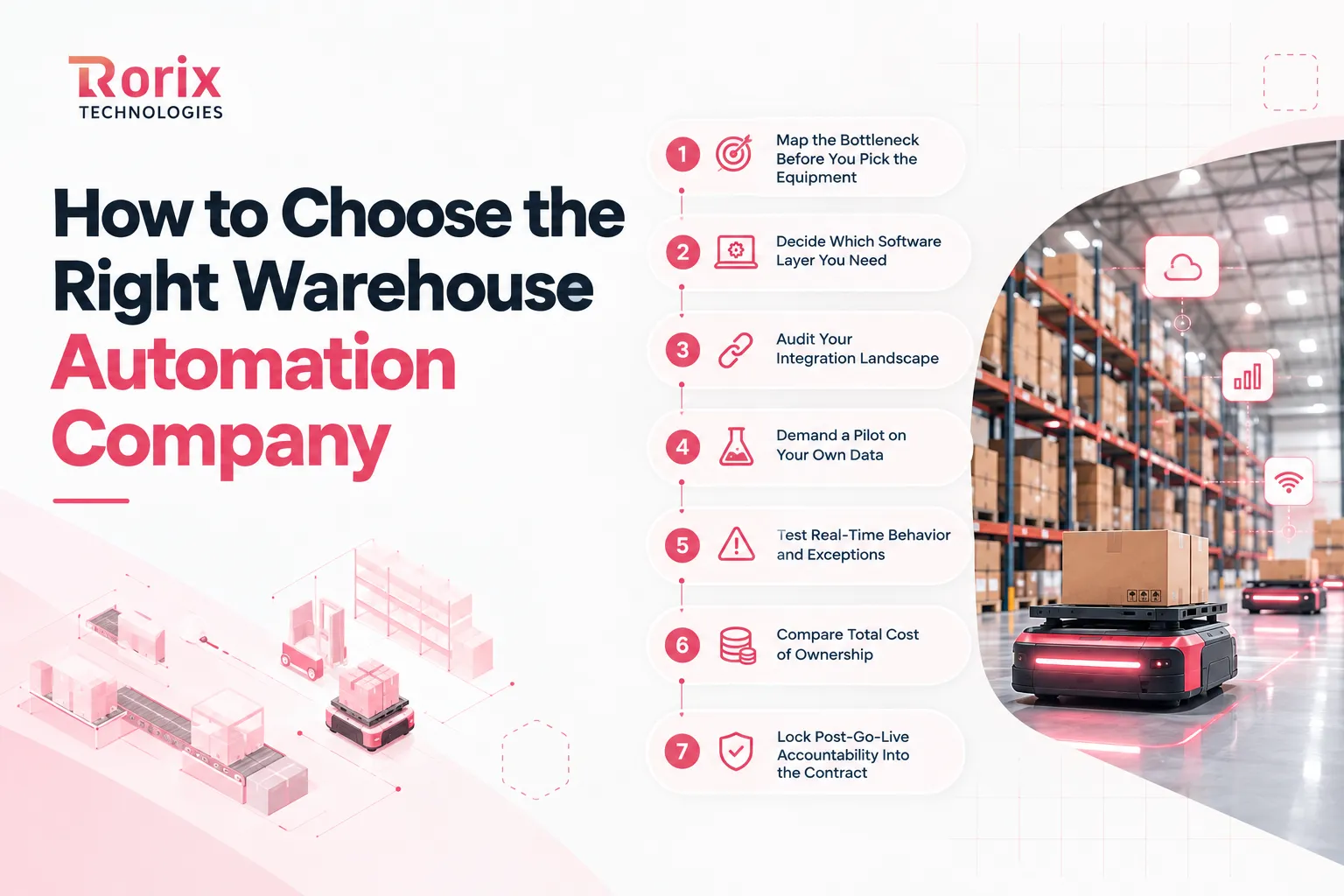
1. Map the Bottleneck Before You Pick the Equipment
Start on the floor. Track receiving time, picker travel, order queues, and other delays to find the bottleneck limiting throughput.
Use that bottleneck to judge every proposal. If a partner recommends robots before understanding the problem, the solution may be equipment-led rather than operation-led.
2. Decide Which Software Layer You Need
Review your current systems and identify where the gap sits. Poor inventory accuracy may point to a WMS issue, while delays between people and machines may require a WES.
Define the need in one sentence before contacting vendors. This helps you decide whether to evaluate custom software builders, software-led integrators, or both.
3. Audit Your Integration Landscape
List every system the automation must connect with, including your ERP, ecommerce channels, carriers, scanners, printers, robots, and conveyors. Note how each system connects today and who owns it.
This becomes your integration scope and can have a major impact on project cost. If an older system creates a blocker, address it early with a plan such as the legacy WMS migration guide.
4. Demand a Pilot on Your Own Data
A polished demo uses clean sample data. Your warehouse does not. Ask shortlisted partners to test one real process using your SKUs, locations, and order history.
A two-to-four-week pilot can reveal how the team communicates, handles unexpected issues, and works with your actual data before you commit to a larger implementation.
5. Test Real-Time Behavior and Exceptions
Ask what happens when a scanner goes offline, a robot stops, or two pickers request the same inventory at once.
Look for specific answers around queued transactions, retry logic, alerts, and recovery. These details show how the system behaves when the normal workflow breaks.
6. Compare Total Cost of Ownership
Compare the full cost, not just the initial quote. Include software or development costs, integrations, hosting, support, training, spare parts, and future changes.
A lower upfront price can come with higher subscriptions or expensive change requests. Review the full cost before comparing proposals.
7. Lock Post-Go-Live Accountability Into the Contract
Decide who remains responsible after launch and put it in writing. Define support hours, response times, assigned engineers, and source-code ownership.
Peak season will test the system most. The team supporting your warehouse should already understand the software, integrations, and workflows behind it.
Now that you've seen how to choose a partner, let's take a look at the red flags and questions that expose a weak one.
Red Flags and Questions to Ask Before You Sign
Even among the top warehouse automation companies, the right fit depends on your operation, software, and support needs. These checks can help you spot problems before signing a contract.
Red Flags That Signal the Wrong Partner
- Equipment before diagnosis: Recommends robots before understanding your bottlenecks.
- Senior sellers, junior builders: Sales leaders appear in meetings, but the delivery team is unclear.
- Vague integration plans: Lists your ERP and carriers without explaining the connections.
- No exception strategy: Cannot explain how offline devices or data conflicts are handled.
- Closed data model: Makes data access or exports difficult or expensive.
- Fixed dates before discovery: Promises a timeline before understanding your operation.
- Thin post-launch support: Offers little support after go-live.
Questions to Ask Every Shortlisted Company
- Which similar warehouse automation projects have you delivered, and can you provide client references?
- Who will work on our project, and what experience do they have?
- Which software layers do you build, and which do you license?
- How will the system connect to our ERP, carriers, and existing equipment?
- What happens when the network drops or a device goes offline mid-task?
- Can you run a paid pilot using our own data?
- Who owns the source code, data, and configuration after delivery?
- How are post-launch change requests priced?
- What support hours and response times are guaranteed during peak periods?
- Which KPIs will you use to measure the project's success?
Warehouse Automation Cost: Ranges to Budget For
Warehouse automation cost depends mainly on the level of automation, site size, and project scope. The ranges below are planning estimates taken from our warehouse automation cost guide, not quotes.
Cost by Automation Level
| Automation Level | Typical Scope | Planning Range |
|---|---|---|
| Mobile scanning and workflows | Barcode/RFID, handhelds, labels, mobile apps | $15,000 to $120,000 |
| Custom WMS | Workflows, integrations, dashboards, real-time inventory | $30,000 to $180,000+ |
| Mobile robots | AMR fleet, fleet software, site mapping | $75,000 to $250,000 for a starting deployment |
| AS/RS and goods-to-person | Shuttles, storage, workstations, controls | $1M to $10M+ |
| Advanced robotics across a distribution center | Storage, sortation, robotics, controls, software | $1M to $15M+ |
For a deeper breakdown of equipment, software, and long-term TCO, read our full guide to warehouse automation cost.
What Drives Software and Integration Cost
- Integrations: More ERP, carrier, marketplace, and equipment connections mean more development and testing.
- Workflow complexity: Kitting, lot control, FEFO, and value-added services add more rules.
- Real-time requirements: Live inventory needs event-driven architecture and careful testing.
- Number of sites: Multi-site operations need shared data models and site-specific setup.
- Devices: Scanners, printers, scales, and robots may require separate drivers, apps, or APIs.
- Data quality: Poor item and location data must be cleaned before automation.
- Support: Retainers, SLAs, and peak-season coverage add recurring costs.
Hidden and Recurring Costs
- Facility upgrades: Flooring, power, wireless coverage, and safety zones.
- Parallel running: Running old and new systems together during migration.
- Training: Time for operators and supervisors to learn new workflows.
- Maintenance: Service contracts and spare parts for automation equipment.
- Software changes: New channels, clients, and equipment can create future development costs.
Also Read: How Much Does a Warehouse Management System Cost?
Why Rorix Technologies Fits Complex Warehouse Automation Projects
Choosing a warehouse software partner is easier when the proof matches the problem you need to solve.
Rorix Technologies builds custom software for operations-heavy businesses, including warehouse workflows where inventory, barcode scanning, automation, and integrations need to work together.
Its approach combines senior engineers, a named technical lead, 2-week sprints, and ongoing support, rather than stopping after the initial build.
- 27 projects: Delivered across operations-heavy software products.
- 80% fewer manual errors: Achieved on WorkCenter Central, the platform built for distributor Lorecs, which also sped up order processing by 50%.
- 40+ integrations: Delivered for one client's platform, including HubSpot, Twilio, RingCentral, and Google APIs.
- Senior engineering: Named technical lead with 2-week development sprints.
- Ongoing support: Retainer-based engagement after launch.
- Global delivery: Experience with clients across the US, UK, Canada, Australia, and New Zealand.
Need a custom warehouse software layer that fits your existing workflows?
Get a project cost estimate and discuss your requirements with the Rorix team.
Build Around the Software, Not Just the Machines
Choosing a warehouse automation partner starts with the software layer your operation actually needs. Compare their warehouse experience, integration capabilities, delivery model, and support after launch.
Use the cost ranges, selection steps, and questions in this guide to compare proposals based on your workflows and long-term needs, not just the equipment being offered.
We hope this guide helps you understand the different types of warehouse automation partners and what to look for before starting your project.
Ready to plan your warehouse automation software? Connect with our experts to discuss your requirements and get a project estimate.
Frequently Asked Questions
Who are the top warehouse automation companies?
They include custom software builders such as Rorix Technologies, ScienceSoft, and Softeq, along with integrators such as Numina Group, Hy-Tek, and Toyota Automated Logistics.
What is the difference between an automation provider and an integrator?
Providers typically make their own equipment, while integrators combine equipment from different vendors and connect it through software such as WES or WCS.
Do I need a WMS, WES, or WCS?
A WMS manages inventory and orders. A WES coordinates people and automation, while a WCS controls equipment such as conveyors and sorters.
How much does warehouse automation cost?
Costs range from about $15,000 for basic mobile scanning to $15M+ for advanced robotics. A custom WMS typically costs $30,000 to $180,000+.
Can custom software connect robots from different vendors?
Yes. A custom orchestration layer can connect multiple robot fleets through APIs or standards such as VDA 5050.
How long does warehouse automation take?
A software pilot can take a few weeks. Full software projects often take several months, while large automation deployments can take 12 months or longer.
Is warehouse automation worth it for a mid-sized warehouse?
It can be, especially when automation targets a clear bottleneck. Many operations can start with a better WMS and mobile workflows before adding robotics.
Should I hire a software builder or hardware integrator first?
Choose a software builder when workflows or data are the main problem. If your software is ready and physical throughput is the constraint, an integrator may be the better starting point.
Costing a WMS build?
Send us your SKU count and daily order volume. You get back a scope and a number you can take to your CFO.
Continue learning
Written by
Renish DadhaniyaFounder & Director, Rorix Technologies
Renish co-founded Rorix Technologies and drives the engineering and delivery culture across the organization. Beyond engineering, he leads the company's sales, finance, and HR operations, building the infrastructure that lets the team focus on shipping quality software. With deep hands-on expertise in architecture and team building, he ensures every project lands on time to the quality standards clients demand.
View full profileRelated articles
How to Evaluate a Warehouse Management Software Development Company: 12 Builders Compared, Costs, and Red Flags
Evaluate a warehouse management software development company with a checklist, cost bands, red flags, and 12 builders compared, from a team that ships WMS.
Read article
WCS vs WMS: Which One Is Right For You In 2026
WCS vs WMS explained: what a warehouse control system actually does, the five differences that change your floor, real cost ranges, and which layer you need.
Read article
15 Top SaaS Development Companies in 2026
Compare 15 top SaaS development companies in 2026, including pricing, services, timelines, strengths, and tips to choose the right SaaS partner.
Read article