15 Top SaaS Development Companies in 2026
Compare 15 top SaaS development companies in 2026, including pricing, services, timelines, strengths, and tips to choose the right SaaS partner.
On this page47 sections
Building a SaaS product takes more than good code. You need the right architecture, secure data handling, reliable integrations, smooth billing, and a team that can support the product as it grows.
That is why choosing among the top SaaS development companies takes more than checking portfolios and hourly rates. You need a team that understands SaaS architecture, security, subscriptions, integrations, and continuous product releases from the start.
Key Takeaways: How to Use This Shortlist
Choosing the right SaaS development company depends on your product stage, technical needs, budget, and long-term goals. This guide compares 15 top SaaS development companies, their strengths, pricing, timelines, and delivery models, while covering SaaS development cost, architecture, integrations, and post-launch support to help you shortlist the right partner for your SaaS product.
The challenge is that almost every agency now claims SaaS expertise. Portfolios look similar, pricing varies widely, and the real differences often become visible only after development is already underway.
So we compared 15 top SaaS development companies using practical criteria instead of marketing claims. The result is a shortlist you can match to your product stage and goals.
In this guide, you will learn:
- What a SaaS development company actually does
- Detailed reviews of all 15 top SaaS development companies
- 10 checks for choosing the right SaaS partner
- SaaS development cost, pricing models, and market rates
By the end, you will know which companies fit your product stage and what to look for in a SaaS development partner. You will also know what to budget.
What Does a SaaS Development Company Do?
Before comparing the top SaaS development companies, check whether they can handle the full SaaS lifecycle, not just write code. The core SaaS product development services include:
- Product discovery: Define users, validate key assumptions, and set the right MVP scope before development.
- UX and UI design: Build simple onboarding, dashboards, and billing flows that customers can use easily.
- Multi-tenant SaaS architecture: Set up secure tenant isolation, data access, and user roles as your customer base grows.
- Subscription billing: Handle plans, trials, seat- or usage-based pricing, upgrades, proration, and invoicing.
- APIs and integrations: Connect CRMs, payment gateways, email, SMS, and other essential business tools.
- Cloud infrastructure and DevOps: Manage automated deployments, staging, monitoring, and scalable infrastructure across AWS, Azure, or Google Cloud.
- Security and compliance: Protect data with encryption, access controls, and audit trails while meeting requirements such as GDPR, HIPAA, or SOC 2 where needed.
- Maintenance and iteration: Fix bugs, improve performance, manage upgrades, and add features based on customer usage.
A capable SaaS development partner should support the product beyond launch, from SaaS MVP development to ongoing improvements and scaling.
Also Read: Staff Augmentation vs Dedicated Team: Which Model Fits Your Roadmap?
How We Selected the Companies on This List
We compared top SaaS development companies using real evidence, not marketing claims. Portfolios, verified reviews, published rates, case studies, and delivery experience shaped the shortlist.
Every company had to meet these seven criteria:
- SaaS-specific proof: Production SaaS and multi-tenant platforms.
- Review quality: Verified reviews and recurring client feedback.
- Delivery process: Clear sprints, demos, and engineer access.
- Integration depth: Billing, CRM, payments, and third-party APIs.
- Security and compliance: GDPR, HIPAA, or SOC 2 practices where relevant.
- Post-launch support: Maintenance, response times, and ongoing support.
- Comparable scale: Teams able to staff a full SaaS build, from architecture through QA.
Rorix Technologies publishes this list and ranks itself first. We applied the same criteria to our own work, and no company paid for placement. Team sizes and rates come from company websites and Clutch listings, so confirm current details before signing.
This gives you a focused shortlist of top SaaS development companies worth evaluating.
Top 15 SaaS Development Companies at a Glance
If you only have a minute, start with this table. It shows who each company suits best, where it delivers from, and what it typically charges per hour.
| Company | Best For | Headquarters | Team Size | Listed Hourly Rate |
|---|---|---|---|---|
| Rorix Technologies (that is us) | Operations-heavy SaaS in logistics, HR, and home services | Ahmedabad, India | Dedicated senior team with a named technical lead | Scoped per engagement |
| DevSquad | Founders who want a complete SaaS product squad | Salt Lake City area, Utah, US | 10 to 49 | $50 to $99 |
| Railsware | Quality-first B2B SaaS on Ruby on Rails | Poland and US offices | 50 to 249 | $100 to $149 |
| Brocoders | Non-technical founders who need product ownership | Tallinn, Estonia | 50 to 249 | $50 to $99 |
| Netguru | Design-led, investor-ready MVPs | Poznań, Poland | Around 500 | $50 to $99 |
| Intellectsoft | SaaS for regulated industries | Miami, Florida, US | 50 to 249 | $50 to $99 |
| DICEUS | Insurance and financial services SaaS | US and European offices | 50 to 249 | $25 to $49 |
| Classic Informatics | Full-cycle SaaS with in-house UX and QA | Gurugram, India | 50 to 200 | $25 to $49 |
| Orases | Premium US-based builds for complex integrations | Frederick, Maryland, US | 50 to 249 | $150 to $199 |
| Taazaa | Healthtech and logistics SaaS | Hudson, Ohio, US, and Noida, India | Around 300 | $50 to $99 |
| Geniusee | Fintech and edtech SaaS | Middletown, Delaware, US | 200+ | $25 to $49 |
| Codica | Marketplaces and multi-vendor platforms | Tallinn, Estonia | 50 to 249 | $25 to $49 |
| BitCot | Fast, mobile-first MVPs | San Diego, California, US | 50 to 249 | $25 to $49 |
| Neoteric | AI-powered SaaS products | Gdańsk, Poland | 50 to 249 | $50 to $99 |
| Dreamix (a Synechron company) | Modernizing legacy enterprise platforms | Sofia, Bulgaria | 300+ | $25 to $49 |
The 15 SaaS Development Companies in Detail
Let's take a look at each one in detail.
1. Rorix Technologies (that is us)
Rorix Technologies builds SaaS for operations-heavy businesses across logistics, HR, order management, and home services, where complex workflows need more than an off-the-shelf platform.
Projects start with a scoped roadmap, technical recommendations, Figma wireframes, and an architecture plan before development begins. Clients then work with senior engineers, a named technical lead, and 2-week sprints with clear visibility into progress.
The proof comes from real products. One white-label SaaS platform carries 40+ vendor integrations, including HubSpot, Twilio, RingCentral, and Google APIs, and its iOS and Android apps run from one React Native codebase.
Key Highlights:
- 12 weeks: SaaS MVP target from build to first paying customer, with a working MVP in 6 to 10 weeks
- 80% fewer manual errors: Warehouse management build with real-time inventory, barcode scanning, and automated workflows
- Multi-tenant foundation: Tenancy, data isolation, API contracts, and integrations planned before development
- Built-in billing: Supports seat pricing, usage metering, trials, upgrades, and proration
- Code ownership: Clients keep the code without vendor lock-in
Best for: Founders and operations teams that need custom SaaS built around complex business workflows.
2. DevSquad
DevSquad helps founders take SaaS ideas from concept to a paying product through small, dedicated product squads. Its model brings product management, UX, development, and QA together, with US-friendly time-zone coverage and structured handover when teams later move development in-house.
Key Highlights:
- 100+ SaaS launches: Experience built around bringing SaaS products to market.
- 2-6 person squads: Small teams designed for focused product development.
- Structured handover: Supports knowledge transfer when development moves in-house.
Best for: Founders who want a complete SaaS product team from idea to launch.
3. Railsware
Railsware combines product engineering with experience running its own SaaS products, including Mailtrap and Coupler.io. Its work with Calendly also reflects an early-stage approach where product assumptions are challenged before development begins.
Key Highlights:
- SaaS operator experience: Its own products inform how the team approaches client platforms.
- Calendly experience: Supported the scheduling platform from early ideation.
- Engineering continuity: Long-term engineers contribute to maintainable, well-documented code.
Best for: B2B SaaS teams that prioritize strong engineering and maintainable products.
4. Brocoders
Brocoders works closely with non-technical founders, combining product ownership with development so priorities and decisions do not depend entirely on a detailed technical brief. Its workflow also uses AI-assisted engineering and reusable components to speed up common development tasks.
Key Highlights:
- Product ownership: Helps shape priorities instead of simply following specifications.
- AI-assisted workflow: Uses coding assistants and custom LLM tools in development.
- Fast delivery: A telehealth platform was delivered in 6 weeks.
Best for: Non-technical founders who need product guidance alongside development.
5. Netguru
Netguru takes a design-led approach to SaaS product development, with experience across startups and established brands. Its work includes modernizing legacy platforms while keeping the product accessible and focused on user adoption.
Key Highlights:
- 4.8 Clutch rating: Across 73 verified reviews.
- Legacy modernization: Rebuilt Cayen's legacy ASP.NET platform on Node.js and Vue.
- Design-led delivery: Strong focus on UX, product quality, and user experience.
Best for: Funded startups and scale-ups where product design and adoption matter.
6. Intellectsoft
Intellectsoft builds SaaS for regulated industries where security and compliance are part of the product from day one. Its work also covers modernization, such as moving Deltager's legacy .NET registration platform to Angular while improving payments and participant feedback.
Key Highlights:
- Compliance focus: ISO 27001-certified, with GDPR practices.
- Modernization: Upgrades legacy systems without replacing the entire product.
- Enterprise experience: Published clients include EY.
Best for: Funded SaaS companies in healthcare, fintech, and other regulated sectors.
7. DICEUS
DICEUS combines SaaS development with deep insurance and financial-services expertise, including ready-made products for insurance management. Its consulting-led process uses discovery and proof-of-concept work to test technical and market risks before larger development begins.
Key Highlights:
- Insurance products: Ready-made solutions for insurance and policy management.
- Proof of concept: Validates ideas before major development investment.
- Broad technology range: Java, Python, .NET, Angular, and Vue.js.
Best for: Insurers, brokers, and fintech teams building policy or customer platforms.
8. Classic Informatics
Classic Informatics keeps architecture, UX, development, QA, and DevOps under one roof, giving clients a single team throughout the product lifecycle. Its SaaS work spans logistics, healthcare, and fintech, with projects delivered across 30+ countries.
Key Highlights:
- Full-cycle delivery: One team handles development through post-launch support.
- Multi-tenant expertise: SaaS architecture designed for growing customer bases.
- Long-term relationships: Reviews highlight continued work with the same teams.
Best for: Companies looking for one offshore team to manage the complete SaaS build.
9. Orases
Orases builds complex US-based SaaS platforms that connect with systems such as ERP, CRM, and EMR platforms. Its two-week sprint model and long-term support make it suited to products where integrations and ongoing maintenance matter as much as the initial build.
Key Highlights:
- 5.0 Clutch rating: Across 74 verified reviews.
- Integration-heavy builds: Connects SaaS platforms with critical business systems.
- AI capabilities: Adds AI consulting and machine learning features to client products.
Best for: US organizations needing onshore engineering for complex platforms.
10. Taazaa
Taazaa combines US-based leadership with an engineering center in India, giving clients a local point of contact with distributed delivery. Its experience covers healthtech, logistics, proptech, and edtech, alongside AI implementation and legacy modernization.
Key Highlights:
- PulseBox MVP: Delivered UX, architecture, QA, MMS processing, and weather integrations.
- Industry depth: Strong experience across healthcare and logistics.
- Modernization: Combines legacy upgrades with AI implementation.
Best for: US healthcare, logistics, and property businesses building or modernizing SaaS.
11. Geniusee
Geniusee focuses on fintech and edtech, with cloud expertise supported by its AWS consulting partner status and delivery centers in Ukraine and Poland. Its strong review record and responsiveness make it suited to products where reliable updates and support matter.
Key Highlights:
- 5.0 Clutch rating: Around 70 reviews provide substantial client feedback.
- Cloud expertise: AWS consulting partner experience.
- Vertical focus: Deep experience across fintech and edtech.
Best for: Growth-stage fintech and edtech SaaS products.
12. Codica
Codica specializes in marketplaces and multi-vendor platforms, where vendor onboarding, commissions, split payments, and two-sided workflows require careful product design. Its focused teams have delivered marketplace products that later attracted larger-company acquisition interest.
Key Highlights:
- Marketplace expertise: Built around complex two-sided platforms.
- 4.7 Clutch rating: Strong client feedback across 17 reviews.
- Focused delivery: Small teams suited to product-led builds.
Best for: Founders launching marketplaces or multi-vendor SaaS platforms.
13. BitCot
BitCot combines US-based delivery with strong mobile development experience, making it a practical option for products launching across web and mobile. Its work increasingly includes AI and automation alongside payment and financial integrations.
Key Highlights:
- 3,000+ projects: Broad delivery experience across web and mobile, by its own count.
- Mobile-first delivery: Web and mobile launches from one team.
- Payments expertise: Experience connecting platforms with Stripe and Plaid.
Best for: Startups launching SaaS products across web and mobile.
14. Neoteric
Neoteric puts AI at the center of SaaS development, combining generative AI and predictive models with standard product engineering.
Key Highlights:
- 300+ projects: Experience across five continents.
- AI-first development: Builds copilots, predictive models, and NLP features.
- 4.9 Clutch rating: Across 71 verified reviews.
Best for: SaaS teams adding practical AI capabilities to an existing or new product.
15. Dreamix (a Synechron company)
Dreamix focuses on modernizing complex legacy systems without disrupting the platforms businesses already depend on. Synechron acquired Dreamix in March 2024, so it now delivers as part of a larger global technology firm. Its work spans cloud migration, microservices, and DevOps across industries where reliability and continuity are critical.
Key Highlights:
- Legacy modernization: Moves aging systems toward modern cloud architectures.
- Cloud expertise: Works across AWS, Azure, and Google Cloud.
- Industry depth: Experience across aviation, healthcare, transportation, fintech, and regtech.
Best for: Companies modernizing legacy platforms into scalable SaaS products.
Also Read: Top 15 Small Software Development Companies for Startups
Now that you have seen what the top SaaS development companies offer, let's take a look at how to pick the right one.
How to Choose the Right SaaS Development Company
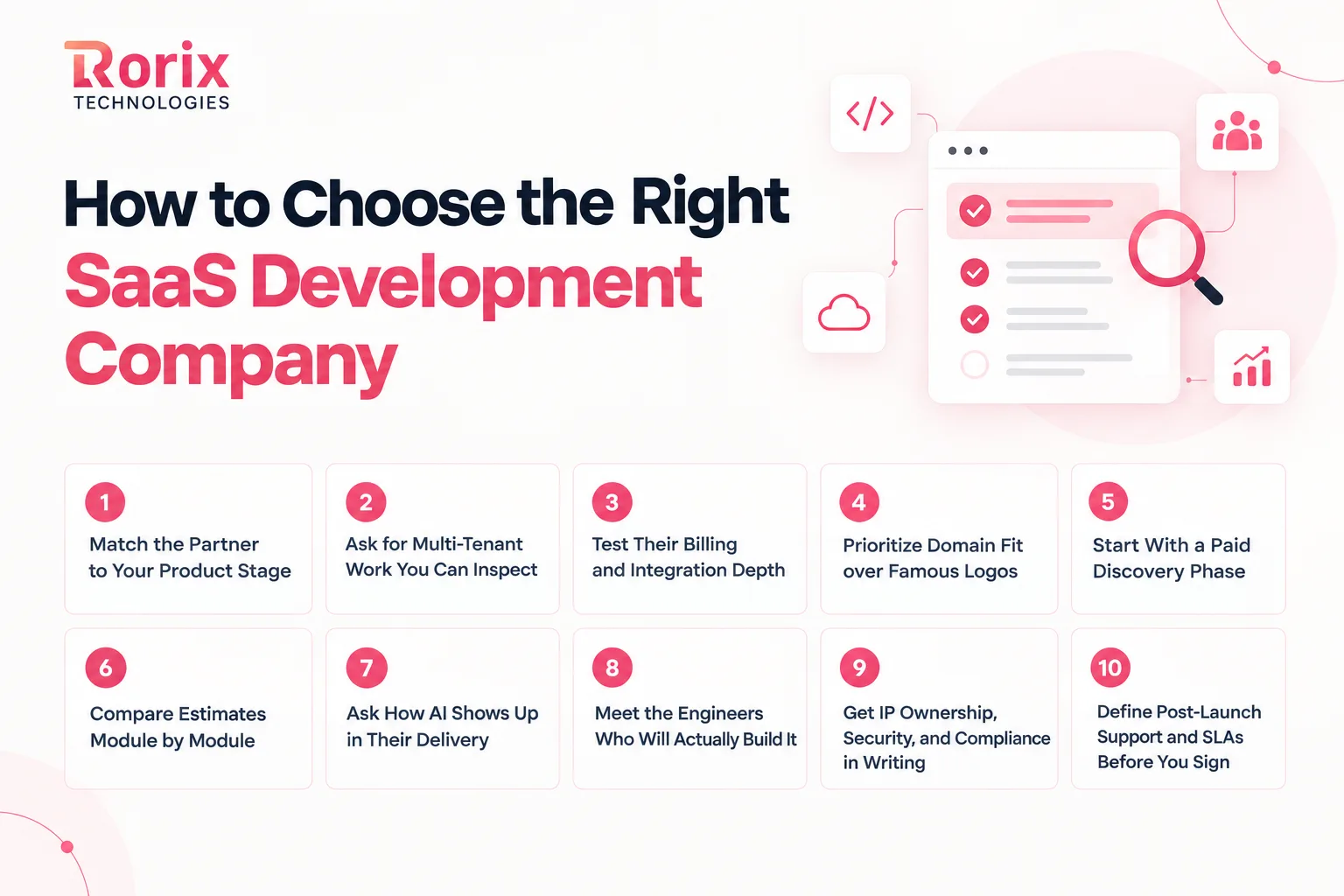
The shortlist gives you the names. These checks help you decide who can actually deliver. Even among the top SaaS development companies, the right fit depends on your product stage, technical needs, and long-term goals.
Use these checks to pressure-test any SaaS development partner before signing a contract.
For a deeper look at agency types and evaluation criteria, see our SaaS development agency comparison guide.
1. Match the Partner to Your Product Stage
Choose a team for where your product is now, not where you want it to be years from now. MVPs need speed and product guidance, while growing SaaS products need stronger architecture, billing, integrations, and scale.
| Product Stage | What You Need Most | Companies to Shortlist |
|---|---|---|
| Idea to MVP | Fast validation, lean scope, and product guidance | Rorix Technologies, Brocoders, DevSquad, BitCot |
| Growth and scale | Hardened multi-tenancy, billing, and integrations | Rorix Technologies, Railsware, Netguru, Geniusee |
| Mature or regulated | Compliance, uptime, and modernization | Intellectsoft, Orases, DICEUS, Dreamix |
2. Ask for Multi-Tenant Work You Can Inspect
Plenty of teams have built software, but far fewer have run a multi-tenant SaaS architecture for hundreds of isolated customers. Ask for a live example, how they isolate tenant data, and what broke first when that product scaled. Vague answers here usually predict an expensive rewrite later.
3. Test Their Billing and Integration Depth
Stripe is only the starting point. Ask how they handle seat pricing, usage metering, trials, proration, failed payments, and third-party APIs. Our API integration strategy guide explains why these choices matter early.
4. Prioritize Domain Fit Over Famous Logos
A famous logo proves a company won a deal, not that it understands your workflow. A partner that has built for your industry spots edge cases, compliance traps, and integration needs before you mention them. Ask for two case studies from your vertical, then call those clients yourself.
5. Start With a Paid Discovery Phase
A 2 to 4 week discovery sprint can uncover technical risks before they become expensive changes. Look for an architecture outline, user stories, risk areas, and a phased roadmap. See our custom software development process for a deeper breakdown.
6. Compare Estimates Module by Module
Two quotes can show the same total while covering very different scopes. Ask for separate estimates for authentication, admin, billing, integrations, and DevOps. A very low quote may simply leave important work out.
7. Ask How AI Shows Up in Their Delivery
Almost every agency now lists AI as a capability, so ask two sharper questions. How does AI appear in the product they build, and how does it speed up their own coding, testing, and reviews? A team using AI in delivery, with seniors checking output, should quote fewer hours.
8. Meet the Engineers Who Will Actually Build It
Even at the top SaaS development companies, senior experts often run the sales call while junior developers run the build. Ask to meet your actual team and technical lead, and confirm they stay for the whole engagement. Then agree on sprint demos with working software and direct engineer access.
9. Get IP Ownership, Security, and Compliance in Writing
Make source code, data, and cloud-account ownership clear in the contract. Also ask about encryption, access controls, security testing, and requirements such as GDPR, HIPAA, or SOC 2 if they apply to your product.
10. Define Post-Launch Support and SLAs Before You Sign
Launch is where SaaS work really begins, because real users find what staging misses. Agree on a warranty period, typically 30 to 90 days for defects in delivered scope, plus response times by severity. Also define how the team separates a bug from a feature request.
Also Read: Cost of Outsourcing Software Development
Now that you know what to check, let's look at SaaS development costs across product stages and engagement models.
How Much Do SaaS Development Companies Charge?
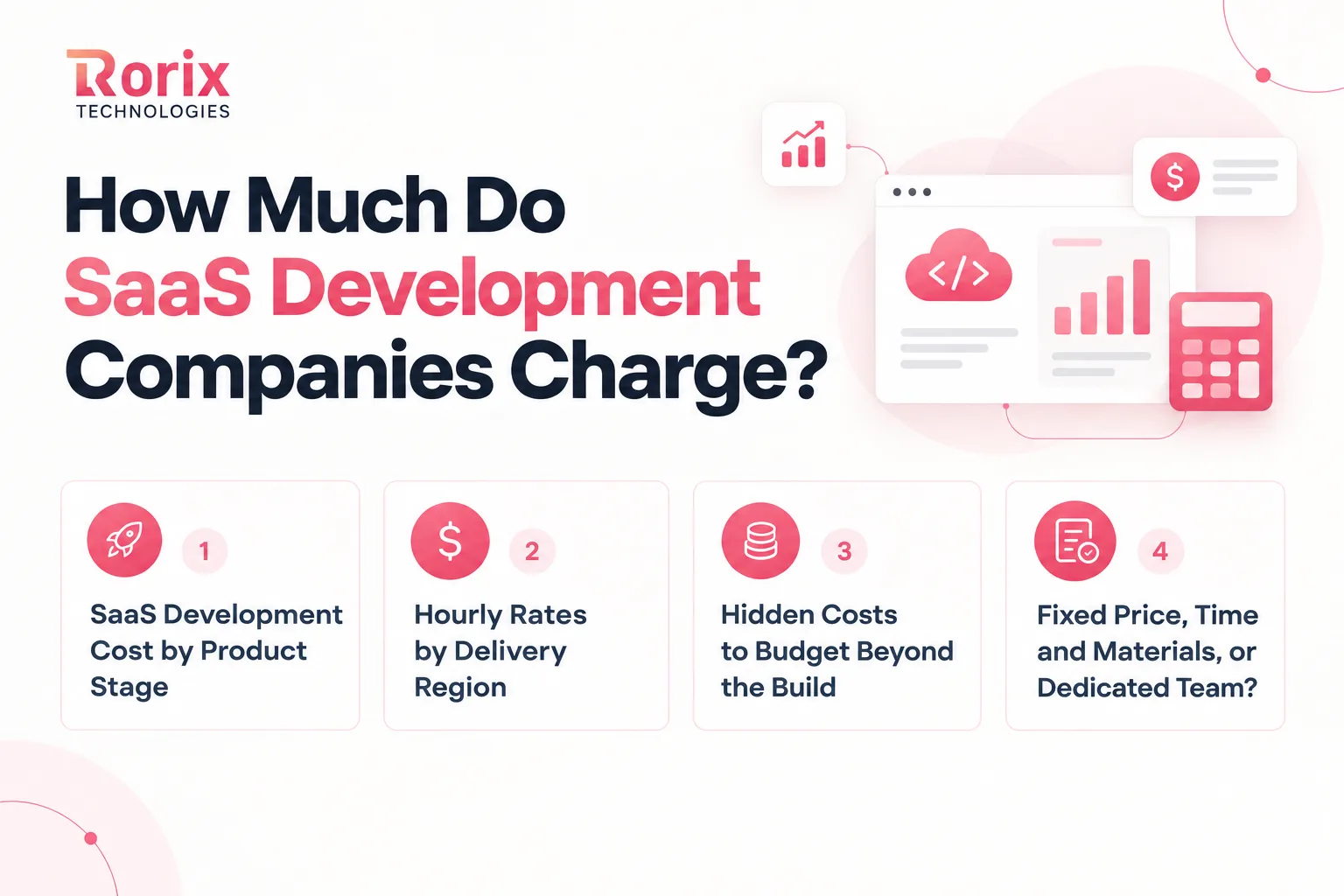
SaaS development cost depends more on scope than on hourly rates. Tenancy, integrations, compliance, platforms, and user roles can quickly change the final budget.
Because Rorix appears in this comparison, the ranges below are market benchmarks from published rates and industry data, not Rorix pricing.
Use them to sanity-check a proposal before you commit. Our custom software development cost guide covers these cost drivers in more detail.
1. SaaS Development Cost by Product Stage
Most SaaS products fall into three cost bands. The biggest variables are tenancy model, user roles, integrations, compliance, and platforms such as web and mobile.
- Tenancy model: Shared-schema, schema-per-tenant, and database-per-tenant architectures have different build and hosting costs.
- User roles: More roles mean more screens, permissions, and testing.
- Integrations: Every CRM, payment system, or API adds development and maintenance work.
- Compliance: SOC 2, HIPAA, and GDPR requirements add security, documentation, and audit work.
- Platforms: Adding mobile apps alongside the web increases the development scope.
| Product Stage | Typical Scope | Market Cost Range | Typical Timeline |
|---|---|---|---|
| MVP | Core workflow, authentication, billing, dashboard, and basic analytics | $40,000 to $120,000 | 3 to 6 months |
| Growth-ready platform | Full multi-tenancy, role-based access, CRM and payment integrations, and monitoring | $120,000 to $300,000 | 6 to 12 months |
| Enterprise-grade platform | SSO, audit trails, SOC 2 or HIPAA readiness, high availability, and multiple integrations | $300,000+ | 9 to 18 months |
These are typical market ranges across the top SaaS development companies. Teams with proven foundations and reusable modules may deliver an MVP faster.
Want a figure for your own SaaS build? Get a free consultation and project estimate based on your features, integrations, and compliance needs.
2. Hourly Rates by Delivery Region
Hourly rates across the top SaaS development companies on this list range from $25 to $199 per hour. Location sets the general range, but seniority, scope, and delivery model affect the actual value you get.
| Region | Typical Hourly Rate | Where It Fits Best |
|---|---|---|
| US and Canada | $100 to $200 | Onshore workshops, sensitive data, and same-hour collaboration |
| UK and Western Europe | $80 to $160 | GDPR-heavy products and local team access |
| Eastern Europe | $25 to $100 | Strong engineering with partial US and UK overlap |
| Latin America | $40 to $100 | US companies needing strong time-zone overlap |
| India and South Asia | $25 to $50 | Cost-effective full-cycle development with planned overlap |
Rates reflect where delivery happens, not where the head office sits. Several US-headquartered firms on this list deliver from lower-cost regions, so their listed rate falls below the US band.
Our nearshore vs offshore software development comparison explains how to weigh collaboration against total cost.
3. Hidden Costs to Budget Beyond the Build
The initial quote rarely tells the whole story. Budget for these costs before development starts:
- Discovery: A 2 to 4 week discovery phase can cost $5,000 to $25,000 and reduce costly rework.
- Cloud hosting: Expect roughly $500 to $5,000 per month as traffic and data grow.
- Third-party services: Payment, email, SMS, authentication, and monitoring tools add recurring costs.
- Complex integrations: Custom CRM syncs or partner APIs can cost $10,000 to $30,000 each.
- Compliance: SOC 2 and HIPAA readiness add audit, documentation, and tooling costs.
- DevOps and QA: CI/CD pipelines, staging, monitoring, and automated testing may sit outside the initial quote.
- Maintenance: Fixes, dependency upgrades, and security patches need an annual budget line, which our software maintenance cost guide helps you size.
4. Fixed Price, Time and Materials, or Dedicated Team?
The engagement model affects your risk as much as the hourly rate. Choose based on how stable your requirements are and how much the product is likely to change.
Fixed price works best for clearly defined work, such as discovery or a tightly scoped MVP. The trade-off is less flexibility, and changes can trigger new estimates or change requests.
Time and materials work well when requirements evolve through user feedback. You pay for actual work, but should have clear sprint goals, logged hours, and regular progress reviews.
A dedicated team fits products with a long-term roadmap. Keeping the same engineers preserves product knowledge and avoids repeatedly explaining the platform to a new team.
A common approach is fixed-price discovery followed by time and materials for development. Whatever model you choose, avoid large upfront payments and tie invoices to clearly delivered work.
Why Rorix Technologies Is Built for Complex SaaS Products
Choosing a SaaS development partner is easier when the proof is clear.
Rorix Technologies focuses on custom SaaS for operations-heavy businesses, where complex workflows, integrations, and multi-tenant requirements need to work together from the start.
Its approach combines senior engineering, short development cycles, and measurable outcomes rather than simply delivering features.
- 27 completed projects with a 5.0 Clutch rating across 4 verified reviews
- 80% fewer manual errors on a warehouse management build
- 40+ integrations on one white-label SaaS platform, including CRM, communication, and Google APIs
- 12-week SaaS MVP target for reaching a first paying customer, with a working MVP in 6 to 10 weeks
- Senior engineers with a named technical lead and 2-week development sprints
- Experience serving clients across the US, UK, Canada, Australia, and New Zealand
Have a complex SaaS workflow to build or scale? Book a free consultation to discuss your requirements and get a project estimate.
Conclusion: Find the SaaS Partner That Fits
Choosing the right SaaS development partner starts with your product stage, industry, technical needs, and long-term roadmap. A team that is right for SaaS MVP development may not be the right fit for a complex or regulated platform.
Use the cost ranges, timelines, company profiles, and selection criteria in this guide to compare proposals more clearly. Look beyond pricing and check technical expertise, delivery process, integrations, security, and post-launch support.
We hope this guide clarified how top SaaS development companies differ and what SaaS development can cost. It should also show you what to check before signing a contract.
Ready to build or scale your SaaS product? Connect with our experts to discuss your requirements and get a clear plan for architecture, billing, integrations, and development.
Frequently Asked Questions
How much does it cost to build a SaaS product?
Typical market ranges are $40,000 to $120,000 for an MVP, $120,000 to $300,000 for a growth-ready platform, and $300,000+ for enterprise builds.
How long does it take to build a SaaS MVP?
A focused SaaS MVP development project usually takes 3 to 6 months. A tightly scoped MVP with reusable foundations can ship as a working MVP in 6 to 10 weeks and reach a first paying customer in about 12 weeks.
What does a SaaS development company do?
A SaaS application development company can handle product discovery, UI/UX, architecture, development, billing, integrations, security, cloud infrastructure, and post-launch support.
How do I choose the right SaaS development partner?
Look for relevant SaaS experience, domain expertise, strong technical leadership, clear estimates, proven delivery processes, security practices, and reliable post-launch support.
Do I need multi-tenant architecture for an MVP?
Yes. Plan your multi-tenant SaaS architecture from the start, even with a small customer base. Retrofitting tenant isolation later can increase cost and complexity.
How do I check a SaaS company's track record?
Review verified client feedback, case studies, and relevant project experience. Speaking with past clients can also reveal how the team handled delivery and support.
Who owns the source code after development?
You should. Make sure the contract gives you ownership of the source code, data, design files, and cloud accounts from day one.
What should post-launch SaaS support include?
Your contract should cover bug fixes, security patches, monitoring, response times, and escalation contacts. It should also clearly separate defects from new feature requests.
Shipping a B2B SaaS product?
We ship SaaS MVPs in 12 weeks on 2-week sprints. Send us your product brief and we will scope the first release.
Continue learning
Written by
Renish DadhaniyaFounder & Director, Rorix Technologies
Renish co-founded Rorix Technologies and drives the engineering and delivery culture across the organization. Beyond engineering, he leads the company's sales, finance, and HR operations, building the infrastructure that lets the team focus on shipping quality software. With deep hands-on expertise in architecture and team building, he ensures every project lands on time to the quality standards clients demand.
View full profileRelated articles
SaaS Product Development: The Complete Guide From Idea to Launch (2026)
Planning a SaaS build? The 10-phase process from validating demand to pricing, tenancy, and launch, with realistic timelines, cost bands, and metrics.
Read article
Top 16 Enterprise Software Development Companies in 2026
Compare the top 16 enterprise software development companies in 2026. Explore their expertise, timelines, and tips for choosing the right partner.
Read article
How to Evaluate a Warehouse Management Software Development Company: 12 Builders Compared, Costs, and Red Flags
Evaluate a warehouse management software development company with a checklist, cost bands, red flags, and 12 builders compared, from a team that ships WMS.
Read article