
SaaS Development Cost in 2026: Pricing by Stage, Features and Team
Explore SaaS development cost in 2026, with pricing by product stage, features, team, and timeline, plus hidden expenses and ways to save money.
On this page68 sections
Two agencies read the same one-page SaaS brief, and one quotes $28,000 while the other asks for $140,000. Neither quote is necessarily wrong. The difference lies in what each team includes in the product.
That is why estimating your SaaS development project takes more than counting screens and features. Tenant isolation, subscription billing, user roles, and admin tools can significantly change the budget, even when the initial demo looks simple.
Key Takeaways: What SaaS Development Costs
- Market ranges: Micro SaaS costs $10,000 to $30,000, an MVP costs $40,000 to $120,000, and enterprise platforms cost $300,000 or more.
- Hidden complexity: Multi-tenancy, billing, roles, and admin tools add significant development effort.
- Team location: Offshore teams can cost less than US or Western European agencies for similar scope.
- Ongoing expenses: Budget for hosting, third-party tools, payment fees, and maintenance after launch.
- First-year budget: Plan for around 1.4 to 1.6 times the initial build quote, including running costs and contingency.
- Avoid costly rework: Design multi-tenancy early rather than retrofitting it later.
These are market estimates, not Rorix pricing. Rorix's published rates are covered separately in this guide.
After the build come hosting, payment processing, maintenance, and ongoing updates. These recurring expenses can push your first-year spending well beyond the initial development quote.
In this guide, you'll learn:
- SaaS development cost by product stage
- Phase-wise and feature-level cost estimates
- Development team models, rates, and contracts
- Costs by SaaS product type
- Monthly maintenance and hosting expenses
- A worked first-year budget
- Hidden expenses and practical ways to reduce costs
By the end of this guide, you'll know how to evaluate development quotes, estimate your first-year budget, and spot missing costs before they become expensive surprises.
What a SaaS Development Cost Actually Covers
A SaaS product has three cost layers: the core workflow, the features that make it sellable, and the infrastructure that keeps it running. Our guide to SaaS product development explains the complete development process.
1. The Core Workflow Customers Pay For
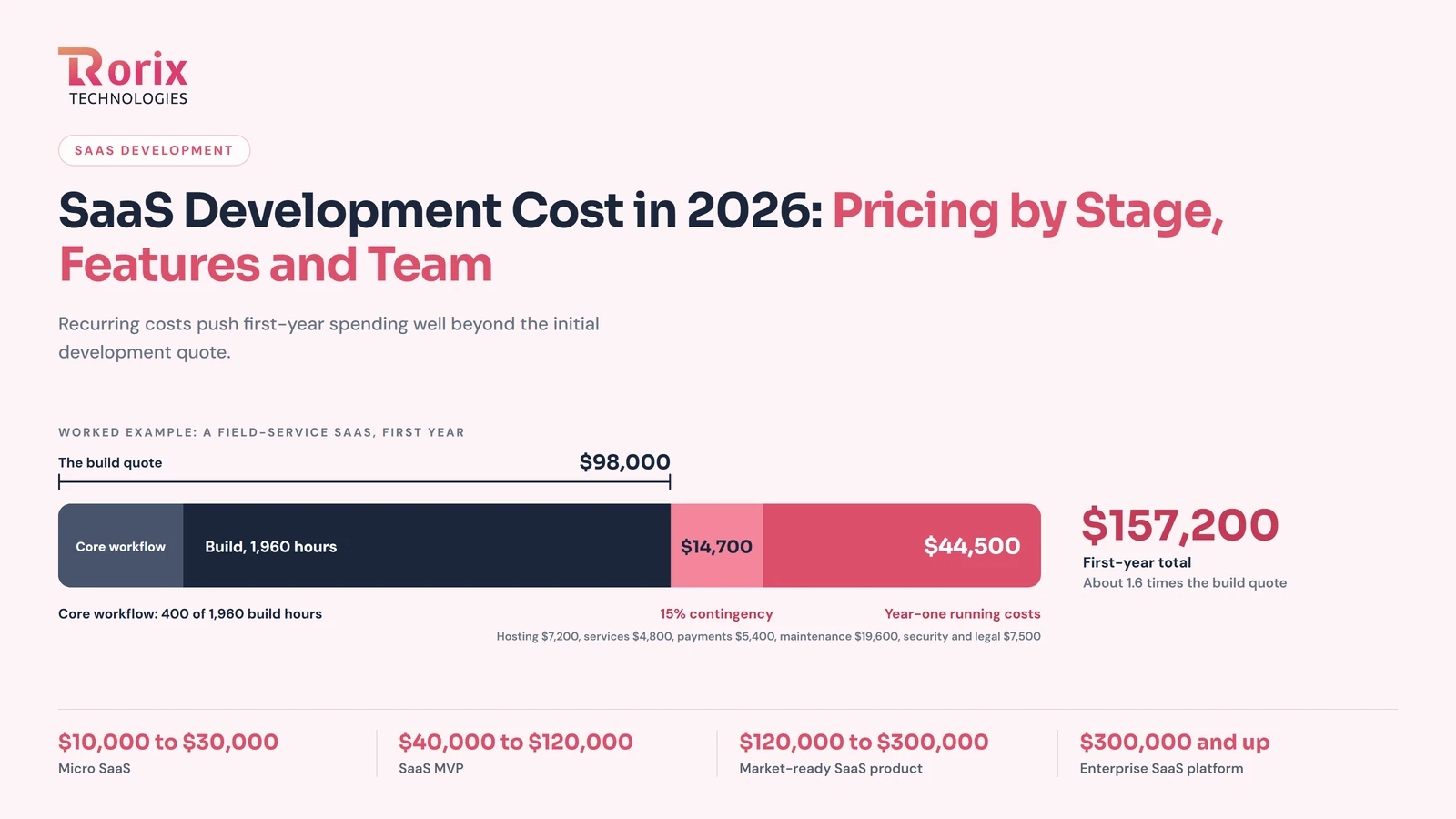
This includes the screens, features, business rules, and data customers use daily, such as scheduling jobs, tracking inventory, or managing payroll. The core workflow is the part customers see, yet it often accounts for half or less of the total build budget, and about a fifth in the worked example below.
2. The SaaS Layer: Tenancy, Billing, Roles, and Admin
This layer handles customer data separation, subscriptions, user permissions, and admin tools for managing accounts and support requests. These features may stay hidden in a demo, but they are essential for running a reliable, multi-customer product.
3. The Running Layer: Hosting, Monitoring, and Support
Once customers start using the product, you pay for hosting, backups, email and SMS services, monitoring, security updates, and support. These recurring expenses can grow with usage, so include them in your budget before launch.
SaaS Development Cost by Stage
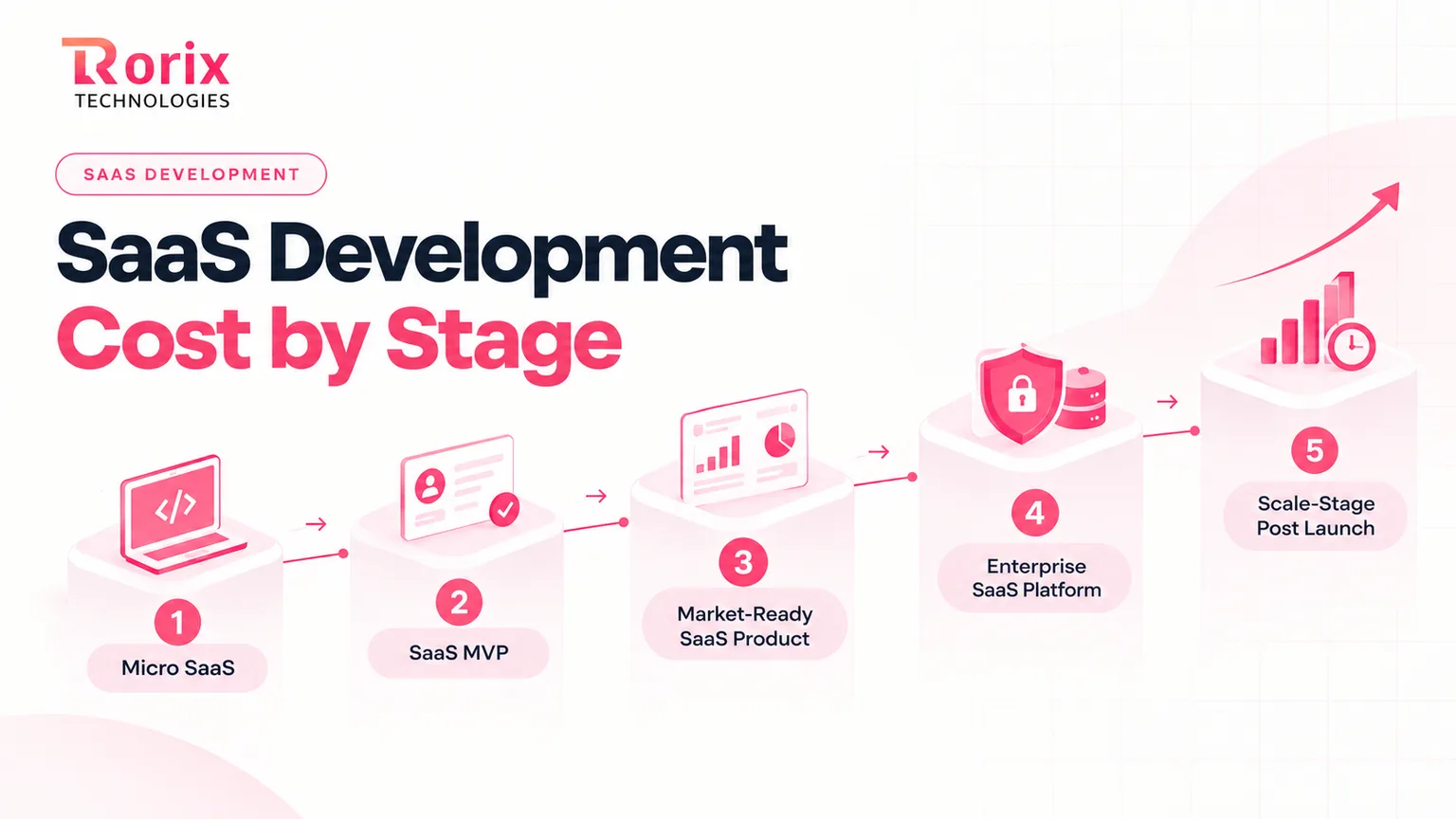
The budget depends on how far your product needs to go, from a focused tool to an enterprise platform. Here's what each stage includes, its typical cost, and development timeline.
1. Micro SaaS
A micro SaaS solves one specific problem, such as tutor bookings or industry-specific reporting. It typically costs $10,000 to $30,000 for one core feature, a simple dashboard, sign-up, and basic billing, with a timeline of 1 to 3 months.
- Includes: Sign-up, one core feature, dashboard, and card billing
- Timeline: 1 to 3 months
- Team: One full-stack developer and a part-time designer
2. SaaS MVP
A SaaS MVP lets customers sign up, pay, and complete the core task without your help. The SaaS MVP development cost typically ranges from $40,000 to $120,000, depending on features, tenancy, billing, and team location. See our guide on how to build an MVP to understand what to prioritize.
- Includes: Authentication, tenant-aware data, one pricing plan, core workflow, admin tools, and deployment
- Timeline: 3 to 6 months, or 6 to 10 weeks to a working MVP for a tightly scoped build by an experienced team
- Team: Developers, a designer, and part-time QA
3. Market-Ready SaaS Product
A market-ready SaaS is built for paying teams and broader adoption, with multi-tenancy, detailed user roles, self-service onboarding, reporting, and integrations. Expect to spend $120,000 to $300,000, with development typically taking 6 to 12 months.
- Includes: MVP features, integrations, dashboards, activity logs, and tiered plans
- Timeline: 6 to 12 months
- Team: Developers, QA, and part-time DevOps
4. Enterprise SaaS Platform
Enterprise platforms need stronger security, reliability, and access controls to meet buyer requirements, especially in healthcare and finance. Costs typically start at $300,000 and rise with scope, with timelines of 9 to 18 months.
- Includes: SSO, public APIs, advanced permissions, multi-region hosting, and compliance controls
- Timeline: 9 to 18 months
- Team: Developers, DevOps, security specialists, and a business analyst
5. Scale-Stage Development After Launch
As customers grow, you may need new features, integrations, performance improvements, and pricing tiers. Budget around $15,000 to $60,000 per quarter as a planning estimate, depending on the product's needs and pace of development.
- Includes: New features, performance tuning, integrations, and plan changes
- Timeline: Ongoing, often in two-week sprints
- Team: An ongoing development team adjusted to the workload
SaaS Development Cost by Development Phase
Each development phase contributes to the total budget. The table breaks down an illustrative $150,000 market-ready SaaS build, including what each phase covers and the risks of cutting corners.
| Phase | What it covers | Share | Cost on a $150,000 build | Risk if you skimp |
|---|---|---|---|---|
| Discovery and scoping | User needs, workflows, pricing, tenancy, and project scope | 8% | $12,000 | Costly rework |
| UI/UX design | User flows, wireframes, prototypes, and admin screens | 12% | $18,000 | Confusing user experience |
| Backend development | Data models, tenancy, billing, APIs, and integrations | 35% | $52,500 | Weak architecture and costly fixes |
| Frontend development | Web app, dashboards, onboarding, and responsive layouts | 20% | $30,000 | Poor usability and lower activation |
| QA and testing | Automated tests, manual checks, security, and tenant isolation | 15% | $22,500 | Bugs reaching paying customers |
| DevOps and launch | Deployment pipelines, monitoring, backups, and production release | 10% | $15,000 | Launch delays and reliability issues |
Backend development takes the largest share because core business logic, billing, tenancy, and integrations depend on it. Discovery also matters because clear requirements reduce rework throughout the project.
Keep a separate line for post-launch fixes, as the worked example below does. For a build of this size, an additional $5,000 to $10,000 can cover the first month of fixes as real users expose issues that testing missed.
Also Read: The Custom Software Development Process, Step by Step
SaaS Development Cost by Feature
Feature-level estimates show what each feature adds to your SaaS development cost. Compare typical engineering hours at two hourly rates below.
| Feature | Typical effort | At $30/hour | At $100/hour |
|---|---|---|---|
| Email, social login and password reset | 40 to 80 hours | $1,200 to $2,400 | $4,000 to $8,000 |
| Multi-tenant data model and isolation | 80 to 160 hours | $2,400 to $4,800 | $8,000 to $16,000 |
| Subscription billing (plans, trials, proration, dunning) | 100 to 200 hours | $3,000 to $6,000 | $10,000 to $20,000 |
| Usage-based or metered billing | 80 to 160 hours | $2,400 to $4,800 | $8,000 to $16,000 |
| Team accounts, roles and permissions | 60 to 120 hours | $1,800 to $3,600 | $6,000 to $12,000 |
| Self-serve onboarding flow | 40 to 80 hours | $1,200 to $2,400 | $4,000 to $8,000 |
| Core product dashboard and reporting | 80 to 160 hours | $2,400 to $4,800 | $8,000 to $16,000 |
| Internal admin panel | 60 to 120 hours | $1,800 to $3,600 | $6,000 to $12,000 |
| Email and in-app notifications | 30 to 60 hours | $900 to $1,800 | $3,000 to $6,000 |
| Third-party integration (each) | 40 to 160 hours | $1,200 to $4,800 | $4,000 to $16,000 |
| Public API and documentation | 80 to 160 hours | $2,400 to $4,800 | $8,000 to $16,000 |
| Enterprise SSO and audit logs | 70 to 160 hours | $2,100 to $4,800 | $7,000 to $16,000 |
| Real-time updates and live dashboards | 80 to 200 hours | $2,400 to $6,000 | $8,000 to $20,000 |
| AI feature through a model API | 80 to 240 hours | $2,400 to $7,200 | $8,000 to $24,000 |
| DevOps: CI/CD, environments, monitoring | 40 to 80 hours | $1,200 to $2,400 | $4,000 to $8,000 |
These estimates cover feature development only. Add design, project management, and QA. A rough allowance is 40 extra hours per 100 hours of feature work, so check whether your quote includes them.
Want a tailored estimate? Get a project cost estimate in about two minutes, with no email needed to see the result.
1. Multi-Tenant Architecture
Multi-tenancy keeps each customer's data separate within a shared system. Your database model affects security, hosting, and future changes, making early decisions important.
| Model | How it works | Build cost | Main challenge |
|---|---|---|---|
| Shared database, tenant ID on every row | Customers share tables, with data filtered by tenant | Lowest | Requires strict access controls and testing to prevent data leaks |
| Schema per tenant | Each customer has a separate schema in one database | Moderate | Migrations become harder as the number of tenants grows |
| Database per tenant | Each customer has a separate database | Highest | Provisioning, backups, and monitoring grow with every customer |
2. Subscription Billing and Payments
Recurring billing needs more than a payment connection. Trials, upgrades, prorated charges, failed payments, retries, invoices, and taxes all require reliable logic and testing.
3. Roles, Permissions and Enterprise SSO
User accounts need clear permissions for owners, admins, members, and read-only users. Planning access controls early also makes enterprise single sign-on easier to add later.
4. Integrations and APIs
Connecting a CRM, accounting tool, telephony provider, or ERP can take a week to a month. Error handling, retries, rate limits, data syncing, and documentation add to the effort.
5. Real-Time Features
Live dashboards, chat, and instant stock updates need real-time communication and data syncing. They can also increase hosting costs, so build them only when users need immediate updates.
6. AI Features
AI assistants, smart search, and summaries using a model API typically take 80 to 240 hours, costing $2,400 to $24,000 at the rates above. Custom model training can cost $25,000 to $80,000 or more, plus ongoing usage fees.
SaaS Development Cost by Team
Your team, hiring model, location, and contract type all affect the SaaS development cost. Compare these options to find the right balance of budget, speed, and control.
1. Team Composition at Each Stage
Your development team is a major cost driver because you pay for people throughout the build. For example, four people working 160 hours a month at $40 per hour cost $25,600 monthly.
| Stage | Typical team | Roles |
|---|---|---|
| Micro SaaS | 1 to 2 people | Full-stack developer, part-time designer |
| SaaS MVP | 2 to 4 people | Developers, designer, part-time QA, technical lead |
| Market-ready SaaS | 4 to 7 people | Frontend and backend developers, designer, QA, part-time DevOps, project manager |
| Enterprise platform | 8 to 15 people | Developer squads, QA team, DevOps, security, business analyst, project manager |
2. Freelancer vs In-House vs Agency vs Dedicated Team
Each hiring model offers a different balance of cost, control, and continuity. A US software developer earns a median of $135,980 a year as of May 2025, before benefits and other employment costs. See our guide to in-house vs outsourcing software development for more detail.
| Model | Cost signal | Speed to start | Accountability | Best for |
|---|---|---|---|---|
| Freelancers | $30 to $120 an hour, variable quality | Fast | Split across individuals | Small, well-defined pieces of work |
| In-house team | Salary plus benefits, payroll tax, equipment, and recruiting | Slow, as hiring takes months | Full internal control | A long-term core product after funding |
| Local US or EU agency | $100 to $250 an hour | Moderate | One accountable vendor | Regulated or on-site projects with large budgets |
| Offshore dedicated team | $20 to $85 an hour, often as a monthly retainer | Fast, as the team already exists | One accountable team | MVP through scale, with continuity after launch |
3. Hourly Rates by Region
Hourly rates vary by region, even when the feature list stays the same. Apart from Australia and New Zealand, these junior-to-senior ranges match our custom software development cost guide.
| Region | Hourly range (junior to senior) | Good fit when |
|---|---|---|
| United States and Canada | $55 to $250+ | You need on-site work or same-time-zone collaboration |
| United Kingdom | $50 to $220 | You sell into UK enterprises with local procurement rules |
| Western Europe | $50 to $200 | Your buyers require EU-based delivery |
| Eastern Europe | $30 to $130 | You want EU time-zone overlap at lower rates |
| Latin America | $30 to $130 | You want close overlap with US working hours |
| India and South Asia | $20 to $85 | You want senior engineers and cost-effective delivery |
| Southeast Asia | $25 to $100 | You want Asia-Pacific time-zone overlap |
| Australia and New Zealand | $60 to $200 | You need local delivery in those markets |
4. Fixed Price vs Time and Materials vs Monthly Retainer
Your contract determines how you pay when requirements change. Fixed price suits a defined scope, time and materials handles uncertainty, and a monthly retainer supports ongoing development after launch.
| Model | How you pay | When scope changes | Best for |
|---|---|---|---|
| Fixed price | One agreed number for a defined scope | Change requests and renegotiation | A well-scoped MVP after discovery |
| Time and materials | Hours actually worked | More billable hours | Unclear scope or rescuing an existing build |
| Monthly retainer | A set team for a set monthly fee | You reprioritize inside the same capacity | Ongoing SaaS products from MVP to scale |
Also Read: Staff Augmentation vs Dedicated Team: Which Model Fits Your Roadmap?
SaaS Development Cost by Product Type
The SaaS development cost varies by product because each type has different technical and compliance needs. These market ranges show typical budgets from MVP to market-ready products.
| Product type | Cost-heavy parts | Typical range |
|---|---|---|
| Inventory or WMS SaaS | Barcode scanning, real-time stock sync, multi-warehouse tenancy, ERP and carrier integrations | $50,000 to $250,000 |
| HRMS or payroll SaaS | Regional payroll rules, leave and attendance, document storage, privacy controls | $50,000 to $250,000+ |
| Field service or home services SaaS | Scheduling, dispatch, technician mobile app, SMS and telephony integrations | $40,000 to $200,000 |
| B2B analytics or reporting SaaS | Data pipelines, tenant-specific dashboards, exports, scheduled reports | $35,000 to $180,000 |
| CRM or order management SaaS | Sales pipelines, quote-to-invoice workflows, accounting and email integrations | $40,000 to $200,000 |
| Marketplace SaaS | Buyer and seller accounts, split payouts, reviews, dispute handling | $45,000 to $220,000 |
| Regulated SaaS (health, finance) | Encryption, audit trails, HIPAA or PCI DSS requirements, security testing | $90,000 to $500,000+ |
| AI-first SaaS | Model integration, evaluation, usage metering, inference cost controls | $40,000 to $250,000+ |
Warehouse management platforms need extra planning because tenancy must separate both customer data and the warehouses within each account. Our scalable WMS architecture guide explains how to design this layer without requiring a costly rewrite.
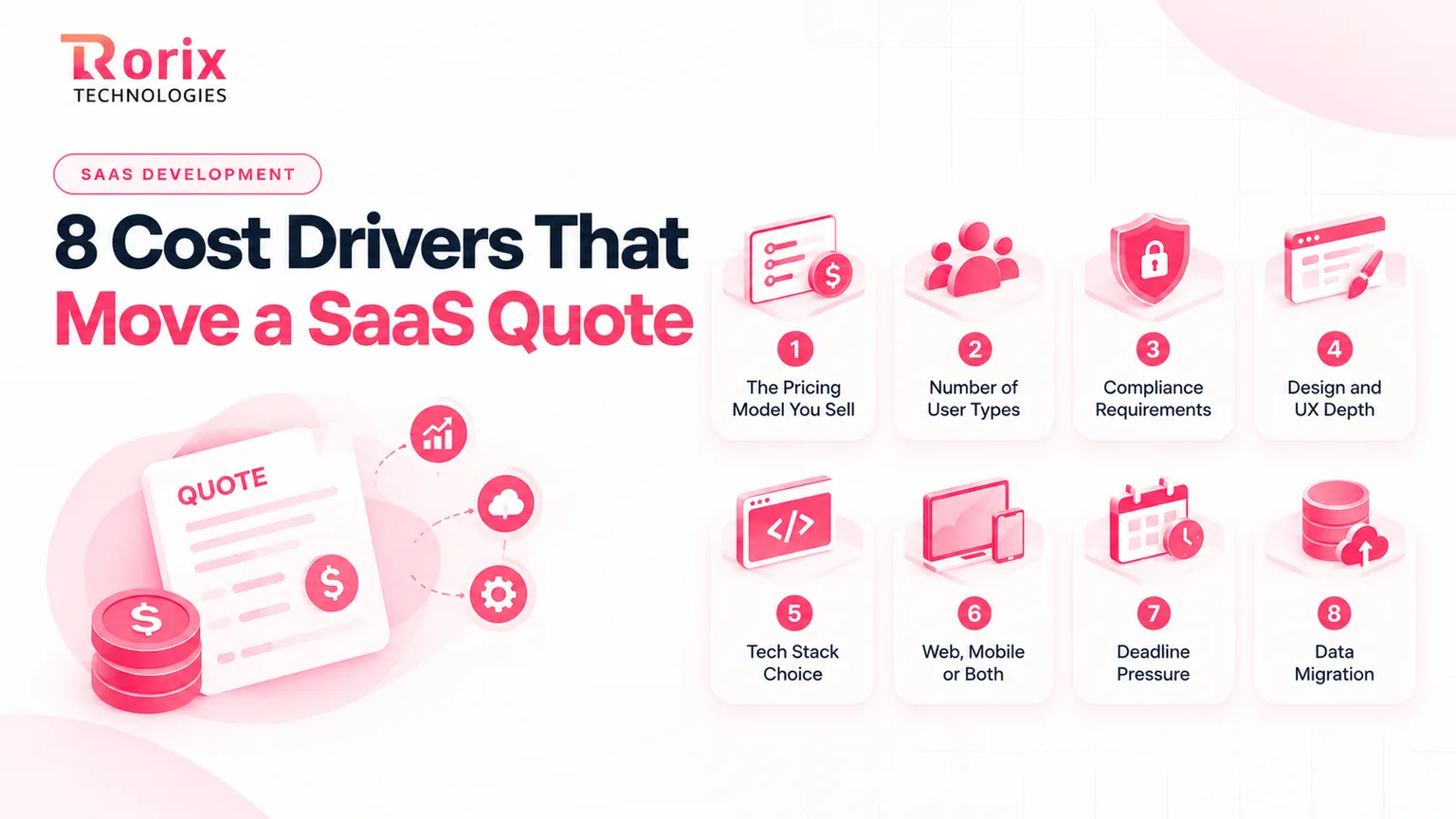
8 Cost Drivers That Move a SaaS Quote
Eight decisions can change your SaaS development cost, even when the core features stay the same. Plan them early to compare quotes and avoid costly changes.
1. The Pricing Model You Sell
Flat-rate billing is simplest, while per-seat pricing needs seat management and proration. Usage-based plans add metering and alerts, so choose your model before development begins.
2. Number of User Types
Each role adds permissions, screens, and tests. Start with essential roles like owner, admin, and member, then add more as customer needs grow.
3. Compliance Requirements
GDPR, HIPAA, and SOC 2 can require encryption, audit logs, data exports, and policy work. Confirm your buyers' compliance needs early to budget accurately.
4. Design and UX Depth
A proven component library costs less than a custom design system and user research. Prioritize onboarding and customer workflows, and keep internal admin screens simple.
5. Tech Stack Choice
React, Node.js, and PostgreSQL offer mature tools and broad developer availability. Avoid niche technologies and early microservices unless your product needs them.
6. Web, Mobile or Both
A web app keeps the first release lean, while mobile apps add device testing, push notifications, and app store reviews. A companion app can add $20,000 to $80,000.
7. Deadline Pressure
Tight deadlines can require more people working in parallel, increasing costs and coordination. If the launch date is fixed, reduce scope before expanding the team.
8. Data Migration
Moving spreadsheets, competitor exports, or legacy data takes time to map, clean, and import. Plan migration tools or services early if customers are switching from another product.
Now that you have seen what drives the build, let us take a look at what your SaaS product costs to run.
What SaaS Costs Per Month After Launch
Monthly operating costs start at launch and grow with usage. Include these expenses when estimating your SaaS development cost and first-year budget.
1. Hosting and Infrastructure by User Stage
Hosting costs rise with active users, stored data, and traffic, and wasted cloud spend can add up quickly. Flexera's 2026 State of the Cloud Report estimates that 29% of IaaS and PaaS spend is wasted, so assign someone to review the bill monthly.
| Stage | Active users | Typical monthly hosting |
|---|---|---|
| Launch | Under 500 | $100 to $500 |
| Growth | 500 to 5,000 | $500 to $2,000 |
| Scale | 5,000 to 50,000 | $2,000 to $8,000 |
| Enterprise | 50,000+ | $8,000 and up |
2. Third-Party Services and Per-User Tools
Authentication, email, SMS, analytics, monitoring, and support tools may start free but often charge by user or message. Budget $100 to $500 monthly at launch and $500 to $3,000 during growth, and estimate each tool's cost at 10,000 users.
3. Payment Processing Fees
Payment processing fees grow with revenue rather than server usage. Stripe's standard US rate is 2.9% + 30¢ per successful domestic card charge, while Stripe Billing adds 0.7% of billing volume on pay-as-you-go, bringing the percentage fees to roughly 3.6%, plus 30¢ per charge, before international or currency fees.
4. Maintenance and Iteration
Annual SaaS maintenance costs typically run 15% to 25% of the original build, covering bug fixes, updates, security patches, and small improvements. For a $150,000 product, budget $22,500 to $37,500 a year before major new features. See our software maintenance cost guide for more detail.
5. Security, Compliance and Audits
Security requires ongoing updates as dependencies age and threats change. SOC 2 readiness and audits can cost $10,000 to $150,000, depending on scope and tools, while legal terms, a privacy policy, and a data processing agreement add one-time costs.
6. Monitoring and Customer Support
Monitoring tools can cost $50 to $500 monthly, but staff time is often the bigger expense. Assign owners for uptime, errors, backups, and customer queries early, so senior developers don't spend costly engineering hours handling routine support.
First-Year SaaS Budget: A Worked Example
Consider a field-service SaaS where home-service companies manage technicians, schedule jobs, text customers, and pay per technician. Here's what building and running it for the first year could cost.
1. Build Cost by Work Package
This estimate uses a blended rate of $50 per hour for a mixed senior and mid-level team. With three to four people working in parallel, the build takes about four months, covering core features, billing, testing, and launch.
| Work package | Hours | Cost |
|---|---|---|
| Discovery and scoping | 80 | $4,000 |
| UX/UI design, including settings and admin screens | 240 | $12,000 |
| Accounts, tenancy, roles and invitations | 200 | $10,000 |
| Plans, subscriptions, invoices and failed payments | 200 | $10,000 |
| Core workflow: jobs, scheduling and technician assignment | 400 | $20,000 |
| Customer notifications by SMS and email | 100 | $5,000 |
| Admin panel and support tools | 160 | $8,000 |
| Reporting dashboards | 120 | $6,000 |
| QA, security review and tenant isolation tests | 240 | $12,000 |
| DevOps, monitoring and launch | 100 | $5,000 |
| First month of post-launch fixes | 120 | $6,000 |
| Total build | 1,960 | $98,000 |
2. Year-One Running Costs
The example assumes a few hundred paying users in the first year, with hosting at $600 a month, a little above the launch range in the hosting table, because it covers a staging environment as well as production. Payment processing is calculated at roughly 3.6% of $150,000 in card revenue, leaving out the 30¢ per-charge fee for simplicity, while maintenance is budgeted at 20% of the build cost.
| Cost line | Monthly | Year one |
|---|---|---|
| Hosting and infrastructure | $600 | $7,200 |
| Third-party services, including SMS | $400 | $4,800 |
| Payment processing (about 3.6% of $150,000) | Varies | $5,400 |
| Maintenance and iteration (20% of build) | Varies | $19,600 |
| Security, legal and policy work | Varies | $7,500 |
| Total running costs | Varies | $44,500 |
3. Total First-Year Cost of Ownership
Adding a 15% contingency helps cover unexpected changes after real users start using the product. The first-year total reaches $157,200, around 1.6 times the initial build quote, with core scheduling accounting for only 400 of the 1,960 build hours.
| Line | Amount |
|---|---|
| Build | $98,000 |
| Contingency (15% of build) | $14,700 |
| Year-one running costs | $44,500 |
| Total first-year cost | $157,200 |
Hidden SaaS Development Costs Most Quotes Leave Out
A development quote rarely covers every cost of launching and running a SaaS product. These 10 hidden expenses can push your first-year budget higher, so check whether your vendor includes them.
| Hidden cost | Typical size | When it surprises you |
|---|---|---|
| Scope creep mid-build | Often the largest single overrun | When a "small" feature arrives in week eight |
| Retrofitting multi-tenancy | Can exceed the cost of building it upfront | When your second customer signs |
| Integration approvals and sandboxes | Weeks of calendar delay | When payment, SMS, or app store reviews depend on another company |
| Data migration for new customers | Days to weeks per customer type | When buyers bring spreadsheets and competitor exports |
| Legal documents | $1,000 to $5,000 | When an enterprise legal team reviews your standard terms |
| Per-user third-party tools | Grows with every active user | When free tiers end as you scale |
| Technical debt from rushed testing | Rework at a higher cost later | When bugs reach paying customers |
| Tax and invoice rules by region | Custom invoice logic and setup | When you start selling across borders |
| A companion mobile app | $20,000 to $80,000 | When customers request one after launch |
| AI inference and API usage | Grows with every request | When an AI feature becomes popular |
Most hidden expenses come from decisions made too late, not poor engineering. Identify them during discovery to protect your budget and avoid expensive changes later.
Also Read: Build vs Buy Software: A Decision Framework for 2026
How AI-Assisted Development Changes SaaS Development Cost
AI coding tools speed up parts of SaaS development, but savings depend on the work. They help with routine tasks more than complex architecture or security.
- Real gains: CRUD screens, form validation, integration adapters, test scaffolding, documentation, and boilerplate.
- Limited gains: Multi-tenancy, billing edge cases, permission design, security reviews, and novel features still need experienced developers.
- Hidden risk: Poorly reviewed AI-generated code can introduce subtle bugs, including flaws that expose one customer's data to another.
AI can reduce development effort on routine features, but it cannot replace sound architecture and expert testing. Be cautious of quotes promising dramatic savings without accounting for security, billing, and tenant isolation.
Now that you have seen where the costs come from, let us take a look at how to bring them down without weakening the product.
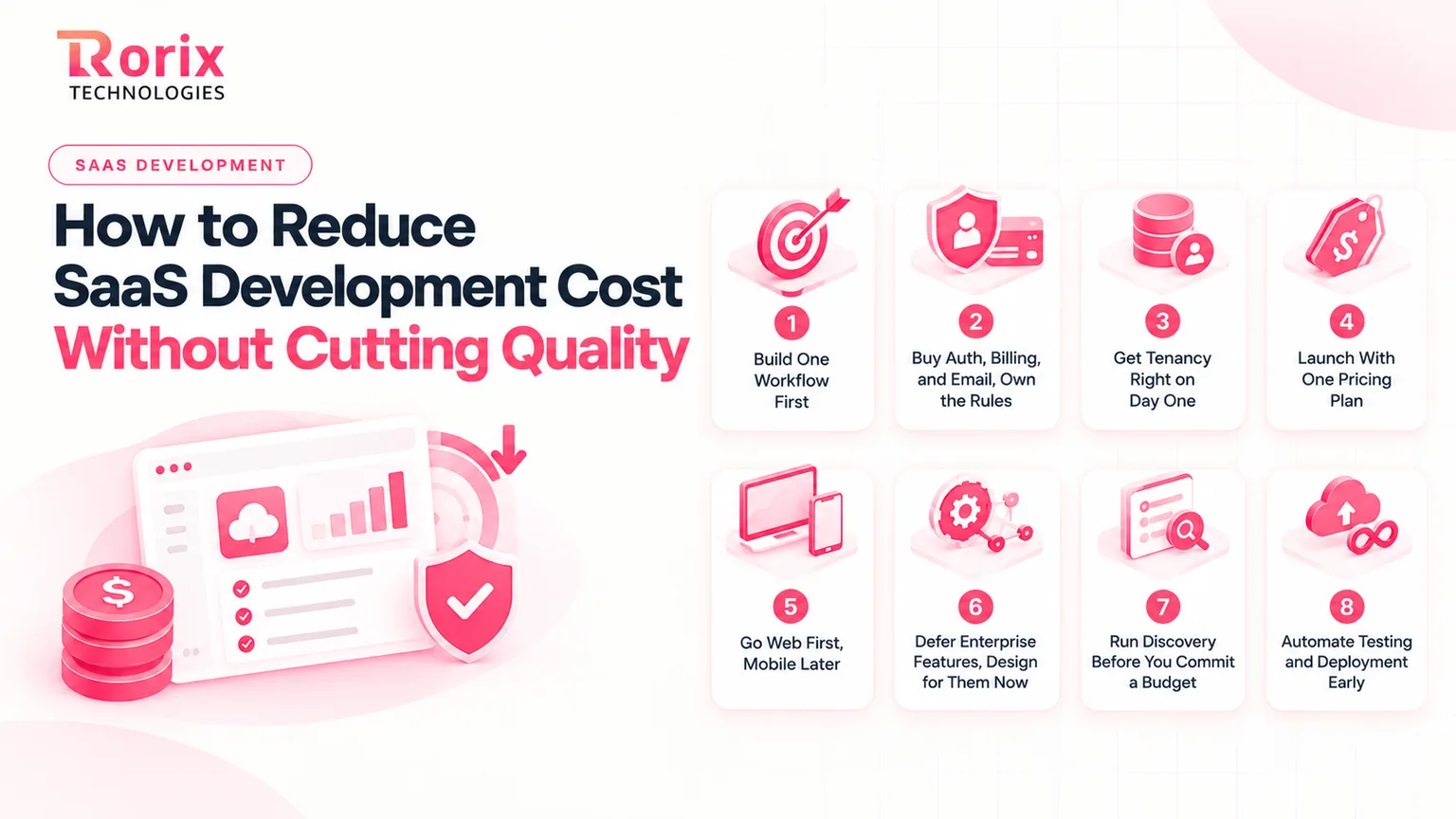
How to Reduce SaaS Development Cost Without Cutting Quality
Reduce costs by prioritizing essential features, choosing the right tools, and planning. These eight steps help control your budget without compromising quality.
1. Build One Workflow First
Start with the one outcome customers will pay for, then add features based on real usage. Focused MVP development helps validate demand before you invest in a larger product.
2. Buy Auth, Billing, and Email, Own the Rules
Use tools like Auth0, Clerk, Stripe Billing, Chargebee, and Postmark instead of building everything from scratch. Keep your business rules, pricing logic, invoices, and permissions tailored to your product.
3. Get Tenancy Right on Day One
Build multi-tenancy into your first data model to keep customer data separate. Retrofitting it later can mean reworking queries, background jobs, and reports, making early planning far cheaper.
4. Launch With One Pricing Plan
Start with one clear pricing plan to reduce billing complexity and speed up launch. Add tiers or usage-based billing when customer behavior shows what people are willing to pay for.
5. Go Web First, Mobile Later
Launch a responsive web app unless your users genuinely need mobile features. Building mobile apps too early adds design, testing, and maintenance costs before demand is proven.
6. Defer Enterprise Features, Design for Them Now
Delay SSO, audit logs, and public APIs until customers need them, but plan your architecture to support them. This keeps the initial budget lean without requiring a costly rebuild later.
7. Run Discovery Before You Commit a Budget
Spend one or two weeks defining user flows, acceptance criteria, and scope before development begins. Clear requirements reduce expensive changes and make fixed-price quotes more reliable.
8. Automate Testing and Deployment Early
Set up automated tests and CI/CD early to catch bugs and release changes safely. This reduces repetitive manual work and helps control long-term maintenance costs.
How to Read a SaaS Development Quote Before You Sign
A low quote can hide missing features and future expenses. Check these ten points before choosing a vendor.
- Check the SaaS essentials: Sign-up, multi-tenancy, roles, invitations, and admin tools should be listed.
- Confirm billing details: Check failed payments, proration, refunds, annual plans, and invoices.
- Verify tenant isolation: Look for automated tests and database-level safeguards to protect customer data.
- Look for discovery: The quote should include scope definition and clear requirements.
- Separate ongoing costs: Hosting, third-party tools, and maintenance should be itemized separately.
- Confirm the team: Check developers' experience, roles, and availability.
- Review post-launch support: Confirm monitoring, tested backups, and a defined bug-fix period.
- Confirm ownership: Your company should control the code, cloud account, domain, and payment account.
- Understand change requests: The contract should explain how extra work is scoped and priced.
- Compare itemized quotes: Compare deliverables and exclusions, not just the final price.
If you're comparing vendors, read our guide on how to compare SaaS development agencies to identify the right SaaS specialist.
Why Rorix Technologies Offers Flexibility and Accountability
Choosing a SaaS development partner is easier when you know what it delivers, how the team works, and what support continues after launch.
Rorix Technologies builds custom SaaS platforms with senior engineering, clear delivery ownership, and ongoing support.
- 27 projects delivered: Experience building custom software and operations-focused products.
- 5.0 Clutch rating: Based on 4 verified reviews.
- Flexible delivery: Work with a dedicated team of senior engineers and a named technical lead.
- Working MVP in 6 to 10 weeks: Build a focused first version with authentication, one pricing plan, and your core workflow; an MVP ready for its first paying customer takes 12 weeks.
- Two-week sprints: Review working software regularly and track progress throughout development.
- 40+ integrations: Connected for Driven, a US performance platform for pest control and field service teams, with iOS and Android apps from one React Native codebase.
- Global delivery: Experience serving clients across the US, UK, Canada, Australia, and New Zealand.
- Ongoing support: Continue improving your product with the same engineers after launch.
Rorix's published pricing starts at $10,000 for a validated MVP, $25,000 for a multi-tenant B2B SaaS platform, and $75,000 for a platform at scale.
Monthly retainers range from $3,500 for one developer to $30,000 for ten, as listed on the pricing page. You can also hire dedicated development teams month to month as your roadmap grows.
Get a free consultation and project estimate to discuss your requirements and get a written project scope.
Conclusion: Plan Your SaaS Budget With Confidence
The SaaS development cost depends on your product scope, features, development team, and ongoing expenses. Understanding these factors helps you plan a realistic budget before development begins.
We hope this guide helps you compare development stages, estimate first-year expenses, and identify costs that vendors may leave out.
Before choosing a partner, define your core workflow, pricing model, and essential integrations. Use the quote checklist to compare scope, timelines, and ongoing support.
Need help estimating your project? Connect with our experts to discuss your requirements, timeline, and budget.
Frequently Asked Questions
How much does SaaS development cost?
At market rates, it ranges from $10,000 for micro SaaS to $300,000 or more for enterprise platforms. Most SaaS MVPs cost $40,000 to $120,000.
How much does a SaaS MVP cost?
A SaaS MVP typically costs $40,000 to $120,000 at market rates. A tightly scoped working MVP may take 6 to 10 weeks with an experienced team.
How long does it take to build a SaaS product?
Across the market, an MVP takes 3 to 6 months, a market-ready product 6 to 12 months, and an enterprise platform 9 to 18 months. A tightly scoped working MVP can take 6 to 10 weeks with an experienced team.
What does SaaS cost per month after launch?
Hosting and third-party tools may cost $100 to $500 per month each at an early stage. Also budget for payment fees and annual maintenance at 15% to 25% of build cost.
Why do SaaS development quotes vary?
Quotes differ based on features, multi-tenancy, billing, testing, team experience, and post-launch support. Some cover only core features, while others include the full SaaS infrastructure.
Does outsourcing reduce SaaS development costs?
Often, yes. Offshore rates may range from $20 to $85 per hour, compared with $100 to $250 for US or Western European agencies. Experience and communication still matter.
How much does it cost to add AI to a SaaS product?
Using an existing AI model API may cost $2,400 to $24,000. Custom model training can cost $25,000 to $80,000+, plus ongoing usage fees.
What are the hidden costs of building SaaS?
The usual ones are scope creep, retrofitting multi-tenancy, integration approvals, data migration for new customers, legal documents, per-user tools, technical debt from rushed testing, regional tax rules, a companion mobile app, and AI usage fees. Most come from decisions made late, so surface them in discovery.
Shipping a B2B SaaS product?
We ship SaaS MVPs in 12 weeks on 2-week sprints. Send us your product brief and we will scope the first release.
Continue learning
Written by
Renish DadhaniyaFounder & Director, Rorix Technologies
Renish co-founded Rorix Technologies and drives the engineering and delivery culture across the organization. Beyond engineering, he leads the company's sales, finance, and HR operations, building the infrastructure that lets the team focus on shipping quality software. With deep hands-on expertise in architecture and team building, he ensures every project lands on time to the quality standards clients demand.
View full profileRelated articles
SaaS Product Development: The Complete Guide From Idea to Launch (2026)
Planning a SaaS build? The 10-phase process from validating demand to pricing, tenancy, and launch, with realistic timelines, cost bands, and metrics.
Read article
15 Top SaaS Development Companies in 2026
Compare 15 top SaaS development companies in 2026, including pricing, services, timelines, strengths, and tips to choose the right SaaS partner.
Read article
How to Build an MVP: What to Cut, and What You Cannot
How to build an MVP: the test that separates a real MVP from a small product, what you can safely cut, what you cannot, plus honest timeline and cost.
Read article