In-House vs Outsourcing Software Development: Cost, Speed, and Control Compared (2026)
Compare in-house vs outsourcing software development on cost, speed, control, risks, and the hybrid model with a practical 2026 decision guide.
On this page74 sections
Choosing between in-house and outsourced software development can have a major impact on your project's cost, timeline, and long-term success.
Key Takeaways: What Actually Separates the Two Models
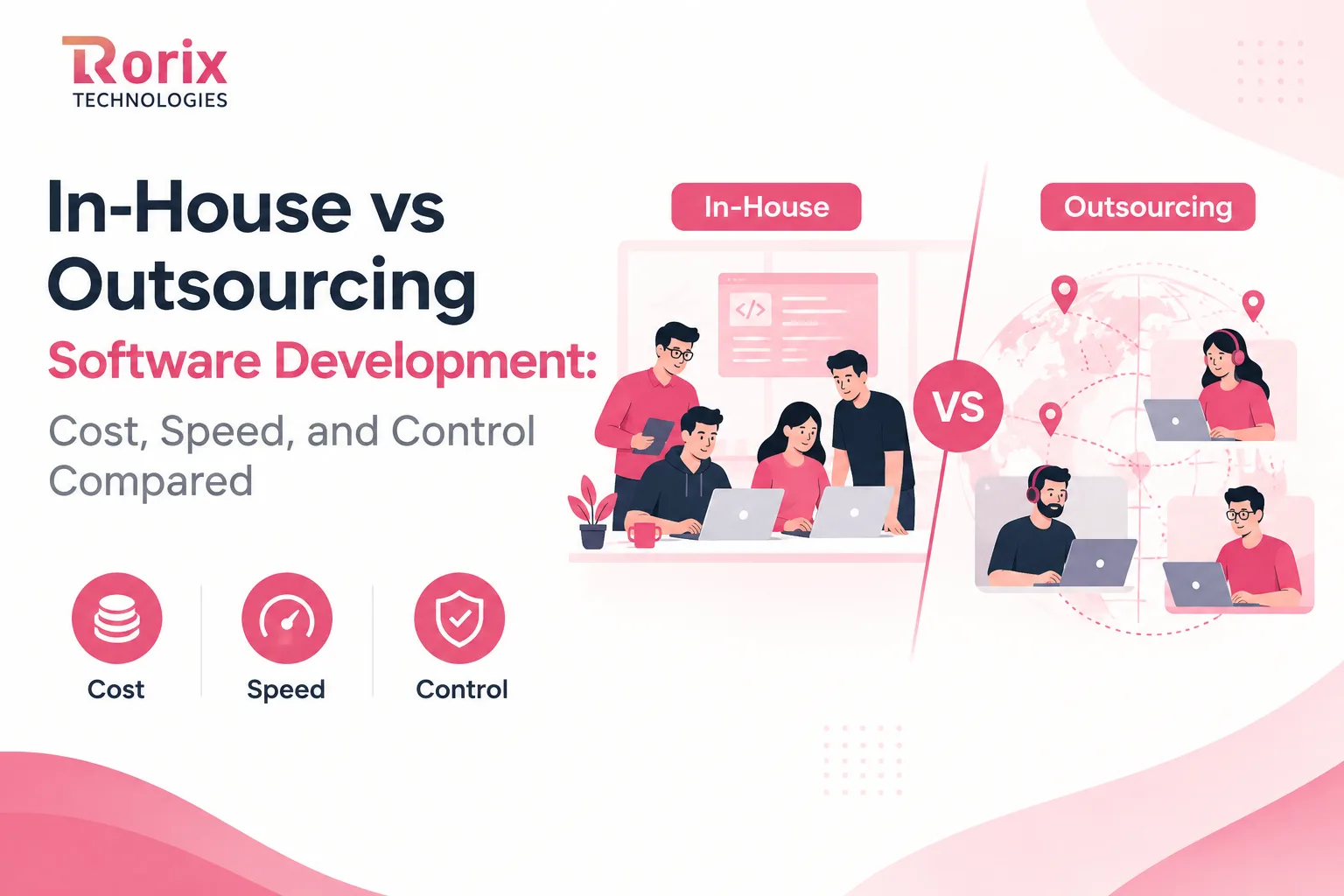
In-house vs outsourcing software development comes down to cost, speed, control, and long-term needs. In-house development offers stronger ownership and institutional knowledge but requires higher fixed costs and a longer hiring cycle. Outsourcing provides faster access to specialist skills and flexible capacity, while hybrid software development combines both models. The right choice depends on your timeline, internal capabilities, security requirements, roadmap stability, and expected demand.
An in-house team gives you direct control and builds product knowledge within your company. Outsourcing gives you faster access to skilled developers and flexible capacity. A hybrid model combines both approaches.
The right choice depends on your project, budget, timeline, and internal capabilities. If the reasons behind the decision matter as much as the comparison, our guide to why companies outsource software development covers the drivers in depth.
In this guide, you'll learn:
- The key differences between in-house vs outsourcing software development
- How costs compare, including the real 3-year TCO
- How hiring and outsourcing timelines affect delivery speed
- How control, security, IP, and ownership differ
- When to choose in-house, outsourcing, or a hybrid model
- A practical framework for choosing the right approach
By the end, you'll have a clear understanding of the trade-offs and which model fits your software project.
Quick Answer: In-House vs Outsourcing Software Development at a Glance
If you only read one section of this guide, start here. The right model depends on your cost, timeline, control, skills, and long-term needs.
- Cost: Outsourcing can reduce year-one spend and improve cost predictability because you pay for the capacity you need instead of carrying full-time headcount.
- Speed: An outsourced development team can usually start in weeks, while hiring and onboarding an in-house team can take months.
- Control: In-house development gives you more direct control over daily decisions, code reviews, and priorities. Strong governance can narrow that gap with an external partner.
- Ownership: An in-house team builds institutional knowledge over time. That knowledge can become valuable when the software is central to the business.
- Practical answer: A hybrid software development model often works when you want to keep product ownership and domain knowledge inside while adding external delivery capacity.
What Is In-House Software Development?
In-house software development means your engineers are employees who work inside your organization and focus on your products. You control the hiring, tools, processes, priorities, and delivery from day one.
The biggest advantage is institutional knowledge. Your team builds context from customer feedback, failed releases, and daily operations, so important decisions do not have to be explained from scratch.
The trade-off is that you are also building an engineering organization. Recruiting, retention, management, tooling, and keeping the team productive all become your responsibility.
What an In-House Team Actually Includes
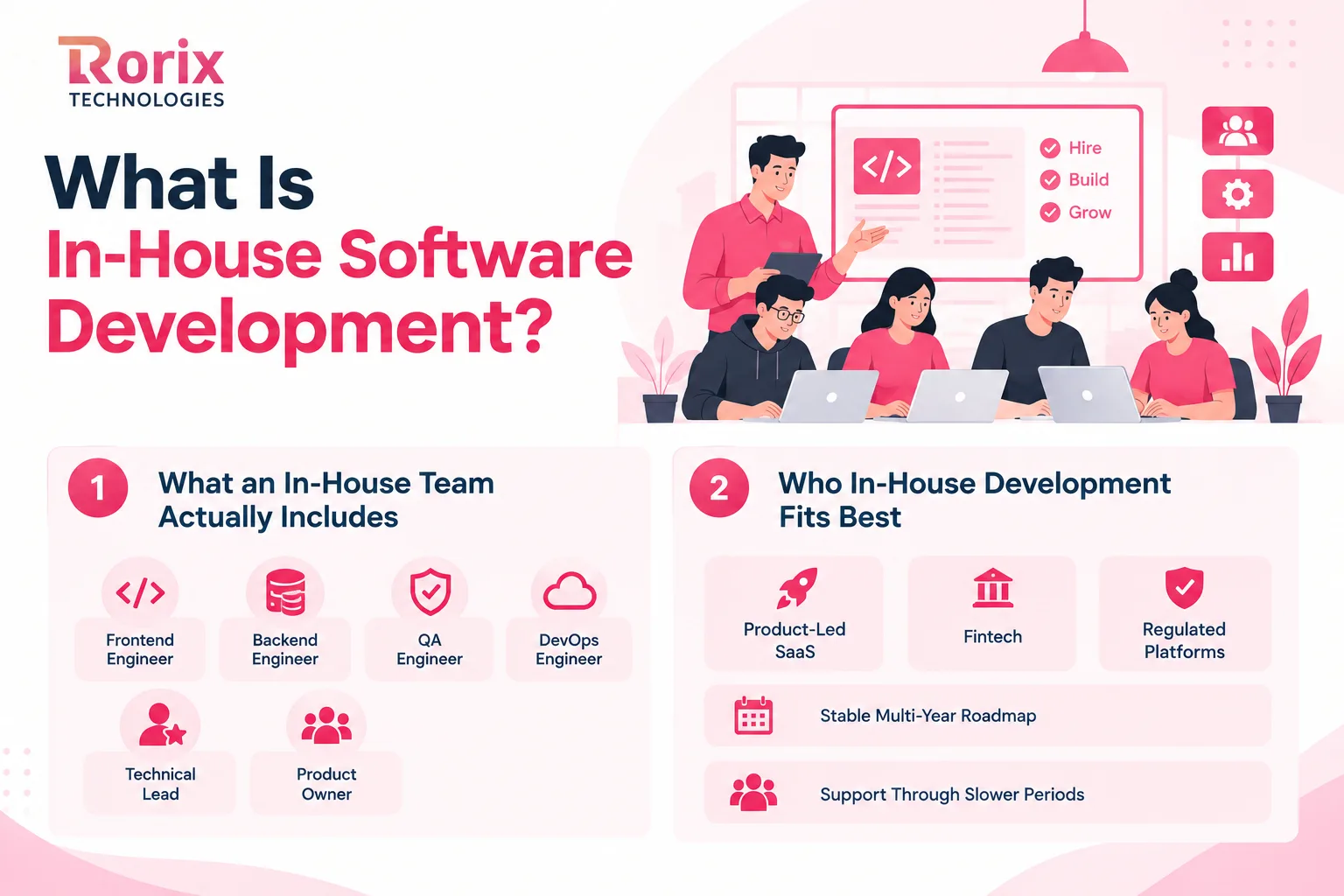
An in-house development team usually needs more than developers. Depending on the product, you may need frontend and backend engineers, QA, DevOps, and a technical lead. A product owner connects engineering with business goals.
Who In-House Development Fits Best
In-house development fits companies where software is central to the business, such as product-led SaaS, fintech, and regulated platforms. It also makes sense when you have a stable multi-year roadmap and can support the team through slower periods.
What Is Outsourcing Software Development?
Outsourcing software development means an external company provides the engineering capability your business needs. You can bring in a few specialists for your existing team or use a complete team to manage delivery from start to finish.
The model is no longer just about lower labor costs. Companies use software development outsourcing to access skills their local market lacks, start within weeks, and scale delivery without adding permanent headcount.
What you are really buying is an existing team with proven processes and shared experience. It can start work without you building an engineering organization from scratch.
The Three Engagement Models: Project-Based, Staff Augmentation, and Dedicated Team
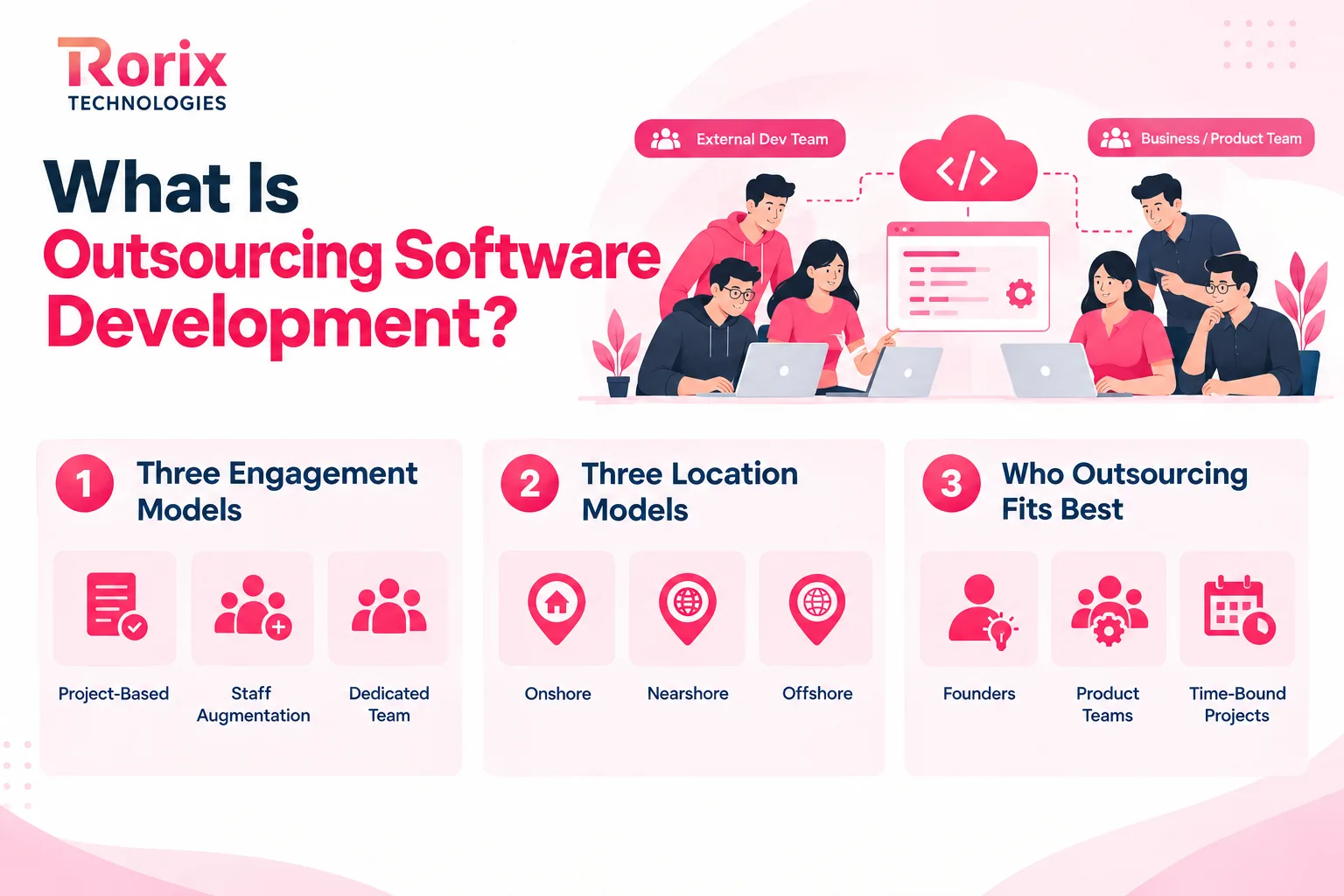
Project-based work fits a defined scope with clear acceptance criteria, with the partner responsible for delivery. IT staff augmentation adds specialists to your existing team, while a dedicated development team provides ongoing capacity and manages delivery around your priorities.
The Three Location Models: Onshore, Nearshore and Offshore
Onshore keeps the team in your country and usually comes at the highest rate. Nearshore offers closer time-zone overlap at a middle rate, while offshore provides broader talent access at lower rates. See our nearshore vs offshore software development guide for the key trade-offs.
Who Outsourcing Fits Best
Outsourcing fits founders validating ideas, operators replacing manual processes, and product teams with more roadmap than internal capacity. It also works well for time-bound projects such as migrations, integrations, and modernization programs that need specialist delivery without permanent headcount.
In-House vs Outsourcing Software Development: 12-Point Comparison Table
This 12-point comparison shows how in-house and outsourced development differ in cost, speed, control, scaling, security, and long-term ownership.
| Criterion | In-house development | Outsourcing development |
|---|---|---|
| Time to start | Four to five months from job post to productive hire | Two to six weeks from shortlist to first commit |
| Cost shape | Fixed and ongoing, even when the backlog is light | Variable and tied to capacity used |
| Cost predictability | Stable per employee, but turnover adds uncertainty | Predictable per sprint, with scope changes affecting cost |
| Specialist skills | Limited to available local or relocating talent | Access to a broader global talent pool |
| Scaling up | Requires another hiring cycle | Extra engineers can often join within one or two sprints |
| Scaling down | May involve layoffs, severance, and disruption | Contract notice can reduce capacity |
| Day-to-day control | Direct control over decisions and priorities | Managed through backlog, demos, and review gates |
| Quality assurance | Internal standards enforced by your team | Partner standards checked through your quality gates |
| IP and data security | Covered by internal policies and controls | Requires NDA, DPA, and clear IP assignment |
| Institutional knowledge | Builds and stays inside the company | Requires documentation and knowledge transfer |
| Management load | Recruiting, retention, performance, and career management | Vendor governance, scope control, and acceptance |
| Best fit | Core products, regulated systems, and stable long-term roadmaps | Speed, specialist skills, changing demand, and defined projects |
Pros and Cons of Each Model at a Glance
Both models have clear trade-offs. Use this section for a quick view before we break down cost, speed, control, and risk in detail.
1. In-House Software Development
Pros
- Direct control: You set priorities, review work, and make decisions without an external layer.
- Institutional memory: Knowledge stays with the team and grows as they work on the product.
- Clear IP ownership: Employees build under your internal policies and agreements.
- Cultural alignment: Engineers understand your customers, processes, and quality standards.
- Long-term efficiency: A stable team can become faster as it learns the codebase and business.
Cons
- High fixed cost: Salaries, benefits, equipment, and management continue even during quiet periods.
- Slow to build: Hiring, notice periods, and onboarding can delay delivery by months.
- Limited talent pool: Your hiring market can restrict access to specialist skills.
- Rigid capacity: Scaling down can mean layoffs, severance, and team disruption.
- Key-person risk: Losing an engineer with critical knowledge can create a delivery gap.
2. Outsourcing Software Development
Pros
- Fast start: An established team can begin work without a long hiring cycle.
- Specialist skills: You can bring in niche expertise when the project needs it.
- Flexible capacity: Team size can change with your backlog and delivery needs.
- Lower management load: Recruiting, retention, and HR remain with the partner.
- Relevant experience: Experienced teams can apply lessons from similar projects.
Cons
- Governance required: Clear backlogs, reviews, documentation, and communication are essential.
- Partner risk: Delivery quality depends heavily on the external team's processes and execution.
- Knowledge transfer: Documentation is needed to retain project context after the engagement.
- Security requirements: External access to code and data needs proper contractual and technical controls.
- Scope sensitivity: Unclear requirements can lead to change requests and higher costs.
Cost Compared: The Total Cost of Ownership Each Model Hides
The headline price rarely tells the full story. In in-house vs outsourcing software development, salary and hourly rates only make sense when you compare the full cost of hiring, managing, scaling, and delivering the work.
The in-house figures below are indicative US market ranges, so adjust them for your own market. Outsourced rates are blended global ranges. None of these are Rorix prices or quotes.
1. What an In-House Engineer Actually Costs Per Year
A developer's salary is only the starting point. The median annual wage for software developers was $133,080 in May 2024, according to the U.S. Bureau of Labor Statistics, before benefits, taxes, recruiting, tools, ramp time, and management.
| Cost line (per senior engineer) | Indicative market range per year |
|---|---|
| Base salary | $135,000 to $165,000 |
| Employer taxes and statutory cost | $11,000 to $14,000 |
| Health, dental and other benefits | $8,000 to $16,000 |
| Equipment, licenses and tooling | $3,000 to $6,000 |
| Recruiting fee, spread over the first year | $4,000 to $8,000 |
| Ramp time before full productivity | $10,000 to $20,000 |
| Management and leadership overhead | $5,000 to $12,000 |
| Fully loaded annual cost | $176,000 to $241,000 |
2. What an Outsourced Team Actually Costs
Blended senior rates across common delivery regions typically range from $30 to $75 an hour, or about $54,000 to $135,000 for a full-time equivalent year. The budget should also account for onboarding, product-owner time, communication, and handover.
Our breakdown of the cost of outsourcing software development shows how these costs can affect a real engagement.
3. Three-Year Total Cost of Ownership: A Side-by-Side Market Range
One year can hide turnover and replacement costs. A three-year total cost of ownership gives a clearer view, so this example compares a five-engineer team using the same indicative market ranges. Recruiting and ramp appear as their own rows here, so the loaded engineering line excludes them.
| Cost element over three years | In-house team (US market) | Outsourced team (blended offshore or nearshore) |
|---|---|---|
| Loaded engineering cost | $2,430,000 to $3,195,000 | $810,000 to $2,025,000 |
| Recruiting and replacement | $110,000 to $220,000 | Carried by the partner |
| Ramp and re-ramp losses | $75,000 to $160,000 | $15,000 to $35,000 |
| Management and HR overhead | Included above, plus leadership time | Reduced, shifted to vendor governance |
| Three-year indicative total | $2,615,000 to $3,575,000 | $825,000 to $2,060,000 |
Region, seniority, and technology stack can change the numbers significantly. Run your own model against the ranges in our custom software development cost guide before accepting a proposal.
4. The Hidden Costs Buyers Miss on Both Sides
In-house costs can grow through idle capacity, turnover, and recruiting. Outsourced projects can add costs through unclear requirements, slow decisions, and rework. Both should be included when calculating the real project cost.
5. The Cost of Delay That Never Reaches the Budget
A delayed build has a cost beyond the development budget. Six months of delay can mean six months without expected revenue, customer feedback, or operational improvements.
Not sure which model your budget supports? Get a free consultation and project estimate, and we will scope the work against both models before you commit.
Also Read: IT Staff Augmentation Cost: What You Actually Pay in 2026
Speed Compared: Time to First Commit and Time to Ship
The biggest speed gap between in-house and outsourced development happens before any code is written. Hiring can take months, while an established external team can move from shortlist to working software in weeks.
1. The In-House Hiring Timeline, Week by Week
Weeks one to three typically cover approval, compensation, and budget. Weeks three to nine go into sourcing, screening, and interviews. The U.S. Bureau of Labor Statistics projects computer and IT employment to grow much faster than average from 2024 to 2034, keeping skilled hiring competitive.
Weeks nine to thirteen can bring offers, counteroffers, and notice periods, followed by onboarding and ramp-up. In practice, one senior hire can take four to five months to become a productive contributor.
2. The Outsourcing Onboarding Timeline, Week by Week
The first week typically covers partner selection, problem definition, and proposals. Week two handles commercial terms, NDA, data processing, IP assignment, and access, followed by architecture context and environment setup.
By weeks three to six, a capable outsourced development team should be shipping a working increment. If nothing usable appears after two sprints, the delivery process deserves a closer look.
3. Where Each Model Slows Down After Go-Live
In-house teams can lose speed when support tickets and operational issues consume development capacity. External teams can stall when client decisions, unclear requirements, or an unmanaged backlog block delivery.
The model matters, but capacity planning and delivery discipline often determine whether the roadmap keeps moving.
Control Compared: What You Actually Own in Each Model
Control is often seen as the biggest advantage of in-house vs outsourcing software development. But control is not just about where engineers sit. It comes from clear decision rights, review gates, security controls, and contractual ownership.
1. Decision Rights Over Scope, Priority, and Architecture
With an internal team, priorities can change immediately. With an external partner, you keep that same authority through a shared backlog that you own and rank. The difference is that expectations and decision rights need to be clearly defined.
2. Code Quality, Review and Definition of Done
In-house quality depends on the standards your engineers enforce. With an external team, those standards can be written into the contract and the delivery pipeline. Use automated tests, coverage requirements, code reviews, and technical approval gates.
3. IP Ownership, Data Security and Compliance
Employee-created code is generally covered by employment agreements and applicable local law, while outsourced work needs clear contractual terms. Use explicit IP assignment, confidentiality terms, a data processing agreement, and least-privilege access to production data.
4. Institutional Knowledge and Key-Person Risk
In-house teams have a natural advantage because product knowledge stays with employees and grows over time. Outsourced teams need strong documentation and knowledge transfer, but internal teams can also face key-person risk when critical knowledge sits with one engineer.
Now that cost, speed, and control are clear, the next question is what can go wrong in either model and how to reduce that risk.
8 Risks in Both Models and How to Mitigate Each One
Both models come with different risks. The goal is not to avoid every risk. It is to identify the ones that could affect delivery, security, cost, or knowledge, then price the mitigation upfront.
| Risk | Model most exposed | Impact | How to mitigate it |
|---|---|---|---|
| IP leakage | Outsourcing | High | Sign an NDA, DPA, and explicit IP assignment before repository access |
| Key-person dependency | In-house | High | Use pair programming, documentation, and cross-training for critical systems |
| Uneven code quality | Outsourcing | High | Set coverage thresholds, security scans, and mandatory review by your technical lead |
| Hiring delay stalls the roadmap | In-house | High | Run a parallel external track while the hiring process continues |
| Vendor lock-in | Outsourcing | High | Negotiate exit terms, retain repository ownership, and define module ownership |
| Idle capacity in slow quarters | In-house | Medium | Keep a lean core team and flex additional capacity through partners |
| Knowledge loss at contract end | Outsourcing | Medium | Make runbooks and architecture documentation contractual deliverables |
| Stack drift and stagnation | In-house | Medium | Budget dedicated learning time and rotate engineers across systems |
When In-House Software Development Is the Right Choice
In-house development makes sense when software, domain knowledge, or long-term control is central to the business. These signals help you decide when a permanent team justifies its fixed cost and management effort.
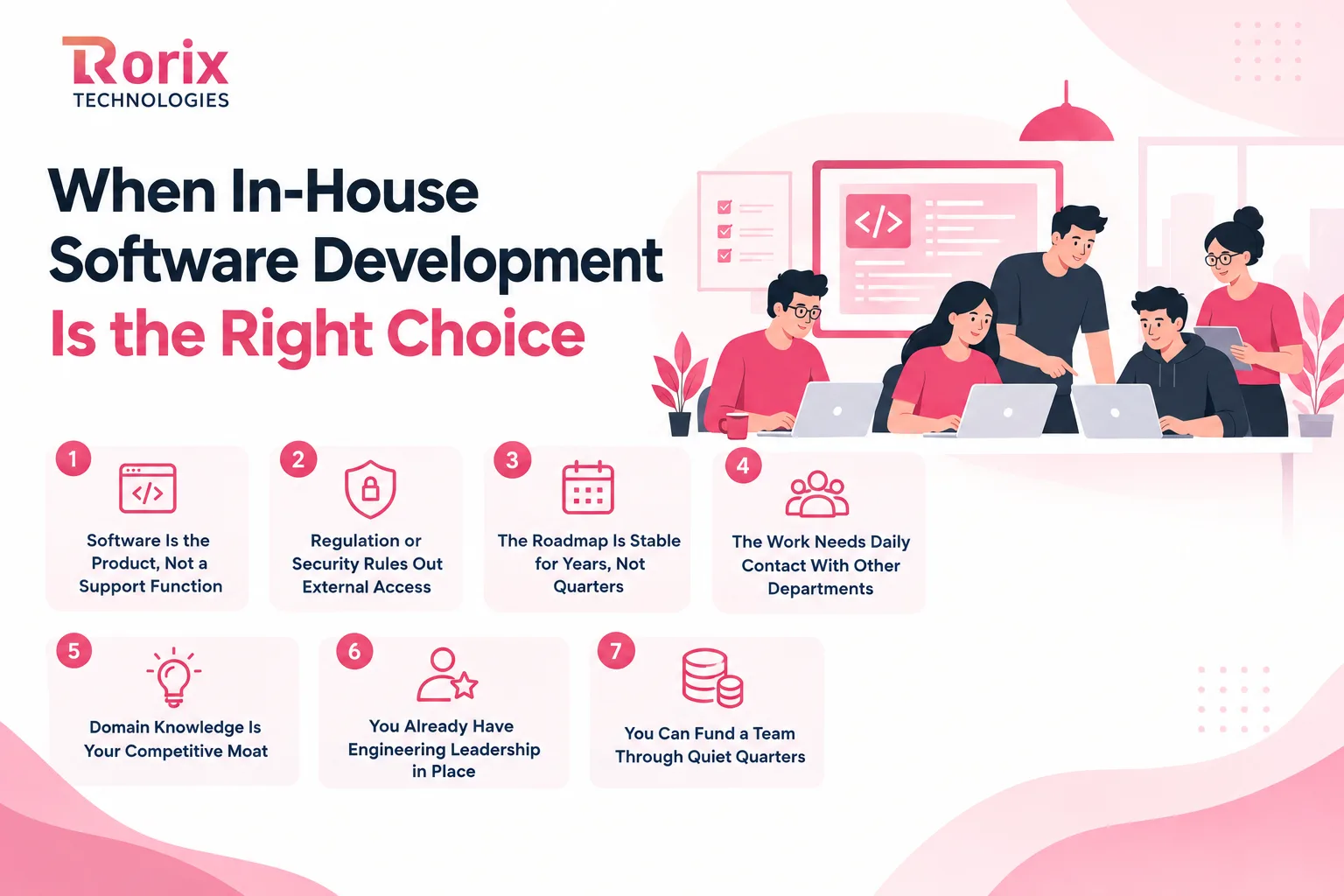
1. Software Is the Product, Not a Support Function
When customers pay for your software, keeping the engineering team in-house protects product knowledge, technical decisions, and lessons from production. It also gives you direct control over architecture, priorities, and future product changes.
2. Regulation or Security Rules Out External Access
Strict requirements around production data, access, and compliance can make internal development necessary. Defense systems, certain banking platforms, and health-related applications may need development and production controls to remain within the organization.
3. The Roadmap Is Stable for Years, Not Quarters
A predictable, multi-year roadmap gives an in-house development team steady work and time to build deeper business knowledge. That consistent demand can make permanent engineering capacity easier to justify than rebuilding a team for every project.
4. The Work Needs Daily Contact With Other Departments
Projects that depend on finance, operations, sales, or warehouse teams often need fast feedback and direct access to users. An internal team can shorten that feedback loop, clarify requirements faster, and respond quickly when business needs change.
5. Domain Knowledge Is Your Competitive Moat
When your advantage comes from understanding a complex workflow, internal engineers can build that knowledge through customer feedback, production incidents, and daily product work. This depth is difficult to transfer completely through documentation or a short project handover.
6. You Already Have Engineering Leadership in Place
A technical lead, architect, or engineering director provides direction on architecture, quality, priorities, and technical decisions. If that leadership capacity already exists, adding engineers is easier to manage and maintain consistent engineering standards.
7. You Can Fund a Team Through Quiet Quarters
An internal team creates fixed costs for salaries, benefits, tools, and management even when demand slows. If you have the runway to maintain that team through quieter periods, permanent capacity can support long-term product development.
When Outsourcing Software Development Is the Right Choice
Outsourcing makes sense when the main constraint is time, specialist skills, or flexible capacity rather than long-term ownership. It adds delivery power without requiring you to build a permanent engineering organization first.
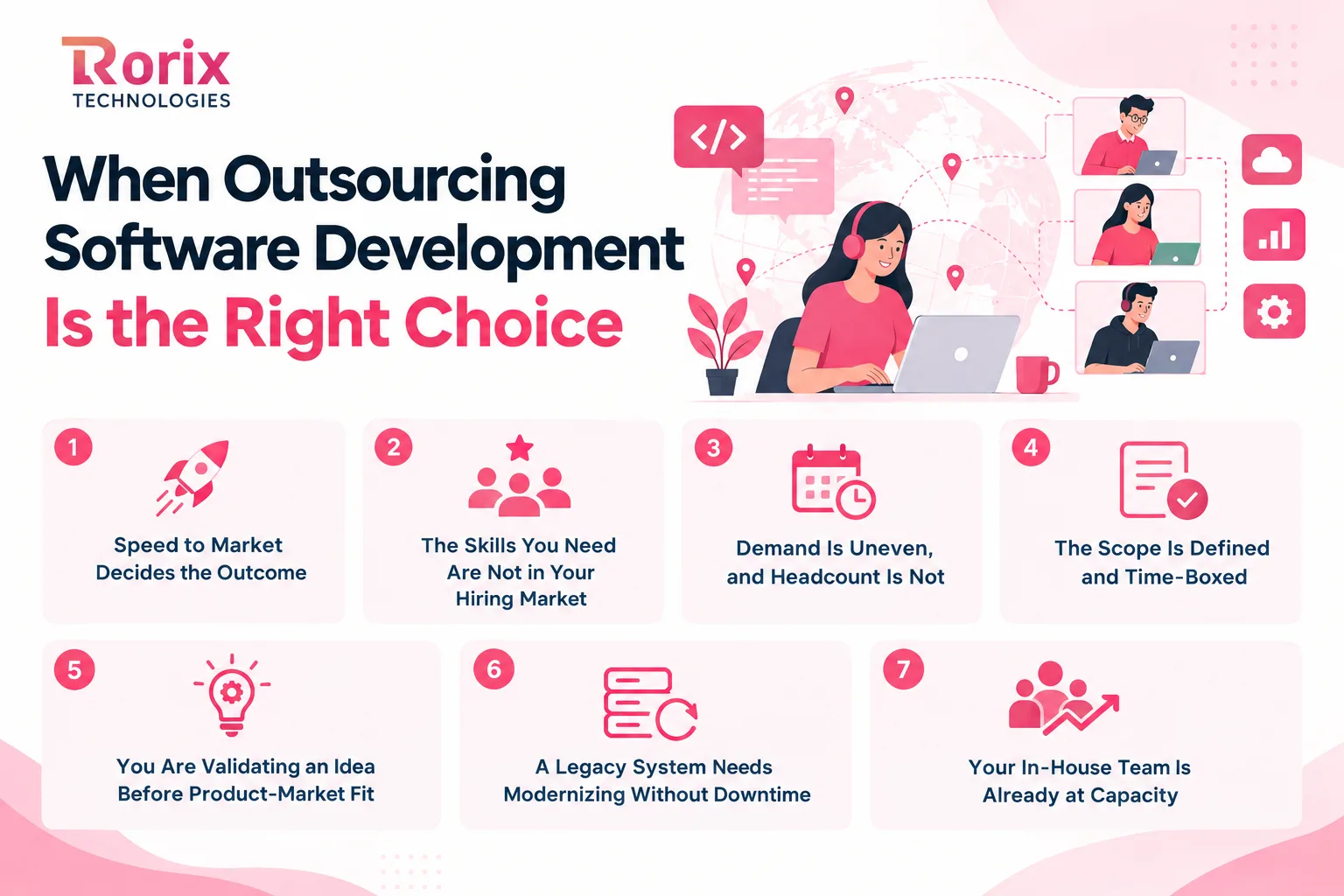
1. Speed to Market Decides the Outcome
When funding, customer commitments, or market deadlines create urgency, hiring may take too long. An outsourced development team can start within weeks and deliver a working increment while your internal hiring process is still underway.
2. The Skills You Need Are Not in Your Hiring Market
Specialist skills can be difficult to find locally, especially for real-time inventory systems, multi-tenant architecture, and integration-heavy platforms. Software development outsourcing gives you access to broader talent and relevant experience without waiting through multiple hiring cycles.
3. Demand Is Uneven, and Headcount Is Not
Seasonal peaks, launches, and migration projects can create temporary engineering demand. An outsourced team lets you increase capacity when the workload rises and reduce it when demand falls, avoiding permanent headcount for short-term work.
4. The Scope Is Defined and Time-Boxed
Defined work with clear requirements, deliverables, and acceptance criteria is easier to outsource. Integrations, reporting modules, mobile applications, and migration projects can fit into clear engagements with measurable delivery expectations.
5. You Are Validating an Idea Before Product-Market Fit
Building a permanent team before proving demand creates a large fixed commitment. An external team can build a working version, put it in front of users, and help you validate the idea before you expand your engineering organization.
6. A Legacy System Needs Modernizing Without Downtime
Legacy modernization often needs migration, integration, and infrastructure skills that your internal team may lack. Bringing in specialists adds focused capacity while your existing engineers continue supporting the live business.
7. Your In-House Team Is Already at Capacity
When your roadmap demands more delivery than the current team can provide, another hire may not solve the immediate gap. An outsourced development team can add capacity while your employees stay focused on architecture, product knowledge, and work requiring deeper internal context.
Also Read: Top 15 Small Software Development Companies for Startups
The Hybrid Model: What Most Operations-Heavy Companies Actually Run
Why choose one side when you can keep the critical work close and flex the rest? A hybrid software development model combines a small internal core with an external team for delivery capacity.
1. How to Split Work Between Your Team and Your Partner
Keep product vision, roadmap priorities, customer relationships, and architecture authority in-house. Let the partner handle feature delivery, QA, DevOps, integrations, and specialist work where external capacity adds value.
2. The Shared Operating Model That Makes Hybrid Work
Keep one backlog, one repository, one definition of done, and one standup. A clear code ownership map keeps both teams aligned and prevents coordination from becoming the new bottleneck.
3. When Hybrid Is the Wrong Answer
Hybrid adds coordination overhead, so it may not suit small or one-off projects. A single integration is often cleaner as a project engagement, while restricted systems may rule out external access completely.
How to Choose: A 7-Step Decision Framework
Still stuck between the two models? Work through these seven questions in order. By the end, your timeline, capabilities, constraints, and growth stage should point toward a clear model.
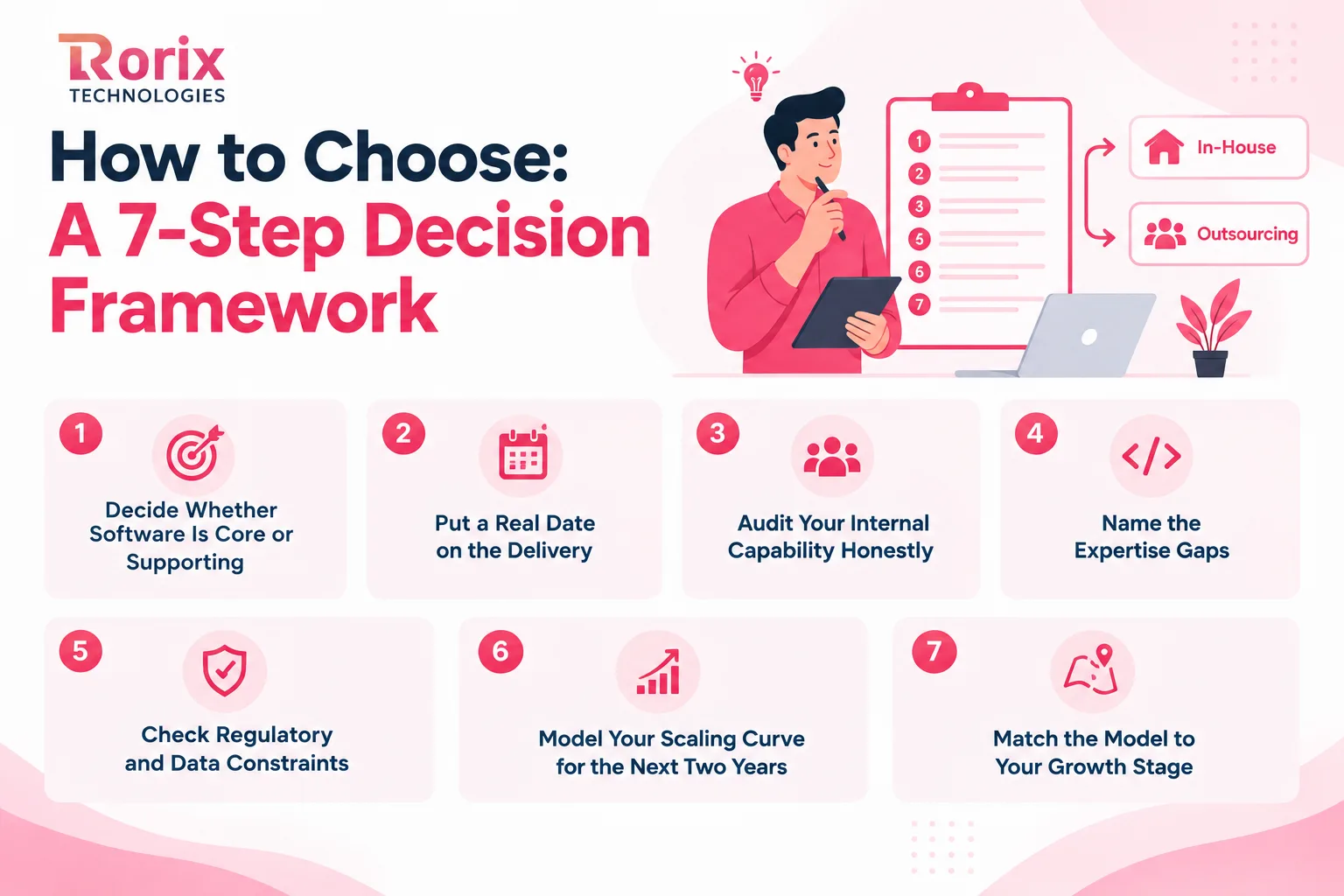
Step 1: Decide Whether Software Is Core or Supporting
Ask whether your product, revenue, or competitive advantage depends directly on the software. If yes, keep the core capability in-house; if it mainly supports operations, speed and flexibility may matter more.
Write the answer in one sentence and get leadership aligned. This single decision sets the direction for the steps that follow.
Step 2: Put a Real Date on the Delivery
Start with the production date and work backward through contracting, onboarding, development, testing, and compliance. If you need working software within three months, building a team from scratch may not fit the timeline.
Separate real commercial deadlines from internal preferences. A hard deadline strengthens the case for outsourcing, while a flexible timeline leaves more room for hiring.
Step 3: Audit Your Internal Capability Honestly
Check three things: technical leadership, your hiring process, and your ability to retain engineers. If two are weak, building an internal team will be difficult even with enough budget.
Be honest about your current capacity, not your ideal future state. That gives you a more realistic view of whether in-house development can support the roadmap.
Step 4: Name the Expertise Gaps
List the skills your next 12 months of work actually require, from multi-tenant architecture and real-time data to integrations and cloud migration. Mark each capability as available, learnable in time, or missing.
Permanent needs may justify hiring, while one-time or specialist gaps can be filled through software development outsourcing. This keeps hiring focused on skills you will need long term.
Step 5: Check Regulatory and Data Constraints
Ask legal and compliance teams what data an external team can access, where it can be processed, and which certifications or controls are required. Do this before shortlisting partners.
Some projects require internal development, while others can use scoped access, anonymized environments, and a proper data processing agreement. Get these requirements confirmed early.
Step 6: Model Your Scaling Curve for the Next Two Years
Estimate the delivery capacity you will need each quarter for the next two years. If demand has sharp peaks and troughs, permanent headcount can leave you overstaffed or underpowered at the wrong time.
Stable demand favors an internal team, while unpredictable demand often suits external or hybrid capacity. The shape of your workload matters as much as its size.
Step 7: Match the Model to Your Growth Stage
Finally, check whether your current business stage supports the model. The priority changes as you move from validation to growth, operations, and long-term product ownership.
| Business stage | Main priority | Model that usually fits |
|---|---|---|
| Pre-product-market-fit startup | Validate the idea quickly | Outsourcing |
| Post-MVP funded startup | Ship and iterate fast | Outsourcing or hybrid |
| Growth-stage SaaS | Scale delivery capacity | Hybrid |
| Operations-heavy SMB | Replace manual work | Outsourcing or hybrid |
| Mature product company | Own the long-term moat | In-house or hybrid |
| Enterprise modernization | Reduce delivery risk | Outsourcing or hybrid |
Revisit the decision as the business changes. The right delivery model can shift as your product, workload, skills, and constraints evolve.
How the Decision Plays Out in Five Real Build Scenarios
The framework becomes easier to apply when you see it in real projects. Here's how the delivery model can change based on the type of software, timeline, and internal expertise.
1. A WMS Replacing Spreadsheets on a Live Warehouse Floor
A live warehouse needs software that works without disrupting daily operations. If your internal team lacks warehouse deployment experience and the timeline is tight, an outsourced development team with domain expertise can handle delivery while your operations lead controls priorities.
2. An HRMS for a Staffing Business With Custom Payroll Rules
Custom payroll rules depend heavily on your contracts, jurisdictions, HR, and finance processes. A hybrid model keeps those business rules with internal owners while an external team handles the development work.
3. A Multi-Tenant SaaS MVP Chasing Its First Paying Customers
For an early SaaS product, speed and validation matter more than building a permanent team upfront. Our SaaS platform development work targets a first paying customer in 6 to 10 weeks, giving founders a faster path to market.
4. A Legacy Order Management System That Cannot Go Offline
Live-system modernization needs migration expertise without disrupting existing operations. Keep internal teams focused on business rules while specialists handle the migration window, then transition ownership once the new system is stable.
5. An Integration Layer Connecting CRM, Telephony and Field Apps
Integration projects often create a temporary spike in engineering demand, making permanent hiring difficult to justify. An external team can handle the build, while technology consulting helps define ownership and technical boundaries before development starts.
These scenarios show why the right model depends on the work, not just the company. The next step is choosing a partner carefully when outsourcing is part of the plan.
Also Read: How to Evaluate a Warehouse Management Software Development Company
Why Choose Rorix Technologies For Software Development
The right software partner should bring more than developers. It should bring domain expertise, clear ownership, consistent delivery, and accountability beyond the first release.
Rorix Technologies combines that delivery model with the working rhythm of an in-house engineering team.
Here's what that looks like in practice:
- Dedicated delivery: Senior engineers work in 2-week sprints with a named technical lead on every engagement.
- Proven delivery: 27 projects delivered across the US, UK, Canada, Australia, and New Zealand.
- Verified quality: 5.0 Clutch rating across 4 verified reviews.
- Measured impact: A Lorecs warehouse build cut manual errors by 80% using real-time inventory, barcode scanning, and automated workflows.
- Deep integration expertise: 40+ integrations on a single white-label SaaS platform built for a home-services company, with iOS and Android from one React Native codebase.
- Speed to market: SaaS MVP builds targeting a first paying customer in 6 to 10 weeks.
- Retainer model: Ongoing engineering capacity on a retainer rather than project handoffs, so the same team stays with the product.
- Domain expertise: WMS, HRMS, SaaS, and order management systems built around real workflows, not adapted from templates.
Book a free consultation with our experts to scope your project, team requirements, and the right development model.
Choose the Model That Fits the Work
The in-house vs outsourcing software development decision comes down to what the project needs. In-house gives you ownership and deeper product knowledge, while outsourcing adds speed, specialist skills, and flexible capacity. A hybrid model can bring both together when needed.
The right choice is not always the lowest rate. Compare the total cost, delivery timeline, internal capabilities, security needs, and long-term ownership before committing to a model.
We hope this guide helped you understand the real differences between the two approaches and gave you a practical way to choose the right team structure for your next build.
Ready to turn that decision into a clear delivery plan? Contact us today.
Frequently Asked Questions
Is outsourcing cheaper than in-house software development?
Usually, yes, over three years because you avoid recruiting, benefits, idle capacity, and turnover costs. In-house can make more sense when the same team supports a product for years.
Which model is faster, in-house or outsourcing?
Outsourcing typically starts faster, with a first commit in 2-6 weeks. A senior in-house hire can take 4-5 months to become productive.
Do you lose control when you outsource software development?
Not necessarily. A shared backlog, sprint demos, code reviews, and clear decision rights can give you strong control over outsourced delivery.
Who owns the code when you outsource software development?
Ownership depends on the contract. Use explicit IP assignment, repository ownership, and confidentiality terms to ensure the code belongs to your company.
When should a startup build an in-house development team?
Usually after demand is validated and the roadmap becomes predictable. Early-stage startups may outsource first, then bring core engineering in-house as the product grows.
What is a hybrid software development model?
A hybrid model keeps product ownership, architecture, and domain knowledge in-house while an external team adds delivery capacity. Both teams work from one backlog, repository, and definition of done.
Can you move from outsourcing to an in-house team later?
Yes. Start with a technical lead, overlap both teams, and transfer ownership module by module. Strong documentation and an exit clause make the transition easier.
What is the biggest risk in outsourcing software development?
Unclear requirements and poor partner selection are major risks. A clear contract, defined scope, and a paid pilot sprint can identify problems early.
Need engineers who stay?
Dedicated developers at $3,500 per developer per month, working your backlog on 2-week sprints with a named technical lead.
Continue learning
Written by
Renish DadhaniyaFounder & Director, Rorix Technologies
Renish co-founded Rorix Technologies and drives the engineering and delivery culture across the organization. Beyond engineering, he leads the company's sales, finance, and HR operations, building the infrastructure that lets the team focus on shipping quality software. With deep hands-on expertise in architecture and team building, he ensures every project lands on time to the quality standards clients demand.
View full profileRelated articles
IT Staff Augmentation Cost: What You Actually Pay in 2026
IT staff augmentation cost in 2026: real hourly rates, the fully loaded math against a US in-house hire, and the six cost lines no rate card shows you.
Read article
Nearshore vs Offshore Software Development: Which One to Choose In 2026
Three vendors quote the same build and the numbers barely overlap. Compare nearshore vs offshore software development on overlap, total cost and risk.
Read article
NestJS vs Express: Which Node.js Framework Fits Your Backend?
NestJS runs on Express by default, so this is not a performance contest. It is a decision about where your backend structure comes from, and who maintains it.
Read article