SaaS Development Agency Comparison: How to Evaluate and Choose a Partner in 2026
How to compare SaaS development agencies: what to evaluate, the questions to ask, generalist vs dedicated SaaS teams, and the hiring mistakes that cost most.
On this page27 sections
Key Takeaways: Score Agencies by Category and Fixed Criteria
To compare SaaS development agencies, evaluate the category they fall into and apply consistent criteria rather than picking from a vendor list. The wrong choice costs 12 to 18 months and a rebuild; the right one becomes a multi-year engineering partnership.
- Most vendors are one of four types: generalist agencies, offshore staff augmentation, dedicated SaaS teams, or Angular/React specialist agencies.
- Prioritize SaaS-specific architecture experience (multi-tenancy, subscription billing, versioned APIs, and SSO) over generic software experience.
- Framework specialization compounds: an Angular agency that has led major version migrations carries knowledge a generalist shop lacks.
- Use a fixed set of criteria to score any agency you evaluate, since a strong fit can become a partnership measured in years rather than sprints — our longest client partnership, begun by our founders before Rorix existed, has run since 2018.
What Hiring the Wrong SaaS Agency Really Costs You
Choosing a SaaS development agency is one of the highest-stakes vendor decisions a startup or scale-up makes. A wrong choice costs 12 to 18 months and a rebuild. A right choice can become an engineering partnership that compounds with every sprint; our longest client partnership, begun by our founders before Rorix existed, has run since 2018.
This guide is a practical SaaS development agency comparison framework, not a list of vendors to look at, but a set of criteria to apply to any agency you evaluate.
The Four Types of SaaS Development Agencies
Before you can compare agencies, you need to understand what category they fall into. If you would rather start from named firms, our ranked list of top SaaS development companies profiles 15 of them. Most vendors in this space are one of four things:
1. Generalist Digital Agencies
Build websites, apps, e-commerce stores, and occasionally SaaS products. Broad portfolio, shallow SaaS expertise. Rarely understand multi-tenancy, billing architecture, or long-term API design. Best for early MVPs where the SaaS model is still being validated.
2. Nearshore / Offshore Staff Augmentation
Provide individual engineers or small pods that embed into your existing team. You manage the work; they supply capacity. Best when you have a strong internal engineering lead and need to scale bandwidth quickly.
3. Dedicated SaaS Development Teams
Provide a full team, typically 2 to 4 engineers plus QA, that operates autonomously under a retainer. They own architecture, sprint planning, and delivery. Best for companies that do not want to build an in-house engineering team but need production-grade software shipped consistently.
4. Angular / React Specialist Agencies
Subset of dedicated SaaS teams with deep specialization in a specific frontend framework. An Angular SaaS development agency typically builds enterprise B2B products: data-heavy dashboards, complex filter systems, multi-tenant admin portals, and white-label platforms where Angular's module system and strict typing add real value.
The 8 Criteria That Separate Good Agencies From Great Ones
1. SaaS-Specific Architecture Experience
Generic software development experience does not transfer cleanly to SaaS. Ask specifically about:
- Multi-tenancy model: Have they built schema-per-tenant, row-level isolation, or shared schema? Do they know when to use each?
- Subscription billing: Have they implemented Stripe with seat-based pricing, proration, dunning, and trial logic? Or just a basic checkout?
- API design: Have they built a versioned public API with webhook delivery, retry logic, and OAuth for marketplace listing?
- Auth and SSO: Have they implemented SAML SSO, SCIM provisioning, or RBAC beyond basic role checks?
An agency that has built one SaaS product as a side project is different from one that has been an engineering partner on a production B2B platform for 5+ years.
2. Framework Specialization vs. Generalism
Framework choice matters in SaaS because the frontend architecture compounds over years. An Angular SaaS development agency that has maintained an Angular codebase through major version migrations (Angular 14 → 18 → 21) has accumulated knowledge about upgrade paths, breaking changes, and pattern libraries that a generalist React shop simply does not have.
Ask: "What Angular versions have you actively worked in? Have you led a major Angular migration in production?"
For React-first products, the equivalent question is about state management patterns, concurrent rendering, and Server Components, not just "we use React."
3. Engagement Length and Client Retention
The most revealing metric in a SaaS development agency comparison is average engagement length. An agency averaging 4-month engagements has a fundamentally different incentive structure than one averaging 4-year engagements.
Long average engagement length signals:
- Architecture decisions that hold up under load
- Communication that works across time zones
- Code quality that the client's internal team can read and extend
- A pricing model the client finds worth renewing
Short average engagement length signals the opposite, even if the case studies look polished.
4. Team Continuity on Your Account
Ask: "Will the engineers who built the first sprint still be on my account in month 12?"
Many agencies staff projects flexibly, which sounds efficient until you realize it means the context accumulated in the first 6 months leaves with the engineers who built it. Insist on named engineers committed to your account with a documented transition policy if someone leaves.
5. Code Ownership and Exit Terms
You should own every line of code from day one. The contract should explicitly state:
- IP assignment to the client
- All repositories under the client's GitHub/GitLab organization
- No proprietary tooling or deployment dependencies that create lock-in
- 30-day notice period with a structured handoff process
Any agency that hedges on code ownership is telling you something important about the relationship they want to have.
6. Fixed-Price vs. Retainer Model
Fixed-price engagements work for well-scoped, bounded projects (a specific integration, a redesign of one module). They fail for ongoing SaaS development because the product changes faster than any scope document.
A dedicated SaaS development team on a monthly retainer gives you:
- Predictable cost (fixed monthly fee for a defined team capacity)
- Flexible scope (you set priorities sprint-by-sprint)
- Aligned incentives (they want to keep the retainer, not bill change orders)
Be skeptical of any agency that insists on fixed-price for a 12-month SaaS roadmap. Nobody can scope that honestly.
7. QA and Testing Culture
Ask to see their PR template. A serious SaaS development agency should have:
- Automated tests required before a PR can merge
- A dedicated QA engineer (not developers testing their own code)
- Staging environment that mirrors production
- A clear definition of "done" that includes test coverage
QA shortcuts taken in the first 6 months of a SaaS build become security incidents and data bugs in month 18.
8. Communication Cadence and Transparency
Weekly standups and sprint demos are table stakes. What separates good agencies from great ones is how they communicate bad news:
- Do they raise blockers in the sprint, or do they wait until the sprint review to explain why things are late?
- Do they flag architectural risks before writing the code, or after the code is already merged?
- Do they give you visibility into what is actually hard, or do they manage the narrative?
Ask for a sample sprint review deck or retro summary from a previous engagement. The real ones have friction documented. The polished ones are marketing.
A Side-by-Side Comparison Template
Use this template when evaluating multiple agencies:
| Criterion | Agency A | Agency B | Agency C |
|---|---|---|---|
| SaaS specialization (multi-tenant, billing, API) | |||
| Framework depth (Angular/React version history) | |||
| Avg. engagement length | |||
| Named engineers committed to account | |||
| Full IP ownership in contract | |||
| Retainer model available | |||
| Dedicated QA on team | |||
| References from 2+ year clients | |||
| Angular migration experience |
Score each criterion 1 to 3 and total by column. This surfaces the gaps that reference calls and proposals tend to obscure.
The Questions to Ask in Every Agency Evaluation Call
These questions cannot be answered with marketing. The answers reveal real experience:
- "Walk me through the multi-tenancy model you chose for your most recent SaaS build and why."
- "Have you done a major Angular version migration in production? What broke?"
- "How do you handle a sprint where scope was underestimated?"
- "Can I speak to a client you have worked with for more than 18 months? I will call them directly."
- "Who is the specific engineer who would own my account? Can I meet them on this call?"
- "What does your QA process look like before a PR merges?"
- "If I decide to move to a different team in 12 months, what does the handoff look like?"
Agencies that answer these fluently with specifics have earned the right to proceed to a proposal. Agencies that answer in generalities have not.
Common Mistakes in SaaS Agency Selection
Choosing on portfolio aesthetics. A polished case study does not reveal who wrote the underlying code, how maintainable it is, or whether the client would hire them again.
Prioritizing cost over continuity. The cheapest agency per hour is often the most expensive over 18 months because of the re-onboarding cost when they roll off.
Skipping the reference call. Every serious evaluation should include a direct call with a previous client, not a managed reference, but an unscripted conversation.
Not reading the exit terms. Code ownership disputes are expensive. Read the IP and handoff clauses before signing, not after.
Choosing based on the sales lead, not the delivery team. The person in the discovery call is often not the person who writes the code. Insist on meeting the actual engineers before signing.
Summary: What a Great SaaS Development Agency Looks Like
The best Angular SaaS development agencies and React-first SaaS teams share a few traits that are not common in the broader agency market:
- They have delivered multi-tenant B2B SaaS products that are still in production 3+ years later
- They have named engineers who stay on accounts for the duration
- They offer retainer models with transparent capacity and predictable cost
- Their contracts give you full IP ownership without negotiation
- They push back on bad decisions before the code is written
- Their clients take unsolicited reference calls
Those traits are easy to claim and hard to fake. References and contract terms are where the real comparison happens.
Rorix Technologies is an Angular SaaS development agency and dedicated React development team based in India, serving product companies in the US, UK, Canada, Australia, and New Zealand. Longest client partnership: running since 2018, begun by our founders before Rorix existed. Book a free 30-minute architecture call or see our SaaS case studies.
Frequently Asked Questions
What are the four types of SaaS development agencies?
They are generalist digital agencies, nearshore or offshore staff augmentation, dedicated SaaS development teams, and Angular or React specialist agencies. Generalists offer broad but shallow SaaS expertise, staff augmentation supplies individual engineers into your team, dedicated teams own architecture and delivery under a retainer, and specialist agencies bring deep framework depth for enterprise B2B products.
What criteria should I use to compare SaaS development agencies?
Evaluate SaaS-specific architecture experience, framework specialization versus generalism, average engagement length and client retention, team continuity on your account, code ownership and exit terms, fixed-price versus retainer model, QA and testing culture, and communication cadence and transparency. Scoring each criterion across agencies surfaces gaps that proposals and reference calls tend to obscure.
Should I choose a fixed-price or a retainer engagement for SaaS development?
Fixed-price works for well-scoped, bounded projects like a specific integration or a single module redesign. Ongoing SaaS development is better served by a dedicated team on a monthly retainer because it gives predictable cost, flexible sprint-by-sprint scope, and aligned incentives. Be skeptical of any agency that insists on fixed-price for a 12-month roadmap, since nobody can scope that honestly.
Why does an agency's average engagement length matter?
Average engagement length is one of the most revealing metrics in an agency comparison because it signals architecture that holds up under load, communication that works across time zones, code quality the client's team can extend, and a pricing model worth renewing. An agency averaging four-month engagements has a fundamentally different incentive structure than one averaging multi-year partnerships.
What should the contract say about code ownership?
You should own every line of code from day one. The contract should explicitly state IP assignment to the client, all repositories under the client's GitHub or GitLab organization, no proprietary tooling that creates lock-in, and a 30-day notice period with a structured handoff. At Rorix, every engagement includes an NDA and 100% IP and source-code transfer to the client.
What engagement models and pricing does Rorix offer?
Rorix offers fixed-cost projects and dedicated development teams on a monthly retainer, starting from $3,500/month for a single developer, $10,000/month for 3 developers plus a dedicated PM, and scaling up to $30,000/month for 10 developers. Retainers are month-to-month with 5%, 10%, and 15% discounts at 3, 6, and 12 months, and every engagement includes an NDA and full IP transfer.
Comparing SaaS development agencies?
Put us on your shortlist. 5.0 on Clutch across 4 verified reviews, and 27 projects delivered.
Continue learning
Written by
Renish DadhaniyaFounder & Director, Rorix Technologies
Renish co-founded Rorix Technologies and drives the engineering and delivery culture across the organization. Beyond engineering, he leads the company's sales, finance, and HR operations, building the infrastructure that lets the team focus on shipping quality software. With deep hands-on expertise in architecture and team building, he ensures every project lands on time to the quality standards clients demand.
View full profileRelated articles
15 Top SaaS Development Companies in 2026
Compare 15 top SaaS development companies in 2026, including pricing, services, timelines, strengths, and tips to choose the right SaaS partner.
Read article
How to Hire a Dedicated Development Team: The Complete 2026 Guide
How to hire a dedicated development team that integrates with your workflow and stays long term: vetting steps, retainer models, and red flags to avoid.
Read article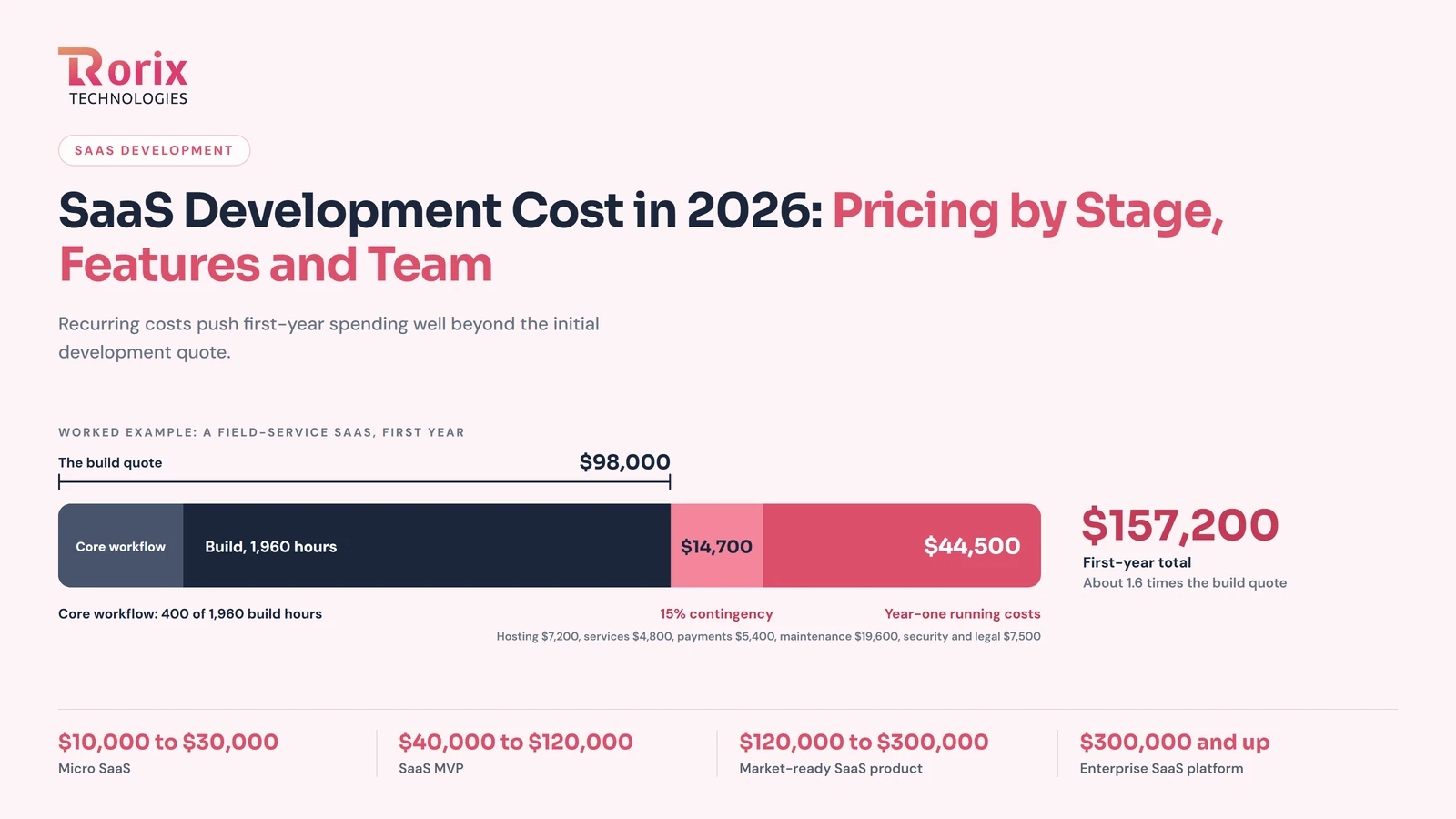
SaaS Development Cost in 2026: Pricing by Stage, Features and Team
Explore SaaS development cost in 2026, with pricing by product stage, features, team, and timeline, plus hidden expenses and ways to save money.
Read article