
How to Hire a Dedicated Development Team: The Complete 2026 Guide
How to hire a dedicated development team that integrates with your workflow and stays long term: vetting steps, retainer models, and red flags to avoid.
On this page23 sections
Key Takeaways: Vet the Stack, Then Sign a Monthly Retainer
To hire a dedicated development team, vet for production experience in your exact stack, timezone overlap, and ownership, then structure a monthly retainer instead of a project handoff. A dedicated team embeds in your product lifecycle and outperforms project-based agencies after about six months.
- A dedicated team works exclusively on your product under a monthly retainer, joining standups and owning features end-to-end.
- After 6 months it beats the project model on speed and quality because there is no per-sprint re-onboarding cost.
- Evaluate stack alignment (real production experience), communication patterns, and timezone overlap before signing.
- Offshore teams operate in a 2 to 4 hour overlap window at lower cost: Rorix rates run $20 to $30/hr versus $100 to $150/hr in the US.
- Rorix dedicated teams start at $3,500/month (1 dev) or $10,000/month (3 devs + PM) and are month-to-month with NDA and 100% IP transfer.
Why Getting This Hire Wrong Sets Your Product Back
Hiring a dedicated development team is one of the most consequential decisions a product company or scale-up can make. Get it right and you ship faster, spend less, and retain institutional knowledge for years. Get it wrong and you spend 18 months rebuilding what a previous team delivered.
This guide covers exactly what to look for, what to ask, what to pay, and how to structure a retainer so the engagement holds up under pressure.
What Is a Dedicated Development Team?
A dedicated development team is a group of engineers, typically a mix of frontend, backend, and QA, who work exclusively on your product under a monthly retainer. Unlike a project-based agency that hands off code and moves on, a dedicated team embeds into your product lifecycle:
- They join your standups
- They own features end-to-end
- They build context over years, not sprints
The offshore variant (most common for US and UK buyers) means the team is based in a lower-cost geography (Eastern Europe, South Asia, or Latin America) while operating in your timezone or a 2 to 4 hour overlap window.
Why Dedicated Teams Outperform Project-Based Agencies
| Factor | Project-Based Agency | Dedicated Team |
|---|---|---|
| Context retention | Resets each project | Compounds over years |
| Ownership | Hands off code, leaves | Stays accountable |
| Cost per feature | Higher (re-onboarding tax) | Lower at 6+ months |
| Speed | Fast to start, slow to deliver | Slower to start, faster at month 3+ |
| Alignment | Incentivized to close scope | Incentivized to keep you shipping |
After 6 months, a dedicated offshore development team retainer consistently outperforms the project model on both speed and quality, because there is no re-onboarding cost on every sprint.
The 5 Things to Evaluate Before You Hire
1. Stack Alignment (Not Just Familiarity)
Ask for evidence of production experience in your exact stack, not just the framework. A team that has "used React" is not the same as a dedicated React development team that has maintained a multi-tenant React application through three major version migrations.
What to ask:
- "Walk me through the most complex state management problem you solved in React."
- "Which version of Angular are your active clients on? Have you done a major version migration?"
- "What does your testing strategy look like for a TypeScript monorepo?"
2. Communication Patterns and Timezone Overlap
The best offshore dedicated development teams can function with 2 to 4 hours of live overlap per day. Below that, async discipline becomes critical. Above that, you get near-shore speed at offshore rates.
What to verify:
- Which hours is the team reliably online?
- How are blockers communicated when there is no overlap?
- Can you talk to a previous client about how communication worked in practice?
3. Client Retention (The Only Signal That Matters)
Average engagement length tells you everything a portfolio cannot. An agency with 12 clients over 3 years has different retention than one with 8 clients over 7 years.
Ask directly: "What is your average engagement length?" and "Can you introduce me to a client you have worked with for more than 2 years?"
At Rorix Technologies, our longest client partnership has run since 2018, begun by our founders before Rorix existed, because we stay until the product no longer needs us.
4. Code Ownership and Handoff Terms
Some agencies retain IP or use proprietary tooling that makes it difficult to transition away. Insist on:
- Full source code ownership from day one
- No proprietary deployment tools
- Clean git history and documented architecture decisions
- 30-day handoff window written into the contract
5. Retainer Structure and Ramp Curve
A dedicated team engagement should have a defined ramp period (usually 4 to 6 weeks), fixed monthly capacity (number of dev hours or story points), and a clear renewal cadence (monthly or quarterly). Avoid any agency that cannot give you a month-by-month cost projection for the first 6 months.
What Does a Dedicated Development Team Retainer Cost?
Costs vary significantly by region and seniority. These are 2026 market benchmarks for a full-stack dedicated team (2 senior engineers + 1 QA):
| Region | Monthly Retainer Range |
|---|---|
| Eastern Europe | $12,000 to $22,000/mo |
| South Asia | $6,000 to $14,000/mo |
| Latin America | $14,000 to $24,000/mo |
| US / Canada onshore | $35,000 to $65,000/mo |
For a dedicated React development team with Angular expertise (common for SaaS products), expect the mid-range of each bracket: teams with strong frontend specialization command a 15% to 20% premium over generalist shops.
The 7 Red Flags to Walk Away From
- They cannot name a client you can call. References that require scheduling are coached. Real long-term clients take calls on short notice.
- The proposal includes a full rewrite of working code. This is a billing strategy, not an engineering recommendation.
- No dedicated QA on the team. The frontend team should not be writing and testing their own work.
- They quote a fixed price for a 12-month product. Nobody can scope a year of product work. Honest teams quote sprints and milestones.
- The tech lead who does the sales call disappears after signing. Ask who will be in your weekly standup by name before you sign.
- No opinion on architecture. A senior team should push back on bad decisions. If they agree with everything in the discovery call, they will agree with everything in production too.
- Turnover in their own team. Ask directly: "How long have the engineers who would work on my product been with your company?" Churn in the vendor's own team predicts churn on your account.
How to Structure the First 90 Days
The first 90 days of a dedicated offshore development team retainer determine whether the engagement reaches its potential or quietly fails. Here is a structure that works:
Days 1 to 14: Codebase Orientation
- Provide full read access to the codebase and documentation
- Schedule 3 to 4 architecture walkthroughs (no code written yet)
- Define the communication protocol: standup format, blocker escalation, PR review SLA
Days 15 to 30: First Deliverable
- Pick one well-defined, medium-complexity feature
- It should touch the core of the stack (not a styling change)
- Review the PR together. This reveals how they think, not just what they ship
Days 31 to 90: Cadence
- Two-week sprints with mid-sprint check-ins
- Retrospective at the end of each sprint
- Review capacity vs. velocity. Adjust team size at Day 90 if needed
Questions to Ask in the Final Interview
Before signing, run through this list with the team lead:
- What was the hardest integration you have delivered, and how did you handle the edge cases?
- Describe a time a client asked you to build something the wrong way. What did you do?
- How do you handle a sprint where you underestimated scope?
- What does your documentation practice look like? Show me an example.
- Who owns architecture decisions, you or the client?
Answers to these questions reveal whether you are hiring engineers or order-takers.
Final Checklist Before You Sign
- References from 2+ clients with 12+ month engagements
- Sample codebase or PR history reviewed by your in-house tech lead
- Contract includes full IP ownership, handoff terms, and 30-day notice period
- Named engineers confirmed for your account (not "a senior team")
- Timezone overlap and async protocol agreed in writing
- Month-by-month cost projection for first 6 months
- Clear definition of "done" for the first sprint
A Dedicated Team Is a Product Partnership, Not Procurement
Hiring a dedicated development team is not a procurement decision. It is a product partnership. The best offshore development team retainers last 3 to 7 years because both parties invest in shared context, communication, and technical standards from day one.
Evaluate for retention, not just portfolio. Ask for references, not case studies. Insist on code ownership, not just delivery. And pick a team that pushes back, because the ones who agree with everything in the sales call will agree with everything in production too.
Rorix Technologies provides dedicated React development team and Angular SaaS development engagements to product companies in the US, UK, Canada, Australia, and New Zealand. Longest client partnership: running since 2018, begun by our founders before Rorix existed. Book a free 30-minute call to discuss your retainer requirements.
Frequently Asked Questions
What is a dedicated development team?
A dedicated development team is a group of engineers, typically a mix of frontend, backend, and QA, who work exclusively on your product under a monthly retainer. Unlike a project-based agency that hands off code and moves on, a dedicated team embeds into your product lifecycle: they join your standups, own features end-to-end, and build context over years rather than sprints.
How much does a dedicated development team retainer cost?
For a full-stack dedicated team of 2 senior engineers plus 1 QA, 2026 benchmarks range from $6,000 to $14,000/mo in South Asia, $12,000 to $22,000/mo in Eastern Europe, $14,000 to $24,000/mo in Latin America, and $35,000 to $65,000/mo for US/Canada onshore. At Rorix Technologies, dedicated team retainers start at $3,500/month for a single developer, run $10,000/month for 3 developers plus a dedicated project manager, and scale up to $30,000/month for 10 developers.
What should I evaluate before hiring a dedicated team?
Focus on five things: stack alignment with evidence of production experience in your exact stack, communication patterns and 2 to 4 hours of timezone overlap, client retention measured by average engagement length, code ownership and clean handoff terms, and a clear retainer structure with a defined ramp period and month-by-month cost projection.
Why do dedicated teams outperform project-based agencies?
After about six months, a dedicated team consistently beats the project model on both speed and quality because there is no re-onboarding cost on every sprint. Context compounds over years, the team stays accountable instead of handing off code, and they are incentivized to keep you shipping rather than to close scope.
Do I keep ownership of the code and IP?
Yes. You should insist on full source code ownership from day one, no proprietary deployment tools, clean git history with documented architecture decisions, and a handoff window written into the contract. Every Rorix engagement includes an NDA and 100% IP and source-code transfer to the client.
How should I structure the first 90 days of the engagement?
Use a three-phase ramp: Days 1 to 14 for codebase orientation with architecture walkthroughs and a defined communication protocol; Days 15 to 30 for one well-defined, medium-complexity first deliverable reviewed together; and Days 31 to 90 for steady two-week sprints with mid-sprint check-ins, retrospectives, and a capacity-versus-velocity review at Day 90 to adjust team size if needed.
Need engineers who stay?
Dedicated developers at $3,500 per developer per month, working your backlog on 2-week sprints with a named technical lead.
Continue learning
Written by
Renish DadhaniyaFounder & Director, Rorix Technologies
Renish co-founded Rorix Technologies and drives the engineering and delivery culture across the organization. Beyond engineering, he leads the company's sales, finance, and HR operations, building the infrastructure that lets the team focus on shipping quality software. With deep hands-on expertise in architecture and team building, he ensures every project lands on time to the quality standards clients demand.
View full profileRelated articles
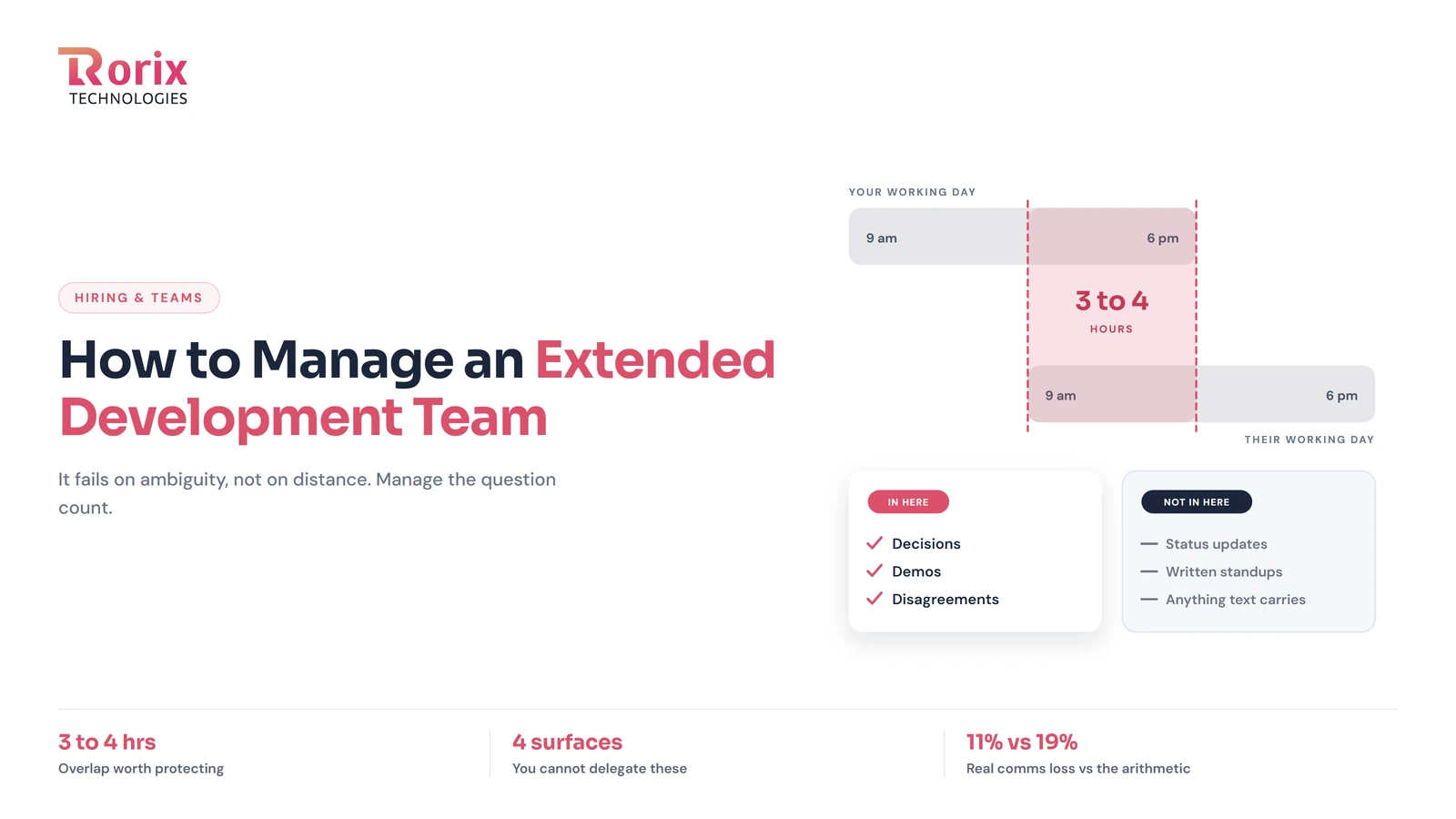
How to Manage an Extended Development Team
Managing an extended development team is not about more status calls. Here is the ownership, written decisions, and overlap that make a distributed team ship.
Read article
Staff Augmentation vs Dedicated Team: Which Model Fits Your Roadmap?
You added the engineers and delivery still slipped. Compare staff augmentation vs dedicated team on delivery ownership, management load and continuity.
Read article
React vs Angular for Enterprise Applications: A 2026 Comparison from Engineers Who've Used Both
An honest, project-grounded comparison of React and Angular for enterprise applications in 2026, from an engineering team that ships both in production.
Read article