
How to Manage an Extended Development Team
Managing an extended development team is not about more status calls. Here is the ownership, written decisions, and overlap that make a distributed team ship.
On this page28 sections
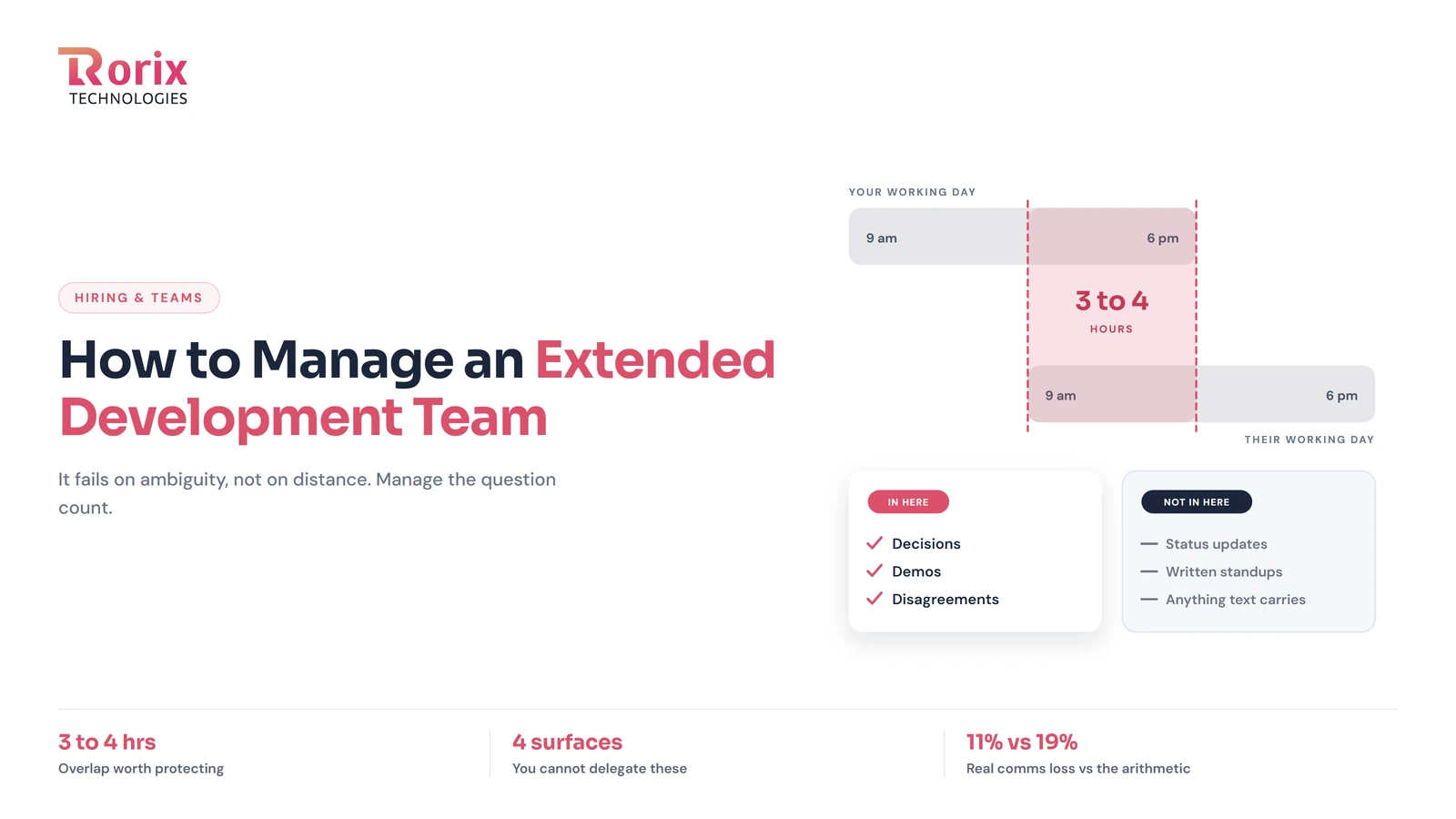
An extended development team fails on ambiguity, not on distance. The job of managing one is to reduce the number of decisions that have to cross the gap between you and them, because every decision that crosses it waits a day. Adding status calls does the opposite: it moves more decisions into the gap instead of fewer.
That distinction matters because almost every guide in this category stops at the signature. There are ten posts on this site about choosing a model, comparing rates, and vetting a partner, and the hard part starts the morning after all of that is settled, when four engineers you have never met open your repository and start asking questions you did not know were ambiguous.
This guide covers the part nobody writes about: the operating system you run once the team is yours.
In this guide, you'll learn:
- Why time zone separation costs less than managers expect, and what it actually costs
- The 4 surfaces someone on your side has to own from day one
- How much working-hours overlap you genuinely need, and what to do with the rest
- What to write down before the first sprint so the same question is not asked twice
- A 30-day plan for a team that started this week
- The metrics that tell you the arrangement is working before revenue does
Quick Answer: What Managing an Extended Development Team Requires
| What you manage | What good looks like | What it costs when missing |
|---|---|---|
| Decision ownership | One named person on your side answers scope questions within a working day | Work stops or, worse, continues on a guess |
| Written decisions | Every architectural choice recorded with its context and consequences | The same debate reopens every few months |
| Definition of done | Written before the sprint, not negotiated at review | Rework that looks like slow delivery |
| Working-hours overlap | 3 to 4 hours, protected and used for decisions only | Questions queue overnight and compound |
| Delivery metrics | Lead time and change failure rate, tracked from week one | You find out at the demo |
| Direct access | Your engineers talk to their engineers without a relay | Requirements degrade at every hop |
The pattern underneath all six: an extended team is not slower because it is far away. It is slower when it has to wait for you.
Key Takeaways: What Makes an Extended Development Team Ship
- An extended development team fails on ambiguity, not on distance, so the number to manage is the count of questions per sprint that only you can answer.
- A 2024 Organization Science study of 12,038 employees by Chauvin, Choudhury, and Fang found that one extra hour of time zone separation cut synchronous communication by 11%, even though that hour removed 19% of overlapping business hours.
- Three to four hours of protected overlap is enough, and it should carry decisions and demos only, because status is the one thing that transfers perfectly in writing.
- Michael Nygard's five-part architecture decision record (title, context, decision, status, and consequences) takes about ten minutes to write and stops the same question being asked twice.
- Rorix prices a single dedicated developer at $3,500 per month and a three-developer team with a project manager at $10,000 per month, with infrastructure and DevOps staying with the client.
What Actually Changes on Day One of an Extended Engagement
The contract changes who writes the code. It does not change who owns the product, and that gap is where most engagements go wrong in the first month.
An in-house engineer resolves small ambiguities by turning around. They see which way the team leans, they overhear the reason a library was rejected last quarter, and they absorb a hundred unwritten conventions without anyone deciding to teach them. None of that transfers. When you extend your team, every one of those invisible transactions becomes an explicit one, and the ones that do not get made explicitly get guessed.
This is why the first month of an extended engagement often looks disappointing even when the engineers are excellent. Velocity in week two is not measuring their ability. It is measuring how much of your product knowledge existed in a form that could be transferred. If you have already read what a dedicated development team is and when to hire one, this is the operational answer to the question that post leaves open.
Why Time Zone Separation Costs Less Than Managers Expect
Distance is the fear everyone brings to this arrangement, and it is the wrong thing to be afraid of. The research on it is unusually good.
Jasmina Chauvin, Prithwiraj Choudhury, and Tommy Pan Fang studied communication records from 12,038 employees at a large multinational, using cities' shifts to and from daylight saving time to isolate the effect of a single hour. Their finding, published in Organization Science in 2024, is that a one-hour increase in temporal distance reduced synchronous communication by 11%, even though that hour represented a 19% loss of overlapping business hours. As Fang put it in the Rice University summary of the work, "This was less than we expected."
The reason the loss is smaller than the mechanical arithmetic predicts is that people time shift. They move work-related communication outside standard hours to keep the collaboration alive, and the study found collaborative workers do this most.
Two conclusions follow, and they point in opposite directions.
The first is reassuring: a distributed team absorbs time zone separation better than a spreadsheet suggests. Your engineers will adapt, and so will theirs.
The second is the warning. That absorption is paid for by individuals, quietly, in their evenings. It is a real cost that does not appear on any invoice, and a team that relies on it indefinitely is running on goodwill it never negotiated for. The management goal is not to maximize how much people time shift. It is to need less of it, by reducing how much has to be synchronous at all.
The Real Constraint Is How Many Decisions Cross the Gap
Every hour of separation is a multiplier on one specific thing: the cost of an unanswered question.
Work through it concretely. An engineer in a nine-hour-offset time zone hits an ambiguity at 2 p.m. their time. You are asleep. They can guess and keep moving, or they can park the ticket and pick up something else. If they guess and guess wrong, you find out at review and pay for rework. If they park it, the question waits until your morning, your answer lands at their evening, and a fifteen-second decision has consumed most of a working day.
Neither outcome is a communication failure. Both are ambiguity failures. The question should not have needed you.
So the number to manage is not meeting hours or response time. It is the count of questions per sprint that only you can answer. Track it for two sprints and the pattern is always the same: they cluster. Most of them come from three or four genuinely undecided areas of the product, and once those are decided in writing, the question count drops off a cliff. Teams that never do this exercise conclude that offshore delivery is inherently slow, when what is actually slow is a product with four unresolved decisions in it.
This is also why seniority matters more at distance than nearby. A senior engineer resolves more ambiguity without asking, correctly. That is not a soft skill, it is the entire economics of the arrangement, and it is the reason staff augmentation and a dedicated team behave so differently in practice despite looking similar on a rate card.
The 4 Surfaces Someone on Your Side Must Own
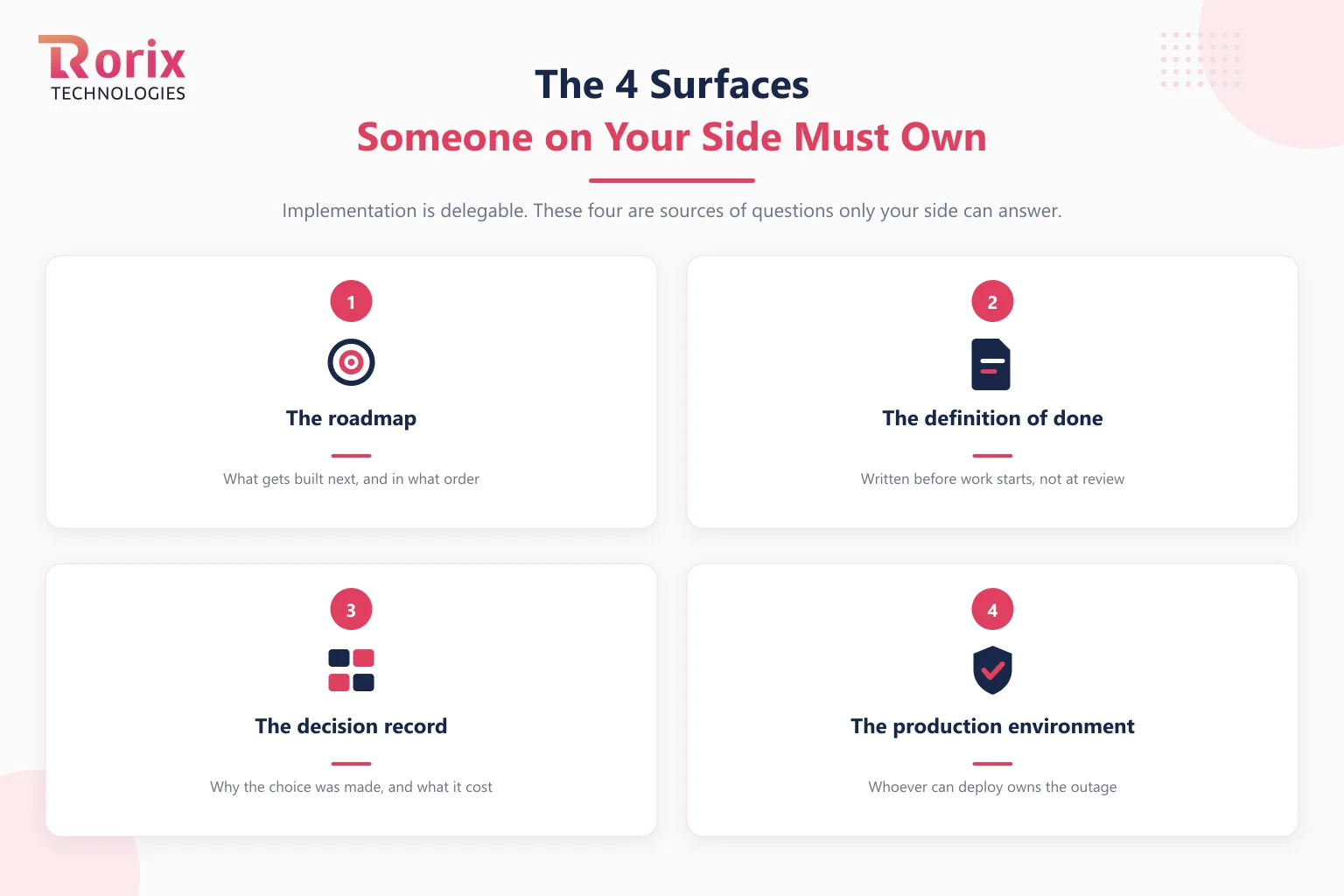
You can outsource implementation. These four cannot go with it, because each one is a source of questions that only your side can answer.
The roadmap. Someone on your side decides what gets built next and in what order. A partner can advise on sequencing and will usually have a view on technical dependencies, but priority is a business judgment. When priority is delegated, the team optimizes for what is easiest to finish rather than what is most valuable to finish, and neither party notices for a quarter.
The definition of done. Written before work starts, covering test expectations, browser and device support, error states, accessibility, and what "handled" means for a failure case. This is the single highest-leverage document in the engagement. Almost everything that gets called a quality problem is a definition-of-done problem discovered late.
The decision record. Covered in its own section below.
The production environment. Rorix's own scope is application engineering, with infrastructure and DevOps staying with the client, and that boundary is worth holding regardless of who your partner is. Whoever can deploy to production owns the outage. Keeping that on your side keeps the accountability legible, and it keeps a partner transition from becoming an infrastructure migration.
Everything else is genuinely delegable. Architecture within a decided direction, implementation, code review, testing, sprint mechanics, and estimation all work fine in an extended team, and trying to hold them centrally is how a manager becomes the bottleneck they were afraid of.
How Much Time Zone Overlap Do You Actually Need?
Three to four hours, protected, and used almost entirely for decisions.
Below about two hours, the day has no room for a question and its answer to happen in the same day, so every ambiguity costs a full cycle. Above five or six, you are paying for a schedule someone dislikes without buying much: the marginal hour goes to work that did not need to be synchronous anyway.
What matters more than the size of the window is what occupies it. The common failure is filling the overlap with status. Status is the one thing that transfers perfectly in writing, asynchronously, at no cost to anyone's evening. Spending scarce shared hours on it is the single most expensive scheduling mistake in this arrangement.
Overlap should be spent on the things that genuinely degrade in text: an unresolved design disagreement, a demo with a real reaction attached, a question where the answer depends on reading the room. If your overlap calls could be replaced by a written update without loss, they should be.
The geography question that sits underneath this is covered separately in nearshore versus offshore development, which compares the models on overlap, cost, and communication distance rather than on management practice.
What to Write Down Before the First Sprint
The document that pays for itself fastest is the one recording why things are the way they are.
Michael Nygard named the problem precisely in his 2011 post documenting architecture decisions: "One of the hardest things to track during the life of a project is the motivation behind certain decisions." Without that record, he argued, a newcomer faces two bad options, to blindly accept a decision or to blindly change it, and both are dangerous when the original circumstances are invisible.
His format, the architecture decision record, has five parts: a title, the context and forces at play, the decision itself, its status, and its consequences both good and bad. It takes about ten minutes to write one.
For an extended team, this is not documentation hygiene. It is the mechanism that stops a question being asked twice. An engineer who can read why you rejected the obvious approach does not need to ask, does not guess, and does not quietly reintroduce it six months later.
Alongside the decision records, four things are worth writing before sprint one:
- A domain glossary. Every business has terms that mean something specific internally. In warehouse software, "allocated" and "reserved" are different states with different consequences, and a team that guesses at the difference will build the wrong one.
- The definition of done, as above.
- A system map, however rough, showing which services exist, which own which data, and where the integration seams are. If the estate has grown past a handful of systems, how to think about integration strategy covers the structural version of that question.
- The escalation path. Who to contact when production is broken and the usual person is asleep, with a real phone number on it.
How to Run the First 30 Days of an Extended Team
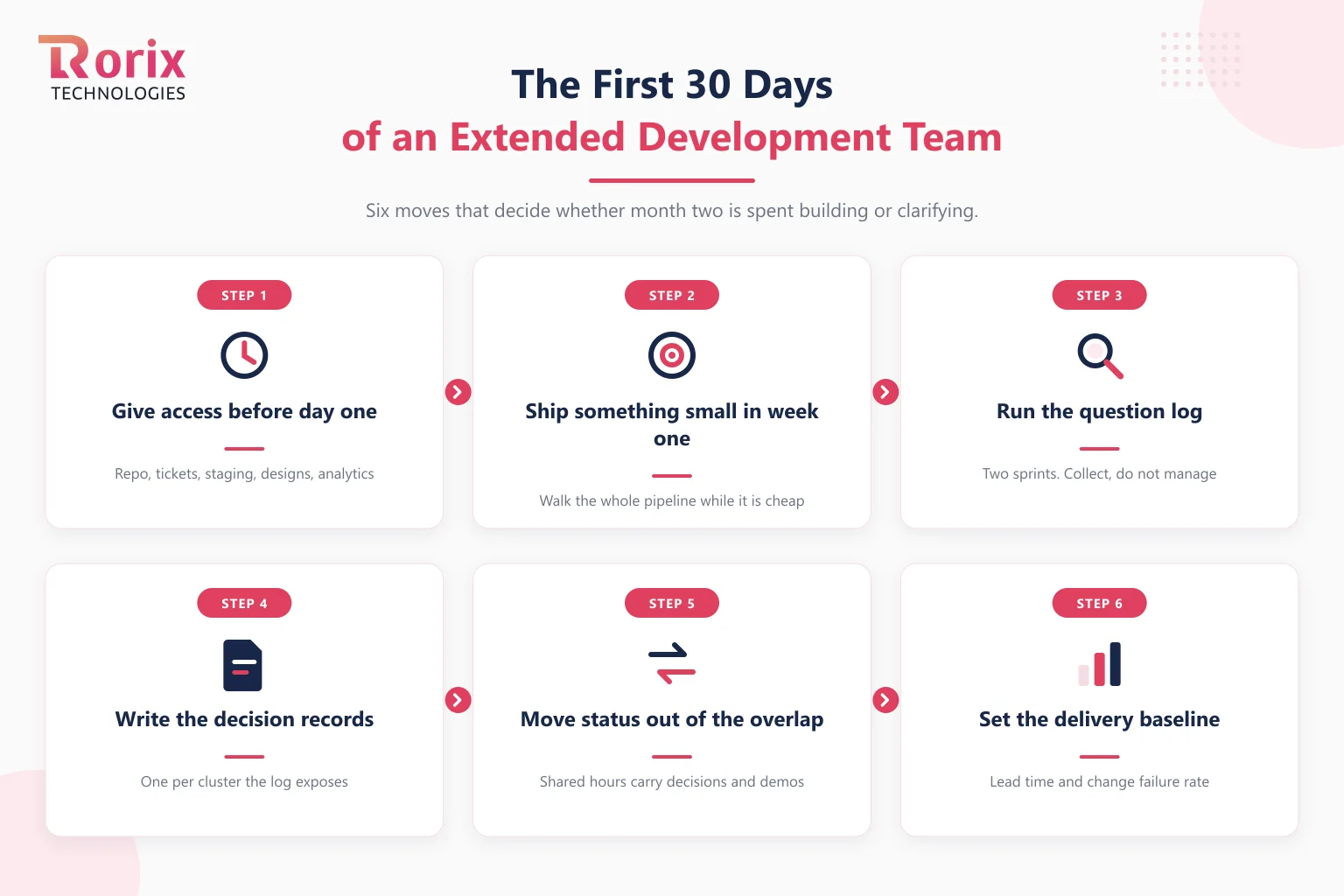
Step 1. Give Access Before Day One
Repository, ticketing, staging environment, design files, and the analytics dashboard should be provisioned before the first morning. Access delays are the most common cause of a wasted first week, and they are entirely self-inflicted. A team that spends four days waiting for a credential has burned a fifth of its first month.
Step 2. Ship Something Small in Week One
Pick a change that is genuinely small, genuinely real, and goes all the way to production. The goal is not the feature, it is to walk the entire pipeline once while it is cheap to discover what is broken in it. Every hidden step comes out: an undocumented environment variable, a review gate nobody remembered, a deploy that requires a person who is on leave.
Step 3. Run the Question Log for Two Sprints
Keep one shared list of every question the team had to escalate, with the date and who answered it. Do not manage it, just collect it. After two sprints the clusters are obvious, and each cluster is a decision record waiting to be written. This is the cheapest diagnostic in the entire engagement and almost nobody runs it.
Step 4. Write the Decision Records the Log Exposes
Take the clusters and resolve them in writing, one record each, in Nygard's five-part format. Expect four to eight of them. This is the single action that most reliably changes the trajectory of an extended engagement, because it converts recurring interruptions into a document that answers itself.
Step 5. Move Status Out of the Overlap Window
By week three, the shared hours should be carrying decisions and demos only. Written standups, a shared board, and a Friday summary handle the rest. If a meeting exists to inform you rather than to decide something, it belongs in text.
Step 6. Set the Baseline You Will Manage Against
Capture lead time for changes and change failure rate at the end of month one, before optimizing anything. A baseline taken later is worthless, because by then you cannot tell improvement from settling in.
Which Metrics Tell You an Extended Team Is Working
Velocity does not survive contact with a distributed team. Story points are calibrated per team, they drift, and they measure the estimate rather than the outcome, which makes them useless for exactly the comparison you want to make.
The DORA metrics are better because each one is defined in units nobody can quietly recalibrate:
| Metric | DORA's definition | Why it exposes an extended team |
|---|---|---|
| Change lead time | "The amount of time it takes for a change to go from committed to version control to deployed in production" | Where a decision gap shows up first. A queue in review is a queue for your attention |
| Deployment frequency | "The number of deployments over a given period or the time between deployments" | Falling frequency usually means batching, and batching hides risk until it is expensive |
| Change fail rate | "The ratio of deployments that require immediate intervention following a deployment" | Rising rate points at the definition of done, not the engineers |
| Failed deployment recovery time | "The time it takes to recover from a deployment that fails and requires immediate intervention" | The honest measure of whether your overlap and escalation path work under pressure |
DORA also tracks a deployment rework rate, "the ratio of deployments that are unplanned but happen as a result of an incident in production," which is a good early signal that work is being shipped against an assumption rather than a decision.
Read them as a set. Lead time alone rewards recklessness and change fail rate alone rewards paralysis, and an extended team under pressure can move either number on its own without the product getting better.
The 6 Ways Extended Teams Actually Fail
| Failure mode | What it looks like | What actually caused it |
|---|---|---|
| The relay | Requirements pass through an account manager, arrive distorted | No direct engineer-to-engineer channel |
| The guess | Work is technically complete and functionally wrong | An ambiguity that could not wait for an answer |
| The status theater | Everyone is informed, nothing is decided faster | Overlap hours spent on reporting |
| The lopsided team | Fast on tickets, unable to make a call without you | Too few senior engineers for the ambiguity level |
| The invisible dependency | One person's absence stops a workstream | Knowledge never written down |
| The silent quarter | Delivery looks fine until the demo | No baseline, no metrics, no question log |
Five of these six are the client's to fix, and that is not a criticism of clients. It is the structure of the arrangement. A partner controls execution quality; you control the clarity that execution runs on, and clarity is the scarcer input.
The exception is the lopsided team, which is a composition problem and belongs to whoever staffed it. Distributed delivery works when senior engineers own architecture, sprints are disciplined, decisions are documented, and hours genuinely overlap. It struggles when a team is junior-heavy relative to the ambiguity it has been handed. The variable is seniority and structure, not geography, and any partner who cannot tell you the experience level of each named person on your engagement is not answering the question that matters.
How Rorix Runs an Extended Team
Rorix runs dedicated development teams for funded startups and mid-market product companies of 10 to 200 employees across the US, UK, Canada, Australia, and New Zealand, in WMS, HRMS, and SaaS.
The operating practices are the ones described above, applied as defaults rather than offered as options:
- Named technical leads. A dedicated team of senior engineers with a named technical lead on every engagement, so the person accountable for architectural direction is identifiable from week one rather than after an escalation.
- Two-week sprints with a written definition of done agreed before the sprint opens.
- Direct access to engineers. Your team talks to the people writing the code. No account manager sits in the middle of a technical conversation.
- Decisions in writing, so the answer to a question outlives the conversation that produced it.
- Application engineering scope. Infrastructure and DevOps stay with you, which keeps production accountability where it belongs.
On scale: a single dedicated developer is $3,500 per month, and a three-developer team with a project manager is $10,000 per month. You can size a team against your own backlog in the cost estimator. The full ladder, and how it compares to a fully loaded in-house hire, is broken down in what IT staff augmentation actually costs, which derives the US blended rate in public rather than asserting it. The engagement model itself, including how work is scoped and reviewed, is set out in our development process.
For proof that the model holds at integration-heavy scale: 40+ integrations on Driven, a US performance platform for pest control and field service teams, with iOS and Android shipped from a single React Native codebase, written up in the Driven portfolio entry.
The Question Count Is the Number to Manage
If you take one number from this guide, make it the count of questions per sprint that only you can answer.
It is the one metric that predicts everything else. When it is high, lead time stretches, rework climbs, your overlap window fills with clarification, and the engagement feels like it is underperforming no matter how good the engineers are. When it falls, all four of those recover together, and they recover without anyone working later.
The count goes down exactly one way, which is by making decisions and writing them down. Not by meeting more often, not by hiring a coordinator, and not by moving the team closer. Those are all attempts to make the gap cheaper to cross. The work is to need to cross it less.
Most teams discover this in month four. You can have it in week three.
If you are still choosing a model rather than running one, why companies outsource development in the first place and how to hire a dedicated development team cover the decision this guide picks up from. If you have a team starting shortly and want the first 30 days planned properly, talk to us.
Frequently Asked Questions
How do you manage an extended development team across time zones?
Reduce what has to be synchronous rather than increasing meeting time. Protect three to four hours of overlap and spend it only on decisions and demos, move all status reporting into writing, and resolve recurring ambiguities into written decision records so the same question stops reaching you.
How much time zone overlap does an extended development team need?
Three to four working hours is the practical target. Below two hours, a question and its answer cannot happen on the same day, so every ambiguity costs a full cycle. Beyond five, the extra hours mostly cover work that never needed to be synchronous.
Why is my extended team slower in the first month?
Early velocity measures how much of your product knowledge existed in transferable form, not how capable the engineers are. In-house engineers absorb conventions by proximity. An extended team has to be told, so the first month exposes every undocumented decision at once.
What should I write down before an extended team starts?
Four documents: a domain glossary for terms with business-specific meanings, a written definition of done, a rough system map showing services and integration seams, and an escalation path with a real phone number. Add architecture decision records as your question log exposes the recurring ones.
Which metrics should I track for a distributed development team?
Track the four DORA metrics: change lead time, deployment frequency, change fail rate, and failed deployment recovery time. Read them together rather than individually. Avoid velocity, which is calibrated per team and measures the estimate rather than the delivered outcome.
Should my extended team talk directly to my engineers?
Yes. Requirements degrade at every hop, and a relay through an account manager adds a hop in both directions. Direct engineer-to-engineer contact is one of the clearest signals of whether a partner is set up for extended team work or for ticket fulfillment.
Who owns architecture decisions in an extended team?
A named technical lead owns architectural direction and someone on your side owns the product decisions that constrain it. What matters is that both are named people rather than roles, and that the reasoning behind each decision is recorded where the next engineer will find it.
How do I tell whether an extended engagement is working before the demo?
Baseline lead time and change failure rate at the end of month one, and keep a log of every question the team had to escalate. Clustered escalations mean undecided product areas, which is a fixable cause, and it surfaces weeks before delivery metrics move.
Need engineers who stay?
Dedicated developers at $3,500 per developer per month, working your backlog on 2-week sprints with a named technical lead.
Continue learning
Written by
Renish DadhaniyaFounder & Director, Rorix Technologies
Renish co-founded Rorix Technologies and drives the engineering and delivery culture across the organization. Beyond engineering, he leads the company's sales, finance, and HR operations, building the infrastructure that lets the team focus on shipping quality software. With deep hands-on expertise in architecture and team building, he ensures every project lands on time to the quality standards clients demand.
View full profileRelated articles
Staff Augmentation vs Dedicated Team: Which Model Fits Your Roadmap?
You added the engineers and delivery still slipped. Compare staff augmentation vs dedicated team on delivery ownership, management load and continuity.
Read article
How to Hire a Dedicated Development Team: The Complete 2026 Guide
How to hire a dedicated development team that integrates with your workflow and stays long term: vetting steps, retainer models, and red flags to avoid.
Read article
NestJS vs Express: Which Node.js Framework Fits Your Backend?
NestJS runs on Express by default, so this is not a performance contest. It is a decision about where your backend structure comes from, and who maintains it.
Read article