
The Custom Software Development Process, Step by Step
Commissioning custom software? Here are the seven process steps, the deliverable each one owes you, and the red flags that predict budget overruns.
On this page28 sections
Most software projects do not fail in the code. They fail in the handoffs: the requirement nobody wrote down, the architecture decision made by default, the testing phase that got compressed because everything before it ran late.
The money at stake makes those gaps expensive. GoodFirms' cost survey puts most small and mid-sized business builds between $30,000 and $100,000, and the average project across Clutch's developer directory runs around $132,480. A budget that size deserves a process you can inspect, because the process is the only part of a build you can evaluate before the invoices start.
This guide walks through the custom software development process from first workshop to post-launch roadmap: what happens at each step, the deliverable each one owes you, and the warning signs that a project is drifting while there is still time to correct it.
In this guide, you'll learn:
- What the custom software development process is and why each step exists
- The 7 steps, from discovery to maintenance, and the deliverable each one owes you
- Whether Agile, Waterfall, or a hybrid fits a custom build
- What you should be handed at the end of every step
- The 8 signs a development process is quietly failing
- What actually drives timelines and cost, and how to pressure-test a partner before you sign
Quick Answer: The Custom Software Development Process at a Glance
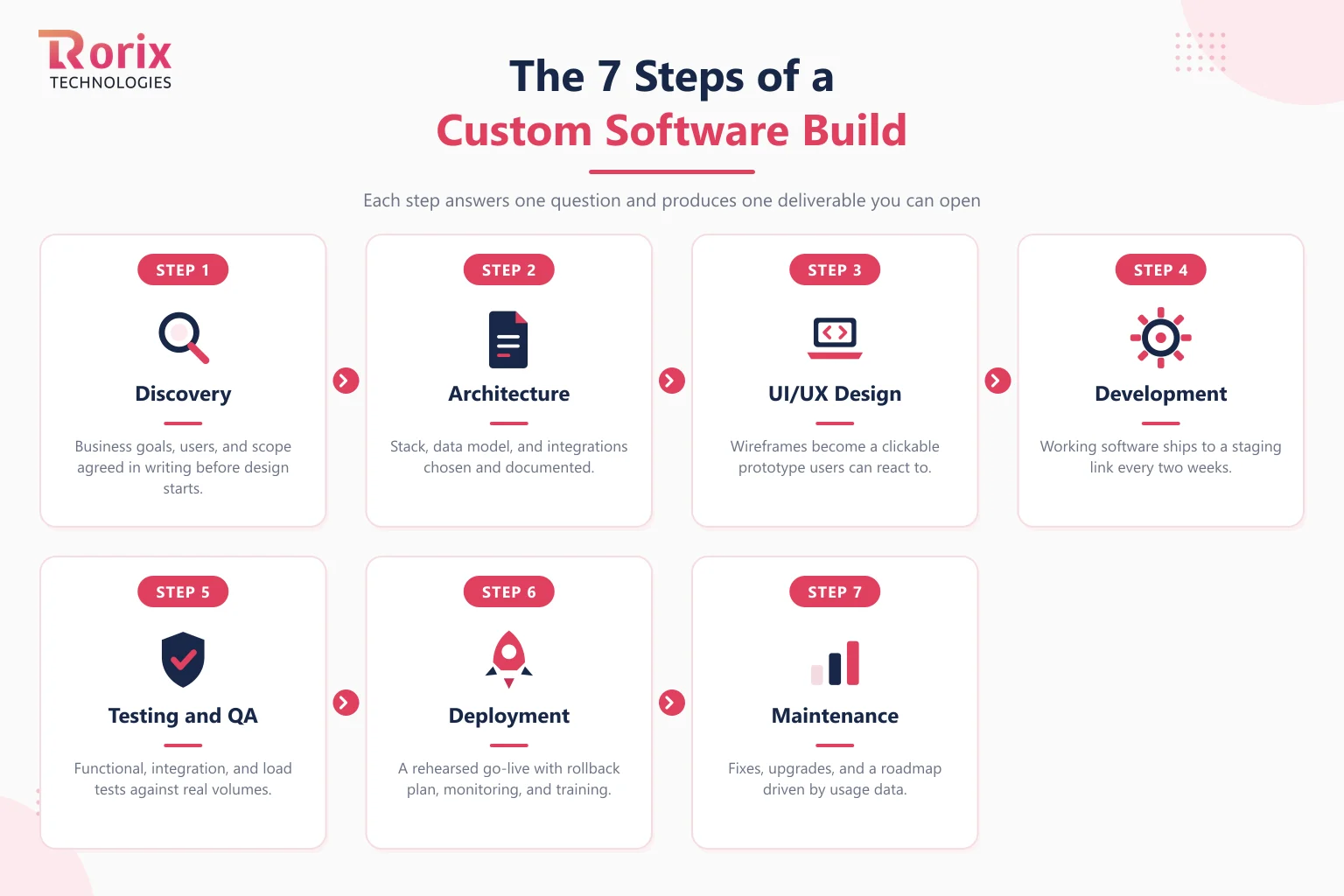
The custom software development process runs through seven steps: discovery, architecture and planning, UI/UX design, sprint development, testing, deployment, and maintenance. Each step exists to answer one question and produce one deliverable you can open. If a team cannot show you the deliverable, the step did not happen, whatever the invoice says.
| Step | The question it answers | What you should be handed |
|---|---|---|
| 1. Discovery | What are we building, for whom, and why? | A written scope document |
| 2. Architecture | How will it be built, and on what? | An architecture blueprint |
| 3. UI/UX design | How will people actually use it? | A clickable prototype |
| 4. Development | Is working software appearing? | A staging build every sprint |
| 5. Testing | Does it hold up under real conditions? | A test report you can read |
| 6. Deployment | Can it go live without drama? | A runbook, credentials, and training |
| 7. Maintenance | Is it improving after launch? | A support agreement and roadmap |
Key Takeaways: Judge a Software Build by Its Artifacts
- The custom software development process runs through seven steps, from discovery to maintenance, and each step owes the buyer one deliverable you can open, from a written scope document to a support agreement.
- GoodFirms' cost survey puts most small and mid-sized business builds between $30,000 and $100,000, and the average project across Clutch's developer directory runs around $132,480.
- In the 2025 Stack Overflow developer survey, Node.js (48.7%) and React (44.7%) lead their categories, with TypeScript at 43.6% and AWS at 43.3%, which is why mainstream technology choices are a feature rather than a lack of imagination.
- Any one of the eight warning signs of a broken process is survivable, but two or more on a live project reliably predict overruns, and all eight are checkable from the buyer's side without reading a line of code.
- Rorix targets a SaaS MVP ready for a first paying customer in 12 weeks by keeping the scope thin and the process intact, because a first release that cuts features rather than steps can move quickly.
What Is the Custom Software Development Process?
The custom software development process is the sequence of stages a build moves through on its way from an idea to a system your team relies on: discovery, planning and architecture, design, development, testing, deployment, and ongoing maintenance. Firms name and slice the stages differently, but the underlying logic is constant: each stage exists to retire a specific risk before that risk gets expensive.
The ordering is the point. Changing a requirement costs a conversation during discovery, a revised diagram during architecture, and a rebuilt module during development. A disciplined sequence front-loads the decisions that are cheap to change early and ruinous to change late.
It is worth saying what the process is not: it is not a guarantee that you should be building at all. If you have not yet settled the build-or-buy question, our build vs buy decision framework is the place to start, because the best process in the world cannot rescue a project that should have been a subscription.
Why Does the Process Matter as Much as the Team?
Buyers evaluate portfolios and rates, but the process is what determines whether a good team produces a good outcome for you specifically. It is also the only part of the engagement you can inspect up front: you cannot read code quality from a sales call, but you can ask to see a scope document, a sprint board, and a decision log from a past project.
Engineering time is the scarce input, which raises the price of a process that wastes it. The US Bureau of Labor Statistics projects 15% growth for software developers between 2024 and 2034, far above the 3% average across occupations, with about 129,200 openings a year. Senior engineers have options. The teams that keep them productive are the ones with senior-owned architecture, disciplined sprints, documented decisions, and enough overlapping hours to unblock work daily. Those habits, or their absence, are visible in the first two weeks.
The 7 Steps of the Custom Software Development Process
The steps below describe a full custom build. Smaller engagements compress the calendar, but a step that produces nothing you can open has not been compressed. It has been skipped, and skipped steps resurface later with interest.
Step 1: Discovery and Requirements
Discovery converts what you know about your own operation into something an engineering team can price and plan. Expect workshops with the people who will use the system, not only the people paying for it, a written list of what is in scope and what is explicitly out, and success metrics with numbers attached: the order volume to support, the manual hours to remove, the error rate to beat.
The deliverable is a scope document you could hand to a different vendor and get a comparable quote. The tell that discovery is being skipped is an estimate produced without questions. A team that quotes your project after one call is pricing a guess, and you will pay for the difference between the guess and reality later, at change-order rates.
Step 2: Planning and Architecture
Architecture decides what the system runs on, how the data is modeled, what integrates with what, and in which order the work ships. This is where an experienced team earns its rate, because these are the decisions that are nearly impossible to reverse once code accumulates on top of them.
Mainstream technology choices are a feature here, not a lack of imagination. In the 2025 Stack Overflow developer survey, Node.js (48.7%) and React (44.7%) lead their categories, with TypeScript at 43.6% and AWS at 43.3%. Popular stacks mean deep hiring pools and answered questions, which is what you want in year three when the original team has rotated. A partner proposing something exotic needs a reason that survives the question of who maintains it. For a closer look at the front-end decision specifically, see our React vs Angular comparison for enterprise applications.
The deliverable is an architecture blueprint: stack choices with reasons, a data model, an integration map, and a delivery plan sequenced by risk.
Step 3: UI/UX Design
Design turns the scope document into screens, and screens are the cheapest place to discover you were wrong. A clickable prototype put in front of the actual users, the dispatcher, the picker, the payroll administrator, surfaces workflow problems for the cost of a revision instead of a rebuild.
Expect wireframes first, then a prototype covering the core workflows, then a design system the developers build from so screens stay consistent as the product grows. The deliverable is that prototype, and the useful habit is testing it with the least technical person who will use the system daily. If it needs explaining, it needs revising.
Step 4: Development in Sprints
Development is where the plan meets a codebase, and cadence is what keeps it honest. Work arrives in sprints, typically two weeks, each ending with a demo of working software on a staging environment you can open from your own browser. You should be able to see the backlog, watch items move, and read what shipped without asking for a status meeting.
The deliverable is a staging build every sprint. The discipline worth insisting on is a written decision log: when scope shifts or a technical trade-off gets made, it gets recorded with its reasoning. Six months later, "why does it work this way?" has an answer that does not depend on anyone's memory.
Step 5: Testing and Quality Assurance
Testing runs alongside development from the first sprint, with a dedicated hardening pass before launch: functional testing against the scope document, integration testing against the real third-party systems, and load testing against the volumes discovery wrote down. The final gate is user acceptance testing, your own people running their real workflows on staging data.
The deliverable is a test report you can actually read: what was tested, what failed, what was fixed, and what was consciously deferred. A team that saves testing for the end has scheduled its bad news for the moment you can least afford it.
Step 6: Deployment and Go-Live
A calm launch is a rehearsed one. Expect a staged rollout rather than a single switch-flip, a rehearsed data migration with a checked result, a rollback plan that has actually been tested, monitoring and alerting wired up before users arrive, and training for the people whose jobs change on day one.
The deliverable is a runbook plus the keys: production credentials, admin access, environment documentation, and the source repository. You are buying an asset. If any part of it lives only with the vendor, you have rented it.
Step 7: Maintenance and Iteration
Launch is the midpoint of ownership, not the finish line. A maintained system gets security patches and dependency upgrades on schedule, bug fixes with response times you agreed in writing, and a roadmap informed by what usage data says people actually do, which is reliably different from what everyone predicted.
The deliverable is a support agreement with named response times and a recurring budget line you planned for from the start. The full economics of that ongoing line are covered in our custom software development cost guide.
Also Read: How to Choose a Custom Software Development Company
What Should You Be Handed at Each Step?
A useful habit for any buyer: judge progress by artifacts, never by narration. Every step above owes you something you can open, click, or read, and one document, the decision log, should stay current through all of them.
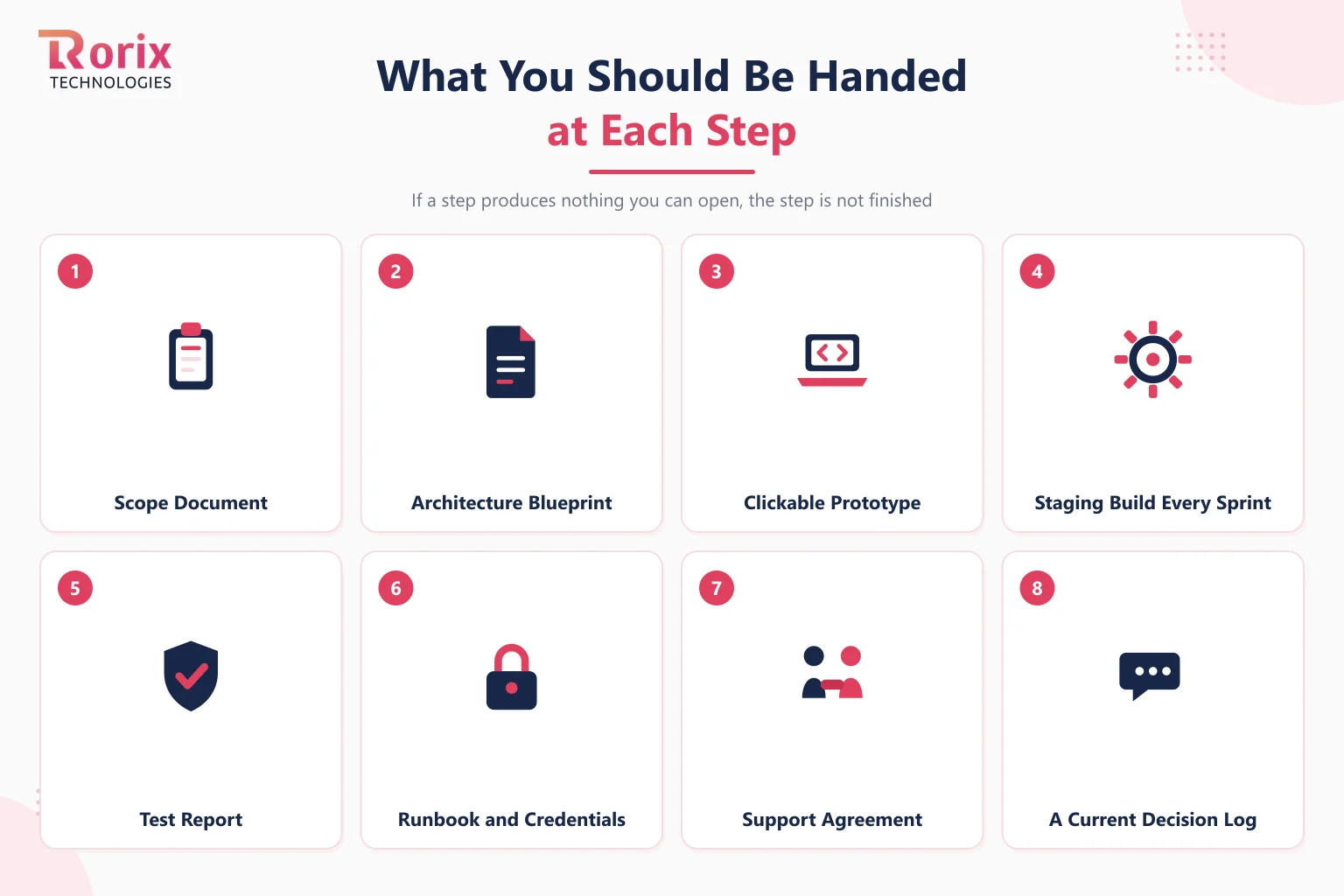
- Scope document: in-scope list, out-of-scope list, success metrics with numbers.
- Architecture blueprint: stack with reasons, data model, integration map, delivery plan.
- Clickable prototype: core workflows you can walk through before code exists.
- Staging build every sprint: working software at a link you can open yourself.
- Test report: what was tested, what failed, what was fixed, what was deferred.
- Runbook and credentials: production access, admin rights, environment docs, the repository.
- Support agreement: named response times, upgrade cadence, a roadmap owner.
- A current decision log: every scope change and trade-off, written down when it happened.
If a step ends and nothing new appears in your hands, that step is not finished, whatever the status report says.
Agile, Waterfall, or Hybrid: Which Fits a Custom Build?
For custom software, an agile cadence is the practical default, because the requirements you start with are never quite the requirements you finish with, and two-week sprints price that reality in. Waterfall survives where scope is genuinely fixed before work starts, usually by contract or regulation. Most serious engagements land on a hybrid: discovery and architecture run as fixed, sequential phases, then delivery switches to sprints.
The methodology question is worth exactly one meeting. What matters is not the label but the observable behavior: short cycles, working software at each demo, and changes handled through a visible backlog instead of hallway agreements.
One distinction worth making before you choose a partner at all: a full delivery process is what you buy when you need an outcome built end to end. If you have an in-house team that owns the process and simply needs more hands, that is a different purchase, covered in our guide to IT staff augmentation.
What Are the Signs of a Broken Development Process?
Any one of these is survivable. Two or more on a live project reliably predict overruns, and all eight are checkable from the buyer's side without reading a line of code.
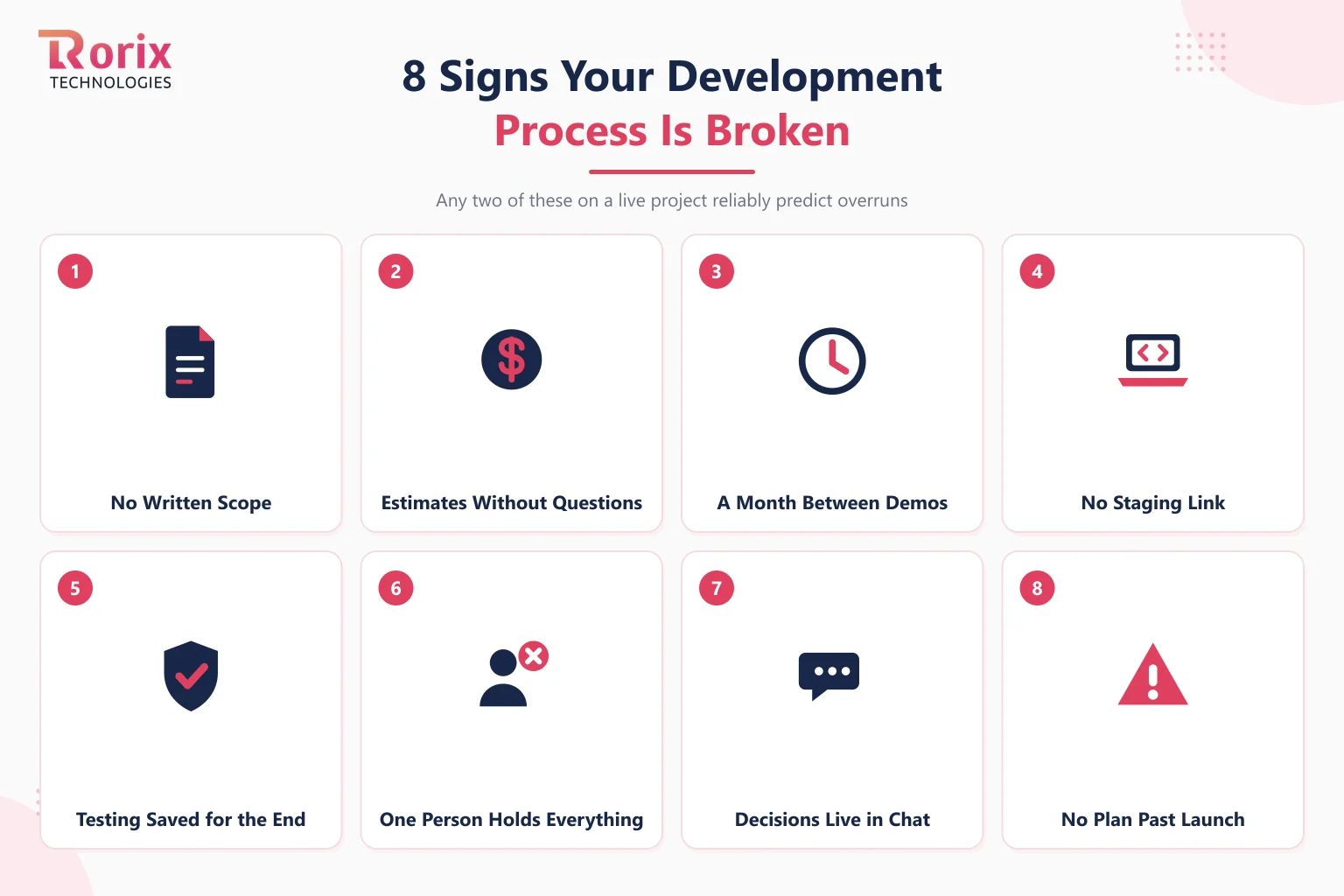
- No written scope: work is proceeding from a proposal deck and everyone's memory of a kickoff call.
- Estimates without questions: a price arrived before anyone asked how your operation actually works.
- A month between demos: long silent stretches mean integration risk is accumulating out of sight.
- No staging link: you cannot open the current state of your own product without scheduling a meeting.
- Testing saved for the end: QA appears on the plan as a final phase instead of a running discipline.
- One person holds everything: a single engineer owns the architecture, the credentials, and the context.
- Decisions live in chat: scope changes are agreed in messages and calls, and nobody could reconstruct why.
- No plan past launch: nobody has raised maintenance, upgrades, or support terms, because nobody plans to be there.
How Long Does the Custom Software Development Process Take?
Long enough that any precise number quoted before discovery is a guess, and worth treating with caution. What genuinely sets the calendar is not the step list but a handful of drivers: how settled the scope is when development starts, how many external systems must be integrated, whether data migrates from a legacy platform, and, most underestimated of all, how quickly your side makes decisions. A team waiting three days for every approval ships months late with no one able to say where the time went.
Scope discipline is the honest lever for speed. A first release that cuts features rather than steps can move quickly: our SaaS development engagements target a SaaS MVP ready for a first paying customer in 12 weeks by keeping the scope thin and the process intact. For startup builds specifically, our guide for startup founders covers how that first-release scoping works.
What Does the Process Cost?
The process itself is not a line item, but it is the main variable behind the ones you see. The same feature list can land at very different totals depending on how much rework the process allows, and the drivers that move the number are the ones already discussed: scope stability, integration count, data migration, and decision speed.
The full breakdown, including team compositions and the recurring maintenance line, lives in our custom software development cost guide. For a scoped figure on your specific project, the project cost estimator will get you a range in a few minutes.
How Rorix Runs the Process
Rorix Technologies builds custom WMS, HRMS, and SaaS platforms, and the process above is the one we run, with the deliverables named in this guide treated as obligations rather than aspirations.
- Delivery you can watch: a retainer model in 2-week sprints, a staging link from the first sprint, and full task visibility throughout.
- Senior-owned architecture: a dedicated team of senior engineers with a named technical lead on every engagement, and decisions recorded as they are made.
- Integration depth as evidence: 40+ integrations on Driven, a US performance platform for pest control and field service teams, with iOS and Android shipped from a single React Native codebase.
- A verifiable record: 27 projects delivered, a 5.0 rating on Clutch across 4 verified reviews, and clients across the US, UK, Canada, Australia, and New Zealand.
- Scope honesty: when the right first release is smaller than the one you asked for, we will say so, because thin scope with an intact process is how a 12-week path to your first paying SaaS customer actually happens.
Book a free consultation and bring your roughest version of the idea. Discovery is where rough is supposed to get precise.
Every Step Owes You a Deliverable You Can Open
A good build is boring in the best way: a scope document that survived contact with real users, demos every two weeks, a launch that was rehearsed before it was performed, and a system that keeps improving after the applause stops.
Every step in the sequence is really the same demand wearing different clothes: show me something I can open. Hold to that one standard, from the first scope document to the post-launch roadmap, and most of the ways software projects go wrong will announce themselves early enough to fix.
The process above is what a full stack development engagement runs. If you are heading into a build, talk to our engineers. The first conversation is discovery working exactly as described: mostly questions, all of them yours to keep.
Frequently Asked Questions
What are the steps of the custom software development process?
Seven steps: discovery and requirements, planning and architecture, UI/UX design, development in sprints, testing and quality assurance, deployment and go-live, then maintenance and iteration. Each step answers one question and produces one deliverable, from the scope document at the start to the support agreement at the end.
How long does custom software development take?
Treat any single figure with caution, because the calendar is set by drivers rather than averages: scope stability, integration count, data migration, and how fast your side makes decisions. A thin, disciplined first release can move quickly, while a build with shifting scope and slow approvals can double its own schedule without adding a single feature.
What is the difference between Agile and Waterfall for a custom build?
Waterfall runs the phases once, in order, and works when scope is genuinely fixed up front. Agile delivers in short sprints with working software at each demo, which suits custom builds because requirements always shift once real users see real screens. Most engagements run a hybrid: fixed discovery and architecture, then sprint-based delivery.
What should I receive at the end of each phase?
Something you can open without the vendor in the room: a scope document, an architecture blueprint, a clickable prototype, a staging build every sprint, a readable test report, a launch runbook with production credentials, and a support agreement with named response times. Progress reported without artifacts is narration.
How much involvement does the process need from my side?
More than most buyers budget for, concentrated in specific places: discovery workshops, prototype reviews, sprint demos, and user acceptance testing. The single biggest client-side factor is decision speed, so name one person with authority to approve changes and attend demos. Slow approvals quietly add more to the schedule than most technical problems do.
Can the process be shortened for an MVP?
Yes, by shrinking the scope rather than skipping steps. An MVP still needs discovery, architecture, testing, and a deployment plan. It simply applies them to a deliberately thin feature set, which is how a first release lands in weeks instead of quarters. Cutting the steps themselves produces speed you repay later with interest.
What happens after the software goes live?
The system enters maintenance and iteration: security patches and dependency upgrades on schedule, bug fixes under agreed response times, and a roadmap steered by what usage data shows people actually doing. Budget for this from the start, because software that stops changing starts decaying the day it ships.
How do I evaluate a development company's process before signing?
Ask to see artifacts from past projects: a scope document, a sprint board, a decision log, a launch runbook. Ask how often you will see working software and whether you get a staging link. A team with a real process can show these in minutes, and a team that cannot is telling you what your project's paper trail will look like.
Costing a custom build?
A dedicated team of senior engineers with a named technical lead on every engagement. Send us the problem and you get back a scope and a price.
Continue learning
Written by
Renish DadhaniyaFounder & Director, Rorix Technologies
Renish co-founded Rorix Technologies and drives the engineering and delivery culture across the organization. Beyond engineering, he leads the company's sales, finance, and HR operations, building the infrastructure that lets the team focus on shipping quality software. With deep hands-on expertise in architecture and team building, he ensures every project lands on time to the quality standards clients demand.
View full profileRelated articles
Bespoke Software Development for Startups: Everything You Need to Know (2026)
Learn how bespoke software development for startups works, including costs, tech stacks, IP ownership, and how to choose the right development partner.
Read article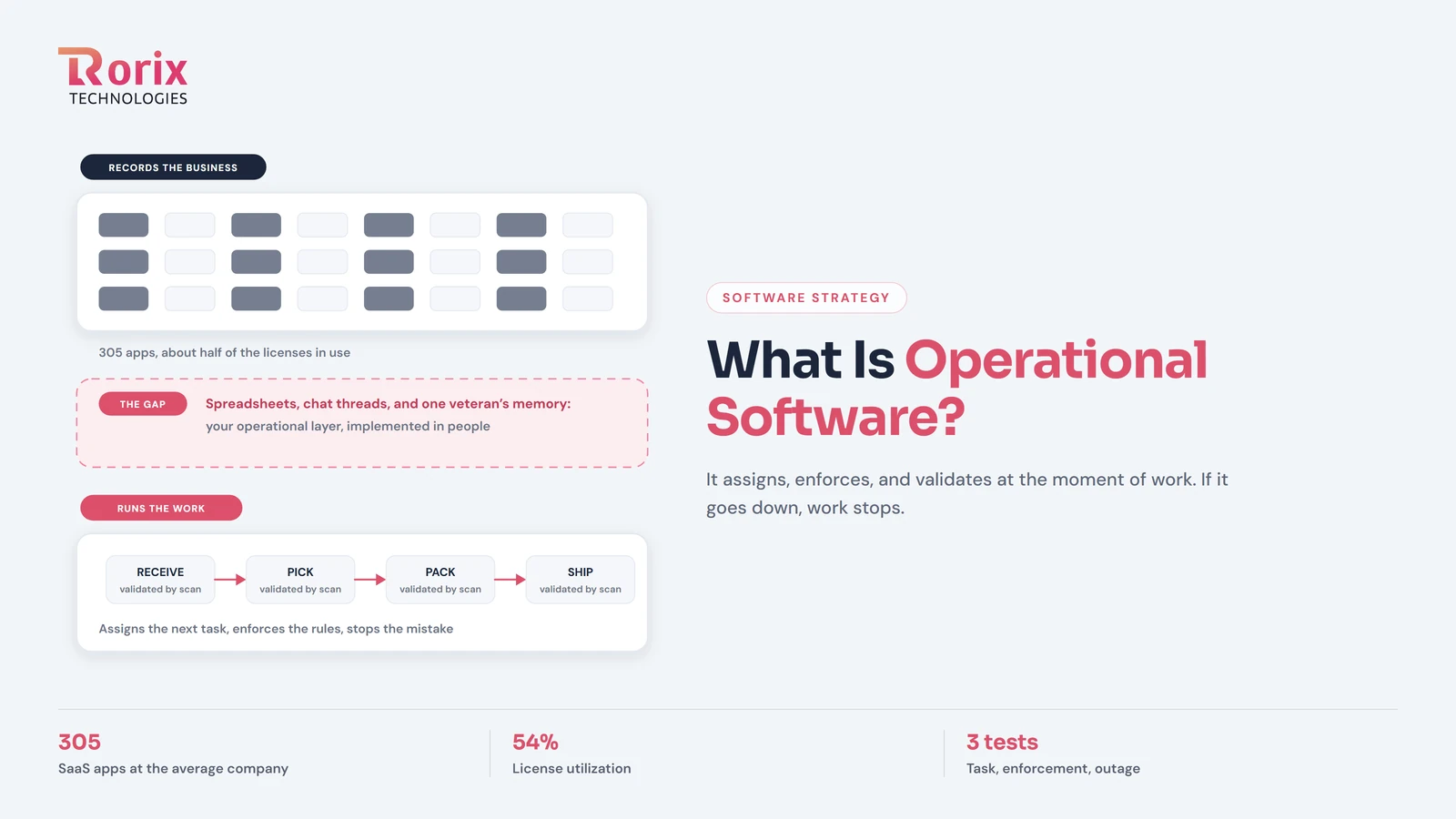
What Is Operational Software? The Layer That Runs the Work
Operational software executes the work itself: it assigns tasks, enforces rules, and validates as work happens. How it differs from record-keeping tools.
Read article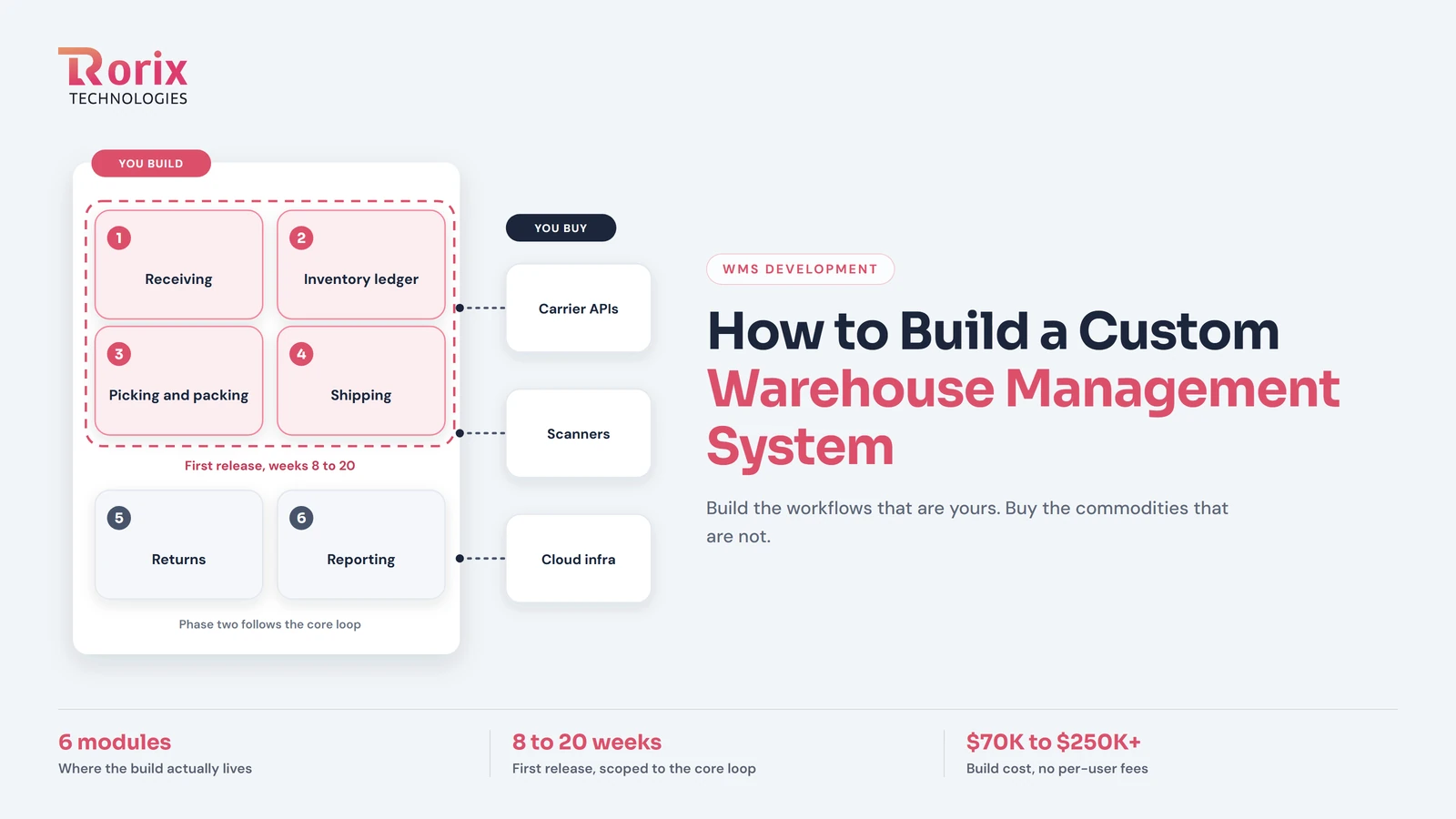
How to Build a Custom Warehouse Management System: Scope, Steps, Cost and Timeline
How to build a custom warehouse management system: the six modules you actually build, what you buy instead, an 8 to 20 week phased plan, and 2026 costs.
Read article