Top 12 AI SaaS Development Companies in 2026
Compare the 12 best AI SaaS development companies for 2026, with services, ratings, costs, and tips to choose the right development partner.
On this page38 sections
Key Takeaways: Best AI SaaS Development Company by Use Case
Choose a partner based on your product, technical stack, and budget.
- Operations-heavy SaaS: Rorix Technologies (that is us) integrates AI into business workflows and existing systems.
- AWS-based AI agents: Euristiq and 27Global support enterprise AI projects.
- US time zone collaboration: Azumo provides nearshore AI engineering.
- Existing SaaS products: Clockwise Software specializes in adding LLM features.
- Microsoft and Azure: Blackthorn Vision focuses on Microsoft-based AI solutions.
- Data-heavy SaaS: STX Next and Algoscale bring data engineering and AI expertise.
- AI search and documents: Syndicode builds RAG-based search for business files.
- Mid-market projects: Classic Informatics offers options for focused AI builds.
- First AI MVP: Upsilon helps founders scope and launch early products.
- Budget benchmark: One production AI feature typically costs $20,000 to $80,000 at market rates.
Impressive AI demos don't guarantee a successful SaaS product. One inaccurate answer, a customer data leak, or an unexpected spike in AI costs can turn a promising feature into an expensive problem.
That's why choosing the right AI SaaS development company matters. Adding AI to an existing SaaS product takes more than connecting a model. It requires reliable integrations, tenant-level data isolation, and cost controls built into the product from the start.
This is where adding AI to a live SaaS product requires the right engineering approach.
But not every AI SaaS development company offers the same expertise. Some specialize in AI SaaS MVP development, while others focus on enterprise integrations, custom AI features, or production-ready platforms.
Choosing without comparing these capabilities can lead to costly rework and features customers never use.
In this guide, you'll learn:
- The 12 best AI SaaS development companies, compared side by side
- What each company does best
- 8 checks to evaluate before signing a contract
- Market costs for adding AI to a SaaS product
- The monthly AI expenses that development quotes often overlook
By the end of this guide, you'll have a practical shortlist, a clearer view of AI SaaS development costs, and the right questions to ask before choosing a partner.
What Is an AI SaaS Development Company?
An AI SaaS development company builds AI features into cloud-based software, from AI assistants and smart search to automated workflows and predictive analytics. It combines SaaS engineering, such as multi-tenancy and billing, with AI integration, data security, and cost control.
These companies either add AI to existing SaaS products or build AI-native platforms. Both require reliable outputs, tenant-level data protection, and predictable operating costs.
Gartner (2025) predicts that 33% of enterprise software applications will include agentic AI by 2028, up from less than 1% in 2024.
Common AI SaaS features include:
| AI Feature | Business Use |
|---|---|
| AI assistants and copilots | Answer questions and draft content |
| AI search (RAG) | Find information in customer documents |
| AI agents | Automate follow-ups, triage, and data entry |
| Document extraction | Convert forms and PDFs into structured data |
| Predictions and scoring | Forecast demand and identify churn risks |
| AI summaries and reports | Generate summaries from product data |
A good AI SaaS development company builds these features with proper permissions, accuracy checks, and cost controls so they work reliably at scale. Explore our guide to AI-enabled business systems for practical examples.
Also Read: In-House vs Outsourcing Software Development
The 12 Best AI SaaS Development Companies Compared
Each AI SaaS development company has different strengths, from adding AI to existing SaaS products to building enterprise-grade AI platforms. Compare their specialties, ratings, rates, and ideal use cases to find the right fit.
| Company | Headquarters | AI Strength for SaaS | Clutch Rating | Hourly Rate | Best For |
|---|---|---|---|---|---|
| Rorix Technologies (that is us) | Ahmedabad, India | AI for operational workflows and integrations | 5.0 (4 verified reviews) | $20 to $30 | Operations-heavy SaaS |
| Euristiq | Toronto, Canada | Generative AI and AI agents on AWS | 4.8 (38 reviews)* | $50 to $99 | AWS-based fintech and healthtech |
| Azumo | San Francisco, USA | AI engineering and nearshore development | 4.9 (27 reviews)* | $25 to $49 | US teams needing overlapping work hours |
| Clockwise Software | Edinburgh, UK | LLM features for existing SaaS products | 4.9 (23 reviews) | $50 to $99 | SaaS products adding AI features |
| Blackthorn Vision | Warsaw, Poland; Lviv, Ukraine | Azure OpenAI and Semantic Kernel | 4.8 (24 reviews) | $25 to $49 | .NET and Azure-based products |
| STX Next | Poznań, Poland | Python-based AI and enterprise RAG | 4.7 (103 reviews)* | $50 to $99 | Data-heavy SaaS platforms |
| 27Global | Leawood, USA | Governed AI agents and enterprise development | Not listed | Not publicly confirmed | US-based enterprise AI projects |
| Syndicode | Lisbon, Portugal; San Francisco, USA | RAG and AI-powered search | 4.8 (21 reviews) | $50 to $99 | Construction and marketplace platforms |
| Classic Informatics | Gurugram, India | RAG, AI agents, and data engineering | 4.9 (39 reviews) | $25 to $49 | Mid-market SaaS products |
| Algoscale | Newark, USA; Noida, India | Data platforms and document AI | 4.9 (12 reviews)* | $25 to $49 | Analytics-heavy SaaS |
| Bitcot | San Diego, USA | AI agents and workflow automation | 4.8 (23 reviews)* | $25 to $49 | Startups, SMBs, and healthcare SaaS |
| Upsilon | Sheridan, USA; Tallinn, Estonia | AI product discovery and MVP development | Not listed | Not publicly confirmed | Early-stage AI SaaS products |
Let's explore each company in detail.
1. Rorix Technologies (that is us)
Rorix Technologies is an AI SaaS development company that builds custom software for operations-heavy businesses, connecting AI with existing SaaS products, warehouse systems, distribution, HR, and field-service workflows. Its approach starts with the business process, identifying where AI can solve a real problem without disrupting production.
For Lorecs, Rorix added an AI SKU price finder to WorkCenter Central as a standalone service without changing production code. The assistant uses normalized price data to provide relevant answers and avoids unsupported responses when matching data is unavailable. WorkCenter Central, the platform Rorix built for Lorecs, cut manual errors by 80% and sped up order processing by 50%.
Rorix also develops AI-native SaaS products and integrates AI into existing platforms. Its portfolio includes an AI interview-prep platform with Gemini as the primary model and Claude as an automatic fallback, plus a B2B sales intelligence platform with AI-assisted data verification and Salesforce and HubSpot sync.
Key Highlights:
- Track record: 27 platforms delivered and a 5.0 Clutch rating across 4 verified reviews.
- Technology stack: Python, Node.js, TypeScript, PostgreSQL, OpenAI API, and Claude API.
- Delivery model: Two-week sprints, a dedicated team of senior engineers with a named technical lead, and a working SaaS MVP in 6 to 12 weeks.
- AI cost control: Token-based credit pricing and model fallback on the interview-prep platform, with gross margins verified above 70% before launch.
- Integrations: 40+ integrations connected for Driven, a US performance platform for pest control and field service teams, such as HubSpot, Twilio, RingCentral, and Google APIs.
Best for: Operations-heavy SaaS businesses that need an AI SaaS development company to embed AI into real workflows, with one team handling product engineering, integrations, and AI delivery.
2. Euristiq
Euristiq is an AWS-focused AI engineering partner with AWS AI Services Competency for generative and agentic AI. It builds AI SaaS solutions for regulated industries, including a multi-tenant wealth management MVP for Mozaiik and a multi-agent research pipeline for B2Buster using Amazon Bedrock and tiered Claude models.
Key Highlights:
- AWS-validated expertise: Holds AWS AI Services Competency for generative and agentic AI.
- AI technology stack: Amazon Bedrock, LangChain, LangGraph, OpenAI, Claude, Gemini, pgvector, and Pinecone.
- Security standards: ISO 27001 certification and SOC 2-aligned architecture for relevant projects.
Best for: Fintech and healthtech SaaS teams building agentic AI solutions on AWS.
3. Azumo
Azumo provides nearshore AI engineers who work US hours, making collaboration easier for SaaS teams building or upgrading AI-powered products. Its work includes multi-tenant SaaS architecture, subscription billing, and LLM-powered automation, with projects for Angle Health and Sparks & Honey.
Key Highlights:
- Nearshore collaboration: Engineers across Latin America work in US time zones.
- SaaS engineering: Supports tenant isolation, SSO, usage-based billing, and white-label platforms.
- AI applications: Built LLM-powered RFP-to-quote automation for Angle Health and a generative AI platform for Sparks & Honey.
Best for: US SaaS teams that want AI engineers working alongside their in-house product team.
4. Clockwise Software
Clockwise Software combines SaaS product engineering with dedicated LLM development, helping businesses add AI without rebuilding their core platforms. For Released, it developed LLM-powered analytics using GPT-4 and Gemini, starting with a one-month proof of concept before turning the feature into a sellable product.
Key Highlights:
- SaaS architecture: Experience with multi-tenancy, subscription billing, and scalable product development.
- LLM capabilities: Builds RAG chatbots, AI analytics, and matching engines.
- Proof-of-concept approach: Can validate an AI feature before committing to a larger build.
Best for: Funded SaaS companies adding LLM features to an established product.
5. Blackthorn Vision
Blackthorn Vision specializes in Microsoft-based AI development, making it a strong option for SaaS products built on .NET and Azure. Its projects include an AI-powered SRE automation platform for unSkript, ML diagnostics software for Selux Diagnostics, and AI legal document recognition.
Key Highlights:
- Microsoft-native AI: Uses Azure OpenAI, Semantic Kernel, and Azure AI Search.
- Industry experience: Has delivered solutions for healthcare, biotech, and legal workflows.
- Long-term development: Supports complex products beyond the initial AI implementation.
Best for: .NET and Azure SaaS teams adding AI agents to existing products.
6. STX Next
STX Next is a Python-focused engineering company with strong data and AI capabilities. It builds enterprise RAG systems and multi-tenant SaaS platforms, including multilingual search with source citations for Linde, helping engineers trace answers back to their sources.
Key Highlights:
- Structured AI offers: Provides a fixed-price AI agent MVP in four weeks and an enterprise RAG proof of concept in two to four weeks.
- SaaS foundations: Supports tenant isolation, usage metering, and subscription billing.
- Security credentials: Holds ISO 27001 and TISAX certifications and AWS Advanced Tier Services Partner status.
Best for: Data-heavy industrial and financial SaaS products that need Python-based AI and formal security controls.
7. 27Global
27Global helps US businesses introduce AI with governance and security built into the delivery process. Its work includes an agentic chatbot for contractor safety reports at Williams Companies, using Azure AI Foundry with human approval, and an NLP model deployed for experience-management platform SMG.
Key Highlights:
- Enterprise governance: Offers AI readiness, agent operations, and governance services.
- Human oversight: Supports approval steps for sensitive AI-driven workflows.
- Cloud expertise: Works across Azure AI Foundry, Amazon Bedrock Agents, Copilot Studio, and Databricks.
Best for: US mid-market and enterprise SaaS teams that need governed AI agents and onshore delivery.
8. Syndicode
Syndicode helps SaaS businesses turn scattered documents and legacy files into searchable, useful product data. Its work includes a RAG-based knowledge base for McCarthy Building Companies and an AI report generator for digital mortgage platform Maxwell that converts natural-language questions into charts.
Key Highlights:
- RAG implementation: Builds search across existing PDFs, spreadsheets, and business documents.
- AI observability: Uses LangSmith tracing to help teams investigate model outputs.
- Security certification: Holds ISO 27001 certification.
Best for: Construction, ecommerce, and marketplace platforms adding AI search or agents to existing products.
9. Classic Informatics
Classic Informatics helps mid-market businesses turn complex data into practical AI features. For a UK construction-tech startup, it built document intelligence and semantic search using Django, LangChain, Qdrant, and Neo4j. For a US wellness app, it delivered LLM-powered personalization with PostgreSQL and pgvector.
Key Highlights:
- AI evaluation: Includes an engine for comparing LLM outputs.
- Technology stack: Works with OpenAI, Claude, Vertex AI, and SageMaker.
- Ecosystem: Google Partner and Microsoft Partner.
Best for: Mid-market SaaS teams adding RAG search and AI agents.
10. Algoscale
Algoscale combines data engineering with AI development, helping SaaS businesses prepare scattered data for reliable AI features. Its DocumentIQ and AnalystIQ accelerators support document processing and analytics, while client projects include multilingual contract intelligence with human review and SKU-level pricing insights for a global fashion brand.
Key Highlights:
- Data platforms: Expertise across Snowflake, Databricks, and modern data pipelines.
- AI accelerators: DocumentIQ and AnalystIQ support document and analytics use cases.
- Security credentials: Holds ISO 27001 certification and AWS and Microsoft data partnerships.
Best for: Data-heavy SaaS products adding document AI, analytics, or embedded BI.
11. Bitcot
Bitcot builds AI agents and workflow automation for startups, SMBs, and healthcare products. In one project, it created an MCP pipeline that gave Claude 22 read-only tools for Amazon Seller data in about four weeks. Other work includes an internal AI persona and AI-assisted authorization intake using Microsoft Power Platform.
Key Highlights:
- Agent tooling: Hands-on work with LangGraph, LangSmith, and MCP.
- Integration options: Supports GPT, Claude, Llama, Pinecone, and Weaviate.
- Workflow automation: Experience with healthcare intake and internal business processes.
Best for: SaaS teams automating data access and repetitive workflows with AI agents.
12. Upsilon
Upsilon helps founders validate and launch AI SaaS products through a staged process, from discovery to proof of concept and MVP. For Neudesk.ai, it built an AI proposal and contract platform using React, Python, and LangChain, with a model fine-tuned on client data. Its own SaaS products also give the team firsthand experience with product launches.
Key Highlights:
- Structured delivery: Moves from discovery to proof of concept and MVP.
- AI stack: Works with GPT, Claude, Gemini, LangChain, and LlamaIndex.
- Product experience: Runs its own SaaS products alongside client projects.
Best for: Early-stage founders who need a scoped, budget-conscious AI SaaS MVP.
Now that you've seen what each partner brings, let's look at how to vet your shortlist before signing a contract.
Also Read: Nearshore vs Offshore Software Development
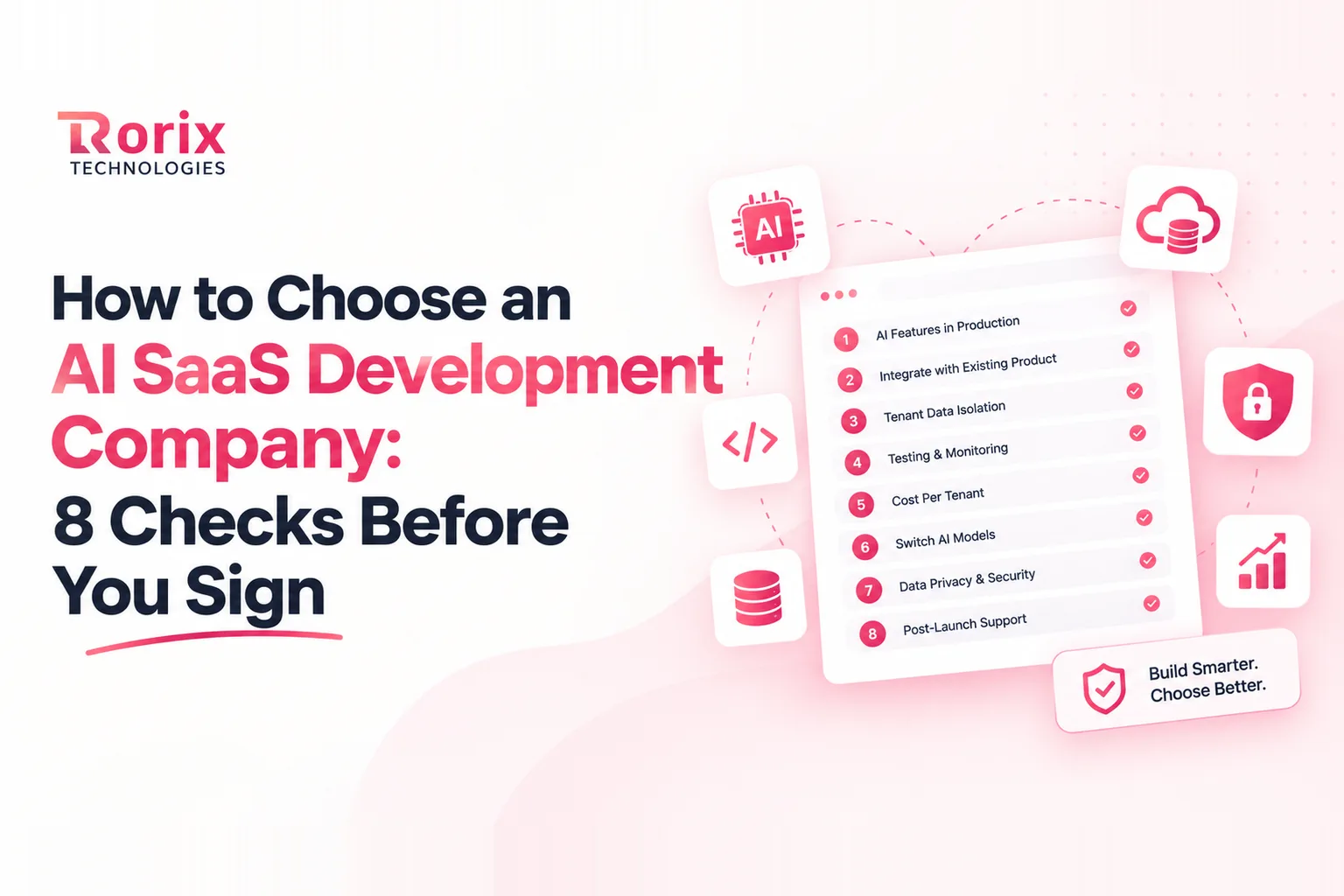
How to Choose an AI SaaS Development Company: 8 Checks Before You Sign
A polished demo can hide problems with AI accuracy, data security, and running costs. Use these eight checks to assess a partner before signing.
For general agency criteria like code ownership, QA, and communication, use our SaaS development agency comparison alongside this checklist.
1. Check for AI Features Running in Production
A demo proves little about real-world performance once customers start using the feature. Ask an AI SaaS development company to show a live feature and explain what changed after launch. Look for evidence of real usage, ongoing improvements, and problems solved.
- Ask: "Which AI feature is live, and what did you improve after launch?"
- Red flag: Every example is a demo or proof of concept that never shipped.
2. Check How They Add AI to Your Existing Product
AI integration for SaaS should improve your product without putting working features at risk. A good AI SaaS development company starts with one focused use case and tests it separately before changing production code. See our API integration strategy guide for more on reliable connections.
- Ask: "Where will the AI connect, and what production code needs to change?"
- Red flag: The plan starts with a full rewrite or broad database access.
3. Verify Tenant Data Isolation
Multi-tenant SaaS products must keep each customer's data separate across searches, embeddings, caches, and AI tools. Enforce these boundaries on the server before data reaches the model. Never rely on prompts or frontend filters alone to prevent cross-tenant leaks.
- Ask: "How do you prevent one tenant's documents from reaching another tenant's AI responses?"
- Red flag: Data isolation depends on instructions given to the model.
4. Check AI Testing and Monitoring
AI responses can change as models, data, and user requests evolve. Your partner should test real questions before releases and track live results after launch. The system should flag unsupported answers instead of inventing information when reliable data is missing.
- Ask: "How do you test AI quality before release and monitor it afterward?"
- Red flag: Testing means trying a few prompts manually.
5. Understand the Cost Per Tenant
Development costs are only part of the budget for AI SaaS products. Ask your AI SaaS development company to estimate model usage, retrieval, and monitoring costs per tenant. Compare those estimates with subscription pricing and expected usage to protect your margins.
- Ask: "What will this feature cost per tenant each month at ten times our current usage?"
- Red flag: The quote excludes ongoing AI and monitoring costs.
6. Confirm You Can Switch AI Models
Model pricing, quality, and terms can change, making provider lock-in an expensive risk. A strong AI SaaS development company uses a provider adapter, versioned prompts, and a tested fallback model. This makes switching easier without rebuilding major parts of your product.
- Ask: "What code changes would be needed to switch model providers?"
- Red flag: Provider-specific calls are scattered throughout the codebase.
7. Know Where Customer Data Goes
Before launch, confirm which model providers process customer data and whether they retain it or use it for training. Check where processing occurs and which agreements apply. Your partner should also use appropriate data masking and access controls to reduce exposure.
- Ask: "Which third parties process our data, and what do their agreements permit?"
- Red flag: The partner cannot explain provider data-retention or training policies.
8. Agree on Post-Launch Support
AI features need ongoing testing, prompt fixes, model updates, and cost reviews after launch. Agree on ownership and response times before signing the contract. An AI SaaS development company on a retainer can provide more consistent support than a one-off engagement.
- Ask: "Who monitors AI quality and costs, and handles model changes?"
- Red flag: Support ends at handover, with no plan for model updates or performance drift.
What AI Development Costs a SaaS Company
Quotes from an AI SaaS development company include the initial build and ongoing usage fees. These are market estimates, not Rorix pricing, and actual quotes depend on scope, data, and integrations.
For general SaaS build costs and regional hourly rates, see the cost section in the 15 Top SaaS Development Companies list linked above. The ranges below cover the extra cost of AI.
1. AI Build Cost by Project Type
| Project Type | What You Get | Market Range | Typical Timeline |
|---|---|---|---|
| AI readiness and discovery | Data audit, feasibility, solution design, and an AI cost estimate | $5,000 to $25,000 | 2 to 4 weeks |
| AI feature in an existing SaaS product | One AI workflow, such as an assistant, RAG search, or document extraction | $20,000 to $80,000 | 4 to 10 weeks |
| AI-native SaaS MVP | A new multi-tenant product with core AI features, billing, and usage tracking | $40,000 to $120,000 | 3 to 6 months |
| Multi-agent or growth-stage AI platform | Multiple AI workflows, agents, evaluations, and deep integrations | $120,000 to $300,000 | 6 to 12 months |
Discovery is especially useful when your data is messy, or the use case is unclear. It helps identify limitations before you invest in features your data cannot support.
If your scope is still open, our guide on how to build an MVP explains what to prioritize. Our prototype and MVP development page covers how to scope a lean first release.
Need a project estimate? Use our Project Cost Estimator to get a starting figure in about two minutes, then compare it with the quotes you receive.
2. Ongoing AI Costs After Launch
The initial build is only part of the budget. Model usage, retrieval, monitoring, and maintenance add recurring costs, so include them in your pricing before launch.
| Cost Line | What Drives It | How to Keep It in Check |
|---|---|---|
| Model API and inference | Requests per tenant, tokens per request, and model choice | Use smaller models for simple tasks, cache repeat answers, and set plan limits |
| Retrieval infrastructure | Vector storage, embeddings, and document re-indexing | Embed only what people search, and re-index only what changes |
| Evaluation and monitoring | Test runs, tracing, and human review | Automate regression tests and sample production traffic |
| Model and prompt maintenance | Provider updates, new edge cases, and performance drift | Version prompts, use a provider adapter, and retest changes |
To estimate inference costs, multiply monthly requests by tokens per request, then apply the provider's price per token. For example, 20,000 requests at 3,000 tokens each use 60 million tokens per month, so reducing unnecessary tokens can lower your bill.
Use that estimate to set AI pricing, whether you bundle usage into a subscription tier, sell credits, or charge for an add-on. This helps heavy usage generate revenue instead of eating into your margins.
Also Read: 15 Best Small Software Development Companies for Startups
Why Rorix Technologies Fits Operations-Heavy AI SaaS Builds
Choosing an AI SaaS development company is easier when its experience matches the workflows your product needs to improve.
Rorix Technologies builds custom software for operations-heavy businesses, connecting AI with warehouse management, order processing, HR, CRM, and other business systems. Instead of treating AI as a standalone chatbot, the team integrates it into existing workflows to reduce manual work and make business data more useful.
Its delivery approach combines senior engineers, a named technical lead, two-week sprints, and ongoing support to keep development aligned with business needs.
- 27 platforms: Delivered across custom software products.
- 80% fewer manual errors: Achieved in the Lorecs project by WorkCenter Central, which now has an AI SKU price finder added beside it.
- 40+ integrations: Delivered for Driven, a US performance platform for pest control and field service teams, including HubSpot, Twilio, RingCentral, and Google APIs.
- AI product experience: Built an AI interview-prep platform with Gemini as the primary model and Claude as an automatic fallback.
- SaaS MVP delivery: A working MVP in 6 to 12 weeks, depending on scope.
- Ongoing partnerships: DealSignal has worked with Rorix's founders for more than five years, continuing under Rorix.
- Global delivery: Experience serving clients across the US, UK, Canada, Australia, and New Zealand.
Need an AI SaaS product that connects intelligent features with your real business workflows?
Get a Project Cost Estimate or talk to our experts to discuss your use case, integrations, and development requirements.
Conclusion: Choose an AI SaaS Partner Built for the Long Run
Choosing the right AI SaaS development company means looking beyond a working demo. Compare production experience, data security, AI running costs, and support after launch.
Use the company comparison, cost estimates, and eight selection checks in this guide to shortlist partners that fit your product, budget, and technical needs.
We hope this guide helps you compare AI SaaS development companies and choose a partner that can turn your AI idea into a reliable product.
Ready to add AI to your SaaS product without risking customer data or profit margins? Connect with our experts to discuss your use case, integrations, and launch plan.
Frequently Asked Questions
How much does it cost to add AI to a SaaS product?
One production AI feature typically costs $20,000 to $80,000. An AI-native SaaS MVP costs $40,000 to $120,000, plus ongoing inference, retrieval, and monitoring costs.
How long does it take to add AI to an existing SaaS product?
A single AI feature usually takes 4 to 10 weeks, while an AI-native MVP takes 3 to 6 months. Clean, organized data can shorten both timelines.
Should we build AI in-house or hire an AI SaaS development company?
Build in-house if AI is your core advantage and you have the right engineering skills. Hire a partner if you need to launch faster or lack AI testing and cost-management experience.
What is the difference between AI-native SaaS and adding AI to an existing product?
AI-native SaaS is built around AI from the start. Adding AI to an existing product means integrating new features into current workflows, permissions, and data without disrupting customers.
Should we use OpenAI, Claude, or an open-source model?
Choose based on performance, cost, and data requirements. Hosted models are often faster to launch, while open-source models can suit specific privacy or high-volume needs. A provider adapter makes switching easier.
How should we price AI features in our SaaS plans?
Bundle AI into a higher tier, sell usage credits, or charge for an add-on. Base pricing on per-tenant AI costs so heavy usage doesn't erode your margins.
How do we prevent AI from exposing one customer's data to another?
Enforce tenant-level access controls on the server, isolate document indexes, and test for cross-tenant leaks before launch and after major changes.
Who owns the prompts, evaluation sets, and fine-tuned models after development?
Your contract should confirm ownership of prompts, evaluation datasets, fine-tuned models, and pipeline code. Keep them in your own repositories and cloud accounts, with documentation for future maintenance.
Adding AI to your system, or building a new AI feature?
Most of the work sits in the data plumbing rather than the model. Send us the workflow you want to automate and we will tell you what is feasible on your current stack.
Continue learning
Written by
Ankur AkvaliyaFounder & Director, Rorix Technologies
Ankur co-founded Rorix Technologies with a mission to deliver enterprise-grade software that growing businesses can actually afford. He drives technical project delivery and client success end-to-end, overseeing product strategy, client partnerships, and the company's long-term vision to ensure every engagement delivers measurable business outcomes across WMS, HRMS, and custom software verticals.
View full profileRelated articles
Top 15 AI Integration Companies for Business Systems in 2026
Explore the top 15 AI integration companies, their services, costs, and expertise to choose a partner for your business systems and workflows.
Read article
Top 15 AI Agent Development Companies in 2026 (Compared)
Explore the top AI agent development companies in 2026. Compare capabilities, headquarters, and Clutch ratings to choose the right development partner.
Read article
AI-Enabled Business Systems: How to Build One That Pays Back
AI-enabled business systems explained: the six layers, where AI pays back by function, a data readiness checklist, six build steps, and the real cost drivers.
Read article