Top 15 AI Integration Companies for Business Systems in 2026
Explore the top 15 AI integration companies, their services, costs, and expertise to choose a partner for your business systems and workflows.
On this page49 sections
Key Takeaways: What to Know Before You Choose
- Match expertise to your systems: Choose a partner experienced with your ERP, CRM, WMS, or other business software.
- Check real-world experience: Look for proven integrations, not just AI demos.
- Plan for data and security: Review data access, permissions, testing, and monitoring before launch.
- Budget by scope: AI integration costs $15,000 to $50,000 for a single-department pilot and $150,000 to $2,000,000+ for a full enterprise integration across multiple systems, according to KrishaWeb's guide updated 6 Aug 2026. These are market ranges, not Rorix prices; our AI integration cost guide breaks them down by kind of feature.
- Confirm ownership and support: Define code ownership, maintenance, and post-launch responsibilities before signing.
Your AI demo works perfectly until it needs live inventory from your WMS, customer records from your CRM, or approval to update an ERP.
The need is growing. McKinsey's State of AI 2025 survey found that 88% of organizations use AI in at least one business function, yet only 7% have fully scaled it across the organization.
But not every partner offers the same expertise. Some focus on enterprise systems, while others specialize in workflow automation, custom AI development, or legacy integrations. The right technology consulting partner can help you identify the right approach before integration gaps become costly problems.
In this guide, you'll learn:
- 15 firms and their core strengths
- Which partners fit ERP, CRM, WMS, HRMS, and other systems
- How to compare expertise, pricing, and timelines
- What to verify before signing a contract, including red flags
- Typical market costs and budget considerations
By the end of this guide, you'll have a practical shortlist and a clearer idea of which partner fits your systems, goals, and budget.
Shortlist by Business System: Which AI Integration Company to Call First
Start with the system your AI needs to access. A partner familiar with that system can reduce integration delays and avoid common data and workflow issues.
Use this table to shortlist AI integration companies based on your business needs.
| Business System | What AI Typically Does There | Shortlist First |
|---|---|---|
| WMS and inventory | Demand forecasting, slotting suggestions, and stock alerts | Rorix Technologies (that is us), Addepto |
| ERP and finance | Invoice and PO extraction, reconciliation, and anomaly detection | Addepto, Scopic |
| CRM and sales (Salesforce, HubSpot) | Lead scoring, call summaries, and next-step suggestions | Master of Code Global, TTMS, RTS Labs |
| HRMS, HRIS, and payroll | Resume screening, policy assistants, and workforce analytics | Rorix Technologies (that is us), Azilen Technologies |
| Customer support and contact centers | Agent assistance, ticket triage, and multilingual chat | Master of Code Global, InData Labs |
| Core banking and insurance | Onboarding checks, credit scoring, and service assistants | 10Clouds, Geniusee |
| Healthcare EHR and digital health apps | Documentation support, claims checks, and health predictions | EffectiveSoft, InData Labs |
| Documents and knowledge bases | RAG search across contracts, SOPs, and manuals | Miquido, TTMS |
| SaaS products | In-product copilots and multi-tenant AI features | Rorix Technologies (that is us), Azilen Technologies, Artkai |
| Legacy systems and data platforms | System adapters, event layers, phased retrofits, and data pipelines | EffectiveSoft, 8th Light, Addepto |
If you need to replace your CRM rather than integrate AI into it, explore our list of top CRM software development companies instead.
What Do AI Integration Companies Actually Do?
AI integration companies connect AI models to your existing software, business data, and workflows. Instead of building everything from scratch, they make AI useful and reliable inside the systems your team already uses.
Most AI integration services cover five core tasks:
- Connecting systems: Using APIs, middleware, or event layers to connect AI with your ERP, CRM, WMS, or HRMS.
- Grounding AI in your data: Using retrieval-augmented generation (RAG) to generate answers from your business records and documents.
- Automating actions: Enabling AI to create tickets, update records, or draft orders, with approvals for sensitive actions.
- Securing access: Applying user permissions, logging actions, and supporting requirements such as GDPR, HIPAA, or SOC 2.
- Maintaining integrations: Monitoring accuracy, costs, and performance, then updating models and connectors as systems change.
AI Integration vs. AI Development vs. AI Consulting
These services solve different problems. Understanding the difference helps you choose the right partner and avoid paying for work you don't need.
| Service | Primary Focus | Main Deliverable | Best When |
|---|---|---|---|
| AI integration | Connecting AI to existing systems, data, and workflows | Working AI within live software, with monitoring | You have a clear use case and systems to connect |
| AI development | Building custom models or AI-powered products | A custom model or AI application | Existing models cannot meet your requirements |
| AI consulting | Strategy, use-case selection, and planning | Recommendations and a prioritized roadmap | You need to identify where AI can deliver value |
Most businesses need integration expertise, supported by enough consulting to select the right use case. Generative AI integration is a common starting point, particularly for copilots, document assistants, and internal knowledge search. If the AI has to plan and carry out multi-step work on its own, our shortlist of AI agent development companies covers the firms that build agents.
Also Read: How to Add AI to Existing Software: What Your System Will Let You Do
How We Selected These 15 AI Integration Companies
We reviewed published rankings, then checked each firm's website, case studies, and review profiles. We focused on small and mid-size specialists suited to practical AI integration projects rather than large, multi-year enterprise programs.
Each company was evaluated against seven weighted criteria:
| Criterion | Weight | What We Checked |
|---|---|---|
| Business system integration | 25% | Experience with ERP, CRM, WMS, HRMS, and similar systems |
| Production delivery | 15% | Named clients and case studies involving live systems |
| Data and architecture | 15% | APIs, data pipelines, event-driven design, and legacy integrations |
| Security and governance | 15% | Access controls, audit logs, data handling, and human approval for actions that write back |
| Modern AI capabilities | 10% | RAG, AI agents, LLM orchestration, and evaluation |
| Post-launch support | 10% | Monitoring, ongoing maintenance, and clear ownership |
| Client feedback and market presence | 10% | Review ratings, partnerships, and public positioning |
Disclosure: Rorix Technologies (that is us) wrote this guide and is ranked #1. We applied the same criteria to ourselves, and no company paid for placement. Verify each company's claims, including ours, during your discovery calls.
Top 15 AI Integration Companies at a Glance
Use this comparison to match each firm's expertise to your business systems and integration needs.
| Company | Headquarters | Best For | Systems They Integrate AI Into |
|---|---|---|---|
| Rorix Technologies (that is us) | Ahmedabad, India | Operations-heavy businesses and SaaS platforms | WMS, HRMS, order management, CRM, SaaS |
| Master of Code Global | Redwood City, California, USA | Conversational AI | CRM, contact centers, messaging channels |
| Azilen Technologies | Irving, Texas, USA | HR tech and SaaS products | HRMS, ERP, CRM, SaaS platforms |
| Addepto | Warsaw, Poland | Manufacturing and engineering data | ERP, supply chain, CAD, PLM |
| EffectiveSoft | San Diego, California, USA | Regulated and legacy-heavy environments | Legacy platforms, EHR, Oracle |
| InData Labs | Nicosia, Cyprus | Data-heavy SaaS and digital health | SaaS and mobile products, e-commerce, document processing |
| SoluLab | Los Angeles, California, USA | AI and blockchain solutions | CRM, HR and finance tools, tokenization platforms |
| Scopic | Marlborough, Massachusetts, USA | AI features in existing software | CRM, ERP, cloud platforms |
| Miquido | Kraków, Poland | Knowledge assistants and digital products | Banking apps, knowledge bases, documents |
| Geniusee | Middletown, Delaware, USA | Fintech and edtech platforms | CRM, ERP, LMS, IoT |
| TTMS | Warsaw, Poland | AI for enterprise platforms | Salesforce, Adobe Experience Manager, Microsoft 365 |
| RTS Labs | Glen Allen, Virginia, USA | Mid-market data and CRM projects | Salesforce, ERP, Snowflake, Databricks |
| 8th Light | Chicago, Illinois, USA | Production AI workflows and modernization | Custom applications, cloud and data platforms |
| 10Clouds | Warsaw, Poland | Banking, insurance, and financial services | Digital banking platforms, Salesforce, SAP, SharePoint |
| Artkai | Gliwice, Poland | AI-powered digital products | Fintech products, CRM, ERP, HRM, inventory |
Let's take a look at each one in detail.
1. Rorix Technologies (that is us)
Rorix Technologies builds custom operational software and integrations for businesses that need AI connected to their existing systems, including warehouse management software, HRMS, order management, and SaaS platforms. Rorix's approach to AI includes LLM and RAG features over business data, shadow-mode testing, and workflow automation.
For Driven, a US performance platform for pest control and field service teams, Rorix built a CRM and real-time performance platform that unifies data from 40+ third-party integrations, including HubSpot, Twilio, RingCentral, and Google APIs.
With 27 platforms delivered and a 5.0 Clutch rating across 4 verified reviews, Rorix serves clients in the US, UK, Canada, Australia, and New Zealand. Rorix's founders have been DealSignal's engineering partner for 5+ years, continuing under Rorix.
Key Highlights:
- Operational proof: WorkCenter Central, the platform Rorix built for distributor Lorecs, cut manual errors by 80% and sped up order processing by 50%. Read the WorkCenter Central case study.
- AI integration approach: LLM and RAG features, shadow-mode testing, and workflow automation within existing systems.
- Delivery model: Two-week sprints with a dedicated team of senior engineers and a named technical lead. Scope stays at the application layer, and your team keeps infrastructure and DevOps.
- SaaS and WMS delivery: A working MVP in 6 to 12 weeks; custom WMS development priced at $30,000 to $180,000+. Single-site WMS projects take 3 to 4 months, with go-live at 8 to 12 weeks.
- Headquarters and markets: Ahmedabad, India; serves the US, UK, Canada, Australia, and New Zealand.
Best for: Wholesale distribution, supply chain, e-commerce, HR tech and staffing, and B2B SaaS businesses that need custom software and AI integrations for operational workflows.
2. Master of Code Global
Master of Code Global specializes in conversational AI that connects chat and voice assistants with customer-facing business systems. It has delivered 1,000+ projects, with digital products reaching over a billion users.
Key Highlights:
- AI orchestration: Its open-source LOFT framework supports conversational AI workflows.
- Security: ISO/IEC 27001:2022 certification covers AI consultancy and AI-powered software development.
- Proven results: A company case study reports that its chatbot for a luxury travel company generated more than $300,000 in revenue within its first 90 days.
Best for: Businesses connecting conversational AI with CRM and customer support workflows.
3. Azilen Technologies
Azilen Technologies approaches AI integration as a product engineering challenge, connecting models to identity systems, APIs, data, and real workflows. Its HR tech expertise stands out, particularly when AI needs to work inside people analytics and SaaS platforms. Its delivery process also covers security, performance optimization, and long-term integration support.
Key Highlights:
- HR tech expertise: Experience with platforms such as HiBob and Visier.
- AI capabilities: Multi-agent orchestration, generative AI, and MLOps.
Best for: HR tech and SaaS companies embedding AI into their own products.
4. Addepto
Addepto specializes in AI for complex engineering and industrial data, where systems such as CAD, PLM, and ERP create integration challenges. Now part of KMS Technology, it combines data science expertise with broader engineering support. Its work spans industrial knowledge graphs, computer vision, and digital twins.
Key Highlights:
- Industrial AI: Expertise in machine learning, computer vision, and knowledge graphs.
- Proprietary tools: ContextClue turns CAD files, ERP data, and engineering documents into searchable knowledge graphs.
- Real-world delivery: Built an AI luggage-tracking system and airport digital twin for a global air transport IT provider.
Best for: Manufacturers and aviation or automotive firms integrating AI with complex operational data.
5. EffectiveSoft
EffectiveSoft helps enterprises introduce AI into established systems without disrupting critical workflows. Its experience across healthcare, fintech, and logistics makes it a strong option for projects involving legacy infrastructure and strict compliance needs. Long-term client relationships also reflect its focus on sustained engineering support.
Key Highlights:
- Legacy integration: Connects AI with existing platforms and healthcare systems such as EHR software, and builds payment integrations.
- Security and expertise: ISO/IEC 27001:2022 certified, with Oracle, AWS, and Microsoft expertise.
- Client trust: A healthcare technology client has worked with EffectiveSoft for nearly two decades.
Best for: Healthcare, fintech, and logistics businesses modernizing legacy systems under strict audit requirements.
6. InData Labs
InData Labs brings a data science-first approach to AI integration, covering everything from data pipelines and feature engineering to model deployment. It publishes indicative project costs, giving buyers an early budget reference before discovery begins. Its work across gaming, digital health, and other data-intensive products shows the range of its applied AI expertise.
Key Highlights:
- AI capabilities: Machine learning, NLP, computer vision, LLMs, RAG, and AI agents.
- Published pricing: Indicative projects range from around $28,000 for a two-month LLM feature to $140,000 for a five-month document-processing system.
- Client portfolio: Spans gaming, telecom, and digital health products.
Best for: SaaS, mobile, and digital health teams that need reliable data pipelines and production-ready AI.
7. SoluLab
SoluLab combines AI with blockchain to build platforms and automated workflows for industries such as fintech and supply chain. An agent platform it built for a French AI startup shows how AI agents can operate across existing HR, CRM, and finance systems, using APIs and passing work to people when an automated step fails. The company also develops AI-powered products for marketing and tokenized assets.
Key Highlights:
- Agentic workflows: The startup's platform coordinates 14+ agents across HR, CRM, finance, legal, and customer support.
- AI and blockchain: Builds tokenization platforms with AI-supported onboarding and KYC workflows.
- Product development: Built an AI marketing platform for a client that brings campaign management, lead generation, and analytics into one place.
Best for: Fintech and supply chain businesses combining AI with blockchain or Web3 platforms.
8. Scopic
Scopic helps businesses add AI to existing software, from early integration planning through data preparation and deployment. Its fully remote delivery model supports distributed teams, while its portfolio spans business applications and specialist AI solutions. Work such as tooth segmentation for an orthodontics company also demonstrates its computer vision experience.
Key Highlights:
- Integration scope: Connects AI models and APIs with CRM, ERP, and cloud platforms, and builds AI POS systems for retail.
- AI capabilities: Generative AI, predictive analytics, LLM integration, and computer vision.
- Buyer reference: Rated 4.9 on Clutch across 71 reviews (read 28 Oct 2026), with a listed minimum project size of $10,000.
Best for: Businesses adding AI features to existing software without committing to a large initial project.
9. Miquido
Miquido brings AI into mobile apps, digital products, and internal workflows rather than treating it as a standalone tool. Its AI Kickstarter framework speeds up RAG-based applications, with a focus on accuracy, security, and cost. Projects such as a travel insurance voice assistant for a major insurer show how it applies AI to real customer workflows.
Key Highlights:
- Faster delivery: AI Kickstarter accelerates LLM and RAG application development.
- Financial services: Built a voice assistant for an insurer and an AI credit-scoring engine for a core banking software provider.
- Client proof: Rated 4.9 on Clutch across 51 reviews (read 28 Oct 2026).
Best for: Fintech and consumer product teams adding AI assistants to existing apps.
10. Geniusee
Geniusee combines AI development with broader product engineering across fintech, edtech, and retail. Its teams build the data pipelines and AI features together, including solutions that connect IoT sensor data with analytics. Its work with a customer-support AI company also reflects its experience in AI-driven products.
Key Highlights:
- AI capabilities: LLMs, RAG, AI agents, computer vision, and data engineering.
- Cloud ecosystem: Builds with services from AWS, Microsoft Azure, and Google Cloud, and is an AWS Advanced Tier Services Partner.
- Client proof: Rated 5.0 on Clutch across 71 reviews (read 28 Oct 2026).
Best for: Fintech and edtech companies that want AI integration and product engineering from one partner.
11. Transition Technologies MS (TTMS)
TTMS embeds AI into enterprise platforms companies already use, including Salesforce, Adobe Experience Manager and Microsoft tools. Its ready-made accelerators cover legal document analysis, knowledge management, anti-money laundering and resume screening, helping teams move faster when a use case matches. Clients across automotive, manufacturing and energy management reflect its enterprise delivery experience.
Key Highlights:
- Platform expertise: A Salesforce Certified Partner and Bronze Adobe Solution Partner, with a Microsoft practice across Microsoft 365, Azure and Power Platform.
- Ready-made accelerators: Solutions for document analysis, compliance and knowledge management.
- AI governance: Certified to ISO/IEC 42001 for AI management systems.
Best for: Enterprises adding AI directly to Salesforce, Adobe, or Microsoft environments.
12. RTS Labs
RTS Labs focuses on the connection between AI, business data, and operational decision-making. It helps companies extend existing Salesforce, analytics, and data-platform investments with AI strategy, agentic workflows, and production deployment. Its Virginia-based team has worked with clients in automotive retail and energy.
Key Highlights:
- Data ecosystem: Works across Salesforce, Snowflake, Databricks, and BI platforms.
- Agentic AI: Supports LLMs, RAG, MCP-based tool access, and model deployment.
- Real-world delivery: Built an AI-powered agent portal for a transportation services company.
Best for: US mid-market businesses adding AI to existing data and Salesforce initiatives.
13. 8th Light
8th Light applies its custom software engineering and modernization expertise to AI workflows that must operate reliably in production. Its Agentic AI Studio is designed to take a workflow from concept to production in 8 to 12 weeks. Partnerships with Anthropic, LangChain, AWS, and Databricks support its work across modern AI and data tools.
Key Highlights:
- Production focus: Agentic AI Studio targets a production-ready workflow in 8 to 12 weeks.
- Technology partners: Works with Anthropic, LangChain, AWS, and Databricks.
- Built-in controls: Designs agent systems with defined boundaries, human oversight, security guardrails, observability, and evaluation harnesses.
Best for: Teams that need a production-grade AI agent embedded in an existing workflow.
14. 10Clouds
10Clouds focuses on banks, insurers, and fintechs, embedding AI into banking, insurance, and internal business workflows where governance matters. Its AIConsole platform helps organizations coordinate agents, knowledge sources, and automated processes. Its work includes an AIConsole deployment that helps an insurer's staff prepare customer offers.
Key Highlights:
- Financial systems: A Mambu partner, with AIConsole connectors for CRM, databases, email, and document storage.
- AIConsole: Provides a structured platform for agent orchestration and knowledge-driven workflows.
- Client proof: Rated 4.9 across 95 reviews on its Financial Institutions profile on Clutch (read 28 Oct 2026).
Best for: Banks and insurers deploying generative AI with strong governance requirements.
15. Artkai
Artkai approaches AI integration through both product design and engineering, helping businesses build features people can actually use. Every engagement starts with an AI readiness assessment that validates opportunities before full implementation, reducing the risk of building features without a clear purpose. Backed by majority ownership from Euvic Group, it also develops operational platforms across CRM, ERP, HRM, and inventory workflows.
Key Highlights:
- Product-led AI: Combines UX research, design, and AI planning.
- AI capabilities: Generative AI copilots, RAG, agentic systems, and process automation.
- Delivery record: Completed 150+ projects since 2014.
Best for: Product companies where usability and adoption are critical to AI feature success.
Also Read: Top 25 API Development Companies
Now that you've seen what each firm brings to the table, the next step is to test its claims, technical fit, and delivery process before signing a contract.
How to Choose an AI Integration Company: 10 Things to Verify
A strong company profile isn't proof of delivery. Our guide on how to choose a custom software development company covers the basics. Use these 10 checks to assess an AI partner before signing.
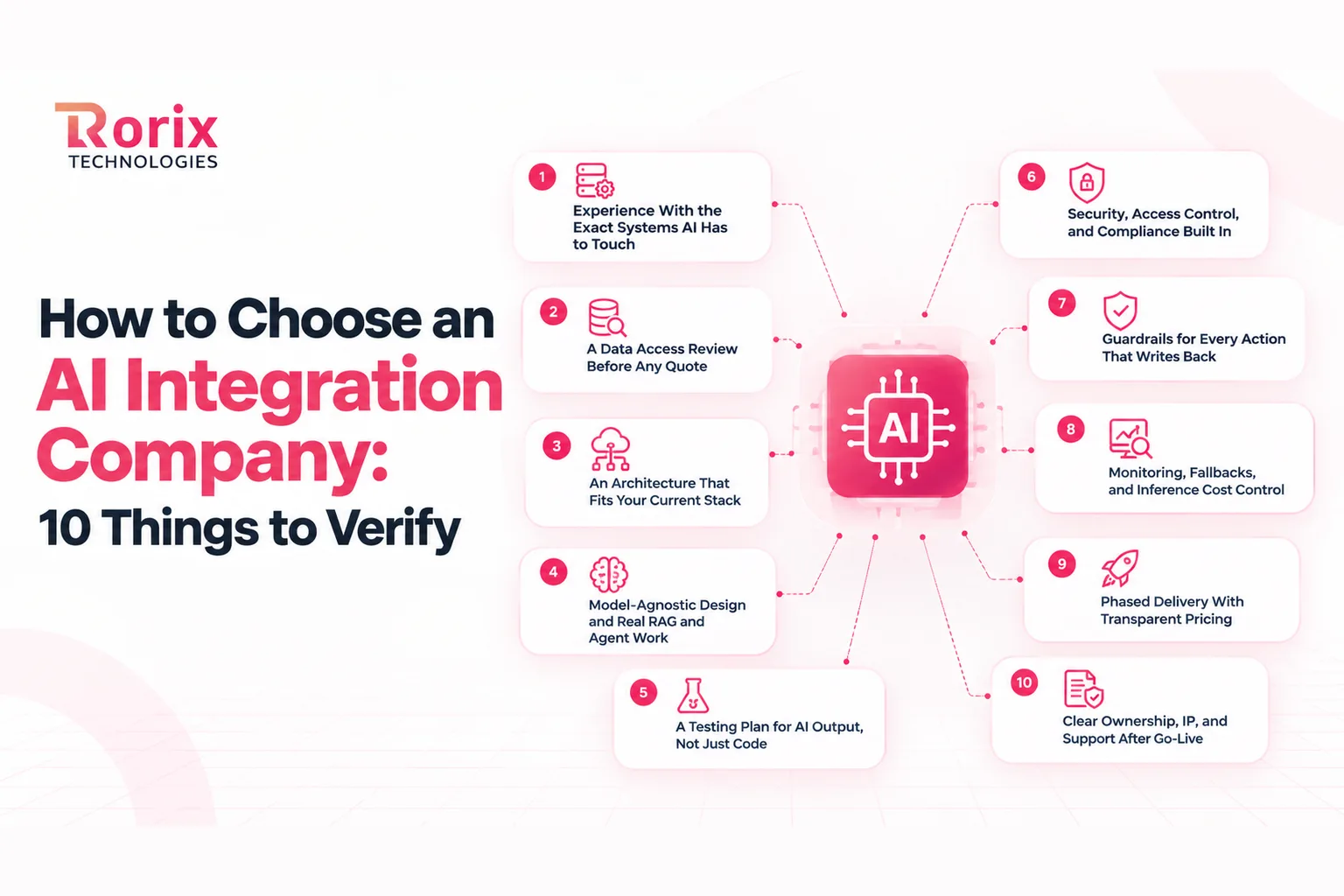
1. Experience With the Exact Systems AI Has to Touch
Ask for proof of integrations with your actual systems, not just experience in your industry. A partner familiar with SAP or a custom WMS will better understand data gaps and API limits. Our guide on How to Evaluate a Warehouse Management Software Development Company covers the warehouse side; ask what broke in their last integration and how they fixed it.
2. A Data Access Review Before Any Quote
AI projects often stall because data is messy, scattered, or restricted. Before quoting, a partner should review data quality, ownership, access, and legal permissions. Ask what their first-week data review delivers, such as a data access map.
3. An Architecture That Fits Your Current Stack
AI should fit your existing systems, not force an expensive rebuild. A good partner selects APIs, middleware, batch jobs, or event streams based on your setup. Our guide on real-time inventory with WebSocket and pub-sub architecture shows an event-driven approach; ask the partner to map your integration path.
4. Model-Agnostic Design and Real RAG and Agent Work
Your integration should support model changes without rebuilding every connector. Look for production experience with RAG, AI agents, and stable interfaces that keep models replaceable. Ask how they would switch your model without disrupting existing workflows.
5. A Testing Plan for AI Output, Not Just Code
Passing software tests doesn't guarantee accurate or safe AI responses. Your partner should test grounding, accuracy, and failure cases, then repeat evaluations after model or prompt changes. Ask to see a past evaluation report and the accuracy threshold the project needed to meet.
6. Security, Access Control, and Compliance Built In
AI must never access data beyond the user's permissions. Require role-based access, audit logs, and relevant controls for GDPR, HIPAA, or SOC 2 where applicable. Ask how the partner enforced access and maintained audit trails in a previous regulated project.
7. Guardrails for Every Action That Writes Back
AI actions that change orders, payroll, or inventory need stricter controls than read-only queries. Require approval steps, action limits, and rollback options to prevent costly mistakes. Ask which actions should require human approval in your workflow and why.
8. Monitoring, Fallbacks, and Inference Cost Control
Production AI needs monitoring for accuracy, latency, failures, and model usage costs. Your partner should provide alerts, fallback paths, and spending limits as usage grows. Ask what happens to your workflow during a model outage or a sudden increase in inference costs.
9. Phased Delivery With Transparent Pricing
A reliable plan moves from pilot to production in stages, with clear acceptance criteria at each step. Pricing should separate development, model usage, hosting, licenses, and ongoing support. Ask what could change the estimate and how scope changes affect the budget.
10. Clear Ownership, IP, and Support After Go-Live
Confirm ownership of code, prompts, connectors, and data pipelines before signing. Define who monitors the integration, fixes failures, and maintains it after launch. Ask about exit terms, ongoing support costs, and the named engineer responsible after go-live.
Now that you know what to verify, let's look at the warning signs that should end a vendor conversation early.
7 Red Flags That Should End the Vendor Conversation
RAND's 2024 report notes that, by some estimates, more than 80% of AI projects fail, roughly twice the rate of IT projects without AI. Watch for these red flags when evaluating AI integration companies.
- Demos without production work: A prototype doesn't prove reliability with live data, real users, or production workloads. Ask for a real case study.
- Model talk with no system talk: If they can't explain how data reaches the model and actions reach your ERP or CRM, question their integration expertise.
- A fixed price before seeing your data: Without a data review, estimates can miss major costs. Ask for an assessment before approving the budget.
- Security pushed to a later phase: Delayed access controls and audit logs create avoidable risks. Require security from the start.
- No evaluation plan: Ask how they test AI accuracy, grounding, and safety before and after launch.
- A senior sales team and a junior delivery team: Confirm who will actually build and lead your project.
- No post-launch owner: Agree on monitoring, maintenance, incident response, and support before signing.
How Much Do AI Integration Companies Charge?
Costs depend on system complexity, data readiness, and AI capabilities. These are market estimates, not Rorix pricing.
1. AI Integration Cost by Project Scope
| Project Scope | What's Included | Market Range (KrishaWeb) | Timeline (Folio3) |
|---|---|---|---|
| Focused pilot | One use case for one team or department, limited data and light integration, to prove the idea works | $15,000 to $50,000 | 6 to 12 weeks |
| Production integration | Real users in a live business function, several workflows, production infrastructure, monitoring and access controls | $50,000 to $150,000 | 3 to 6 months to build (6 to 12 from scoping to production, Folio3) |
| Multi-system program | Enterprise integration across multiple systems, with governance, security reviews and compliance controls | $150,000 to $2,000,000+ | 12 to 24 months |
Sources: build costs from KrishaWeb (updated 6 Aug 2026), timelines from Folio3 (3 Jun 2026).
Other guides draw the lines differently. Folio3 prices a pilot at $15,000 to $60,000, a departmental deployment at $75,000 to $350,000 and an enterprise-wide integration at $500,000 to $2,000,000+. GMWare (18 May 2026), which prices the integration by the system it goes into, puts a single AI feature added through an API at $5,000 to $20,000 and an enterprise ERP, CRM or legacy system at $40,000 to $150,000+. For ranges per kind of feature, see our AI integration cost guide.
Legacy systems and regulated data raise costs. KrishaWeb and Folio3 both put the extra integration work for older systems at $30,000 to $200,000, Folio3 adds 3 to 8 months to the timeline, and KrishaWeb adds 15% to 20% for compliance in regulated sectors. Clean APIs and focused use cases help control them.
Example: An AI assistant added to the WMS you already run, which answers one team's questions without writing anything back, is a pilot: $15,000 to $50,000 in KrishaWeb's figures and 6 to 12 weeks in Folio3's. Putting it in front of real users, with approved write-back into your ERP, monitoring and access controls, makes it a production integration: $50,000 to $150,000 (KrishaWeb) over 3 to 6 months to build (6 to 12 from scoping to production, Folio3).
Need a project estimate? Tell us your systems and workflow. Get a Free Consultation and Project Estimate
2. AI Development Hourly Rates by Region
| Where the AI Firm Is Based | Average Hourly Rate |
|---|---|
| India, Australia, the Philippines and Ukraine | $25 to $49 |
| United States, Canada, Poland, Spain and Mexico | $50 to $99 |
| Enterprise consulting firms (Big Four, Accenture) | $250 to $500 (Layer3 Labs) |
Source: Clutch, updated 21 Sep 2026, averages from client reviews; enterprise row from Layer3 Labs, a US AI consultancy, updated 27 Oct 2026. Clutch puts the average for all AI development companies at $25 to $49 an hour. These are market averages, not Rorix pricing.
The regional rows are Clutch's averages for AI development firms; Clutch's averages for software development firms in general, updated 21 Sep 2026, are higher in some regions (for example Canada and Australia), as our outsourcing guide shows.
Rates vary by location. Read our guides to the cost of outsourcing software development and nearshore vs offshore software development.
3. Engagement Models: Pilot, Project, Dedicated Team, or Retainer
Choose based on scope, budget, and ongoing support needs.
| Model | How It Works | Best When |
|---|---|---|
| Fixed-price pilot | Fixed scope and budget | You need proof before scaling |
| Time and materials | Pay for hours as scope evolves | Requirements may change |
| Dedicated team | Engineers join your in-house team | You need steady development capacity |
| Retainer | Ongoing development and maintenance | AI supports critical workflows |
4. Running Costs After Go-Live
Budget for ongoing costs beyond development:
- Model and API usage: Fees grow with users and document volume. At vendor list prices checked 28 Oct 2026, 20,000 questions a month cost about $10 to $200 in model fees on small and mid-range models, as our AI integration cost guide works out.
- Hosting and vector storage: Databases, indexes, and compute.
- Evaluation and monitoring: Regular accuracy checks and reviews.
- Connector maintenance: Updates when Salesforce, ERP, or WMS APIs change.
- Model and prompt updates: Regression testing before changes go live.
Also Read: AI-Enabled Business Systems: How to Build One That Pays Back
Why Rorix Technologies Fits Operations-Heavy AI Integration
Choosing an AI partner is easier when its experience matches the systems and workflows you need to connect.
Rorix Technologies builds custom software that connects AI with existing business systems, including WMS, HRMS, order management, CRM, and SaaS platforms. Its focus is on practical AI integration that reduces manual work and fits daily operations.
The team combines senior engineers, a named technical lead, two-week sprints, and ongoing support to keep development aligned with business goals.
- 27 platforms delivered: Across custom software products.
- 80% fewer manual errors: Achieved with WorkCenter Central, the platform we built for distributor Lorecs, which also sped up order processing by 50%.
- 40+ integrations: Unified in one CRM for Driven, a US performance platform for pest control and field service teams, including HubSpot, Twilio, RingCentral, and Google APIs.
- AI capabilities: LLM and RAG features, workflow automation, and AI connected to business data.
- MVP delivery: A working MVP in 6 to 12 weeks, depending on scope.
- Long-term partnerships: Our founders have been DealSignal's engineering partner for 5+ years, continuing under Rorix.
- Global delivery: Serves clients across the US, UK, Canada, Australia, and New Zealand.
Need AI connected to your existing business systems?
Check your AI readiness or talk to our experts to discuss your workflows, integrations, and project requirements.
Conclusion: Choose an AI Partner That Understands Your Systems
The right AI partner knows how to connect AI with your existing ERP, CRM, WMS, or HRMS while keeping data secure and workflows reliable.
We hope this guide helps you compare AI integration companies by their expertise, pricing, system compatibility, and post-launch support.
Shortlist three partners, use the 10 selection checks, and compare their approach before making a decision.
Ready to bring AI into your business workflows? Connect with our experts to discuss your requirements, identify the right use case, and estimate your project cost.
Frequently Asked Questions
What does an AI integration company do?
It connects AI models to existing software, data, and workflows using APIs, RAG, automation, security controls, and monitoring.
How much does AI integration cost?
KrishaWeb's guide, updated 6 Aug 2026, puts a single-department AI pilot at $15,000 to $50,000, a mid-market project spanning several workflows at $50,000 to $150,000, and a full enterprise integration across multiple systems at $150,000 to $2,000,000+. GMWare puts one AI feature added through an API at $5,000 to $20,000. These are market ranges, not a Rorix price.
How long does AI integration take?
A proof-of-concept pilot on one use case typically takes 6 to 12 weeks, a production deployment for one department 3 to 6 months to build (6 to 12 from scoping to production), and an enterprise-wide integration 12 to 24 months (Folio3, 3 Jun 2026). MIT NANDA's July 2025 report, as reported by Virtualization Review, found mid-market organizations move from pilot to full implementation in about 90 days, against nine months or longer for large enterprises, though the report's method has been questioned.
Can AI integrate with legacy ERP or on-premise systems?
Yes. APIs, middleware, or custom adapters can connect AI to legacy systems. Some may need minor modernization first.
Do we need clean data before hiring an AI integration company?
No, but a data review is essential. Your partner should identify access, quality, and security gaps before development.
Who owns the code, prompts, and data pipelines?
Your contract should define ownership. Secure rights to custom code, prompts, and pipelines, plus repository access, documentation, and exit terms.
Should we build AI integration in-house or hire a partner?
Build in-house if AI is core to your product and you have the right engineers. Otherwise, a partner can speed up implementation and help your team learn.
How do we measure AI integration ROI?
Track a baseline metric such as manual hours, error rates, or processing time. Compare results after launch against ongoing costs.
Adding AI to your system, or building a new AI feature?
Most of the work sits in the data plumbing rather than the model. Send us the workflow you want to automate and we will tell you what is feasible on your current stack.
Continue learning
Written by
Ankur AkvaliyaFounder & Director, Rorix Technologies
Ankur co-founded Rorix Technologies with a mission to deliver enterprise-grade software that growing businesses can actually afford. He drives technical project delivery and client success end-to-end, overseeing product strategy, client partnerships, and the company's long-term vision to ensure every engagement delivers measurable business outcomes across WMS, HRMS, and custom software verticals.
View full profileRelated articles
Top 15 AI Agent Development Companies in 2026 (Compared)
Explore the top AI agent development companies in 2026. Compare capabilities, headquarters, and Clutch ratings to choose the right development partner.
Read article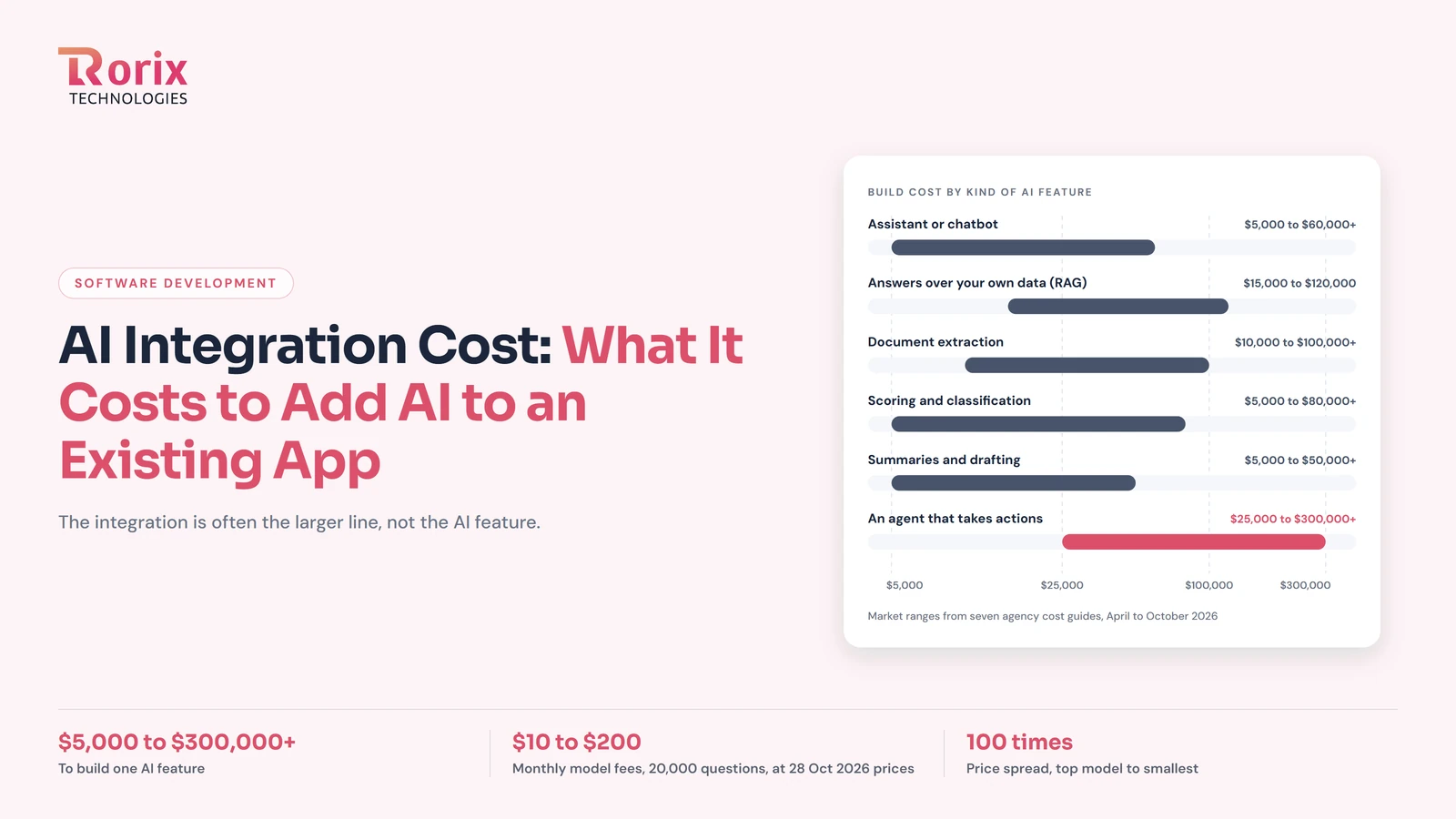
AI Integration Cost: What It Costs to Add AI to an Existing App
AI integration cost for an existing app: market ranges per feature, monthly model prices checked 28 Oct 2026, hidden costs and when to modernize first.
Read article
EDI vs API: Which Integration Works Best for Warehouses and 3PLs in 2026?
Compare EDI vs API for warehouses and 3PLs. Explore key differences, EDI transaction sets, integration costs, timelines, and when to use both.
Read article