
AI Integration Cost: What It Costs to Add AI to an Existing App
AI integration cost for an existing app: market ranges per feature, monthly model prices checked 28 Oct 2026, hidden costs and when to modernize first.
On this page37 sections
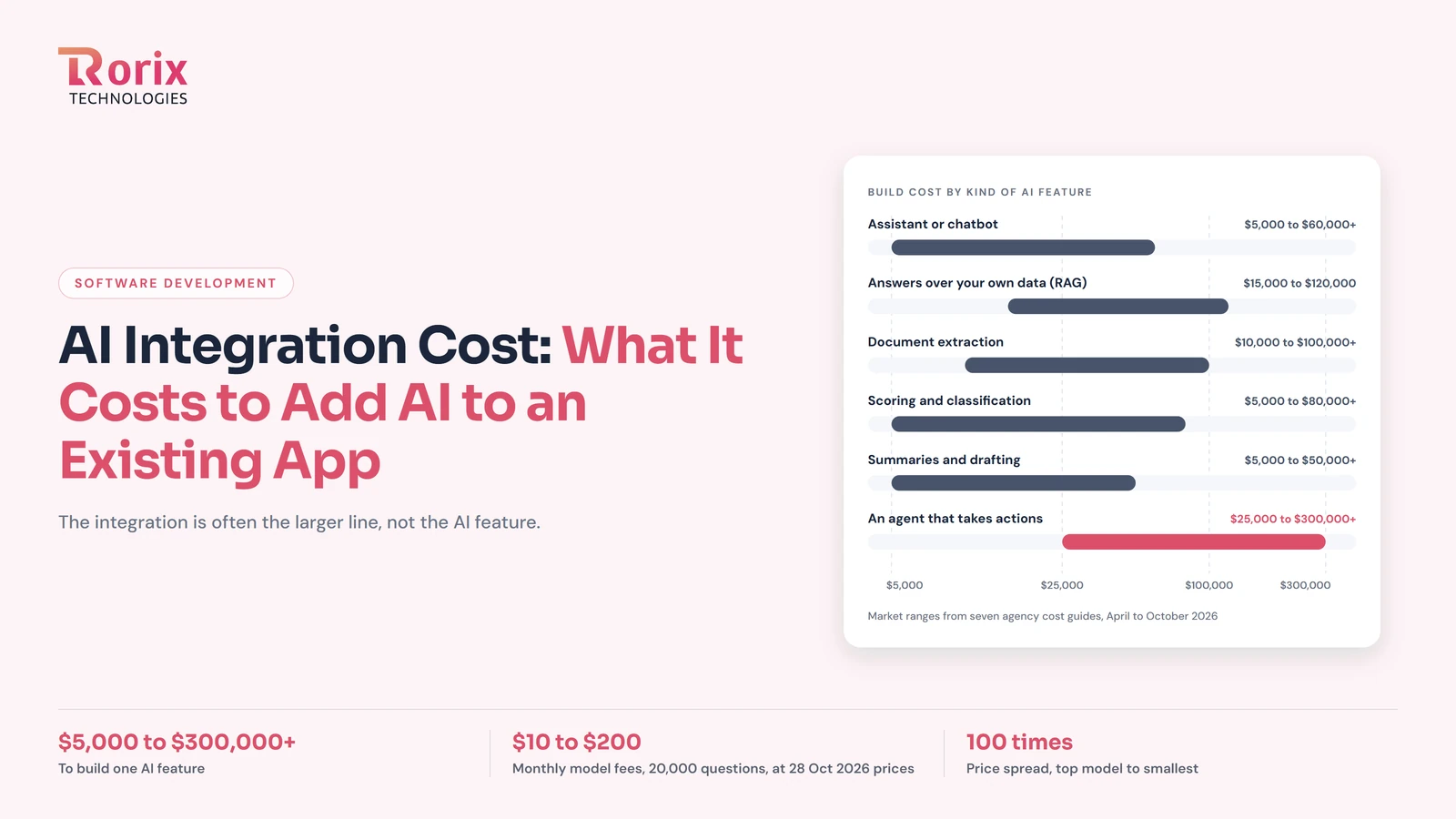
It costs $5,000 to $300,000+ to add AI to an existing app, according to seven agency cost guides published or updated between April and October 2026. That is the AI integration cost to build one feature: an assistant, a score or a summary sits near the bottom of the range, and an agent that takes actions inside your systems sits at the top. Running it adds model fees of about $10 to $200 a month for 20,000 questions on small and mid-range models, at vendor list prices checked on 28 Oct 2026.
These are market ranges, not a Rorix price. They are wide because fitting the AI into the app you already run is often the larger line, and that part depends on your system rather than on the model. AI integration is the work we do at Rorix, so this guide gives you the numbers we would want a buyer to have before any quote: the range per kind of feature, the running cost by model, the hidden costs, and a test for whether your app needs work before AI goes in.
Key Takeaways: What It Costs to Add AI to an Existing App
- Build cost: one AI feature in an existing app costs $5,000 to $300,000+ in published agency guides from April to October 2026; assistants, scoring and summaries start near $5,000, and agents that take actions cost $25,000 to $300,000+.
- The integration is often the larger line: an agency estimate puts integration and QA at 40% to 60% of an enterprise AI build (GMWare).
- Running cost: at list prices checked 28 Oct 2026, 20,000 questions a month cost $10 to $200 in model fees on small and mid-range models, before Gemini 4 Argon's price rises on 1 Dec 2026, and the most expensive models cost 100 times the smallest per token.
- Prices move on a schedule: Google's Gemini 4 Argon doubles in price on 1 Dec 2026 and Gemini 3.8 Flash on 1 Jan 2027, so date every running-cost estimate.
- Most AI pilots stall before production: IDC found only four of every 33 AI proofs of concept reached production, and S&P Global found the average organization scrapped 46% of its proofs of concept before they reached production.
- One real number: an AI candidate score in our own HR system costs about $0.004 at list price (our estimate), because the resume text in every call is capped at 8,000 characters.
What Does "Adding AI" to an Existing App Actually Mean?
Adding AI to an existing app means calling a hosted model, such as Claude, GPT or Gemini, from software you already run, and putting its answer into a screen or workflow your users already use. You pay for the model by the token, and you build everything around it: data access, prompts, screens, checks and monitoring.
Six kinds of feature cover most requests, and each has its own price range:
- An assistant or chatbot that answers questions inside the app.
- Answers over your own data, where the model searches your documents or records before it answers. This is called retrieval-augmented generation, or RAG.
- Document extraction, which reads invoices, forms or contracts and fills in fields.
- Scoring and classification, which ranks, tags or routes a record for a person to act on.
- Summaries and drafting, which turn records into a report, an email or a note.
- An agent that takes actions, which plans steps and writes into your systems.
Where the feature enters your app matters as much as which feature it is. Our guide on how to add AI to existing software maps the four insertion points, from the read side where nothing is written to a new surface beside the system.
How Much Does Each Kind of AI Feature Cost?
Published agency guides price a single AI feature in an existing app from $5,000 to $300,000+. Assistants, scoring and summaries start near $5,000, answers over your own data near $15,000, and an agent that takes actions near $25,000. The table shows each range, the timeline and monthly cost where a guide gives one, and how many guides agree.
| Kind of AI Feature | Build Cost (Market Range) | Typical Timeline (Where Sourced) | Monthly Running Cost (Where Sourced) | Guides Behind the Range |
|---|---|---|---|---|
| Assistant or chatbot | $5,000 to $60,000+ | 2 to 3 weeks for a basic chatbot over your documents | $340 a month in one reported build | 6 |
| Answers over your own data (RAG) | $15,000 to $120,000 | 4 to 6 weeks | About $2,000 a month for a lean $40,000 build | 5 |
| Document extraction | $10,000 to $100,000+ | 3 to 5 weeks for one document type; 6 to 10 weeks for several | $200 to $2,000 a month, plus $0.01 to $0.05 a page for OCR | 3 |
| Scoring and classification | $5,000 to $80,000+ | No sourced figure | No sourced figure | 4 |
| Summaries and drafting | $5,000 to $50,000+ | 1 to 3 weeks for a basic feature; 3 to 5 weeks for a fuller one | No sourced figure | 4 |
| An agent that takes actions | $25,000 to $300,000+ | No sourced figure | No sourced figure | 5 |
These are agency estimates, not Rorix pricing, and each range runs from the lowest floor to the highest ceiling among the guides that price that feature. Timelines and running costs come from Apptitude (4 Apr 2026), except the RAG running cost, which comes from Space-O Technologies (updated 21 Oct 2026).
Sources: Apptitude, Biz4Group (updated 27 May 2026), OrangeMantra (21 Sep 2026), Primocys (31 Aug 2026), Space-O Technologies, Aalpha (updated 20 Jul 2026), Dotcube Technologies (3 Sep 2026)
The spread is wide because each guide prices a different scope. At the extremes, Dotcube puts the whole field at $3,000 to $500,000+. For whole projects, GMWare (18 May 2026) quotes $5,000 to $20,000 for a single-feature API integration, $15,000 to $50,000 for an app touching two to four AI APIs, and $40,000 to $150,000+ for enterprise ERP, CRM or legacy systems. Clutch (updated 21 Sep 2026) puts the average AI project at $120,594.55, with most between $10,000 and $49,999, though that average covers every kind of AI project, not only features added to an existing app.
Assistant or Chatbot: $5,000 to $60,000+
Apptitude prices a basic chatbot on OpenAI's API, with your documents as context, at $5,000 to $10,000 and 2 to 3 weeks. It also reports one real build: "Development cost was $18K. Monthly API spend settled at $340 after prompt optimization. It deflected 64% of support tickets in the first month." The other guides put an assistant at $15,000 to $35,000 (Biz4Group), $5,000 to $20,000 (OrangeMantra), $15,000 to $50,000 (Primocys), $10,000 to $30,000 (Space-O) and $20,000 to $60,000+ (Aalpha).
Answers Over Your Own Data (RAG): $15,000 to $120,000
An assistant that answers from your own documents costs more because the documents have to be split, indexed and kept current, and the answers have to cite them. Space-O puts it at $40,000 to $120,000 and adds: "A lean RAG assistant built for $40,000 runs at $2,000 a month in API and infrastructure fees." Biz4Group says $40,000 to $90,000, Primocys $20,000 to $60,000+, Aalpha $20,000 to $50,000+, and Apptitude $15,000 to $25,000 over 4 to 6 weeks.
Document Extraction: $10,000 to $100,000+
Apptitude prices extraction for a single document type at $15,000 to $25,000 over 3 to 5 weeks, and for several document types at $30,000 to $50,000 over 6 to 10 weeks, with running costs of $200 to $2,000 and OCR adding $0.01 to $0.05 a page. Primocys says $15,000 to $40,000, and Dotcube gives two tiers, $10,000 to $30,000 and $30,000 to $100,000+.
Scoring and Classification: $5,000 to $80,000+
Scoring ranks or tags a record so a person can act on it first, which is the cheapest place for a model to be wrong. Primocys prices a basic LLM feature at $5,000 to $20,000, and Space-O's simple tier, which covers classification, at $10,000 to $30,000. Aalpha prices prebuilt analytics models at $10,000 to $20,000 and custom churn, lifetime value or cohort models at $30,000 to $80,000+, and OrangeMantra prices predictive AI at $20,000 to $60,000+. Our own candidate matching is a scoring feature; its build size and cost per score are below.
Summaries and Drafting: $5,000 to $50,000+
Apptitude prices a basic summary or drafting feature at $5,000 to $10,000 over 1 to 3 weeks and a fuller one at $12,000 to $20,000 over 3 to 5 weeks, with guardrails at $2,000 to $5,000 on top. Biz4Group says $20,000 to $50,000+, Aalpha $15,000 to $40,000 and OrangeMantra $10,000 to $40,000.
An Agent That Takes Actions: $25,000 to $300,000+
An agent plans several steps and writes into your systems, so it needs permissions, approval steps and far more testing than a feature that only suggests. Primocys starts at $25,000 to $80,000+, OrangeMantra $30,000 to $150,000+, Aalpha $30,000 to $70,000 and $100,000 to $250,000+, Biz4Group $70,000 to $150,000+, and Space-O $80,000 to $300,000+. Our AI agent development cost guide breaks agents down by complexity tier, integrations and team.
Why Does Integration Often Cost More Than the AI Feature?
Integration often costs more than the AI feature because the model is rented by the token, while the integration is built by hand for your system: reading the right data, checking permissions, handling slow or wrong answers and testing on real traffic. GMWare, an agency, puts integration and QA at 40% to 60% of an enterprise AI build.
Ask for these as two separate lines in any quote:
The AI feature cost is the prompt, the retrieval or extraction logic, the guardrails and the evaluation tests that make the model answer well. Apptitude prices guardrails alone at $2,000 to $5,000.
The integration cost is the work inside your existing app that gets data to the model and the answer back to a user: data access, permissions, the screen or workflow change, error handling, logging and testing against real traffic. In an enterprise AI build, GMWare, an agency, counts integration and QA as a large share of the budget.
A quote that prices only the first line is missing a large part of the job. The second line shrinks when your app already has clean APIs to read from, which is why an API integration strategy often comes before the model. It also shrinks when the AI writes its results into new tables beside the app instead of changing the tables the app depends on. That is how we added candidate matching to our own HR system, and why the price finder we built for Lorecs shipped without a single change to the production codebase of the platform it reads from.
What Does AI Cost to Run Every Month?
Model fees are the part of the running cost that grows with traffic, paid per million tokens read and written. At list prices checked 28 Oct 2026, a month of 20,000 questions costs $10 on Claude Haiku 5.5 or gpt-6-luna and $200 on Claude Sonnet 5.5. At low volume, monitoring and search can cost more than the model.
Model Prices Checked 28 October 2026
| Vendor | Model | Input per Million Tokens | Output per Million Tokens |
|---|---|---|---|
| Anthropic | Claude Fable 5.1 | $10 | $50 |
| Anthropic | Claude Opus 5.5 | $4 | $20 |
| Anthropic | Claude Sonnet 5.5 | $2 | $10 |
| Anthropic | Claude Haiku 4.5 | $1 | $5 |
| Anthropic | Claude Haiku 5.5 (prompts up to 100,000 tokens) | $0.10 | $0.50 |
| OpenAI | gpt-6-astra | $10 | $50 |
| OpenAI | gpt-6.1-sol | $2 | $10 |
| OpenAI | gpt-6.1-terra | $1 | $5 |
| OpenAI | gpt-6-luna | $0.10 | $0.50 |
| Gemini 4 Argon | $2 through 30 Nov 2026, then $4 | $10, then $20 | |
| Gemini 3.8 Flash | $0.75 through 31 Dec 2026, then $1.50 | $3.75, then $7.50 | |
| Gemini 3.5 Flash-Lite | $0.30 | $2.50 |
Sources: list prices published by Anthropic, OpenAI and Google, all checked 28 Oct 2026. Claude Haiku 5.5 costs $0.50 and $2.50 for prompts over 100,000 tokens.
Three things in this table move a budget more than any build decision:
- The spread is 100 times. The top models, Claude Fable 5.1 and gpt-6-astra, cost 100 times the smallest, Claude Haiku 5.5 and gpt-6-luna, per token.
- Some prices are already scheduled to rise. Google's price page shows Gemini 4 Argon doubling on 1 Dec 2026 and Gemini 3.8 Flash doubling on 1 Jan 2027.
- Waiting is cheaper. Anthropic's Batch API takes 50% off, and OpenAI's batch pricing halves its rates, for work that does not need an answer within seconds.
The One-Line Monthly Formula
Monthly model cost = requests a month × (input tokens × input price + output tokens × output price) ÷ 1,000,000, with prices per million tokens.
A Worked Month: 20,000 Questions on Seven Models
Assume 20,000 questions a month, each sending 3,000 tokens in and getting 400 tokens back. That is 60 million input tokens and 8 million output tokens. On Claude Sonnet 5.5, 60 × $2 is $120 and 8 × $10 is $80, so the month costs $200.
| Model | Model Fees for the Month |
|---|---|
| Claude Sonnet 5.5 | $200 |
| gpt-6.1-sol | $200 |
| Gemini 4 Argon | $200 through 30 Nov 2026, then $400 |
| Claude Haiku 4.5 | $100 |
| Gemini 3.8 Flash | $75 through 31 Dec 2026, then $150 |
| Claude Haiku 5.5 | $10 |
| gpt-6-luna | $10 |
Same questions, same month: $10 to $400 depending on the model and the date. Pick the smallest model that passes your own tests on real questions, and move up only where it fails.
Search, Monitoring and Upkeep: The Costs Beside the Model
Model fees are not the whole bill, and at low volume they are not always the largest part of it. Answers over your own data need a vector database, and every feature needs monitoring:
- Vector database: Pinecone lists a free Starter plan, Builder at $20 a month, Standard from $50 and Enterprise from $500, checked 28 Oct 2026. GMWare, an agency, estimates $100 to $2,000 a month.
- Embeddings: Google lists its Embedding 2 model at $0.20 per million input tokens.
- Monitoring and evaluation: Langfuse lists a free Hobby plan, Core at $29, Pro at $199 and Enterprise at $2,499 a month, checked 28 Oct 2026. Apptitude, an agency, estimates $2,000 to $5,000 to set monitoring up and $200 to $500 a month to run it.
- Upkeep: GMWare, KrishaWeb and Space-O all put yearly maintenance at 15% to 25% of the build cost, the same range our software maintenance cost guide uses for any software.
All in, published guides put the monthly running cost of an AI feature anywhere from $40 (Space-O) to $50,000+ (KrishaWeb, updated 6 Aug 2026). Traffic and model choice decide where you land.
What Hidden Costs Push the AI Budget Up?
The hidden costs sit outside the model: cleaning the data, working around the seams of the existing system, testing against real traffic, and security and privacy reviews. IDC found only four of every 33 AI proofs of concept reached production, and S&P Global found the average organization scrapped 46% of its AI proofs of concept before production.
What Independent Research Says About AI Projects That Stall
- IDC with Lenovo, reported by CIO.com on 25 Mar 2025: "88% of observed POCs don't make the cut to widescale deployment. For every 33 AI POCs a company launched, only four graduated to production, IDC found."
- S&P Global, reported by CIO Dive on 14 Mar 2025: "The share of companies abandoning most of their AI initiatives jumped to 42%, up from 17% last year." The same survey found that "The average organization scrapped 46% of AI proof-of-concepts before they reached production."
- Deloitte, State of AI in the Enterprise, 3 Mar 2026, a survey of 3,235 leaders: "only 25% of respondents have moved 40% or more of their AI pilots into production".
- MIT NANDA, July 2025, as reported by Virtualization Review on 19 Aug 2025: "Just 5% of integrated AI pilots are extracting millions in value..." The report measures impact on profit and loss, not failure, and its method has been questioned. It also found that "mid-market organizations move faster from pilot to full implementation (~90 days) than large enterprises (nine months or longer)."
- RAND, 13 Aug 2024: "By some estimates, more than 80 percent of AI projects fail, twice the rate of failure for information technology projects that do not involve AI."
- Informatica, CDO Insights 2025, Jan 2025, which is vendor research: "43% of data leaders say that data quality, completeness and readiness are among the biggest obstacles..."
The pattern is the one our guide to AI-enabled business systems describes: the model is rarely the constraint, and the data and the workflow around it usually are.
What Agencies Estimate for Data, Legacy Systems and Testing
These are agency estimates, not research; we found no research firm that measures the share of an AI budget that data preparation takes:
- Data preparation: 15% to 35% of the budget (Biz4Group).
- A legacy enterprise system: can add 20% to 60% to AI integration costs (Biz4Group).
- Integration and QA: a large share of an enterprise AI build (GMWare), as covered above.
Testing Against Real Traffic
A feature that looks right in a demo can still be wrong on your data. Running the model in shadow mode, where it sees real traffic and its answers are logged but shown to nobody, catches that before users do. Budget engineering time for it, plus an evaluation tool from the monitoring line above.
Security and Privacy Reviews
Every request sends some of your data to the model provider. Before launch, decide which fields may leave your system, strip what the feature does not need, make sure the model only sees records the signed-in user is allowed to see, and log what was sent. Ask for this as its own line in the quote rather than assuming it is inside the build.
Should You Modernize Your App Before Adding AI?
Modernize first when the AI would need data or changes your current system cannot safely give it. If data leaves only through a screen export, two systems disagree about the same records, or the framework no longer gets security fixes, the AI budget pays for the modernization anyway. The six-question test below shows which side you are on.
Answer yes or no for the system the AI feature will live in:
- Can another program read the data the feature needs through an API or a database view, without a screen export?
- Is there one agreed source for each record the AI will read, such as the customer or the order? If not, a single source of truth comes first.
- Can the app accept a value from something other than a form, so an AI suggestion can be saved?
- Does the framework the app runs on still receive security updates? Our guide to .NET 8 and .NET 9 end of support shows what changes when they stop.
- Can your team ship a small change in weeks rather than a quarter?
- Do you know where the personal data in the system sits and who may see it?
Six yes answers: add AI now, starting with a feature that only reads and suggests. One or two no answers: add AI where the answers are yes, and fix the rest as you go. Three or more no answers: modernize the slice the AI needs first, because an agency estimate says a legacy enterprise system can add 20% to 60% to AI integration costs (Biz4Group), and that money buys a better system if you spend it on purpose. Our legacy application modernization guide covers how to do that without stopping the business.
Is your system ready? Our readiness assessment scores your technology, process, people and data in about two minutes and shows your biggest gaps, with no email needed to see the result.
How Can You Keep AI Integration Cost Down?
Keep AI integration cost down by starting small and capping everything that is billed by use. Begin with a feature that reads and suggests, pick the smallest model that passes your tests, cap the input, cache repeated prompts, batch work that can wait, and give every call a time limit with a plain fallback.
- Start where nothing is written. Scoring, classification and summaries start near $5,000 in the guides above, and a wrong answer shown to a person costs little.
- Use the smallest model that passes. On the worked month above, moving from Claude Sonnet 5.5 to Claude Haiku 5.5 takes the model fees from $200 to $10.
- Cap the input. In both worked examples in this guide, input tokens are most of the bill, so cut long documents to the part the model needs. Our candidate matching cuts every resume at 8,000 characters.
- Cache the repeated part of the prompt. On Claude Haiku 4.5, a cached prompt read costs $0.10 per million tokens instead of $1.
- Batch work that can wait. Anthropic and OpenAI both halve their prices for batch jobs.
- Give every call a time limit and a fallback. On our ROI report, the page waits at most 10 seconds for the model, then shows the plain result, so a slow model never holds the visitor up.
- Store AI results beside the app, not inside it. New tables for results leave the tables your app depends on untouched, which keeps the integration line short.
- Re-check prices on a schedule. Vendor prices change on announced dates, as Gemini's do on 1 Dec 2026 and 1 Jan 2027.
How Does Rorix Add AI to Systems That Already Exist?
We add AI to systems that are already running, on hosted models, and we do not train models. Candidate matching, our ROI report and the Lorecs price finder were all added to systems that already existed: our own HR system, the ROI calculator on our website, and WorkCenter Central, the platform we built for Lorecs, a distributor.
Candidate matching and the ROI report run on Claude Haiku 4.5 by Anthropic, at a list price of $1 per million input tokens and $5 per million output tokens, checked 28 Oct 2026. The same approach runs through the AI integration work we do for clients. These are the figures we can publish from our own systems:
| Figure | Value | Feature |
|---|---|---|
| Shipped | 8 Apr 2026 | Candidate matching in RMS, the management system we run Rorix on |
| Size of the change | About 1,000 lines across the backend and the screens | Candidate matching |
| Database change | Two new tables; no column added to the existing hiring tables | Candidate matching |
| Response time | About 4 seconds (median 3.8 s, slowest 5.7 s) | Candidate matching |
| Cost per score | About $0.004 at list price (our estimate) | Candidate matching |
| Time limit and fallback | The page waits at most 10 seconds for the model, then shows the plain result | ROI report on our website |
| Change to the client's platform | None to WorkCenter Central's production codebase | Lorecs AI SKU price finder |
What One AI Candidate Score Costs: About $0.004
This is an estimate, not a metered bill, because the system does not store token counts. It is worked from the input cap and the average reply at list price:
- Input: the job description, five candidate fields and the resume cut at 8,000 characters (about 2,000 tokens), so roughly 3,000 input tokens at most. 3,000 × $1 ÷ 1,000,000 = $0.003.
- Output: replies average 516 characters, about 150 tokens. 150 × $5 ÷ 1,000,000 = $0.00075.
- Per score: about $0.004, under half a cent.
- Per 10,000 applications: about $37.50, roughly $40.
The 8,000-character cut is the design decision that matters. A resume can be any length, but the part the model reads is not, so the input side of every score has a fixed ceiling. Cap the input on every feature you add, and the monthly bill becomes far easier to predict.
Why the Lorecs Price Finder Needed No Change to the Platform
Our founders took over Lorecs' business platform in 2018 and rebuilt it from scratch as WorkCenter Central. Years later, the AI SKU price finder was built as a separate service that reads thousands of vendor price files and answers "best price for this SKU" questions in plain English. It shipped without a single change to WorkCenter Central's production codebase, which is the pattern this guide recommends: add AI beside the app, not through it.
Behind those features:
- 27 platforms delivered and a 5.0 Clutch rating from 4 reviews on Clutch.
- A dedicated team of senior engineers with a named technical lead.
- Application engineering only: infrastructure and DevOps stay with your team.
- Clients in the US, UK, Canada, Australia, and New Zealand.
What Should You Do Before Asking for an AI Quote?
Pick one feature, check whether your system is ready for it, and ask for the AI feature and the integration work as two separate lines. Then price a month of running cost with the formula above, at prices dated the day you check them, and budget 15% to 25% of the build each year for upkeep.
- Name one feature and the decision it supports, such as which applications to read first or which supplier is cheapest.
- Run the six-question test above, or take the readiness assessment for a scored view of your gaps.
- Price the running cost for your expected traffic on two or three models from the price table.
- Ask every vendor for two lines, the AI feature and the integration, plus a yearly upkeep figure.
When you have the feature and the score, scope an AI build with our engineers. We will tell you which line will be the larger one in your system, and whether any of it should wait for modernization.
Frequently Asked Questions
How much does it cost to add AI to an existing app?
Agency guides published between April and October 2026 price one AI feature in an existing app at $5,000 to $300,000+. Assistants, scoring and summaries start near $5,000, answers over your own data near $15,000, and agents that take actions near $25,000. Running it adds model fees of about $10 to $200 a month for 20,000 questions at list prices checked 28 Oct 2026.
How much does it cost to add a chatbot to an existing app?
Agency guides put an assistant or chatbot at $5,000 to $60,000+. Apptitude prices a basic chatbot over your own documents at $5,000 to $10,000 and 2 to 3 weeks, and reports one build that cost $18,000 and settled at $340 a month in API spend. A chatbot that answers from your own data with retrieval (RAG) costs $15,000 to $120,000.
How much does AI cost to run per month?
It depends on the model and the traffic. At list prices checked 28 Oct 2026, 20,000 questions a month with 3,000 tokens in and 400 out cost $10 on Claude Haiku 5.5 or gpt-6-luna, $100 on Claude Haiku 4.5, and $200 on Claude Sonnet 5.5 or gpt-6.1-sol. Published guides put the total monthly running cost at $40 (Space-O) to $50,000+ (KrishaWeb).
What are the hidden costs of AI integration?
Data clean-up, the integration seams of the existing system, testing against real traffic, security and privacy reviews, monitoring and yearly upkeep. Biz4Group, an agency, puts data preparation at 15% to 35% of the budget and says a legacy enterprise system can add 20% to 60% to AI integration costs.
Why does integrating AI often cost more than the AI feature itself?
Integration often costs more because the model is rented by the token, while the integration is built by hand for your system: reading the right data, checking permissions, changing screens, handling slow or wrong answers and testing on real traffic. GMWare, an agency, puts integration and QA at 40% to 60% of an enterprise AI build. Writing AI results to new tables, rather than changing existing ones, keeps that line smaller.
How much should we budget each year to maintain an AI feature?
Budget 15% to 25% of the build cost a year, the range GMWare, KrishaWeb and Space-O all publish, on top of monthly model and hosting fees. Upkeep covers prompt and model updates, evaluation tests, integration fixes and price changes, such as Google's Gemini 4 Argon doubling in price on 1 Dec 2026.
Why do AI running costs rise after launch?
Usage grows, prompts get longer as features are added, and vendor prices change on a schedule. Google's price page shows Gemini 4 Argon rising from $2 to $4 per million input tokens on 1 Dec 2026, and Gemini 3.8 Flash from $0.75 to $1.50 on 1 Jan 2027. Capping input size, caching repeated prompts and re-checking prices keeps the rise in view.
Which AI feature should we add first?
Start with a feature that reads and suggests rather than writes: a summary, a score or a classification shown to a person who decides. These start near $5,000 in published guides, and a wrong answer costs little. Move to features that write into your system, and then to agents, once the first feature has proved itself on real data.
Why do so many AI projects fail to reach production?
Usually for reasons outside the model, such as data that is not ready and integration work nobody budgeted. IDC found only four of every 33 AI proofs of concept reached production (CIO.com, March 2025), S&P Global found the average organization scrapped 46% of its proofs of concept (CIO Dive, March 2025), and Informatica's vendor research (Jan 2025) found 43% of data leaders name data quality, completeness and readiness among the biggest obstacles to getting GenAI initiatives to the finish line.
Do we need to train our own model to add AI to our app?
Usually not. Hosted models from Anthropic, OpenAI and Google are called through an API and paid per token, so there is no training bill. Our own AI features run on hosted models, and answers over your own data come from retrieval (RAG), which hands the model the relevant documents at the moment of the question.
Adding AI to your system, or building a new AI feature?
Most of the work sits in the data plumbing rather than the model. Send us the workflow you want to automate and we will tell you what is feasible on your current stack.
Continue learning
Written by
Ankur AkvaliyaFounder & Director, Rorix Technologies
Ankur co-founded Rorix Technologies with a mission to deliver enterprise-grade software that growing businesses can actually afford. He drives technical project delivery and client success end-to-end, overseeing product strategy, client partnerships, and the company's long-term vision to ensure every engagement delivers measurable business outcomes across WMS, HRMS, and custom software verticals.
View full profileRelated articles
AI Agent Development Cost in 2026: Pricing by Complexity, Integrations, and Team
Explore AI agent development cost in 2026, including build prices, monthly expenses, integrations, maintenance, and ways to reduce your budget.
Read article
How to Add AI to Existing Software: What Your System Will Let You Do
How to add AI to existing software: the four insertion points, whether your system can emit what a model needs, shadow mode, and when to modernize first.
Read article
Cost of Outsourcing Software Development: Complete Pricing Breakdown 2026
Three vendors quoted the same build at $45,000, $95,000 and $160,000. See what outsourced software development really costs in 2026, line by line.
Read article