
Single Source of Truth for Business Data: One Writer Per Fact
A single source of truth is not one giant system. It is one writer per fact: how to map your systems of record, wire the reads, and end reconciliation.
On this page21 sections
Every company that has sat through a meeting arguing about whose number is right already knows what a single source of truth is worth. The sales sheet says one figure, the system says another, the owner's file says a third, and the first twenty minutes go to deciding which version of reality to use. That meeting is not a data problem. It is an authority problem: three places are allowed to write the same fact, so the fact has three values.
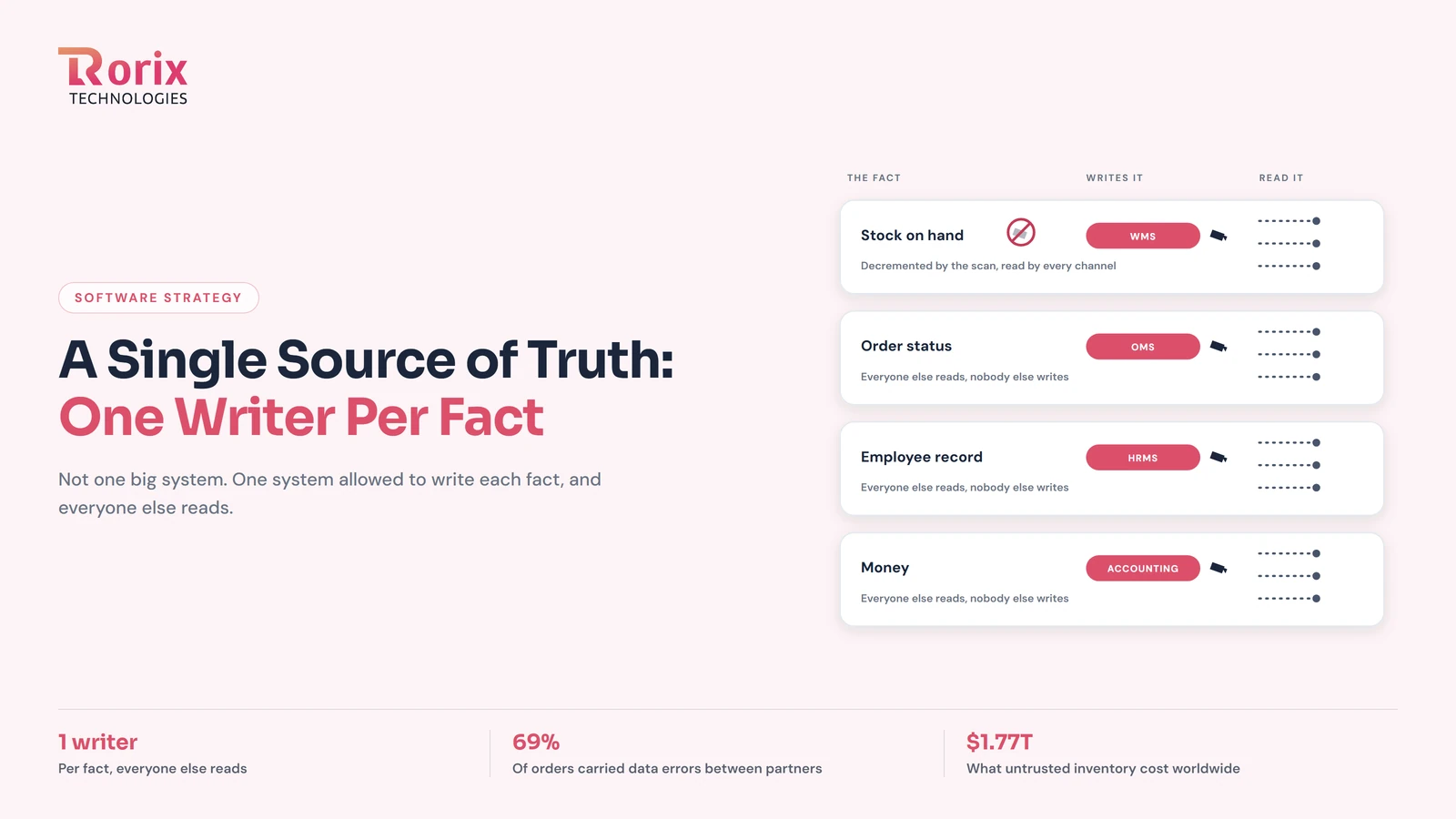
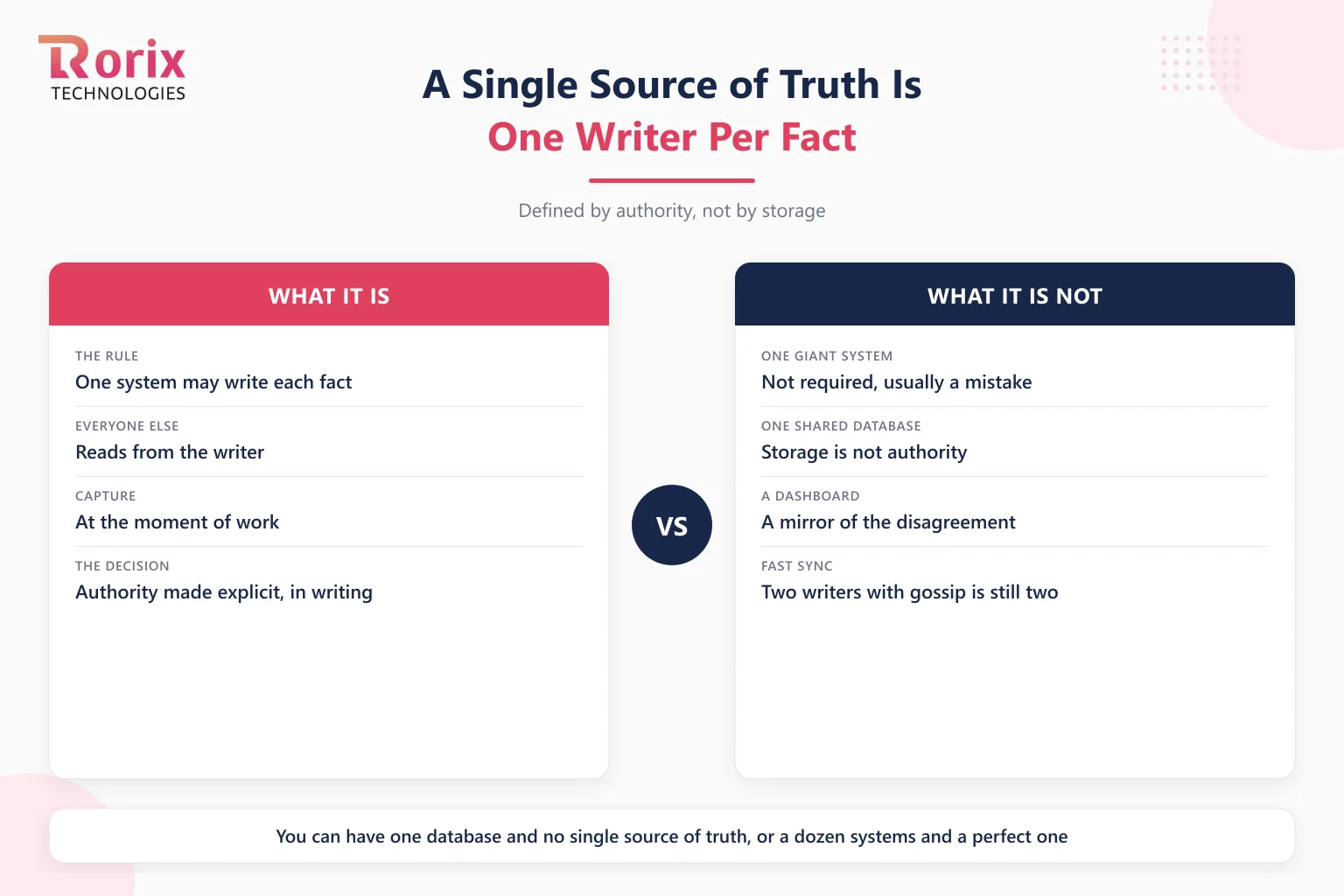
The fix is smaller and harder than most vendors make it sound. A single source of truth is not one giant system, one database, or one dashboard. It is a rule: every fact gets exactly one system allowed to write it, and everyone else reads from there. One writer per fact. Everything else in this guide is the working-out of that rule.
The cost of not having one is documented at planetary scale. IHL Group's 2023 Retail Inventory Distortion Study put the worldwide cost of inventory nobody could trust at $1.77 trillion, $1.2 trillion of it from out-of-stocks and $562 billion from overstocks. And when Auburn University's RFID Lab and GS1 US audited actual data flowing between brands and retailers in Project Zipper, 69% of orders contained data errors between trading partners, against 99.9% accuracy where item-level capture gave the fact one authoritative writer. Copies drift. That is not an IT opinion; it is the most consistently replicated finding in operational data.
In this guide, you'll learn:
- What a single source of truth actually is, and the three things it is not
- The one-writer test, and how to run it across your own facts
- Why companies end up with five versions of the truth without anyone deciding to
- A 6-step build that does not require replacing your systems
- When absorbing a system beats integrating it
Quick Answer: What a Single Source of Truth Is and Is Not
| Claim | Verdict |
|---|---|
| One system allowed to write each fact | This is it, entirely |
| One giant system that does everything | Not required, and usually a mistake |
| One database all tools share | Not required; authority matters, not storage |
| A dashboard that pulls from everywhere | Not a source of truth; a mirror of the disagreement |
| Real-time sync between equal systems | Two writers with fast gossip is still two writers |
| A data warehouse for reporting | Useful for analysis; irrelevant to who writes the fact |
The test for any architecture claiming to be a single source of truth is one question asked fact by fact: who is allowed to write this, and is the answer exactly one name?
Key Takeaways: One Writer Per Fact, Everyone Else Reads
- A single source of truth is a rule, not a system: every fact gets exactly one system allowed to write it, and everyone else reads from there.
- IHL Group's 2023 Retail Inventory Distortion Study put the worldwide cost of inventory nobody could trust at $1.77 trillion, with $1.2 trillion from out-of-stocks and $562 billion from overstocks.
- In Project Zipper, the Auburn University RFID Lab and GS1 US found 69% of orders carried data errors between trading partners, against 99.9% accuracy where item-level capture gave the fact one authoritative writer.
- Most companies find the list of contested facts that cause reconciliation meetings is short, usually five to ten, and naming one writer per fact is governance work, not engineering.
- Rorix builds the operational systems that act as writers of record, with one platform build carrying 40+ vendor integrations on a single system.
The One-Writer Test, Fact by Fact
Run your own operation through the question and the map draws itself.
Stock on hand. One system should own the count, decremented by scans at the moment of work, and every sales channel should read availability from it. The moment two systems both write stock, you get the overselling pattern our multi-channel order management guide exists to fix. Which system holds the pen is the inventory system vs WMS question: whichever directs the physical work should write the fact, because it is present when the fact changes.
Order status. Written by the system that advances the order, read by support, the storefront, and finance. A support team that updates status by hand in a second tool has just become a second writer.
The employee record. Written by the HR system, read by payroll, IT provisioning, and access control. Half the pain our HRMS guides catalog is this fact having four writers: a contract in a folder, a row in a sheet, an email to IT, a payroll entry.
Money. Written by accounting, read by everyone. This one usually already works, which proves the pattern: nobody lets three systems write the ledger, and the discipline that protects money is the same discipline every operational fact deserves.
Why Companies End Up With Five Truths
Nobody chooses fragmentation; it accretes. Each team adopts the tool that fits its work, each tool keeps its own copy of the shared facts, and the copies are joined by export, paste, and scheduled sync. Every copy is a potential writer, every manual bridge injects drift, and the Project Zipper finding shows the endpoint even between professionally run companies: seven in ten orders carrying data errors, because each partner maintained its own version of the same fact.
Internal versions of this are worse, not better, because nobody audits them. The spreadsheet layer is the usual culprit, and the signs you have outgrown spreadsheets are largely the symptoms of multiplying writers. A dashboard on top does not help: pulling five disagreeing numbers into one screen produces a prettier disagreement.
The deeper fix is architectural, and it does not require replacing everything. It requires deciding authority, then wiring reads.
How to Build a Single Source of Truth in 6 Steps
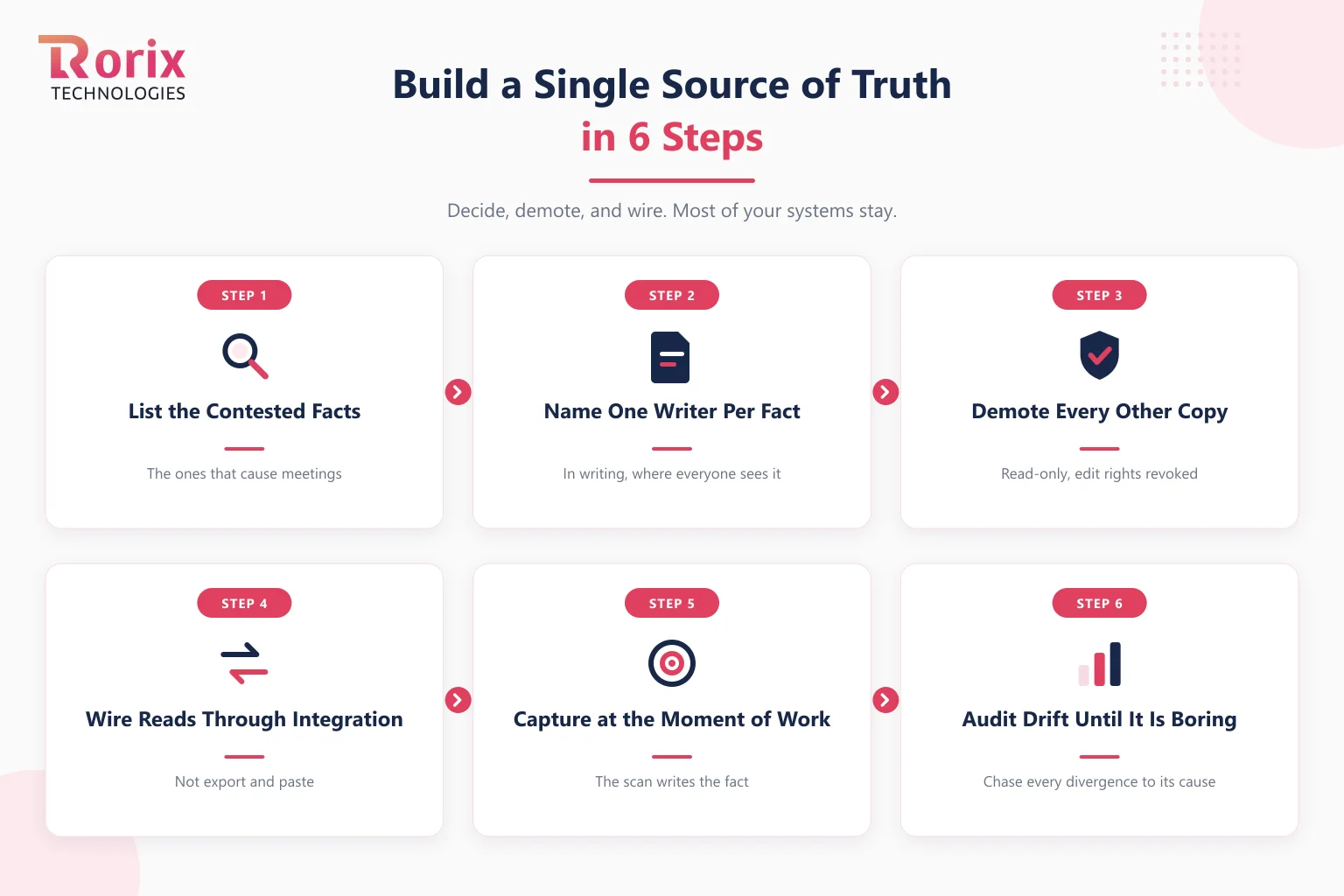
Step 1. List the Facts That Cause Reconciliation Meetings
Not all data, just the contested facts: stock, order status, customer balance, employee records, prices. If a fact has never had two versions argued in a meeting, it does not need this treatment yet. Most companies find the contested list is short, usually five to ten facts.
Step 2. Name One Writer Per Fact, in Writing
For each fact, decide which system holds the pen, and write the decision down where the whole company can see it. The right writer is the system closest to the moment the fact changes: the floor system for stock, the HR system for people. This step is governance, not engineering, and it is the step companies skip.
Step 3. Demote Every Other Copy to Read-Only
Every other place the fact lives becomes a display, not an editor: forms removed, sheets frozen, edit rights revoked. A copy that can still be written will be, and one writable copy quietly reverses the whole decision.
Step 4. Wire the Reads Through Integration, Not Export
Readers should pull from the writer automatically, through the patterns in our API integration strategy guide, with message queues on the boundaries where systems keep different hours. Export-and-paste is not integration; it is a human pretending to be one, and it reintroduces drift at every run.
Step 5. Capture the Fact at the Moment of Work
A single writer helps only if the writer is told the truth promptly, which is why capture belongs at the moment of work: the scan that decrements stock, the status change that fires on the action itself. An event-history model makes the writer auditable too, so "who changed this and when" always has an answer.
Step 6. Audit Drift Until It Is Boring
For a quarter, compare the retired copies against the writer on a schedule and chase every divergence to its cause: an un-demoted form, a sync gap, a workaround reborn. When the drift audit stops finding anything, the meetings about whose number is right have already stopped happening.
When One System Should Absorb Another
Sometimes the writer map exposes a deeper problem: two systems that each half-own a fact, wired together by increasingly heroic sync. At that point integration stops being the answer and consolidation starts, which is a different project with its own patterns and costs, covered in full in our guide to consolidating fragmented business systems. The one-writer map is still the right first step, because it tells you exactly which seams are worth closing and which systems earn their place.
How Rorix Builds Systems That Hold the Pen
Rorix Technologies builds the custom operational systems that act as writers of record, warehouse, inventory, HR, and order platforms, and the integration layers that carry their facts everywhere else. One platform build carries 40+ vendor integrations on a single system, which is what one-writer-many-readers looks like at scale. 27 projects delivered, a 5.0 rating on Clutch, a dedicated team of senior engineers on a retainer model with 2-week sprints. If your meetings still start by arguing about numbers, bring us two of those numbers and we will trace where the second writer got in.
Truth Is a Decision Before It Is an Architecture
A single source of truth is what you get when authority is explicit: one writer per fact, readers wired through integration, capture at the moment of work, and copies demoted to displays. None of that requires a mega-system, and all of it requires a decision most companies never quite make. Make the writer map, and the architecture follows; skip it, and every new tool is another pen hovering over the same page.
Frequently Asked Questions
What is a single source of truth for business data?
A single source of truth is an arrangement where every business fact has exactly one system authorized to write it, and every other tool, report, and team reads from that system. It is defined by authority, not by storage: you can have one database and no single source of truth, or a dozen systems and a perfect one.
Is a single source of truth the same as having one big system?
No. One system that does everything is one way to get one writer, and usually an expensive way. Most companies get there by keeping several systems and making authority explicit: the floor system writes stock, HR writes people, accounting writes money, and integration carries each fact to its readers.
What is the difference between a system of record and a source of truth?
They are the same idea at different scopes. A system of record is the designated writer for a domain of facts; your single source of truth is the complete map of those designations, with reads wired so nobody works from copies. A company has many systems of record and, if the map is coherent, one source of truth.
What causes data silos in a business?
Accretion, not decisions: each team adopts its own tool, each tool keeps its own copy of shared facts, and the copies connect through exports and manual re-entry. Every copy is a potential writer and every manual bridge adds drift, which is how professionally run companies still ended up with data errors in 69% of orders between trading partners in the Auburn and GS1 US audit.
How do you create a single source of truth without replacing every system?
Decide, demote, and wire: name one writer per contested fact, make every other copy read-only, and connect readers to the writer through automated integration rather than export. The systems you keep mostly stay; what changes is who may write. Consolidation is only needed where two systems genuinely half-own the same fact.
What does not having a single source of truth cost?
At world scale, IHL Group put untrusted inventory alone at $1.77 trillion in 2023, split between out-of-stocks and overstocks. Inside one company the costs are reconciliation labor, decisions argued instead of made, overselling and stockouts from drifting counts, and errors that reach customers before they reach a report.
Costing a custom build?
A dedicated team of senior engineers with a named technical lead on every engagement. Send us the problem and you get back a scope and a price.
Continue learning
Written by
Renish DadhaniyaFounder & Director, Rorix Technologies
Renish co-founded Rorix Technologies and drives the engineering and delivery culture across the organization. Beyond engineering, he leads the company's sales, finance, and HR operations, building the infrastructure that lets the team focus on shipping quality software. With deep hands-on expertise in architecture and team building, he ensures every project lands on time to the quality standards clients demand.
View full profileRelated articles
What Is Operational Software? The Layer That Runs the Work
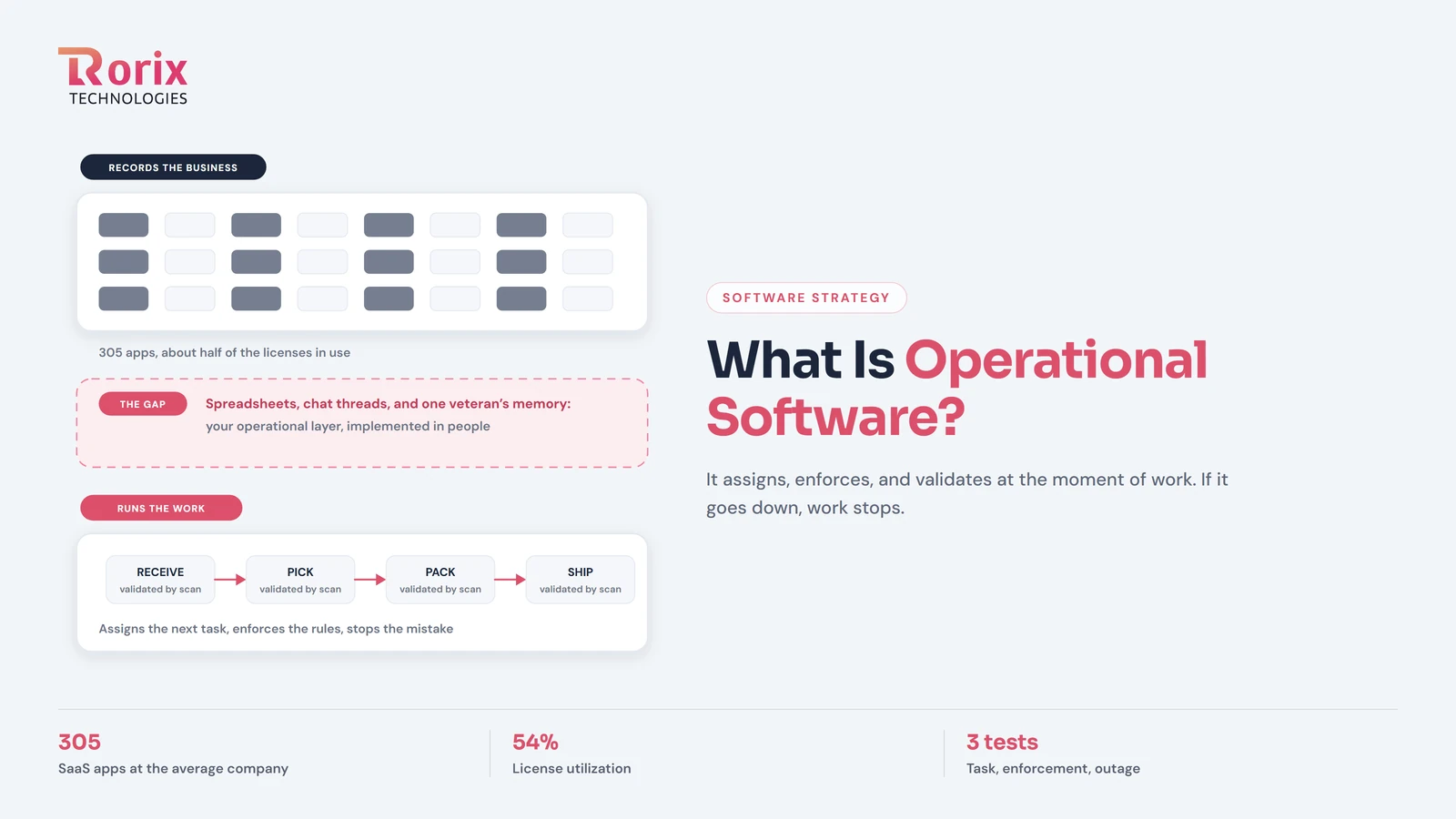
Operational software executes the work itself: it assigns tasks, enforces rules, and validates as work happens. How it differs from record-keeping tools.
Read article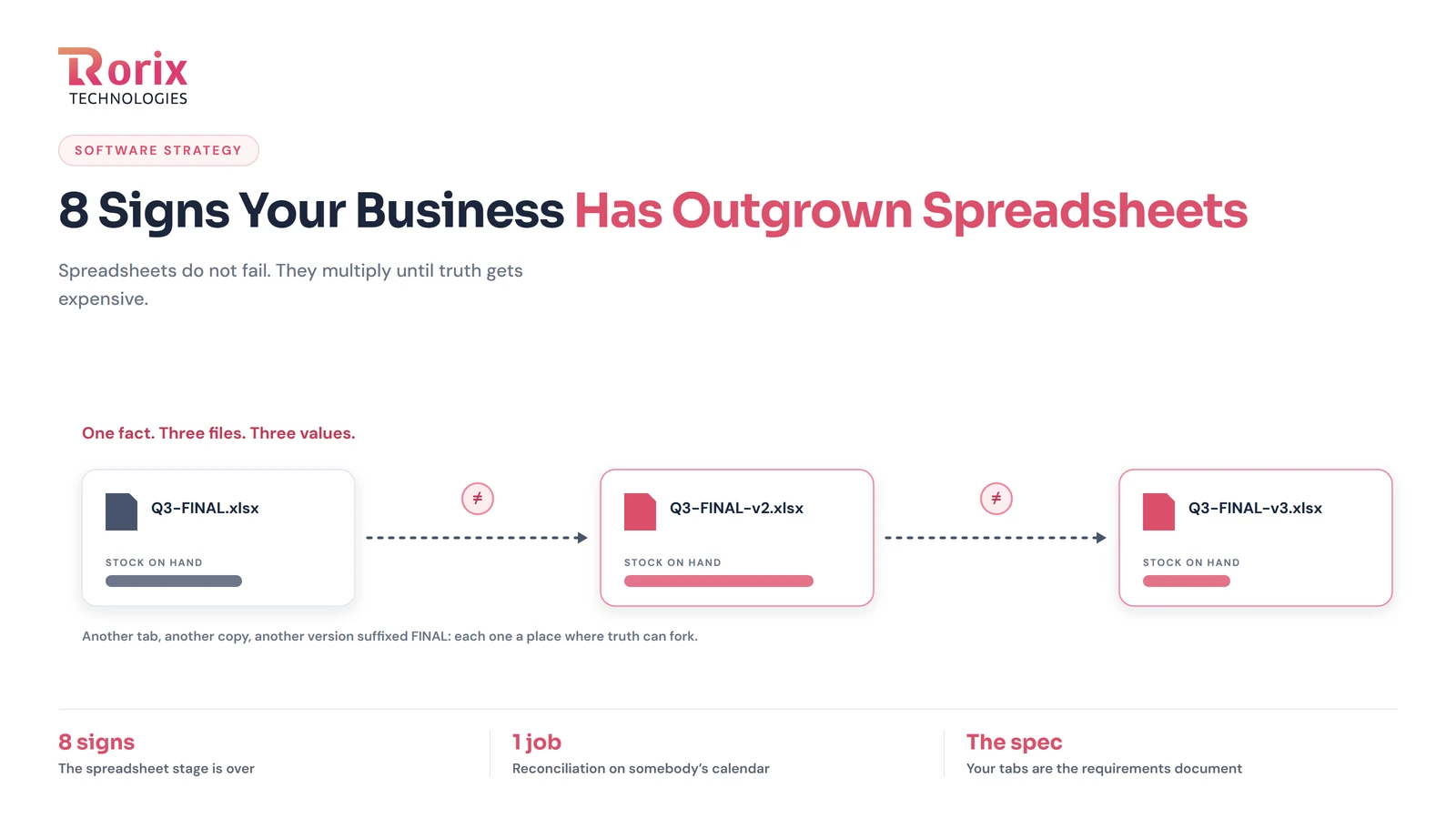
8 Signs Your Business Has Outgrown Spreadsheets
The signs a business has outgrown spreadsheets: reconciliation as a job, version conflicts, one person who cannot take vacation, and what to move to first.
Read article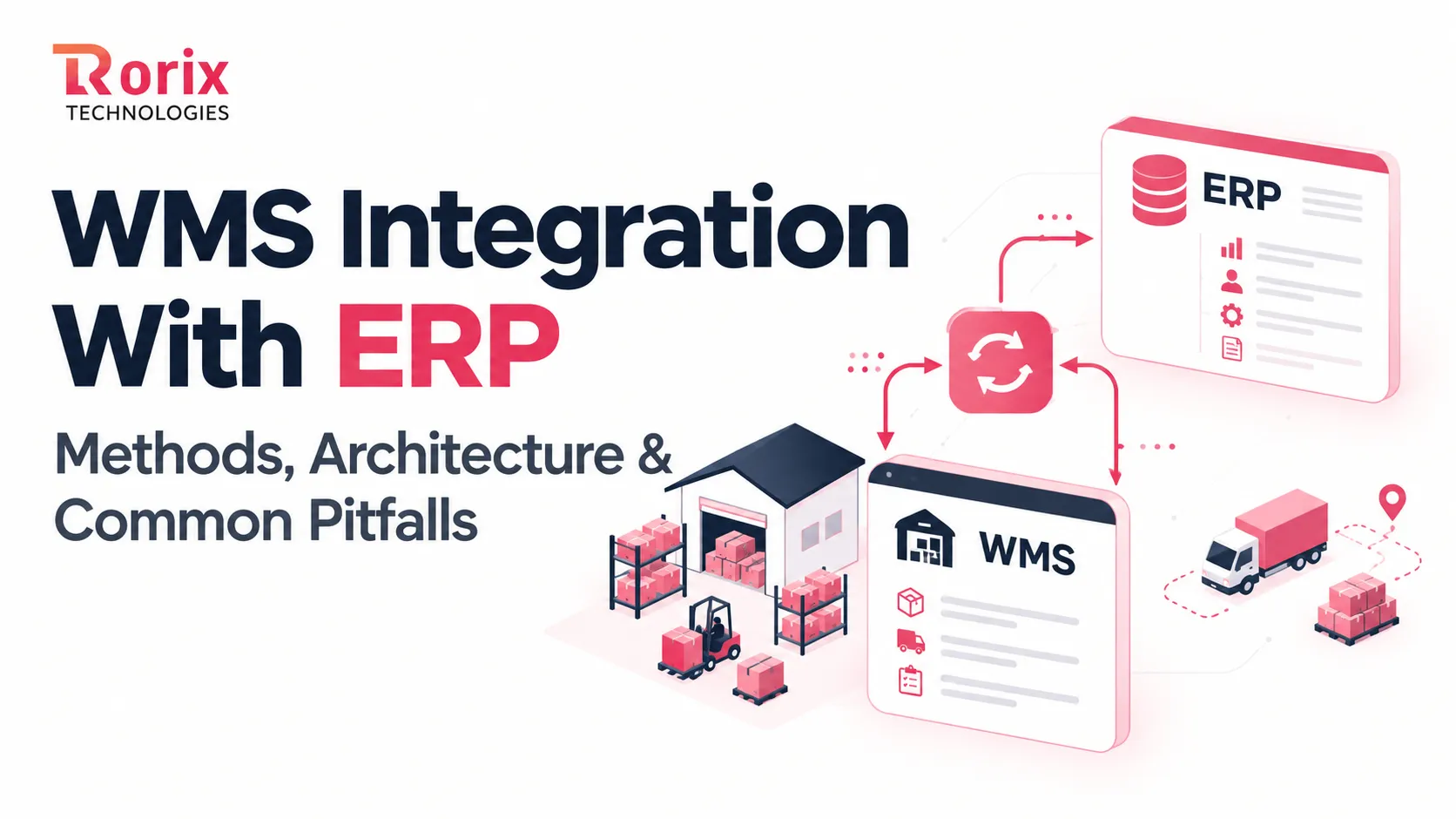
WMS Integration With ERP: Methods, Architecture & Common Pitfalls
Learn how WMS integration with ERP works, with 7 methods, architecture decisions, data flows, an 8-step roadmap, costs, timelines, and common pitfalls to avoid.
Read article