
AI Agent Development Cost in 2026: Pricing by Complexity, Integrations, and Team
Explore AI agent development cost in 2026, including build prices, monthly expenses, integrations, maintenance, and ways to reduce your budget.
On this page73 sections
Key Takeaways: AI Agent Development Cost at a Glance
- Build costs: Most business agents cost $40,000 to $150,000; advanced multi-agent systems can exceed $500,000.
- Budget for running costs: Monthly expenses range from $150 to $40,000+, depending on usage and complexity.
- Integrations drive costs: Connecting business systems and testing their reliability can cost more than the AI model itself.
- Maintenance plan: Budget 15% to 25% of the build cost annually, on top of running expenses.
- Start small: Build one focused workflow, measure its value, and expand when the results justify the investment.
Your AI agent works perfectly in the demo, but moving it to production can turn a $30,000 pilot into a $300,000 project. The difference often comes down to costs that never made it into the original quote.
Estimating the cost of AI agent development takes more than comparing vendor prices. One provider might quote $15,000 while another asks for $400,000 because their estimates cover different levels of complexity, system integrations, and ongoing support.
Then come API connections, token usage, hosting, and maintenance. These expenses continue after launch and can push your total budget far beyond the initial development quote.
In this guide, you'll learn:
- AI agent development costs by complexity level
- Integration costs for WMS, HRMS, and ERP systems
- Development team rates and pricing models
- Token usage, maintenance, and three-year running costs
- Hidden expenses and practical ways to reduce spending
- How to estimate costs, calculate ROI, and compare vendor quotes
By the end of this guide, you'll know how to budget for your AI agent, evaluate vendor proposals, and spot hidden costs before they become expensive surprises.
What an AI Agent Budget Covers: Cost Breakdown by Phase
Two AI agents can use the same model and still cost thousands of dollars apart. The difference often comes down to data preparation, system integrations, testing, and the safeguards needed to run an agent reliably in production.
A clear AI agent development cost estimate should break the project into phases rather than quote one lump sum. For a tool-using workflow agent that connects to two to four systems, the following market ranges show where a typical $80,000 to $150,000 budget goes.
| Phase | What It Covers | Cost (Market Range) |
|---|---|---|
| Discovery and solution design | Workflow mapping, architecture, success metrics, risk review | $5,000 to $12,000 |
| Data preparation and knowledge base | Data cleaning, document processing, embeddings, vector database | $8,000 to $20,000 |
| Agent core | Prompt design, orchestration, memory, fallback rules | $20,000 to $35,000 |
| Integrations and tool APIs | Authentication, data mapping, write actions, error handling | $20,000 to $40,000 |
| Admin console and interface | Chat UI, approval screens, audit views | $8,000 to $15,000 |
| Testing and security | Evaluation sets, edge cases, adversarial testing, accuracy checks | $9,000 to $16,000 |
| Deployment and handover | Hosting setup, logging, alerts, documentation, runbooks | $10,000 to $12,000 |
| Total | $80,000 to $150,000 |
These are market estimates, not Rorix pricing. Each row sits within the per-phase ranges that published cost guides list, scaled to this budget. Actual costs depend on the agent's scope, data quality, integration requirements, and security needs.
Sources: Azilen, Decipher Zone, Space-O Technologies
Integrations are often the largest single line, ahead of the agent core itself. Connecting an agent to a WMS, HRMS, or ERP requires reliable data exchange, permissions, error handling, and safeguards against incorrect actions. Testing must also confirm that the agent behaves safely when inputs are incomplete or unexpected.
When comparing vendor quotes, check whether these phases are included. A lower upfront price may reflect missing production work rather than a more affordable solution.
AI Agent Development Cost by Complexity Tier
The more decisions an agent makes, systems it connects to, and tasks it handles independently, the more it costs to build and maintain.
Published cost guides draw these lines differently. The ranges below come from 2026 cost guides and place each tier boundary where most of them agree. These ranges reflect blended offshore and nearshore delivery teams, and a US-only team costs more at the rates in the hourly-rate table below. They are market estimates, not Rorix pricing.
If scripted answers are enough, a chatbot or rule-based workflow may work better. Our guide to AI agents for business operations explains when an agent makes sense.
1. Single-Task Agents
A single-task agent handles one job, such as sorting support emails or finding an SOP. It reads from one or two sources and follows fixed rules without writing to business systems. Development costs $15,000 to $40,000 and takes 4 to 8 weeks, and running costs are around $200 to $1,000 a month.
2. RAG Knowledge Agents
A retrieval-augmented generation (RAG) agent answers questions using internal documents, such as HR policies, SOPs, and product manuals. Costs depend on data preparation, document indexing, and accurate retrieval with source references. Development costs $40,000 to $80,000 and takes 6 to 12 weeks, and running costs are around $1,000 to $4,500 a month.
3. Tool-Using Workflow Agents
These agents connect two to four systems to update orders, create tickets, or prepare inventory adjustments for approval. Write access requires stronger permissions, error handling, testing, and safeguards. Development costs $80,000 to $150,000, with a typical timeline of 10 to 20 weeks.
4. Autonomous Multi-Step Agents
Autonomous agents plan and execute multiple steps, recover from errors, and escalate decisions when human input is needed. Planning complexity, monitoring, and safeguards against incorrect actions increase development effort. Costs range from $150,000 to $250,000, with a timeline of 3 to 6 months.
5. Multi-Agent Systems
Multi-agent systems use a supervisor agent to coordinate specialist agents with separate tools, tasks, or memory. Orchestration, shared state, monitoring, and combined token usage increase development and operating costs. Builds typically cost $250,000 or more and can exceed $500,000, take 6 months or more, and carry monthly running costs of $10,000 to $40,000+.
Sources: Decipher Zone, Riseup Labs, Bacancy Technology, ITRex Group, DestiLabs. Running costs are our estimates from the list prices in the run-cost table below.
AI Agent Development Cost by Integrations
Every system an agent connects to adds API work, authentication, data mapping, and testing. A clear API integration strategy helps estimate these costs before development begins.
1. Cost per Integration Type
Modern SaaS APIs are easier to connect than legacy systems with limited API access. Costs increase with data complexity, write permissions, and testing requirements.
| Integration Type | Example Systems | Cost per Integration (Market Range) |
|---|---|---|
| Read-only SaaS API | Knowledge base, calendar, analytics | $2,000 to $5,000 |
| Two-way SaaS integration | CRM, helpdesk, ecommerce platform | $3,000 to $10,000 |
| Real-time sync or event stream | Inventory levels, order status, webhooks | $2,000 to $6,000 for API or webhook sync; $12,000 to $35,000 for an event stream |
| System of record with write access | ERP, WMS, HRMS with approval rules | $5,000 to $25,000 (up to $50,000 for SAP, Oracle, or Dynamics) |
| Legacy system with no documented API | On-premise databases, old ERPs, screen-only apps | $10,000 to $40,000 |
These are market ranges per integration, not Rorix pricing. Published estimates for legacy systems vary widely, from under $10,000 to $80,000 per system, depending on documentation and access.
Sources: Softermii, Groovy Web, Cleveroad, Decipher Zone, Uvik Software, Bacancy Technology, Space-O Technologies, Synarion IT Solutions
For inventory and order updates, reliable real-time data matters. See our guide to real-time inventory architecture.
2. Cost by Number of Integrations
More integrations mean more credentials, failure points, and testing. Start with essential systems and add others after the first release proves its value.
There is no standard price per number of integrations: multiply the per-integration ranges above by the systems you need. Published guides put integration work at 15% to 35% of the build budget (Decipher Zone), or 20% to 50% on top of it (Uvik Software), and one prices two to three tool integrations at $5,000 to $12,000 (Synarion IT Solutions).
3. Connecting Agents to WMS, HRMS, ERP, and CRM Systems
Operations systems need secure permissions, approval rules, and audit trails because incorrect stock, order, or payroll updates can be costly. The Model Context Protocol (MCP) can standardize how agents access supported tools, but secure APIs and access controls remain essential.
If your software lacks AI-ready endpoints, review how to add AI to existing software. Building the required connections through API development can be more reliable than screen scraping or fragile workarounds.
Also Read: WMS Integration With ERP: Methods, Architecture & Common Pitfalls
AI Agent Development Cost by Team
The team, location, and pricing model can change your total AI agent development cost significantly, even when the project scope stays the same.
1. Team Composition by Complexity Tier
Simple agents need fewer specialists, while autonomous and multi-agent systems require more engineering, testing, and security expertise. Team size and timelines vary with the agent's scope.
| Agent Tier | Core Roles | Team Size | Timeline |
|---|---|---|---|
| 1. Single-task | AI engineer, part-time QA | 1 to 2 | 4 to 8 weeks |
| 2. RAG knowledge | AI engineer, data or backend engineer, part-time QA | 2 to 3 | 6 to 12 weeks |
| 3. Tool-using workflow | 2 AI engineers, integration engineer, part-time PM and QA | 3 to 4 | 10 to 20 weeks |
| 4. Autonomous multi-step | Senior AI engineers, backend engineer, MLOps engineer, PM, QA | 4 to 6 | 3 to 6 months |
| 5. Multi-agent system | Senior AI engineers, systems engineer, MLOps, security lead, PM, QA | 5 to 10 | 6 months or more |
2. Hourly Rates by Region
Senior AI engineer rates vary by location, experience, and project requirements. These market ranges help estimate development expenses.
| Region | Senior AI Engineer Rate (Market Range) |
|---|---|
| United States and Canada | $120 to $200 per hour |
| United Kingdom and Western Europe | $90 to $170 per hour |
| Eastern Europe | $85 to $135 per hour |
| India and South Asia | $55 to $90 per hour |
These are senior AI and machine learning rates. Blended agency rates across all seniority levels are lower: Clutch lists $25 to $49 an hour for AI development companies in India.
Sources: Index.dev, Upwork, IT Jobs Watch, Clutch
For broader engineering rates, see our guide to IT staff augmentation cost. Lower hourly rates offer value only when the team delivers reliable work without excessive oversight.
3. In-House Team vs Freelancers vs Development Partner
The right model depends on your budget, timeline, and need for ongoing support. Compare total costs and accountability, not just hourly rates.
| Factor | In-House Team | Freelancers | Development Partner |
|---|---|---|---|
| Upfront cost | $400,000 to $700,000 in year-one pay for a three-person US team (two AI/ML engineers and one software engineer) | $50 to $150 per hour per person | Project, hourly, or monthly retainer |
| Time to start | 1 to 4 months per hire | Days to weeks | 1 to 3 weeks |
| Accountability | Full internal control | Split across individuals | One accountable team |
| Best fit | Companies building many agents over several years | Small, well-defined tasks | First agents through to scale |
The in-house range runs from median pay to median total compensation and excludes recruiting fees.
Sources: US Bureau of Labor Statistics, Levels.fyi, Upwork
An in-house team suits companies planning multiple AI projects over several years, while freelancers work well for focused tasks such as prompt tuning or a single connector. A development partner offers a coordinated team and one point of accountability for a production-ready agent.
See our comparison of in-house vs outsourcing software development for more details.
4. Pricing Models: Fixed Price, Time and Materials, Dedicated Team and Retainer
Choose a pricing model based on how clearly you can define the scope and how much the agent will evolve after launch.
- Fixed price: Best for well-defined projects. The budget is predictable, but changes usually cost extra.
- Time and materials: Suits discovery and evolving requirements. You pay for hours worked, so track scope and spending closely.
- Dedicated team or retainer: Provides consistent engineering support through monthly payments, making it useful for complex agents that need ongoing improvements.
- Hybrid: Starts with a fixed-price pilot, then moves to a retainer for production development and support.
A dedicated development team can maintain continuity from development through post-launch improvements.
Also Read: Staff Augmentation vs Dedicated Team: Which Model Fits Your Roadmap?
8 Other Factors That Move AI Agent Development Cost
Beyond complexity, integrations, and team rates, eight factors can change your final budget.
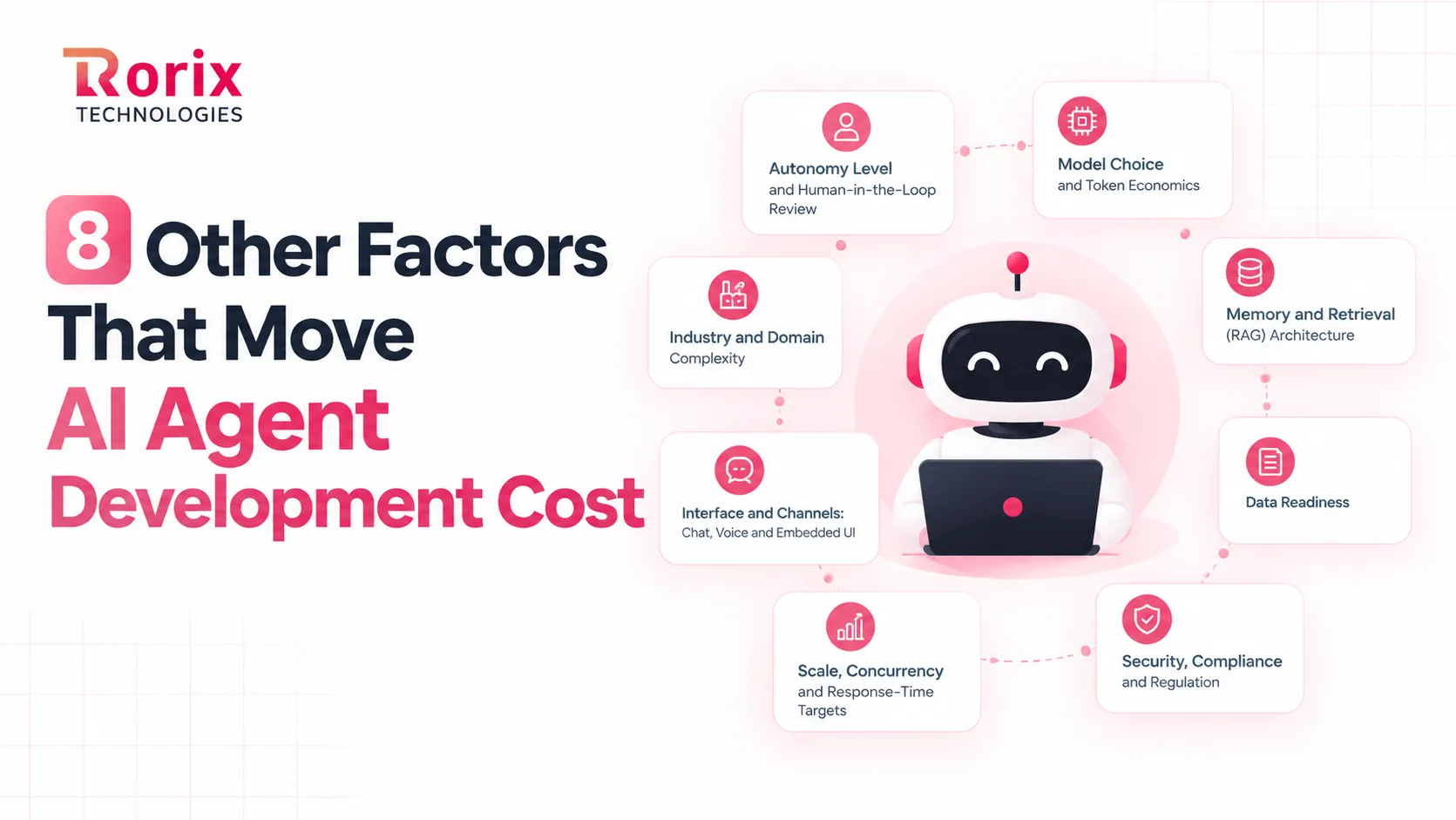
1. Autonomy Level and Human-in-the-Loop Review
An agent that drafts actions for approval costs less to build than one that acts independently. Full autonomy needs stronger testing, monitoring, and rollback controls, while human review adds ongoing labor costs.
2. Model Choice and Token Economics
Premium models cost more per call, and agents may make several calls to complete one task. Using smaller models for routine steps and premium models for complex decisions can reduce token costs without sacrificing accuracy where it matters.
3. Memory and Retrieval (RAG) Architecture
Agents that remember past interactions or search internal documents need retrieval pipelines, vector databases, embeddings, and regular re-indexing. These features increase initial development costs and add recurring storage and processing expenses.
4. Data Readiness
Clean, structured data reduces development effort, while duplicate records, messy spreadsheets, and scattered documents require extra preparation. Treat major data cleanup as a separate budget item rather than assuming the agent can handle it automatically.
5. Security, Compliance and Regulation
Requirements such as HIPAA, SOC 2, GDPR, and the EU AI Act can add costs for encryption, access controls, audit logs, and data residency. Define your compliance requirements early because they can make even a relatively simple agent more expensive.
6. Scale, Concurrency and Response-Time Targets
An internal agent serving 20 employees has different infrastructure needs from one handling thousands of customer conversations per hour. Higher traffic and strict response times may require load testing, caching, queueing, and more powerful infrastructure.
7. Interface and Channels: Chat, Voice and Embedded UI
Text chat is usually the simplest interface, while voice adds speech recognition and synthesis, and image processing requires vision models. Embedding an agent in your existing software with approval screens and audit views adds front-end work but can improve adoption.
8. Industry and Domain Complexity
Industry rules affect how an agent must operate and how its results are tested. Warehouse agents must respect stock rules and carrier cutoffs, while healthcare and finance agents need stronger accuracy checks and domain-specific evaluations.
Now that you've seen what moves the build price, let's take a look at what your agent costs to keep running once it goes live.
What It Costs to Run an AI Agent Every Month
Building an agent is a one-time cost, but running it creates ongoing expenses. Model tokens, hosting, databases, and monitoring drive the monthly bill, which grows with usage.
1. Monthly Run Cost by Usage Volume
Monthly costs depend on how many tasks your agent handles and how much processing each task requires. These estimates, not Rorix pricing, show what businesses may spend at different usage levels.
| Cost Component | Low Volume (under 1,000 tasks a day) | Medium Volume (1,000 to 10,000 a day) | High Volume (over 10,000 a day) |
|---|---|---|---|
| Model tokens | $100 to $800 | $800 to $8,000 | $8,000 to $32,000+ |
| Vector database | $0 to $50 | $50 to $500 | $500 to $1,000+ |
| Compute and hosting | $50 to $200 | $200 to $600 | $600 to $2,500 |
| Observability and evaluations | $0 to $300 | $50 to $1,100 | $750 to $4,000+ |
| Total per month (rounded) | $150 to $1,350 | $1,100 to $10,000 | $10,000 to $40,000+ |
Assumptions: a 30-day month and 6 model calls per task, each with 4,000 input and 400 output tokens, as in the worked example below, with 2 calls on Claude Sonnet 5.5 and 4 on Claude Haiku 5.5. No prompt caching or batch discount is applied, so token figures are upper estimates. The vector database floors are Pinecone's plan minimums and its ceilings are estimates; the compute row is an estimate from AWS Fargate list prices for one to thirty small containers.
Sources: estimates built from October 2026 list prices published by Anthropic, Pinecone, and AWS, with Datadog and Langfuse prices for observability
2. How to Estimate Token Spend: Formula and Worked Example
Estimate model costs by multiplying monthly tasks by model calls per task and the cost of input and output tokens. This helps you compare models before development begins.
Monthly model cost = tasks per month × calls per task × ((input tokens × input price) + (output tokens × output price))
For example, an agent handling 20,000 tasks monthly makes 6 model calls per task, with 4,000 input tokens and 400 output tokens per call. Using Claude Sonnet 5.5 at Anthropic's list prices as of October 2026, $2 per million input tokens and $10 per million output tokens, the monthly bill is $1,440. See Anthropic's published API pricing for model rates.
Routing four of the six calls to Claude Haiku 5.5, at $0.10 per million input tokens and $0.50 per million output tokens (the rate for prompts up to 100,000 tokens), reduces the estimated bill to about $528 a month. That is about 37% of the original cost, a saving of almost two-thirds.
Track cost per successful task, not just total usage. If only 17,000 of 20,000 tasks succeed, a $1,440 bill works out to about $0.085 per completed task.
3. Annual Maintenance and Model Updates
Agents need regular updates as models change, prompts drift, business systems evolve, and evaluation tests need refreshing. Budget 15% to 25% of the original build cost annually for maintenance, separate from monthly running expenses.
4. 3-Year Total Cost of Ownership
The build price is only part of the long-term budget. These examples include the initial build and annual running costs, plus maintenance at 20% of the build cost in Years 2 and 3.
| Cost Line | Tier 1 Single-Task | Tier 3 Workflow | Tier 5 Multi-Agent |
|---|---|---|---|
| Build cost | $25,000 | $120,000 | $350,000 |
| Running cost per year | $7,200 ($600 a month) | $60,000 ($5,000 a month) | $240,000 ($20,000 a month) |
| Maintenance per year (Years 2 and 3) | $5,000 | $24,000 | $70,000 |
| 3-year total | $56,600 | $348,000 | $1,210,000 |
Sources: build figures sit inside the tier ranges above, running costs inside the run-cost estimates, and maintenance at 20% inside the 15% to 25% that Decipher Zone, Neontri, and DestiLabs publish
For workflow and multi-agent systems, three years of running costs can exceed the original build price. Approve the operating budget separately so ongoing expenses don't get overlooked.
8 Hidden AI Agent Costs Most Budgets Miss
The initial quote rarely covers every expense. After launch, token overruns, maintenance, security reviews, and human oversight can increase your total AI agent development cost.
1. Token Overruns From Retries and Loops
When an agent retries failed steps or repeats self-correction, token usage can rise far beyond the original estimate. Set limits on retries, loops, and tokens per task to keep monthly spending under control.
2. Data Cleanup and Preparation
Duplicate records, outdated documents, and inconsistent field names can prevent an agent from retrieving reliable information. Audit your data before development, as cleanup can add weeks to the project timeline and increase costs.
3. Evaluation Upkeep and Red Teaming
Evaluation tests must evolve as workflows, edge cases, and AI models change. Budget regular engineering time for fresh test cases and adversarial testing before major releases to catch failures before they reach users.
4. Observability and Logging Tools
Tracing decisions, logging tool calls, and tracking accuracy help teams identify failures before they disrupt operations. Free tiers cover a pilot. In production, list prices run from about $50 to $4,000 or more a month as trace volume grows, making observability an ongoing expense rather than an optional extra.
5. Model Deprecation and Upgrades
AI providers may retire models, forcing teams to retest prompts, workflows, and agent behavior. A model-agnostic design makes switching providers easier and reduces the cost and disruption of future upgrades.
6. Integration Breakage When APIs Change
Third-party systems can change endpoints, rename fields, or tighten rate limits, causing existing agent workflows to fail. Budget for integration monitoring, maintenance, and quick fixes, especially when your agent relies on external SaaS platforms.
7. Security Reviews and Compliance Audits
Regulated industries may need recurring penetration tests, access reviews, and compliance audits. Agents with write access also require strict permissions and approval controls, so include these reviews in the ongoing operating budget.
8. Human Review Time and Change Management
Human reviewers may need to approve actions, resolve escalations, and correct mistakes, adding labor costs beyond software expenses. Staff training and process changes also matter because an agent delivers little value if employees don't trust or adopt it.
Build vs Buy vs Platform: Which AI Agent Approach Costs Less?
Not every workflow needs a custom agent. The right choice depends on how unique your process is, which systems it must connect to, and how much control you need.
| Approach | Upfront Cost (Market Range) | Monthly Cost | Time to Production | Best Fit |
|---|---|---|---|---|
| Buy a prebuilt agent | $0 to $10,000 setup | $500 to $5,000 in subscriptions, plus per-use fees | 1 to 4 weeks | Common tasks with standard tools |
| Use an agent platform | $10,000 to $40,000 plus subscription | Platform subscription and usage fees | 1 to 8 weeks | Teams already inside one vendor ecosystem |
| Build custom | $40,000 to $150,000 for most business agents | $1,000 to $8,000 in running costs | 6 to 20 weeks | Unique workflows and deep system integrations |
These are market estimates, not Rorix pricing.
Sources: Groovy Web, Decipher Zone, Uvik Software, Team400, Customertimes
Buy a prebuilt agent: Best for standard tasks such as meeting summaries or common IT questions. You can launch in 1 to 4 weeks, but you depend on the vendor's features and roadmap, while seat and usage fees can rise as your team grows. At list price, Intercom charges $0.99 per Fin outcome and Salesforce charges $2 per Agentforce conversation.
Use an agent platform: Platforms provide ready-made components and hosting, reducing the amount of custom coding required. However, platform fees and usage-based billing can make costs harder to predict, and moving to another solution later may be expensive. Microsoft, for example, sells Copilot Studio capacity at $200 a month per pack of 25,000 credits.
Build custom: Custom AI agent development costs more upfront but gives you control over logic, data flows, and integrations. It's often the better fit for agents working inside a WMS, HRMS, or ERP, where business rules and secure system access matter.
AI Agent Cost Examples for Operations Teams
These examples show how AI agent costs vary by workflow, integrations, and autonomy. All figures are market ranges for a scoped first release with clean data, not Rorix pricing.
| Agent | What It Does | Systems Connected | Tier | Build Cost (Market Range) | Monthly Run Cost (Estimate) |
|---|---|---|---|---|---|
| Warehouse SOP lookup agent | Answers staff questions using SOPs and safety guides | Document store | Tier 1 | $15,000 to $40,000 | $200 to $1,000 |
| HR policy and onboarding agent | Answers policy questions and prepares onboarding checklists | HRMS, handbook, document store | Tier 2 | $40,000 to $80,000 | $1,000 to $4,500 |
| Warehouse exception agent | Investigates short picks and count mismatches, then drafts adjustments for approval | WMS, scan data, ERP | Tier 3 | $80,000 to $150,000 | $2,500 to $8,000 |
| Order status and returns agent | Answers order questions and starts returns within policy | Ecommerce platform, helpdesk, carrier APIs | Tier 3 | $80,000 to $150,000 | $2,500 to $8,000 |
| Home-services dispatch agent | Plans jobs, assigns technicians, and updates customers | Scheduling, CRM, SMS, payments | Tier 4 | $150,000 to $250,000 | $5,000 to $15,000 |
Sources: build ranges as in the tiers above (Decipher Zone, Riseup Labs); run costs are our estimates from the run-cost table
The main cost driver is how much the agent must do, not how natural its conversations sound. Agents that write to multiple systems need more integration work, testing, and safeguards, which raises both development and operating costs.
How to Calculate AI Agent ROI and Payback Period
Build cost matters, but the real question is how quickly an agent pays for itself. Use these formulas to estimate ROI and payback.
ROI = (annual business value minus annual agent cost) ÷ annual agent cost
Payback period in months = build cost ÷ monthly net saving
Consider a warehouse exception agent used across three sites. Fifteen supervisors spend a combined 180 hours a week investigating issues. At $45 an hour, that costs about $35,100 a month.
If the agent reduces this work by two-thirds, it saves about $23,400 monthly. After $5,000 in running costs, the net saving is $18,400 a month; maintenance starts in Year 2.
With a $120,000 build cost, payback takes about 6.5 months. The best returns come from workflows with enough volume to justify the investment.
Also Read: AI-Enabled Business Systems: How to Build One That Pays Back
Now that you know how to judge the return, let's take a look at how to build your own estimate first.
How to Estimate Your AI Agent Development Cost in 7 Steps
You can estimate your budget before contacting vendors. Follow these seven steps to build a realistic cost range and prepare for vendor discussions.
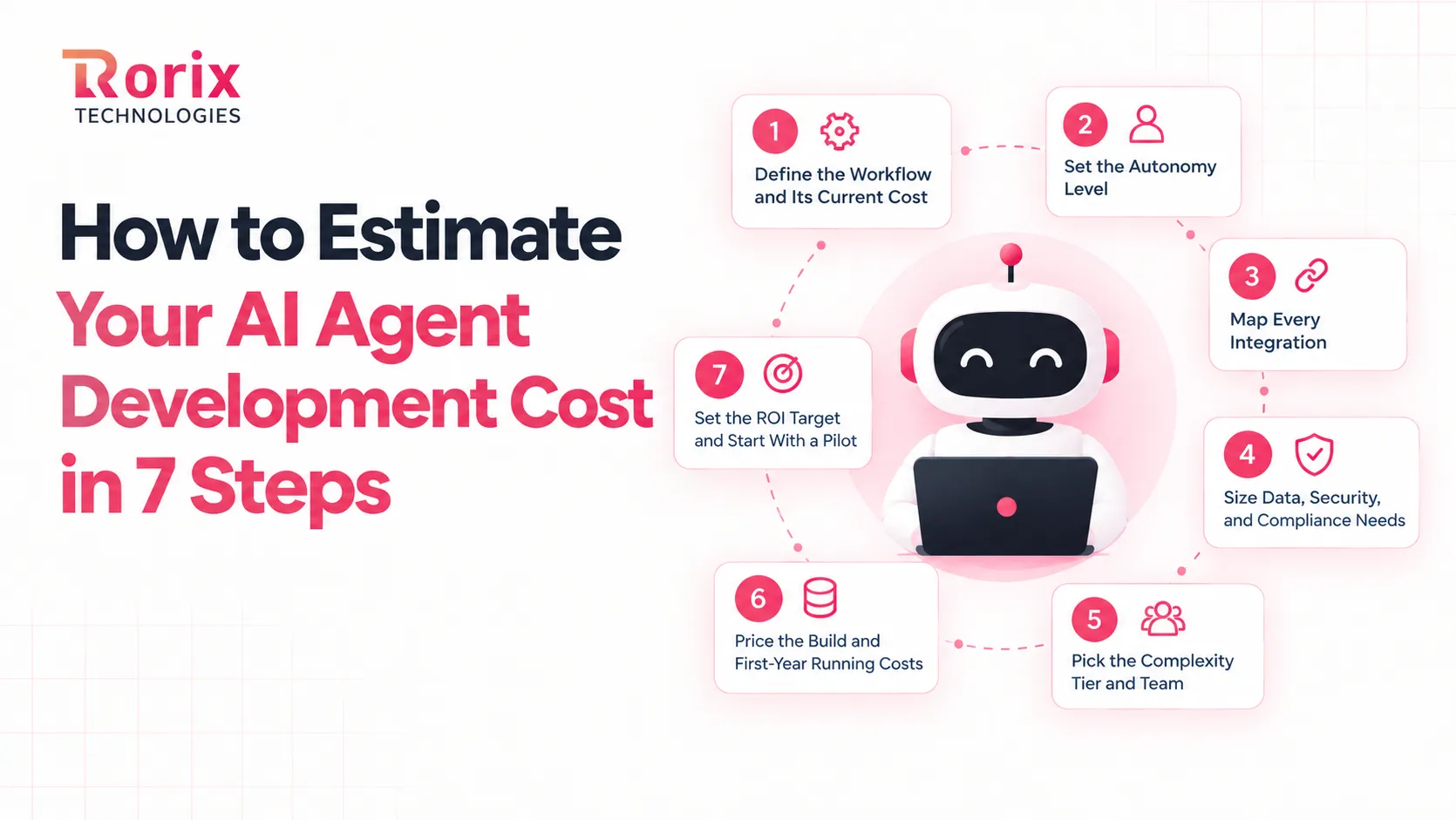
Step 1: Define the Workflow and Its Current Cost
Start with one workflow and document who handles it, how long each case takes, and how often it occurs. Multiply monthly hours by the loaded hourly rate to estimate the current cost and set a realistic budget ceiling.
Step 2: Set the Autonomy Level
Decide whether the agent will suggest actions, draft them for approval, or act independently and report results. Higher autonomy increases development and testing costs, so approval-based workflows are often a practical starting point.
Step 3: Map Every Integration
List the systems the agent must read from or write to, noting API access, permissions, and real-time data needs. Use the integration cost ranges above to estimate each connection and avoid overlooking a major budget item.
Step 4: Size Data, Security, and Compliance Needs
Check data quality, freshness, and accessibility, then budget for cleanup if information is scattered or inconsistent. Include requirements such as HIPAA, SOC 2, GDPR, encryption, audit logs, and data residency before development begins.
Step 5: Pick the Complexity Tier and Team
With autonomy, integrations, and data mapped, match your agent to one of the five tiers. Use the tier's build range as your starting point. Then choose who builds it. Apply the team composition and regional rates from earlier, and pick the pricing model that fits how fixed your scope is today.
Step 6: Price the Build and First-Year Running Costs
Add the development phases to estimate the build budget, then calculate monthly usage and hosting expenses. Include annual maintenance at 15% to 25% of the build cost, and present build and operating costs separately.
Step 7: Set the ROI Target and Start With a Pilot
Compare the estimated costs with current workflow expenses and set a target, such as payback within 12 months. Test the agent on real data first to measure accuracy, token use, time saved, and errors avoided before scaling.
Not sure your systems are ready to feed an agent? Our readiness assessment scores your technology, process, people, and data in about two minutes and shows your biggest gaps, with no email needed to see the result.
10 Ways to Reduce AI Agent Development Cost Without Weakening the Agent
You can lower development and monthly costs without sacrificing accuracy or safety. These ten steps help control spending while keeping your agent useful and reliable.
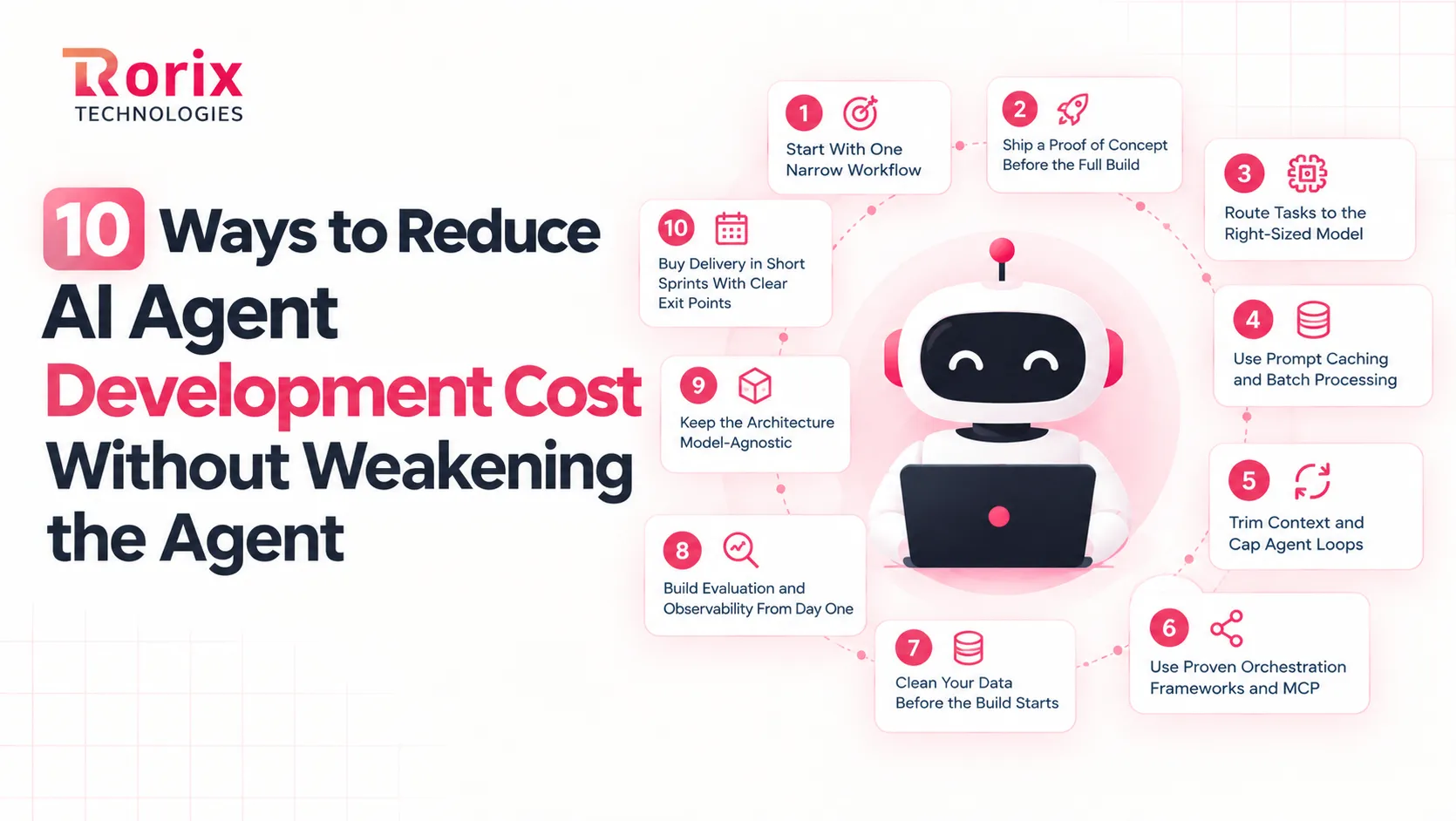
1. Start With One Narrow Workflow
An agent built for one clear task costs less to develop, test, and run than a broad assistant. Prove its value first, then expand to other workflows using the same foundation.
2. Ship a Proof of Concept Before the Full Build
A proof of concept typically costs $15,000 to $35,000 and takes 4 to 6 weeks. It proves one workflow on real data before you pay for production integrations, guardrails, and monitoring.
3. Route Tasks to the Right-Sized Model
Use smaller models for classification, extraction, and formatting, and reserve premium models for complex reasoning. This approach can reduce token spending significantly without sacrificing quality where it matters.
4. Use Prompt Caching and Batch Processing
Prompt caching reduces costs when the same instructions or documents appear across repeated calls. For tasks that don't need instant responses, Anthropic's batch processing cuts token prices by 50%.
5. Trim Context and Cap Agent Loops
Send only the information each step needs, summarize long histories, and limit retries. These controls reduce unnecessary token use and prevent repeated calls from inflating your monthly bill.
6. Use Proven Orchestration Frameworks and MCP
Frameworks such as LangGraph, CrewAI, and LlamaIndex provide tools for orchestration, memory, and tool calling. MCP can standardize access to supported tools across agents, reducing the need to build every connection from scratch.
7. Clean Your Data Before the Build Starts
Fix duplicate records, outdated documents, and inconsistent fields before development begins. Clean data reduces engineering rework and helps the agent deliver more reliable results.
8. Build Evaluation and Observability From Day One
Set up evaluation tests and tracing early to catch errors and identify wasted model calls. Adding them after a production incident can cost more in engineering time and damage user trust.
9. Keep the Architecture Model-Agnostic
Separate your agent logic from the model provider so you can switch models without rebuilding the system. This makes it easier to respond to changing prices, new models, and provider retirements.
10. Buy Delivery in Short Sprints With Clear Exit Points
Use short development sprints with working demos to review progress and remove low-value features early. Clear checkpoints help control spending and let you pause the project if results don't justify further investment.
Why Rorix Offers Flexibility and Accountability in AI Agent Development
Choosing an AI agent development partner is easier when you know what it delivers, how the team works, and what support continues after launch.
Rorix builds AI agents for business operations, connecting them with the systems your teams already use.
- 27 platforms delivered: Experience building custom software and operations-focused solutions.
- 5.0 Clutch rating: Based on 4 verified reviews on Clutch.
- Flexible delivery: Work with senior engineers and a named technical lead in 2-week sprints.
- Shadow mode first: Test agent accuracy against real outcomes before allowing actions in live systems.
- 40+ integrations: Driven, a US performance platform for pest control and field service teams, runs on 40+ third-party integrations we connected, including HubSpot, Twilio, RingCentral, and Google APIs.
- Proven operations results: WorkCenter Central, the platform we built for distributor Lorecs, cut manual errors by 80% and sped up order processing by 50%.
- AI already in production: An AI SKU price finder that answers Lorecs' vendor pricing questions in plain English from thousands of supplier files, and AI-assisted verification for DealSignal.
- Global delivery: Serving clients across the US, UK, Canada, Australia, and New Zealand.
- Hosted AI models: Built on hosted models from OpenAI and Anthropic (Claude) through their APIs, so you never pay to train a foundation model.
- Clear scope: Scope stays at the application layer, and your team keeps infrastructure and DevOps.
Rorix's published pricing ranges from $20 to $30 an hour by project size, length, and complexity. Dedicated developer retainers start at $3,500 a month for one developer, and team packages at $10,000 a month for three developers plus a project manager.
Get a Free Consultation and Project Estimate to discuss your workflow and receive a clear project scope.
Conclusion: Set a Realistic Budget for Your AI Agent
The AI agent development cost depends on the agent's complexity, integrations, and ongoing maintenance. Most business agents cost $40,000 to $150,000 to build, while running costs can exceed the initial investment over time.
We hope this guide helps you understand the main cost drivers, estimate monthly expenses, and spot hidden costs before approving a project.
Before you choose a development partner, define one priority workflow, map its integrations, and calculate the potential savings. This gives you a clearer budget and a way to measure results. Our comparison of the top AI agent development companies can help you build the shortlist.
Ready to turn your use case into a working agent? Connect with our experts to discuss your requirements, estimate costs, and plan your first release.
Frequently Asked Questions
How much does AI agent development cost in 2026?
Costs range from $15,000 to $500,000+. Most production business agents cost $40,000 to $150,000, depending on complexity and integrations.
How much does it cost to run an AI agent monthly?
Monthly costs range from $150 to $40,000+, depending on usage, model tokens, hosting, databases, and monitoring.
How long does it take to build an AI agent?
Simple agents take 4 to 8 weeks, while workflow agents take 10 to 20 weeks. Advanced autonomous and multi-agent systems can take 3 to 6 months or more.
How much does each integration cost?
Read-only SaaS integrations cost about $2,000 to $5,000 each and two-way SaaS integrations $3,000 to $10,000. ERP, WMS, HRMS, and legacy integrations usually cost $5,000 to $40,000 each, and large ERPs can reach $50,000.
Is it cheaper to build or buy an AI agent?
Buying costs less upfront, with setup fees of $0 to $10,000 and subscriptions of about $500 to $5,000 a month that rise with usage. Custom builds typically cost $40,000 to $150,000 and offer more control over unique workflows.
Should I hire an in-house AI team or a development partner?
A three-person US team (two AI/ML engineers and one software engineer) can cost $400,000 to $700,000 in first-year pay. A development partner is often more practical for your first production agents, while in-house teams suit long-term, large-scale development.
What is the most expensive part of building an AI agent?
Integrations are often the largest single line, ahead of the agent core itself, especially when agents need write access, error handling, and strict accuracy checks.
How much should I budget for annual AI agent maintenance?
Budget 15% to 25% of the original build cost annually, plus monthly running expenses. This covers model updates, testing, prompt tuning, and integration fixes.
Adding AI to your system, or building a new AI feature?
Most of the work sits in the data plumbing rather than the model. Send us the workflow you want to automate and we will tell you what is feasible on your current stack.
Continue learning
Written by
Ankur AkvaliyaFounder & Director, Rorix Technologies
Ankur co-founded Rorix Technologies with a mission to deliver enterprise-grade software that growing businesses can actually afford. He drives technical project delivery and client success end-to-end, overseeing product strategy, client partnerships, and the company's long-term vision to ensure every engagement delivers measurable business outcomes across WMS, HRMS, and custom software verticals.
View full profileRelated articles
Top 15 AI Agent Development Companies in 2026 (Compared)
Explore the top AI agent development companies in 2026. Compare capabilities, headquarters, and Clutch ratings to choose the right development partner.
Read article
AI Agents for Business Operations: Use Cases, Architecture and Rollout
See how AI agents run business operations: use cases by team, warehouse and order workflows, architecture, guardrails, and a step-by-step rollout plan.
Read article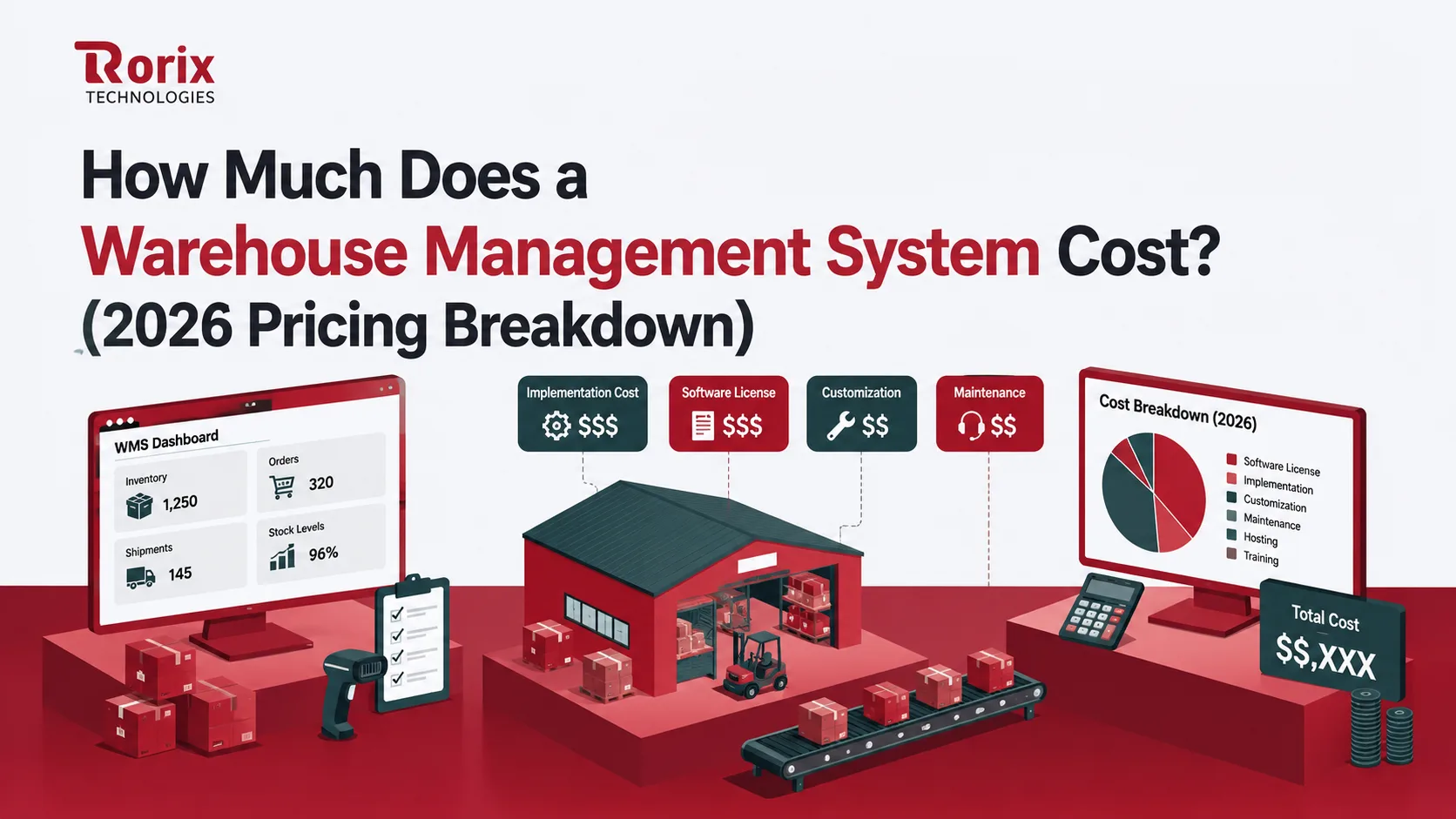
How Much Does a Warehouse Management System Cost? (2026 Pricing Breakdown)
How much does a warehouse management system cost? WMS pricing by deployment, size and features, with five-year TCO tables and vendor rates compared.
Read article