
25 Best Offshore Software Development Companies in 2026 (and How to Pick the Right One)
Compare 25 of the best offshore software development companies in 2026, with regional rates, engagement models, and a practical 7-step guide to picking one.
On this page51 sections
Most offshore software projects do not fail because developers cannot write code.
They fail because the team changes halfway through. Communication breaks down. Ownership disappears after launch. The partner you hired quietly becomes a vendor you barely recognize.
That is why choosing the right offshore software development company matters far more than finding the lowest hourly rate.
Today, thousands of companies promise world-class engineering, flexible teams and lower costs. Yet many offer similar portfolios, similar technology stacks, and nearly identical pricing. The real difference appears after the contract is signed.
The best offshore software development companies provide more than developers. They bring experienced engineers, proven delivery processes, domain expertise, and long-term accountability that help products evolve long after the first release.
To help you separate genuine engineering partners from sales-driven vendors, this guide profiles 25 firms and sets out the questions that expose the difference.
In this guide, you'll discover:
- What is an offshore software development company
- Why companies hire offshore software development companies
- 25 offshore software development companies, with what each one builds
- Offshore software development rates by region
- A practical 7-step framework to choose the right partner
- 5 biggest red flags that buyers should never ignore
By the end, you'll know which delivery model fits your build, what it should cost, and how to test a shortlist before you sign anything.
Key Takeaways: How to Pick an Offshore Development Partner
- Offshore software development rates run $20 to $45 an hour in India, $25 to $50 in Southeast Asia, $35 to $70 in Eastern Europe, and $40 to $80 in Latin America, against $100 to $150 in Western Europe and the US.
- Seniority moves the invoice more than region does: a junior engineer bills $20 to $35 an hour and a senior engineer or architect $45 to $85, so ask every vendor for a named seniority split before comparing two quotes.
- This guide profiles 25 offshore firms on five evaluation criteria (delivery model, technical expertise, industry experience, engagement structure, and post-launch support) with no scored ranking, and Rorix Technologies publishes it and appears first.
- A paid pilot of two to four weeks on a self-contained piece of real work is the most honest test of a shortlisted vendor, because free pilots attract the bench rather than the best engineers.
- Rorix Technologies has delivered 27 projects, holds a 5.0 rating on Clutch across 4 verified reviews, and reports up to 80% fewer picking errors on a custom WMS deployment.
What Is an Offshore Software Development Company?
An offshore software development company builds, tests, and maintains software for businesses in another country. Instead of hiring an in-house team, you work with a dedicated external team.
Depending on your needs, you can hire a few developers or an entire team to handle the project from planning to launch.
The best offshore software development companies do more than develop software. They provide technical expertise, manage delivery, and continue supporting your product after it goes live.
Offshore vs Nearshore vs Onshore Development
Buyers usually weigh three options, and each one trades a different thing away. Offshore means a distant country with a wide cost gap and a large talent pool. Nearshore means a neighboring region with fewer working-hour clashes. Onshore means hiring in your own market at full local rates.
The right pick depends on how much live collaboration your build actually needs.
| Factor | Offshore | Nearshore | Onshore |
|---|---|---|---|
| Typical hourly rate | $20 to $70 | $40 to $80 | $100 to $150 |
| Talent pool | Very large and deep | Moderate, regionally strong | Limited and competitive |
| Working-hour overlap | 3 to 6 hours, planned | 5 to 8 hours, natural | Full overlap |
| Best suited to | Long-running builds and scale | Collaboration-heavy products | Regulated or classified work |
| Main risk | Async discipline is mandatory | Smaller specialist bench | Budget ceiling hits fast |
Why Companies Hire Offshore Software Development Companies
Cost is the headline reason, but it is rarely the reason a partnership lasts. Buyers who stay with an offshore partner for years do so for capability and continuity.
- Access to engineers you cannot hire locally: Warehouse systems, HRMS platforms, and multi-tenant SaaS all need niche experience that local markets ration.
- Capacity that flexes without redundancy costs: You add two engineers for a release push and scale back afterwards, with no severance conversation.
- Faster starts: A partner with a bench can begin in weeks, while an in-house hire takes months to source and onboard.
- Coverage across time zones: Handing work over at the end of your day means fixed land before your morning standup.
- Internal teams stay on strategy: Your senior people focus on customers and roadmap while execution-heavy work moves out.
- Shared delivery risk: A retainer partner carries responsibility for quality and uptime, which a freelancer never does.
- Continuity through internal churn: When your own developer resigns, an established partner still holds the context, the codebase, and the deployment history.
Also Read: WMS Implementation Checklist: 50 Steps to Successful Deployment
How This List Was Compiled
A list of firms is only useful if you know what shaped it. Here is what we looked at, and what this guide does not claim.
- Five evaluation criteria: delivery model, technical expertise, industry experience, engagement structure, and post-launch support. Firms that only sell headcount, with no answer on what happens after launch, did not make the list.
- Each profile describes publicly stated positioning: delivery base, focus areas, engagement model, and the type of buyer each firm is set up to serve. These are descriptions of what firms do, not audited assessments of how well they do it.
- No scored ranking. There is no index that makes one of these firms objectively better than another, because they solve different problems. A firm near the bottom of this list may be the obvious choice for your build.
- Rorix Technologies publishes this guide and appears first in it. Read our entry with that in mind, and put us through the same seven steps below that you apply to everyone else.
Use the profiles to build a shortlist, then use the evaluation steps further down to test it.
25 Offshore Software Development Companies at a Glance
Here is how all 25 firms compare on delivery base, core strength, and the buyer each one suits.
| Company | Delivery base | Core strength | Best for |
|---|---|---|---|
| Rorix Technologies | India | WMS, HRMS and SaaS builds on retainer | Operations-heavy custom software |
| BairesDev | Latin America | Large vetted nearshore bench | Fast team scale in US hours |
| N-iX | Eastern Europe | Cloud, data and AI consulting | Enterprise modernization |
| Mobilunity | Eastern Europe | Dedicated teams with back-office support | Long-term in-house team extension |
| ELEKS | Eastern Europe | R&D and data science engineering | Analytics-heavy platforms |
| Netguru | Poland | Product design plus engineering | Consumer-facing digital products |
| Intellectsoft | Global | Digital transformation consulting | Legacy replacement programs |
| ScienceSoft | Global | QA, testing and compliance rigor | Regulated software builds |
| Simform | India and US | Cloud-native and DevOps pods | Cloud rebuilds and scaling |
| Uptech | Eastern Europe | Product discovery before build | Startups validating an idea |
| Space-O Technologies | India | Mobile-first product delivery | App-led products |
| Saigon Technology | Vietnam | Agile delivery discipline | Southeast Asia delivery |
| Sigma Software | Eastern Europe | Embedded, automotive and aviation | Hardware-adjacent software |
| Miquido | Poland | AI features in consumer apps | AI-integrated products |
| DICEUS | Global | Insurance technology products | Insurers and banks |
| DECODE | Croatia | Discovery workshops and validation | Founders pre-build |
| Infinum | Croatia | Polished mobile and web products | Brand-critical interfaces |
| Ciklum | Global | Experience and data engineering | Large-scale platforms |
| Selleo | Poland | SaaS and EdTech specialization | Subscription products |
| Innowise Group | Eastern Europe | Deep bench, cost-efficient scale | Rapid headcount growth |
| Zoolatech | US and Eastern Europe | Retail and commerce engineering | Retail tech teams |
| The Scalers | India | Offshore development center setup | Building an offshore unit |
| Alcor | Eastern Europe and LATAM | R&D office setup and recruitment | Owning your offshore entity |
| MindInventory | India | Design-led product engineering | Mid-market product builds |
| Daffodil Software | India | Healthcare and BFSI engineering | Compliance-bound platforms |
Each profile below covers what the firm builds, where it delivers from, and the buyer it fits.
1. Rorix Technologies
Rorix Technologies builds software that supports real operations, not just digital products. The company specializes in custom WMS, HRMS, SaaS platforms and enterprise applications for businesses across the US, UK, Canada, Australia, and New Zealand.
Rorix works as a long-term engineering partner rather than handing a project over at launch. Clients work with the same dedicated team throughout the engagement, following 2-week sprint cycles with visibility into progress, priorities, and deliverables. The team works through warehouse operations, HR workflows and SaaS architecture before writing code, which is what keeps rework down on operations-heavy builds.
Key highlights:
- 27 projects delivered across WMS, HRMS, SaaS, and mobile
- 5.0 rating on Clutch across 4 verified reviews
- A dedicated team of senior engineers with a named technical lead on every engagement
- Retainer model with 2-week sprints and full task visibility
- 80% reduction in picking errors on a custom WMS deployment
- 40+ integrations shipped on a single platform
- Multi-year SaaS partnerships that continue well past the first release
Best for: Operations-heavy businesses in warehousing, HR, retail and logistics that need domain-specific software and a partner who stays involved after launch.
2. BairesDev
BairesDev operates one of the largest nearshore benches in Latin America, with several thousand engineers across the region. Screening is the pitch, since candidates pass a heavy vetting funnel before reaching any client project. That scale suits companies adding ten or twenty engineers without a long recruitment cycle.
Best for: US companies scaling large teams inside overlapping working hours.
3. N-iX
N-iX runs delivery centers across Europe and works mostly on enterprise modernization programs. Its strongest practices sit in cloud migration, data platforms and AI consulting, which is why manufacturing and logistics clients keep showing up in its portfolio. Engagements tend to be multi-track, with data engineers, cloud architects and product teams working in parallel.
Best for: Enterprises modernizing data and cloud infrastructure alongside application work.
4. Mobilunity
Mobilunity is a dedicated development team provider that states a team can be assembled in 3 to 6 weeks from its database of 5,000+ pre-vetted engineers. Its all-inclusive rate covers salary, payroll taxes, leave, equipment, recruitment and retention, while clients keep direct control of the team's day-to-day work. The company reports an average client partnership of 4.2 years.
Best for: Companies that want a long-term extension of their in-house team with recruitment and back-office support included.
5. ELEKS
ELEKS pairs software engineering with a research arm, which shapes how it handles ambiguous problems. Data science, advanced analytics and optimization sit at the center of its positioning rather than the edges. Energy, logistics and fintech clients hire it when the hard part is the algorithm, not the interface. Expect a consultative discovery phase first.
Best for: Analytics-heavy or research-led builds where the solution is not obvious up front.
6. Netguru
Netguru sits at the intersection of product design and engineering, and design is not treated as a service line bolted on afterwards. Consumer brands hire it when interface quality directly affects adoption and retention. The team also invests in composable commerce and AI features, which suits retail and finance products.
Best for: Consumer-facing products where design quality decides whether people stay.
7. Intellectsoft
Intellectsoft positions itself as a transformation consultancy first and a development shop second. That framing fits enterprises carrying legacy systems across several business units at once. Construction, fintech, and hospitality are its most established verticals, with mobile and IT strategy work wrapped around the core builds. Engagements skew long, structured, and documentation-heavy.
Best for: Enterprises replacing legacy systems across multiple departments.
8. ScienceSoft
ScienceSoft treats parts of delivery that many firms handle as overhead as core offerings. QA, testing, and compliance documentation are named service lines, which matters in healthcare and finance. Buyers working under audit requirements tend to shortlist it for exactly that reason.
Best for: Regulated builds where audit trails and test coverage are non-negotiable.
9. Simform
Simform organizes delivery into agile pods and leans hard into cloud-native architecture and DevOps. Companies rebuilding a monolith or fixing a scaling problem are its natural fit. The pod model gives you a defined team with its own lead rather than a pool of rotating contractors.
Best for: Cloud-native rebuilds and platforms hitting scaling limits.
10. Uptech
Uptech starts with product discovery rather than a feature list, which is a meaningful difference for early-stage teams. Workshops, user research, and validation come before any development estimate is issued. Fintech, wellness, and marketplace products dominate its portfolio, with an AI practice growing alongside.
Best for: Startups that need an idea validated before committing a budget.
11. Space-O Technologies
Space-O built its reputation on mobile delivery and still concentrates there. Cross-platform apps, native builds, and mobile-first products move quickly through its pipeline. Offices in the US and Canada sit alongside its India delivery base, which shortens the communication gap.
Best for: Mobile-led products that need to ship on a tight timeline.
12. Saigon Technology
Saigon Technology gives buyers a Southeast Asian option with agile discipline behind it. Sprint ceremonies, documentation and QA processes are followed rather than described. Its stack strengths sit in .NET, Java and modern web frameworks, with healthcare and logistics clients across its portfolio. Vietnam runs roughly 11 to 12 hours ahead of US Eastern time, so handovers need deliberate planning.
Best for: Buyers who want Vietnam delivery with a predictable agile process.
13. Sigma Software
Sigma Software works in industries where software touches physical systems, which is rarer than it sounds. Automotive, aviation and advertising technology form the core, with embedded and IoT engineering supporting them. Safety-adjacent work demands documentation habits that most product shops never develop.
Best for: Embedded, automotive and aviation software with hardware dependencies.
14. Miquido
Miquido builds consumer products with AI features woven in rather than bolted on at the end. Entertainment, fintech and e-commerce clients use it for apps where personalization drives engagement. Product strategy sits alongside engineering, so scoping conversations start with outcomes.
Best for: AI-integrated consumer apps where personalization is the product.
15. DICEUS
DICEUS is one of the few offshore firms with a genuine vertical product line. Its insurance technology practice includes policy administration, underwriting and claims platforms built before a client arrives. Banking and fintech work runs alongside, along with legacy modernization.
Best for: Insurers and banks modernizing core policy or claims systems.
16. DECODE
DECODE runs structured discovery workshops before it agrees to build anything, and it applies the same rigor to its own products. Having shipped and scaled a commercial developer tool, the team works through product economics rather than delivery alone. Fintech, IoT and transportation clients make up much of its portfolio.
Best for: Founders who want an idea pressure-tested before development starts.
17. Infinum
Infinum is a digital product agency where craft is the selling point. Mobile applications, enterprise platforms and design systems get equal engineering attention, which shows in the finished interfaces. Recognizable global brands appear across its work, particularly in health, finance and mobility.
Best for: Brands where interface polish is commercially critical.
18. Ciklum
Ciklum operates delivery centers across Europe and Asia. Big data platforms, analytics and automation form its center of gravity, supported by cloud and IoT practices. Retail, finance and travel enterprises use it for long-running programs.
Best for: Large-scale data and experience platforms with long roadmaps.
19. Selleo
Selleo keeps teams small and deliberately specialized, which suits products with a long life ahead of them. SaaS platforms, EdTech and HR technology dominate its portfolio, and subscription mechanics are familiar territory. The model centers on engineers staying with a product long enough to build real context rather than on rapid scale-up.
Best for: SaaS products in education, HR and workforce management.
20. Innowise Group
Innowise carries a deep talent bench and structures most work as staff augmentation. Companies with their own technical leadership use it to add engineers quickly without rebuilding a hiring pipeline. Under this model, project ownership stays with you.
Best for: Teams with strong in-house leadership that need headcount fast.
21. Zoolatech
Zoolatech grew out of retail engineering and continues to concentrate there. Commerce platforms, supply chain tools, and fashion technology run through its case studies. The culture leans towards long-term embedded teams rather than transactional projects.
Best for: Retail and commerce companies building internal engineering capability.
22. The Scalers
The Scalers builds offshore development centers in India and treats recruitment as its core product. Sourcing, hiring, workspace, HR and retention all sit inside its remit, which removes most operational friction. Teams are built to grow from a handful of engineers into a substantial unit, so the model targets multi-year commitments rather than short projects.
Best for: Companies building a long-term offshore development center from scratch.
23. Alcor
Alcor helps clients open their own R&D office abroad instead of contracting a vendor. It handles recruitment, legal entity setup, payroll, and back-office operations across Eastern Europe and Latin America. The engineers you hire become your team, not an agency's, which brings real management responsibility with it.
Best for: Firms that want a wholly owned offshore R&D office.
24. MindInventory
MindInventory pairs design-led thinking with practical product engineering for mid-market buyers. Web platforms, mobile apps, and internal business tools move through predictable delivery cycles from its India base.
Best for: Mid-market product builds that need design and engineering together.
25. Daffodil Software
Daffodil works in industries where compliance shapes every technical decision. Healthcare and financial services clients dominate, supported by a growing AI and data engineering practice. Documentation and security processes are built into how it delivers.
Best for: Healthcare and financial platforms bound by compliance requirements.
Offshore Software Development Rates by Region
Rates are the first thing buyers compare and the easiest thing to misread. A low hourly figure means little if the team needs twice the hours to reach the same outcome. The strongest firms publish clear bands and explain what sits inside them.
| Region | Typical hourly rate (USD) | What you gain | What you manage |
|---|---|---|---|
| India | $20 to $45 | Deepest talent pool, strongest cost efficiency | Deliberate overlap planning with US hours |
| Southeast Asia | $25 to $50 | Growing agile maturity at low cost | Smaller senior bench for niche stacks |
| Eastern Europe | $35 to $70 | Strong engineering culture, EU and UK hours | Higher rates for specialist roles |
| Latin America | $40 to $80 | Natural overlap with North American teams | Regional talent depth still maturing |
| Western Europe and US | $100 to $150 | Full overlap and local contracting | Budget ceiling arrives quickly |
Rates by Developer Seniority
Regional averages hide the number that actually drives your invoice, which is the mix of seniority on your team. A build staffed entirely with junior engineers looks cheap for a quarter and expensive by the end. Ask every vendor for a named seniority split before you compare two quotes.
| Role | Typical hourly rate (USD) |
|---|---|
| Junior engineer | $20 to $35 |
| Mid-level engineer | $30 to $55 |
| Senior engineer or architect | $45 to $85 |
| Specialist (AI, data, security) | $60 to $150 |
| QA and DevOps | $25 to $55 |
What Rate Cards Leave Out
The hourly figure is rarely the full cost, and the gaps tend to surface after the contract is signed. Project management, QA, DevOps, and post-launch support are frequently priced separately or absorbed into a vague retainer.
- Management overhead: Delivery leads and project managers are often billed on top of engineering hours.
- Rework from unclear scope: Weak discovery produces expensive corrections in the second and third sprints.
- Knowledge transfer: Rebuilding context after engineer turnover costs real weeks, not goodwill.
- Post-launch support: Bug fixes and maintenance need a defined rate before launch, not after.
- Integration surprises: Legacy systems with poor documentation inflate effort well beyond the estimate.
Get a scoped number for your own build with the project cost estimator.
Also Read: Custom Software Development Cost: A Complete Breakdown
How to Choose the Right Offshore Software Development Company: 7 Steps
Work through these seven steps with every firm on your shortlist. They surface the gap between firms that deliver and firms that simply present well.
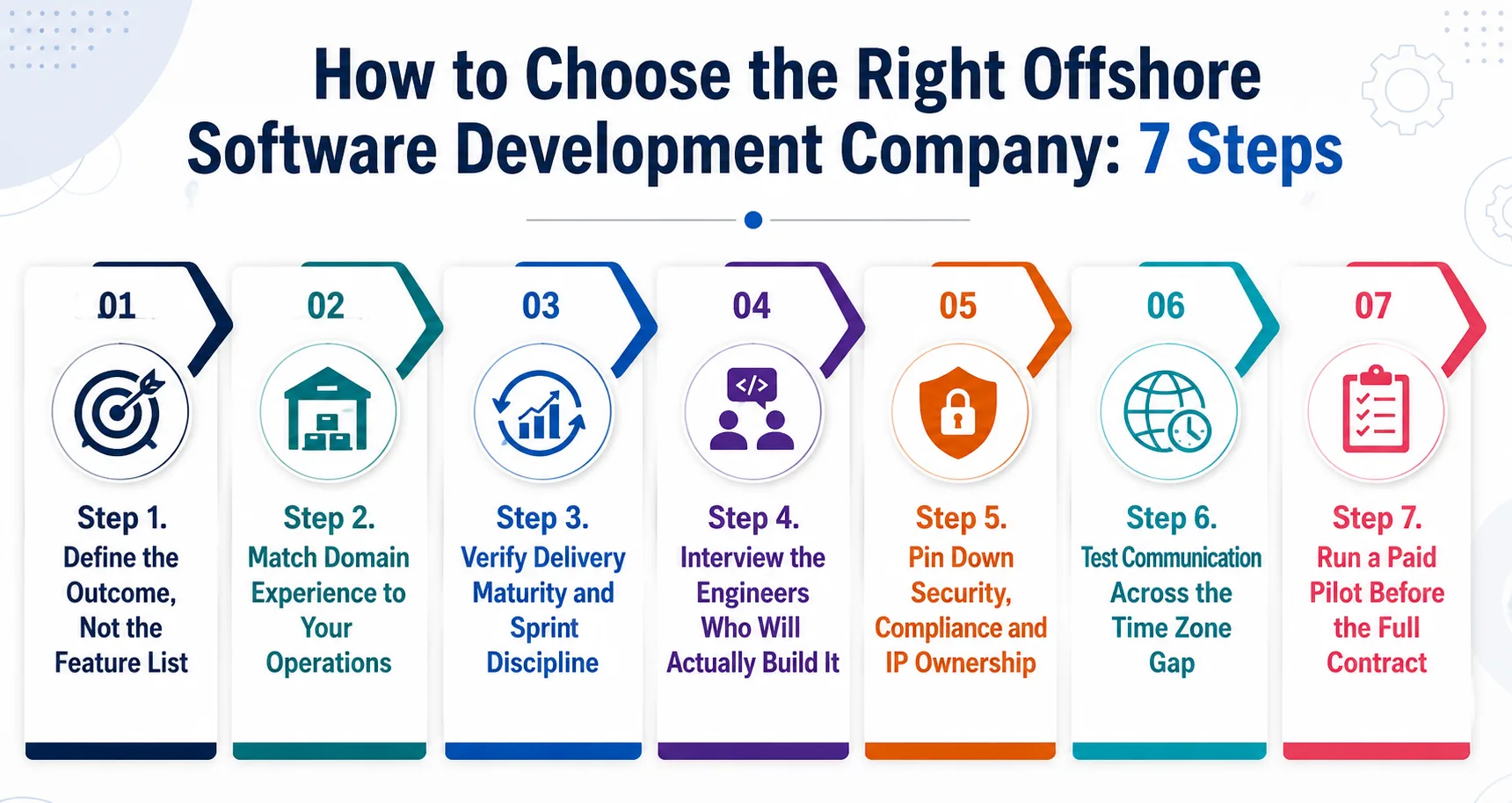
Step 1. Define the Outcome, Not the Feature List
Start by writing down the business result you need, in plain numbers. Something like "cut picking errors below 1%" or "onboard a new client in under a day" gives every vendor the same target.
A feature list does the opposite. It invites each firm to quote a different interpretation, and you end up comparing proposals that describe five different products.
Once you have the outcome written down, share it with every vendor identically. The firms that push back on your assumptions, rather than nodding along, are usually the ones worth continuing with.
Step 2. Match Domain Experience to Your Operations
Ask for two case studies from your industry, and read them for the problems rather than the technology. A team that has built a warehouse system knows what happens when two pickers reach for the last unit at the same moment.
That knowledge is not transferable from a generic portfolio. Domain experience is what stops you from paying to teach a vendor your business during paid sprints.
Push for specifics on the call. Ask how they handled a returns workflow, a payroll edge case, or a multi-warehouse stock transfer. Then listen for whether the answer sounds lived or rehearsed.
Step 3. Verify Delivery Maturity and Sprint Discipline
Ask to see a real sprint report from an active engagement, with client details removed. You are looking for evidence that planning, demos and retrospectives actually happen on a fixed cadence.
Vague answers here predict vague delivery later. A mature partner will describe sprint length, ceremony schedule and how scope changes get approved without hesitating.
Also check how progress reaches you. Read-only access to the board and repository is a reasonable expectation. Firms that resist it are usually managing something they would rather you not see.
Public engineering writing is another honest signal. A detailed framework release breakdown shows how a team tracks its stack when nobody is buying anything.
Step 4. Interview the Engineers Who Will Actually Build It
Insist on speaking with the named technical lead assigned to your project, not a solutions architect from the sales team. Ask that person to walk you through an architecture decision they regretted and what they did about it.
That single question separates practitioners from presenters. Engineers who have shipped production systems answer it easily and specifically.
Read their technical writing first so you can press properly on the answers, and follow up on the parts that sound rehearsed.
Then confirm the commitment in writing. Get the named lead and core engineers into the contract, along with a notice period before anyone is rotated off your team.
Step 5. Pin Down Security, Compliance and IP Ownership
Settle intellectual property before the first line of code, not during handover. Your contract should state clearly that you own the source code, the data and any derived assets.
Then work through security practically. Ask how repository access is granted and revoked, where client data sits, and which regulations the team has worked under before.
Confirm that every contributor, including subcontractors, has signed appropriate agreements. Firms that route work through unnamed third parties create exposure you will only discover during an audit.
Step 6. Test Communication Across the Time Zone Gap
Fix your overlap window before you sign, and make it specific. Three to four shared hours daily is usually enough for standups, decisions, and unblocking.
Then test how the team works outside that window. Good async habits look like detailed written updates, decisions logged in one place, and questions raised before they become blockers.
Watch the response pattern during the sales process itself. How a firm handles your questions before the contract is the most honest preview you will get of how it handles them afterwards.
Step 7. Run a Paid Pilot Before the Full Contract
Commission a small, self-contained piece of real work for two to four weeks. A single integration, an API layer, or one complete user flow gives you genuine evidence.
Pay properly for it, because free pilots attract the bench rather than the best engineers. What you are buying is information about how this team behaves under real conditions.
Judge the pilot on process as much as output. Did estimates hold, did questions arrive early, and did the code arrive with tests and documentation? Those signals predict the next twelve months far better than any proposal deck.
Also Read: How to Choose a Custom Software Development Company
5 Red Flags That Should End the Conversation
A few behaviors during the sales process tell you exactly how delivery will go. Any one of these is reason enough to stop.
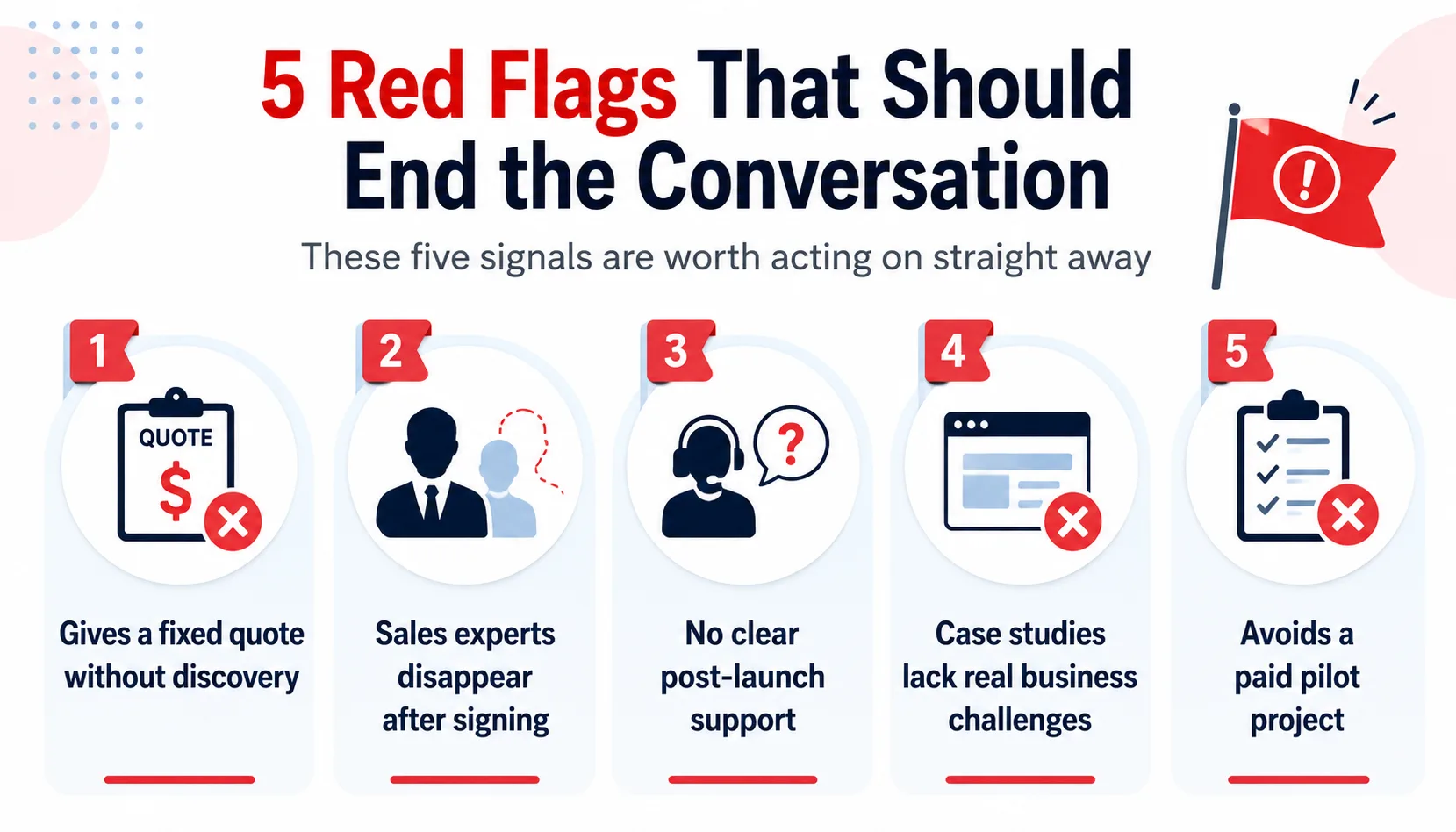
- Gives a fixed quote without discovery: Prices your project before understanding your requirements, leading to inaccurate estimates and costly change requests.
- Sales experts disappear after signing: Senior people handle the sales process, but junior developers end up working on your project.
- No clear post-launch support: Cannot clearly explain who will manage maintenance, bug fixes, and future updates after launch.
- Case studies lack real business challenges: Showcases technologies used but provides no evidence of solving real business problems.
- Avoids a paid pilot project: Hesitates to prove delivery capabilities through a small paid engagement before a long-term contract.
Why Rorix Technologies Is a Safe Offshore Software Development Partner
Choosing an offshore partner eventually comes down to one question: who is still accountable when the software has to run your operation every day.
Rorix Technologies is built around that answer. The team works on retainer rather than project handover, and delivers in 2-week sprints with full task visibility. The specialization sits in operational systems that break loudest when they go wrong.
- Domain-specific engineering: WMS, HRMS and SaaS platforms built for the workflow, not adapted from a template.
- Proven operational impact: Up to 80% fewer picking errors and 40+ integrations shipped on a single platform.
- Verified track record: 27 projects delivered and a 5.0 rating on Clutch across 4 verified reviews.
- Named engineers, not account managers: A dedicated team where a named technical lead owns delivery end-to-end.
- Global delivery, US-first framing: Clients across the US, UK, Canada, Australia, and New Zealand, supported from India.
- Independent technology consulting: Architecture and stack guidance available without a build commitment.
Get a free consultation and project estimate, and we will scope your build against your actual operational constraints.
Match the Delivery Model First, Then Run a Paid Pilot
Picking a partner is less about ranking firms and more about matching a delivery model to the software you need. A fixed-scope contract suits a defined build, while a retainer suits systems that keep evolving with your operation.
Use the comparison table to narrow the field, the rate tables to set a realistic budget, and the seven steps to test what vendors claim. Then run a paid pilot before you commit to anything longer.
The firms above solve different problems, so the one that fits you is the one that has already shipped something close to what you need. Ask for the names of the engineers who would build it, and a notice period before any of them move.
When you are ready to scope the build properly, connect with our experts to turn your requirements into a cost-effective delivery plan.
Frequently Asked Questions
What does an offshore software development company actually do?
An offshore software development company designs, builds, tests, and maintains software for clients in another country. Work happens through a contracted team rather than your own employees, under a project, dedicated team, or retainer arrangement.
How much do offshore software development rates vary by region?
Rates typically run $20 to $45 per hour in India and $25 to $50 in Southeast Asia. Eastern Europe sits at $35 to $70, Latin America at $40 to $80, and onshore Western rates start near $100.
What is the difference between offshore vs nearshore software development?
Offshore means a distant country with a wider cost gap and a deeper talent pool. Nearshore means a neighboring region with more natural working-hour overlap but higher rates and a smaller specialist bench.
Should I hire offshore developers individually or engage a full team?
Hire individually when you have strong internal engineering leadership and specific skill gaps. Engage a dedicated offshore development team when you need someone else to own architecture, quality, and delivery outcomes.
Who owns the source code and intellectual property?
You should, and the contract must say so explicitly before development starts. Confirm that ownership covers source code, data and derived assets, and that every contributor has signed the relevant agreements.
Need engineers who stay?
Dedicated developers at $3,500 per developer per month, working your backlog on 2-week sprints with a named technical lead.
Continue learning
Written by
Renish DadhaniyaFounder & Director, Rorix Technologies
Renish co-founded Rorix Technologies and drives the engineering and delivery culture across the organization. Beyond engineering, he leads the company's sales, finance, and HR operations, building the infrastructure that lets the team focus on shipping quality software. With deep hands-on expertise in architecture and team building, he ensures every project lands on time to the quality standards clients demand.
View full profileRelated articles
Nearshore vs Offshore Software Development: Which One to Choose In 2026
Three vendors quote the same build and the numbers barely overlap. Compare nearshore vs offshore software development on overlap, total cost and risk.
Read article
Staff Augmentation vs Managed Services: Who Should Own Your Software Project in 2026?
Compare staff augmentation vs managed services, including costs, key differences, pros and cons, and how to choose the right model for your project.
Read article
How to Choose a Custom Software Development Company in 2026
How to choose a custom software development company: a vetting checklist, red flags, key questions to ask, and how to compare proposals with confidence.
Read article