Top 16 Enterprise Software Development Companies in 2026
Compare the top 16 enterprise software development companies in 2026. Explore their expertise, timelines, and tips for choosing the right partner.
On this page62 sections
Choosing the wrong enterprise software development partner can cost far more than the development budget.
Key Takeaways: How to Read This Shortlist
Enterprise software development companies help businesses build custom systems for complex workflows, integrations, and large-scale operations. This guide compares 16 leading companies, their strengths, services, costs, timelines, and ideal use cases. It also covers how to choose the right partner, evaluate proposals, spot red flags, and avoid costly mistakes before signing a contract.
A software project may look successful at launch, but poor architecture, weak integrations, and limited scalability can create expensive problems months later.
As businesses grow, spreadsheets, disconnected tools, and manual workflows often become difficult to manage. Enterprise software helps bring these systems together while supporting complex operations, integrations, security, and future growth.
That's why choosing the right enterprise software development services partner matters. The right team should understand your business requirements, technical environment, integrations, and long-term goals, not just deliver code.
But with so many enterprise software development companies offering similar promises, finding the right fit can be challenging.
In this guide, you'll discover:
- 16 leading companies and what they specialize in
- Enterprise software services, costs, and timelines
- How to compare specialists, integrators, and staffing firms
- What to check before choosing a development partner
- Key questions to ask and red flags to avoid
By the end, you'll have a clearer view of which type of development partner fits your project, budget, and growth plans.
What Is an Enterprise Software Development Company?
An enterprise software development company builds business-critical systems such as ERP, HR, warehouse management, order management, and multi-tenant SaaS platforms.
The difference is business impact. If the software fails, operations can stop. That's why enterprise systems must handle complex integrations, legacy data, security, scalability, and reliability.
A custom enterprise software development company must understand your existing technology environment before development starts, including APIs, databases, identity systems, and internal workflows.
How We Shortlisted These Enterprise Software Development Companies
A strong website does not prove a company can handle an enterprise build. We looked at what matters after the contract is signed:
- Domain expertise: Can they understand complex industries, workflows, and real business problems?
- Integration depth: Can they reliably connect ERP, CRM, APIs, payments, devices, and legacy systems?
- Architecture maturity: Can they build for scale, high availability, cloud environments, and future growth?
- Trust signals: Do independent reviews and client feedback support their claims?
- Team fit: Will you actually work with experienced engineers and senior decision-makers?
- Delivery transparency: Are sprints, progress, communication, and accountability clearly defined?
- Post-launch support: Will the team stay involved after launch for maintenance and improvements?
- Global reach: Have they successfully delivered software for businesses across major markets?
Working to a smaller budget or an earlier stage? Our list of small software development companies for startups covers that end of the market.
Top 16 Enterprise Software Development Companies at a Glance
Looking for the quick shortlist? These 16 enterprise software development companies cover different enterprise needs from operations and cloud engineering to IoT, cybersecurity, analytics, and legacy modernization.
| # | Company | Best For | Headquarters | Known For |
|---|---|---|---|---|
| 1 | Rorix Technologies (that is us) | Operations-critical systems (WMS, HRMS, SaaS) | Ahmedabad, India | Domain-built software with retainer accountability |
| 2 | Innowise | Full-cycle builds and platform engineering | Warsaw, Poland | Modernizing legacy estates at scale |
| 3 | Netguru | Product design and engineering | Poznań, Poland | Design-led fintech and retail delivery |
| 4 | Andersen | Regulated industries and team scaling | Warsaw, Poland | Finance, healthcare, and logistics platforms |
| 5 | Itransition | Long-term product partnerships | Decatur, USA | ERP, BI, and SaaS delivery |
| 6 | ScienceSoft | CRM, ERP, and data-heavy apps | McKinney, USA | Structured delivery and security |
| 7 | Simform | Cloud-native product engineering | Orlando, USA | DevOps and scalable architecture |
| 8 | Softeq | Hardware, firmware, and IoT systems | Houston, USA | Embedded and device-to-cloud engineering |
| 9 | Trinetix | Enterprise automation and workflows | Nashville, USA | Complex operational workflows |
| 10 | Avenga | Regulated pharma and finance builds | Cologne, Germany | Compliance-focused architecture |
| 11 | EffectiveSoft | AI-enabled product engineering | San Diego, USA | Fintech and healthcare platforms |
| 12 | Sigma Software | Automotive, telecom, and aerospace | Sweden | Embedded and R&D engineering |
| 13 | Oxagile | Video, streaming, and media platforms | New York, USA | Real-time media architecture |
| 14 | Apriorit | Cybersecurity and low-level systems | Needham, USA | Kernel, driver, and protocol engineering |
| 15 | Qubika | Nearshore product teams | Austin, USA | Timezone-aligned product engineering |
| 16 | Classic Informatics | Portals and legacy modernization | Gurugram, India | Enterprise web platforms |
The 16 Enterprise Software Development Companies in Detail
Let's take a look at what each company actually builds, and who it suits.
1. Rorix Technologies (that is us)
Rorix Technologies builds custom software for operations-heavy businesses, including WMS, HRMS, order management, workforce systems, and multi-tenant SaaS. It focuses on complex workflows that generic platforms cannot handle.
Its domain-first approach means software is built around how the business actually works, from workflows and integrations to data and operational requirements.
Rorix combines 2-week sprints, direct technical leadership, staging from the first sprint, and ongoing retainer support, giving clients visibility and accountability throughout the project.
Its projects include a warehouse build that cut manual errors by 80%. Another is a white-label SaaS platform with 40+ integrations. That combination makes Rorix a strong fit for businesses needing custom software built around real operational needs.
Key Highlights:
- 80% fewer manual errors through real-time inventory and automated workflows
- 40+ integrations across a white-label SaaS platform
- 27 projects with a 5.0 Clutch rating across 4 verified reviews
- 6 to 10 week SaaS MVP target from build to first paying customer
Best for: Operations leaders and founders who need domain-built software plus accountability after launch.
2. Innowise
Innowise provides full-cycle software development and modernization for finance, manufacturing, logistics, and other complex industries. Its strength is handling large systems where legacy modernization, cloud migration, integrations, and ongoing support need to work together.
Key Highlights:
- 1,600+ projects and 3,500+ IT professionals
- Legacy modernization without disrupting existing operations
- Full-cycle delivery covering development, cloud, integration, DevOps, and support
Best for: Large modernization programs and multi-system projects that need a scalable engineering team.
3. Netguru
Netguru is a design-led engineering firm, and that ordering matters. Product discovery, interface design, and engineering sit inside the same team, so the interface is not bolted onto a finished backend. For enterprise buyers, this pays off on systems that thousands of employees or customers touch daily. Adoption is a real project risk, and Netguru treats it as one.
Key Highlights:
- Design-led engineering with product discovery and development together
- Customer-facing platforms built for high user adoption
- End-to-end product delivery from discovery through engineering
Best for: Customer-facing enterprise platforms where user experience directly affects adoption.
4. Andersen
Andersen focuses on enterprise development and modernization across regulated industries such as finance, healthcare, and logistics. Its large engineering pool makes it easier to scale teams when complex programs expand.
Key Highlights:
- Regulated-industry expertise across finance, healthcare, and logistics
- Fast team scaling for large or expanding programs
- Enterprise modernization across complex technology environments
Best for: Regulated enterprise projects that need to scale engineering capacity quickly.
5. Itransition
Itransition specializes in long-term enterprise platforms, with strong experience across ERP, business intelligence, SaaS, and modernization. Its model suits businesses looking for an ongoing technology partner rather than a one-time delivery team.
Key Highlights:
- ERP and BI expertise for business-critical systems
- Long-term product development and modernization
- Predictable delivery for evolving enterprise roadmaps
Best for: Long-term enterprise platforms with continuous development needs.
6. ScienceSoft
ScienceSoft combines enterprise application development with data engineering and security expertise. Its structured approach works particularly well for CRM, ERP, analytics, and systems handling sensitive business information.
Key Highlights:
- CRM, ERP, and analytics development
- Security-focused delivery for sensitive data
- Structured documentation suited to complex environments
Best for: CRM, ERP, and data-heavy projects where security and documentation are critical.
7. Simform
Simform focuses on cloud-native product engineering, with strong depth in architecture, DevOps, and scalable infrastructure. It is a good fit when traffic, availability, and multi-region performance are major requirements.
Key Highlights:
- Cloud-native architecture for scalable platforms
- DevOps expertise across deployment and infrastructure
- High-load engineering for unpredictable traffic and growth
Best for: Cloud-native enterprise platforms with demanding scalability and DevOps requirements.
8. Softeq
Softeq specializes in systems where software meets hardware, covering embedded software, firmware, device connectivity, and cloud platforms. Its strength is connecting physical devices with enterprise applications.
Key Highlights:
- Embedded and firmware engineering
- IoT connectivity and device-to-cloud systems
- End-to-end hardware/software development
Best for: IoT, connected operations, and device-driven enterprise systems.
9. Trinetix
Trinetix combines enterprise automation and design to improve complex workflows, digital workplaces, and analytics systems. It is particularly suited to projects where business processes need improvement alongside the technology.
Key Highlights:
- Workflow automation for complex operations
- Digital workplace solutions for distributed teams
- Design and engineering combined in one delivery model
Best for: Workflow automation and internal platforms for large organizations.
10. Avenga
Avenga specializes in industries where a failed audit costs more than a failed release. Pharma, life sciences, financial services, and insurance are core to its portfolio, with validation, traceability, and regulated architecture built into its approach. This adds time upfront but reduces costly surprises later.
Key Highlights:
- Regulated-industry expertise across pharma and finance
- Compliance-focused architecture and development
- Validation and traceability for business-critical systems
Best for: Compliance-heavy software projects in regulated industries.
11. EffectiveSoft
EffectiveSoft is strongest when a project needs AI capability built into the product rather than bolted on afterwards. Its teams work primarily in fintech and healthcare, where accuracy and compliance shape the architecture. That focus also carries into its data and reporting work, so analytics can be designed into the system from the start.
Key Highlights:
- AI-enabled product engineering across the full build
- Deep fintech and healthcare domain experience
- Data-first architecture for growing reporting needs
Best for: Fintech and healthcare platforms where AI capability and regulated-industry experience matter.
12. Sigma Software
Sigma Software is a Swedish-Ukrainian engineering group and part of the Danir group. It brings strong R&D and embedded engineering experience from automotive, telecom, and aerospace. These industries demand high reliability, rigorous testing, and engineering discipline. That experience makes Sigma a strong choice for technically demanding enterprise systems.
Key Highlights:
- Embedded and R&D engineering for complex systems
- High-reliability development for demanding environments
- Automotive, telecom, and aerospace expertise
Best for: High-reliability systems in automotive, telecom, and aerospace.
13. Oxagile
Oxagile specializes in video, streaming, and media platforms, where real-time performance is critical. Its expertise covers video delivery, adaptive playback, and content workflows. That specialist knowledge is valuable when media is the core of the product rather than an added feature.
Key Highlights:
- Video and streaming platform development
- Real-time media architecture for high-demand environments
- Content delivery and interactive media expertise
Best for: Streaming, video, and interactive media platforms.
14. Apriorit
Apriorit works at the systems and security layer, handling challenges that go beyond standard business applications. Its expertise includes kernel modules, drivers, network protocols, and security research. This makes it particularly useful when the project depends on deep technical or low-level engineering.
Key Highlights:
- Kernel and driver development
- Cybersecurity and security research
- Protocol and systems engineering
Best for: Cybersecurity, systems programming, and low-level engineering.
15. Qubika
Qubika, formed in 2023 when Moove It and December Labs merged, provides nearshore product engineering for businesses that need close collaboration with an external team. Its timezone alignment with North American clients can make daily communication and fast decisions easier. The firm has experience across fintech, healthcare, and media products.
Key Highlights:
- Nearshore engineering for US businesses, with delivery centers across Latin America
- Timezone overlap for real-time collaboration
- Product engineering across fintech, healthcare, and media
Best for: US businesses that value close collaboration with an external engineering team.
16. Classic Informatics
Classic Informatics focuses on mid-market web platforms, internal tools, and legacy modernization. Its strength is replacing aging systems without introducing unnecessary complexity or forcing a complete operational reset. The smaller delivery model can also suit businesses that do not need a large enterprise integrator.
Key Highlights:
- Legacy modernization with a practical approach
- Enterprise web platforms and internal applications
- Cost-efficient delivery for mid-market businesses
Best for: Mid-market portals, internal tools, and pragmatic legacy modernization.
Now that you've seen who specializes in what, the next question is what these projects actually include. The services you choose directly affect your cost, timeline, and technical requirements.
Services Enterprise Software Development Companies Provide
Most vendors offer similar services. The real difference is how deeply they handle your architecture, integrations, data, and business workflows.
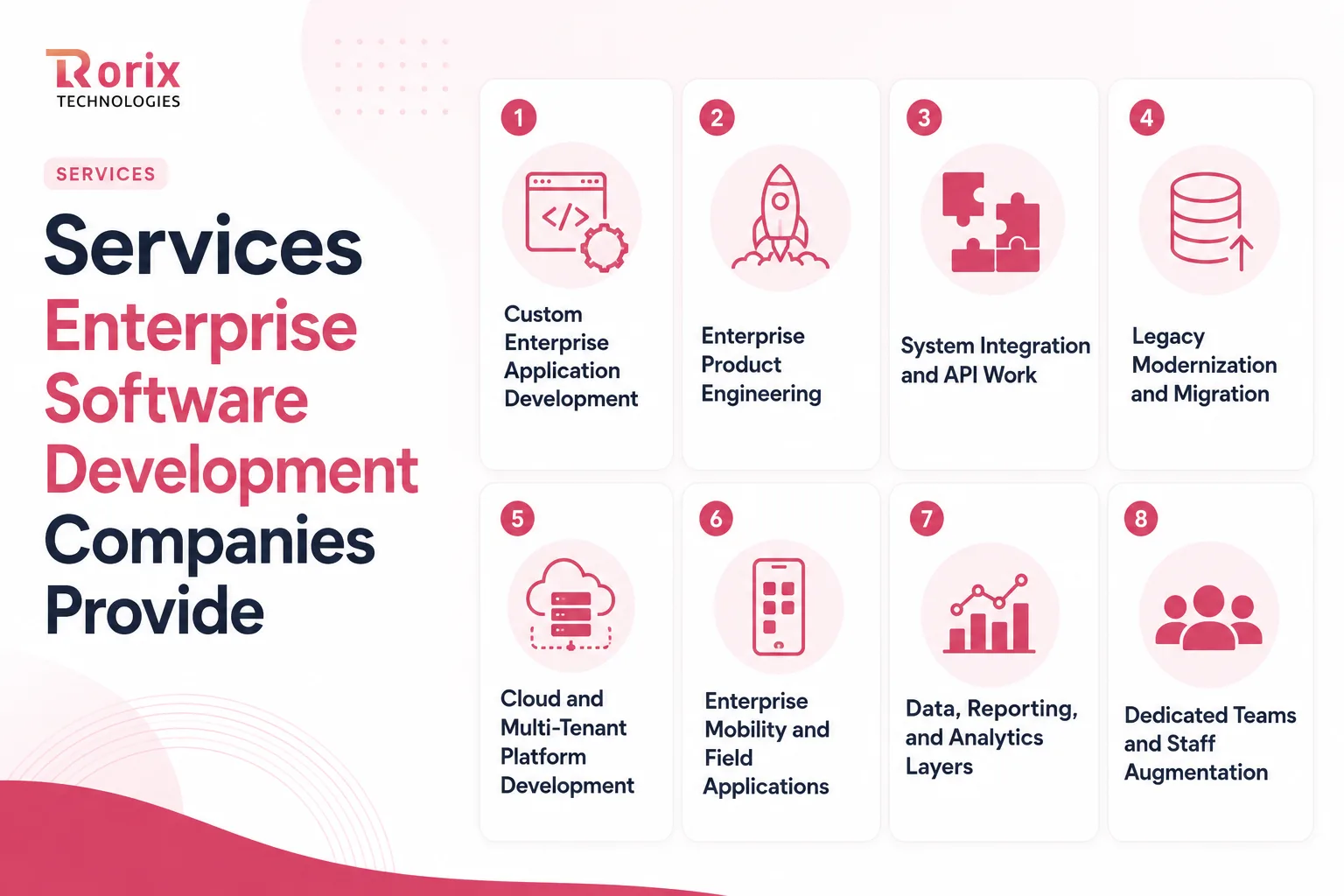
1. Custom Enterprise Application Development
Build software around your workflows instead of adapting the business to an off-the-shelf platform. This covers business logic, databases, APIs, user interfaces, and workflows designed around your operational requirements.
2. Enterprise Product Engineering
Product engineering supports software you plan to sell or license, including multi-tenancy, onboarding, pricing, and public APIs. A strong SaaS platform engineering partner builds these foundations for long-term growth.
3. System Integration and API Work
Enterprise systems often connect ERPs, CRMs, payment platforms, carriers, and legacy databases. Effective integration covers API contracts, data synchronization, retries, and reconciliation to keep connected systems reliable. Our API integration strategy guide covers the key considerations.
4. Legacy Modernization and Migration
Modernization replaces aging technology without disrupting daily operations. Experienced teams use phased migration, data validation, parallel systems, and rollback plans to reduce risk during complex technology transitions.
5. Cloud and Multi-Tenant Platform Development
Cloud development covers migration and cloud-native applications across AWS, Azure, or Google Cloud. The focus should be on scalability, availability, security, and tenant isolation, not simply moving existing servers online.
6. Enterprise Mobility and Field Applications
Mobile applications give technicians, drivers, warehouse teams, and field workers access to critical systems wherever they work. Offline functionality is essential when users operate in locations with unreliable connectivity.
7. Data, Reporting, and Analytics Layers
Enterprise platforms need reliable data pipelines, warehouses, reporting, and analytics alongside operational functionality. Designing the data layer early improves reporting accuracy and makes the system easier to scale.
8. Dedicated Teams and Staff Augmentation
If you already control the roadmap and delivery process, adding engineers may be more practical than outsourcing the entire build. Our guide to IT staff augmentation cost explains when this model makes sense.
For warehouse-specific builds, see our guide on how to evaluate a warehouse management software development company.
Enterprise Software Development Cost
Enterprise software development cost depends on scope, integrations, data, compliance, and team location, not just hourly rates. Use the ranges below as planning benchmarks, not fixed quotes.
These are market ranges across the vendor types covered in this guide, not Rorix pricing. For a project-specific figure, use the project cost estimator.
1. Hourly Rates by Delivery Region
Location affects rates, but the cheapest option isn't always the most cost-effective. Seniority, communication, quality, and rework can change the final budget.
| Region | Typical Hourly Rate | Common Advantage |
|---|---|---|
| North America | $100-$200 | Time-zone alignment, onshore delivery |
| Western Europe | $80-$160 | Regulatory and enterprise expertise |
| Eastern Europe | $40-$100 | Strong engineering talent |
| Latin America | $45-$110 | Nearshore US collaboration |
| South & Southeast Asia | $25-$70 | Large talent pool, lower rates |
Compare nearshore vs offshore software development before choosing a region.
2. Cost by Enterprise Project Type
Project scope gives a better cost estimate than hourly rates alone. These ranges help you quickly evaluate whether a proposal is realistic.
| Project Type | Estimated Cost | Typical Scope |
|---|---|---|
| Departmental | $60K-$150K | One workflow, core roles, 2-3 integrations |
| Core operational | $150K-$400K | Multiple roles, mobile, ERP/CRM |
| Multi-site | $400K-$900K | Multiple locations, permissions, complex data |
| Regulated or multi-tenant | $900K+ | Compliance, auditability, isolation, high availability |
3. Pricing Models Compared
The right pricing model depends on how stable your requirements are and how much control you need over scope and budget.
| Model | Best When | Main Risk |
|---|---|---|
| Fixed price | Scope is well defined | Change requests increase costs |
| Time & materials | Requirements may evolve | Budget can expand |
| Dedicated team | Long-term roadmap | Requires strong product ownership |
| Retainer | Ongoing improvements | Less predictable monthly scope |
4. Hidden Costs to Budget For
The development quote is only part of the total investment. Plan for:
- Maintenance: Often 15 to 25% of the build cost per year. See our software maintenance cost guide.
- Third-party tools: Cloud services, APIs, licenses, and monitoring.
- Data migration: Cleanup, validation, mapping, and testing.
- Internal effort: Time from product, IT, operations, and compliance teams.
Broader outsourcing economics, including team composition and regional totals, are covered in our guide to the cost of outsourcing software development.
How Long an Enterprise Software Development Project Takes
Enterprise projects rarely have one fixed deadline. Integrations, approvals, compliance, data quality, and scope changes can all shift the schedule, so realistic time ranges matter more than a single date.
1. Timeline by Project Tier
| Project Tier | Discovery & Design | Build & Test | Total to Go-Live |
|---|---|---|---|
| Departmental system | 2-4 weeks | 8-14 weeks | 3-5 months |
| Core operational platform | 4-6 weeks | 16-28 weeks | 5-9 months |
| Multi-site enterprise platform | 6-10 weeks | 28-44 weeks | 9-14 months |
| Regulated or multi-tenant platform | 8-12 weeks | 36+ weeks | 12+ months |
Tip: A phased rollout can deliver value sooner. Start with one department or location, validate the system, then expand.
2. What Actually Moves the Timeline
Most delays come down to five factors:
- Integrations: More systems mean more testing and dependencies.
- Decision speed: Slow approvals can stop development.
- Compliance: Audits and sign-offs add time.
- Data quality: Poor legacy data makes migration harder.
- Scope changes: New requirements can extend the schedule.
Use the custom software development process to understand what each phase should deliver and track whether the project is genuinely on schedule.
Mid-Size Specialist vs Global Integrator vs Staffing Platform
The right choice comes down to project size, delivery ownership, expertise, and speed. These are market ranges across the vendor types covered in this guide, not Rorix pricing.
| Factor | Global Integrator | Mid-Size Specialist | Staffing Platform |
|---|---|---|---|
| Typical market engagement size | $2M+ | $60K-$900K | Per engineer/month |
| Delivery owner | Integrator | Specialist | You |
| Senior access | Account layers | Usually direct | Direct |
| Domain depth | Broad | Deep | Individual-dependent |
| Start time | 6-12 weeks | 2-4 weeks | Days |
| Post-launch | Formal | Ongoing | Usually none |
| Best for | Global transformation | Business-critical builds | Team extension |
1. Global Integrator
Best for large, multi-country transformations requiring extensive governance, coordination, and change management. The higher cost makes more sense when the program spans multiple business units or runs into millions.
2. Mid-Size Specialist
Best for business-critical projects with defined scope. You typically get direct senior engineers, faster decisions, deeper domain expertise, and a team focused on the actual build.
3. Staffing Platform
Best when you already have product, architecture, and delivery leadership. You gain engineering capacity quickly, but your team remains responsible for quality, architecture, delivery, and continuity.
Now that you can see which vendor type fits your situation, let us turn to the selection work. This is the part that separates a good shortlist from a good decision.
How to Choose the Right Enterprise Software Development Company
A sales call can make almost any vendor look capable. The real difference appears in their experience, delivery team, technical decisions, and accountability.
1. Check Domain Expertise and Proof
Choose a vendor with proven experience in your industry and similar systems. Ask for two comparable projects, independent reviews, named clients, and measurable results you can verify.
2. Know Who Will Build Your Product
The senior architect on the sales call may not lead delivery. Ask for the names, roles, seniority, and availability of your actual team, and make those commitments part of the contract.
3. Test Integration and Architecture Skills
Ask how they handle APIs, legacy systems, retries, duplicate records, data growth, and external failures. A strong team should explain scalability, bottlenecks, trade-offs, and how it would avoid over-engineering.
4. Verify Security and Compliance
Check access control, encryption, secrets management, audit logging, and data location before development starts. For GDPR, HIPAA, SOC 2, or similar requirements, ask how compliance affects architecture and testing.
5. Make Delivery and Communication Visible
Look for regular sprints, working software, a shared task board, staging access, and clear escalation paths. Agree on communication channels and time-zone overlap so delays and issues are handled quickly.
6. Protect IP and Post-Launch Support
Confirm that you own the source code, data, documentation, and intellectual property. Define repository access, credentials, handover, support scope, response times, and who remains responsible after launch.
10 Questions to Ask Before You Sign the Contract
Ask these before signing. Focus on specific, verifiable answers, not sales promises.
- Who will actually build the system? Confirm names, roles, seniority, and availability.
- Can you show two similar projects? Look for relevant experience and real challenges solved.
- How do you handle integration failures? Check their approach to monitoring, retries, and recovery.
- How will the system scale 10×? Test their architecture and scalability planning.
- What do we receive each sprint? Expect working software, staging access, and clear deliverables.
- How are scope changes handled? Confirm the process for tracking cost and timeline impact.
- Where is our data stored? Verify GDPR, HIPAA, and data residency requirements where applicable.
- Who owns the code and IP? Get ownership, documentation, credentials, and handover terms in writing.
- What support do we get after launch? Confirm maintenance, response times, and long-term ownership.
- What would you challenge in our requirements? Good partners identify unnecessary features instead of saying yes to everything.
Earlier-stage teams should also read our guide to bespoke software development for startups.
8 Red Flags That Predict a Failed Enterprise Software Project
One red flag may be explainable. Several together are a reason to walk away, regardless of which vendor you're considering.
- Quote before discovery: A firm price without understanding the project often means costly surprises later.
- No named engineers: If you cannot see who will build it, delivery quality becomes a gamble.
- Vague integration answers: Generic API answers usually signal limited real-world integration experience.
- Every requirement gets a yes: Good partners challenge unnecessary features instead of maximizing scope.
- No staging environment: If you cannot test working software, you cannot properly verify progress.
- No maintenance plan: Ignoring ongoing support can hide 15 to 25% of the build cost per year.
- IP terms are unclear: Source code ownership, documentation, and handover must be written into the contract.
- Poor pre-sales communication: Slow or unclear responses rarely improve after you sign.
Why Rorix Technologies Belongs on Your Shortlist
Most vendors sell breadth. Rorix Technologies focuses on operations software that works around your actual business workflows, from warehouse management to order and workforce systems.
Its track record combines measurable outcomes, deep integrations, senior engineering, and visible delivery.
- 27 projects with a 5.0 rating across 4 verified Clutch reviews
- 80% fewer manual errors on a Lorecs warehouse build
- 40+ integrations on one white-label SaaS platform, with cross-platform React Native apps
- A dedicated team of senior engineers with a named technical lead
- 2-week sprints with staging and task visibility from sprint one
- Clients across the US, UK, Canada, Australia, and New Zealand
Have a complex workflow to solve? Let Rorix Technologies help. Book a free consultation and get a project estimate tailored to your requirements.
Conclusion: How to Pick the Right Partner for Your Build
Choosing between enterprise software development companies starts with one question: which vendor type fits your project? From there, compare domain expertise, named engineers, delivery transparency, and post-launch accountability.
The cost ranges, timelines, and selection criteria in this guide give you a practical benchmark for evaluating proposals, not just sales pitches.
We hope this guide helped you understand what separates capable enterprise software development companies from vendors who simply market well.
Ready to scope your project? Connect with our experts to turn your requirements into a cost plan with a named team.
Frequently Asked Questions
What do enterprise software development companies do?
They design, build, integrate, and maintain business-critical software that off-the-shelf products cannot handle. Common projects include WMS, HR systems, order management, and multi-tenant SaaS platforms.
How much does enterprise software development cost?
A departmental system typically costs $60,000-$150,000, while core operational platforms range from $150,000-$400,000. Multi-site and regulated projects can exceed $900,000 depending on integrations, data, and compliance.
How do I choose between an agency and a staffing platform?
Choose an agency for end-to-end delivery and accountability. Choose staffing when you already manage the roadmap, architecture, and delivery process but need additional engineers.
How long does an enterprise software project take?
Departmental systems typically take 3-5 months, core operational platforms 5-9 months, and complex multi-site or regulated builds 12+ months.
Should I choose a global integrator or mid-size specialist?
Choose a global integrator for multi-country transformations with large budgets and complex governance. A mid-size specialist is usually better for contained, business-critical builds requiring senior expertise and faster decisions.
What are the highest hidden costs?
Maintenance, data migration, and third-party licenses are commonly underestimated. Maintenance alone can add around 15-25% of the build cost annually.
How do I verify a vendor before signing?
Check independent reviews, comparable projects, client references, and the actual delivery team. Confirm key commitments in the contract rather than relying on sales promises.
Who should own the source code and IP?
The client should clearly own the source code, data, and intellectual property. The contract should also cover repositories, credentials, documentation, deployment instructions, and handover terms.
Costing a custom build?
A dedicated team of senior engineers with a named technical lead on every engagement. Send us the problem and you get back a scope and a price.
Continue learning
Written by
Renish DadhaniyaFounder & Director, Rorix Technologies
Renish co-founded Rorix Technologies and drives the engineering and delivery culture across the organization. Beyond engineering, he leads the company's sales, finance, and HR operations, building the infrastructure that lets the team focus on shipping quality software. With deep hands-on expertise in architecture and team building, he ensures every project lands on time to the quality standards clients demand.
View full profileRelated articles
Top 15 Small Software Development Companies for Startups (2026)
Every small development firm sounds the same on a sales call. Compare 15 startup-ready companies, what each one builds, what it costs, and how to choose.
Read article
How to Choose a Custom Software Development Company in 2026
How to choose a custom software development company: a vetting checklist, red flags, key questions to ask, and how to compare proposals with confidence.
Read article
How to Evaluate a Warehouse Management Software Development Company: 12 Builders Compared, Costs, and Red Flags
Evaluate a warehouse management software development company with a checklist, cost bands, red flags, and 12 builders compared, from a team that ships WMS.
Read article