Top 15 AI Chatbot Development Companies in 2026
Compare 15 AI chatbot development services in 2026 by expertise, Clutch ratings, hourly rates, and use cases. Find the right partner for your business.
On this page48 sections
Key Takeaways: Choose a Chatbot Builder That Fits Your Needs
Start with your chatbot's main purpose, then shortlist any AI chatbot development company that has relevant experience.
- Operations chatbots: Rorix Technologies (that is us) builds chat assistants on hosted models, and builds the WMS, HRMS, and SaaS systems a chatbot reads from.
- Customer service at scale: Master of Code Global and BotsCrew specialize in conversational AI.
- Advanced LLM and RAG builds: Vstorm and Kodexo Labs handle complex AI use cases.
- Ecommerce assistants: Netguru builds product advisors grounded in store catalogs.
- Enterprise AI projects: BlueLabel offers consulting-led chatbot development.
- Budget-friendly builds: EnactOn Technologies and Konstant Infosolutions each list a $5,000 minimum project size on Clutch.
- Enterprise system integration: Softweb Solutions connects chatbots with Microsoft, ERP, and CRM environments.
- Before choosing: Test how the chatbot handles missing information, protects data, and transfers conversations to human agents.
One wrong answer can cost a business a customer. When someone asks about an order, payment, or account at midnight, a chatbot that cannot access the right business data is little more than an automated FAQ.
Reliable chatbots need more than natural conversations. They must connect with business systems, retrieve accurate information, and know when to hand a conversation to a human.
This is where AI integration with existing business systems becomes important, especially for companies using WMS, ERP, and CRM platforms.
But not every provider of AI chatbot development services offers the same capabilities. Some specialize in customer support and voice assistants, while others focus on enterprise integrations, RAG-based chatbots, or custom AI solutions.
In this guide, you'll learn:
- The 15 best AI chatbot development companies in 2026
- What their AI chatbot development services include
- Which providers suit different business needs
- 10 practical tests to evaluate a development partner
- Market costs, development timelines, and ongoing expenses
By the end of this guide, you'll have a practical shortlist, a clearer understanding of development costs, and the questions to ask any AI chatbot development company before investing in a custom chatbot.
What Do AI Chatbot Development Services Include?
When you hire an AI chatbot development company, the work covers the complete process, from planning and content preparation to system integration, testing, and ongoing improvements. The aim is to build a chatbot that gives accurate answers, handles real customer questions, and works with your existing business systems.
A full development engagement usually includes:
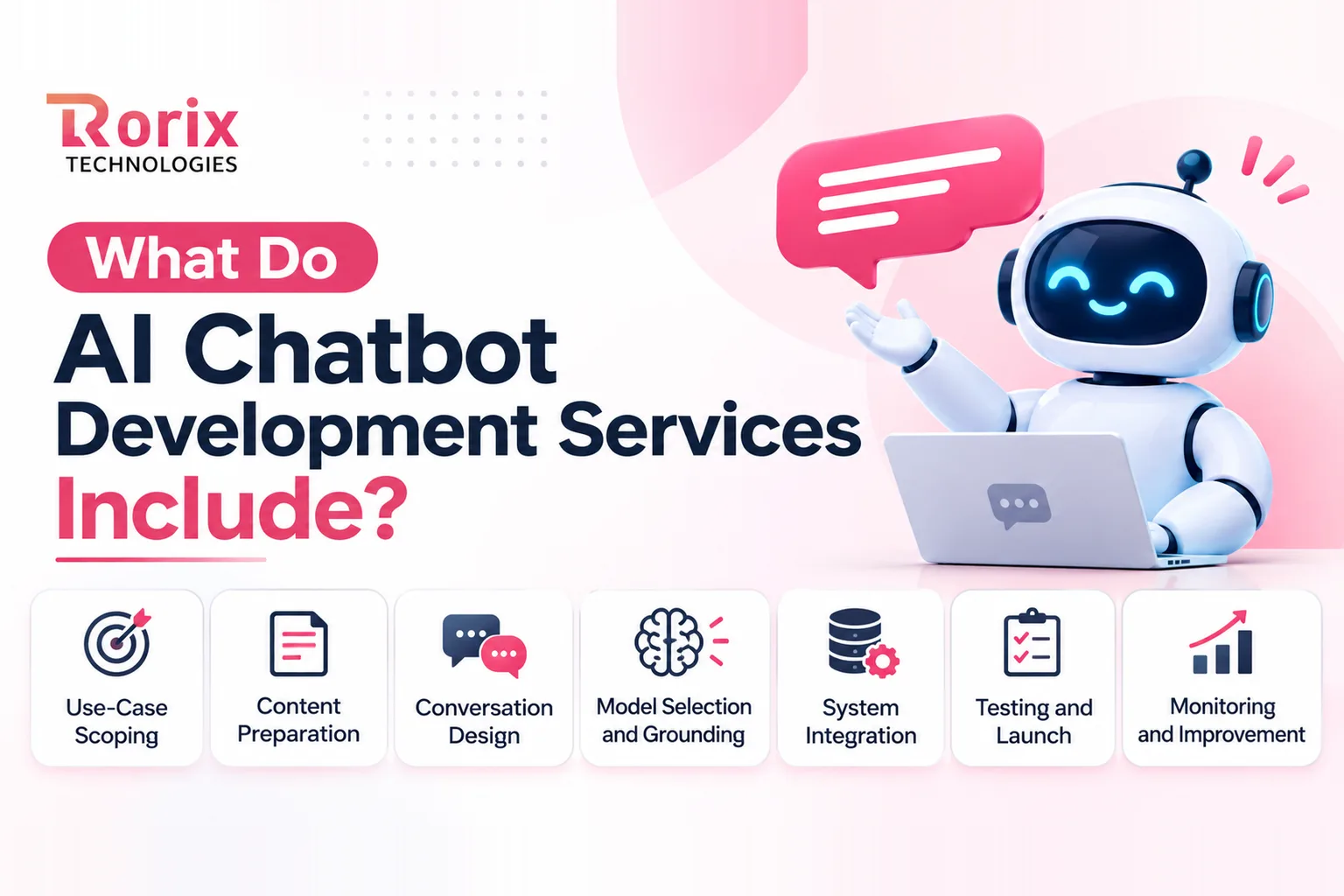
- Use-case scoping: Identifying tasks to automate and the metrics to track.
- Content preparation: Organizing help articles, policies, and product data.
- Conversation design: Defining user intents, response tone, fallback replies, and human handoffs.
- Model selection and grounding: Choosing an AI model and using retrieval-augmented generation (RAG) to provide relevant answers.
- System integration: Connecting the chatbot to WMS, ERP, CRM, helpdesk, or HRMS platforms through APIs.
- Testing and launch: Testing real user queries before deploying across selected channels.
- Monitoring and improvement: Tracking answer accuracy, escalations, and costs to improve performance.
Rule-Based, AI, and Integrated Chatbots Compared
The right chatbot depends on the questions it needs to handle and the data required to answer them. Rule-based bots work for simple tasks, while AI and integrated chatbots handle more varied questions and business data. Knowing which type you need makes it easier to scope AI chatbot development services with a vendor.
| Chatbot type | How it works | Best fit | Watch out for |
|---|---|---|---|
| Rule-based bot | Uses scripted menus and keyword triggers | FAQs, appointment booking, and simple routing | Cannot handle questions outside its scripts |
| AI chatbot over your content | Uses an LLM and RAG to answer from documents and help articles | Product, policy, and how-to questions | Outdated content can lead to incorrect answers |
| Integrated AI chatbot | Retrieves live records from WMS, ERP, CRM, or HRMS | Order status, stock checks, leave balances, and account queries | Requires reliable APIs and role-based access |
| Voice or omnichannel assistant | Works across websites, apps, WhatsApp, Slack, Teams, and phone | Customer support across channels and languages | More channels and compliance requirements increase costs |
When a chatbot starts taking actions, such as rebooking deliveries or approving returns, it moves into AI agent territory. These workflows need approvals, audit logs, and failure handling. Read our guide to AI agent development companies to understand the development requirements.
Where an AI Chatbot Pays Back First: Use Cases by Team
Chatbots deliver value when teams repeatedly answer the same questions and the required information is already available in business systems. Customer support, warehouse operations, HR, and sales are common starting points.
| Team | Questions the bot handles | System it reads |
|---|---|---|
| Customer support | Order status, returns, and delivery windows | Order management system, helpdesk |
| Warehouse and 3PL | Stock availability, shipment status, and dock appointments | WMS |
| Ecommerce | Product fit, sizing, and order tracking | Product catalog, order system |
| HR operations | Leave balances, payslip questions, and policy lookups | HRMS |
| IT helpdesk | Password resets, access requests, and how-to steps | ITSM tool, identity system |
| Sales | Lead qualification, pricing questions, and meeting bookings | CRM, calendar |
| Field service | Job status, technician arrival times, and rescheduling | Field-service platform, CRM |
| SaaS products | In-app help, plan limits, and billing questions | Product database, billing system |
For warehouse use cases, explore AI in warehouse management to see where automation can improve operations. For employee support, our guide to AI in HRMS covers practical chatbot applications.
Custom Chatbot Development Company vs Chatbot Platform: Which Do You Need?
A chatbot platform gives you a ready-made builder. A custom chatbot development company builds around your business systems, workflows, and data. The right choice depends on how much control and integration your chatbot needs.
| Factor | Chatbot platform | Custom chatbot development company |
|---|---|---|
| What you get | A subscription tool your team configures | A chatbot built for your workflows and systems |
| Cost model | Monthly fee or per-conversation pricing | Project fee, hourly rate, or retainer |
| Speed to launch | Days to weeks for standard flows | Weeks to months, depending on integrations |
| Integration depth | Prebuilt connectors for popular tools | Custom integrations with API-enabled systems, including WMS and ERP |
| Ownership | Data and logic remain within the vendor's platform | Code, prompts, and data pipelines can be handed over under agreed terms |
| Upkeep | Managed by your team within platform limits | Managed by the development partner or your team after handover |
| Best fit | Standard FAQs and lead capture | Live business data, custom workflows, and strict compliance needs |
Choose a platform when your chatbot handles routine questions and your helpdesk already has a built-in solution. For example, a support team answering shipping and returns FAQs may be able to launch within a week without investing in custom development.
Custom AI chatbot development makes more sense when answers depend on systems that standard platforms cannot access, such as a custom WMS, ERP, or SaaS database. It also suits businesses with complex workflows, regulated data, or a need for greater control over the code and integrations.
This article focuses on custom AI chatbot development services rather than ready-made products such as Intercom, Kore.ai, and Yellow.ai.
Also Read: Top 15 AI Integration Companies for Business Systems
The 15 Best AI Chatbot Development Companies Compared
Each provider of AI chatbot development services on this list brings different strengths, from customer support bots to enterprise system integrations. Compare their expertise, Clutch ratings, hourly rates, and best-fit projects.
Disclosure: Rorix Technologies (that is us) wrote this guide and is ranked #1. We applied the same criteria to ourselves, and no company paid for placement. Verify each company's claims, including ours, during your discovery calls.
| Company | Headquarters | Chatbot Strength | Clutch Rating | Hourly Rate | Best For |
|---|---|---|---|---|---|
| Rorix Technologies (that is us) | Ahmedabad, India | AI workflows and system integrations | 5.0 (4 verified reviews) | $25 to $49 (Clutch) | Operations-heavy businesses |
| Master of Code Global | Winnipeg, Canada | Conversation design for chat and voice assistants | 4.7 (37 reviews) | $50 to $99 | Consumer brands and enterprises with high-volume customer conversations |
| BotsCrew | San Francisco, USA | GPT and Llama chatbots, AI agents, and enterprise search | 4.8 (40 reviews) | $50 to $99 | Established brands building customer-facing AI assistants |
| Vstorm | Wrocław, Poland | Source-backed LLM assistants and tool-using agents | 4.9 (22 reviews) | $100 to $149 | Complex, accuracy-sensitive use cases |
| Kodexo Labs | Austin, USA | RAG and voice bots on a modern LLM stack | 4.9 (14 reviews) | $50 to $99 | SMBs and mid-market businesses exploring chat and voice automation |
| Netguru | Poznań, Poland | RAG product advisors grounded in store catalogs | 4.8 (73 reviews) | $50 to $99 | Ecommerce and marketplace businesses |
| BlueLabel | New York, USA | Consulting-led conversational copilots | 4.7 (71 reviews) | $100 to $149 | US enterprises that want strategic guidance |
| Space-O Technologies | Ahmedabad, India | Chat and voice bots across messaging channels | 4.8 (75 reviews) | $25 to $49 | Mid-market businesses building chat and voice experiences |
| TechAhead | Agoura Hills, USA | In-app chat and voice assistants in 30+ languages | 4.9 (125 reviews) | $25 to $49 | Product teams adding conversational features to an app |
| Softweb Solutions | Plano, USA | Assistants connected to ERP, CRM, SharePoint, and Office 365 | 5.0 (5 reviews) | Not publicly listed | Enterprises connecting assistants to established systems |
| Edvantis | Rzeszów, Poland | Multilingual RAG proofs of concept | 4.8 (45 reviews) | $25 to $49 | Organizations validating AI across large document collections |
| EnactOn Technologies | Surat, India | Fallback design and human handoffs | 4.8 (17 reviews) | $25 to $49 | SMBs launching their first business chatbot |
| Konstant Infosolutions | Jaipur, India | Chatbots embedded in mobile and web apps | 4.9 (174 reviews) | $25 to $49 | Startups and SMBs adding AI chat to a digital product |
| Codiant | East Moline, USA | Sector-specific chatbot flows with compliance support | 5.0 (21 reviews) | Under $25 | Industry-specific chatbots for customer and sales workflows |
| AnyforSoft | Sarasota, USA | AI and rule-based education assistants | 4.9 (88 reviews) | $25 to $49 | Universities, EdTech platforms, and corporate learning providers |
Clutch ratings, review counts, and hourly bands are from each company's Clutch profile, read on 18 November 2026. Softweb Solutions does not disclose its rate there.
Let's explore each company in detail.
1. Rorix Technologies (that is us)
Rorix Technologies offers AI chatbot development services for operations-heavy businesses. It builds chat assistants on hosted models, and builds the WMS, HRMS, and SaaS systems a chatbot reads from. Its approach starts with a system readiness survey to understand available data, API access, and where an assistant can fit safely into existing workflows.
Every chatbot project moves through shadow-mode testing before the assistant can take action or update records. This helps validate responses against real outcomes, while a named technical lead manages delivery through two-week sprints.
Rorix also runs an AI assistant on its own site. Its AI-powered marketing website uses a Claude-powered discovery chat that interviews visitors about their project and files each brief as a structured inquiry. Other shipped AI work includes the Lorecs AI SKU price finder, which answers vendor pricing questions in plain English, and candidate matching in RMS hiring. The First Interview, an AI mock-interview platform Rorix designed and built (feature-complete, in pre-launch testing), runs on a dual-model pipeline with automatic failover; token costs were modeled across 60+ session types to verify gross margins above 70% before launch.
Key Highlights:
- Track record: 27 platforms delivered and a 5.0 Clutch rating across 4 verified reviews.
- Technology stack: Python, Node.js, TypeScript, PostgreSQL, OpenAI API, and Claude API.
- AI chatbot development services: Operational chatbots, retrieval over company data, customer and staff assistants, API integrations, and production monitoring.
- Integration experience: 40+ integrations connected for Driven, a US performance platform for pest control and field service teams, including HubSpot, Twilio, RingCentral, and Google APIs.
- Delivery model: Dedicated team of senior engineers with a named technical lead, two-week sprints, and a working SaaS MVP in 6 to 12 weeks.
- Client markets: US, UK, Canada, Australia, and New Zealand.
Best for: Distributors, HR teams, and SaaS businesses that need a chatbot connected to live operational data and the systems they already run.
2. Master of Code Global
Master of Code Global specializes in conversational AI, combining conversation design with AI engineering to build chat and voice assistants for customer-facing businesses. Its LOFT framework supports generative AI workflows, with projects including an AI assistant for a luxury beauty brand and a chatbot for a luxury travel company.
Key Highlights:
- Conversation design: Custom personas, dialogue flows, and brand voice.
- AI technology: OpenAI, Cohere, and LLaMA models for chat and voice assistants.
- Omnichannel support: Deployment across messaging apps, websites, mobile apps, and phone systems.
Best for: Consumer brands and enterprises handling high-volume customer conversations across multiple channels.
3. BotsCrew
BotsCrew started as a dedicated chatbot studio and has expanded into AI agents and enterprise search. Now majority-owned by US agency CourtAvenue, its core team remains in Lviv. Its portfolio includes a GPT agent for an international basketball tournament, chatbots for a car brand and a city tourism board, and support automation for an auto parts maker.
Key Highlights:
- GPT and Llama chatbots: Brand-grounded assistants for support and sales.
- Enterprise AI search: RAG-based search across internal documents.
- Healthcare and voice AI: Patient-facing bots and voice interfaces with industry-specific safeguards.
Best for: Established brands building customer-facing AI assistants or campaign chatbots.
4. Vstorm
Vstorm is a specialist LLM engineering firm from Wrocław, focused on complex assistants that retrieve information and act on it. Its projects include a print-order advisor for an online printing company, a clinical triage assistant for a medical protocols provider, and a bilingual English-Arabic support agent for a journalism network. The work reflects a focus on accuracy, reliable retrieval, and practical business workflows.
Key Highlights:
- Source-backed answers: Assistants that cite the information behind their responses.
- Internal helpdesks: HR and IT bots built for Slack.
- Tool-using agents: Product advisors that interact with business systems and complete workflow steps.
Best for: Teams with complex, accuracy-sensitive use cases that need specialist LLM engineering.
5. Kodexo Labs
Kodexo Labs is an AI-native development firm with offices in the US, UK, and Pakistan. It builds chatbots, voice assistants, and agent-based systems using a modern LLM stack. Its published technology choices include LangChain, LangGraph, and CrewAI.
Key Highlights:
- RAG infrastructure: Qdrant, Pinecone, and Weaviate for knowledge retrieval.
- Voice technology: LiveKit, Deepgram, and ElevenLabs.
- Messaging integrations: WhatsApp Business API, SMS, and Slack.
Best for: SMBs and mid-market businesses exploring LLM-powered chat and voice automation.
6. Netguru
Netguru is a product design and engineering firm from Poznań with a strong focus on commerce-focused chat experiences. Its open-source Chatguru assistant uses RAG to ground product recommendations in store catalogs, while a concierge assistant built for a dental education organization brings the same approach to educational content in implant dentistry. Its design expertise also helps make conversational interfaces feel like a natural part of the product.
Key Highlights:
- Catalog-based recommendations: Product advice grounded in store inventory.
- Specialized knowledge bots: Assistants for educational and industry-specific content.
- Conversation UX: Interface and interaction design for branded chat experiences.
Best for: Ecommerce and marketplace businesses building polished product-advisor experiences.
7. BlueLabel
BlueLabel positions itself as an AI strategy and implementation partner for mid-market and enterprise companies, building assistants that support customer interactions and operational work. Its engagements begin with strategy sessions that decide what is worth building before development starts.
Key Highlights:
- Conversational copilots: Assistants for customers and internal teams.
- Operational automation: Agents for repeatable business tasks.
- Strategy sessions: Early planning around scope, data requirements, and success measures.
Best for: US enterprises that want strategic guidance alongside AI assistant development.
8. Space-O Technologies
Space-O Technologies delivers AI solutions through its Space-O AI brand, with operations in Ahmedabad and offices in the US and Canada. Its chatbot practice covers modern language models, voice interfaces, and business-system integrations. The team works across customer communication channels and connects assistants with CRM and ERP platforms.
Key Highlights:
- Model options: Claude, Mistral, and Cohere.
- Speech stack: Whisper and ElevenLabs for voice experiences.
- Channel integrations: WhatsApp, Messenger, Slack, and Microsoft Teams.
Best for: Mid-market businesses building connected chat and voice experiences across customer channels.
9. TechAhead
TechAhead grew out of mobile app development, so its chatbots are designed to work inside digital products rather than just sit on websites. Its conversational AI practice covers RAG assistants, agentic chatbots, voice interfaces, and IVR, with multilingual support across more than 30 languages. The team also connects assistants to collaboration and contact center platforms.
Key Highlights:
- In-app AI: Chat and voice features for iOS, Android, and web products.
- Contact center integration: Connections with Microsoft Teams and contact center software.
- Language coverage: Multilingual experiences across 30+ languages.
Best for: Product teams adding conversational features to an existing app.
10. Softweb Solutions (an Avnet company)
Softweb Solutions, an Avnet company, focuses on enterprise chatbot deployments connected to the systems employees already use. Its assistants work with ERP, CRM, document management, SharePoint, and Office 365, supporting workflows across supply chain, customer care, HR, and sales. This broader operational focus makes it a fit for organizations looking beyond basic customer support bots.
Key Highlights:
- Enterprise integrations: Connections with ERP, CRM, and document repositories.
- Microsoft ecosystem: Assistants built around SharePoint and Office 365.
- Internal workflows: Conversational interfaces for employee-facing tools.
Best for: Enterprises connecting AI assistants to established business systems.
11. Edvantis
Edvantis is an engineering firm with offices across Poland, Germany, Ukraine, and the US, offering chatbot development as part of its wider AI practice. One published project involved a RAG chatbot that answered questions in seven languages using a custom document library. A three-person team delivered the proof of concept in three months for a business education company that serves the public sector, demonstrating a practical route to validating document-based AI.
Key Highlights:
- Multilingual RAG: One knowledge base supporting answers in seven languages.
- Document summarization: Tools that help staff process lengthy materials.
- Proof-of-concept delivery: Fixed-scope pilots to test accuracy before scaling.
Best for: Organizations validating AI use cases across large document collections.
12. EnactOn Technologies
Surat-based EnactOn Technologies builds custom chatbots with a strong focus on what happens when an assistant cannot answer. Its approach defines data sources, fallback responses, and human handoffs before launch, while connecting bots to live CRM, order, and knowledge-base systems. The team also develops the surrounding software, making it easier to fit a chatbot into a wider product or business workflow.
Key Highlights:
- Fallback design: Clear escalation paths for unanswered questions.
- Live data access: Responses grounded in current business records.
- Cross-channel delivery: Shared conversation flows across web, WhatsApp, and social platforms.
- Project entry point: A $5,000 minimum project size on its Clutch profile.
Best for: SMBs launching their first business chatbot with clear human handoffs.
13. Konstant Infosolutions
Jaipur-based Konstant Infosolutions builds chatbots mainly as features within mobile and web applications, with additional offices in New York and Dubai. Its AI practice covers LLM integration, RAG, and agentic features, while connections to CRM and CMS platforms allow assistants to work with business-specific information. This makes its offering relevant to companies adding conversational capabilities to existing digital products.
Key Highlights:
- Application integration: Chat experiences embedded in mobile and web products.
- Knowledge retrieval: RAG-based responses grounded in business content.
- Business platforms: Connections with CRM and CMS tools.
- Project entry point: A $5,000 minimum project size on its Clutch profile.
Best for: Startups and SMBs adding AI chat to an existing digital product.
14. Codiant (a YASH Technologies company)
Codiant, part of YASH Technologies, develops industry-focused chatbots for healthcare, financial services, and ecommerce. Its solutions cover customer support, sales, and lead qualification across websites, mobile apps, messaging platforms, and voice channels. The team also builds knowledge-base assistants over FAQs and documents, and says its solutions can support HIPAA and GDPR requirements where the project scope calls for them.
Key Highlights:
- Sector-specific flows: Conversational workflows tailored to regulated industries.
- Lead qualification: Automated screening and booking journeys.
- Compliance support: HIPAA and GDPR considerations for relevant projects.
Best for: Businesses seeking industry-specific chatbots for customer and sales workflows.
15. AnyforSoft
AnyforSoft specializes in education technology, building conversational assistants for universities, EdTech platforms, and corporate learning teams. Based in Sarasota with a delivery office in Latvia, the firm offers both AI-powered and rule-based bots for student support, admissions, and learning experiences. It also develops custom AI agents for higher education institutions, giving education providers options beyond standard FAQ automation.
Key Highlights:
- Student support: Assistants for admissions and learner queries.
- Flexible chatbot logic: AI and rule-based approaches based on the use case.
- Education integrations: Deployment across websites, messaging apps, and mobile products.
Best for: Universities, EdTech platforms, and corporate learning providers.
Also Read: AI Agents for Business Operations: Use Cases, Architecture and Rollout
Now that you've seen what each AI chatbot development company does best, let's look at the tests that separate a production-ready partner from a polished demo.
How to Pick the Right AI Chatbot Development Services Partner: 10 Tests That Go Beyond the Demo
A polished demo proves very little. Use these 10 tests to check whether a vendor's AI chatbot development services can build, integrate, and support a chatbot in real business conditions.
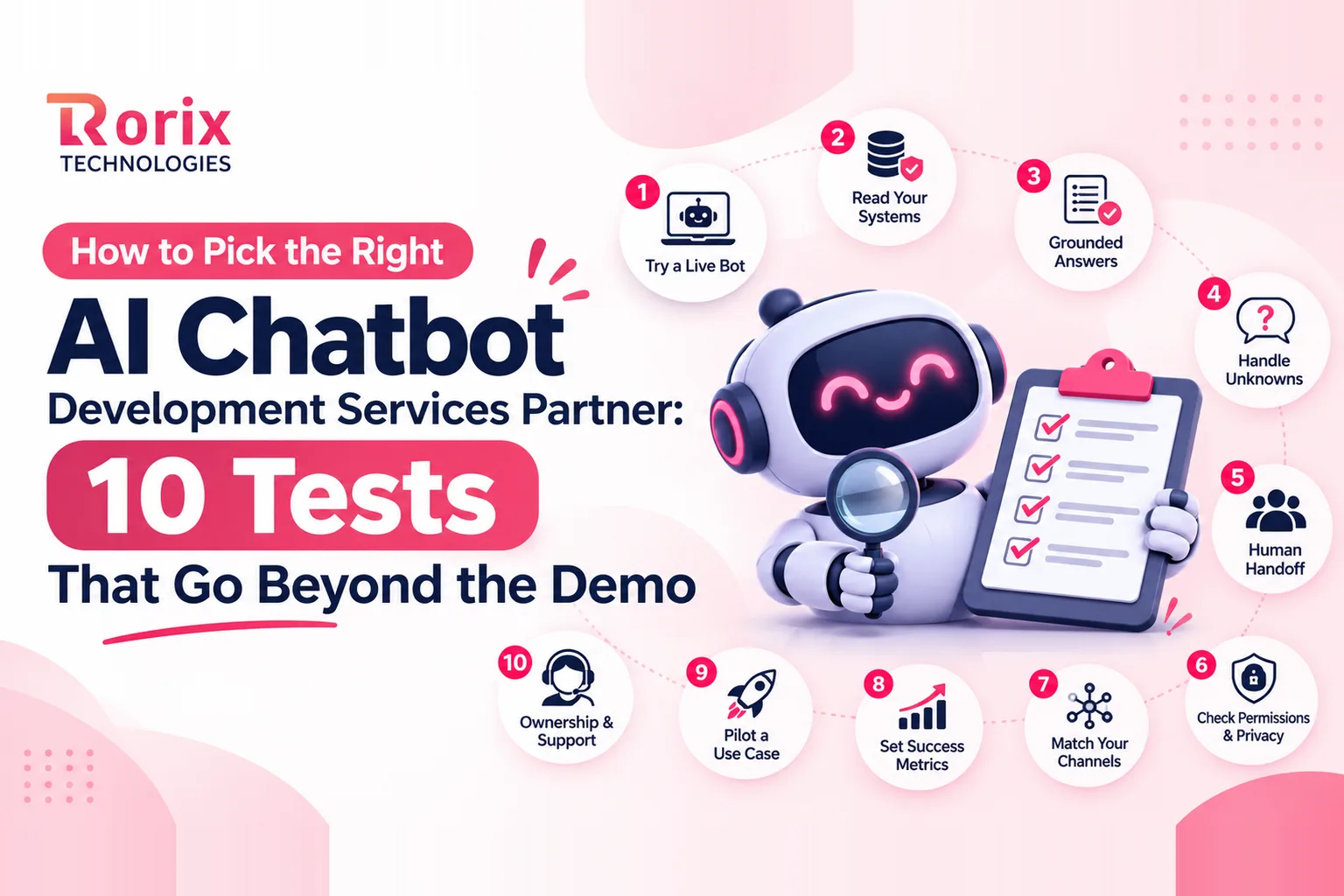
1. Try a Live Bot the Vendor Built, Not a Sales Demo
A demo only has to answer the questions someone prepared for it. Ask for a chatbot the vendor shipped that real customers use today, then try to trip it up with odd phrasing. Your question: "Which live bot can I test right now, and what changed after launch?"
2. Confirm It Can Read Your Systems of Record
Your chatbot may need live order, stock, or customer data from your WMS, ERP, or CRM. Check whether the vendor has integrated similar systems and can work with your clean, secure APIs. Ask: "Which systems will the bot access, and how will authentication work?"
3. Ask How Every Answer Is Grounded in Your Data
A chatbot should answer from trusted business data, not rely only on model memory. Check whether it uses RAG, retrieves approved documents, and shows sources where needed. Ask: "Where does each answer come from, and who keeps that information updated?"
4. Test What Happens When the Bot Does Not Know
A reliable chatbot should admit when it cannot answer instead of making something up. Test an unrelated question and check whether it gives a useful next step or escalates the conversation. Ask: "Can you show me how the bot handles questions outside its scope?"
5. Walk Through the Human Handoff
Some conversations need a human, and customers should not have to repeat themselves. Check whether the chatbot transfers the conversation, customer details, and chat history into your helpdesk. Ask: "What information will my support agent receive during a handoff?"
6. Check Permissions and Data Privacy
A chatbot connected to live systems must follow the same access rules as your staff. Test whether customers and employees can only access records they are authorized to see. Ask: "How do you manage role-based access, conversation logs, and data retention?"
7. Match the Channels Your Users Already Use
Your customers may prefer WhatsApp, while internal teams use Slack or Microsoft Teams. Confirm which channels the vendor supports and whether each needs separate setup, testing, or integration work. Ask: "Which channels are included, and what will additional channels cost?"
8. Agree on Success Metrics Before the Build
Set measurable targets before development so the launch has clear results to prove. Track answer accuracy, resolution rate, escalation rate, and customer satisfaction against existing baselines. Ask: "Which metrics will you report, and how often will we review them?"
9. Pilot One High-Volume Use Case First
Start with one frequent task, such as order-status queries, before expanding the chatbot across departments. Test it with a small user group or in shadow mode to measure accuracy and workload reduction. Ask: "What will the pilot cost, how long will it run, and what results justify a full rollout?"
10. Settle Ownership, Model Choice, and Post-Launch Support
Confirm that your business owns the code, prompts, integrations, and data pipelines after delivery, whichever provider of AI chatbot development services you choose. Check whether the chatbot can switch models and what ongoing monitoring, updates, and support include. Ask: "What does monthly support cover, and how can we move the project to another team?"
How Much Do AI Chatbot Development Services Cost?
Professional AI chatbot development services typically cost $5,000 to $300,000+, depending on complexity, integrations, and features. These are market estimates from published agency cost guides, not Rorix pricing.
1. AI Chatbot Development Cost by Chatbot Type
| Chatbot type | Typical scope | Market range | Typical timeline |
|---|---|---|---|
| Rule-based FAQ bot | Scripted answers and menu flows on one channel | $5,000 to $15,000 | 2 to 6 weeks |
| AI chatbot over your content | RAG answers from help docs and policies, with basic analytics | $15,000 to $120,000 | 4 to 20 weeks |
| Integrated AI chatbot | RAG plus live reads from WMS, ERP, or CRM, with human handoff | $40,000 to $150,000+ | 10 to 18 weeks |
| Enterprise omnichannel assistant | Multiple channels and languages, compliance controls, and system integrations | $100,000 to $300,000+ | 4 to 9 months |
Source: the ranges in our AI chatbot development cost guide, which covers seven chatbot types and links the published agency guide behind each figure.
Gaincafe puts most production-ready business chatbots at $25,000 to $80,000. Integrations, knowledge preparation, and security controls move the total most. A chatbot that reads live business records needs more integration work, access controls, and testing than one that answers from documents.
2. What Pushes a Chatbot Quote Up
Two projects with similar requirements can have very different quotes. The difference usually comes down to the systems, features, and safeguards involved. These are the main factors that affect AI chatbot development cost:
| Cost driver | Why it adds cost |
|---|---|
| Systems the bot reads | Each integration needs authentication, data mapping, and error handling. |
| Write actions | Bookings, refunds, and record updates need approvals, audit logs, and rollback controls. |
| Channels | Each channel needs separate formatting, rules, and testing. WhatsApp also requires approved message templates. |
| Languages | Every language needs content review and accuracy testing. |
| Voice | Speech recognition, voice output, and telephony add another interface to build. |
| Compliance | HIPAA, GDPR, and financial regulations require additional security reviews, logging, and data residency controls. |
| Content readiness | Outdated or scattered content must be cleaned before the chatbot can use it. |
| Evaluation depth | Larger test sets and ongoing accuracy checks require more engineering time. |
3. Monthly Spend Once the Bot Is Live
The cost does not stop at launch. Model usage, search infrastructure, hosting, monitoring, content updates, and technical support all add to monthly spend. Include these recurring costs when comparing quotes from each AI chatbot development company.
Our cost guide estimates that a custom AI chatbot costs about $50 to $230 a month to run at 1,000 conversations, $165 to $950 at 10,000, and $625 to $3,500 at 50,000, before channel fees, human agent seats, and yearly maintenance of 15% to 25% of the build cost. For the cost per conversation by model tier, see the same chatbot cost guide; OpenAI and Google model prices are compared in our guide to AI integration cost.
4. Rorix's Published Rates
Rorix's published rates are separate from the market estimates above. On Clutch, Rorix is listed in the $25 to $49 an hour band; the plans below are the ones published on our pricing page. Use this breakdown to compare hourly development, dedicated resources, and ongoing support costs.
| Engagement | Rorix's published price |
|---|---|
| Hourly, Standard (defined scope) | $20 an hour |
| Hourly, Advanced (complex logic, multiple integrations) | $25 an hour |
| Hourly, Enterprise (architecture-heavy, compliance or high availability) | $30 an hour |
| Dedicated developer (Basic plan) | $3,500 a month for 1 dedicated developer |
| Dedicated team | From $10,000 a month for 3 developers with a project manager |
| After-launch care (fixed-cost builds) | $200 a month for 10 hours or $400 a month for 20 hours |
Retainer discounts are 5% for 3 months, 10% for 6 months, and 15% for 12 months. Month-to-month billing is also available. To estimate your project scope, use the Rorix Project Cost Estimator. It takes about two minutes and shows the result without requiring an email.
Also Read: AI Agent Development Cost: Pricing by Complexity, Integrations, and Team
Why Rorix Technologies Builds AI Chatbots Around Your Operations
An AI chatbot delivers more value when it understands how your business actually works. Rorix builds assistants around existing systems, data, and operational workflows.
Rorix Technologies has delivered 27 platforms and holds a 5.0 Clutch rating across 4 verified reviews. Its team works with clients across the US, UK, Canada, Australia, and New Zealand, using a retainer model that operates like an extension of their in-house team.
Through its AI chatbot development services, Rorix focuses on practical delivery, from checking system readiness to testing responses before an assistant can update live records.
- System-first development: Rorix builds the WMS, HRMS, and SaaS platforms a chatbot reads from, so its team knows the data and APIs an assistant depends on.
- Practical AI decisions: The team identifies where AI adds value and where a simple rule is enough, avoiding unnecessary complexity.
- Shadow-mode testing: New assistants run alongside existing processes and are evaluated before receiving permission to make changes.
- Proven operational results: WorkCenter Central, the platform we built for distributor Lorecs, cut manual errors by 80% and sped up order processing by 50%; an AI SKU price finder was added on top.
- Long-term partnerships: Our founders have been DealSignal's engineering partner for 5+ years, continuing under Rorix.
- Consistent delivery: Two-week sprints keep working software moving, with a working SaaS MVP in 6 to 12 weeks, depending on scope.
- Clear ownership: Month-to-month terms, an NDA from day one, and 100% IP transfer as work is delivered and paid for.
Looking for AI chatbot development services that connect chatbots to your actual business workflows?
Book a Free Consultation to discuss your use case, required integrations, and realistic project budget.
Conclusion: Choose an AI Chatbot Partner That Delivers Real Results
Choosing AI chatbot development services takes more than comparing demos and service lists. Look for a partner that can connect your business systems, protect customer data, and support the chatbot as your needs grow.
We hope this guide gives you a clear view of the leading chatbot companies, their strengths, development costs, and the checks that matter before signing a project.
Compare every provider of AI chatbot development services on your shortlist against real use cases, technical capabilities, integration needs, and long-term costs. The right partner should make automation useful for your customers and easier for your teams.
Ready to plan your chatbot project? Connect with our team to discuss your requirements, system integrations, and a practical rollout plan.
Frequently Asked Questions
Which channels can an AI chatbot support?
One AI chatbot can work across websites, mobile apps, WhatsApp, Messenger, Slack, Microsoft Teams, and phone lines. Each channel needs its own setup and testing.
How much do AI chatbot development services cost?
AI chatbot development services typically cost $5,000 to $300,000+. A rule-based FAQ bot costs $5,000 to $15,000, while a chatbot connected to live business systems costs $40,000 to $150,000+. Our AI chatbot development cost guide has the full breakdown.
How long does it take to build a custom AI chatbot?
A rule-based bot takes 2 to 6 weeks, while a RAG chatbot over your content takes 4 to 20 weeks. A chatbot connected to WMS, ERP, or CRM systems usually takes 10 to 18 weeks, and enterprise builds can take 4 to 9 months.
Should I choose a chatbot platform or a custom development company?
A chatbot platform works well for basic FAQs and lead capture. A custom chatbot development company is better for complex workflows, live system integrations, strict compliance, and full code ownership.
Can an AI chatbot access live WMS, ERP, or CRM data?
Yes. With secure APIs or a data layer, a chatbot can retrieve current order, inventory, and customer records while following user access permissions.
How can I prevent an AI chatbot from giving wrong answers?
Use RAG to ground responses in approved documents and business records. Add fallback responses, test real customer questions, and review inaccurate answers regularly.
How does an AI chatbot transfer a conversation to a human?
The chatbot can trigger a handoff when confidence is low, attempts fail, or a customer requests an agent. It should pass the chat history and customer details to the helpdesk.
How do I measure an AI chatbot's performance?
Track answer accuracy, resolution rate, escalation rate, customer satisfaction, and cost per conversation. Review failed chats regularly to identify what needs improvement.
Adding AI to your system, or building a new AI feature?
Most of the work sits in the data plumbing rather than the model. Send us the workflow you want to automate and we will tell you what is feasible on your current stack.
Continue learning
Written by
Ankur AkvaliyaFounder & Director, Rorix Technologies
Ankur co-founded Rorix Technologies with a mission to deliver enterprise-grade software that growing businesses can actually afford. He drives technical project delivery and client success end-to-end, overseeing product strategy, client partnerships, and the company's long-term vision to ensure every engagement delivers measurable business outcomes across WMS, HRMS, and custom software verticals.
View full profileRelated articles
Top 15 AI Integration Companies for Business Systems in 2026
Explore the top 15 AI integration companies, their services, costs, and expertise to choose a partner for your business systems and workflows.
Read article
Top 15 AI Agent Development Companies in 2026 (Compared)
Explore the top AI agent development companies in 2026. Compare capabilities, headquarters, and Clutch ratings to choose the right development partner.
Read article
Top 12 AI SaaS Development Companies in 2026
Compare the 12 best AI SaaS development companies for 2026, with services, ratings, costs, and tips to choose the right development partner.
Read article