AI in HRMS: Where It Pays Back and What the Law Now Expects
AI in HRMS splits in two. Automating paperwork is ordinary software work. Scoring or ranking people is a regulated employment decision, with rules attached.
On this page30 sections
AI in an HRMS splits cleanly in two. Anything that moves paperwork faster is ordinary software work. Anything that ranks, scores, or screens a person is a regulated employment decision, and several jurisdictions now write rules about exactly that. Which side of the line a feature falls on decides its scope, its architecture, and how much of the project is model work at all.
That second half is where most HR AI roadmaps get expensive, and not for the reason teams expect. The model is rarely the hard part. The hard part is that your system has to be able to prove, months later, which decisions the model touched and what it did to different groups of people. That is a record-keeping problem, and record keeping lives in the HRMS.
This guide is the build-side view: which use cases earn their keep, where the regulatory line actually sits as of August 2026, and the four things your HR system has to be able to produce on demand no matter which way the rules move next.
In this guide, you'll learn:
- What AI in an HRMS means in practice, and what it does not mean
- Where the payback sits across the employee lifecycle
- How the rules changed in the last eighteen months, in both directions
- The one distinction that sets the scope of every HR AI project
- The four records your system needs regardless of jurisdiction
- A six-step sequence for adding AI to an HRMS you already run
This is engineering guidance, not legal advice. Every rule below is linked to its source so your counsel can confirm what applies to you.
Quick Answer: Which AI in HRMS Use Cases Are Safe to Automate First
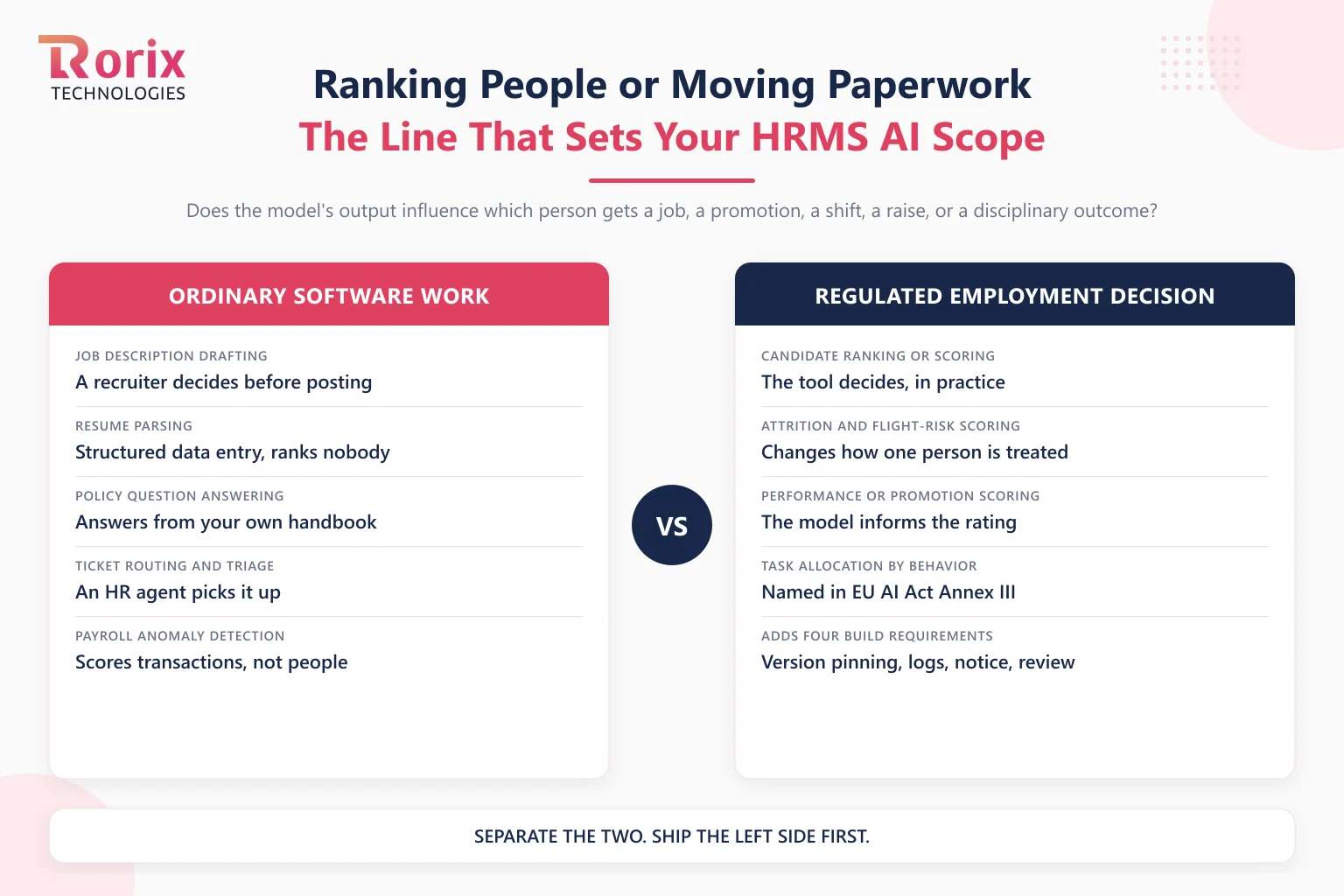
Start where the model handles text and a human still decides about the person. The table maps the common use cases against the only column that changes your build.
| Use case | What the model does | Who decides | Regulatory weight |
|---|---|---|---|
| Job description drafting | Generates and rewrites copy | A recruiter, before posting | Low |
| Resume parsing | Extracts structured fields from documents | Nobody, it is data entry | Low |
| Policy question answering | Answers from your own handbook | The employee reads it | Low |
| Ticket routing and triage | Classifies and assigns HR requests | An HR agent picks it up | Low |
| Interview note summarization | Condenses a transcript into a scorecard draft | The interviewer edits and signs | Moderate |
| Candidate ranking or scoring | Orders or filters applicants | The tool, in practice | High |
| Attrition and flight-risk scoring | Predicts who will leave | A manager, on the model's prompt | High |
| Performance or promotion scoring | Rates or ranks employees | The model informs the rating | High |
The four low-weight rows are worth building this quarter. The high-weight rows are worth building too, but they carry an audit trail requirement that the low rows do not, and pretending otherwise is how HR tech projects acquire a compliance retrofit halfway through.
Key Takeaways: Paperwork Is Software, Ranking People Is Regulated
- AI in an HRMS splits cleanly in two: anything that moves paperwork faster is ordinary software work, and anything that ranks, scores, or screens a person is a regulated employment decision.
- The European Union's AI Act classifies employment AI as high risk in Annex III, point 4, and the Digital Omnibus agreement postponed those obligations from August 2, 2026 to December 2, 2027 without changing the classification.
- Illinois HB 3773 took effect January 1, 2026 and bars AI that has the effect of subjecting employees to discrimination on the basis of protected classes, while Texas landed on the opposite standard the same day, requiring intent rather than effect.
- New York City's Local Law 144 has required an independent annual bias audit and ten business days of candidate notice since 2023, yet DLA Piper's analysis reports the enforcing agency identified a single compliance issue across 32 employer bias audits where the Comptroller found at least 17 potential issues.
- Every current regime asks an HRMS for the same four records: a decision inventory, an outcome distribution by protected category, notice delivered and logged, and a human review path with teeth.
What Does AI in an HRMS Actually Mean?
Three distinct technologies get sold under one label, and they fail in different ways.
Language models handle the text HR drowns in: job descriptions, policy questions, interview notes, offer letters, the same benefits question asked four hundred times a year. This is where most of the immediate payback sits, because the work is high volume, low stakes, and easy for a person to check.
Predictive models score people or events: who is likely to leave, which requisition will take longest to fill, which shift will be understaffed. These learn from your history, which means they learn your history's biases along with its patterns.
Matching and ranking engines order candidates against a requirement. This is the oldest form of HR AI, it predates the current wave by a decade, and it is the one regulators name explicitly.
None of the three works well on top of an HR data layer that cannot agree with itself. If your attendance system and your payroll system disagree about who worked last Tuesday, a model trained on either will be confidently wrong in a new way. The signs that an organization has outgrown manual HR processes are the same signs that say the data foundation is not ready for a model on top of it.
Why HR AI Carries Legal Weight the Rest of Your Stack Does Not
A demand forecast that misreads next month is a bad forecast. A candidate score that systematically misreads one group of applicants is a discrimination claim.
That is the structural difference between HR AI and every other AI project in your business, and it drives every design decision that follows. In a warehouse, the cost of a wrong prediction is measured in inventory, and AI in warehouse management earns its place by producing a number you can check against operations. In HR, the output is an act with legal consequences for a named person, and the check happens in front of a regulator or a court, sometimes years later.
The European Union's AI Act classifies employment AI as high risk in Annex III, point 4. The definition is broad on purpose. It covers systems used for "recruitment or selection of natural persons, in particular to place targeted job advertisements, to analyse and filter job applications, and to evaluate candidates," and separately systems used to "make decisions affecting terms of work-related relationships, the promotion or termination of work-related contractual relationships, to allocate tasks based on individual behaviour or personal traits or characteristics or to monitor and evaluate the performance and behaviour of persons in such relationships."
Read that second clause again if you build workforce management software. Task allocation based on individual behavior is on the list. So is performance monitoring. A shift-assignment optimizer sits closer to the regulated category than most teams building one assume.
Every Compliance Deadline Moved in the Last Year. The Classification Did Not.
Anyone who wrote an HR AI compliance plan in early 2025 has watched most of its dates move, several of them twice, and in both directions at once.
The federal US posture reversed. The EEOC removed its AI employment guidance from its site in January 2025, and an April 2025 executive order directed agencies to deprioritize disparate-impact liability. As of a March 2026 check, those guidance pages were still gone. What did not change is the statute. Title VII and the Uniform Guidelines on Employee Selection Procedures are still law, and a private plaintiff does not need the EEOC's enforcement priorities to file.
States filled the space, and disagreed with each other. California's rules took effect in October 2025 with a disparate-impact standard and vendor liability. Illinois HB 3773 took effect January 1, 2026, amending the Illinois Human Rights Act to bar AI that "has the effect of subjecting employees to discrimination on the basis of protected classes" across recruitment, hiring, promotion, discipline, discharge and the terms of employment, and requiring an easily understandable notice when AI is used. Texas landed on the opposite standard the same day, requiring intent rather than effect.
Colorado passed a law, paused it, then rewrote it. SB 24-205 slipped from February to June 2026, was paused by a federal court on April 27, 2026, then repealed outright. Its replacement, SB 26-189, was signed on May 14, 2026, and reenacts the provisions with a lighter framework whose obligations start January 1, 2027: notice before an automated decision-making technology is used, a plain-language explanation within 30 days of an adverse outcome, a right to meaningful human review, and record retention of three years or more.
The EU moved its date but not its classification. The Annex III obligations were due to apply from August 2, 2026. The Digital Omnibus agreement postponed stand-alone Annex III systems to December 2, 2027. Employment AI is still high risk. It simply has to be compliant later.
New York City's law has been live the whole time, and barely enforced. Local Law 144 has required an independent annual bias audit, a public summary of the results, and ten business days of notice to candidates since 2023. Then the New York State Comptroller audited the enforcement. DLA Piper's analysis of the findings reports that the enforcing agency reviewed 32 employer bias audits and identified a single compliance issue, while the Comptroller's own review of those same 32 audits found at least 17 potential issues of non-compliance. Three quarters of test calls to the city's complaint line were misrouted and never reached the agency at all.
That last finding is the one to plan around. Weak enforcement is a temporary condition, and the published response to being audited is always more enforcement, not less.
The pattern across all five: the dates keep moving and the classification does not. Every regime that has survived contact with a legislature converges on the same handful of obligations, and those obligations are engineering requirements before they are legal ones.
The Line That Sets Your Scope: Ranking People or Moving Paperwork
Before scoping any HR AI feature, answer one question. Does the model's output influence which person gets a job, a promotion, a shift, a raise, or a disciplinary outcome?
If the answer is no, you are building normal software. Ship it the way you ship anything else.
If the answer is yes, four things become part of the definition of done rather than a later compliance phase:
- Version pinning. You need to know which model version scored which candidate on which date. "We upgraded the model in March" is not an answer when the claim concerns February.
- Outcome logging by protected category. You cannot compute a selection rate or an impact ratio after the fact from data you never captured. This is the requirement teams discover too late.
- Notice, before the fact. Illinois and Colorado both require it. New York City requires ten business days.
- A human review path that is real. Colorado's replacement law grants a right to meaningful human review after an adverse decision. A reviewer who rubber-stamps a ranked list has not provided one, and your system should record enough to show the difference.
The useful consequence of drawing this line early: most HRMS AI roadmaps contain far more paperwork automation than decision automation, and the paperwork half can ship immediately while the decision half goes through design review. Teams that do not draw the line hold the whole roadmap to the strictest standard and ship nothing.
Where AI Pays Back Across the Employee Lifecycle
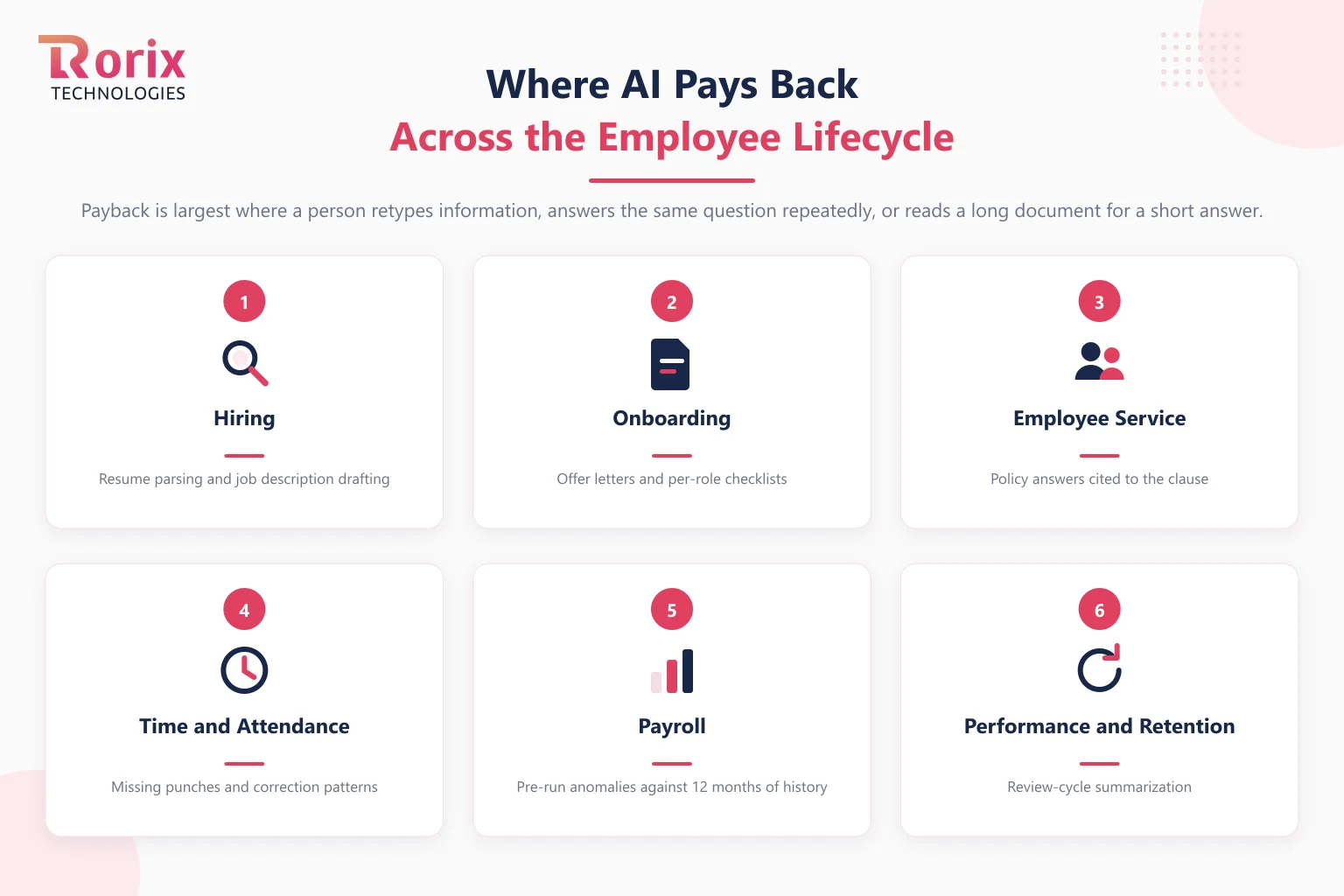
Payback in HR follows a consistent shape. It is largest where a person currently retypes information, answers the same question repeatedly, or reads a long document to extract a short answer.
Hiring. Resume parsing into structured fields removes the most tedious job in recruiting, and it ranks nobody. Job description drafting from a role template saves a recruiter an hour per requisition. Interview note summarization into a scorecard draft is genuinely useful and sits on the line, because the summary shapes the evaluation. Keep the interviewer's edit in the record.
Onboarding. Document generation, offer and appointment letters, checklist assembly per role and location. This is high-volume templated output with a human signature at the end, which is close to an ideal fit.
Employee service. A policy assistant grounded in your own handbook and leave rules deflects the repeat questions that consume an HR team's week. The engineering that matters here is retrieval, not generation: the assistant must cite the policy clause it answered from, so a wrong answer is traceable to a document rather than to a model's imagination.
Time, attendance and scheduling. Anomaly detection over clock-in data catches missing punches and correction patterns worth reviewing. Demand-based shift suggestions are useful and, per the EU's task-allocation language, closer to the regulated line than the rest of this list.
Payroll. Pre-run anomaly detection is the highest-confidence use case in HR AI and the least discussed. A model that flags this month's outliers against twelve months of history catches the errors that otherwise surface as a corrected payslip and a very direct conversation. It scores transactions, not people.
Performance and retention. Review-cycle summarization across a year of notes is real work saved. Attrition scoring is the section below.
Our own HRMS covers this lifecycle end to end, which is why the boundaries above are specific. They come from the workforce platform we built and still run, across hiring, attendance, leave, assets and payroll.
Attrition Prediction Is the Use Case That Most Often Backfires
Flight-risk scoring demos beautifully and deploys badly, for reasons that have nothing to do with model accuracy.
The first problem is the intervention. A model that flags an employee as likely to leave has to hand that flag to someone, and that someone is usually the person's manager. From that moment the score is not a prediction, it is an input to how the employee is treated. Two managers handle it differently: one has a retention conversation, another quietly stops assigning the stretch project. The second behavior is both a self-fulfilling prophecy and, if the flagged population skews toward a protected group, a discrimination exposure with a written audit trail attached.
The second problem is the training data. Attrition models learn from who left, and people leave for reasons that correlate with caregiving status, age, commute, and pay band. A model trained on that history reproduces it and calls it insight.
The third problem is that the honest answer is usually already known. Most attrition signal in a mid-market company is available from exit interviews, compensation bands, and tenure curves without any model at all.
If you build it anyway, and there are good reasons to, build it at the team level rather than the individual level. Aggregate risk by department and tenure band drives a real staffing decision. An individual score handed to a line manager creates a legal artifact and changes behavior toward one person. The aggregate version answers the same business question with a fraction of the exposure.
The Four Records Every Regime Asks Your HRMS to Produce
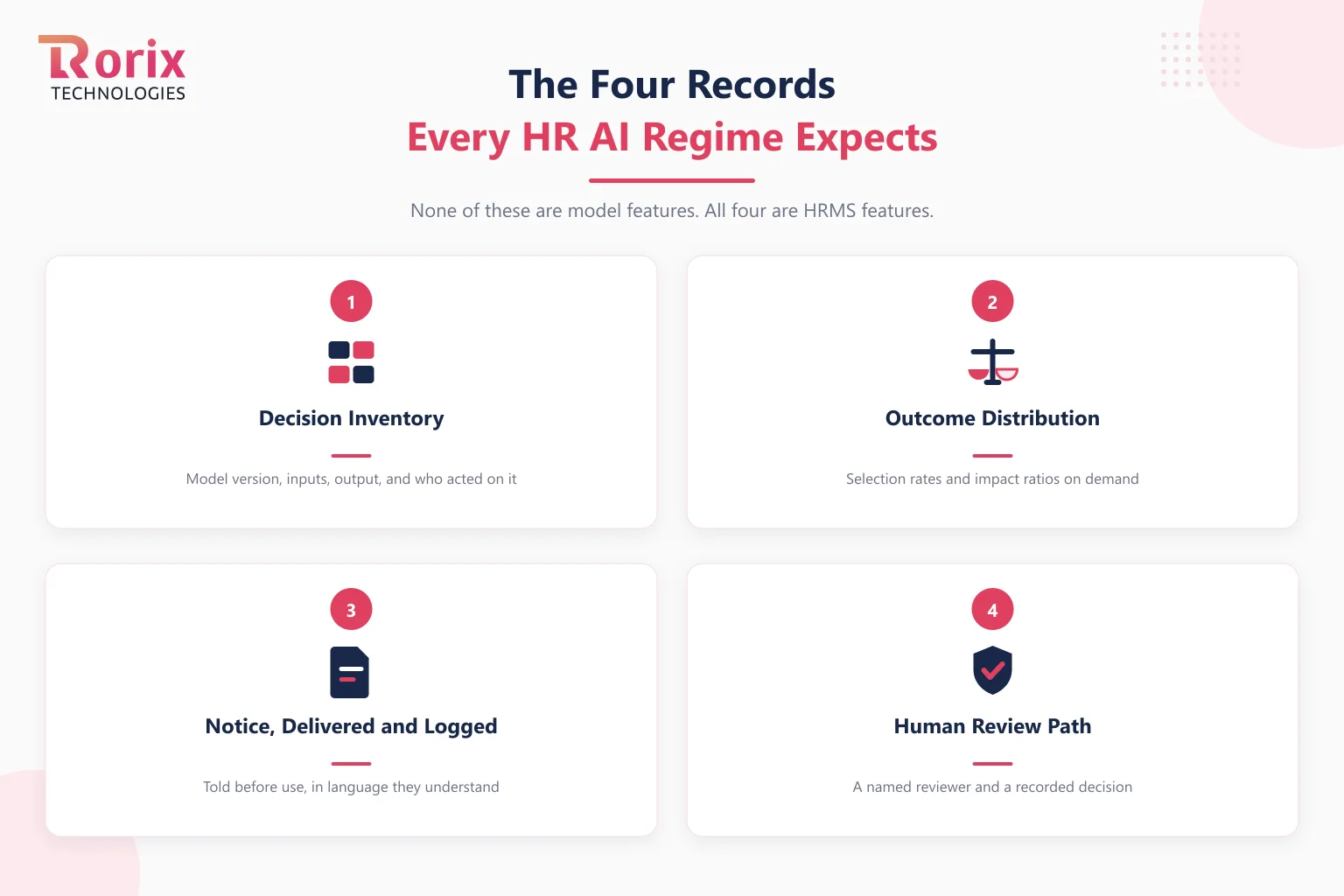
Read the EU's Annex III obligations, Illinois's notice duty, Colorado's replacement framework and New York City's bias audit rule side by side, and the same four artifacts appear in all of them. Build these and you are substantially ready for whichever regime lands on you.
- A decision inventory. Every decision a model touched, with the model version, the input snapshot, the output, and the human who acted on it. This is an append-only log, cheap to build on day one and expensive to reconstruct on day four hundred.
- An outcome distribution you can compute on demand. Selection rates by protected category and the resulting impact ratios. New York City's rule points at the four-fifths threshold, an impact ratio below 0.80, as the standard screen. You cannot produce this from data you did not collect, which means the collection decision has to be made before launch, along with the access controls that keep that data out of everyday reporting.
- Notice, delivered and logged. Told the affected person before the tool was used, in language they can understand, and recorded that you did.
- A human review path with teeth. A named reviewer, their decision, and enough context to show it was a decision rather than an approval click.
Notice what is not on that list: anything about the model. All four are HRMS features. The compliance surface of HR AI lands in your system of record, which is why bolting a third-party scoring tool onto an HRMS that cannot log any of this is the most common architecture mistake in this space.
Is Your HR Data Ready? The Honest Checklist
Run this before scoping anything. Each item that fails is a project of its own, and finding out during a model build is the expensive way.
- One agreed source of truth per fact. If attendance and payroll disagree about hours worked, that disagreement is the first project.
- History, not just current state. Models need what happened over time. An HRMS that overwrites a record on change instead of versioning it has no history to learn from.
- Structured outcomes. "Rejected" as a status is useful. "Rejected" buried in a free-text note is not.
- Documented policies in a retrievable form. A policy assistant is only as good as the handbook behind it, and a PDF nobody has updated in two years produces confidently outdated answers.
- Role-based access already working. Adding a model to a system where anyone can read anyone's salary widens an existing problem.
- A retention policy you actually apply. Compliance frameworks expect records kept for years and personal data not kept forever. Those two requirements need a written answer before they need a technical one.
If several of these fail, the honest sequence is platform first and model second. That is the same conclusion the guide to adding AI to existing software reaches from the general case: the system you have is the constraint, not the model you want. The technical readiness assessment returns a written score against these dimensions in about five minutes.
How to Add AI to Your HRMS in 6 Steps
The sequence below assumes the HRMS itself is already live and holding real data. Where it is not, this work runs after the platform is in production rather than alongside it, and the HRMS implementation guide covers that phase.
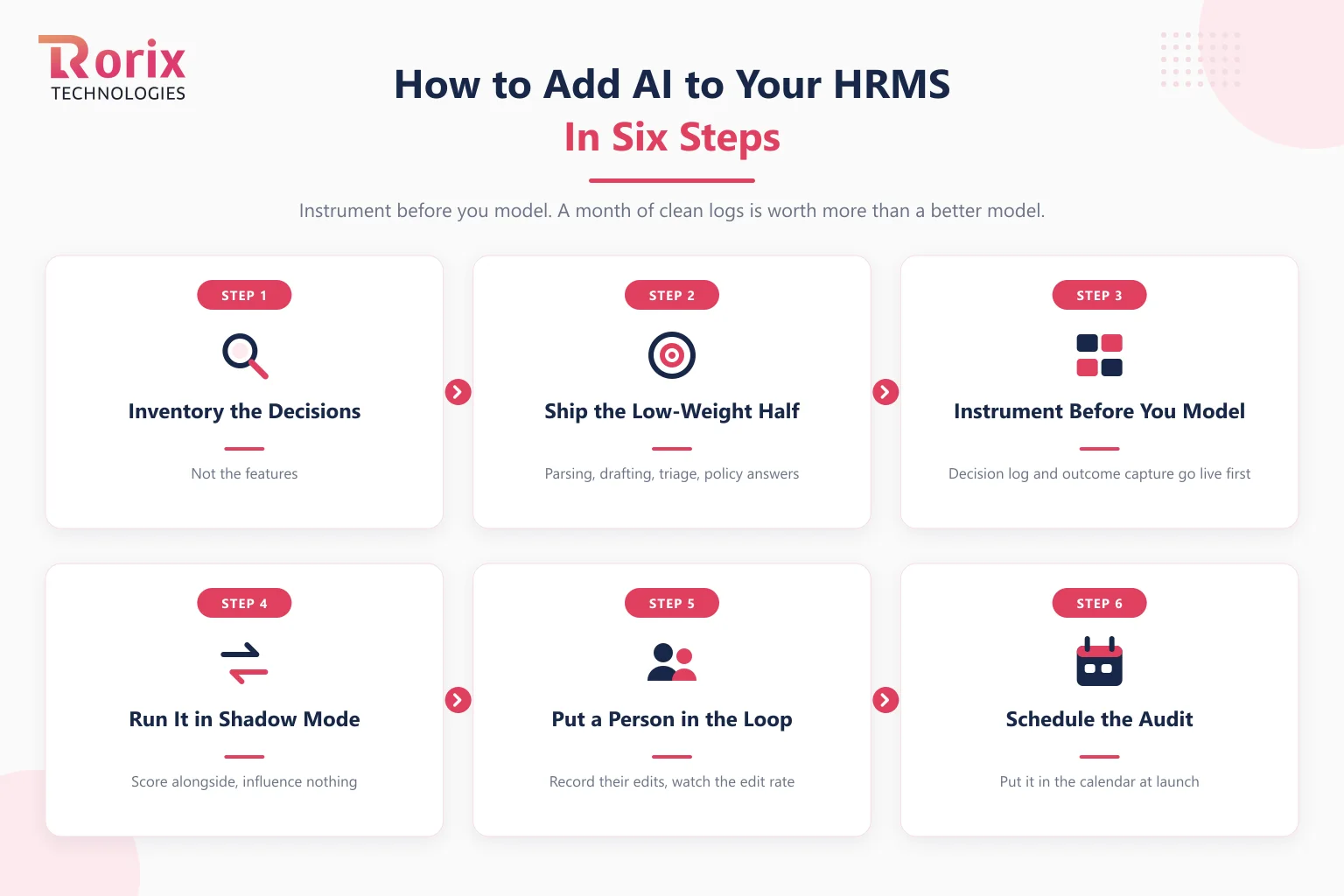
Step 1: Inventory the decisions, not the features
List every point where your HRMS influences an outcome for a person, and mark which ones a model would touch. This list is the scope document, the compliance register, and the thing you hand to counsel. It takes an afternoon and it prevents the two most expensive mistakes: automating a regulated decision by accident, and holding an unregulated one to a standard it never needed.
Step 2: Ship the low-weight half first
Document generation, parsing, triage, policy answers. These deliver visible value in weeks, they build your team's judgment about where models are reliable, and they create no audit obligations. They also earn the credibility that the harder half of the roadmap will need.
Step 3: Instrument before you model
Turn on the decision log and the outcome capture before the first model reaches production, including the protected-category fields your impact analysis will need and the access controls around them. This is the step teams skip and the one that cannot be backfilled. A month of clean logs is worth more than a better model.
Step 4: Run it in shadow mode
Let the model score alongside the existing process without influencing it, and compare. You learn the real accuracy on your data, you find the population where it degrades, and you generate the first outcome distribution while nothing is at stake. Two full hiring cycles is a reasonable minimum.
Step 5: Put a person in the loop, and record their edits
Ship as a suggestion, not a decision. The edit rate is your most useful metric: it tells you where the model is wrong, and it is the evidence that human review is real. A suggestion accepted 98% of the time without changes is not being reviewed, and that is a finding rather than a success.
Step 6: Schedule the audit before you need it
Annual bias audit, documented review of the decision log, and a re-run of the impact analysis after any model change. Put it in the calendar at launch. New York City already requires an independent annual audit for tools in scope, and every framework that has followed asks a version of the same question.
What AI in an HRMS Actually Costs
The model is rarely the expensive part, and vendor pricing pages train buyers to look in the wrong place.
Four things drive the real number. Data preparation is usually the largest, because it is where the source-of-truth disagreements get resolved and no model can start without it. Logging and audit infrastructure is a fixed cost that arrives with the first regulated decision and does not scale down. Integration work depends entirely on whether your HRMS can expose the data cleanly or needs a layer built to do it. Ongoing evaluation is a recurring line rather than a one-time cost, because a model that is not re-tested after a change is a model nobody can vouch for.
Two cost patterns surprise people. Retrofitting audit logging after launch costs several times what building it in costs, since it usually means changing how records are written across the system. And a third-party AI feature bolted onto an HRMS that cannot log decisions transfers none of the compliance burden to the vendor: you are the deployer, and the obligations in Illinois, Colorado and New York City attach to you.
For how HRMS budgets break down more generally, the HRMS cost breakdown covers deployment models and total cost of ownership, and the HRMS ROI calculator prices the admin hours a system gives back each year.
How to Test an HR Software Vendor's AI Claims Before You Sign
Six questions, written so that a vendor who has deployed this in a regulated setting answers immediately and a vendor who has not, cannot.
- "Which of your AI features touch an employment decision, by your own reading of Annex III?" A vendor selling into the EU has this answer written down. One that treats the question as novel has not done the analysis you are relying on.
- "Show me a bias audit you have published." For any tool used on New York City candidates, the summary is supposed to be public. Ask for the link, not a description.
- "How do I produce the selection rate and impact ratio for my own data?" The answer should be a report or an export. If it is a services engagement, price it now, because you will need it annually.
- "What is logged when the model scores someone, and how long do you keep it?" You want model version, inputs, output, and timestamp. Anything less does not survive a challenge to a specific decision.
- "What happens to my audit trail when you upgrade the model?" The correct answer preserves history and pins versions. A vendor whose scores are not reproducible after an upgrade cannot support a claim about last quarter.
- "Who is the deployer in your contract?" It is almost certainly you. Getting the vendor to say so is a faster way to find out what they will actually indemnify than reading the marketing site.
The same discipline applies to any AI vendor. The guide to AI-enabled business systems covers the layers underneath these questions, and the post on operations agents covers what changes when a model is allowed to act rather than suggest.
Why Rorix Builds AI Into HR Systems We Also Run
Rorix Technologies builds WMS, HRMS, and SaaS platforms, and the HR work is not theoretical for us. We built our own HRMS and run the company on it: 12 or more live modules covering hiring, attendance with biometric and GPS clock-in, leave, assets, payroll, and role-based dashboards, built by a six-developer team over two years on React, TypeScript, Node.js, Express and PostgreSQL.
- The record layer first. We build the decision log, the version pinning, and the outcome capture as part of the feature, because retrofitting them is the expensive path we would rather you did not take.
- HR domain depth. Leave accrual, attendance correction workflows, and payroll rules change by jurisdiction and by policy. Systems that absorb those changes without a rewrite are designed that way from the start.
- Honest scope. We build application software. Infrastructure and DevOps stay with your team, and we will tell you when the answer is a workflow rule or a cleaner data model rather than a model.
- A team you can name. A dedicated team of senior engineers with a named technical lead on every engagement, working in two-week sprints on a retainer with full task visibility.
- A verifiable record. 27 platforms delivered and a 5.0 rating on Clutch across 4 verified reviews, with clients in the US, UK, Canada, Australia, and New Zealand.
If you build or sell HR software, our HR technology engineering practice covers applicant tracking, HRMS and employee lifecycle, staffing automation, and workforce analytics. If the AI layer is the immediate question, an AI integration engagement starts by scoping what is feasible on the stack you already have. Talk to an HR systems engineer about the decision you want to automate first, and we will tell you which side of the line it falls on.
Build the Record, Then the Model
The teams getting value from AI in HRMS are not the ones with the most ambitious roadmap. They separated paperwork from people, shipped the paperwork half in a quarter, and treated the people half as a system design problem rather than a model selection problem.
That approach survives the thing every other approach breaks on: the rules are still moving. The EU pushed its deadline out by more than a year. Colorado repealed its own law and passed a different one. The US federal posture reversed, and four states wrote four different standards. Any plan pinned to a specific date has already been wrong twice.
What has not moved is the underlying expectation, which every one of those regimes states in its own words. Know which decisions the machine touched, be able to show what it did to different groups of people, tell the person, and give them a human to appeal to. A system that can do those four things is ready for rules that have not been written yet, and a system that cannot is exposed to the ones that already exist.
Build the record layer first. The model is the easy part, and it is the part you can change later.
Frequently Asked Questions
What is AI in HRMS?
AI in HRMS refers to machine learning and language models built into a human resource management system to handle work an HR team currently does by hand. In practice it covers three distinct things: language models that draft and summarize documents, predictive models that score people or events, and matching engines that rank candidates. The first is low risk and immediately useful. The other two produce outputs that count as employment decisions in a growing number of jurisdictions.
Is using AI in hiring legal?
Yes, with conditions that vary by where your candidates are. Illinois has prohibited AI that has a discriminatory effect in employment decisions since January 1, 2026 and requires notice when AI is used. New York City requires an independent annual bias audit, a public summary, and ten business days of candidate notice. The EU classifies recruitment and candidate evaluation AI as high risk under Annex III of the AI Act. Confirm your specific obligations with counsel, because the standards genuinely conflict between states.
Did the EU AI Act deadline for HR systems change?
The date changed, the classification did not. Obligations for stand-alone Annex III high-risk systems, which include recruitment, candidate evaluation, promotion, termination, task allocation and performance monitoring, were due to apply from August 2, 2026 and were postponed to December 2, 2027 under the Digital Omnibus agreement. Employment AI remains high risk. Compliance is simply required later.
Which HR AI use cases carry the least regulatory risk?
Anything where the model handles text or transactions rather than ranking people. Job description drafting, resume parsing into structured fields, HR ticket triage, policy question answering from your own handbook, and payroll anomaly detection all deliver value without producing an employment decision. These are the right place to start, both for payback and for building your team's judgment about where models are reliable.
What records does an HRMS need to keep when AI is involved?
Four, and they appear in every current framework. A decision inventory recording which model version touched which decision and who acted on it. An outcome distribution you can compute on demand, meaning selection rates and impact ratios by protected category. Evidence that notice was given before the tool was used. And a human review path where a named reviewer's decision is recorded. None of these are model features. They are all HRMS features.
Should we build attrition prediction into our HRMS?
Build it at the team level rather than the individual level. Aggregate risk by department and tenure band answers the staffing question without creating a written record that changes how one named person is treated. Individual flight-risk scores handed to line managers tend to become self-fulfilling, and because attrition history correlates with caregiving status, age and pay band, a model trained on it can reproduce those patterns and present them as insight.
Can we add AI to an HRMS we already have?
It depends on what your system can emit rather than on what the model can do. You need one agreed source of truth per fact, versioned history rather than overwritten records, structured outcomes instead of free-text notes, and working role-based access. Where those hold, the AI layer is a matter of weeks. Where they do not, the honest sequence is fixing the data foundation first, and that is a separate project with its own payback.
Does a third-party AI recruiting tool transfer the compliance burden to the vendor?
No. In every current framework the obligations attach to the deployer, which is the employer using the tool, not the company that built it. A vendor can supply a bias audit and documentation, and you should require both, but the notice, the record keeping and the exposure remain yours. That is why an HRMS that cannot log the decisions a bolted-on tool makes is an architecture problem rather than a procurement one.
Building or replacing an HRMS?
We engineer HR products, from applicant tracking to payroll integration. Tell us your headcount and what your current stack cannot do.
Continue learning
Written by
Renish DadhaniyaFounder & Director, Rorix Technologies
Renish co-founded Rorix Technologies and drives the engineering and delivery culture across the organization. Beyond engineering, he leads the company's sales, finance, and HR operations, building the infrastructure that lets the team focus on shipping quality software. With deep hands-on expertise in architecture and team building, he ensures every project lands on time to the quality standards clients demand.
View full profileRelated articles
10 Clear Signs You Need an HRMS System
Payroll errors, onboarding chaos, compliance gaps: 10 clear signs your company has outgrown spreadsheets and needs an HRMS, and what to do about each one.
Read article
HRMS Cost Breakdown: Complete Pricing Guide (2026)
What does an HRMS really cost in 2026? SaaS vs custom pricing, implementation fees, hidden expenses, and how to judge the ROI before you commit.
Read article
Warehouse Management System for Food Industry: Features, Compliance and How to Build One (2026)
Learn how to choose or build a warehouse management system for food industry operations, including features, integrations, costs, and compliance.
Read article