
PostgreSQL vs MongoDB for Warehouse Management: A 2026 Comparison from Engineers Who've Used Both
An honest, project-grounded comparison of PostgreSQL and MongoDB for warehouse management systems, from a team that runs both in production.
On this page17 sections
Part of the Scalable WMS Architecture guide. This head-to-head sits behind the pillar's database-choice section, which links here for the full comparison.
For the inventory and order ledger at the core of a warehouse management system, we default to PostgreSQL, because warehouse data is densely relational and every stock movement has to stay consistent across orders, shipments, and billing. We reach for MongoDB when a specific module has genuinely variable structure, such as heterogeneous product attributes or a high-volume stream of scan and event logs, which is exactly the problem the document model solved on our Driven build. In most warehouse platforms we have shipped, one database becomes the system of record and the other, if it appears at all, handles a single specialized module rather than the whole system.
At Rorix we run both in production. PostgreSQL sits behind our HRMS platform, a two-year build on Node.js, Express, and Prisma that handles attendance, leave, payroll, and assets for a live workforce. MongoDB ran in production on Driven, an enterprise CRM and performance platform for pest control and field service teams, where it sat alongside MySQL and absorbed the parts of the system that refused to hold a fixed shape. So this is not a benchmark post or a feature checklist copied from two vendor sites. It is what we have learned choosing between the two for data-heavy operational systems, applied to the specific shape of a warehouse management system (WMS).
Key Takeaways: Which Database Fits a WMS Ledger
- For the inventory and order ledger at the core of a warehouse management system, Rorix defaults to PostgreSQL, because warehouse data is densely relational and every stock movement has to stay consistent across orders, shipments, and billing.
- Rorix reaches for MongoDB when a specific module has genuinely variable structure, such as heterogeneous product attributes or a high-volume stream of scan and event logs, which is the problem the document model solved on the Driven build.
- A stock decrement on a busy SKU is the textbook race condition: PostgreSQL handles it directly with row-level locks and SELECT ... FOR UPDATE, while MongoDB's multi-document transactions, available since MongoDB 4.0, carry design and performance caveats.
- PostgreSQL sits behind Rorix's HRMS platform, a two-year build on Node.js, Express, and Prisma, while MongoDB ran in production on Driven alongside MySQL, absorbing the parts of the system that refused to hold a fixed shape.
- In most warehouse platforms Rorix has shipped, one database becomes the system of record and the other, if it appears at all, handles a single specialized module rather than the whole system.
What a WMS actually stores
Before comparing engines, it helps to be honest about the data. A WMS is, at its heart, a ledger. Stock moves in and out, orders are raised and fulfilled, shipments are tracked, and money is reconciled at the end. On Lorecs, our seven-plus-year supply chain and warehouse-logistics engagement, the data that mattered most was exactly this: client request to vendor quote to order to shipment to invoice, with multi-currency billing and a QuickBooks sync on the end. Every invoice line tied back to an order, a vendor, and a shipment, and a single inconsistency there was not a cosmetic bug, it was a financial error that could get an invoice rejected.
That shape, many entities referencing many other entities, with correctness measured across rows rather than within a single record, is the backdrop for everything below. A WMS also has softer data: product catalogs where every category has different attributes, and event streams like barcode scans that arrive fast and are rarely joined. Those two halves pull toward different databases, which is the whole reason this comparison is worth writing.
Comparison at a glance
| Criterion | PostgreSQL | MongoDB |
|---|---|---|
| Fit for the order and stock ledger | Strong. Orders, line items, locations, and stock movements map cleanly to related tables, and joins are first class. | Weaker. A self-contained order document is fine, but the same entity referenced from many places forces either duplication or manual joins. |
| Cross-row transactional consistency | Mature multi-row ACID is the default; the engine protects you. | Document writes are atomic; multi-document transactions exist since 4.0 but carry design and performance caveats. |
| Variable or heterogeneous structure | Possible via jsonb, but it is an escape hatch, not the native mode. | Native strength. Records with genuinely different shapes coexist without a migration. |
| Schema evolution | Explicit. Migrations are a deliberate, reviewed step (how we run RMS with Prisma). | Loose. Fast to start, but undocumented schema drift becomes the team's problem later. |
| Concurrency on hot rows (stock decrements) | Row-level locks and SELECT ... FOR UPDATE handle the classic oversell race directly. | Atomic single-document updates work well if the counter lives in one document, harder across documents. |
| Reporting, aggregation, and BI | SQL, window functions, and broad BI-tool support make multi-table reports straightforward. | Aggregation pipeline is powerful but a separate skill, with fewer off-the-shelf BI connectors. |
| Horizontal write scaling | Scales with bigger instances, read replicas, and partitioning; sharding is more work. | Native sharding makes a high-write firehose easier to scale out. |
| Developer velocity for full-stack JS | Needs SQL or ORM knowledge; very productive once that exists. | Documents map directly to JavaScript objects, quick out of the gate for JS-only teams. |
| Operational maturity and hosting | Ubiquitous managed options, deep tooling, long track record. | Mature managed service in Atlas, strong tooling, well documented. |
None of those rows is a knockout. The decision comes from which rows describe your hottest workload, so the analysis below weights them for a WMS specifically.
Data model fit: the relational core
The order and stock ledger is the part of a WMS that you cannot afford to get wrong, and it is relational by nature. On Lorecs, an order touched vendors, quotes, shipments, inventory, and invoices, and the system had to handle real logistics exceptions: delayed shipments, returns, missing deliveries, and multi-shipment orders, each of which triggered inventory reconciliation and billing adjustments across several records at once. In a relational schema those relationships are expressed once and enforced by foreign keys. In a document store you either embed copies of that data, which then drift out of sync, or you reference across documents and rebuild joins in application code, which is the exact work the database was supposed to do for you. For the ledger, PostgreSQL wins this row, and it wins it because of the domain, not because of a preference.
Transactional consistency: where the WMS ledger lives or dies
A stock decrement on a busy SKU is the textbook race condition. Two orders read the same on-hand quantity, both believe stock is available, and both commit, and now you have sold inventory you do not have. PostgreSQL solves this with row-level locking and explicit SELECT ... FOR UPDATE, the same family of guarantees we lean on in RMS when concurrent attendance and leave writes touch overlapping records. MongoDB is not helpless here. If the stock counter for a SKU lives in a single document, an atomic update is safe and fast. The difficulty appears when a correct decision spans several documents, an order plus a stock record plus a billing line, because then you are reaching for multi-document transactions, and the moment you need those routinely you are modeling relations inside a document database. For a WMS ledger, where almost every meaningful write touches related records, PostgreSQL gives you that consistency as the default path rather than the exception.
Schema evolution: explicit versus loose
This row genuinely cuts both ways, and we have lived both sides. PostgreSQL forces schema changes to be deliberate. On RMS, every field we add to a model is a reviewed Prisma migration, which is slower in the moment but leaves an auditable, predictable history that a six-person team can reason about two years in. MongoDB's schema-on-write is the opposite trade. On Driven it let us move fast while requirements were still shifting, but the cost of that freedom is that the real schema lives in your application code and in your head, and without discipline it drifts. For a WMS core, where the data outlives any single sprint, we prefer the explicit path. For a fast-moving module whose shape is still being discovered, the loose path is a feature, not a flaw.
The genuine case for MongoDB in a warehouse system
It would be dishonest to frame this as PostgreSQL for everything. The clearest MongoDB win we have shipped came from Driven, where the platform needed to support many metric types, each with a different data structure and configuration. A rigid, one-size-fits-all table would have broken under that variety, so the flexible document model was the right call, and it held up. A WMS has the same kind of corner. Product catalogs are notorious for heterogeneous attributes: apparel needs sizes and colors, electronics need voltage and warranty terms, perishables need batch and expiry. Forcing all of that into one rigid table produces a wall of nullable columns, while a document per product carries exactly the attributes it needs. The second strong fit is high-volume, low-relationship data, such as a firehose of barcode scan or device telemetry events that you append constantly and rarely join. For those, MongoDB's document model and native sharding are a better tool than bending the relational ledger to absorb them.
Reporting, scaling, and operations
Warehouse questions are aggregate questions. Stock turnover, fulfillment time, and billing reconciliation are all multi-table, and SQL with window functions, plus the wide set of BI tools that already speak to PostgreSQL, makes those reports approachable. We have used MongoDB's aggregation pipeline and it is powerful, but it is a different skill with fewer off-the-shelf BI connectors, so heavy reporting needs nudge us toward PostgreSQL. On scaling, the honest split is by workload again: PostgreSQL on a well-provisioned instance with read replicas and table partitioning has comfortably carried our warehouse-adjacent and HRMS workloads, while a pure high-write event stream with no join requirement is genuinely easier to scale horizontally on MongoDB. Operationally both are mature in 2026, with strong managed offerings, so neither earns or loses the decision on tooling alone.
When we would pick PostgreSQL
We reach for PostgreSQL when the system of record is the warehouse ledger and correctness is measured across rows. That is the situation on RMS, where payroll, leave balances, and attendance must reconcile exactly, and it is the shape of the order-to-invoice spine on Lorecs, where multi-currency billing had to tie back to orders and shipments cleanly enough to pass an external invoice-validation check. When most of your writes touch several related records, when you need dependable multi-row transactions, and when reporting and reconciliation are central, PostgreSQL is our default. It is also our default when a team is small and a predictable, migration-driven schema is worth more than early speed.
When we would pick MongoDB
We reach for MongoDB when a module's data genuinely refuses a fixed shape, or when it is high-volume and low-relationship. The flexible metric-configuration system on Driven is the real example: heterogeneous structures per record where a rigid table would have buckled. In a WMS that maps to a product catalog with wildly different attributes per category, or to an append-heavy scan and event stream. The pattern we trust is polyglot: keep the stock and order ledger in PostgreSQL, and let MongoDB own the one module that fights the relational model. The cost is operating two databases, so we only split when a module clearly earns it.
From the author. "On a WMS, the question I ask first is not which database is better, it is which part of the system we are talking about. The order and stock ledger is relational and unforgiving, so it lives in PostgreSQL. The catalog and the event stream are where MongoDB earns its place. Almost every warehouse platform I have led ends up with one clear system of record and, at most, one specialized store next to it."
Nirmal J, Team Lead, WMS and Inventory Systems at Rorix Technologies
Where this fits in your architecture
The database is one decision inside a larger set a scalable warehouse system has to make. Whichever store you choose, it has to absorb the concurrent writes from a real-time inventory layer, preserve a trustworthy audit trail, and stay consistent across an ERP integration. For how the database choice fits with the real-time, integration, and deployment decisions, see the Scalable WMS Architecture guide. We make these calls on live systems as part of custom WMS development.
Frequently Asked Questions
Can a warehouse management system use both PostgreSQL and MongoDB?
Yes, and it is a normal pattern. On Driven we ran MySQL and MongoDB side by side, the relational store for structured records and MongoDB for the variable-shape data. For a WMS you might keep the stock and order ledger in PostgreSQL and push a heterogeneous product catalog or a high-volume scan-event stream into MongoDB. The cost is operating two systems, so we only split when one module genuinely fights the other model.
MongoDB supports multi-document transactions now. Doesn't that close the gap with PostgreSQL?
It narrows it. Multi-document transactions have been available since MongoDB 4.0 and they work. But they carry design and performance caveats, and the moment your data needs them across many documents routinely, you are modeling relations inside a document store. On a WMS ledger, where almost every write touches several related records, PostgreSQL gives you that consistency for free, so we treat Mongo transactions as a tool for the exception rather than the default path.
Which one handles a high-throughput warehouse better?
It depends on which part. For the transactional core, PostgreSQL with read replicas and table partitioning has handled everything our warehouse-adjacent and HRMS workloads have needed. For a pure high-write firehose such as millions of barcode scans with no need for joins, MongoDB's native sharding is genuinely easier to scale out. The right answer is per workload, not per system.
Our team knows JavaScript end to end. Does that tilt the decision toward MongoDB?
It is a real factor, not a deciding one. Documents map directly to JavaScript objects, which speeds up early development, and that fit helped on Driven. But we also run PostgreSQL behind a Node.js and TypeScript stack on RMS with Prisma, and the team is just as productive. Familiarity with SQL or an ORM closes the gap quickly, so we weigh data shape ahead of language comfort.
What about reporting and analytics on warehouse data?
This is where PostgreSQL's relational roots pay off. Stock turnover, fulfillment times, and billing reconciliation are aggregate, multi-table questions, and SQL with window functions plus broad BI-tool support makes those reports straightforward. MongoDB's aggregation pipeline is powerful and we have used it well, but it is a different skill with fewer off-the-shelf BI integrations, so heavy reporting needs push us toward PostgreSQL.
Building this into a live warehouse system?
Bring the constraint you keep hitting and a named engineer will walk the design with you.
Continue learning
Written by
Nirmal JTeam Lead, WMS & Inventory Systems, Rorix Technologies
Nirmal leads WMS and inventory software delivery at Rorix, from warehouse picking and stock control to real-time inventory tracking and fulfillment workflows. He manages project timelines, stakeholder alignment, and sprint execution, ensuring production-ready systems are delivered on time and keep operations running without disruption.
View full profileRelated articles
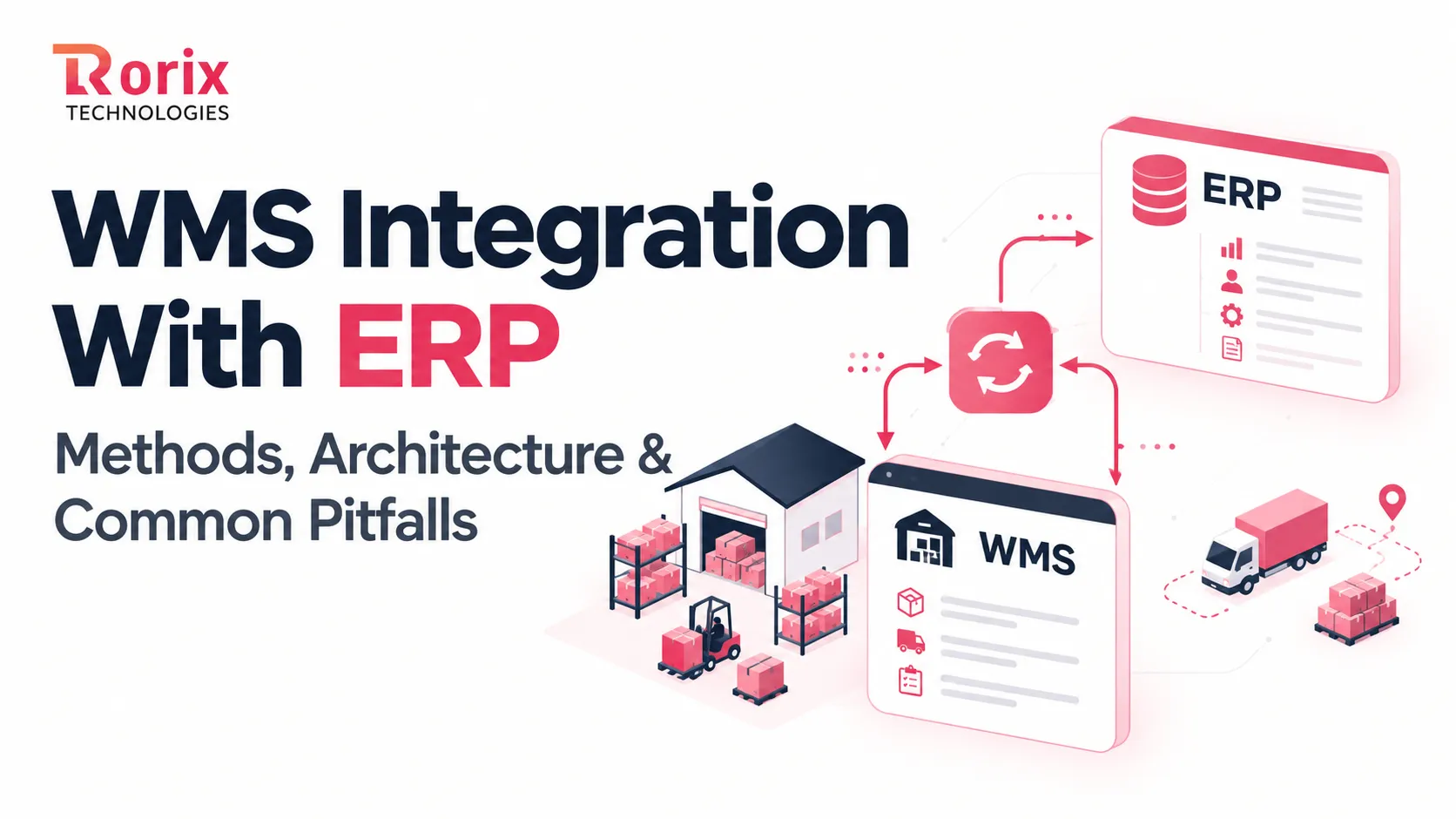
WMS Integration With ERP: Methods, Architecture & Common Pitfalls
Learn how WMS integration with ERP works, with 7 methods, architecture decisions, data flows, an 8-step roadmap, costs, timelines, and common pitfalls to avoid.
Read article
Barcode and RFID Integration Patterns in React
A practical guide to integrating barcode scanners and RFID readers with a React warehouse app: the four real connection patterns and when to use each.
Read article
WMS to ERP Integration: REST vs Message Queue
When to connect a WMS to an ERP over REST and when a message queue wins: the trade-offs, failure modes, and a pragmatic hybrid from a team that ships both.
Read article