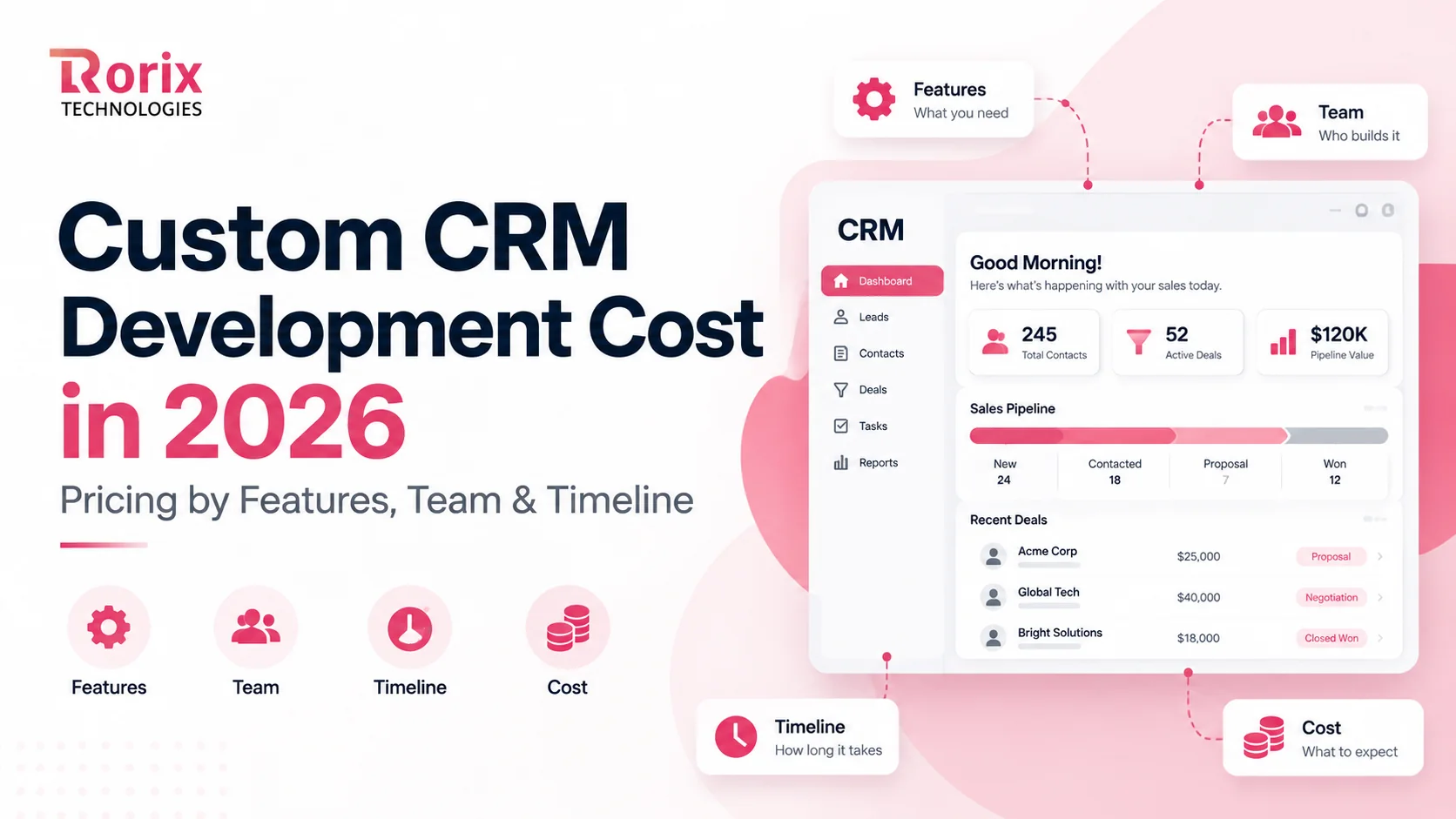
Custom CRM Development Cost in 2026: Pricing by Features, Team & Timeline
How much does custom CRM development cost in 2026? See pricing by build tier, features, team size, timeline, data migration, and ongoing maintenance.
On this page48 sections
Custom CRM development costs $18,000 to $45,000 for a focused pipeline tool, $45,000 to $110,000 for an operational CRM that runs daily work, and $110,000 to $250,000 or more for a platform CRM with billing, portals, and automation. Add 15% to 20% of the build each year for support.
Your CRM should make your team's work easier, not harder.
But when leads are scattered across spreadsheets, follow-ups sit in inboxes, and your CRM is packed with features nobody uses, the problem is not always the software. Sometimes, it is the fit.
That is why businesses choose custom CRM development. You get a system built around your sales process, team structure, integrations, and day-to-day operations instead of changing your workflow to fit someone else's platform.
The challenge is knowing what it will actually cost.
A simple pipeline tracker and a CRM that handles quoting, automation, payments, integrations, and customer portals are completely different products. Treating them as the same "CRM" is how budgets go wrong.
In this guide, you will learn:
- What a custom CRM costs by build tier, feature, team size, and industry
- The seven factors that move a quote most
- What data migration actually costs, based on the state of your records
- The ongoing costs that show up after launch
- How custom compares to a per-seat subscription over three years
- A five-step method for pricing your own CRM before you talk to a vendor
By the end, you should have a realistic cost range and a clearer idea of what your CRM budget actually needs to cover.
Quick Answer: What a Custom CRM Costs at a Glance
Most custom CRM projects land in one of three tiers, from about $18,000 for a pipeline that replaces spreadsheets to $250,000 or more for a platform that runs the business. Timeline and team size scale with the tier, and ownership costs continue long after launch.
| What you need | Typical cost | Timeline | Team |
|---|---|---|---|
| Focused CRM (pipeline replacing spreadsheets) | $18,000 to $45,000 | 6 to 10 weeks | 2 to 3 people |
| Operational CRM (runs daily work) | $45,000 to $110,000 | 12 to 20 weeks | 3 to 4 people |
| Platform CRM (runs the business) | $110,000 to $250,000+ | 20 to 36 weeks | 5 to 7 people |
| Annual maintenance | 15% to 20% of build cost | Ongoing | Retained |
| Hosting and infrastructure | $50 to $600 per month | Ongoing | Managed |
Key Takeaways: What Drives Custom CRM Development Cost
- A focused CRM that replaces spreadsheets costs $18,000 to $45,000 and ships in 6 to 10 weeks, an operational CRM runs $45,000 to $110,000 over 12 to 20 weeks, and a platform CRM runs $110,000 to $250,000 or more over 20 to 36 weeks.
- Plan for 15% to 20% of the build cost per year in support and iteration, plus $50 to $600 per month for hosting and infrastructure.
- Data migration ranges from $1,500 to $4,000 for one clean spreadsheet to $12,000 to $25,000 or more for years of inconsistent records, and it is the most common reason a build lands over budget.
- Over three years, an off-the-shelf CRM for 20 users totals $78,000 to $126,000 against $94,000 to $100,000 for a custom operational CRM, after which the build cost stays flat while the subscription rises at renewal.
- A custom CRM has no per-user line, so the twenty-first user changes nothing on the invoice, while below roughly 10 users a subscription almost always wins.
How Much Custom CRM Development Costs by Build Tier
The custom CRM development cost usually falls into three tiers. The right tier depends on what you need the CRM to do, not just your budget.
1. Focused CRM ($18,000 to $45,000)
This CRM is ideal for managing contacts, companies, deals, tasks, notes, and follow-ups in one place. It includes a simple sales pipeline, basic search, one or two user roles, hosting, and backups. It is a good choice if you mainly want to replace spreadsheets and keep your sales process organized.
2. Operational CRM ($45,000 to $110,000)
This CRM supports more of your daily business work, including quotes, scheduling, job tracking, documents, email logging, reports, and basic integrations. It also includes different access levels for admins, managers, and staff. The cost is higher because more features, data, and user permissions need to work together.
3. Platform CRM ($110,000 to $250,000+)
This is a full business system that can handle billing, payments, automation, customer portals, external system sync, audit logs, and multiple teams or locations. It costs more because it involves complex workflows, stronger security, deeper integrations, and more testing. The same tiering logic drives our wider custom software development cost guide, where a CRM sits alongside WMS, HRMS, and SaaS builds.
Custom CRM Development Cost by Feature
Tiers help you budget, but most buyers arrive holding a feature list. The ranges below assume each capability is built into a system that already exists rather than as standalone work.
| Feature | Typical cost | What drives the range |
|---|---|---|
| Contact and company records with custom fields | $3,000 to $7,000 | The foundation every other module attaches to |
| Pipeline and deal stages | $3,000 to $8,000 | Stage-specific rules, validation and permissions |
| Tasks, notes and reminders | $2,000 to $5,000 | Inexpensive, and decides whether the CRM gets used |
| Quoting and estimates | $6,000 to $16,000 | Templates, line items, versioning, PDF output |
| Scheduling or job tracking | $6,000 to $15,000 | Calendar logic and conflict handling |
| Reporting and dashboards | $5,000 to $14,000 | A few fixed reports cost little; a report builder is a product |
| Email integration | $4,000 to $11,000 | Sending is simple; two-way threading is not |
| Accounting sync (QuickBooks, Xero) | $5,000 to $16,000 | Depth of the sync, not the connection itself |
| Invoicing and payments | $10,000 to $28,000 | Money code needs testing; normal features do not |
| Customer-facing portal | $12,000 to $32,000 | A second application with its own security surface |
| Workflow automation engine | $8,000 to $22,000 | Fixed triggers cost little; a rules builder is a product |
| Roles and permission system | $4,000 to $14,000 | Per-stage permissions touch every screen and query |
| Mobile app for field teams | $12,000 to $35,000 | One shared codebase versus two native builds |
| AI lead scoring or call summarization | $12,000 to $40,000 | Plus a recurring model usage fee |
Also Read: Top 15 Small Software Development Companies for Startups
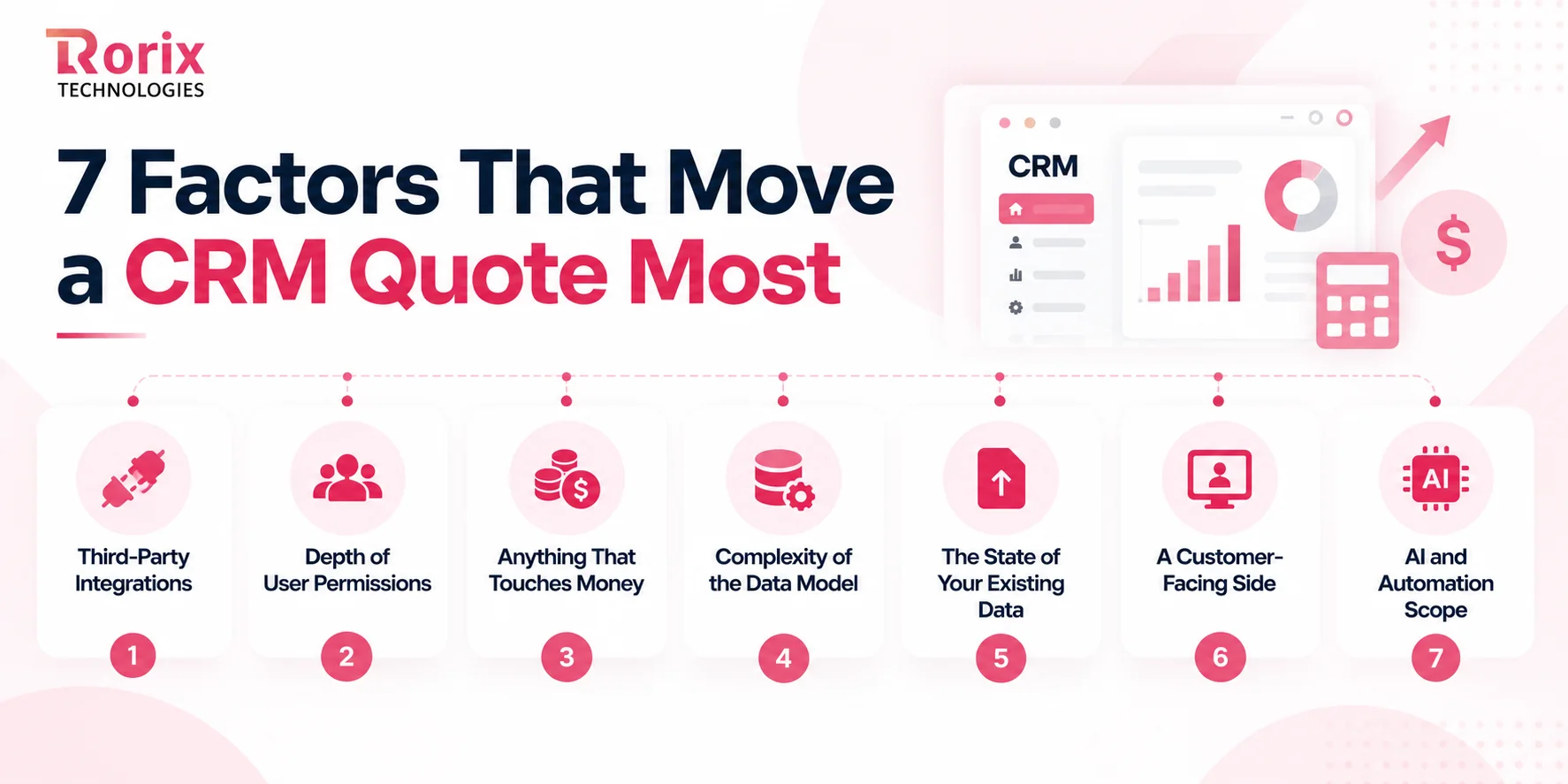
7 Factors That Move a CRM Quote Most
Two projects can sit in the same tier and still differ by $40,000. These seven factors explain almost all of that gap, listed in the order they usually bite.
1. Third-Party Integrations
Every external system you connect brings its own API, its own authentication model, and its own set of edge cases nobody documents. A CRM with no integrations sits at the floor of its tier. Four connected systems can push it to the ceiling on integration work alone, which is why an API integration strategy belongs in scoping rather than in the build.
2. Depth of User Permissions
Two roles are a straightforward build. Five roles with different visibility rules per pipeline stage is a different animal. Permission logic touches every screen, every query, and every report you write.
3. Anything That Touches Money
Quoting is moderate work, invoicing is significant, and recurring billing with payment reconciliation sits at the top. Financial code demands a level of edge-case handling and testing that ordinary features never require, and that discipline shows up in the price.
4. Complexity of the Data Model
A CRM tracking leads and deals is one thing. A system tracking applications, documents, payments, approvals, tasks, and full status history is a product build. The custom CRM development cost then reflects structural depth rather than screen count.
5. The State of Your Existing Data
Clean, consistent records import quickly and at low cost. Several years of inconsistent spreadsheets or an undocumented legacy export turns migration into reconciliation work. Nobody can price that accurately without seeing the data first.
6. A Customer-Facing Side
The moment your customers log in, you own two applications instead of one. Authentication, security review, and design effort roughly double for that surface, so a portal is a scope decision rather than a feature toggle.
7. AI and Automation Scope
Calling a hosted model for summarization sits at the low end of the range. Training scoring logic on your own historical pipeline data sits far higher. Both options add a recurring usage line that never appears in the build quote.
What CRM Data Migration Actually Costs
Migration is the line most quotes leave vague, and most projects overrun. The price depends almost entirely on the condition of what you already have, not on the size of the CRM you are moving into.
| Your current state | Migration cost | Why it costs that |
|---|---|---|
| One clean spreadsheet, consistent columns | $1,500 to $4,000 | Mostly a scripted import plus verification |
| Several spreadsheets with duplication | $4,000 to $9,000 | Deduplication and deciding which record wins |
| Legacy CRM export, undocumented fields | $6,000 to $18,000 | Someone has to work out what each field meant |
| Years of inconsistent records, no clear owner | $12,000 to $25,000+ | The work is reconciliation, and only your team can answer |
Now that you have seen how scope, features, and data condition build the number, let us look at how team size and industry shift it.
Custom CRM Development Cost by Team Size
Team size does not change the custom CRM development cost the way per-seat pricing trains you to expect. It changes it indirectly, through how many roles and workflows the system has to support.
| Your team | Typical tier | Build cost | Why it lands there |
|---|---|---|---|
| 1 to 5 people | Focused | $18,000 to $32,000 | One workflow, one or two roles |
| 5 to 20 people | Focused to operational | $32,000 to $75,000 | Multiple roles, reporting, usually one integration |
| 20 to 50 people | Operational | $65,000 to $130,000 | Departments with different views and permissions |
| 50+ people | Operational to platform | $110,000 to $250,000+ | Team separation, audit trails, automation |
Look at what is missing from that table. There is no per-user line anywhere in it, so adding your twenty-first user changes nothing on the invoice.
That structural difference is the whole argument for building. Subscription spend rises fastest at exactly the moment your business is growing, while a build cost stays where you left it.
Custom CRM Development Cost by Industry
Industry matters when it brings regulation, unusual data, or a workflow that no off-the-shelf product handles properly. The bands below reflect an operational CRM adjusted for those demands.
| Industry | Cost band | What actually drives it |
|---|---|---|
| Healthcare and patient management | $90,000 to $200,000+ | Protected data handling, EHR integration, audit logging |
| Financial services | $85,000 to $180,000+ | Encryption, access control, regulated audit trails |
| Real estate | $55,000 to $120,000 | Listing sync, site-visit scheduling, commission workflows |
| Retail and eCommerce | $60,000 to $140,000 | Order management sync, segmentation, returns logic |
| Logistics, 3PL and distribution | $65,000 to $150,000 | Order lifecycle, inventory visibility, carrier data |
| Manufacturing and B2B wholesale | $60,000 to $130,000 | Quote-to-order, account price lists, long sales cycles |
Developer Rates by Region and What They Do Not Tell You
Regional rates are the first thing most buyers compare and the least reliable signal in the whole exercise. A lower rate only lowers the total when the team needs the same number of hours, and that is a question about seniority and process rather than geography.
| Region | Typical hourly rate |
|---|---|
| United States and Canada | $100 to $200 |
| Western Europe | $80 to $150 |
| Eastern Europe | $40 to $85 |
| Latin America | $35 to $75 |
| South and Southeast Asia | $25 to $55 |
Also Read: IT Staff Augmentation Cost: Rates and Real Math
The CRM Costs That Show Up After Launch
Your custom CRM development cost does not stop at the build quote. These lines continue for as long as the system runs, and a vendor who hides them is leaving you to discover them.
| Ongoing cost | Typical amount |
|---|---|
| Hosting and infrastructure | $50 to $600 per month |
| Support and iteration | 15% to 20% of build cost per year |
| Third-party services (email, SMS, telephony, e-signature) | $50 to $500 per month |
| Payment processing fees, where billing is in scope | Per transaction, set by the provider |
| AI model usage, where scoring or summarization is in scope | $200 to $3,000 per month |
| Additions in year two and beyond | Quoted per feature |
CRM maintenance cost is the line people underestimate most. It is not a warranty against bugs; it is the budget for the changes your team requests after a month of daily use, and our software maintenance cost breakdown shows where that percentage actually goes.
With the full cost picture in view, the real decision comes next: whether building beats simply paying per seat.
Custom CRM vs Off-the-Shelf CRM Cost Over Three Years
The comparison that matters is not the build price against month one of a subscription. It is the three-year total, because one number stays flat while the other compounds with every hire.
| Off-the-shelf CRM (20 users) | Custom CRM (operational tier) | |
|---|---|---|
| Year 1 | $24,000 to $38,000 | $70,000 build plus $2,000 hosting |
| Year 2 | $26,000 to $42,000 | $11,000 to $14,000 support |
| Year 3 | $28,000 to $46,000 | $11,000 to $14,000 support |
| Three-year total | $78,000 to $126,000 | $94,000 to $100,000 |
| Code and data ownership | None | Full |
| Per-seat cost | Continues indefinitely | Never applies |
| Cost of adding 10 users | Rises with every seat | No change |
The year-one gap looks decisive in favor of subscribing. By year three the totals converge, and every year after that the build cost stays flat while the subscription rises at renewal.
Year one also hides costs on the subscription side. Higher tiers commonly carry one-time onboarding fees, paid connectors, and a consultant to configure the platform properly.
Three options are on the table, and each breaks in a different place:
| Option | Time to start | Where it breaks | Best fit |
|---|---|---|---|
| Per-seat SaaS platform | Days | Per-seat spend and workflow mismatch at scale | Standard process, small team, immediate need |
| No-code or low-code stack | Weeks | Permissions, reporting across records, deep integrations | Very small teams testing a process |
| Custom build | Weeks to months | Upfront investment and ownership of maintenance | Unique workflow, growing team, real integration needs |
Now for the honest counterweight. If a per-seat tool genuinely fits how you work, buy it. The custom CRM development cost only pays back when the subscription does not fit your process, and our build vs buy decision framework walks through that test in detail.
When the tool is wrong for your process, you pay twice. You pay the license, and you pay the daily cost of every workaround your team invents to get around it.
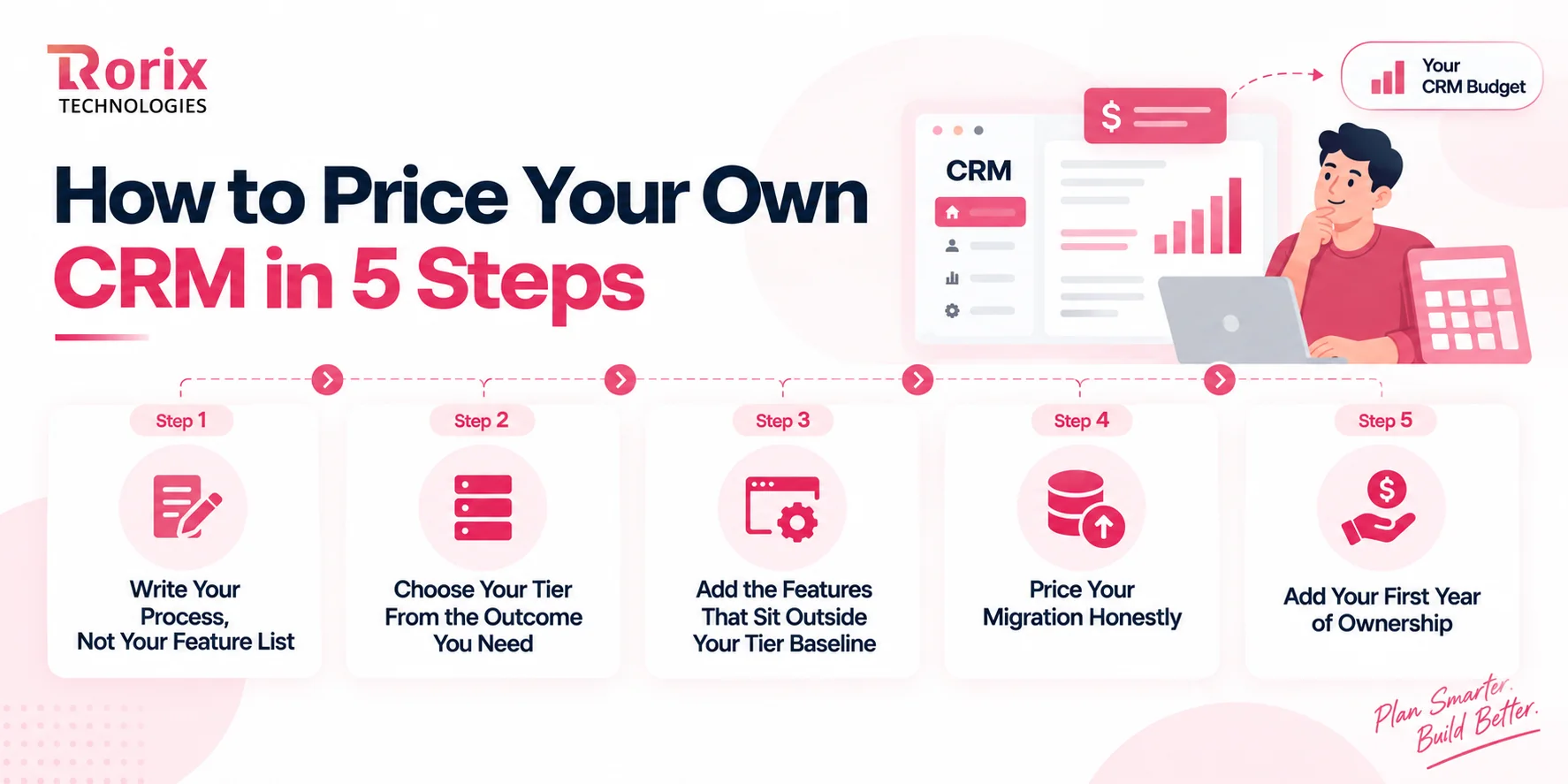
How to Price Your Own CRM in 5 Steps
You can produce a realistic number yourself before you speak to anyone. Work through these five steps in order and write each figure down as you go, then sanity-check the total against our project cost estimator.
Step 1: Write Your Process, Not Your Feature List
Start by describing what happens from the moment a lead arrives to the moment a deal closes. Name every person who touches it, every decision point, and every place the record moves to another system.
Do this in plain sentences rather than bullet points, because the sentences expose the approvals and handoffs that a feature list hides. A vendor who reads that page can scope you accurately, and one who quotes without reading it is guessing.
Step 2: Choose Your Tier From the Outcome You Need
Now decide which of three things you actually want. If you want deals to stop slipping, you need the focused tier, and you can stop reading the platform section entirely.
If your team also quotes, schedules, or tracks jobs inside the same record, you are in the operational tier. Reach for the platform tier only when billing, a customer portal, or automation across departments is genuinely part of the job.
Step 3: Add the Features That Sit Outside Your Tier Baseline
Take your tier band as the starting figure, then open the feature table earlier in this guide. Add only the capabilities your process description proved you need, and be strict with yourself here.
Remember that features sharing a data model cost less together than apart. So if quoting and invoicing both appear in your process, add roughly 75% of the second one rather than its full band.
Step 4: Price Your Migration Honestly
Open your current records and look at them properly before you estimate. Count how many sources you have, how many duplicates you can see, and whether anyone still understands what each column means.
Match that reality to the migration table and add the figure. Teams consistently underestimate this step, and it is the most common reason a build lands over budget rather than on it.
Step 5: Add Your First Year of Ownership
Finish by adding hosting, third-party service fees, and 15% to 20% of your build figure for support and iteration. That gives you a first-year total instead of a build price, which is the number your finance team actually needs.
8 Ways to Cut CRM Build Cost Without Cutting the System
Reducing the custom CRM development cost is about sequencing and scope discipline, not about buying less quality. Each of these has a trade-off, so read both halves.
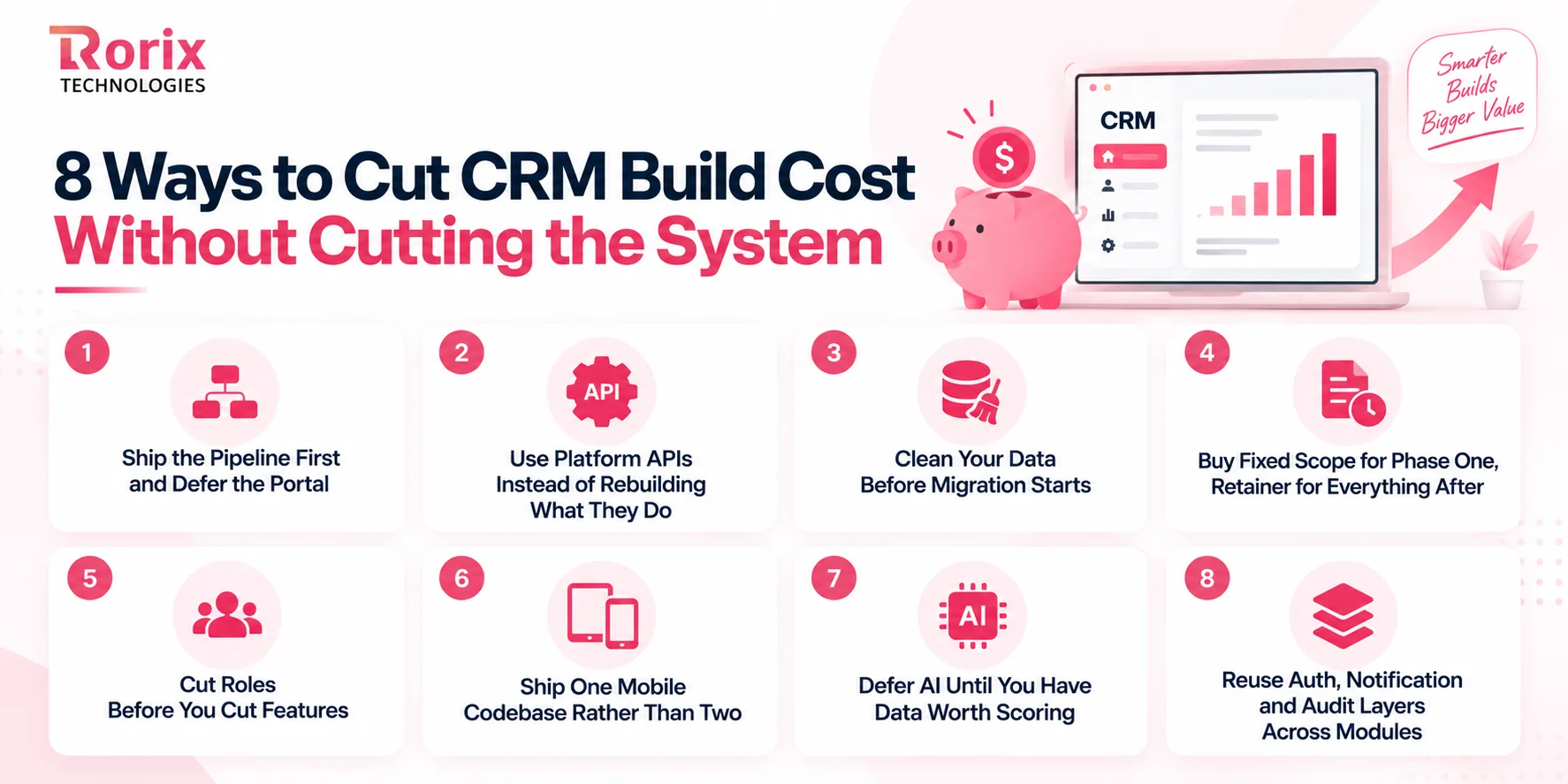
1. Ship the Pipeline First and Defer the Portal
Launch the internal CRM before you build anything customer-facing, since the portal is effectively a second application. Your team gets a working system months earlier, and you learn what customers should actually see before you build it.
2. Use Platform APIs Instead of Rebuilding What They Do
Your accounting tool, calendar, and e-signature provider already solve hard problems well. Connecting to them costs a fraction of rebuilding them, and the trade-off is a dependency you should confirm has a stable public API.
3. Clean Your Data Before Migration Starts
Every duplicate your team resolves in a spreadsheet is a decision an engineer does not have to bill you for. This is unglamorous work, though it reliably removes thousands from the migration line.
4. Buy Fixed Scope for Phase One, Retainer for Everything After
A fixed-scope phase one gives you a number you can approve before development begins. Once the system is live, a retainer suits the steady stream of small changes far better than raising a new quote each time.
5. Cut Roles Before You Cut Features
Permission depth costs more than most buyers expect, because it touches every screen and query in the system. Launching with three well-defined roles instead of seven often saves more than removing a whole module would.
6. Ship One Mobile Codebase Rather Than Two
A shared codebase covering iOS and Android costs meaningfully less than two native builds. Rorix ships that pattern regularly, and the trade-off only appears if you later need deep device-level hardware access.
7. Defer AI Until You Have Data Worth Scoring
Lead scoring trained on 200 historical deals will not outperform your sales manager's judgment. Wait until the CRM has collected real pipeline history, then add scoring against data that can actually support it.
8. Reuse Auth, Notification and Audit Layers Across Modules
Ask your development partner to build authentication, notifications, and audit logging once as shared services. Every module added afterwards then inherits them, which is why later features cost less in a well-architected system than a poorly structured one.
Also Read: Bespoke Software Development for Startups: Complete Guide
What a Trustworthy CRM Quote Must Itemize
A proposal is easy to compare once you know what should appear on it. Hold every quote you receive against this list.
- Discovery and process mapping: Named as a phase with a deliverable, not absorbed silently into development.
- Feature list with exclusions: What is in scope and, just as importantly, what is explicitly out of it.
- Each integration priced individually: Named systems with their own line, since "integrations" as one word hides the real work.
- Data migration against your records: Quoted after someone has actually looked at your existing data.
- QA and user acceptance testing: A separate line, because testing folded into development is testing that gets compressed.
- Deployment and handover: Environments, documentation, and the training your team receives.
- First-year support and hosting: A recurring figure you can put on a budget from day one.
- Code and IP ownership: Confirmation that you hold the repository, the data, and the intellectual property.
Our custom software development process guide sets out the deliverables each stage owes you.
Why Rorix Technologies Builds CRMs That Fit Your Business
Your business has its own way of working, so your CRM should be built around it. Rorix Technologies creates custom CRMs that match your workflows, connect with your existing systems, and help your team work more efficiently.
- Built around your workflow: We design the CRM around your actual processes, roles, data, and business needs instead of forcing your team into a fixed system.
- 40+ integrations delivered: We have connected 40+ vendor systems on a single platform using direct APIs and event-driven workflows.
- Support beyond launch: We work in 2-week sprints with clear task visibility and continue supporting your CRM after it goes live.
- Focused on real results: One warehouse project reduced picking errors by up to 80% using real-time tracking, barcode scanning, and automated workflows.
Want a CRM that works the way your business does? Book a free consultation with our experts to discuss your requirements, workflow, and estimated development cost.
What Your CRM Budget Really Comes Down To
The custom CRM development cost depends on what you need your CRM to do. A simple pipeline CRM may cost around $18,000, while a full business platform can go beyond $250,000.
Before choosing a development partner, look beyond the initial quote. Consider features, integrations, data migration, development time, maintenance, and long-term support. Our shortlist of CRM software development companies compares 25 firms by build type, hourly rate, and reviews.
If your current CRM is limiting your team or forcing you to change your workflow, a custom solution may be worth the investment. Connect with our experts, and we will map your process and price the build against it.
Frequently Asked Questions
How much does custom CRM development cost?
A focused CRM covering contacts, pipeline, and tasks runs $18,000 to $45,000. An operational CRM adding quoting, scheduling, and reporting runs $45,000 to $110,000, while a platform CRM with billing and a portal starts around $110,000.
How long does it take to build a custom CRM?
A focused build ships in 6 to 10 weeks and an operational CRM in 12 to 20 weeks. A platform CRM takes 20 to 36 weeks, with integrations and data migration driving the schedule.
Is a custom CRM more cost-effective than Salesforce or HubSpot?
Over three years, the totals usually converge for teams around 20 users, then custom pulls ahead. Below roughly 10 users, a subscription almost always wins, because the per-seat spend has not compounded enough to justify the build.
How much does CRM data migration cost?
A clean, consistent spreadsheet migrates for $1,500 to $4,000. Several years of inconsistent records or a legacy export with undocumented fields runs $12,000 to $25,000, since that work is reconciliation rather than a script.
What does a custom CRM cost per user?
Nothing, and that is the structural difference. A custom build carries a one-time cost plus flat hosting and support, so your twenty-first user and your fiftieth change nothing on the invoice.
How much should I budget for CRM maintenance?
Plan for 15% to 20% of the build cost per year, plus hosting and any third-party service fees. On a $70,000 operational CRM, that is roughly $11,000 to $14,000 annually for support, fixes, and the changes your team requests.
Does an industry-specific CRM cost more?
Only when the industry brings regulation or unusual data. Healthcare and financial services carry real compliance work in access control and audit logging, which typically adds 20% to 40% over a comparable build.
Can I start with a no-code CRM and build custom later?
Yes, and for very small teams that is often the sensible first move. The limit usually arrives at permissions, reporting across related records, or an integration the platform cannot reach, which is the signal to build.
Costing a custom build?
A dedicated team of senior engineers with a named technical lead on every engagement. Send us the problem and you get back a scope and a price.
Continue learning
Written by
Renish DadhaniyaFounder & Director, Rorix Technologies
Renish co-founded Rorix Technologies and drives the engineering and delivery culture across the organization. Beyond engineering, he leads the company's sales, finance, and HR operations, building the infrastructure that lets the team focus on shipping quality software. With deep hands-on expertise in architecture and team building, he ensures every project lands on time to the quality standards clients demand.
View full profileRelated articles
Custom Software Development Cost in 2026: Pricing by Project Type, Team & Region
See what custom software development costs in 2026 by project type, team size, and region, plus hidden fees, pricing models, and ROI to budget accurately.
Read article
Top 25 CRM Software Development Companies in 2026
Compare 25 CRM software development companies by services, expertise, hourly rates, and project costs to find the right partner for your business.
Read article
How Much Does a Warehouse Management System Cost? (2026 Pricing Breakdown)
How much does a warehouse management system cost? WMS pricing by deployment, size and features, with five-year TCO tables and vendor rates compared.
Read article