
When an Agency Should Subcontract a Build Instead of Turning It Down
A decision framework for agencies with more pipeline than capacity: five questions that decide whether to subcontract a build, hire for it, or turn it down.
On this page18 sections
Subcontract when the work sits inside your competence, the client relationship is worth more than this one project, and somebody on your side has the capacity to run the account. Turn it down when the project is a bet on a domain you cannot evaluate, when the margin only survives at full utilization, or when nobody in your agency is free to own the client. The engineering is rarely the deciding factor. Your ability to manage the work is.
Agencies do not usually turn work down because it is bad work. They turn it down because it arrives in the wrong month.
Key Takeaways: When Subcontracting Pays and When It Does Not
- The bottleneck is management capacity, not engineering capacity. Adding engineers you have nobody to direct makes delivery worse, not better.
- Turning down work has a cost you do not see on any invoice, because the client who found someone else for this project usually stays there for the next one.
- Scope it before you price it. Quoting a fixed price against an estimate you did not produce is how agencies fund their own overruns.
- Say no when you cannot evaluate the work. If you could not tell good from bad in that domain, subcontracting moves the risk to your balance sheet without moving it off your reputation.
- Small projects can be the worst candidates. Coordination overhead is close to fixed, so it eats a short engagement's margin faster than a long one's.
What Turning the Work Down Actually Costs
The visible cost is the project. The invisible one is the sequence that follows it.
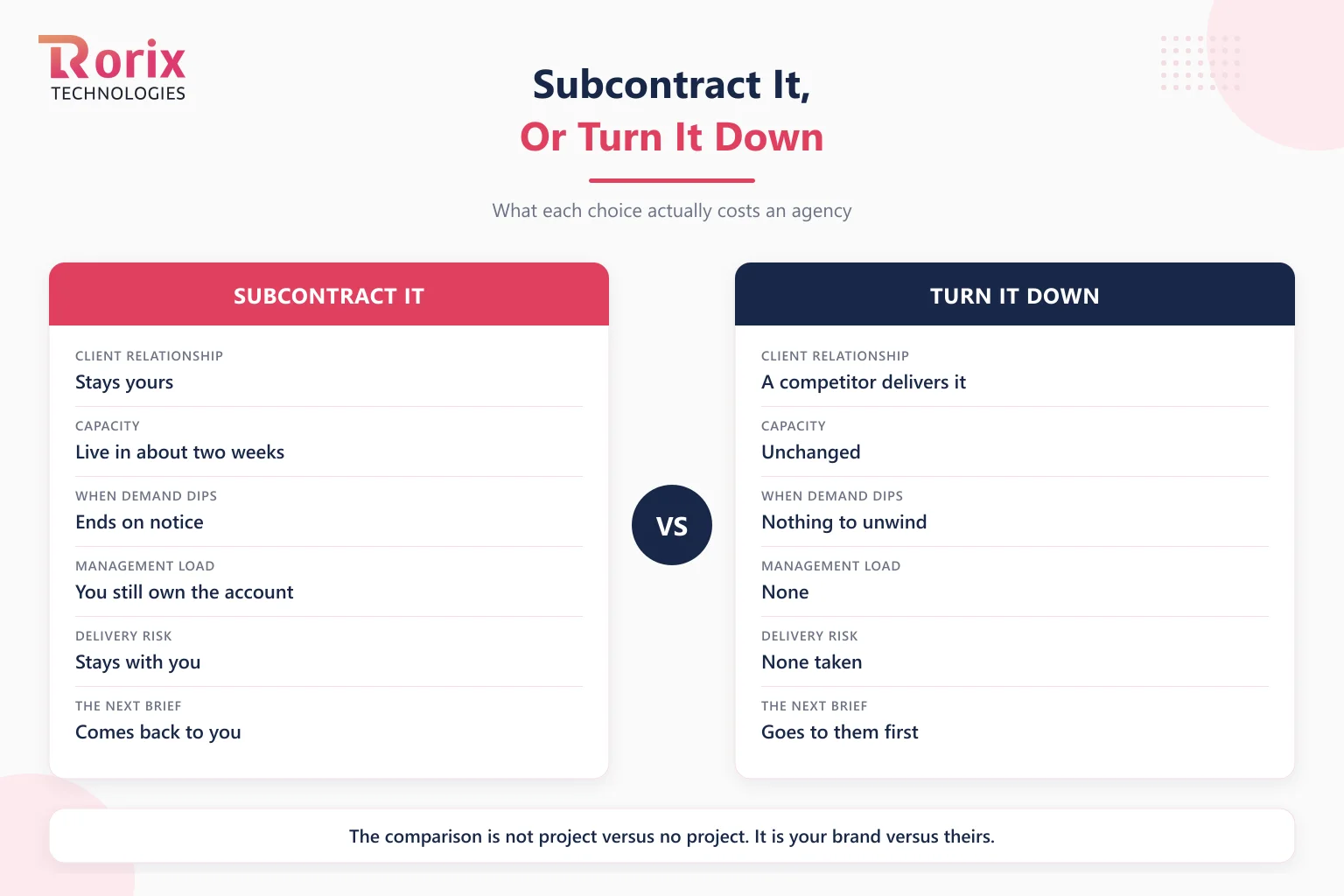
A client with a build you declined does not pause their roadmap. They find another agency, that agency does the work acceptably, and the relationship you spent two years building now has a second supplier inside it with a delivered project as a reference. The next brief goes to them first. That is the real price of a capacity gap, and it does not appear on any report you run.
There is a second cost inside your own team. Agencies that turn down work repeatedly stop pursuing the kind of work they keep declining, and the pipeline quietly reshapes itself around what current capacity can absorb. That is a strategy decision being made by your staffing calendar rather than by you.
None of which means say yes to everything. It means the comparison is not "this project versus no project." It is "this project delivered by someone else under my brand, versus this project delivered by a competitor under theirs."
The Five Questions That Decide It
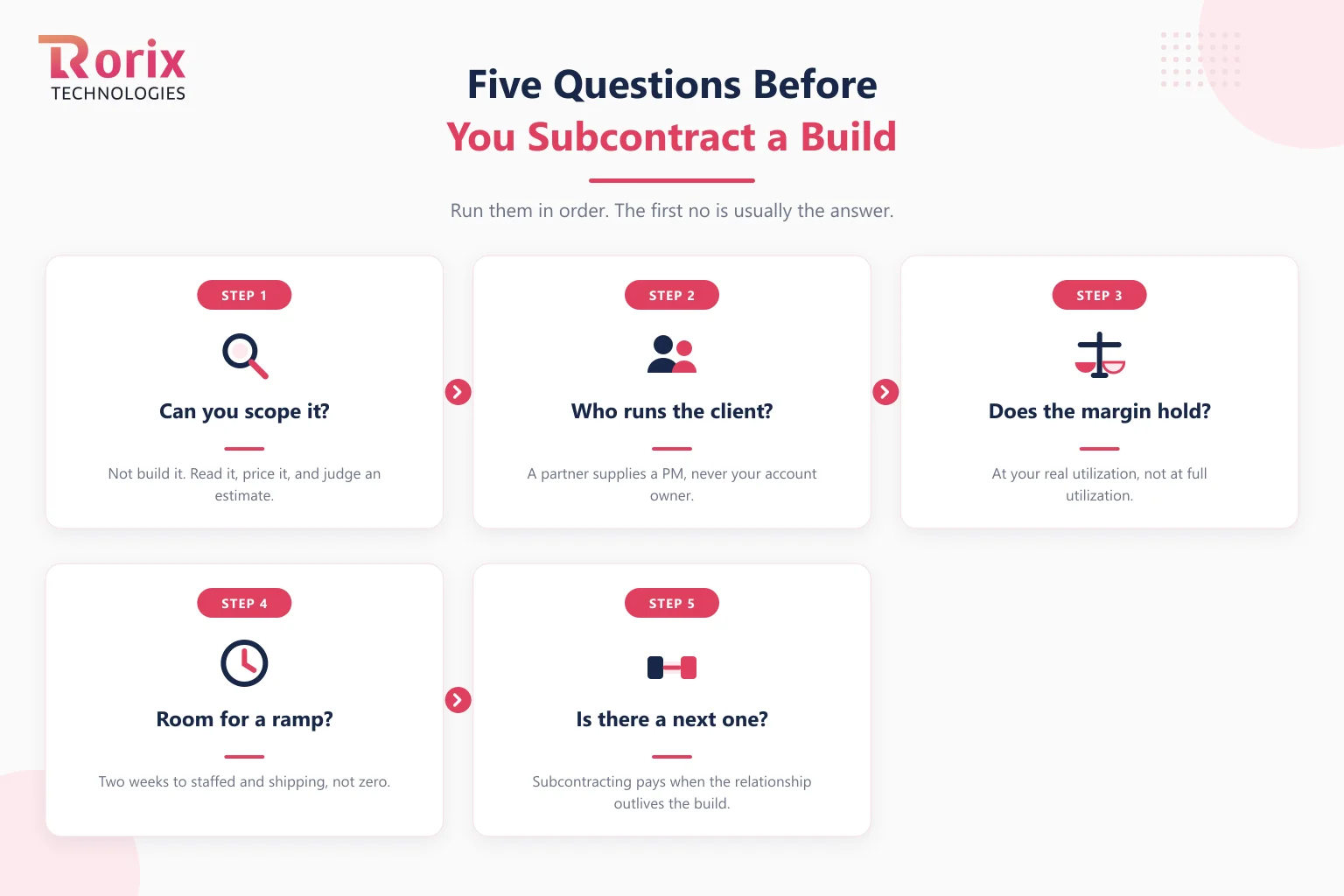
Run these in order. The first no is usually the answer.
1. Can You Scope It Yourself?
Not build it. Scope it. Can you read the requirements, identify what is genuinely hard, and tell whether an estimate is honest? If yes, subcontracting is a capacity decision and you stay in control of it. If no, you are outsourcing judgment rather than labor, and you will not know the project is in trouble until the client tells you.
This is the question that separates "we do not have engineers free" from "we do not do this kind of work." The first is solvable. The second is a different business decision.
2. Is There Someone on Your Side to Run the Client?
A subcontracted build still needs an owner at your agency: someone who runs the calls, sets priorities, makes scope decisions, and absorbs the client's Tuesday afternoon question. A partner supplies a project manager for the engineering. They do not supply your account.
If the honest answer is that nobody has room for another account, the project will go badly no matter how good the engineers are. That is the single most reliable predictor of a failed white-label engagement.
3. Does the Margin Survive at Your Real Utilization?
Not at full utilization. At yours. Model the engagement on the assumption that scope moves, the client takes two weeks to review a milestone, and one sprint gets partly wasted on a decision that had not been made yet. If the margin only works when nothing slips, it does not work.
The arithmetic is simple once the cost side is fixed. What white-label engineering costs per engineer covers the cost side in detail, and the project cost estimator produces a range for the client-facing number.
4. Is the Timeline Compatible With a Ramp?
Nobody is productive on day one. A team needs the brief, repository access, and a scoping conversation before it produces anything, and a codebase with history needs longer. Ours are staffed and shipping within two weeks of signing, which is fast, but it is not instant.
If the client needs delivery in six weeks and four of those are already spent, you are not solving a capacity problem. You are transferring an impossible timeline to someone else and keeping the accountability.
5. What Happens to This Client's Next Project?
Subcontracting makes most sense when the relationship outlives the build. If this client has a roadmap, the project you deliver through a partner buys you the next three. If it is genuinely one-off work from a client you will never hear from again, the margin has to justify the coordination on its own, and often it does not.
When the Answer Is No
Four cases where subcontracting is the wrong instrument, and saying so early is cheaper than discovering it in month two.
You cannot evaluate the domain. Regulated healthcare data, payment infrastructure, anything where "looks fine" and "is fine" are different states. Take work you can audit.
The client is buying your specific people. Some clients hire your agency because of a named designer or a lead engineer they trust. That is a compliment and a constraint. A white-label team cannot deliver a specific person's judgment.
The contract forbids it. Some enterprise MSAs require written consent before any subcontracting. Read yours before the first white-label project rather than during it.
The project is too small. Coordination cost is close to fixed. A two-week build carries almost the same setup as a two-month one, which is why very short engagements are usually better declined, delayed until you have capacity, or handled in-house at a loss you accept deliberately.
Subcontract, Hire, or Decline
Three ways to close a capacity gap, and they fail differently.
Hiring solves capacity permanently and slowly. Recruiting, notice periods, and ramp time put a productive new engineer three months out at best, and the cost stays on your books when the pipeline dips. Hire against demand you are confident will still be there next year.
Freelancers are fast and unstructured. They work for a defined gap with someone managing them, and they fail when a whole build is handed over, because nobody owns the delivery. The distinction is the same one between staff augmentation and a dedicated team: one supplies hands, the other supplies delivery.
A partner team is capacity you can turn on in weeks and off with notice, with delivery management inside it. It costs more per engineer than a freelancer and much less than a hire, and it only works if you have an account owner. When the client wants a standing team rather than a delivered project, dedicated development teams fit better than a project subcontract.
What the First Engagement Should Look Like
Do not make the first one your largest client's flagship rebuild.
Pick a real project small enough that a bad outcome is survivable and large enough to test the actual mechanics: the scoping conversation, the first sprint demo, what happens when a requirement changes mid-sprint, and how the partner communicates a slip. A pilot that never encounters friction tells you nothing.
Before that, get the contract questions settled, because they are much harder to raise later: how IP transfers, whether the non-solicit runs both directions, and what happens when an engineer rolls off. How white-label software development actually works walks through each of them, and our partner team terms state where we land on all three.
If it helps to see the arrangement in practice first, read how we engineer Jedari's white-label platform, and the wider portfolio shows the kind of systems a team works on.
Frequently Asked Questions
Should agencies outsource development work?
Selectively. Outsource capacity for work you can scope and evaluate, when you have someone free to run the client relationship. Do not outsource work in a domain you cannot audit, because subcontracting moves the labor without moving the reputational risk.
How do I know if I should subcontract or hire?
Hire against demand you expect to still exist in a year, and subcontract against demand that is real now but uneven. Hiring takes about three months to productivity and stays on your cost base through the quiet quarters. A team turns on in weeks and off on notice.
Will my client find out the work was subcontracted?
Not in a properly structured white-label arrangement. There is no contract, invoice, or repository that names the partner, so disclosure becomes a choice you make per client rather than something that leaks.
What size project is worth subcontracting?
Large enough that the setup cost is a small share of the engagement. Coordination overhead barely changes between a two-week project and a two-month one, so short builds tend to be the least attractive candidates even when they look easy.
How quickly can subcontracted capacity start?
Ours is staffed and shipping within two weeks of signing, after a 30-minute intro call, signed NDA and partnership terms, and a joint scoping session on the first brief. Treat any promise of same-week starts with suspicion, because nobody is productive on an unfamiliar codebase on day one.
What if the subcontracted project goes wrong?
You are still accountable to your client, which is exactly why the escalation path, the replacement terms, and the status cadence belong in the agreement before the first sprint. Ask what the partner does when a sprint slips before you need the answer.
Need engineering capacity under your own brand?
A partner team is 3 senior engineers and a project manager at $10,000 a month, white label by default and month to month. You keep the client, the brand, and the spread.
Continue learning
Written by
Renish DadhaniyaFounder & Director, Rorix Technologies
Renish co-founded Rorix Technologies and drives the engineering and delivery culture across the organization. Beyond engineering, he leads the company's sales, finance, and HR operations, building the infrastructure that lets the team focus on shipping quality software. With deep hands-on expertise in architecture and team building, he ensures every project lands on time to the quality standards clients demand.
View full profileRelated articles
White-Label Software Development: How the Arrangement Actually Works
White label software development explained through the contracts: who signs what, how the money moves, when IP transfers, and who meets your client.
Read article
What White-Label Engineering Costs an Agency Per Engineer
White label development cost, per engineer and per month: what a partner team runs, what the same seniority bills in the US, and what the rate excludes.
Read article
How to Choose a Custom Software Development Company in 2026
How to choose a custom software development company: a vetting checklist, red flags, key questions to ask, and how to compare proposals with confidence.
Read article