
White-Label Software Development: How the Arrangement Actually Works
White label software development explained through the contracts: who signs what, how the money moves, when IP transfers, and who meets your client.
On this page21 sections
White label software development is an arrangement where your agency holds two separate contracts: one with your client for the build, and one with an engineering partner who does the work under your brand. Your client never signs with the partner, never receives an invoice from them, and in most cases never learns their name. Every other detail follows from that two-contract structure.
The reason agencies go looking for this is narrow and repeatable. A proposal lands, the client says yes, and the two engineers who would have built it are committed to another project for the next six weeks. Turning the work down costs the relationship. Hiring for it costs three months you do not have. So the question becomes whether someone else can build it without the client ever experiencing a handoff.
Most articles on this topic sell the idea and skip the mechanics. This one is the mechanics.
Key Takeaways: What the Two-Contract Structure Commits You To
- You hold both contracts. Your client has no agreement with the partner, no invoice from them, and no clause naming them.
- Paying for code does not transfer ownership of it. Under US copyright law, commissioned software moves only by a signed written assignment, and that assignment has to run back to back through both contracts.
- Engineers appear under your brand or not at all. Which of the two happens is your decision, made per client, not the partner's default.
- A non-solicit is only useful if it runs both directions and survives termination. One that protects only the partner is a red flag on the page it appears.
- Continuity is a contract term, not a promise. Name the replacement window and the handover overlap before you sign, because you will need them at the worst possible moment.
What White Label Software Development Means Once the Contracts Are on the Table
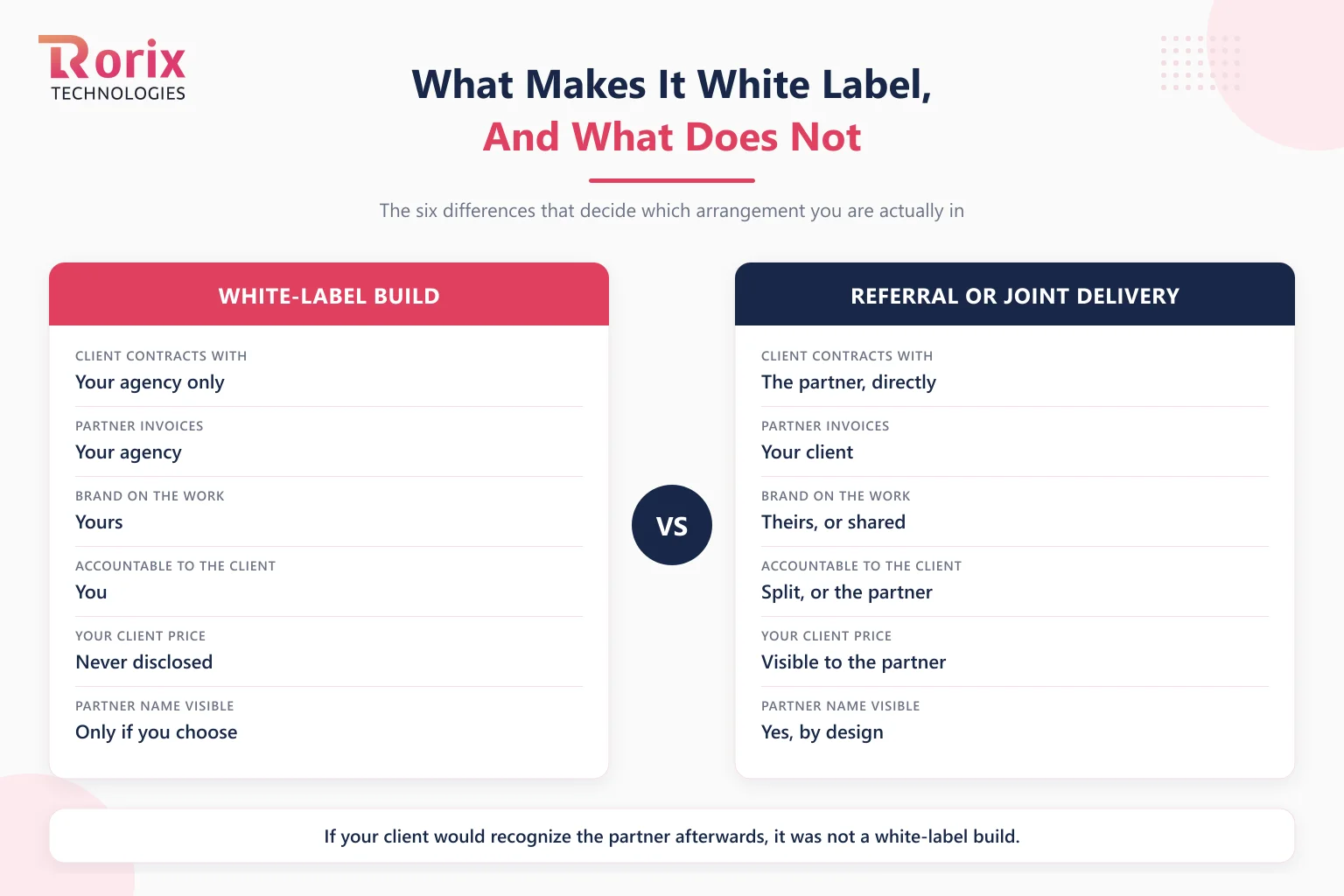
White label means a contractual position rather than a marketing arrangement. The partner signs with your agency. You sign with your client. There is no agreement between the partner and your client, no invoice flowing between them, and no line in your client's contract that names anyone but you.
That definition matters because the alternatives get called white label too, and they are not. A referral where the partner contracts directly with your client is a finder's fee. A subcontract where the partner's logo sits in the client's repository is a joint delivery with extra steps. If your client would recognize the partner's name after the project ends, the arrangement was something else.
Who Signs What, and Who Signs Nothing
Three documents do the work. Two of them you already write.
Your Agreement With the Client
Unchanged from any other project you sell. Your scope, your timeline, your price, your warranty, your liability. The client is buying a build from your agency, and your agency is accountable for delivering it. A right-to-subcontract clause belongs here, and most agency MSAs already carry one. Read yours before the first white-label project rather than during it, because a handful of enterprise MSAs require written consent before any subcontracting, and finding that out mid-build is expensive.
Your Agreement With the Engineering Partner
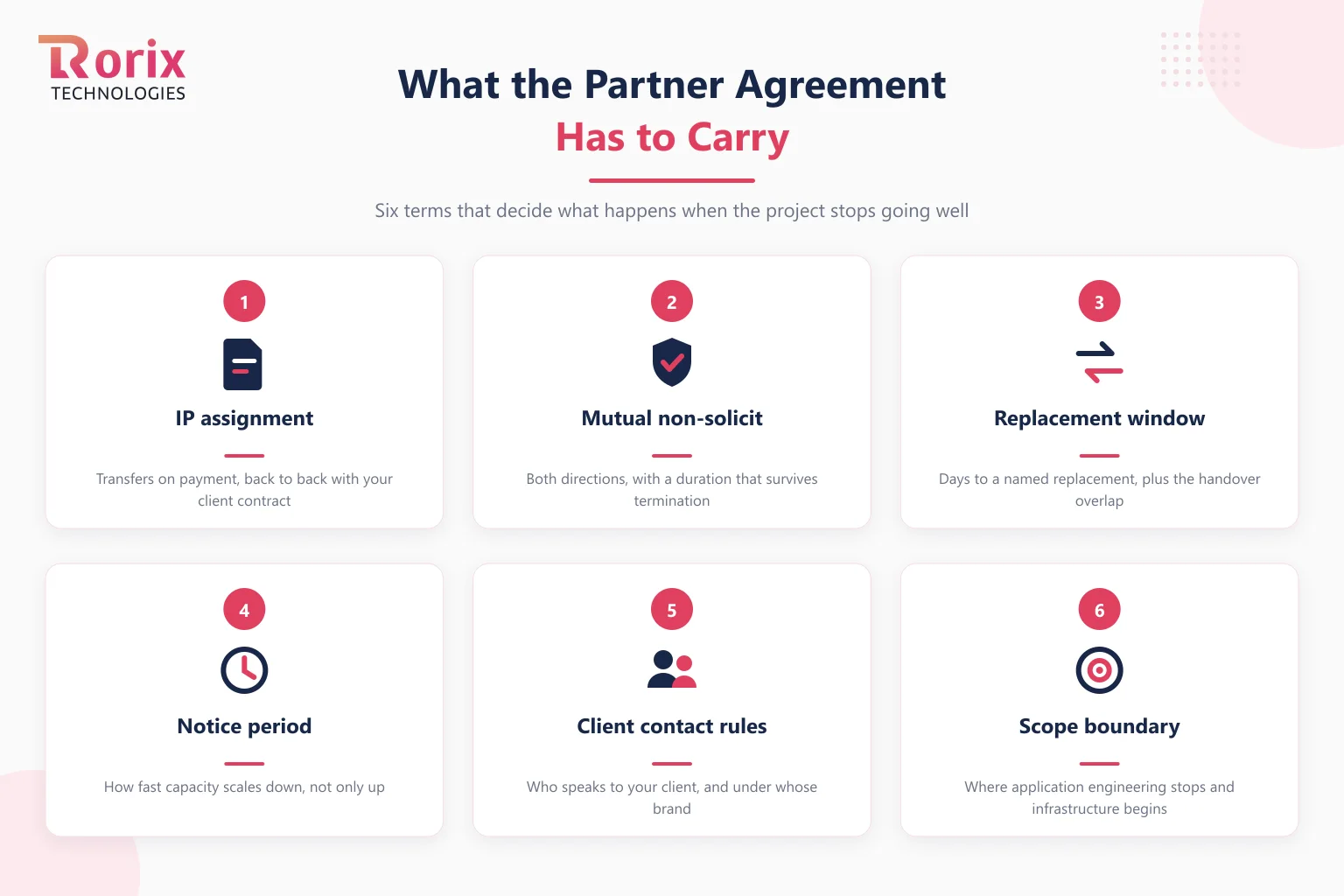
This is the document that has to be right. It carries the scope, the monthly rate, the notice period, the IP assignment, the confidentiality terms, and the non-solicit. It should also carry the operational terms most agencies leave out and later wish they had: the replacement window when an engineer rolls off, the escalation path when a sprint slips, and who is permitted to speak to the client.
Why Your Client Never Signs With the Partner
Because that separation is the entire product. The moment your client has a direct agreement with the partner, they have a direct relationship, a direct price reference, and a reason to wonder what you add. Keeping the partner one layer behind you is not secrecy for its own sake. It is what preserves your position as the accountable party, which is what your client is actually paying for.
There is one exception worth negotiating for. If your client's own MSA has to cover everyone touching the code, a partner should be willing to sign it as a subcontractor while your agency remains the prime contractor and carries the liability flow-down. Expect them to read the liability and indemnity terms before signing, which is reasonable in both directions. That keeps the structure intact. A partner who wants to sign directly with your client as a peer is proposing a different arrangement.
How the Money Moves, and Why the Spread Stays Yours
One invoice per month from the partner to your agency. You invoice your client separately, on your own terms, your own cycle, and your own number. What you charge is never disclosed to the partner, and never disclosed by them.
The arithmetic here is the reason the model exists. Senior engineering in the US and UK bills at rates the offshore market does not match, and the difference between what you pay for capacity and what you bill for outcomes is yours to set. What that difference works out to depends on your utilization, your discounting, and your contract shape, which is why no honest partner will publish your margin for you. Take both ends of the range, apply your own assumptions, and price the way you already price. What white-label engineering costs an agency per engineer sets out the cost side in detail. If you want a sanity check on the client-facing number before the proposal goes out, our project cost estimator produces a range in about two minutes, and our retainer pricing shows the other end of the calculation.
Two practical terms belong in the same conversation. Bill in one currency, and agree the notice period for scaling capacity down. A partner arrangement that cannot shrink on short notice is a fixed cost wearing a variable cost's clothes.
Who Owns the Code, and the Moment Ownership Actually Transfers
Ownership does not transfer because you paid. It transfers because someone signed something, and in the US the requirements are specific enough to catch agencies out.
Software written by an outside contractor is generally not a "work made for hire." 17 U.S.C. § 101 limits that category, for specially ordered or commissioned works, to nine listed types: contributions to collective works, parts of motion pictures or other audiovisual works, translations, supplementary works, compilations, instructional texts, tests, answer material for tests, and atlases. Software is not on the list. Titling the agreement a work-for-hire contract does not add it.
What moves ownership instead is an assignment, and 17 U.S.C. § 204(a) is blunt about the form: a transfer of copyright ownership "is not valid unless an instrument of conveyance, or a note or memorandum of the transfer, is in writing and signed by the owner of the rights conveyed." Not an invoice. Not an email. A signed instrument.
For a white-label build that means the assignment has to run back to back. The partner assigns to your agency, your agency assigns to your client, and the two clauses have to be compatible. The failure case is an agency that promised its client full ownership on payment while its partner agreement transferred nothing until final invoice settlement, which leaves a window where the client owns less than their contract says. Check that the trigger conditions line up before the first project rather than at closeout.
Three related terms belong in the same clause: that the partner retains no license to reuse the work, that no dependency requires the partner to keep anything running after handover, and that third-party and open-source components are disclosed with their licenses.
When the Engineers Join a Client Call, and When They Stay Invisible
Three arrangements are common, and the choice is yours per client rather than a partner default.
Fully behind the curtain. The partner never appears. You run every call, write every update, and relay technical questions. This costs you the most time and reveals the least.
Present under your brand. An engineer joins a technical call on your meeting link, introduced by you, with your agency's name in the room. The client gets direct access to the person who wrote the code, and you keep the framing. This is where most agencies land after the first project.
Named as a delivery partner. Some clients prefer to know, particularly on longer engagements or in regulated work. Disclosure is then a decision you make deliberately, once, rather than one made for you by an engineer who joins a call with the wrong company name in their meeting profile.
Whichever you pick, the operational details have to match it: repository ownership, documentation branding, sprint board access, and the email domain on standup invitations. An arrangement that is white label in the contract and visibly not in the tooling fools nobody.
What a Mutual Non-Solicit Has to Cover to Be Worth Signing
Both directions, or it is not protecting you.
The partner agrees not to approach your clients. You agree not to approach their engineers. Both halves matter: the first protects the relationship you spent years building, and the second is what makes a partner willing to put senior people in front of your client at all. A one-way clause tells you which risk the partner was thinking about.
Two terms decide whether the clause is real. Duration, which should run for the engagement plus a defined period after it, and survival, meaning it outlives termination. A non-solicit that expires when the engagement ends protects you during the only period you were never at risk. Ours runs in both directions for 24 months from the end of your last engagement with us, rather than from each individual team, and survives termination.
Ask also when the NDA gets signed. Before the first brief is the correct answer, because the first brief is when you hand over a client's problem in detail.
What Happens When an Engineer Rolls Off Mid-Build
This is the question most agencies forget to ask and every agency eventually needs answered. People leave, projects get reprioritized, and continuity is the difference between a partner and a staffing marketplace.
Get three numbers in writing. How long until a replacement is named. How much handover overlap the outgoing engineer provides. Whether you approve the replacement or simply receive them. Vague answers here are a reliable forecast of how the situation will actually go.
Our commitment is a replacement named within 10 business days, a two-week overlap where both engineers are on the project, and your approval before the swap. The overlap is the part that matters, because context transfers through conversation and code review far better than through a handover document nobody reads.
This is also where the model separates from hiring contractors individually. When one contractor disappears, their context leaves with them. When a team loses an engineer, the project manager, the code review history, and the rest of the team still hold it. That structural difference is the same one that separates staff augmentation from a dedicated team, and it applies here for the same reason.
Where the Arrangement Breaks Down
Four failure modes account for most of it, and three of them are avoidable.
Nobody on your side runs the client. White label moves the engineering, not the account. If no one at your agency is running client conversations, setting priorities, and making scope calls, the arrangement fails regardless of how good the engineers are.
The scope boundary was never drawn. Application engineering and infrastructure are different disciplines. If your partner builds applications and your client expects production infrastructure ownership, someone discovers the gap at the worst possible time. Ours stays at application engineering, and infrastructure remains with your team or the client's.
The client wanted a team, not a build. Some clients are buying access to people they will still have next year. That is a legitimate thing to want, and it points at dedicated development teams rather than at a project subcontract.
The margin was priced before the scope was. Quoting a fixed client price against an estimate you did not produce is how agencies end up funding the overrun themselves. Scope the build with the partner before the number goes into the proposal.
How Rorix Structures a Partner Team
A team is senior engineers plus a dedicated project manager, taken as a unit. Team S is 3 senior engineers and a PM at $10,000 a month. Teams run month to month, and you move between sizes with 15 days notice. No juniors, code review on every merge, a written status every Friday, and a named delivery lead you contact directly with a response inside 24 business hours on escalations.
Time zone overlap is full UK mornings, US East until noon, and Australian afternoons, which is what makes joining your client calls practical rather than theoretical. The team works from one office in Ahmedabad with no subcontracting chains behind it, so the people on your project are the people you were introduced to. You can see the stack a team already works in and the builds behind the arrangement before committing to anything.
The closest published example is the white-label platform we engineer for Jedari, where our engineers ship under someone else's brand.
If the structure fits what you are trying to solve, how we run white-label partner teams covers the rate card, the terms, and the first 30 days in more detail than a blog post can.
Frequently Asked Questions
What is white label software development?
An arrangement where an engineering partner builds software that is delivered under your agency's brand. Your agency contracts with the client, the partner contracts with your agency, and the two contracts never meet. The client's relationship, invoice, and warranty stay entirely with you.
Does my client find out who actually built the software?
Only if you decide they should. In a properly structured arrangement there is no contract, invoice, or repository that names the partner, so disclosure is a choice you make per client rather than something that leaks. Some agencies disclose deliberately on longer engagements. Most do not.
Who owns the code in a white-label build?
Your agency, and through you, your client. Ownership moves by written assignment rather than by payment alone, so the assignment clause has to run back to back through both contracts with matching trigger conditions. Confirm that your partner's transfer point is no later than the one you promised your client.
How does invoicing work in a white-label arrangement?
The partner sends your agency one invoice per month for the capacity. You invoice your client separately at your own price, on your own cycle. Your client price is never disclosed to the partner, and the difference between the two is yours.
What happens if the partner's engineer leaves mid-project?
That depends entirely on what you negotiated. Ask for a named replacement window, a defined handover overlap, and approval rights over the replacement. Our terms are 10 business days to a named replacement, a two-week overlap, and your approval before the swap.
Is white-label development the same as staff augmentation?
No. Staff augmentation places engineers into your team and leaves delivery management with you. A white-label team arrives with its own project manager and takes delivery of the work inside your priorities, which is why it can absorb a whole build rather than a named gap.
Will a white-label partner sign my client's MSA?
A reasonable partner will, provided your agency stays the prime contractor and carries the liability flow-down. That preserves the structure while satisfying a client whose contracting rules require every party touching the code to be on paper. Where no such requirement exists, the simpler arrangement is one agreement between you and the partner.
Need engineering capacity under your own brand?
A partner team is 3 senior engineers and a project manager at $10,000 a month, white label by default and month to month. You keep the client, the brand, and the spread.
Continue learning
Written by
Renish DadhaniyaFounder & Director, Rorix Technologies
Renish co-founded Rorix Technologies and drives the engineering and delivery culture across the organization. Beyond engineering, he leads the company's sales, finance, and HR operations, building the infrastructure that lets the team focus on shipping quality software. With deep hands-on expertise in architecture and team building, he ensures every project lands on time to the quality standards clients demand.
View full profileRelated articles
What White-Label Engineering Costs an Agency Per Engineer
White label development cost, per engineer and per month: what a partner team runs, what the same seniority bills in the US, and what the rate excludes.
Read article
When an Agency Should Subcontract a Build Instead of Turning It Down
A decision framework for agencies with more pipeline than capacity: five questions that decide whether to subcontract a build, hire for it, or turn it down.
Read article
How to Choose a Custom Software Development Company in 2026
How to choose a custom software development company: a vetting checklist, red flags, key questions to ask, and how to compare proposals with confidence.
Read article