
What White-Label Engineering Costs an Agency Per Engineer
White label development cost, per engineer and per month: what a partner team runs, what the same seniority bills in the US, and what the rate excludes.
On this page17 sections
A white-label engineer costs an agency $3,000 to $3,333 per month at Rorix, depending on team size, with a project manager already inside that number. The same seniority contracted in the US bills $100 to $150 an hour, which is $16,000 to $24,000 a month at 160 hours. The gap between those two numbers is the reason the model exists. What you do with it is a pricing decision on your side, not a figure anyone else should publish for you.
Most pricing pages in this category answer a different question than the one agency owners actually ask. The question is not "what is your hourly rate." It is "what does one engineer cost me per month, what is already inside that number, and what will I be billed for separately when the project is halfway done."
Key Takeaways: The Four Numbers That Decide a White-Label Engagement
- Cost per engineer per month: $3,000 to $3,333. It falls as the team grows, because one project manager and one shared codebase context cover more engineers.
- The US comparison: $16,000 to $24,000 per engineer per month at the same 160 hours. That is roughly five times the team cost at the floor of the US band and eight times at the ceiling.
- The project manager is inside the rate, not beside it. So is code review, sprint ceremony, and replacement cover.
- Infrastructure and DevOps are outside it. That is the line item most likely to surprise you, so price it into the client proposal before you send it.
What a White-Label Engineer Actually Costs Per Month
A team is priced as a unit rather than per seat, so the per-engineer figure is arithmetic rather than a rate card entry.
| Team | Makeup | Monthly | Per engineer |
|---|---|---|---|
| Team S | 3 senior engineers + PM | $10,000 | $3,333 |
| Team M | 5 senior engineers + PM | $16,000 | $3,200 |
| Team L | 10 senior engineers + PM | $30,000 | $3,000 |
All figures are USD, billed monthly. Teams run month to month, and you move between sizes on 15 days notice. The full rate card and terms sit on the white-label partner teams page.
Why the Per-Engineer Rate Falls as the Team Grows
Not a volume discount in the usual sense. One project manager can run five engineers on a shared codebase about as well as three, and the context that makes a team productive on your client's system is built once regardless of how many people share it. The fixed part of the cost spreads. That is also why the per-engineer number stops falling at Team L: past ten engineers you need a second manager, and the arithmetic resets.
What the Monthly Rate Already Covers
The team price includes senior engineers only with no juniors billed at senior rates, a dedicated project manager, code review on every merge, automated tests in the definition of done, a weekly sprint demo, a written status every Friday, and your brand on repositories, documentation, and standups. Replacement cover is inside it too: if an engineer rolls off, the replacement arrives at no additional cost.
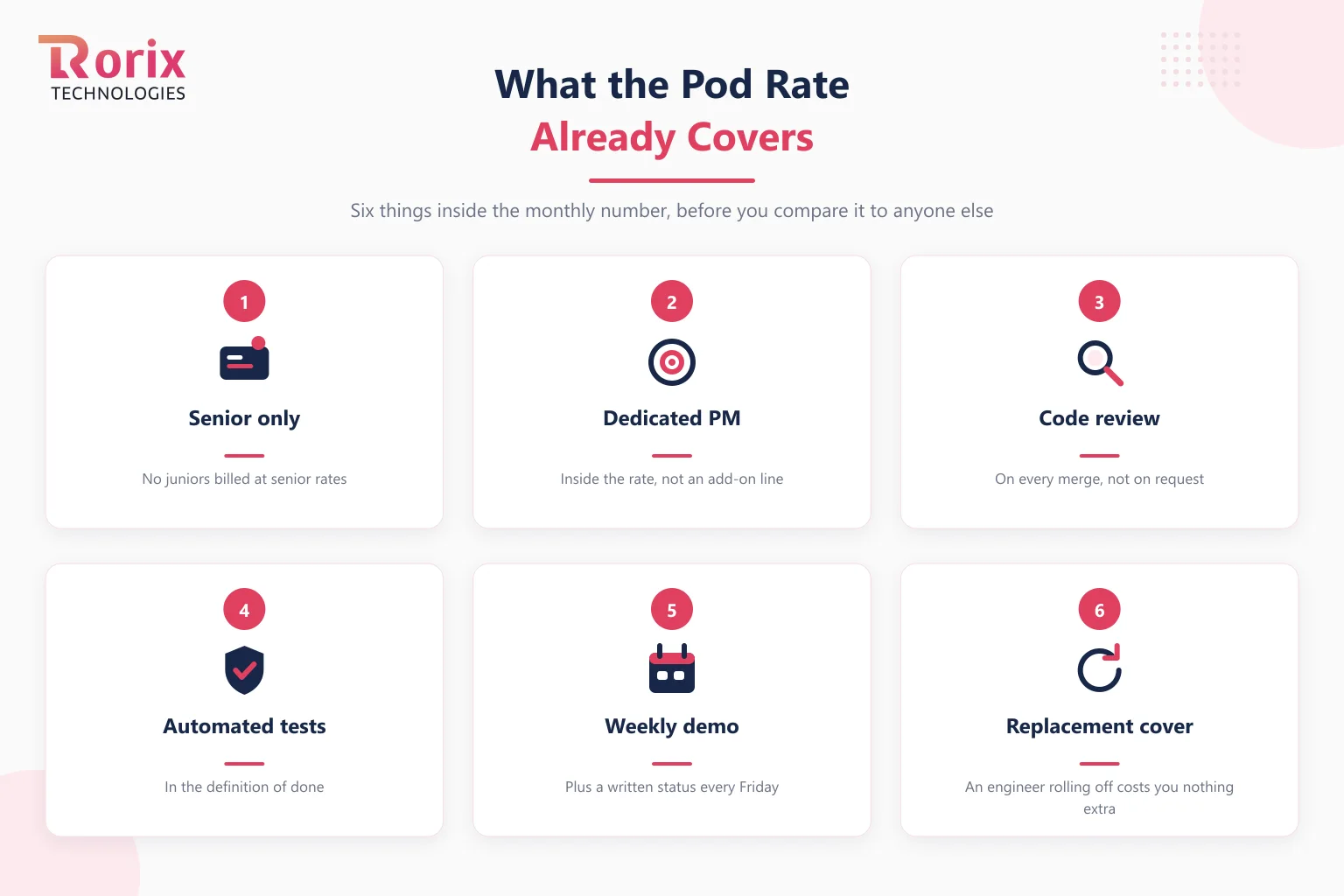
That list matters when you compare quotes. A partner quoting a lower per-engineer number without a project manager inside it is quoting a different product, and the management hours land on you. Price your own time into the comparison before deciding which number is lower.
What the Rate Does Not Cover
Four things sit outside it, and all four are cheaper to discover now than mid-project.
Infrastructure and DevOps. Our scope is application engineering. Cloud architecture, production infrastructure ownership, and the on-call rotation remain with your team or your client's. If your client expects the build to arrive with someone running its infrastructure, that is a separate line in your proposal.
Third-party licenses and services. Cloud hosting, payment processors, monitoring, email delivery, and any commercial library the build depends on. These belong to whoever owns the accounts, which is usually your client.
Your own account management. White label moves the engineering, not the account. The hours you spend running client conversations, setting priorities, and making scope calls are real costs that never appear on a partner invoice.
Design, where a build needs it. A team ships engineering. If the project needs product design or brand work, that stays with your team.
What the Same Engineer Costs in the US or UK
Senior engineering in the US blends to $100 to $150 an hour once employer costs are counted, not the salary figure alone. We published the derivation rather than asserting the band: the arithmetic behind US developer rates starts from the BLS median software developer wage, adds the employer benefits share, and divides by realistic productive hours to land at roughly $106 an hour before overhead.
At 160 hours a month, that band converts to $16,000 to $24,000 per engineer per month for the same capacity a team supplies at $3,000 to $3,333. Against Team S at the floor of the US band, that is a multiple of about 4.8. Against Team L at the ceiling, it is eight.
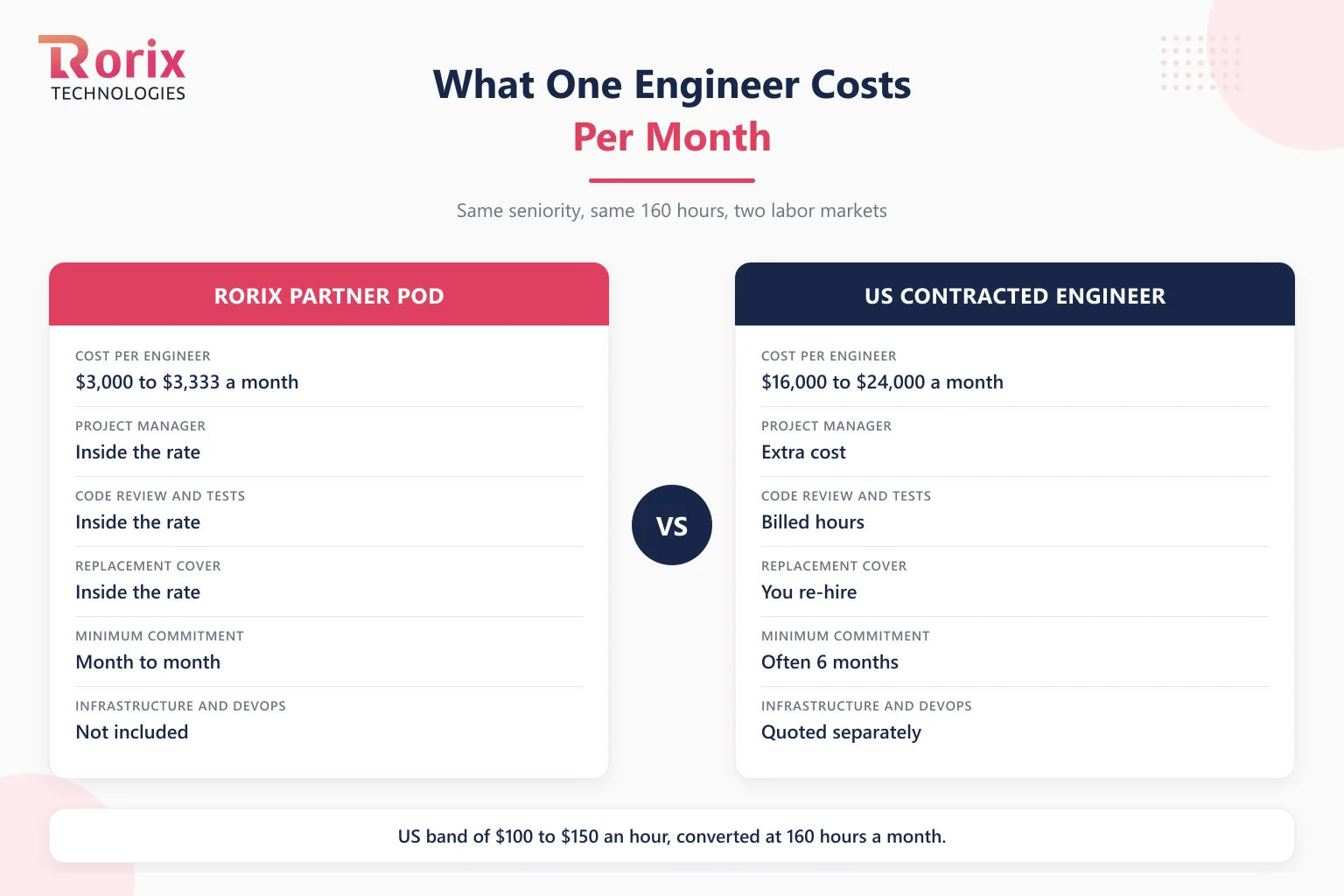
Two honest qualifications belong with those numbers. The US figure is a contractor blended rate rather than a salary, so comparing it to a full-time hire's base pay understates the hire. And a multiple of five is not a promise of five times the margin, because your billing rate does not move when your cost does.
Why We Do Not Publish Your Margin
Every white-label pricing page eventually shows a worked example: the team costs this, you bill that, here is your margin. We deliberately do not, and the reason is not modesty.
Three variables sit between the team cost and your actual margin, and all three belong to you. Utilization, because an engineer you are paying for and not billing is pure cost. Discounting, because the rate in your proposal and the rate after procurement finishes with it are different numbers. Contract shape, because a fixed-price build carries overrun risk that a time-and-materials engagement does not.
Publishing a margin figure would mean publishing assumptions about your business that we cannot see. Both ends of the range are on this page. Apply your own numbers, and if you want a sanity check on the client-facing figure before the proposal goes out, our project cost estimator produces a range in about two minutes.
The Costs That Never Appear on the Invoice
Three of these catch agencies out on the first engagement.
The payment terms gap. You pay the partner monthly. Your client pays you on 30 or 60 day terms, sometimes on milestones. On a six-month build that gap is real working capital, and it is the most common reason a profitable-on-paper subcontract feels tight in month two.
Scoping time before revenue. The brief has to be turned into something a team can start on. That work happens before your client's first invoice and rarely gets billed.
Currency and transfer costs. Small per transaction and not nothing over a year. Agree the billing currency up front.
How to Price a Client Build Against a Monthly Team Cost
Teams are priced monthly. Client builds are frequently sold fixed price. Converting between them is where the margin is actually won or lost.
The sequence that works: scope the build with the partner before the number goes into your proposal, convert the estimate into team-months, add contingency for the scope you know will move, then price the client from your own market position rather than by marking up the cost. Pricing off cost is how agencies end up billing offshore rates to a client who was ready to pay for outcomes.
If the client is buying access to a team they will still have next year rather than a delivered build, the shape you want is a dedicated development team rather than a project subcontract, and the pricing conversation changes with it. The mechanics of who signs what in either arrangement are covered in how white-label software development actually works.
Frequently Asked Questions
What does white label software development cost?
At Rorix, $3,000 to $3,333 per engineer per month depending on team size, with a dedicated project manager included in that figure. Teams start at $10,000 a month for 3 senior engineers plus a PM. Market rates vary widely by region and by what a partner includes, so compare what is inside the number rather than the number alone.
Is a white-label team priced hourly or monthly?
Monthly, as a unit. Hourly pricing pushes both sides into counting hours instead of shipping, and it makes the project manager an add-on rather than part of the team. Our retainer pricing shows the same monthly structure for direct engagements.
Is there a minimum commitment?
Teams run month to month, and you move between S, M, and L on 15 days notice. That matters more than it sounds: capacity you cannot shrink on short notice is a fixed cost, which defeats most of the reason to subcontract in the first place.
What is not included in the monthly rate?
Infrastructure and DevOps ownership, third-party licenses and hosting, product or brand design, and your own account management time. Engineering, project management, code review, testing, and replacement cover are inside it.
How does this compare to hiring an engineer in the US?
At 160 hours a month, US blended contractor rates of $100 to $150 an hour work out to $16,000 to $24,000 per engineer per month, against $3,000 to $3,333 for a team engineer. The comparison holds for contracted capacity. A full-time hire carries different economics and different commitments.
Can we buy one engineer instead of a whole team?
Ask and we will quote it. The team exists because a lone engineer without a project manager tends to become the agency's management problem, but single-engineer arrangements are quoted where they genuinely fit.
Does the rate change if the client project runs longer?
The monthly rate is the monthly rate, and engagements are month to month by default. Rorix publishes commitment discounts on dedicated capacity of 5% at three months, 10% at six, and 15% at twelve. Team L is staffed to bench availability, which is worth raising early on a large or long build.
Need engineering capacity under your own brand?
A partner team is 3 senior engineers and a project manager at $10,000 a month, white label by default and month to month. You keep the client, the brand, and the spread.
Continue learning
Written by
Renish DadhaniyaFounder & Director, Rorix Technologies
Renish co-founded Rorix Technologies and drives the engineering and delivery culture across the organization. Beyond engineering, he leads the company's sales, finance, and HR operations, building the infrastructure that lets the team focus on shipping quality software. With deep hands-on expertise in architecture and team building, he ensures every project lands on time to the quality standards clients demand.
View full profileRelated articles
White-Label Software Development: How the Arrangement Actually Works
White label software development explained through the contracts: who signs what, how the money moves, when IP transfers, and who meets your client.
Read article
How to Vet a White-Label Development Partner
Eight questions that separate a white-label development partner from a subcontractor, what a good answer sounds like, and where the bad answers hide.
Read article
Custom CRM Development Cost in 2026: Pricing by Features, Team & Timeline
How much does custom CRM development cost in 2026? See pricing by build tier, features, team size, timeline, data migration, and ongoing maintenance.
Read article