
How to Vet a White-Label Development Partner
Eight questions that separate a white-label development partner from a subcontractor, what a good answer sounds like, and where the bad answers hide.
On this page19 sections
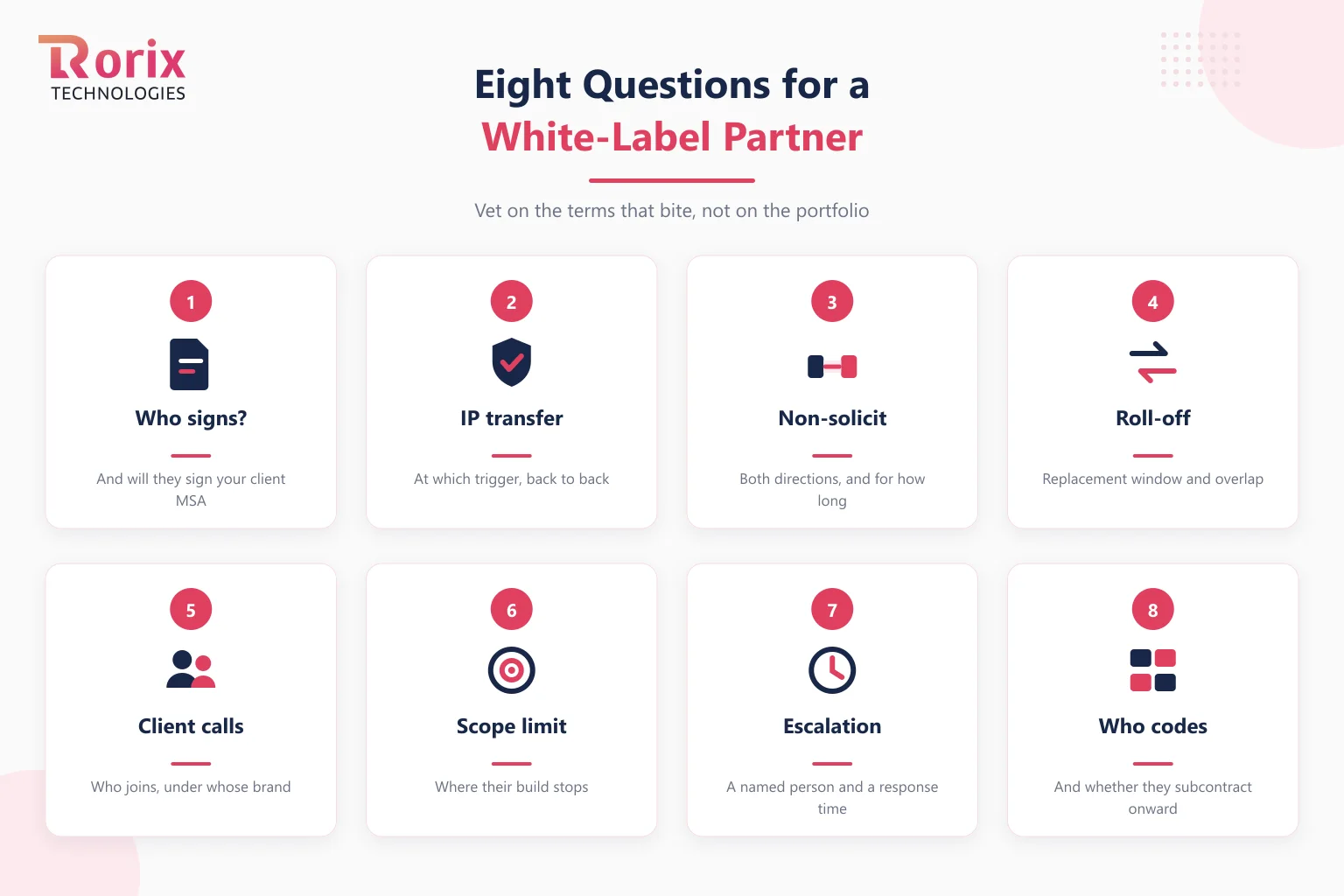
Vet a white-label partner on the terms that bite when something goes wrong, not on the portfolio. Eight questions do most of the work: who signs what, when IP transfers, whether the non-solicit runs both directions, what happens when an engineer rolls off, who joins client calls, where their scope stops, how you escalate, and whether they subcontract onward. A partner who answers all eight without checking is a partner who has been asked before.
Portfolios and case studies tell you what a partner can build. They tell you nothing about what happens in week nine when a lead engineer resigns and your client's launch is booked. This checklist is written to be run on us and on our competitors, because a version that only we pass would not be worth publishing.
Key Takeaways: What Separates a Partner From a Subcontractor
- Specific answers beat reassuring ones. "We would work something out" is a red flag wearing a friendly face.
- Every commitment that matters belongs in the agreement, not in the sales call where it was made.
- Mutual terms are the tell. A non-solicit protecting only the partner tells you which risk they were thinking about.
- Ask who writes the code. Onward subcontracting is the single fastest way for the team you vetted to stop being the team you get.
- Test with a real project before a flagship one. A pilot that never meets friction proves nothing.
The Eight Questions
1. Who Signs What, and Will You Sign My Client's MSA?
Why it matters. The two-contract structure is what keeps you accountable and the partner invisible. Some enterprise clients require every party touching the code to be on paper, which puts pressure on that structure.
A good answer describes the default clearly: the partner contracts with your agency, never with your client. It then handles the exception without either refusing outright or agreeing too easily, because signing directly with your client as a peer is a different arrangement entirely.
Ours. Rorix contracts with your agency. Where your client's MSA has to cover everyone touching the code, we will sign it as a subcontractor provided your agency stays the prime contractor and carries the liability flow-down. We read the liability and indemnity terms before signing, which is a reasonable thing to expect in either direction. The full mechanics are in how white-label software development actually works.
2. When Does IP Actually Transfer?
Why it matters. You have promised your client ownership. If your partner agreement transfers later than your client agreement does, there is a window where you have promised something you do not yet hold.
A good answer names a trigger condition and does not flinch when you ask to see the clause. Watch for transfer on "final settlement" when you have promised your client ownership on delivery.
Ours. IP transfers to your agency on payment, with no retained license and no dependency that requires us to keep anything running after handover.
3. Does the Non-Solicit Run Both Directions, and for How Long?
Why it matters. One direction protects your clients from the partner. The other makes the partner comfortable putting senior engineers in front of your client at all. You want both, and you want to know it outlives the engagement.
A good answer states a duration and confirms survival after termination. A clause that expires when the engagement ends protects you during the only period you were never exposed.
Ours. Mutual, running 24 months from the end of your last engagement with us rather than from each individual team, and it survives termination. The NDA is signed before the first brief rather than after it.
4. What Happens When an Engineer Rolls Off Mid-Build?
Why it matters. This is the question most agencies forget and every agency eventually needs answered. People resign, projects get reprioritized, and continuity is what separates a partner from a staffing marketplace.
A good answer contains three numbers: how long until a replacement is named, how much handover overlap you get, and whether you approve the replacement. Vague answers here are a reliable forecast of how the situation will go.
Ours. A replacement named within 10 business days, a two-week overlap where both engineers are on the project, and your approval before the swap.
5. Who Joins a Client Call, and Under Whose Brand?
Why it matters. An engineer joining a call with the wrong company name in their meeting profile ends the white-label arrangement in one second, in front of the client.
A good answer treats this as your decision per client rather than their policy, and covers the operational details that have to match it: repository ownership, documentation branding, sprint board access, and the email domain on standup invitations.
Ours. Your brand on repositories, documentation, and standups. Engineers join client calls under your banner, introduced by you, or stay behind the curtain entirely. Both arrangements run today.
6. Where Does Your Scope Stop?
Why it matters. The gap between what a partner builds and what your client assumed they were getting is discovered at the worst possible time, usually the week before launch.
A good answer draws the line without being asked twice. Application engineering and production infrastructure are different disciplines, and a partner who claims both should be able to describe how they staff both.
Ours. Application engineering. Infrastructure and DevOps remain with your team or your client's. You can see the stack a team works in before scoping anything against it.
7. How Do I Escalate, and to Whom?
Why it matters. Every engagement eventually has a bad week. The difference between a bad week and a lost client is how fast you can reach someone with authority.
A good answer names a person and a response time, not a support address. Ask what the regular reporting cadence is too, because escalation should never be how you first learn a sprint is off track.
Ours. A named delivery lead you contact directly, with a response inside 24 business hours on delivery escalations, which is a separate clock from the support ticket response times on our pricing page. A weekly sprint demo and a written status every Friday run alongside it.
8. Who Actually Writes the Code, and Do You Subcontract Onward?
Why it matters. A partner who subcontracts your work onward has turned your one-layer arrangement into two, and the team you vetted is not the team you get. It also quietly breaks the confidentiality chain you promised your client.
A good answer is a plain no, with a description of where the engineers actually sit. Ask about seniority mix in the same breath, because juniors billed at senior rates is the oldest arithmetic in this industry.
Ours. One team in one office in Ahmedabad with no subcontracting chains. Senior engineers only, and the people on your project are the people you were introduced to.
Red Flags That Should End the Conversation
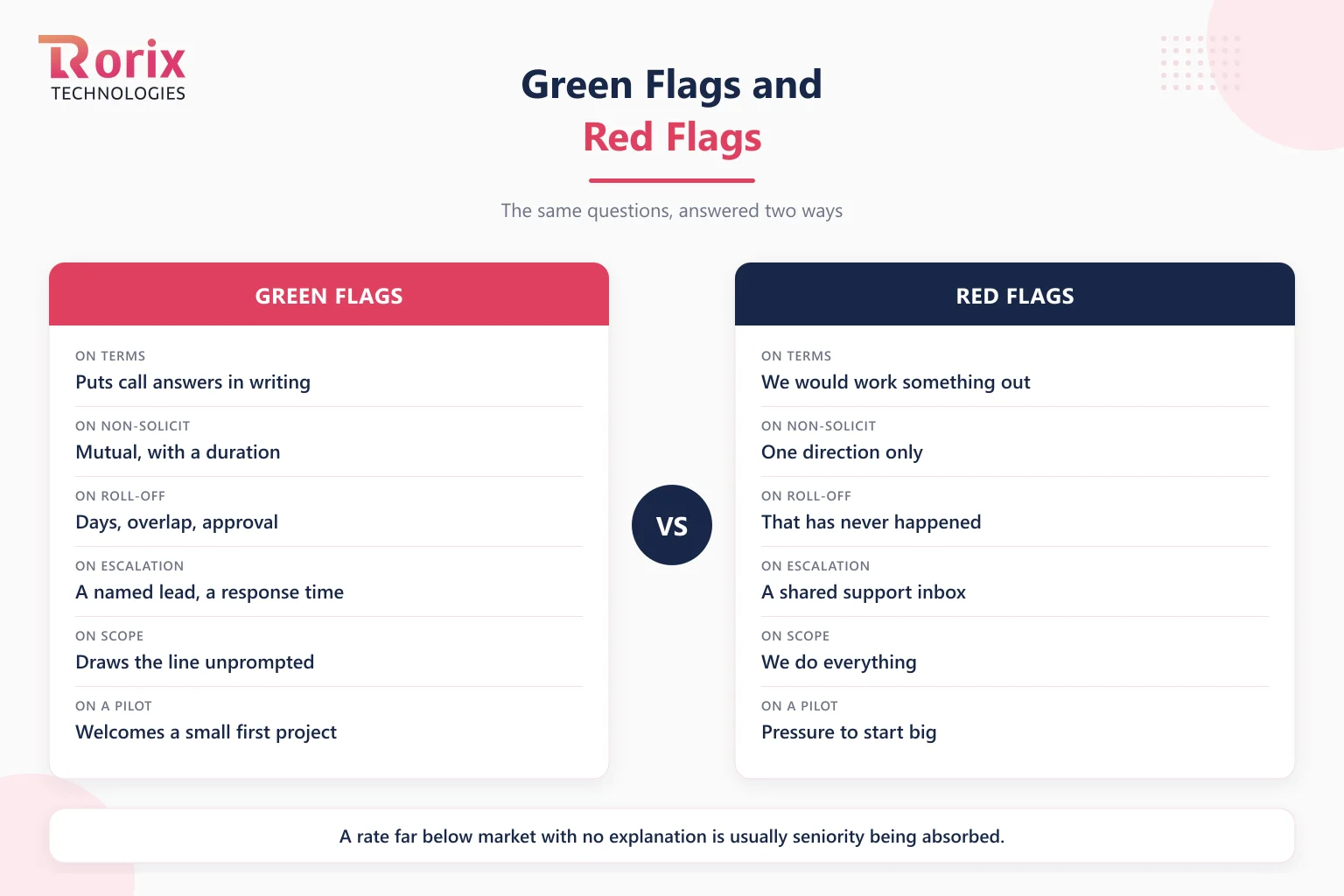
A rate far below the market with no explanation. Someone is absorbing the difference, and it is usually seniority. What white-label engineering costs per engineer gives you a reference point for what a senior team actually costs.
Reluctance to put a sales-call commitment into the agreement. If it was true on the call it can be in the contract.
A one-directional non-solicit. See question 3.
No named individual anywhere. A partner who will not name your delivery lead before signing will not produce one after.
Pressure to skip the pilot. A partner confident in their delivery has no reason to resist a small first project.
Portfolio work they cannot discuss. Confidentiality is normal and expected. A complete inability to describe the shape of the problem or the technical decisions is not.
What to Test Before the Full Engagement
Run one real project. Small enough that a bad outcome is survivable, real enough to meet friction.
Watch four things. How the scoping conversation goes, because a partner who accepts a vague brief without pushing back will accept a vague sprint too. Whether the first demo shows working software or a status update. What happens when a requirement changes mid-sprint. And how a slip gets communicated, since every project has one and only the good partners tell you early.
Deciding whether this route is right at all is a separate question from choosing who to run it with. When an agency should subcontract a build covers that decision, and if the client is really buying a standing team rather than a delivered project, dedicated development teams are the better shape.
To run this checklist on us, our partner team terms answer all eight in writing, and the closest published example of the arrangement working is the white-label platform we engineer for Jedari.
Frequently Asked Questions
How do I choose a white-label development partner?
Vet on contract terms and continuity rather than on portfolio alone: who signs what, when IP transfers, whether the non-solicit is mutual, what happens when an engineer rolls off, and whether they subcontract onward. Then test with one small real project before committing a flagship client.
What should be in a white-label development agreement?
Scope boundaries, the monthly rate and notice period, the IP assignment and its trigger condition, confidentiality, a mutual non-solicit with a stated duration, the replacement window when an engineer rolls off, the escalation path with a named contact, and who is permitted to speak to your client.
How do I check a partner's engineers are actually senior?
Ask who writes the code and whether any of it is subcontracted onward, ask for the seniority mix on your specific team, and interview the engineers assigned to you rather than the ones in the pitch deck. A partner who will not let you meet the assigned team before signing is answering the question.
Is a cheap white-label rate a bad sign?
Not automatically, since offshore economics are real. A rate far below the market with no explanation of what makes it possible usually is, because the difference tends to come out of seniority, project management, or code review.
Should I tell my client I use a white-label partner?
That is your call, and a properly structured arrangement leaves nothing that discloses it for you. Some agencies disclose deliberately on longer engagements or in regulated work. Most do not.
How long should a white-label pilot project run?
Long enough to meet real friction, which usually means at least two sprints. A single sprint on a clean greenfield task tells you the partner can write code. It tells you nothing about how they handle a changed requirement or a slipped estimate.
Need engineering capacity under your own brand?
A partner team is 3 senior engineers and a project manager at $10,000 a month, white label by default and month to month. You keep the client, the brand, and the spread.
Continue learning
Written by
Renish DadhaniyaFounder & Director, Rorix Technologies
Renish co-founded Rorix Technologies and drives the engineering and delivery culture across the organization. Beyond engineering, he leads the company's sales, finance, and HR operations, building the infrastructure that lets the team focus on shipping quality software. With deep hands-on expertise in architecture and team building, he ensures every project lands on time to the quality standards clients demand.
View full profileRelated articles
What White-Label Engineering Costs an Agency Per Engineer
White label development cost, per engineer and per month: what a partner team runs, what the same seniority bills in the US, and what the rate excludes.
Read article
White-Label Software Development: How the Arrangement Actually Works
White label software development explained through the contracts: who signs what, how the money moves, when IP transfers, and who meets your client.
Read article
Best WMS for Ecommerce: Buyer's Guide (2026)
Choose the best WMS for ecommerce with a buyer's guide: a 10-step selection process, vendor questions, costs, timelines, and mistakes to avoid.
Read article