
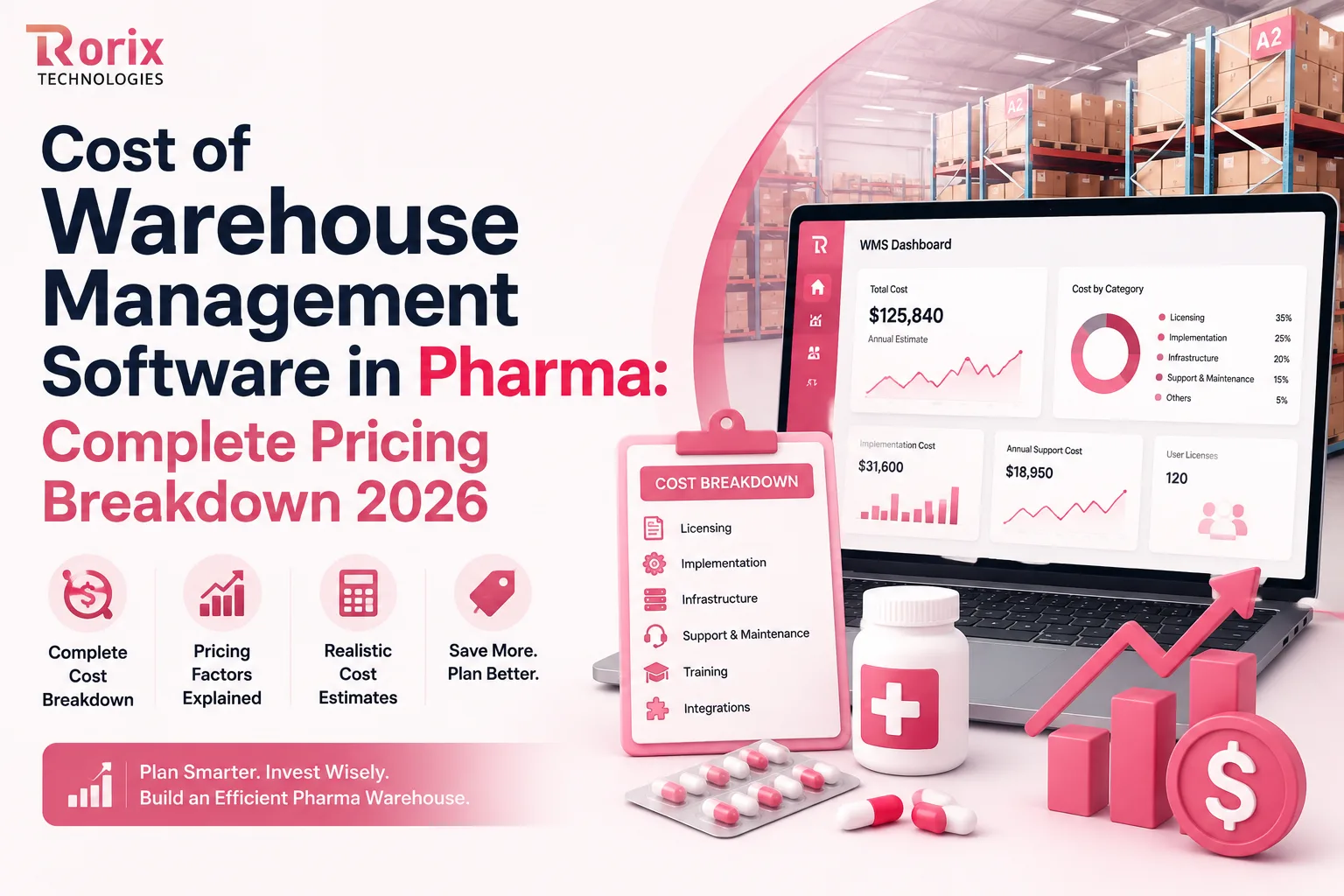
Cost of Warehouse Management Software in Pharma: Complete Pricing Breakdown 2026
What does a pharma WMS really cost? Year-one bands by operator profile, what validation and DSCSA add, and the three-year total hiding behind the quote.
On this page36 sections
A pharma warehouse management system costs roughly $40,000 in year one for a single ambient site and passes $750,000 for a manufacturer running serialization at scale. Most regulated distributors land between $120,000 and $350,000. The license is the small half of that number. Validation, DSCSA, integrations, and hardware are the large half.
That gap is where budgets break. A vendor quotes a monthly subscription, finance approves it, and eighteen months later the project has absorbed a validation program, an EPCIS exchange, a sensor integration, and a requalification cycle nobody costed.
The difference comes down to what the system has to control and prove. Pharma warehouses need more than inventory and picking. They need lot and serial tracking, FEFO, quarantine enforcement, temperature monitoring, audit trails, validation, and compliance controls that hold up when an inspector asks for evidence. Those requirements are what separate a lightly configured off-the-shelf product from custom WMS development, and they are most of the reason the two carry such different price tags.
In this guide, you'll learn:
- What a pharma WMS costs in year one, by operator profile
- Which regulated capabilities drive the most cost
- What validation and computer system validation actually add
- What DSCSA and serialization cost by trading partner role
- How each pricing model behaves by year three
- Whether to buy, configure, or build
- The hidden costs that arrive after go-live
- A worked three-year total cost of ownership
Key Takeaways: What a Pharma WMS Really Costs
- Year one runs about 1.5 times the general-market WMS cost for a warehouse of the same size. A single ambient site starts near $40,000. A DSCSA-active regional wholesaler runs $120,000 to $350,000. A custom build runs $250,000 to $600,000 and up.
- Validation is the line most budgets miss. A configured single-site platform needs $25,000 to $75,000 of qualification work, a custom system $120,000 to $250,000 or more, and 15% to 25% of that again every year for requalification.
- DSCSA cost depends on your role, not your size. A dispenser group may add $15,000 to $60,000. A manufacturer commissioning and aggregating serial numbers reaches $80,000 to $250,000 on the warehouse side alone.
- Compare quotes on three-year totals. The worked example later in this guide reaches $687,000 across three years on a first-year quote that looked like $60,000 of software.
Cost of Warehouse Management Software in Pharma at a Glance
Two warehouses of identical square footage can sit $200,000 apart. Temperature control, controlled substances, serialization scope, and customer quality agreements move the number far more than floor space does.
| Operator profile | Software (recurring) | Implementation and validation | Year one all-in |
|---|---|---|---|
| Small pharma or medical supply distributor (one site, ambient) | $1,000 to $3,000 per month | $25,000 to $70,000 | $40,000 to $110,000 |
| Regional pharma wholesaler (multi-zone, DSCSA active) | $3,000 to $8,000 per month | $80,000 to $250,000 | $120,000 to $350,000 |
| Pharma 3PL (multi-client, quality agreements) | $4,000 to $10,000 per month | $120,000 to $300,000 | $170,000 to $420,000 |
| Manufacturer or enterprise network (serialization at scale) | Enterprise license or subscription | $250,000 to $600,000 and up | $300,000 to $750,000+ |
| Custom-built pharma WMS | Hosting plus support | $200,000 to $500,000 build | $250,000 to $600,000+ |
How Much Is the Pharma Premium Over a Standard WMS?
Set these bands against the general market and the premium becomes measurable. A small warehouse in our WMS pricing guide runs $25,000 to $75,000 in cloud year one, and a mid-size warehouse $75,000 to $200,000. The pharma equivalents above are $40,000 to $110,000 and $120,000 to $350,000.
That is roughly 1.5 to 1.75 times the same-size band. Part of it is configuration, because regulated workflows carry more rules, more statuses, and more blocking conditions. The rest is validation, which is not configuration at all and arrives as its own line on the invoice.
A custom pharma build at $200,000 to $500,000 sits in the complex-platform tier of general custom software costs, which is where a system with its own compliance surface belongs.
Why a Pharma WMS Costs More Than a Standard Warehouse System
The extra money does not buy extra features. It buys enforcement.
In a general warehouse, putaway means moving stock to a location. In a pharma warehouse, the same transaction may have to check the lot number, the expiry date, the quarantine status, the temperature zone, and the operator's authority, then write an audit record before the pallet is allowed to move.
Every one of those checks is a rule that has to be built, tested, documented, approved, and retested whenever the system changes. That is why the cost lands in implementation and validation rather than in the license.
Which Pharma WMS Capabilities Drive the Most Cost
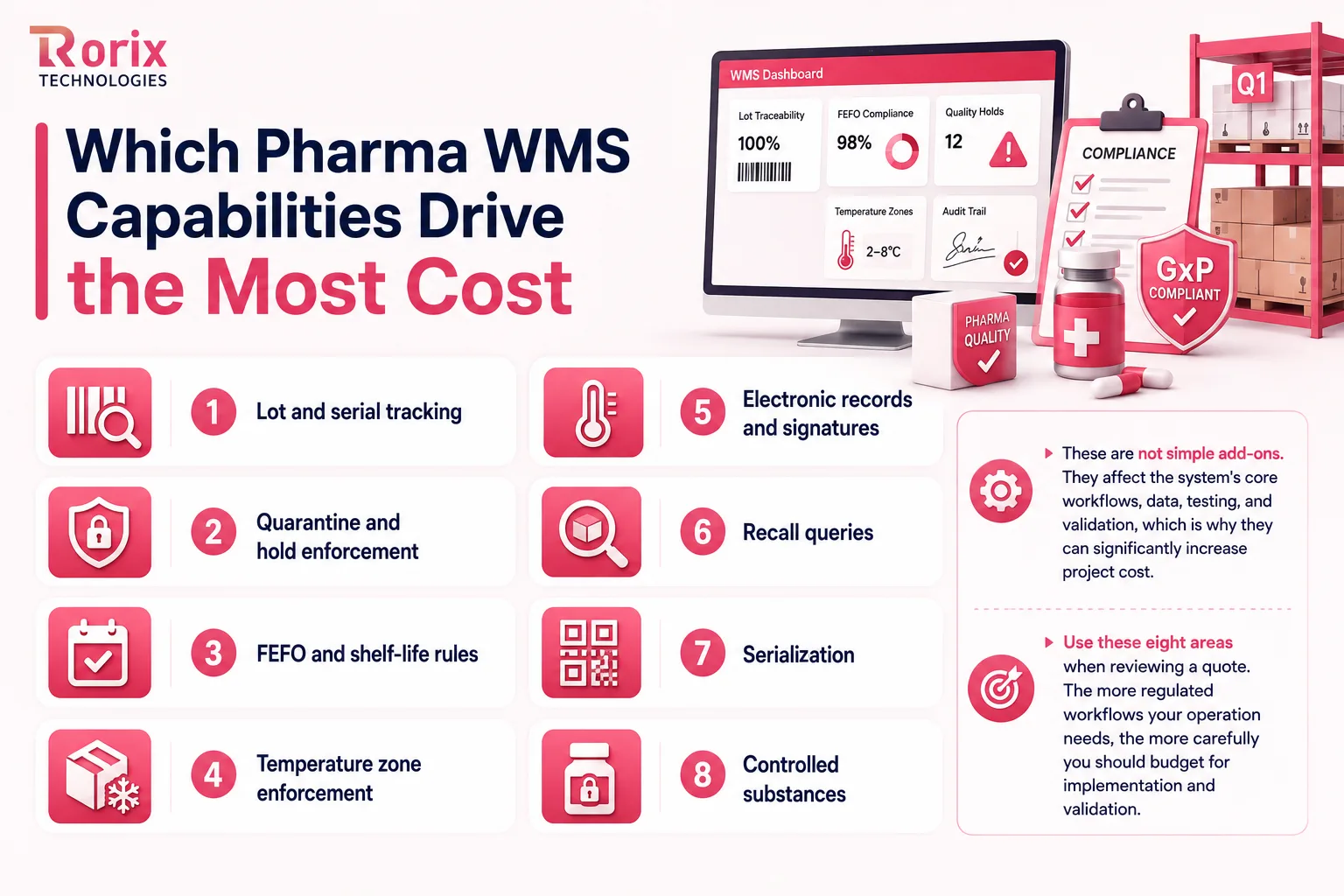
These eight capabilities move a quote more than any other line on a requirements list:
- Lot and serial tracking: keeps every unit linked to its lot or serial number from receiving through shipping and returns, which is what makes a recall trace fast instead of frantic.
- Quarantine and hold enforcement: blocks product on quality hold from being picked or shipped. The control has to bind across the warehouse, not sit on the record as a status nobody reads.
- FEFO and shelf-life rules: allocates by expiry and can refuse an order that fails a customer's minimum remaining shelf life.
- Temperature zone enforcement: keeps product moving only through approved zones and stops a wrong move before it becomes a quality event.
- Electronic records and signatures: builds the audit trail showing who did what and when, with signatures on critical actions, in line with 21 CFR Part 11.
- Recall queries: one lot number returns the affected stock, customers, shipments, and quantities. That depends on transaction history being complete rather than on a report being clever.
- Serialization: captures and exchanges package-level identifiers at volume. The hard part is retrieval years later, not capture today.
- Controlled substances: adds restricted access, reporting, and record-keeping on top of everything else.
None of these are add-ons. Each one reaches into core workflows, the data model, testing, and validation, which is why a requirements list with all eight prices differently from one with three.
Use them as a quote checklist. The more of them your operation genuinely needs, the more of your budget belongs in implementation and validation rather than software.
What You Are Actually Paying For: The Full Cost Breakdown
| Cost component | Cost type | Main cost driver |
|---|---|---|
| Software license or subscription | Recurring | Users, sites, volume |
| Implementation and configuration | One-off | Workflows, zones, data |
| Validation and qualification | One-off plus recurring | GxP scope and risk |
| Integrations | Mixed | ERP, QMS, LIMS, sensors |
| DSCSA and serialization | Mixed | Data volume and trading role |
| Hardware | One-off plus replacement | Scanners, printers, sensors |
| Training and SOPs | Recurring | Users and shifts |
| Support and data retention | Recurring | SLA and archive needs |
Integrations deserve particular attention, because they are the line most often quoted as a single number and delivered as several. Our guide to WMS integration best practices covers how to scope ERP, QMS, and sensor connections before a vendor prices them.
Validation and CSV: The Line Item Most Pharma Budgets Miss
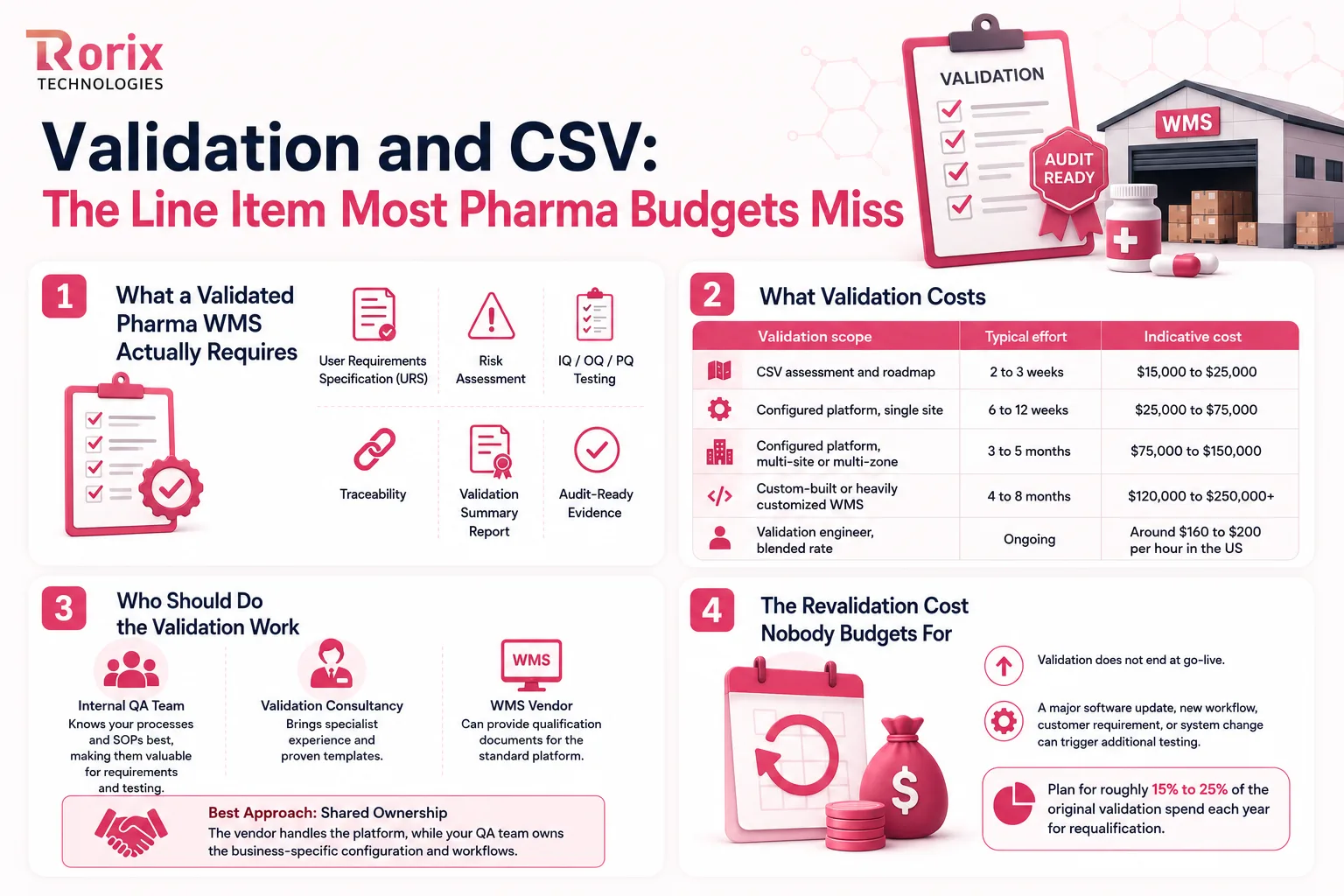
Validation does not happen at the end of the project. It starts during implementation and continues for as long as the system is in service.
Configuration shows the system does what you planned. Validation proves it was specified, tested, approved, and documented well enough to survive an inspection.
What Pharma WMS Validation Actually Includes
A typical validation package covers:
- User Requirements Specification (URS)
- Risk assessment
- IQ, OQ, and PQ testing
- Requirements and test traceability
- Final validation report
Each requirement that matters has to trace to a test and an approval. That traceability is the deliverable, and it is what takes the time.
How Much Does Pharma WMS Validation Cost?
| Validation scope | Typical effort | Indicative cost |
|---|---|---|
| CSV assessment and roadmap | 2 to 3 weeks | $15,000 to $25,000 |
| Configured WMS, single site | 6 to 12 weeks | $25,000 to $75,000 |
| Configured WMS, multi-site or multi-zone | 3 to 5 months | $75,000 to $150,000 |
| Custom or heavily customized WMS | 4 to 8 months | $120,000 to $250,000+ |
| Validation engineer | Ongoing | Around $160 to $200 per hour in the US |
These bands hold up against independent pricing. A published CSV pricing guide from IntuitionLabs puts a CSV assessment and roadmap at $15,000 to $25,000, full validation execution at $40,000 to $120,000 per system over 6 to 12 weeks, and US validation consultants at $160 to $192 an hour. Its per-system range runs wider at the top than the single-site row above, which is worth knowing before you treat $75,000 as a ceiling.
One reconciliation to keep in mind: the small distributor profile earlier shows $25,000 to $70,000 for implementation and validation combined, which is less than a full single-site CSV package. That profile assumes a light, risk-based validation scope, closer to the assessment tier. Once GxP scope widens, the full package applies and the profile moves up a band.
Using your own QA team lowers the external invoice. It does not lower the work, because your team still owns requirements, testing, documentation, and approvals.
Who Should Handle the Validation Work?
Your QA team knows your processes and SOPs, so requirements and test review belong with them. The vendor can supply qualification documents and testing for the standard platform. A validation consultancy brings templates and specialist testing.
Shared ownership usually costs least: the vendor validates the standard system, your QA team owns the business-specific configuration and workflows.
The Revalidation Cost That Outlives Go-Live
Validation does not stop when the WMS goes live. A major update, a new workflow, a new integration, or a process change can each trigger fresh testing and approval.
Budget 15% to 25% of the original validation spend every year for requalification. On a $100,000 validation program that is $15,000 to $25,000 annually, and putting it in the model from the start is cheaper than explaining it later.
Also Read: WMS Implementation Checklist: 50 Steps to Successful Deployment
What DSCSA and Serialization Add to the Bill
The timing matters now in a way it did not two years ago. FDA's phased exemptions have expired for manufacturers and repackagers (May 27, 2025), wholesale distributors (August 27, 2025), and dispensers with 26 or more employees (November 27, 2025). Only small dispensers of 25 or fewer employees still hold an exemption, and it ends on November 27, 2026, according to the DSCSA deadline map by trading partner type. For everyone else, full interoperable DSCSA scope is live today, not a future project.
What Does DSCSA Cost by Trading Partner Role?
| Trading partner role | What your WMS must handle | Indicative added cost |
|---|---|---|
| Manufacturer or repackager | Serial generation, aggregation, commissioning, outbound EPCIS | $80,000 to $250,000 |
| Wholesale distributor | Inbound and outbound EPCIS, returns verification, exception queue | $50,000 to $180,000 |
| Third-party logistics provider | Receive, retain, and pass data without title, per-client segregation | $40,000 to $150,000 |
| Dispenser or pharmacy group | Package-level receipt, identifier verification, record retention | $15,000 to $60,000 |
These are the warehouse-system numbers, and that distinction matters when you compare them with figures published elsewhere. A full enterprise serialization platform program, the kind built on TraceLink, SAP ATTP, or similar, is quoted at $200,000 to $2 million and up for manufacturers depending on volume. That is a different scope: line-level commissioning, plant equipment, and a dedicated serialization repository. The rows above cover what the WMS itself has to do alongside it.
The expensive part was never scanning a barcode. It is storing, exchanging, and retrieving package-level data reliably at volume.
What Drives Serialization Data Volume
Three things set the size of the problem:
- Product structure: a pallet holds cases, which hold units. The system has to keep those parent-child links correct through every move, split, and repack.
- Transaction volume: every receipt, movement, and shipment multiplies the serialized records you create.
- Data retention: serialization records have to stay available for years, not months.
Storage is cheap. Retrieval is not. The design question is whether you can pull the right record quickly when the volume is four years deep, and whether you hold that data yourself or pay a managed service to hold it.
Returns and Exception Handling
A returned pack cannot go back to saleable stock until its identifier and transaction history check out. Exceptions work the same way: missing serials, failed transactions, and mismatched records all need investigation before the inventory moves.
Build those queues into the WMS and the work stays inside the system. Leave them out and a cheaper license quietly becomes a spreadsheet, an email thread, and a full-time coordinator.
How Cold Chain Requirements Increase WMS Costs
Cold storage adds a layer that ambient operations never pay for. The system has to track conditions continuously, control which zone a product may occupy, and connect a temperature event to the exact inventory it affected.
The cost sits in four places: sensor and monitoring integration, zone enforcement logic, excursion workflows that route an alert through investigation, corrective action, and QA release, and cold-rated hardware, because scanners, printers, batteries, and labels all cost more when they have to work below freezing.
Costs climb fastest when temperature data and inventory data live in separate systems. Manual reconciliation adds labor, and any change to chillers, racking, or airflow can trigger new temperature mapping and system checks. Alerts also need to arrive fast enough to block an unsafe pick, which is an integration design decision rather than a licensing one.
Our cold storage WMS guide covers the zone model, FEFO rules, and excursion workflows in full.
Pharma WMS Pricing Models and What Each One Costs You in Year Three
The cheapest quote today is frequently not the cheapest system by year three. Users grow, sites get added, order volume rises, and every vendor release carries a revalidation question.
| Pricing model | How you pay | Pharma-specific risk |
|---|---|---|
| SaaS subscription | Monthly or annual fee | Vendor releases may trigger revalidation |
| Per user | Named or concurrent users | QA reviewers and seasonal staff inflate the count |
| Per site | Fee for each facility | Every site may need its own validation |
| Perpetual license | Upfront plus 15% to 22% annual maintenance | Upgrades and requalification stay your cost |
| Usage based | Per order, line, or scan | High serialization volume raises the meter |
The question worth asking is not which model is cheapest. It is which model stays predictable as you grow.
SaaS starts easily and hands you an update cadence you do not control. Per-user and per-site pricing punish exactly the growth you are planning for. Perpetual licensing buys control of the release calendar and bills you for using it. Usage-based pricing tracks serialization volume, which in pharma only goes up.
Deployment choice compounds all of it, and our cloud versus on-premise WMS comparison works through what each one does to a validated environment.
Off-the-Shelf vs Configured Platform vs Custom-Built Pharma WMS
Buy, configure, or build is the decision that moves this budget by hundreds of thousands of dollars, and it turns on one question: how closely do your workflows already match what the software does?
| Criterion | Off-the-shelf | Configured platform | Custom-built |
|---|---|---|---|
| Year one cost | $40,000 to $110,000 | $150,000 to $500,000 | $250,000 to $600,000 |
| Time to go-live | 8 to 16 weeks | 6 to 18 months | 4 to 8 months with validation |
| Validation burden | Vendor supplies most documents | Shared, heavy configuration testing | Full requirements to PQ, owned by you |
| Workflow fit | Whatever the vendor built | Close, within configuration limits | Exact |
| Upgrade risk | Forced, on vendor schedule | Forced, as large projects | You control the release calendar |
| Source code ownership | None | None | Full |
Independent benchmarks put a cloud WMS deployment at 8 to 12 weeks and a complex custom implementation at 6 to 12 months, with the full range running 3 to 12 months by warehouse complexity, according to Davanti WICS. Treat any single timeline as a scope statement rather than a speed claim.
When Each Option Is the Right Call
- Choose off-the-shelf when your workflows are standard, one site covers your operation, and you want a rollout rather than a program.
- Choose a configured platform when you need depth across multiple sites and have the IT and QA capacity to run a complex validated environment.
- Choose a custom pharma WMS when multi-client segregation, controlled substances, or contractual shelf-life rules force logic that packaged software cannot express.
If that decision is still open, our build versus buy framework scores it against switching cost and workflow fit rather than sticker price.
Also Read: 12 Top Warehouse Management Software Development Companies
What the Engineering Itself Costs at Rorix Rates
Strip out validation and compliance for a moment: the core engineering for a custom pharma WMS follows our published build bands. A single-site system with ERP integration runs $30,000 to $64,000, and multi-site or serialization-heavy builds run $80,000 to $180,000 or more, derived from 3 to 5 developers at our public $10,000 to $16,000 monthly retainer rates.
CSV documentation, IQ/OQ/PQ execution, and the DSCSA integrations covered earlier in this guide are additional scope on top of those bands, which is exactly why they belong itemized in your quote rather than bundled. The WMS solutions page shows what the base bands include.
Hidden Costs in Pharma Warehousing
Compliance work does not end at go-live, which is why the quote and the invoice rarely match:
- Quality agreements: a customer requires a workflow, report, or control that was never in the original scope.
- Supplier audits: your vendor may bill for supporting a customer or regulatory audit of their system.
- Requalification after updates: software updates buy new testing and approval.
- Controlled substances: extra access controls, records, and reporting.
- Periodic reviews: validated systems need scheduled checks that they still do what the documentation says.
- Data retention: records have to stay retrievable for years, and archive tiers are priced accordingly.
- Exception handling: missing serials, failed checks, and data errors consume staff time indefinitely.
- Temperature changes: new racking, chillers, or airflow can require fresh mapping and system checks.
Three-Year Total Cost of Ownership: A Worked Pharma Example
Take a regional distributor with two temperature zones, around 1,200 order lines per day, and DSCSA obligations as a wholesaler.
| Cost item | Year 1 | Year 2 | Year 3 | 3-year total |
|---|---|---|---|---|
| Software subscription | $60,000 | $63,000 | $66,000 | $189,000 |
| Implementation and configuration | $95,000 | - | - | $95,000 |
| Validation and qualification | $85,000 | $18,000 | $22,000 | $125,000 |
| Integrations | $70,000 | $15,000 | $15,000 | $100,000 |
| Hardware | $45,000 | $6,000 | $10,000 | $61,000 |
| Training and change control | $25,000 | $12,000 | $12,000 | $49,000 |
| Support and periodic review | $18,000 | $24,000 | $26,000 | $68,000 |
| Total | $398,000 | $138,000 | $151,000 | $687,000 |
Year one lands at $398,000, which is above the $350,000 ceiling on the regional wholesaler row earlier in this guide. That is the useful part of the example rather than a contradiction. This operator runs two temperature zones, a heavy integration list, and distributor-scope DSCSA, and each of those pushed its line item toward the top of its range. Profile tables describe the middle of a band. Your project sits wherever your scope puts it.
Note also what the subscription did. It was $60,000 in year one and $189,000 across three, which is 28% of the total. Everything else is work.
Run your own model before you compare quotes. Our WMS ROI calculation guide sets these costs against expected savings and payback, and the project cost estimator gives you a scoped starting number.
How to Reduce Pharma WMS Costs Without Weakening Compliance
Cutting this budget is not about removing controls. It is about scoping the project properly, refusing customization that has no compliance or business reason, and concentrating testing where the risk actually sits.
8 Ways to Cut Cost Without Cutting Compliance
- Focus testing on high-risk workflows: anything that can affect product quality or patient safety earns deep testing. Low-risk functions do not need the same depth.
- Use a risk-based approach: test what matters most, apply lighter checks elsewhere, and document why you drew the line where you did.
- Use vendor validation documents: many vendors ship qualification templates with the platform. Every one you reuse is work you do not repeat.
- Clean your data first: fix product, lot, expiry, and packaging data before migration. Dirty data is the most reliable source of unplanned cost in this entire project.
- Build serialization in stages: implement what your current trading role requires instead of buying every future requirement upfront.
- Use standard integrations: existing ERP and sensor connectors cost less to build and far less to revalidate than custom ones.
- Avoid unnecessary customization: every custom change adds development, testing, and a permanent revalidation obligation.
- Reuse your validated setup: once one site works, replicate the configuration and the qualification package rather than starting over.
10 Questions to Ask Your Pharma WMS Vendor
Before you sign anything:
- Which validation documents are included in the contract?
- Which validation work will our team have to handle?
- Can we defer software updates that would trigger revalidation?
- Who pays for revalidation caused by your updates?
- What audit support is included, and what is billable?
- Which DSCSA and serialization features are in the base product?
- How long is our data retained, and what does longer retention cost?
- Which integrations are standard and which are custom work?
- How much can the price rise at renewal, and is there a cap?
- What are the data export, exit, and transition costs?
The answers turn a quote into a comparable number. Vendors who answer them precisely are usually the ones who have done this before.
Also Read: How to Calculate WMS ROI: Complete Guide
What Rorix Brings to a Regulated Warehouse Build
Pharma warehouses need more than a standard WMS with a few compliance fields added. They need software built around the workflows they actually run, from lot tracking and quarantine through traceability, integrations, and audit-ready records.
Rorix Technologies builds custom software for operations-heavy businesses, with warehouse management as our deepest specialization. We have delivered 27 software projects for operators in the US, UK, Canada, Australia, and New Zealand, and we hold a 5.0 rating on Clutch across 4 verified reviews.
What that looks like on a regulated build:
- Engineered for the domain: we build the WMS around your zones, statuses, and blocking rules instead of adapting a template to them
- Proven operational impact: up to 80% reduction in picking errors through real-time inventory, barcode scanning, and directed workflows
- Real integration depth: 40+ integrations on Driven, a US performance platform for pest control and field service teams, with iOS and Android shipped from a single React Native codebase
- A named team: a dedicated team of senior engineers with a named technical lead on every engagement, working on a retainer with two-week sprints and full task visibility
- Validation handled jointly: we build and document the system to your URS and test scripts while your QA team owns qualification and approval, which is the split that keeps validation cost down
- Full ownership: you keep the code, the data model, and the roadmap
Planning a pharma WMS or replacing one that has stopped keeping up? Book a free consultation and we will map the scope, the integration list, and a realistic project cost before you commit to an approach.
Price the Whole System, Not the License
The license is the number vendors lead with and the smallest part of what you will spend. Validation, DSCSA, cold chain, integrations, hardware, and support decide the real figure, and most of them bill again in year two.
So build the three-year model before you shortlist. Define your compliance scope, confirm your trading partner role, list every integration by name, and put requalification in the plan rather than in the risk register.
A cheaper WMS is not automatically the better one. The system worth buying is the one that enforces your workflows, keeps your data traceable and retrievable, and still makes sense at your volumes in three years. Start from your actual requirements, and the price stops being a mystery.
Ready to scope it properly? Talk to our team about your zones, your DSCSA role, and your integration list.
Frequently Asked Questions
What is the average cost of warehouse management software in pharma?
Most pharma operations land between $40,000 and $350,000 in year one, depending on site count, temperature zones, and DSCSA role. Enterprise networks running serialization at scale commonly pass $750,000 across software, implementation, and validation.
Why does a pharma WMS cost more than a standard warehouse system?
Every transaction has to be enforced, evidenced, and defensible, which changes the software rather than adding to it. Comparing the bands in this guide with general-market WMS pricing puts the pharma premium at roughly 1.5 to 1.75 times for a warehouse of the same size, and validation arrives as a separate line on top.
How much does validation add to a pharma WMS project?
A configured single-site platform typically needs $25,000 to $75,000 of validation work. Custom or heavily modified systems run $120,000 to $250,000 or more. Budget a further 15% to 25% of that spend annually for requalification.
What does DSCSA compliance add to warehouse software costs?
It depends on your trading partner role, not your size. Dispenser groups may add $15,000 to $60,000 and wholesale distributors $50,000 to $180,000. Manufacturers reach $80,000 to $250,000 on the warehouse side for serial generation, aggregation, and data exchange.
Does cloud or on-premise lower the cost of warehouse management software in pharma?
Cloud lowers upfront cost and removes infrastructure work, though vendor release cycles can force requalification you never planned. On-premise costs more initially and buys you control over when your validated system changes.
Should we buy an off-the-shelf pharma WMS or build a custom one?
Buy when your workflows match standard pharmaceutical distribution and a single site covers your operation. Build when multi-client segregation, controlled substances, or contractual shelf-life rules force logic that packaged products cannot express.
What hidden costs affect the cost of warehouse management software in pharma?
Plan for quality agreement changes, supplier audits of your vendor, requalification after upgrades, and periodic review. Add long-term data retention, exception-handling labor, and fresh temperature mapping whenever your layout changes.
How long does a pharma warehouse management system take to implement?
An off-the-shelf single-site deployment usually runs 8 to 16 weeks. Configured platforms run 6 to 18 months and custom builds 4 to 8 months. Validation runs alongside the build rather than after it, so treat it as part of the timeline and not a phase at the end.
Costing a WMS build?
Send us your SKU count and daily order volume. You get back a scope and a number you can take to your CFO.
Continue learning
Written by
Renish DadhaniyaFounder & Director, Rorix Technologies
Renish co-founded Rorix Technologies and drives the engineering and delivery culture across the organization. Beyond engineering, he leads the company's sales, finance, and HR operations, building the infrastructure that lets the team focus on shipping quality software. With deep hands-on expertise in architecture and team building, he ensures every project lands on time to the quality standards clients demand.
View full profileRelated articles
Cold Storage Warehouse Management System: A Complete Guide to Building a Custom WMS for Cold Chain and Pharma
Spoilage you cannot explain, audits you dread, FEFO nobody enforces? Here is what a cold storage WMS has to do, and what building one actually takes.
Read article
Warehouse Management System for Food Industry: Features, Compliance and How to Build One (2026)
Learn how to choose or build a warehouse management system for food industry operations, including features, integrations, costs, and compliance.
Read article
Custom CRM Development Cost in 2026: Pricing by Features, Team & Timeline
How much does custom CRM development cost in 2026? See pricing by build tier, features, team size, timeline, data migration, and ongoing maintenance.
Read article