
Cold Storage Warehouse Management System: A Complete Guide to Building a Custom WMS for Cold Chain and Pharma
Spoilage you cannot explain, audits you dread, FEFO nobody enforces? Here is what a cold storage WMS has to do, and what building one actually takes.
On this page68 sections
A cold storage warehouse management system is more than inventory software. It holds products inside a required temperature band, manages expiry dates, tracks every movement, and produces the records food and pharmaceutical regulators ask for.
Generic warehouse software was never designed for that. It can tell you where a pallet sits. It cannot stop a temperature excursion, enforce FEFO, or hand an auditor a chain of custody without someone assembling it by hand.
Across food warehousing, pharmaceutical storage and cold chain logistics, custom WMS development can cut spoilage, tighten traceability, and keep a compliance failure from becoming a recall.
In this guide, you'll learn:
- What a cold storage WMS is and how it differs from a standard one
- Why generic warehouse software fails in cold chain operations
- How it works across the warehouse lifecycle
- Why FEFO, not FIFO, governs perishable and pharmaceutical stock
- The temperature zones and product rules the system has to model
- 12 features that separate a real cold chain platform from a temperature field
- The food and pharmaceutical regulations it has to satisfy
- Whether to buy off the shelf or build custom, and what a build costs
Quick Answer: What a Cold Storage WMS Does and Who Needs One
A cold storage warehouse management system runs a temperature-controlled facility end to end. It enforces which zone a product may occupy, rotates stock by expiry date, watches conditions continuously, and writes an audit trail as it goes.
Who needs one: food warehouses, pharmaceutical distributors, and cold chain third-party logistics providers holding stock across more than one temperature band.
Build or buy: buy when you run a single zone under light regulation. Build when pharmaceutical record integrity, multi-client billing, or automation is in scope.
What Is a Cold Storage Warehouse Management System?
Every warehouse system answers two questions: what do you have, and where is it. Temperature-controlled operations need a third answer, which is what condition the stock has been held in since it arrived.
That third dimension is the whole job. A cold storage WMS tracks inventory and orders like any other platform, then layers on temperature zone enforcement, expiry management, condition monitoring, and the traceability records food and pharmaceutical regulators require.
Why Generic Warehouse Software Breaks in Cold Chain Operations
The failures below are not gaps a configuration screen closes. They are consequences of a data model built for a single ambient building.
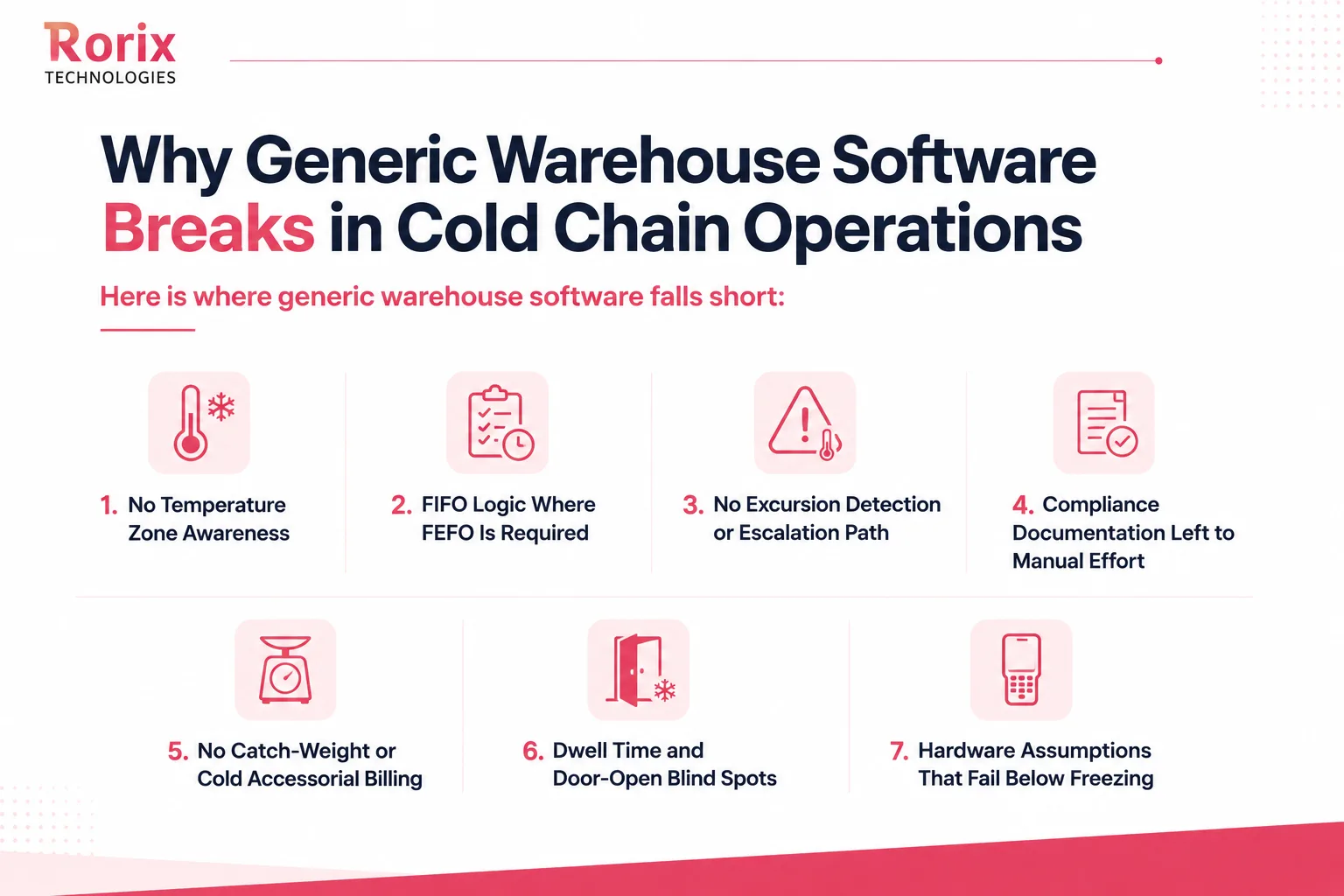
1. No Temperature Zone Awareness
Generic software tracks locations, not conditions. It cannot tell a freezer from a cooler from an ambient rack, so stock lands in the wrong zone and nothing objects.
2. FIFO Logic Where FEFO Is Required
Most systems ship in arrival order. Perishable and pharmaceutical stock has to ship in expiry order instead, and without that rule product ages out on your own racking.
3. No Excursion Detection or Escalation Path
When temperature monitoring lives in a separate system, an excursion can run for hours before anyone connects it to the pallets that were exposed. The loss is discovered after it is unrecoverable.
4. Compliance Documentation Left to Manual Effort
Inventory data sits in one system and temperature data in another, so every audit request becomes a reconciliation exercise. Teams lose days assembling what should be a query.
5. No Catch-Weight or Cold Accessorial Billing
Meat, seafood, and produce move at variable weights, and blast freezing, re-icing, and reefer plug-in time are billable events. A standard WMS models neither, so inventory value and invoices both drift.
6. Dwell Time and Door-Open Blind Spots
Open doors and pallets parked in a staging lane cost refrigeration load, but generic software has no concept of either. The bill goes up and nothing in the system explains why.
7. Hardware Assumptions That Fail Below Freezing
Gloved hands, weak signal, and batteries that drain fast are the normal operating conditions in a freezer. Software written for a warm building assumes none of them.
How a Cold Storage WMS Works Across the Warehouse Lifecycle
Follow one pallet from the gate to the outbound trailer and the difference becomes concrete. At each handoff the system is doing two jobs at once: moving the stock, and proving the conditions it was held in.
1. Inbound Receiving and Temperature Capture at the Dock
The system records the vehicle temperature before a single pallet moves, then scans the label to capture lot number, expiry date, and weight. A reading outside the safe band flags the shipment for inspection instead of letting it into stock.
2. Directed Putaway by Temperature Zone
Storage locations carry their own temperature ranges, and the system assigns each receipt to a compatible one. Frozen stock cannot be putaway into a chilled aisle, because the location refuses it.
3. Storage, Continuous Monitoring, and Shelf-Life Management
Connected sensors stream conditions into the same record that holds the inventory. Expiry dates are watched alongside them, so short-dated stock surfaces while it can still be sold or moved.
4. Replenishment and Slotting Inside the Cold Rooms
Fast movers sit near the pick face and slow movers go deeper into the room. Shorter pick paths mean less time in the cold and less door-open time per order.
5. FEFO Picking, Packing, and Cold-Pack Verification
Allocation runs on expiry date, and the pack step verifies the right insulation or coolant went into the box. Every action is recorded against the lot as it happens.
6. Dock Scheduling and Reefer Dispatch
Loading appointments are spread so doors are not standing open behind a queue. The reefer temperature is checked before release and the shipping paperwork is generated from the same data.
7. Audit Trail, Recall Hold, and Traceback
Because every movement writes lot, location, operator, and timestamp as part of the transaction, the audit trail already exists. A recall becomes a lookup and a hold rather than a reconstruction.
Also Read: WMS Implementation Checklist: 50 Steps to Successful Deployment
FEFO vs FIFO in Cold Storage: Which Rotation Rule Applies
FIFO ships stock in the order it arrived. FEFO ships by the earliest expiry date, regardless of arrival. In cold storage the two rules routinely disagree, because a later delivery can easily carry a shorter remaining shelf life than an earlier one.
| FIFO | FEFO | |
|---|---|---|
| Allocates on | Receipt date | Expiry or best-before date |
| Fits | Non-perishable, stable goods | Perishable food, pharmaceuticals, biologics |
| Failure mode | Short-dated stock sits behind older, longer-dated stock and expires | Requires accurate date capture at receiving, or the rule allocates on bad data |
| What the WMS needs | Receipt timestamp | Date code captured at receiving, plus a rule per product family |
Three details decide whether FEFO actually works. The system has to distinguish a best-before date from a hard expiry date, because the consequences differ. Rotation rules have to be configurable per product family rather than fixed site-wide. And quality teams need to change that logic themselves, without raising a development ticket.
Temperature Zones and Product Rules a Cold Storage WMS Has to Model
Zones are where most implementations succeed or quietly fail. A facility rarely holds one temperature, and the bands below have to behave as enforceable rules rather than descriptive labels.
What Temperature Is Chilled Storage, and What Counts as Frozen?
Chilled storage generally runs between 2°C and 4°C for food, and 2°C to 8°C for pharmaceuticals. Frozen storage starts at the regulatory floor of 0°F, which is -17.8°C. Below that sit deep freeze and ultra-cold, each with its own tolerance and escalation rules.
| Zone | Typical range | Common products | Named source | Rules the WMS must enforce |
|---|---|---|---|---|
| Cool | 12°C to 14°C (54°F to 57°F) | Bananas, tropical fruit, tubers | Transport Geography | Zone-only putaway, chilling-injury guards |
| Chill | 2°C to 4°C (36°F to 39°F) | Fruit, vegetables, fresh meat | Transport Geography | FEFO, continuous logging, catch-weight capture |
| Refrigerated food floor | 4.4°C or below (40°F or below) | All perishable food | USDA FSIS | Alert on any reading above the limit |
| Pharmaceutical refrigerator | 2°C to 8°C (36°F to 46°F) | Vaccines, biologics | CDC Vaccine Storage and Handling Toolkit | Excursion alerting, quarantine on deviation |
| Frozen food floor | -17.8°C or below (0°F or below) | Frozen foods, ready meals | USDA FSIS | Zone-block on putaway, dwell-time limits |
| Deep freeze | -25°C to -30°C (-13°F to -22°F) | Seafood, shrimp, ice cream | Transport Geography | Tighter tolerance bands, faster escalation |
| Ultra-cold | -90°C to -60°C (-130°F to -76°F) | Certain COVID-19 vaccines | CDC Vaccine Storage and Handling Toolkit | Redundant sensors, restricted access logging |
Published bands vary by source and by product, which is the point: your quality team sets the thresholds, and the system enforces theirs, not a vendor default.
Which Products Need Ultra-Low Storage Below -70°C?
Certain vaccines and biological materials do. CDC guidance for the Pfizer-BioNTech COVID-19 vaccine specifies ultra-cold storage between -90°C and -60°C. Facilities at this range need redundant sensors and access logging, because a single failed unit is the whole loss.
How Many Temperature Zones Should the System Support?
More than you run today. Zone count is the cost driver operators most often underestimate, and a facility that adds a pharmaceutical client to a food footprint has changed its compliance scope, not just its rack layout.
12 Core Features of a Cold Storage Warehouse Management System
Vendor feature lists look identical on paper. These twelve are the ones that separate a working cold chain platform from a general system with a temperature field bolted on.
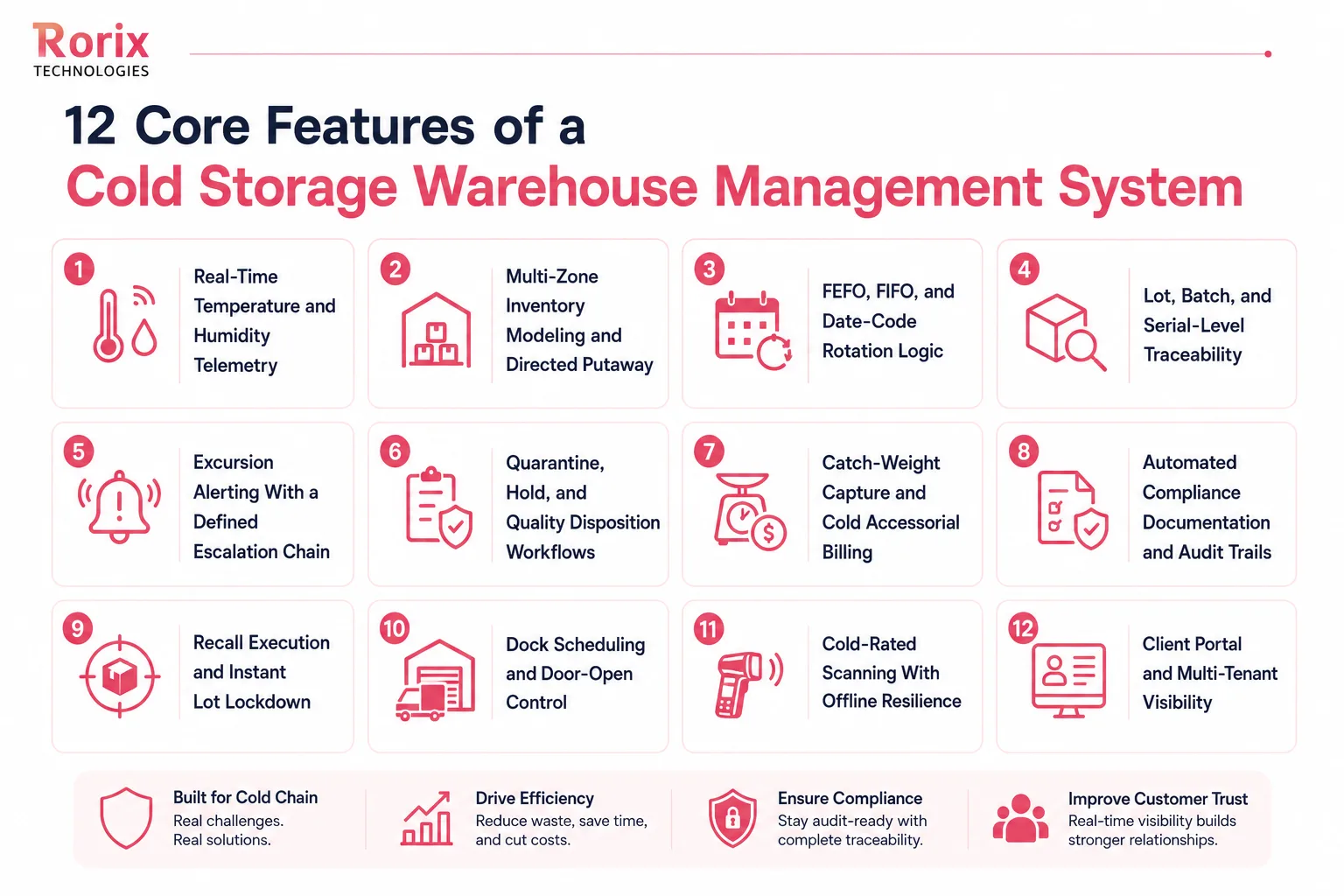
1. Real-Time Temperature and Humidity Telemetry
Sensors across zones, racks, and equipment stream readings into the same system that holds your inventory. That link is what lets you answer which specific pallets were exposed during a given window. Without it you have a monitoring product and a WMS that never speak to each other.
2. Multi-Zone Inventory Modeling and Directed Putaway
Locations carry their own temperature ranges, and the system directs each receipt to a compatible one automatically. Operators stop deciding where things go, which removes an entire class of costly mistakes. It also makes multi-temperature facilities far easier to reconfigure as your client mix changes.
3. FEFO, FIFO, and Date-Code Rotation Logic
Rotation rules belong to your quality team, configured per product family, with best-before and hard expiry treated as different things. Good implementations let that logic change without a development ticket.
4. Lot, Batch, and Serial-Level Traceability
Every movement records the lot, the location, the operator, and the timestamp as part of the transaction itself. Traceability that only exists as a nightly report is worthless during a live recall. Build it into the write path and the audit trail assembles itself.
5. Excursion Alerting With a Defined Escalation Chain
An alert that lands in an unmonitored inbox at midnight has done nothing useful. The system should page a named on-call person, wait for acknowledgement, then escalate if nobody responds inside a set window. Each step of that chain belongs in the permanent record.
6. Quarantine, Hold, and Quality Disposition Workflows
Suspect stock needs somewhere to sit that is visible but not sellable, with a clear owner for the release decision. The system should block allocation of held lots automatically rather than relying on a note. The same workflow handles returned cold stock arriving back at your dock.
7. Catch-Weight Capture and Cold Accessorial Billing
Actual weights get captured at receiving and again at picking, so inventory value and invoices stay aligned. Blast-freeze fees, re-icing, storage duration, and reefer plug-in charges post as billable events when they happen. That removes the month-end scramble to recover value-added work.
8. Automated Compliance Documentation and Audit Trails
The system should generate the evidence pack an auditor asks for without anyone assembling it manually. Temperature history, handling times, and chain of custody sit in one queryable record. Retention periods and access controls are configured, not improvised.
9. Recall Execution and Instant Lot Lockdown
You should be able to enter one lot number and see every affected pallet, order, and client in seconds. The same action places a hold that stops those units from shipping anywhere. Test this on real data during evaluation, because vendors describe it far more easily than they demonstrate it.
10. Dock Scheduling and Door-Open Control
Appointment scheduling spreads arrivals so doors are not standing open while a queue forms outside. Dwell-time rules flag pallets sitting too long in a staging lane. Both controls cut refrigeration load in ways you can measure on the bill.
11. Cold-Rated Scanning With Offline Resilience
Screens need high contrast and large targets because gloved hands are imprecise and cold slows everyone down. Devices must buffer scans locally and sync once signal returns, without duplicating or dropping tasks. This is a design requirement, not a hardware afterthought.
12. Client Portal and Multi-Tenant Visibility
Clients who can see their own inventory, expiry dates, and order status stop calling your operations team for updates. Data isolation between tenants has to be airtight, especially where competitors share a facility. Done well, the portal becomes a retention tool rather than a support cost.
Compliance Requirements Your Cold Storage WMS Has to Satisfy
Compliance dates and requirements in this section were verified against primary sources on August 3, 2026.
FSMA 204: The Federal Date Moved, Your Customers' Deadline Did Not
The federal deadline is no longer the forcing function. The compliance date for the FDA Food Traceability Final Rule moved from January 20, 2026 to July 20, 2028. FDA proposed the 30-month extension in March 2025 and published it in the Federal Register on August 7, 2025, and Congress made it binding through the Continuing Appropriations Act of 2026 in November 2025. The rule itself is unchanged and remains codified at 21 CFR Part 1, Subpart S.
Retail mandates moved into that gap. Walmart requires every food supplier to send an Advance Shipment Notice carrying the Key Data Elements, to label pallets with an SSCC-18 barcode linked to that ASN, and to label cases with a GS1-128 barcode. For products on the Food Traceability List, Walmart set that expectation at August 1, 2025.
So the deadline that governs you is probably not the federal one. A supplier that cannot produce lot codes, date codes, and their source against a shipment today is already short of what its largest customer asks for, whatever FDA enforcement does before 2028.
FDA cGMP and USDA Temperature Requirements
USDA FSIS sets the working floors most food operations are held to: 40°F or below for refrigerated storage and 0°F or below for frozen. Continuous logging against those limits, retrievable per lot, is what proves the stock was held correctly.
Good Distribution Practice for Pharmaceutical Cold Storage
The EU Guidelines on Good Distribution Practice of medicinal products for human use (2013/C 343/01) require that medicines keep their quality, identity, and integrity from purchase and storage through to supply or export. In system terms that means monitored storage conditions, recorded deviations, and documentation an inspector can be handed.
21 CFR Part 11 for Electronic Records and Signatures
If your compliance records are electronic, 21 CFR Part 11 governs them. It sets the criteria under which FDA treats electronic records and signatures as equivalent to paper, which in practice means controlled user access, electronic signatures bound to their records, and a computer-generated audit trail of every change.
DSCSA Serialization for Prescription Drugs
The Drug Supply Chain Security Act requires each package and homogeneous case of prescription drug product to carry a product identifier: a standardized numerical identifier, lot number, and expiration date, encoded in a 2D data matrix barcode. Handling that product means serial-level inventory, not lot-level.
HACCP Plans and Critical Control Point Logging
FDA HACCP guidance builds a plan around monitoring critical control points, taking corrective action when control is lost, and keeping records that prove both. Receiving and storage temperature checks are the two control points a cold storage WMS should log automatically rather than on a clipboard.
GS1 Standards and Third-Party Audit Schemes
GS1 standards define the identifiers your customers scan: the SSCC for logistic units, and GS1-128 barcodes carrying lot number, expiry date, and weight. Support them natively and retailer onboarding stops being a project. Audit schemes such as SQF and BRC lean on the same records.
Now that you have seen what the system must do and which rules it satisfies, one question remains. Should you buy it or build it?
Custom vs Off-the-Shelf Cold Storage WMS: The Build-vs-Buy Decision
This is the decision most operators get wrong in one direction or the other. Some buy a rigid product and spend years working around it, while others commission a custom build for requirements a configurable platform already handles. The table below sets the three paths side by side.
| Criterion | Off-the-Shelf Product | Configurable Platform | Custom-Built WMS |
|---|---|---|---|
| Time to first live zone | Fastest | Moderate | Longest |
| Fit to your actual workflow | You adapt to the software | Close, within set limits | Built around how you run |
| Zone and FEFO logic | Often basic or absent | Usually solid | Exactly as your quality team defines |
| Compliance coverage | Food-oriented by default | Broad, pharma varies | Scoped to your regulations |
| Integration flexibility | Fixed connector list | Open API, some limits | Any system, any protocol |
| Cost profile | Low up front, recurring license | Mid up front, recurring license | Higher up front, lower long-run license |
| Change speed after go-live | Vendor roadmap decides | Configuration, sometimes fast | Your sprint queue decides |
| Code and data ownership | Vendor holds it | Vendor holds it | You own both outright |
| Best for | Single-zone, low regulation | Multi-client 3PLs with standard needs | Complex, regulated, or differentiated operations |
When Off-the-Shelf Software Is the Right Call
- Small and simple warehouse operations
- Quick to implement, lower cost up front
- Single-zone warehouses with basic requirements
- Speed matters more than fit
When a Configurable Platform Is Enough
- Growing warehouses and multi-client 3PLs
- Workflow changes without heavy development
- Varied billing and labeling needs
- You need flexibility, not a full custom build
When a Custom Cold Storage WMS Wins
- Complex or highly regulated operations
- Pharmaceutical warehouses and advanced automation
- Processes that are a competitive advantage worth encoding
- Complete ownership of the software, code, and roadmap
Also Read: Real-Time Inventory: WebSocket and Pub-Sub Architecture
How to Build a Custom Cold Storage WMS: An 8-Step Roadmap
Most failed builds were mis-scoped before a line of code existed. The sequence below front-loads the decisions that are expensive to reverse: what you actually do today, which regulations apply, and who is accountable after go-live.
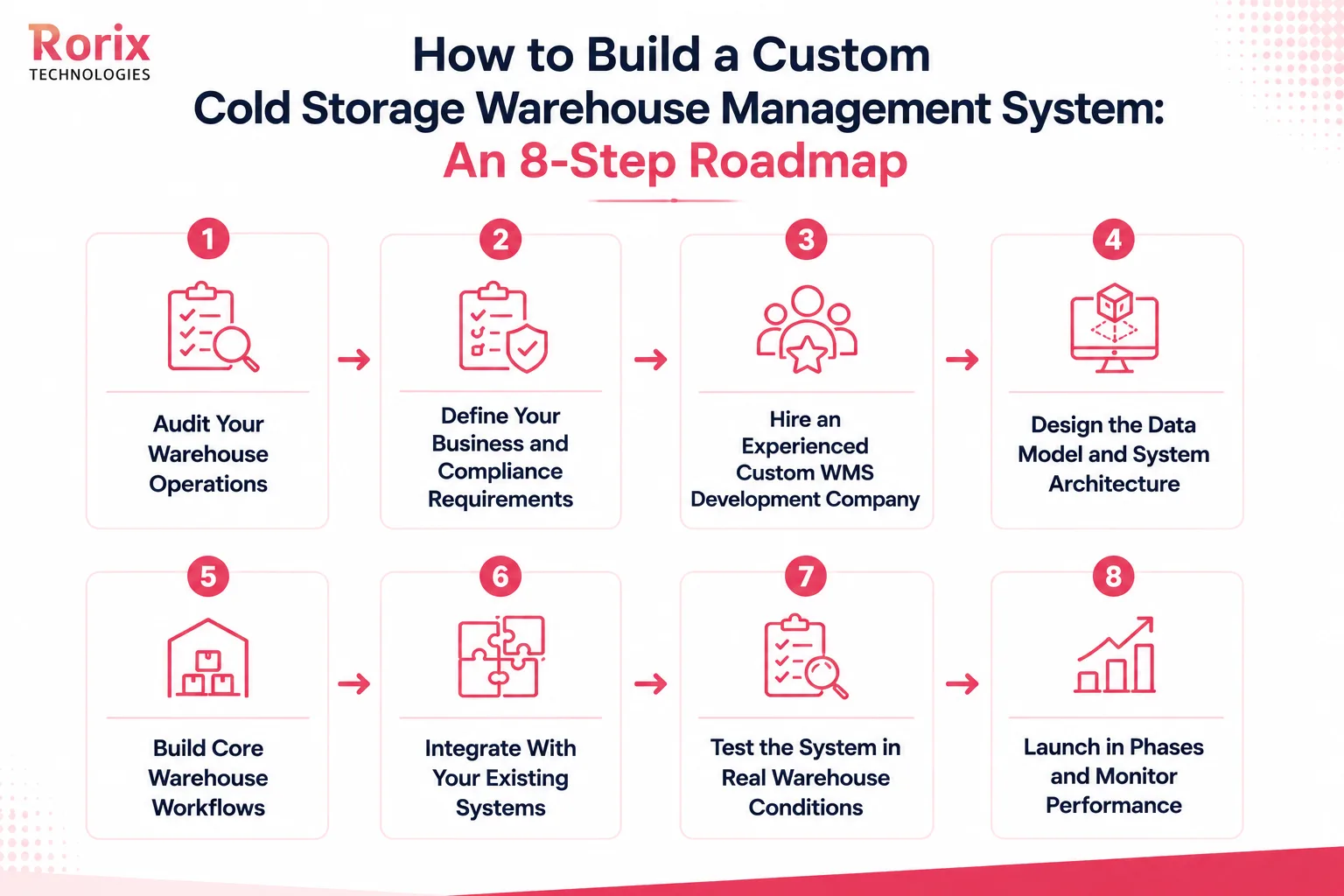
Step 1: Audit Your Warehouse Operations
Map how product moves from receiving to dispatch, and mark every point where delay, manual work, or error shows up. Pay particular attention to temperature checks, inventory tracking, picking, and compliance tasks, because those are where a custom build earns its money.
Step 2: Define Your Business and Compliance Requirements
List what the system has to support before development starts: workflows, temperature zones, traceability depth, integrations, and the regulations in scope, whether that is FSMA 204, GDP, or 21 CFR Part 11. Clear requirements are the cheapest rework you will ever buy.
Step 3: Hire an Experienced Custom WMS Development Company
Look for proven work in warehouse management, cold chain operations, IoT integration, barcode scanning, and compliance-driven software. A partner who has shipped this before will argue with your assumptions early, which is exactly what you are paying for.
Step 4: Design the Data Model and System Architecture
Lot tracking, expiry dates, temperature zones, inventory status, and traceability all have to be first-class in the schema rather than fields added later. This is the decision that determines how painful your third integration will be.
Step 5: Build Core Warehouse Workflows
Receiving, putaway, inventory tracking, FEFO picking, replenishment, packing, dispatch, and quality control get built with the business rules inside them. Temperature validation, holds, and expiry management belong in the workflow, not in a report that runs afterwards.
Step 6: Integrate With Your Existing Systems
Connect the ERP, IoT sensors, scanners, transport management system, and GS1 labeling early rather than at the end. Integration is where schedules slip, and the quality of the other side's API decides how much.
Step 7: Test the System in Real Warehouse Conditions
Test inside the actual building, in the cold, with gloves on. Verify scanning, temperature monitoring, offline behavior, integrations, inventory accuracy, and a full recall drill before anyone depends on it.
Step 8: Launch in Phases and Monitor Performance
Start with one zone or one client and run it alongside the existing system until the counts reconcile. Expand only after that, fixing what the first phase exposes.
What Drives the Cost of a Custom Cold Storage WMS
Cost in a cold chain build is driven by compliance depth and integration count far more than by screen count. Use the table below to shape the budget conversation, then price the specifics against your own zones and systems with our project cost estimator.
| Cost driver | What increases it | Indicative effect on budget |
|---|---|---|
| Zone and site complexity | Multiple temperature zones, several facilities | Baseline, rising with every zone added |
| Compliance depth | Pharma records, Part 11, DSCSA serialization | Substantial uplift over a food-only scope |
| Integration count | Legacy ERP, EDI, telematics, automation | Moderate to high, driven by API quality |
| Hardware and automation | AS/RS, conveyors, robotics interfaces | Significant, scoped per vendor |
| Multi-client billing | Client-specific rates, accessorials, catch-weight | Moderate to high, rules-driven |
| Data migration | Years of lot history, poor source data quality | Frequently underestimated |
| Ongoing change | New clients, new regulations, new products | Recurring, best handled on retainer |
7 Mistakes That Derail Cold Storage WMS Projects
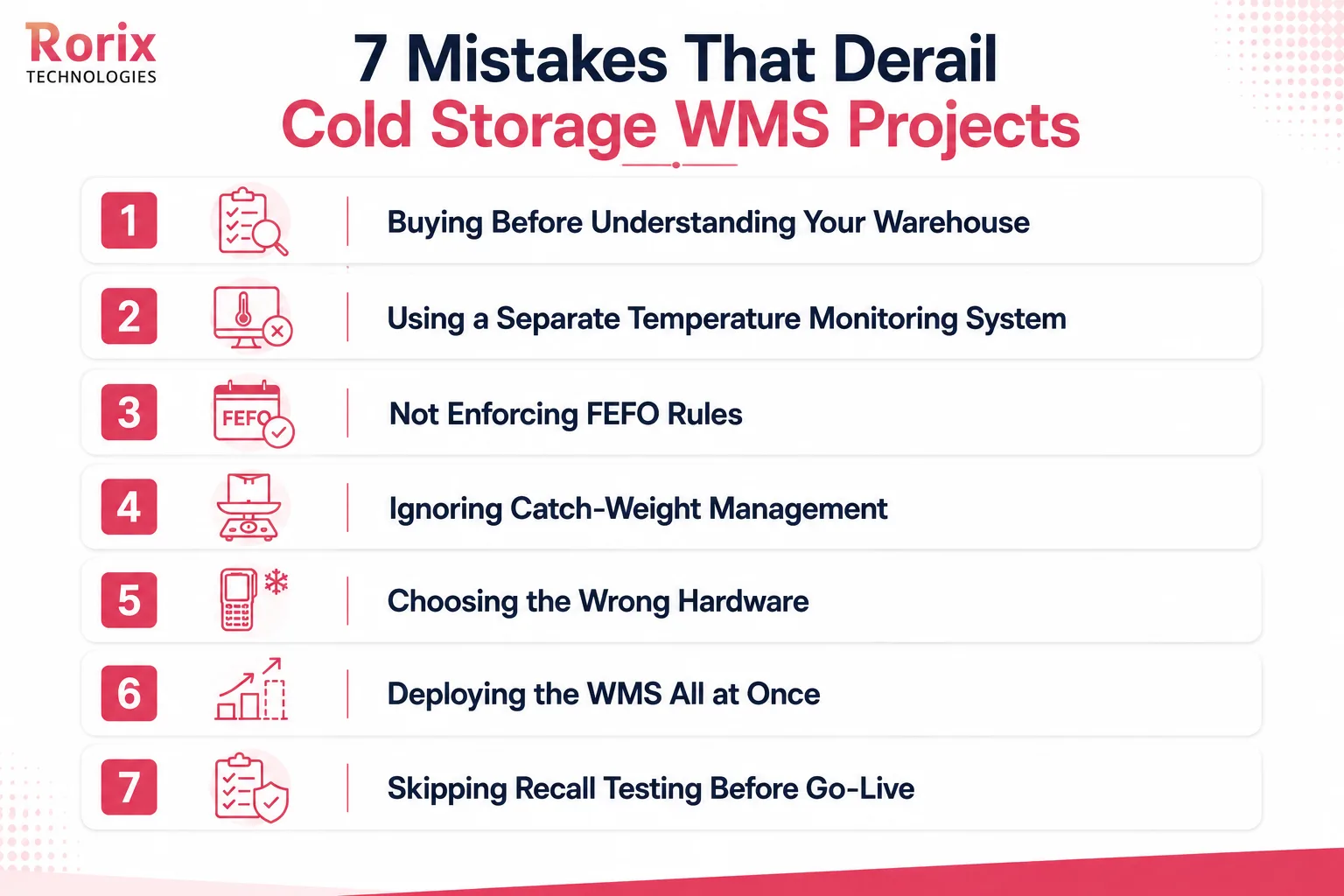
- Buying before understanding your warehouse: audit your own processes first. You cannot evaluate a system against requirements you have not written down.
- Using a separate temperature monitoring system: if conditions and inventory live apart, you cannot answer which pallets an excursion touched.
- Not enforcing FEFO rules: allocation has to run on expiry date automatically. A manual check is a rule that stops working on a busy day.
- Ignoring catch-weight management: variable-weight product needs actual weights captured, or inventory value and invoices both drift.
- Choosing the wrong hardware: use cold-rated devices that work with gloves, in the cold, on unreliable Wi-Fi.
- Deploying the WMS all at once: roll out by zone or by client. A phased cutover contains the damage when something is wrong.
- Skipping recall testing before go-live: run a real traceback drill on real data before launch, not during your first incident.
Also Read: Returns Management Optimization: Complete Guide to Reverse Logistics
Why Rorix Builds Cold Chain WMS Platforms That Hold Up on the Floor
Building this well takes more than software engineering. It takes people who understand warehouse operations, cold chain workflows, compliance, and system integration, and who stay accountable after the first zone goes live.
That is where Rorix Technologies can help. We have delivered 27 software projects for businesses across the US, UK, Canada, Australia, and New Zealand, with a 5.0 Clutch rating.
Why businesses choose Rorix:
- Engineered for the domain: WMS, HRMS, and SaaS built from the workflow up, never adapted from a template
- Accountable past go-live: a dedicated team of senior engineers with a named technical lead on every engagement, working on retainer in 2-week sprints, which is why clients describe us as an in-house team
- Integration depth: 40+ integrations on a white-label SaaS platform for a home-services company, with iOS and Android shipped from a single React Native codebase
- A verifiable record: 27 projects delivered, 5.0 on Clutch, and multi-year partnerships including a five-plus-year B2B SaaS engagement
- Full ownership: you keep the code, the data model, and the roadmap
Weighing a cold chain build? Our technology consulting team reviews your zones, compliance scope, and integration list before you commit to an approach.
Get a Free Consultation and Project Estimate
Cold Storage Needs More Than a WMS With a Temperature Field
Cold storage is not ambient warehousing with a colder thermostat, and the software running it cannot be a general platform with a temperature field bolted on. The system has to enforce zone rules at the point of scan, rotate by expiry, and catch excursions while they are still fixable.
The deadline pressure has also changed shape. FSMA 204 enforcement sits in 2028, but Walmart's traceability requirements have been live since August 2025, so for most food operations the customer arrived well ahead of the regulator.
Start with the specific failure that costs you most: the excursion nobody caught, the audit that took a week to assemble, the short-dated pallet found behind a longer-dated one. Price the fix for that, and the scope of the rest of the build tends to define itself.
Frequently Asked Questions
What is a cold storage warehouse management system?
A cold storage warehouse management system is software that runs a temperature-controlled facility end to end. Alongside normal inventory and order functions, it enforces temperature zones, rotates stock by expiry, and monitors conditions continuously. It also produces the compliance records auditors ask you to hand over.
How is a cold storage WMS different from a standard WMS?
A standard WMS tracks what you have and where it sits. A cold chain system adds a third dimension, which is the condition the stock has been held in. It turns that condition into rules enforced at the point of scan, not facts reported later.
When is the FSMA 204 compliance deadline?
July 20, 2028. FDA extended the original January 20, 2026 date by 30 months, published the extension in the Federal Register on August 7, 2025, and Congress made it binding through the Continuing Appropriations Act of 2026. The rule itself is unchanged. Retail requirements run ahead of it: Walmart has required ASN, SSCC-18, and GS1-128 traceability data from food suppliers on the Food Traceability List since August 1, 2025.
Should I buy an off-the-shelf cold storage WMS or build a custom one?
Buy when your operation resembles a vendor's typical customer and speed matters most. Build when your workflow is a competitive advantage or when pharmaceutical record integrity is in scope. Integrations and automation that push a product past its limits also justify a custom build.
How does a cold storage WMS support FSMA 204 and GDP compliance?
It captures the data elements tied to each tracking event as part of the normal transaction, then keeps them in an append-only record. That makes temperature history, handling times, and chain of custody retrievable on demand instead of reconstructed from separate exports.
How long does it take to build a custom cold storage WMS?
Timelines depend on zone count, compliance scope, and integration complexity, so treat any single figure with caution. Most operations start with one zone or one client, run it in parallel with the existing system, then expand once counts reconcile cleanly.
Costing a WMS build?
Send us your SKU count and daily order volume. You get back a scope and a number you can take to your CFO.
Continue learning
Written by
Renish DadhaniyaFounder & Director, Rorix Technologies
Renish co-founded Rorix Technologies and drives the engineering and delivery culture across the organization. Beyond engineering, he leads the company's sales, finance, and HR operations, building the infrastructure that lets the team focus on shipping quality software. With deep hands-on expertise in architecture and team building, he ensures every project lands on time to the quality standards clients demand.
View full profileRelated articles
Cost of Warehouse Management Software in Pharma: Complete Pricing Breakdown 2026
What does a pharma WMS really cost? Year-one bands by operator profile, what validation and DSCSA add, and the three-year total hiding behind the quote.
Read article
Warehouse Management System for Food Industry: Features, Compliance and How to Build One (2026)
Learn how to choose or build a warehouse management system for food industry operations, including features, integrations, costs, and compliance.
Read article
AI in HRMS: Where It Pays Back and What the Law Now Expects
AI in HRMS splits in two. Automating paperwork is ordinary software work. Scoring or ranking people is a regulated employment decision, with rules attached.
Read article