
E-commerce Fulfillment Optimization Guide: 2X Your Speed (2026)
Complete guide to e-commerce fulfillment optimization. Learn pick-pack strategies, automation, multi-channel integration, and reduce fulfillment time by 50%.
On this page45 sections
Key Takeaways: How to Cut Fulfillment Time in Half
To optimize e-commerce fulfillment and 2X your speed, automate order processing, use batch or zone picking, integrate inventory across channels, and apply warehouse automation to cut fulfillment time by up to 50% and costs by 30-40%. Speed matters because 83% of shoppers expect delivery within 3 days or less.
- 83% of shoppers expect delivery in 3 days or less, and 96% won't buy again after a bad delivery experience.
- Automated order import eliminates 3-4 hours of daily manual entry and lifts accuracy up to 99.9%.
- Optimizing pick-pack-ship, multi-channel inventory, and automation reduces fulfillment time and trims costs by 30-40%.
- Returns processing matters: 30% of online orders are returned, doubling logistics costs.
Why Slow Fulfillment Loses Repeat Customers
E-commerce fulfillment can make or break your business. Studies show:
- 83% of shoppers expect delivery within 3 days or less
- 96% won't buy again after a bad delivery experience
- 30% of online orders are returned, doubling logistics costs
- 69% of consumers are less likely to shop with a retailer if orders take more than 2 days to ship
This guide covers proven strategies to 2X your fulfillment speed while reducing costs by 30-40%.
What you'll learn:
- Pick-pack-ship optimization
- Batch vs. wave picking strategies
- Multi-channel inventory management
- Automation technologies (robots, conveyors, sortation)
- Returns processing
- Shipping cost optimization
Part 1: Order Processing Optimization
1. Real-Time Order Import
Manual Order Entry Problems:
- 2-4 hours delay from order to processing
- Human transcription errors (5-10% error rate)
- No prioritization logic
- Missed orders
Automated Order Import:
- Orders flow directly from website/marketplace to WMS
- Instant order validation
- Auto-prioritization (Prime, Same-day, etc.)
- Up to 99.9% accuracy
Integration Requirements:
- Shopify
- WooCommerce
- Amazon Seller Central
- eBay
- Walmart Marketplace
- Custom APIs
ROI: Eliminate 3-4 hours of manual entry daily, 99% fewer order errors.
2. Order Prioritization Rules
Prioritization Criteria:
Priority 1 - Same Day / Next Day:
- Cut-off time: 2 PM
- Process immediately
- Pick-pack-ship within 2 hours
Priority 2 - Prime / Expedited:
- Process before standard orders
- Ship same day if ordered before 12 PM
Priority 3 - Standard Orders:
- Batch process for efficiency
- Ship within 24-48 hours
Priority 4 - Backorders:
- Hold until inventory arrives
- Auto-release when stock available
Best Practice: Display real-time cut-off times on your website to set customer expectations.
ROI: 98% on-time shipping rate, reduced customer complaints.
3. Order Consolidation
Problem: Customer places 3 orders in a day = 3 shipments = 3X shipping cost.
Solution: Auto-consolidate orders from same customer within a time window (2-4 hours).
Benefits:
- 40-50% reduction in shipping costs
- Reduced packaging waste
- Better customer experience (one delivery vs. three)
ROI: Save $5-$15 per consolidated shipment.
Part 2: Pick-Pack Strategies
4. Single Order Picking vs. Batch Picking
Single Order Picking:
- Pick one order at a time
- Simple, low error rate
- Speed: 50-80 picks/hour
Best for:
- Low order volume (<100/day)
- Large/bulky items
- High-value items requiring extra care
Batch Picking:
- Pick multiple orders (5-20) in one trip
- Sort at packing station
- Speed: 150-250 picks/hour
Best for:
- High order volume (500+/day)
- Small items
- Similar product categories
ROI: 3X faster than single order picking.
Zone Picking (Pick-and-Pass):
- Divide warehouse into zones
- Pick all orders for a zone simultaneously
- Pass tote to next zone
- Speed: 200-300+ picks/hour
Best for:
- Very high volume (1,000+/day)
- Large warehouses
- Multi-category orders
A note on wave picking: a wave is a release schedule, not a walking pattern. Orders are grouped and released to the floor together against carrier cutoffs, and within a wave the picking itself runs as batches or zones. Our warehouse picking methods guide covers how the methods combine and how to choose by order profile.
ROI: 4X faster than single picking, 30% faster than batch.
5. Zone-Based Picking
How it works:
- Divide warehouse into zones (Electronics, Apparel, Home Goods)
- Assign pickers to zones
- Orders pass through zones via conveyor or cart
Benefits:
- Pickers become experts in their zone
- Reduced travel time
- Parallel processing
Example:
- Order has 3 items: Electronics, Apparel, Home
- Zone 1 picker adds electronics
- Zone 2 picker adds apparel
- Zone 3 picker adds home goods
- All happening simultaneously
ROI: 40% reduction in travel time, 50% increase in picks/hour.
6. Pick-to-Light / Put-to-Light
Pick-to-Light:
- Lights illuminate bins to pick from
- Picker presses button to confirm pick
- Speed: 300-500 picks/hour
Best for:
- Small items (cosmetics, electronics accessories)
- High-velocity SKUs
- Minimal thinking required
Put-to-Light:
- Used for sorting after batch picking
- Lights show which order bin to place item
- Speed: 400-600 sorts/hour
ROI: 5X faster than paper picking for small items.
Cost: $10K-$50K initial setup, $3K-$10K per pick station.
7. Cart Optimization
Problem: Pickers waste time returning to packing station after each order.
Solution: Multi-tote carts
Standard Cart: 1 order per trip = 20 trips for 20 orders
Multi-Tote Cart: 8-12 orders per trip = 2-3 trips for 20 orders
ROI: 60% reduction in travel time.
Part 3: Packing Optimization
8. Packing Station Design
Essentials:
Ergonomic Setup:
- Packing table at optimal height (waist level)
- Box sizes within arm's reach
- Tape dispenser, label printer, scale integrated
- Monitor for order details
Pre-Pack Supplies:
- Pre-made box sizes (Small, Medium, Large, Extra-Large)
- Bubble wrap, air pillows on dispensers
- Poly mailers for soft goods
Auto-Suggest Box Size:
- System recommends box based on item dimensions
- Reduce void fill and shipping costs
ROI: 30% faster packing, 20% reduction in packaging costs.
9. Scan Verification
Why It Matters:
- Pick errors happen (5-10% without verification)
- Wrong item shipped = return + re-ship = 2X cost
- Customer dissatisfaction
How it works:
- Scan item barcode before packing
- System verifies against order
- Alert if wrong item scanned
ROI: Reduce shipping errors from 5% to 0.5%, save $10-$50 per prevented error.
10. Automated Packing Solutions
Automated Void Fill:
- Machine dispenses exact amount of void fill needed
- Reduces material waste by 40%
- Cost: $5K-$15K
Box-on-Demand:
- Creates custom-sized box for each order
- Eliminates void fill entirely
- Reduces dimensional weight charges
- Cost: $30K-$100K
Auto-Taping Machines:
- Apply tape automatically
- Speed: 20-30 boxes/minute
- Cost: $3K-$10K
ROI: Pay for themselves in 12-18 months through material savings and speed.
Part 4: Shipping Optimization
11. Multi-Carrier Integration
Why Multi-Carrier:
- No single carrier is cheapest for all zones
- Carrier A might be 20% cheaper for West Coast
- Carrier B cheaper for East Coast
- Backup options during peak season
Rate Shopping:
- System compares rates across carriers in real-time
- Selects cheapest option automatically
- Accounts for delivery time requirements
Carriers to integrate:
- USPS
- UPS
- FedEx
- Regional carriers (OnTrac, LSO)
- Amazon Shipping (for FBA sellers)
ROI: 15-25% reduction in shipping costs.
12. Shipping Label Automation
Manual Labeling:
- Enter address manually
- Print label
- Apply to box
- Time: 2-3 minutes per order
Automated Labeling:
- Label auto-generated from order data
- Print on auto-apply printer
- Time: 10 seconds per order
ROI: 90% faster, eliminate addressing errors.
13. Package Weight & Dimensions
Dimensional Weight Pricing: Carriers charge based on whichever is greater:
- Actual weight
- Dimensional weight = (L × W × H) / 166
Example:
- Box: 18" × 14" × 12" = 3,024 cubic inches
- Dimensional weight: 3,024 / 166 = 18.2 lbs
- Actual weight: 5 lbs
- Billed weight: 18.2 lbs (ouch!)
Solution:
- Right-size boxes
- Use poly mailers for soft goods
- Compress packaging when possible
ROI: Save 20-40% on shipping costs by optimizing box sizes.
14. Zone Skipping
What is Zone Skipping: Consolidate shipments to same zone, truck them to regional carrier hub, then inject into carrier network locally.
Example:
- You're in California
- 500 orders going to East Coast
- Normal: Each package ships across country individually ($8-$12 each)
- Zone Skipping: Truck 500 boxes to East Coast hub ($2,000), then local delivery ($3-$5 each)
- Savings: $1,500-$3,000 per truckload
Best for: 200+ packages/week to same region.
ROI: 30-50% reduction in long-distance shipping costs.
Part 5: Multi-Channel Management
15. Centralized Inventory Pool
Problem: Selling on Website + Amazon + eBay with separate inventory allocations.
Result:
- 100 units total
- 33 allocated to Website (sells 10)
- 33 allocated to Amazon (sells 30, now out of stock)
- 33 allocated to eBay (sells 5)
- Lost sales on Amazon despite having 51 units available
Solution: Shared inventory pool with real-time sync.
Benefits:
- Maximize sales across all channels
- Reduce stockouts by 40%
- Lower overall inventory levels (no safety stock per channel)
ROI: 15-20% increase in sales with same inventory.
16. Channel Priority Rules
Scenario: 10 units left, orders coming from all channels.
Priority Rules:
- Own Website: Highest margin, customer relationship
- Amazon FBM: Fast shipping required, high volume
- eBay / Other marketplaces: Lower priority
Advanced: Set dynamic priorities based on margin, velocity, or promotional activity.
17. Marketplace Compliance
Amazon:
- Same-day handling for Prime
- Accurate tracking upload
- Strict packaging requirements
- On-time delivery rate >97%
Walmart:
- 2-day delivery commitment
- No-contact delivery options
- Specific label formats
Best Practice: Integrate marketplace requirements into your WMS to auto-enforce compliance.
ROI: Avoid account suspensions and performance penalties.
Part 6: Returns Management
18. Streamlined Returns Process
Returns Cost 2X:
- Reverse shipping
- Inspection labor
- Restocking or disposal
Best Practices:
Easy Return Initiation:
- Self-service return portal
- Auto-generate return labels
- QR codes for label-free returns
Fast Processing:
- Separate returns receiving area
- Inspect within 24 hours
- Restock or dispose immediately
Disposition Automation:
- System suggests: Resell, Refurbish, Liquidate, or Scrap
- Based on condition, cost, and demand
ROI: Reduce return processing time by 60%, get inventory back to sellable faster.
19. Return Fraud Prevention
Common Fraud:
- Empty box returns
- Used item returned as new
- High-value item replaced with low-value
- Serial number swapping
Prevention:
Photo Verification:
- Take photos during inspection
- Compare with photos at original packing
Serial Number Tracking:
- Log serial numbers at packing
- Verify serial matches at return
Weight Verification:
- Flag returns with significant weight discrepancy
ROI: Prevent $10K-$100K in fraud annually.
Part 7: Technology & Automation
20. Warehouse Management System (WMS)
Core Features:
- Real-time inventory tracking
- Directed picking and putaway
- Multi-channel order import
- Shipping integration
- Returns management
ROI:
- 99% inventory accuracy (vs. 85% with spreadsheets)
- 40% faster picking with directed workflows
- 50% reduction in shipping errors
Cost:
- SaaS WMS: $500-$2,000/month
- Custom WMS: $50K-$150K one-time
Break-even: 6-12 months for 500+ orders/day.
21. Conveyor Systems
When to Consider:
- 1,000+ orders/day
- Multi-zone picking
- Large warehouse (20,000+ sqft)
Benefits:
- Hands-free transport between zones
- 40% reduction in travel time
- Enables zone picking with pass lines
Cost: $50K-$500K depending on length and complexity.
ROI: Payback in 2-3 years for high-volume operations.
22. Automated Sortation
Sortation Systems:
- Scan package
- Automatically sort to correct shipping lane
- Speed: 2,000-5,000 packages/hour
Best for:
- 2,000+ orders/day
- Multi-carrier shipping
- Regional distribution centers
Cost: $100K-$500K
ROI: Eliminate 5-10 sorter positions, payback in 2-3 years.
23. Robots & AMRs (Autonomous Mobile Robots)
Use Cases:
Goods-to-Person Robots:
- Robot brings shelf to picker
- Picker stays stationary
- Speed: 300-400 picks/hour per picker
- Cost: $30K-$50K per robot + $50K-$100K infrastructure
Examples: Amazon Robotics, Locus, Fetch
Collaborative Robots (Cobots):
- Follow picker and carry totes
- Reduce walking
- Cost: $10K-$30K per robot
ROI: 2-3X increase in picker productivity, payback in 3-5 years.
Part 8: KPIs & Metrics
24. Track Key Performance Indicators
Order Accuracy:
Order Accuracy = (Orders Shipped Correctly / Total Orders) × 100%
Target: 99.5%+
Orders Per Hour:
Orders/Hour = Total Orders Fulfilled / Total Labor Hours
Benchmarks:
- Manual picking: 10-15 orders/hour
- Batch picking: 25-40 orders/hour
- Automated: 50-100 orders/hour
On-Time Shipping:
On-Time % = (Orders Shipped By Cut-Off / Total Orders) × 100%
Target: 98%+
Cost Per Order:
Cost Per Order = (Labor + Materials + Overhead) / Total Orders
Benchmarks: $3-$8 for small items, $8-$15 for multi-item orders
Return Rate:
Return Rate = (Units Returned / Units Sold) × 100%
Typical: 20-30% for apparel, 5-10% for electronics
Part 9: Peak Season Preparation
25. Scale for Black Friday / Cyber Monday
Planning Timeline:
3 Months Before:
- Hire and train seasonal staff
- Increase inventory levels
- Test systems at peak load
1 Month Before:
- Set up temporary packing stations
- Stock up on packaging supplies
- Confirm carrier capacity
1 Week Before:
- All hands training
- Daily team meetings
- Monitor inventory levels
During Peak:
- Extended hours (12-16 hour shifts)
- Real-time monitoring
- Daily huddles
Best Practice: Plan for 3-5X normal volume during peak weeks.
Conclusion: Your Fulfillment Optimization Roadmap
Month 1: Quick Wins
- Implement order prioritization
- Set up scan verification
- Optimize packing stations
Month 2-3: Process Improvements
- Switch to batch picking
- Implement zone picking
- Multi-carrier rate shopping
Month 4-6: Technology
- Implement WMS
- Multi-channel integration
- Automated label printing
Month 6-12: Scale
- Pick-to-light systems (if high volume)
- Conveyor systems (if 1,000+/day)
- Consider robotics (if 5,000+/day)
Ready to 2X your fulfillment speed?
Get Your Free Fulfillment Assessment
We'll:
- Analyze your current fulfillment process
- Identify bottlenecks and quick wins
- Recommend the right technology for your volume
- Provide ROI projections
See how we build multi-channel fulfillment systems for retailers who have outgrown their cart.
About Rorix: We've helped e-commerce businesses optimize fulfillment, with clients achieving up to 99%+ accuracy and up to 50% faster order processing. Individual results vary. From small Shopify stores to multi-channel enterprises shipping 10,000+ orders/day.
Disclaimer
The ROI figures, efficiency gains, cost savings, and performance metrics mentioned in this article are based on industry research, published benchmarks, and Rorix Technologies client implementations. Individual results vary significantly based on organization size, current processes, implementation quality, team training, and business conditions. These figures are provided for educational and planning purposes only and should not be interpreted as guaranteed outcomes. Consult with our team for assessments specific to your operation.
Last reviewed: February 2026
Frequently Asked Questions
How much can e-commerce fulfillment optimization improve speed and cost?
This guide focuses on proven strategies to 2X fulfillment speed while reducing costs by roughly 30-40%. Specific gains depend on order volume, current processes, and how much automation you adopt, so individual results vary.
What is the difference between single, batch, and wave picking?
Single order picking handles one order at a time at 50-80 picks per hour and suits low volume or large, high-value items. Batch picking gathers 5-20 orders per trip at 150-250 picks per hour, about 3X faster, and fits high volume. Wave picking is different in kind: it is a release schedule that groups orders against carrier cutoffs rather than a walking pattern, while the zone pattern that picks areas simultaneously and passes totes runs at 200-300+ picks per hour in very high-volume operations.
Should I build a SaaS WMS or a custom warehouse management system?
A SaaS WMS typically costs $500-$2,000 per month, while a custom WMS runs $50K-$150K one-time and usually breaks even within 6-12 months at 500+ orders per day. A WMS improves inventory accuracy to about 99 percent, speeds picking by roughly 40 percent, and cuts shipping errors by about 50 percent.
How does multi-carrier integration reduce shipping costs?
No single carrier is cheapest across all delivery zones, so real-time rate shopping compares carriers like USPS, UPS, FedEx, regional options, and Amazon Shipping and automatically selects the lowest-cost option that still meets delivery requirements. This typically reduces shipping costs by 15-25 percent.
How do I cut costs from dimensional weight pricing?
Carriers bill on whichever is greater between actual weight and dimensional weight, calculated as length times width times height divided by 166, so an oversized box can be billed far heavier than its real weight. Right-sizing boxes, using poly mailers for soft goods, and compressing packaging can save 20-40 percent on shipping costs.
Can Rorix Technologies build custom fulfillment and WMS software?
Yes. Rorix Technologies is a B2B custom software company that builds warehouse management and fulfillment systems, with a custom WMS typically going live in 8-12 weeks. Every engagement includes an NDA and full transfer of intellectual property and source code to the client.
Fulfillment breaking at volume?
We build the picking and returns layer for retailers who have outgrown the tools built into their cart. Send us your channel list and daily order count.
Continue learning
Written by
Nirmal JTeam Lead, WMS & Inventory Systems, Rorix Technologies
Nirmal leads WMS and inventory software delivery at Rorix, from warehouse picking and stock control to real-time inventory tracking and fulfillment workflows. He manages project timelines, stakeholder alignment, and sprint execution, ensuring production-ready systems are delivered on time and keep operations running without disruption.
View full profileRelated articles
Multi-Channel Order Management: Complete Implementation Guide
How to implement multi-channel order management across Amazon, Shopify, eBay, and retail: integration steps, inventory sync, and automation strategies.
Read article
Returns Management Optimization: Complete Guide to Reverse Logistics
How to optimize e-commerce returns management and cut reverse logistics costs: automation strategies, return fraud prevention, and refurbishment workflows.
Read article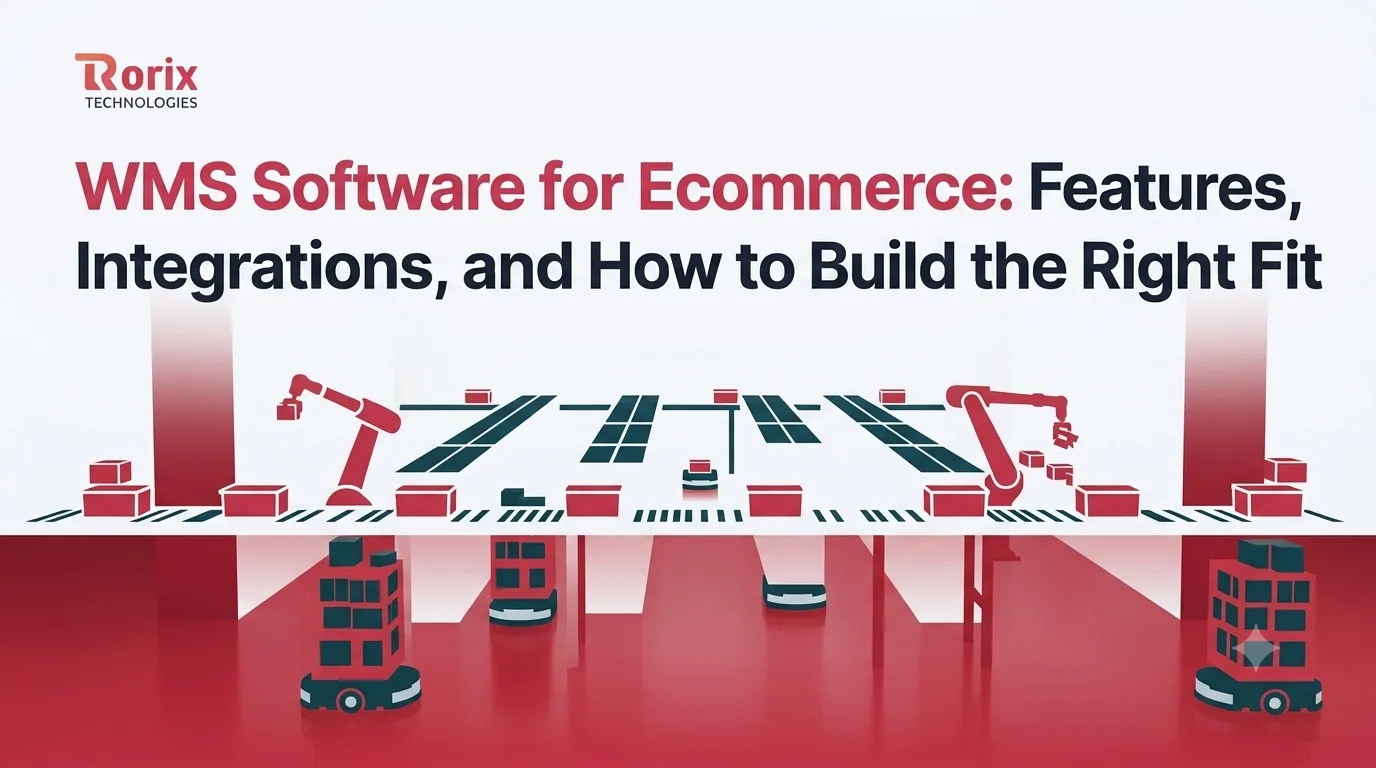
WMS Software for Ecommerce: Features, Integrations, and How to Build the Right Fit
WMS software for ecommerce: the must-have features, the integrations that matter, and how to build a right-fit system for your store as it scales.
Read article